1822 Capped Bust Quarter Coin Value: How Much Is It Worth?
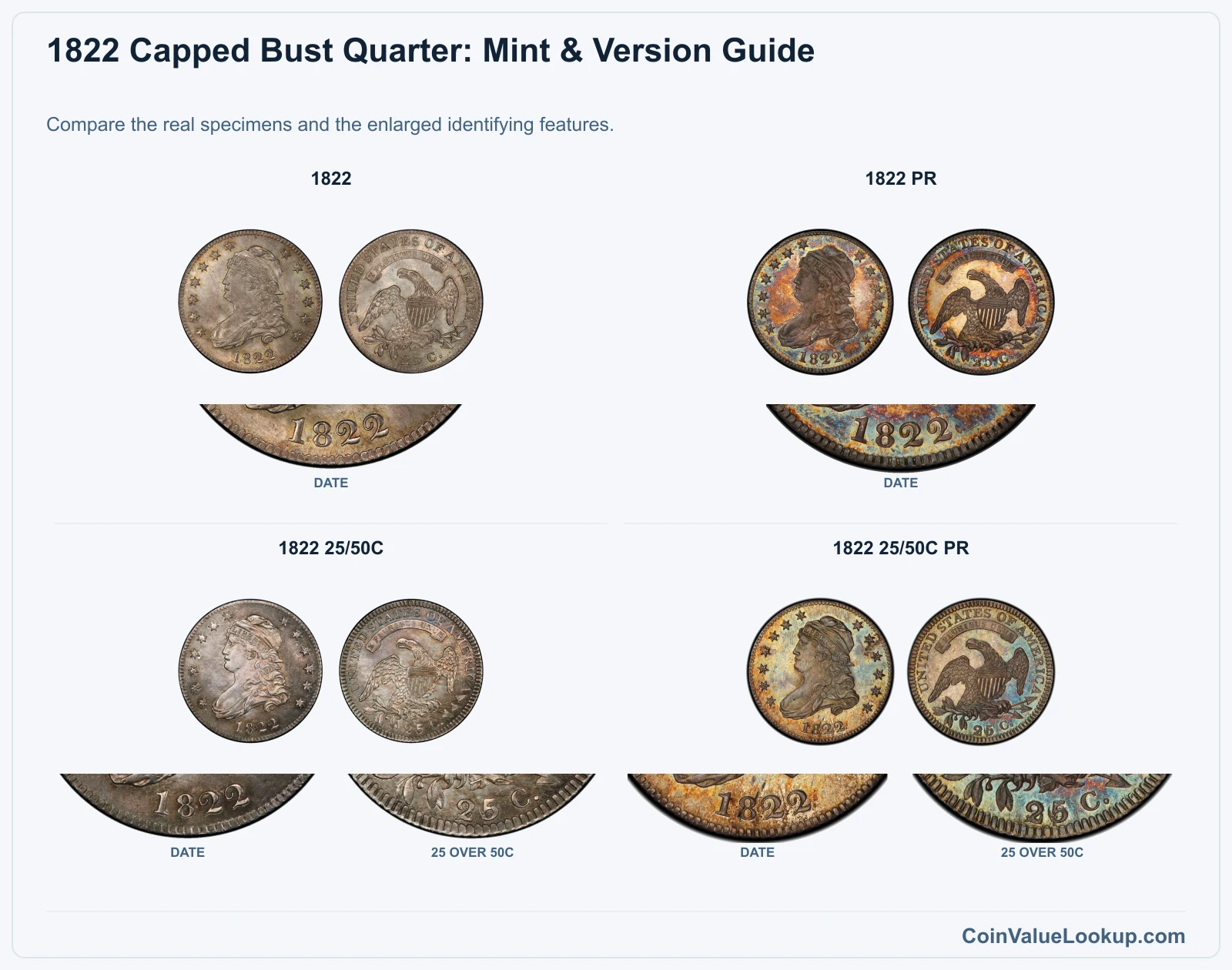
The 1822 Capped Bust Quarter is a scarce early American silver coin struck only at Philadelphia. Guide estimates for this year range from about $447.00 in well-worn condition up to $105,870.00 for the top-graded version of the coveted 25/50C blundered denomination variety.
Which part of that range applies depends entirely on the specific version, finish and condition of your coin.
Fast Way to Identify Your 1822 Capped Bust Quarter
The fastest way to start figuring out what your 1822 quarter is worth is to upload clear photos of both the front and back. Our identifier can give you a preliminary read on which version you might have.
Snap the images in good light, avoid glare, and include the coin's edge if possible so details like the denomination on the reverse are visible.
1822 Capped Bust Quarter Value
Upload both sides of your 1822 Capped Bust Quarter.
Front Obverse
Upload photo
Back Reverse
Upload photo
Which 1822 Capped Bust Quarter Versions Are Worth Money?
- 1822 25/50C — the blundered denomination variety where "50" remnants appear under "25 C." on the reverse. USA Coin Book estimates run from $7,140.00 in G4 to $105,870.00 in MS63.
- 1822 standard business strike — guide values range from $447.00 in G4 to $15,254.00 in MS63, making even a well-worn example worth checking.
- 1822 25/50C PR and 1822 PR — proof versions exist for both the standard and blundered denomination types; no guide prices are adopted, so individual professional assessment determines value.
- Check the reverse denomination area under magnification before assuming you have the common version. The 25/50C variety commands dramatically higher prices at every grade level.
Step 1: Identify Your 1822 Capped Bust Quarter Mint Mark and Version
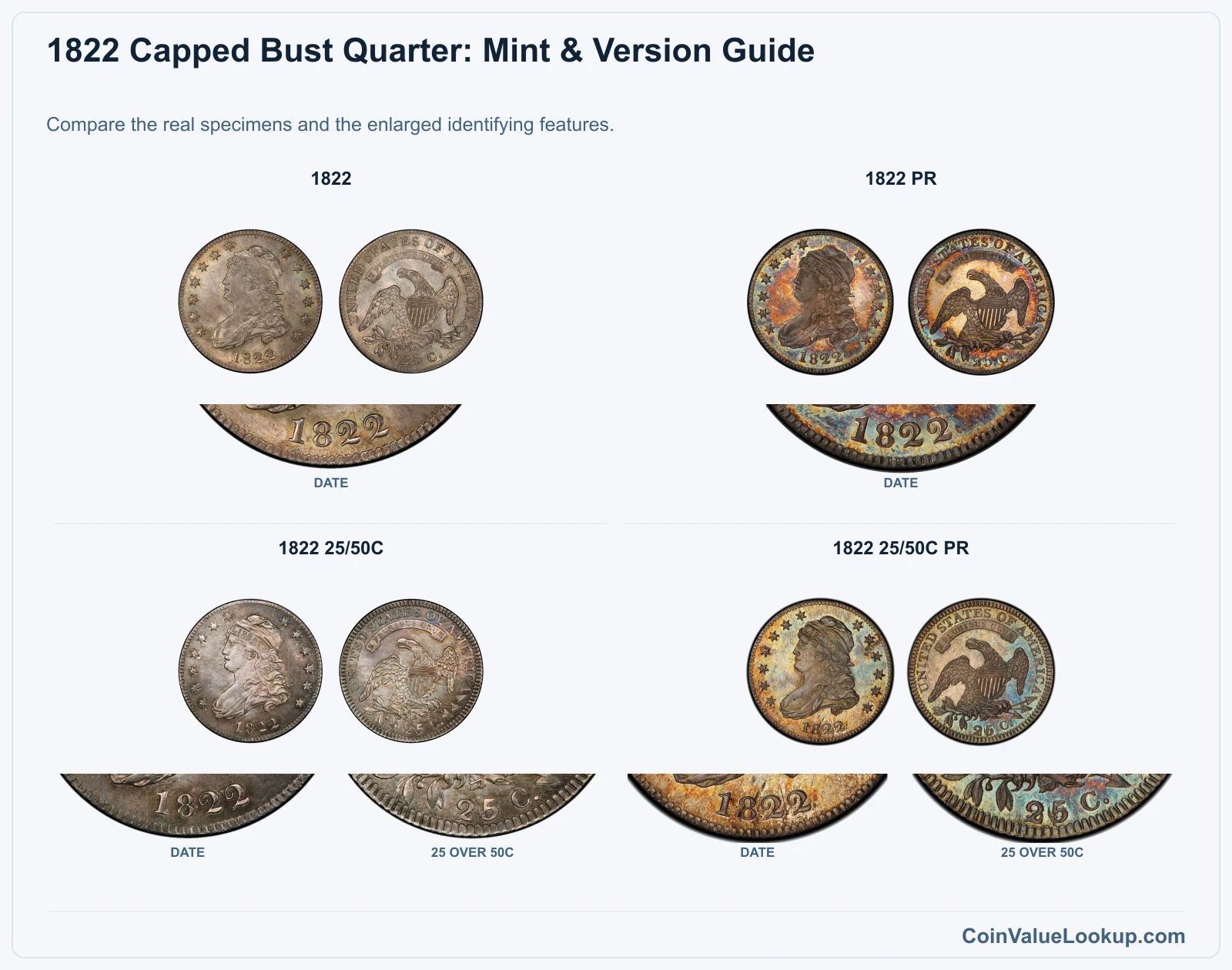
Every 1822 Capped Bust Quarter was struck at Philadelphia, so there is no mintmark to look for. The large-diameter design features a capped Liberty bust on the obverse and an eagle on the reverse with "E PLURIBUS UNUM" on a ribbon above.
The metal is a silver-copper alloy, roughly 89.24% silver. These coins have a distinctive heft and color compared to later base-metal quarters.
Four branches exist for 1822: the standard business strike, a proof version, the 25/50C blundered denomination business strike, and the 25/50C proof. The 25/50C versions show traces of a "50" denomination beneath the corrected "25 C." on the reverse.
That is the single most important thing to check.
Proofs from this era are extremely rare. A proof has mirrored fields and sharp rims produced by a special striking process.
A shiny, lightly circulated coin is not a proof. If you suspect you have a proof 1822 quarter, professional authentication is essential.
Coin Value Lookup is a good starting point if you want to look up other coin guides alongside this one. You can compare values across years and denominations to put your 1822 quarter in context.
Step 2: Check Your 1822 Capped Bust Quarter Grade
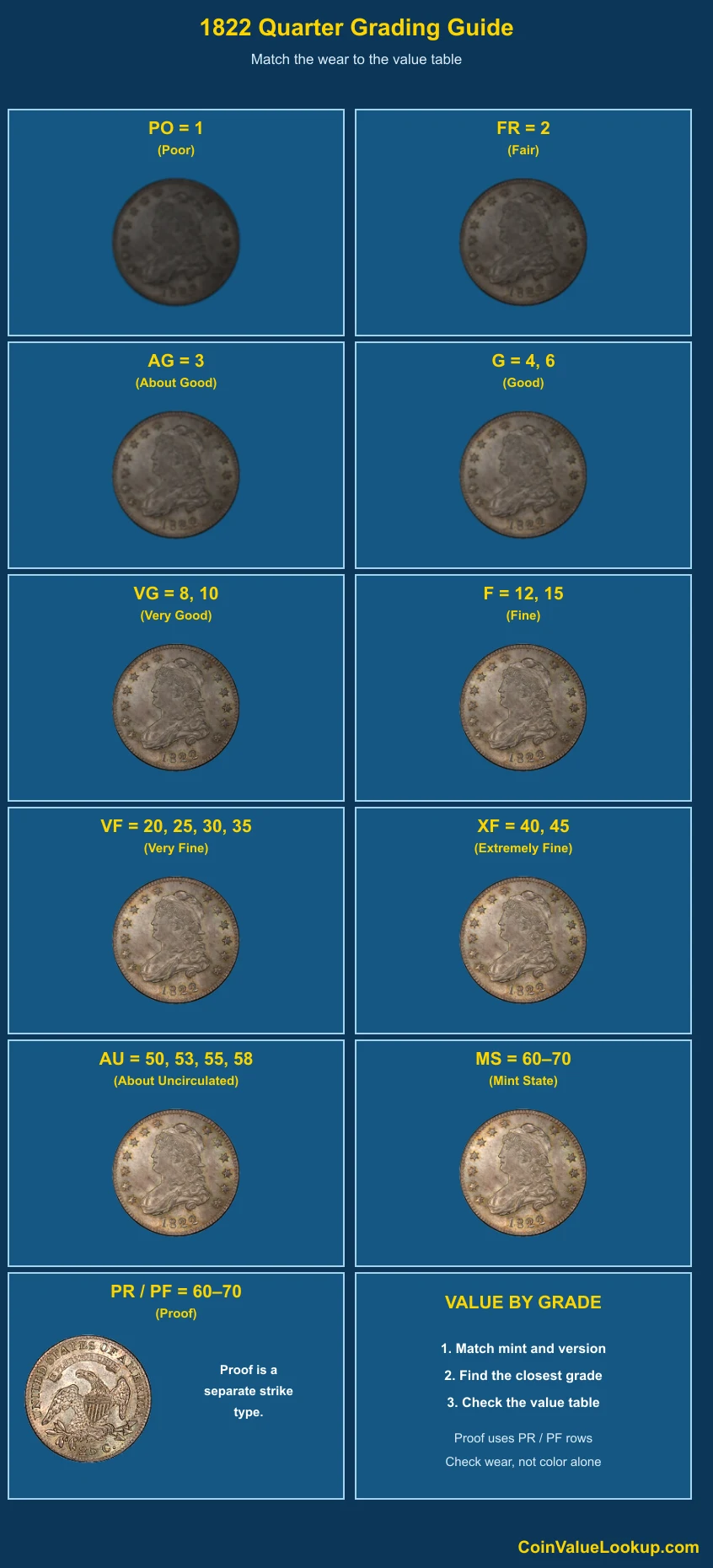
Start by examining Liberty's hair directly above the ear. On a lightly worn coin, individual hair strands are visible there.
As wear increases, that area flattens into a smooth patch, and eventually the cap folds above lose their separation too.
On the reverse, the eagle's breast feathers and the tops of the wings show wear first. A coin grading around Good (G4) will have a clear outline of Liberty and the eagle but almost no interior detail remaining.
Compare your coin against the reference image for this type. Look at both wear and luster together.
A weakly struck coin can lack detail on the high points even without any circulation wear, so do not confuse a soft strike for heavy use.
Cleaning, polishing or environmental damage reduces value regardless of how much detail remains. Original surfaces with natural toning are what collectors prefer on early silver.
Step 3: Check 1822 Capped Bust Quarter Value by Mint and Version
1822 Capped Bust Quarter
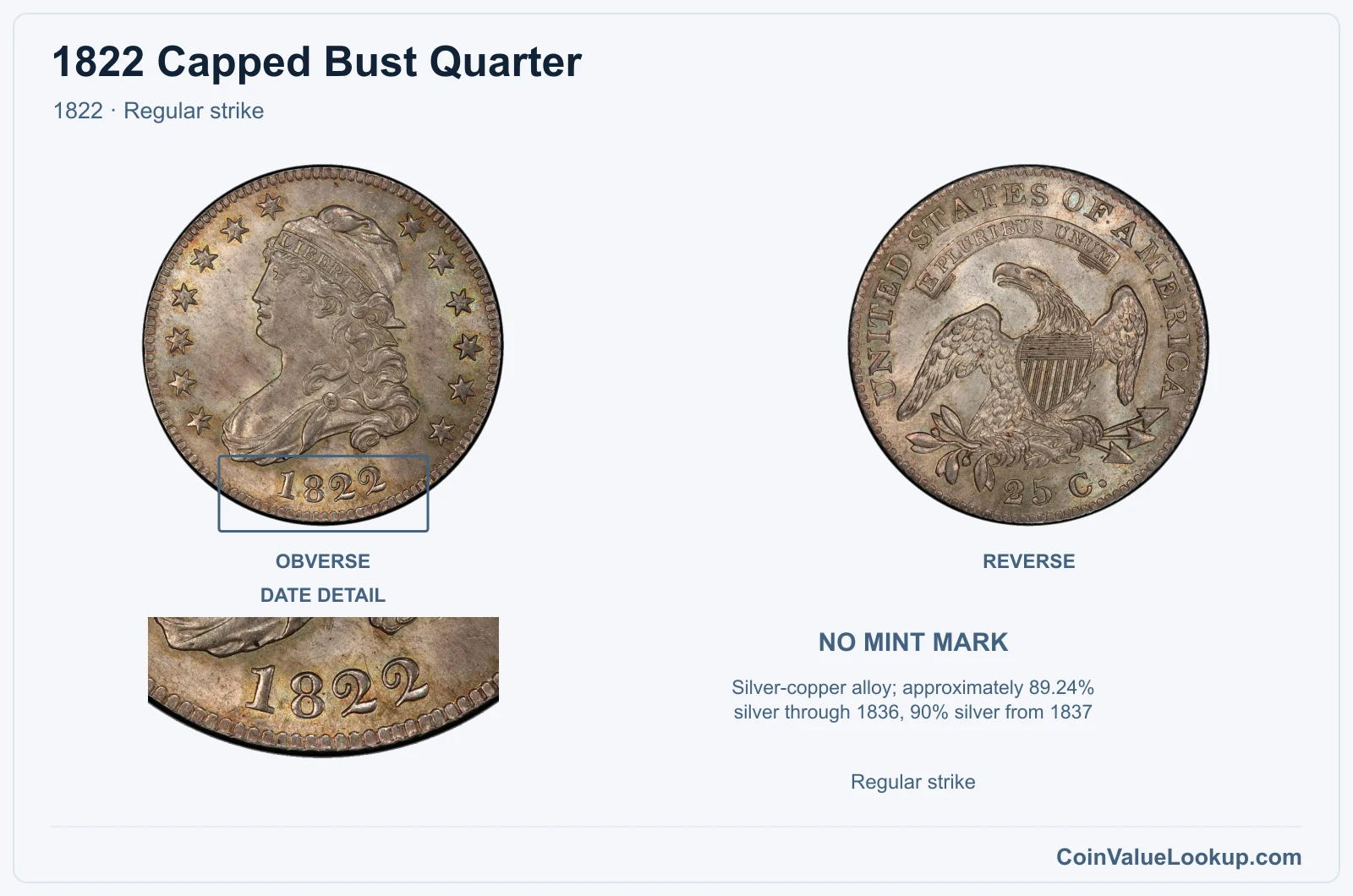
The standard 1822 business-strike quarter is the version most collectors will encounter, though "encounter" is generous for a 200-year-old coin. It carries no mintmark and shows the regular "25 C." denomination on the reverse without any underlying traces of a different value.
USA Coin Book estimates place a G4 example at $447.00 and an MS63 at $15,254.00. These are guide figures, not guaranteed sale prices.
Original, problem-free surfaces matter enormously on early silver. A cleaned or damaged piece will trade well below these benchmarks.
Confirm that the reverse denomination is a clean "25 C." with no ghosting of a "50" before settling on this version.
Range Grade
Price Auction Records Appraisal PO PO 1
—
Coin Identifier FR FR 2
—
Coin Identifier AG AG 3
Coin Identifier G G 4
Coin Identifier
G 6
Coin Identifier VG VG 8
Coin Identifier
VG 10
Coin Identifier F F 12
Coin Identifier
F 15
Coin Identifier VF VF 20
Coin Identifier
VF 25
Coin Identifier
VF 30
Coin Identifier
VF 35
Coin Identifier XF XF 40
Coin Identifier
XF 45
Coin Identifier AU AU 50
Coin Identifier
AU 53
Coin Identifier
AU 55
Coin Identifier
AU 58
Coin Identifier MS MS 60
—
Coin Identifier
MS 61
Coin Identifier
MS 62
Coin Identifier
MS 63
—
Coin Identifier
MS 64
Coin Identifier
MS 65
—
Coin Identifier
MS 66
—
Coin Identifier
MS 67
—
Coin Identifier
MS 68
—
—
—
MS 69
—
—
—
MS 70
—
—
—
1822 Capped Bust Quarter — PR
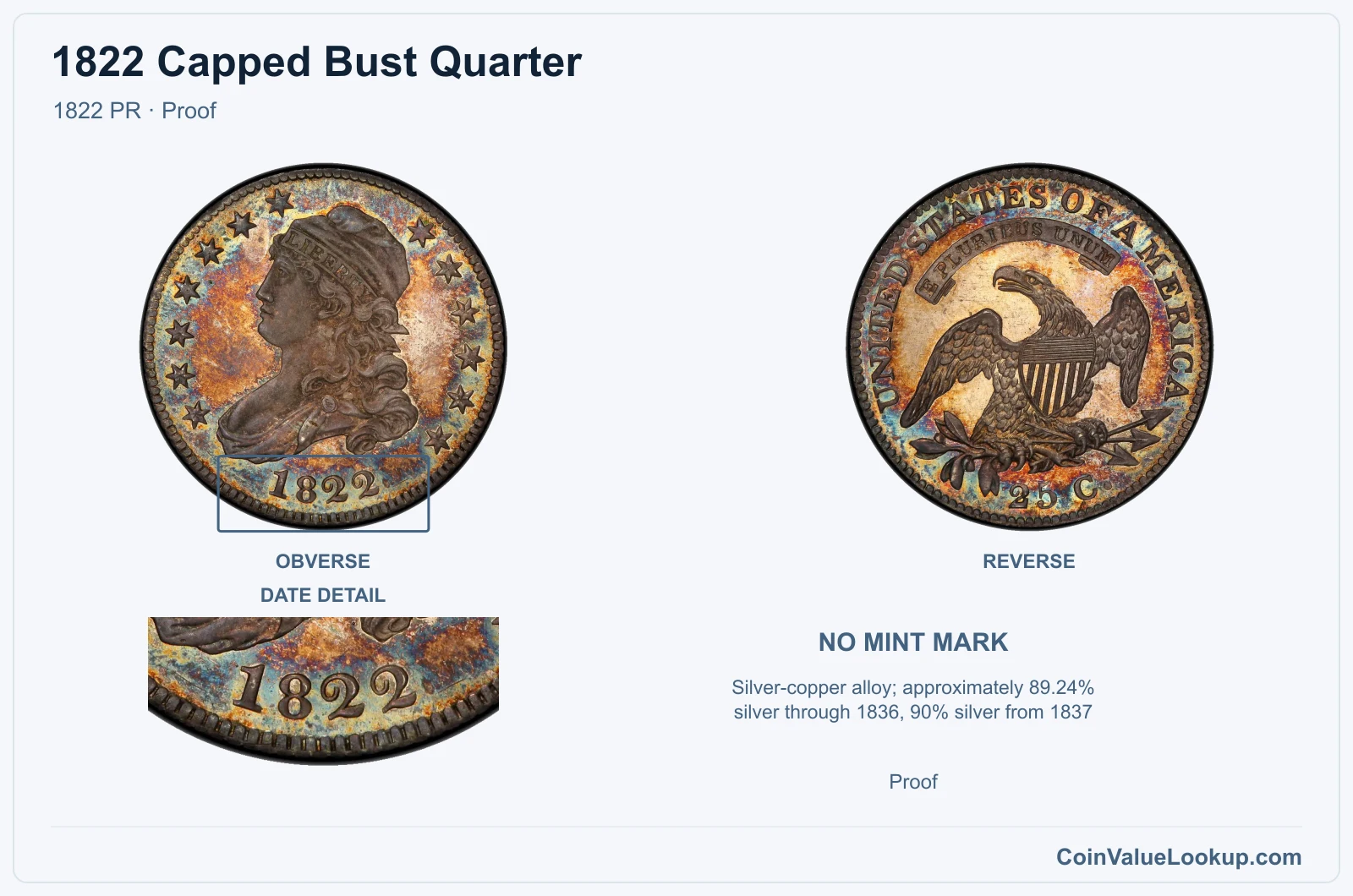
The 1822 proof quarter is a separate manufacturing category from the business strike. Proofs of this era were made in tiny numbers, often for presentation or collector purposes, using polished dies and planchets struck more than once.
Do not confuse a bright, lightly circulated coin for a proof. True proofs show mirror-like fields and exceptionally sharp design edges.
Surface haze, hairlines from handling and any cleaning all affect collector value.
No numerical guide range is adopted for this version. Because so few exist, each coin's value depends on its authenticated identity and individual condition.
Professional grading and authentication by a major service is the only practical path to establishing value here.
Range Grade
Price Auction Records Appraisal PR PR 1
—
Coin Identifier
PR 2
—
Coin Identifier
PR 3
—
Coin Identifier
PR 4
—
Coin Identifier
PR 6
—
Coin Identifier
PR 8
—
Coin Identifier
PR 10
—
Coin Identifier
PR 12
—
Coin Identifier
PR 15
—
Coin Identifier
PR 20
—
Coin Identifier
PR 25
—
Coin Identifier
PR 30
—
Coin Identifier
PR 35
—
Coin Identifier
PR 40
—
Coin Identifier
PR 45
—
Coin Identifier
PR 50
—
Coin Identifier
PR 53
—
Coin Identifier
PR 55
—
Coin Identifier
PR 58
—
Coin Identifier
PR 60
—
Coin Identifier
PR 61
—
Coin Identifier
PR 62
—
Coin Identifier
PR 63
Coin Identifier
PR 64
—
Coin Identifier
PR 65
—
Coin Identifier
PR 66
—
Coin Identifier
PR 67
Coin Identifier
PR 68
—
—
—
PR 69
—
—
—
PR 70
—
—
—
1822 Capped Bust Quarter — 25/50C
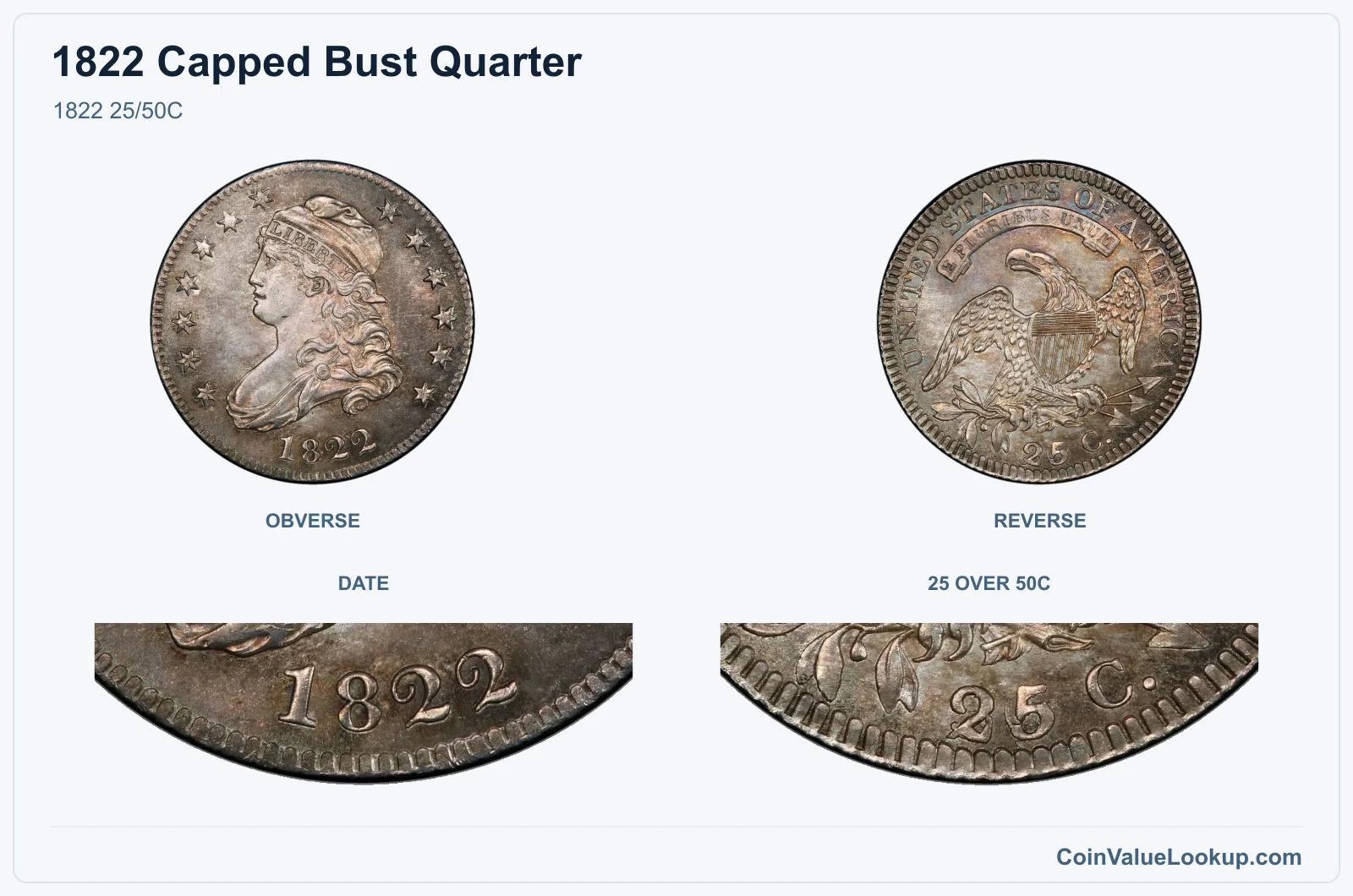
This is the star of the 1822 quarter series. The 25/50C variety resulted from a blundered denomination punch: the die was initially impressed with a "50" value (as used for half dollars) before being corrected to "25 C." for the quarter denomination.
The coin is still a quarter dollar in every other respect.
To identify it, magnify the "25 C." on the reverse and look for remnants of the earlier "50" punch lurking beneath or around the corrected numbers. The traces can range from obvious to subtle depending on the individual die state and wear.
USA Coin Book estimates this variety at $7,140.00 in G4 and $105,870.00 in MS63. Even a heavily worn example commands a substantial premium over the standard 1822 quarter.
Make sure you are comparing original surfaces and not confusing die cracks or damage marks for denomination remnants.
Range Grade
Price Auction Records Appraisal PO PO 1
—
Coin Identifier FR FR 2
—
Coin Identifier AG AG 3
Coin Identifier G G 4
—
Coin Identifier
G 6
Coin Identifier VG VG 8
Coin Identifier
VG 10
Coin Identifier F F 12
—
Coin Identifier
F 15
—
Coin Identifier VF VF 20
Coin Identifier
VF 25
—
Coin Identifier
VF 30
Coin Identifier
VF 35
Coin Identifier XF XF 40
—
Coin Identifier
XF 45
—
Coin Identifier AU AU 50
—
Coin Identifier
AU 53
—
Coin Identifier
AU 55
—
Coin Identifier
AU 58
—
Coin Identifier MS MS 60
—
Coin Identifier
MS 61
—
Coin Identifier
MS 62
—
Coin Identifier
MS 63
—
Coin Identifier
MS 64
—
Coin Identifier
MS 65
Coin Identifier
MS 66
—
—
—
MS 67
—
—
—
MS 68
—
—
—
MS 69
—
—
—
MS 70
—
—
—
1822 Capped Bust Quarter — 25/50C PR
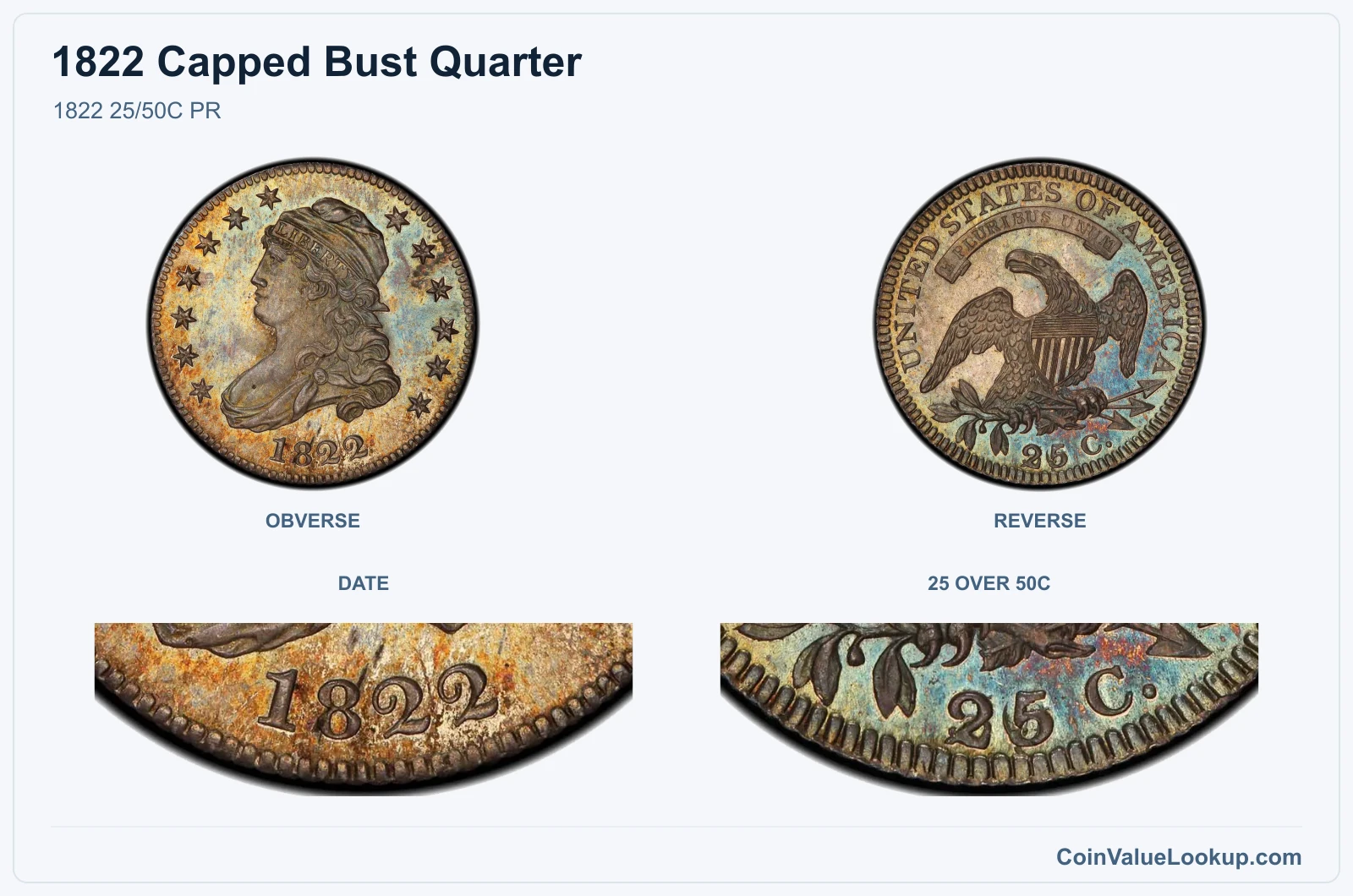
The proof version of the 25/50C blundered denomination combines two layers of rarity: the proof manufacturing finish and the mistaken denomination punch. Like its business-strike sibling, the reverse shows remnants of a "50" beneath the corrected "25 C." denomination.
A genuine proof will display mirrored fields and crisp, squared-off design details that circulated coins cannot replicate. Hairlines from old cabinet storage or gentle cleaning are common on early proofs and affect value.
No numerical guide price is adopted for this version. With proof Capped Bust quarters of any variety being exceedingly scarce, each piece is assessed individually based on its authenticated identity, surface quality and the clarity of the denomination error.
Third-party certification from a recognized grading service is practically a requirement for any transaction involving this coin.
Range Grade
Price Auction Records Appraisal PR PR 1
—
Coin Identifier
PR 2
—
Coin Identifier
PR 3
—
Coin Identifier
PR 4
—
Coin Identifier
PR 6
—
Coin Identifier
PR 8
—
Coin Identifier
PR 10
—
Coin Identifier
PR 12
—
Coin Identifier
PR 15
—
Coin Identifier
PR 20
—
Coin Identifier
PR 25
—
Coin Identifier
PR 30
—
Coin Identifier
PR 35
—
Coin Identifier
PR 40
—
Coin Identifier
PR 45
—
Coin Identifier
PR 50
—
Coin Identifier
PR 53
—
Coin Identifier
PR 55
—
Coin Identifier
PR 58
—
Coin Identifier
PR 60
—
Coin Identifier
PR 61
—
Coin Identifier
PR 62
—
Coin Identifier
PR 63
—
Coin Identifier
PR 64
—
Coin Identifier
PR 65
Coin Identifier
PR 66
—
—
—
PR 67
—
—
—
PR 68
—
—
—
PR 69
—
—
—
PR 70
—
—
—
1822 Capped Bust Quarter Error List
1. 1822 Capped Bust Quarter — 25 over 50 Denomination
The 25 over 50 denomination error is the defining collectible variety for the 1822 Capped Bust Quarter. It occurred when a die intended for quarter production was first punched with a "50" denomination value, then corrected to "25 C." before being used to strike coins.
To spot it, examine the reverse denomination under magnification. Look at and around the "25 C." for ghost traces of the underlying "50" digits.
The remnants may be partially obscured by the overstriking, so good lighting and at least 5x magnification help.
Do not confuse this with a double-denomination strike on another series, an overdate, or simple contact damage near the numbers. The traces should be consistent with a punched numeral, not random scratches.
This error applies specifically to 1822 Philadelphia-struck quarters.
No specific price range is adopted for the error category alone. Value depends on the coin's overall condition, the visibility of the denomination remnants and whether the coin has been authenticated by a professional grading service.