1838 Capped Bust Quarter Coin Value: How Much Is It Worth?
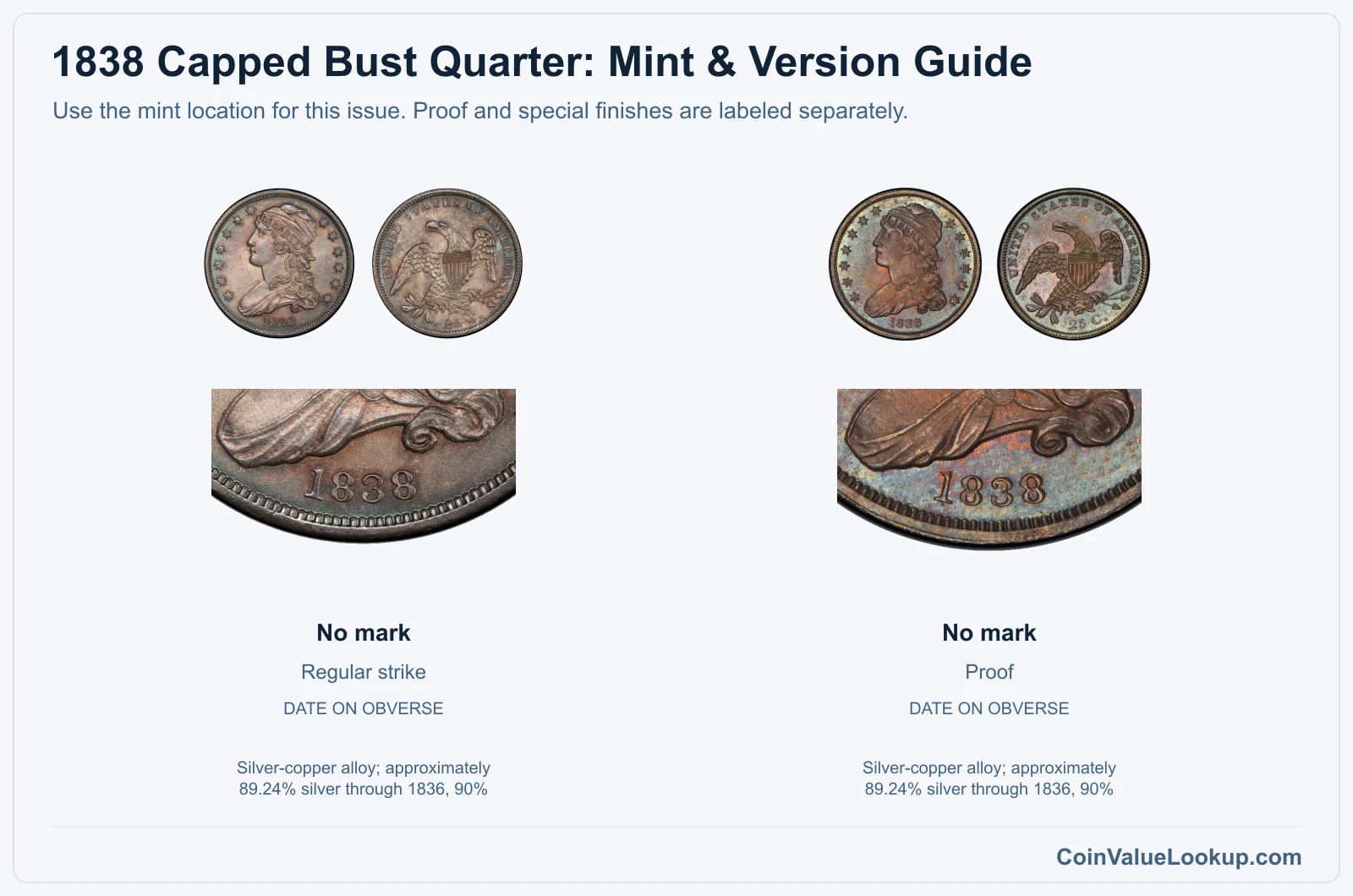
The 1838 Capped Bust quarter was struck at the Philadelphia Mint during the final year of this classic design series. USA Coin Book guide estimates for the listed versions range from $132.00 to $5,228.00, depending on the specific version and grade.
Mint finish, condition and whether you hold a business strike or a proof all determine where your coin falls within that spectrum.
Fast Way to Identify Your 1838 Capped Bust Quarter
The quickest way to start figuring out what your 1838 quarter is worth is to upload clear photos of both the front and back. Our identifier can give you a preliminary read on the version and condition.
Good lighting and a steady shot of each side make all the difference.
1838 Capped Bust Quarter Value
Upload both sides of your 1838 Capped Bust Quarter.
Front Obverse
Upload photo
Back Reverse
Upload photo
Which 1838 Capped Bust Quarter Versions Are Worth Money?
- 1838 Capped Bust business strike: USA Coin Book lists $5,228.00 at MS63, making higher-grade survivors the coins to watch for.
- 1838 Capped Bust Proof: no adopted numeric value, but proofs from this final Capped Bust year are scarce and require individual assessment.
- Check finish first: a bright, cleaned business strike is not a proof and will not carry proof-level collector interest.
- Condition matters sharply: the same coin jumps from $132.00 at G4 to $2,506.00 at MS60 for a business strike, per USA Coin Book.
Step 1: Identify Your 1838 Capped Bust Quarter Mint Mark and Version
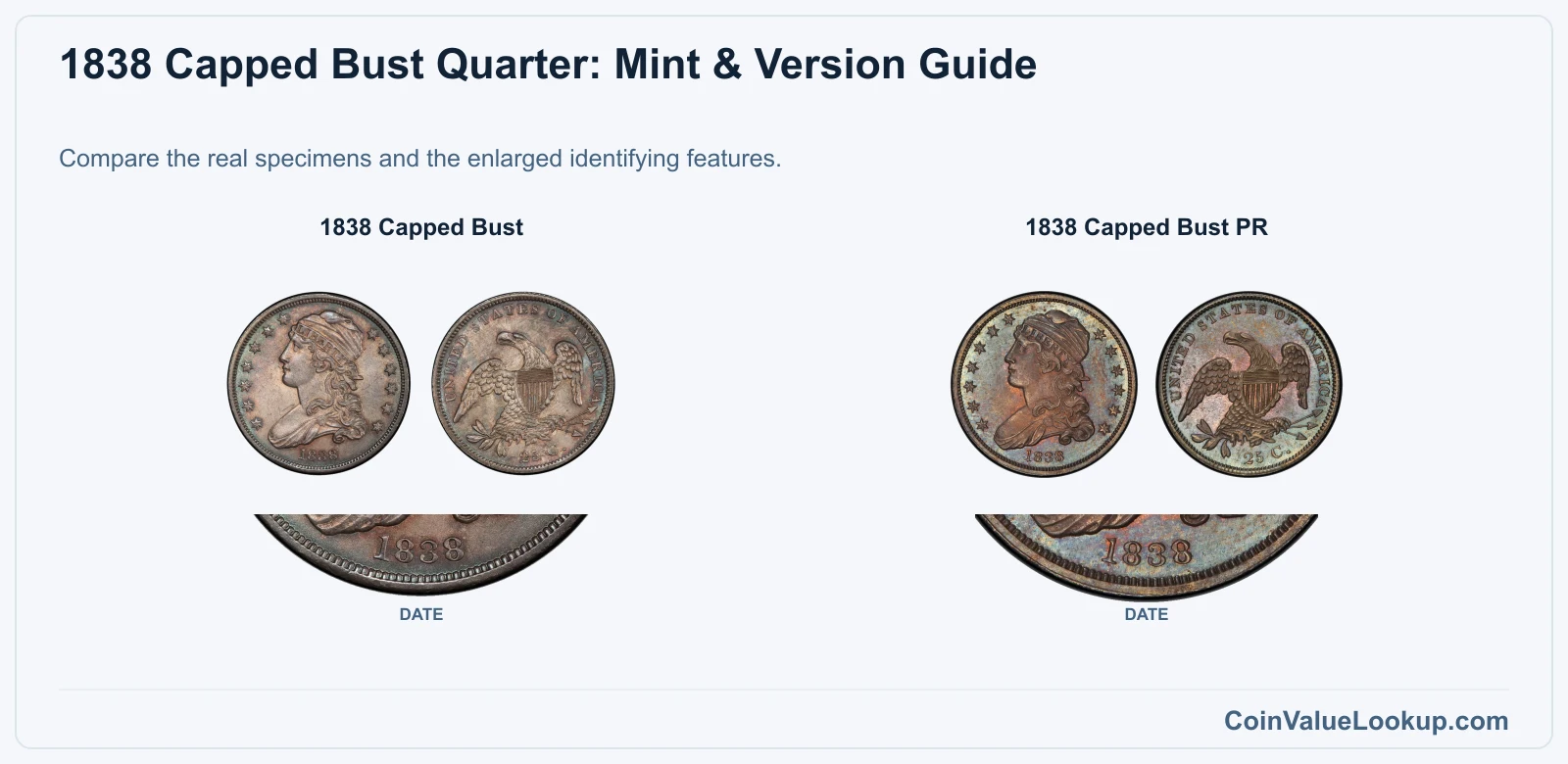
Every 1838 Capped Bust quarter came from Philadelphia, so there is no mintmark to look for. The coin is a reduced-diameter design without E PLURIBUS UNUM on the reverse, a format the Mint adopted starting in 1831.
The two branches you need to separate are the regular business strike and the proof. Proofs have deeply mirrored fields and sharp, squared-off rims; a shiny circulated coin is not a proof.
Look at the surfaces under angled light: a business strike will show cartwheel luster, while a proof reflects like a mirror.
The 1838 issue is struck in a 90% silver alloy. Weight, color and edge reeding should all be consistent with a genuine silver quarter of this era.
If the coin sticks to a magnet or feels too light, you may have a counterfeit rather than a rare variety.
Step 2: Check Your 1838 Capped Bust Quarter Grade
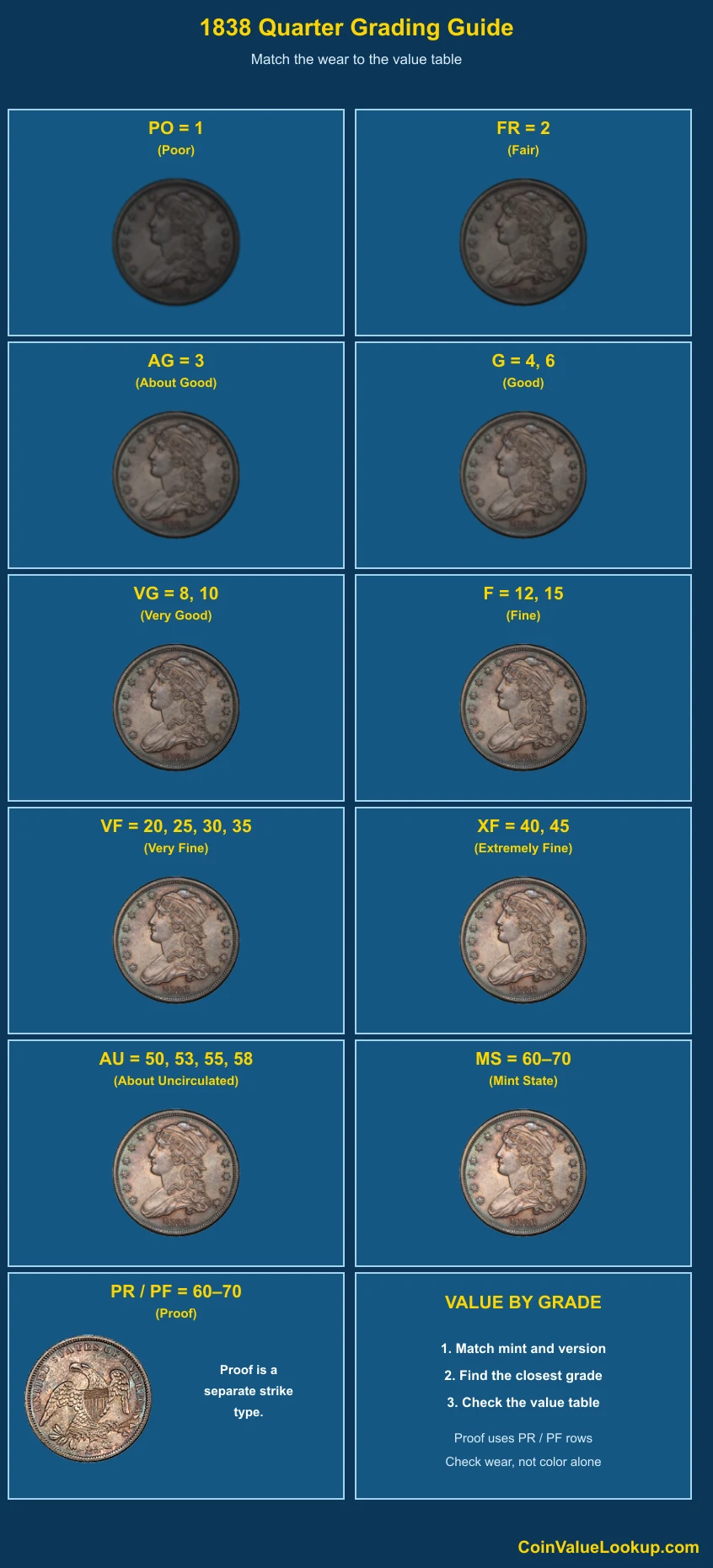
Start with the hair above Liberty's ear and the folds in the cap. On a well-preserved coin, fine strands of hair are individually visible and the cap shows crisp, separated creases.
Early wear smooths these areas first, blending the hair into a flat mass.
On the reverse, check the eagle's breast feathers and the tops of both wings. These high points lose detail quickly in circulation.
A coin grading around Good-4 will have a clear outline of the design but almost no interior detail.
Strike weakness and wear are two different things. A weakly struck coin may lack full hair detail even without any circulation, so compare your coin's luster alongside its sharpness.
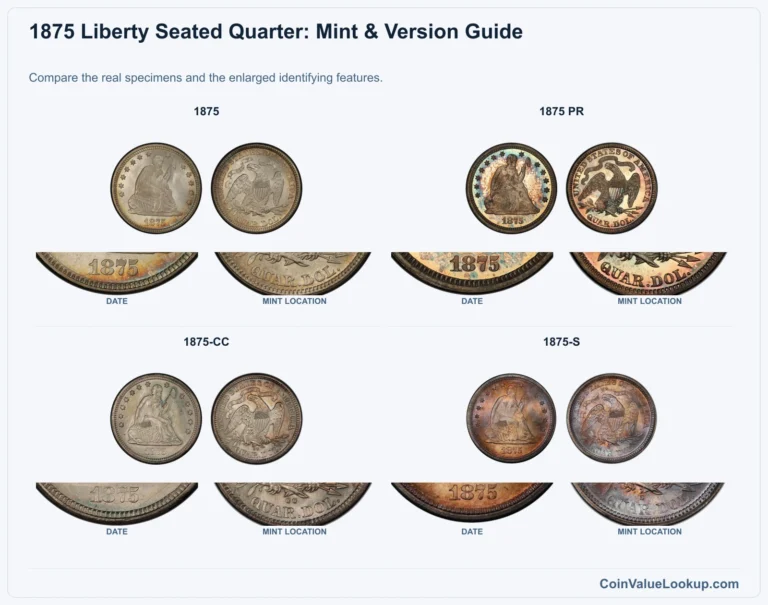
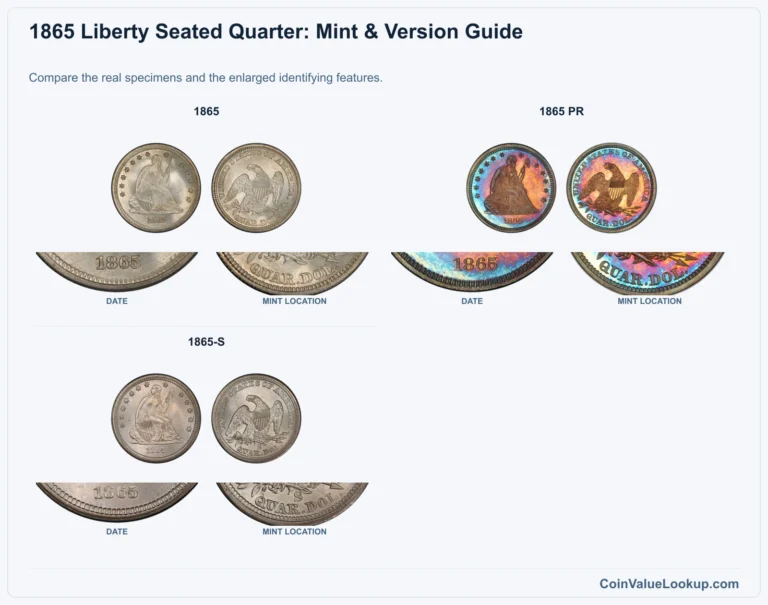
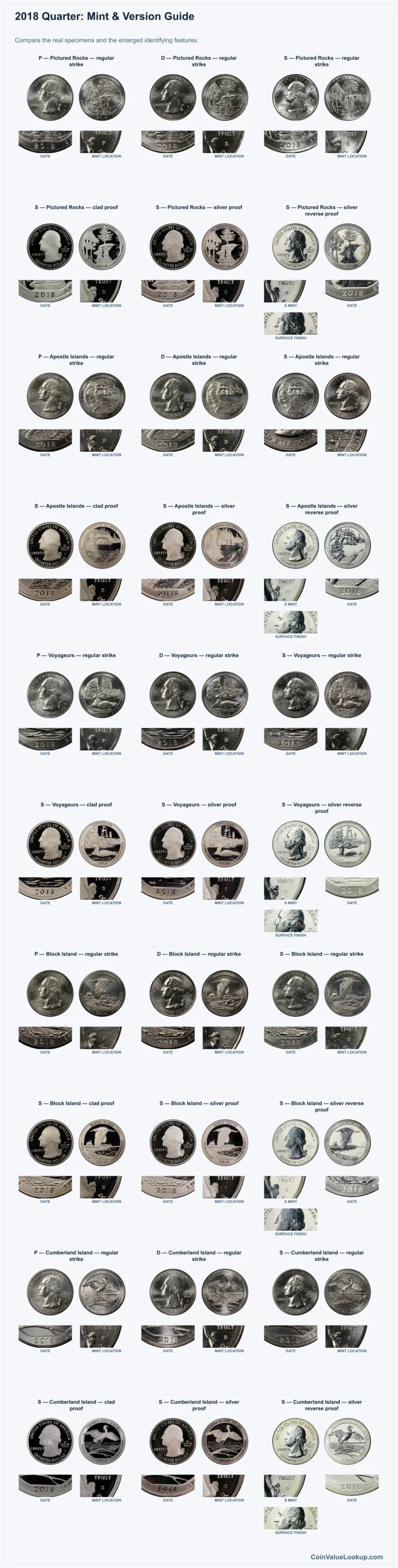
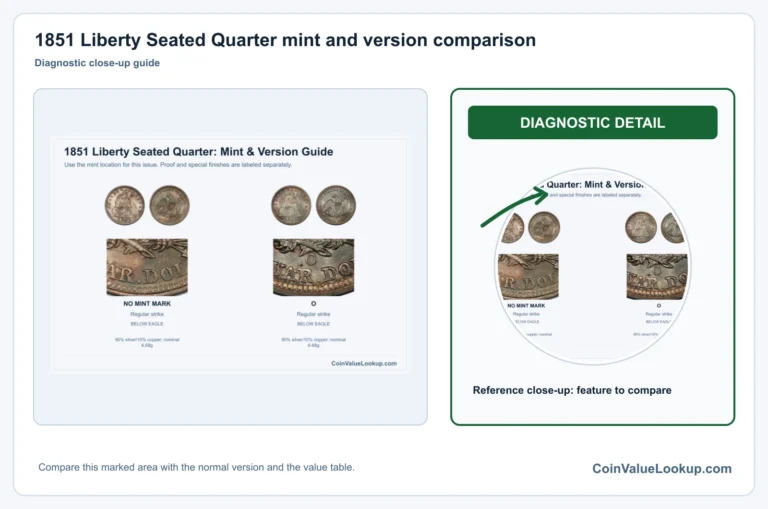
Use the comparison image to gauge where your piece sits. Original surfaces with natural toning typically grade more favorably than coins that have been cleaned or harshly polished.
Step 3: Check 1838 Capped Bust Quarter Value by Mint and Version
1838 Capped Bust Quarter — Capped Bust
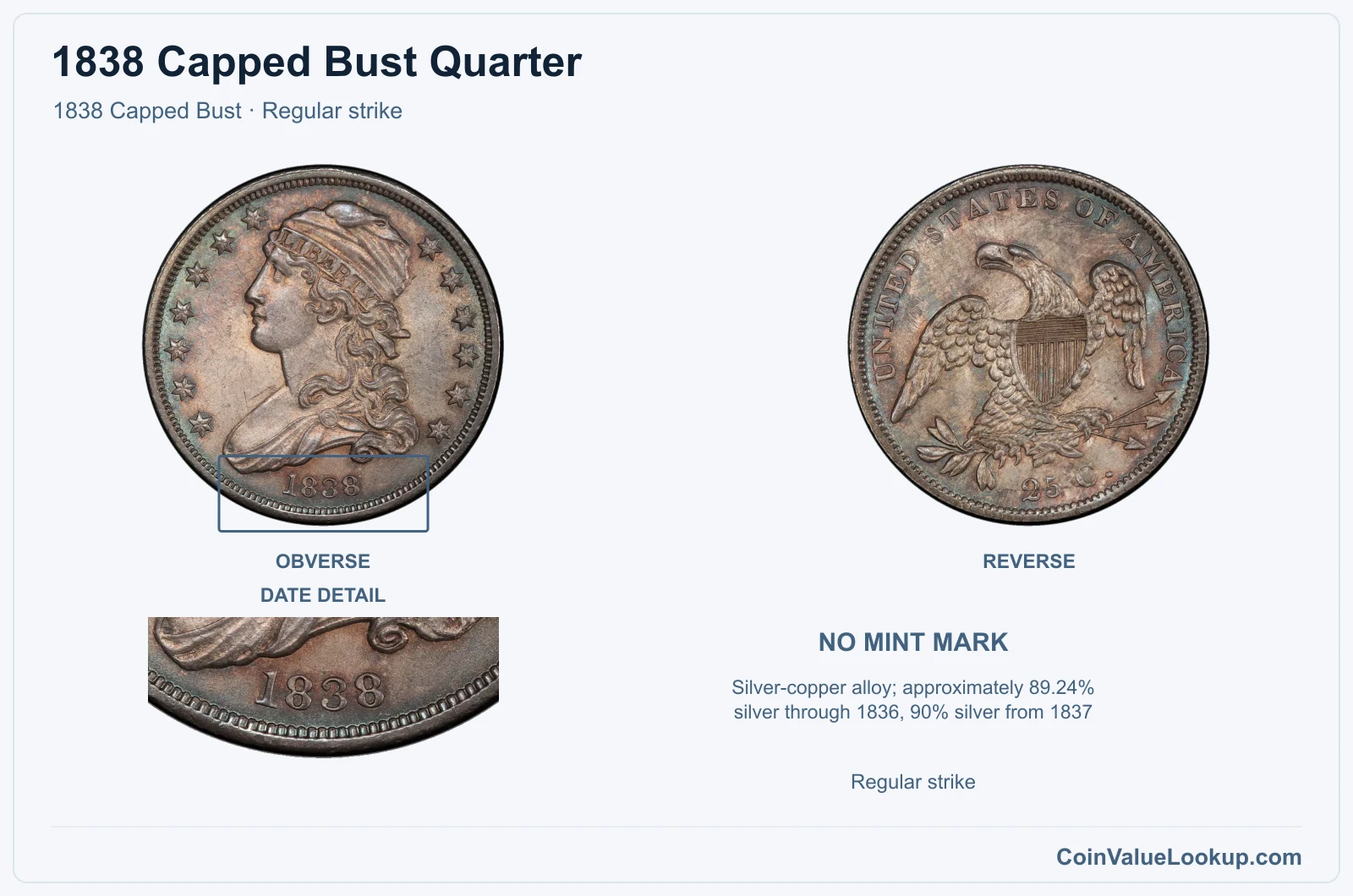
The 1838 Capped Bust quarter is a Philadelphia business strike with no mintmark. It uses the reduced-diameter design introduced in 1831, with a plain reverse lacking E PLURIBUS UNUM.
The silver content is 90%.
USA Coin Book estimates place this coin at $132.00 in G4, $2,506.00 in MS60, and $5,228.00 in MS63. These are guide estimates, not guaranteed sale prices.
The jump between circulated and uncirculated grades is steep, so original surfaces and minimal wear matter a lot. Cleaning or damage will knock the value well below these figures, even on an otherwise sharp coin.
Coin Value Lookup is a good starting point if you want to compare this quarter with values from other years or denominations in the Capped Bust series.
Range Grade
Price Auction Records Appraisal PO PO 1
—
Coin Identifier FR FR 2
—
Coin Identifier AG AG 3
—
Coin Identifier G G 4
—
Coin Identifier
G 6
—
Coin Identifier VG VG 8
Coin Identifier
VG 10
Coin Identifier F F 12
Coin Identifier
F 15
—
Coin Identifier VF VF 20
Coin Identifier
VF 25
Coin Identifier
VF 30
Coin Identifier
VF 35
Coin Identifier XF XF 40
Coin Identifier
XF 45
Coin Identifier AU AU 50
Coin Identifier
AU 53
Coin Identifier
AU 55
Coin Identifier
AU 58
Coin Identifier MS MS 60
—
Coin Identifier
MS 61
Coin Identifier
MS 62
Coin Identifier
MS 63
Coin Identifier
MS 64
Coin Identifier
MS 65
Coin Identifier
MS 66
Coin Identifier
MS 67
Coin Identifier
MS 68
—
—
—
MS 69
—
—
—
MS 70
—
—
—
1838 Capped Bust Quarter — Capped Bust PR
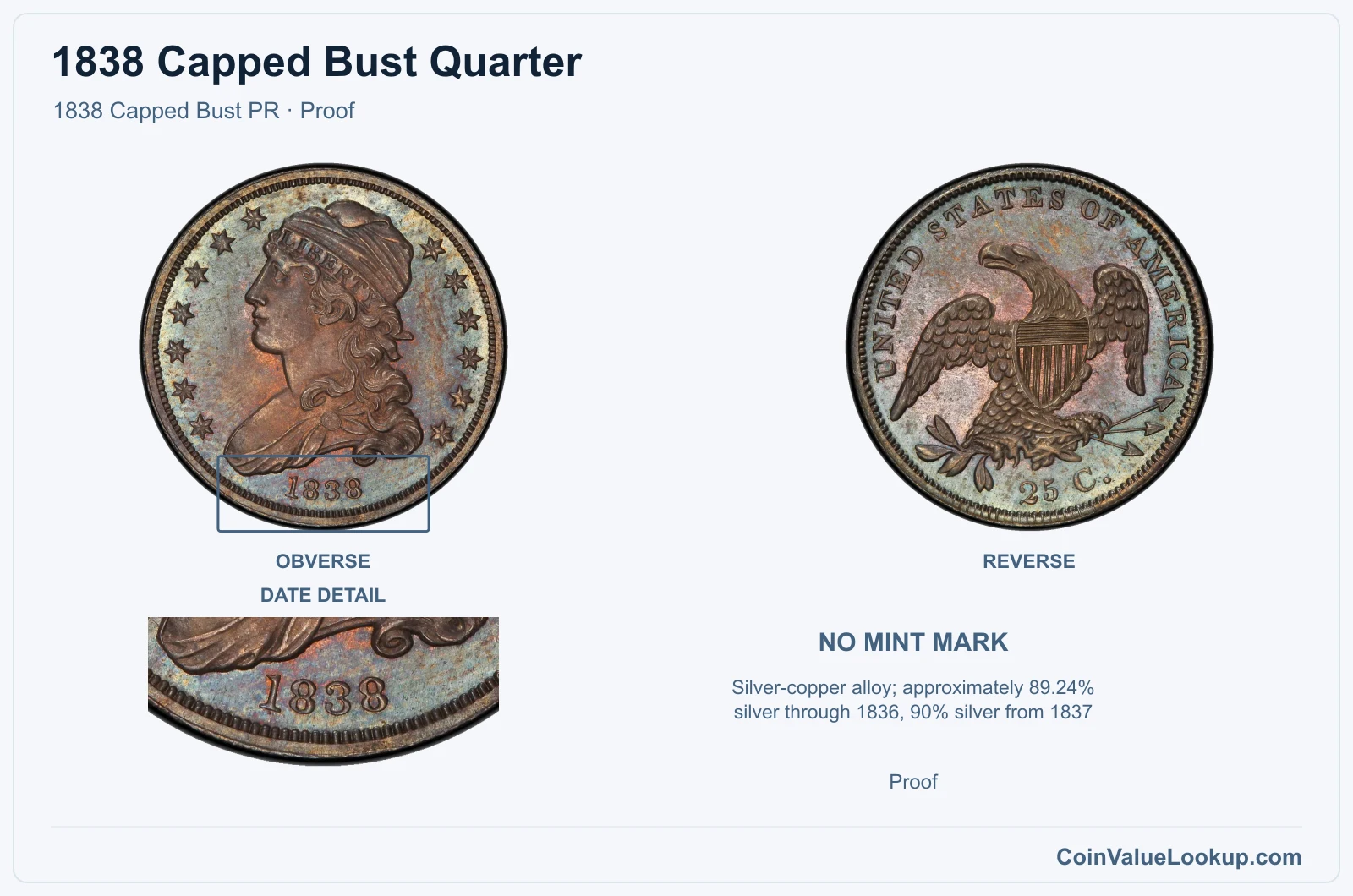
The 1838 Capped Bust proof is also a Philadelphia product, but it was made using a different manufacturing process. Proof coins were struck on specially prepared planchets with polished dies, producing mirror-like fields and exceptionally sharp design elements.
They were not intended for circulation.
No adopted numeric price range is available for this version, so each coin needs individual assessment based on its authenticated identity, surface condition and any hairlines or haze. Do not confuse a lightly circulated business strike that still has some shine with an actual proof.
True proofs exhibit a specific combination of squared rims, deeply reflective fields and fully struck devices that no amount of polishing a regular coin can replicate. If you suspect you have one, professional authentication is the logical next step.
Range Grade
Price Auction Records Appraisal PR PR 1
—
Coin Identifier
PR 2
—
Coin Identifier
PR 3
—
Coin Identifier
PR 4
—
Coin Identifier
PR 6
—
Coin Identifier
PR 8
—
Coin Identifier
PR 10
—
Coin Identifier
PR 12
—
Coin Identifier
PR 15
—
Coin Identifier
PR 20
—
Coin Identifier
PR 25
—
Coin Identifier
PR 30
—
Coin Identifier
PR 35
—
Coin Identifier
PR 40
—
Coin Identifier
PR 45
—
Coin Identifier
PR 50
—
Coin Identifier
PR 53
—
Coin Identifier
PR 55
—
Coin Identifier
PR 58
—
Coin Identifier
PR 60
—
Coin Identifier
PR 61
—
Coin Identifier
PR 62
—
Coin Identifier
PR 63
—
—
—
PR 64
—
—
—
PR 65
—
—
—
PR 66
Coin Identifier
PR 67
—
—
—
PR 68
—
—
—
PR 69
—
—
—
PR 70
—
—
—
1838 Capped Bust Quarter Error List
1. 1838 Capped Bust Quarter — Lamination / Split Planchet
A lamination error on an 1838 Capped Bust quarter shows up as a peeling flap of metal or a visible split within the planchet's alloy. The separation can range from a small raised sliver to a larger section that has partly detached.
Photograph the edge and the affected face together so both the depth and extent of the flaw are clear.
These are caused during the planchet preparation stage, before the coin is struck. Do not confuse them with post-mint scraping, corrosion pitting or a coin that someone deliberately cut into.
A genuine lamination will follow the contour of the metal's layers.
No adopted price range is available for this error on the 1838 quarter. Value depends on the size of the affected area, overall condition of the coin and whether the error is visually dramatic or subtle.
2. 1838 Capped Bust Quarter — Off-Center Strike
An off-center strike on an 1838 Capped Bust quarter means the planchet was not properly seated between the dies when struck, leaving part of the design missing and an unstruck crescent of blank metal along one edge. Heritage Auctions has reported an 1838 Capped Bust quarter struck roughly 20% off center.
The key diagnostic is that displaced crescent: the design shifts in one direction while blank planchet shows on the opposite side. Coins where the date remains fully visible tend to draw more collector interest.
Do not confuse this with a clipped planchet, which has a curved bite taken from the edge, or with post-mint damage like flattening from a vise.
No adopted price range is available. The specific percentage of displacement, date visibility and overall condition all affect what the coin would bring at sale.