1838 Capped Bust Half Dollar Coin Value: How Much Is It Worth?
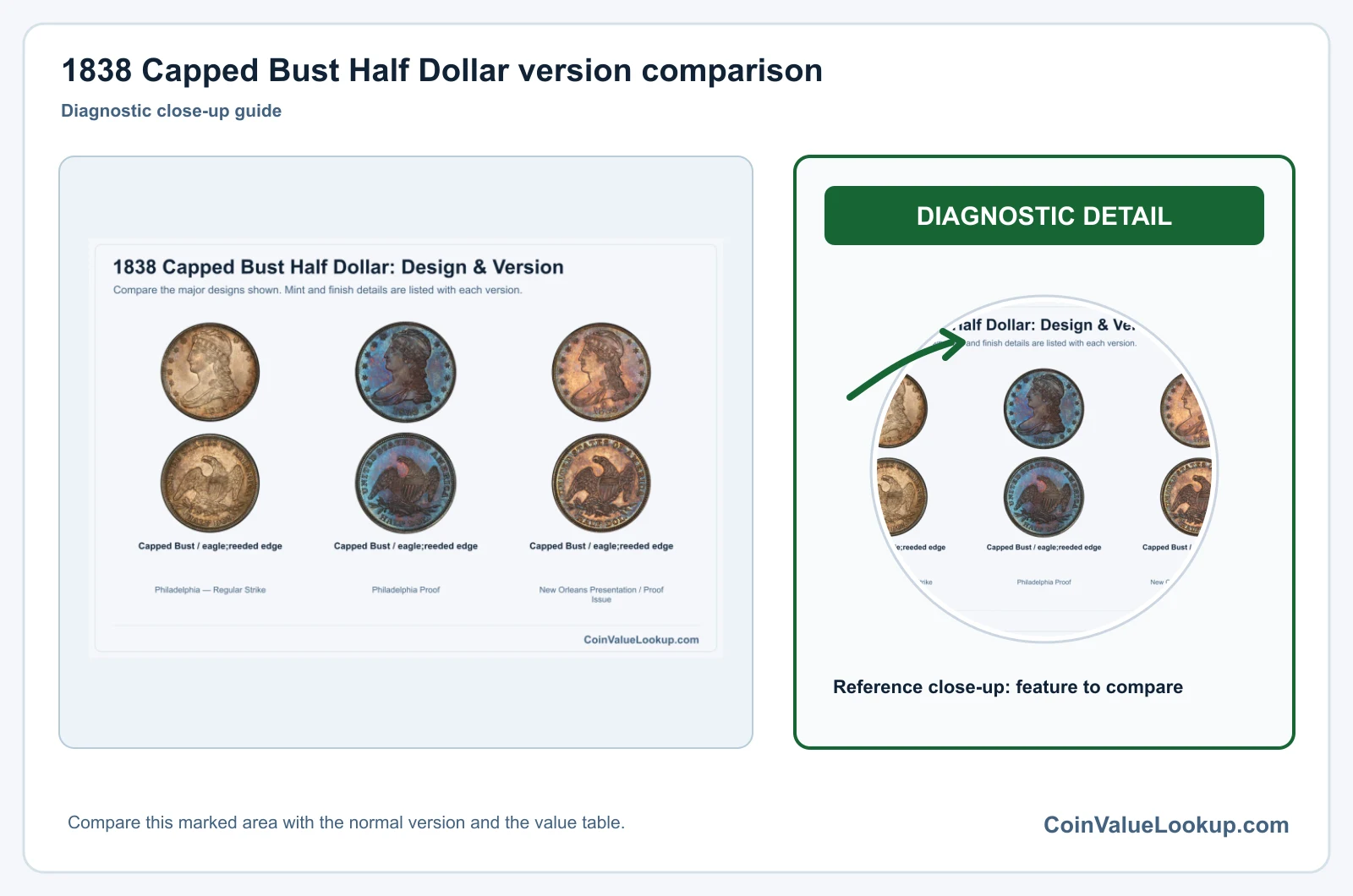
The 1838 Capped Bust Half Dollar is a one-year overlap coin from the Philadelphia Mint, struck in 90% silver just before the Seated Liberty design took over in 1839. Regular circulation strikes in collectible condition range from roughly $100 at G4 to $575 at AU50, according to guide estimates.
Rare proof and presentation issues exist from both Philadelphia and New Orleans, but those are in a completely different league and require professional attribution.
Fast Way to Identify Your 1838 Capped Bust Half Dollar
Want a quick read on what you have? Upload clear photos of the front and back of your coin, and our identifier can help with a preliminary identification of your 1838 half dollar.
Edge details and surface condition matter too, so natural lighting and a steady hand go a long way.
1838 Capped Bust Half Dollar Value
Upload both sides of your 1838 Capped Bust Half Dollar.
Front Obverse
Upload photo
Back Reverse
Upload photo
Which 1838 Capped Bust Half Dollar Versions Are Worth Money?
- Philadelphia regular strikes range from about $100 at G4 to $575 at AU50 per guide estimates — the version most collectors will encounter.
- A Philadelphia Proof graded PR66+ sold at Heritage in August 2018 for $336,000 — a rare proof finish requiring professional attribution.
- A New Orleans Presentation or Proof issue graded SP64 sold at Heritage in January 2014 for $763,750 — an extremely rare coin from the New Orleans Mint's early operations.
- Check your reverse legend (HALF DOL, not 50 CENTS) and edge (reeded, not lettered) to confirm the correct 1838 type before estimating value.
Step 1: Identify Your 1838 Capped Bust Half Dollar Mint Mark and Version
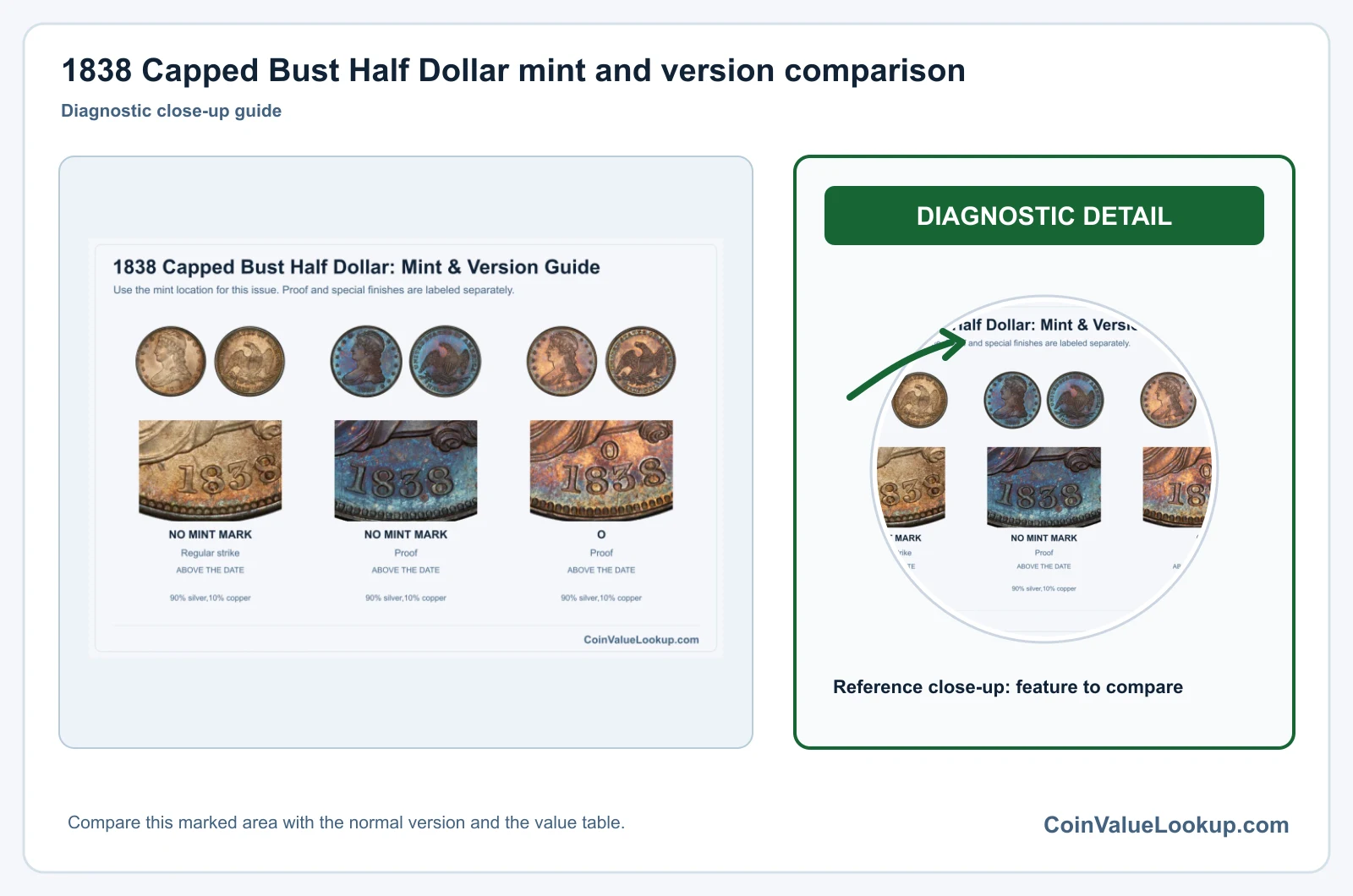
The 1838 Capped Bust Half Dollar shows Liberty facing left wearing a cap, with flowing curls and a star border. The reverse features a heraldic eagle with the denomination spelled out as HALF DOL.
This is a key detail. Earlier Capped Bust halves from 1836–37 read "50 CENTS" on the reverse and have a lettered edge.
The 1838 version uses a reeded edge and the HALF DOL legend, so check both the reverse text and the edge to confirm you have the right type.
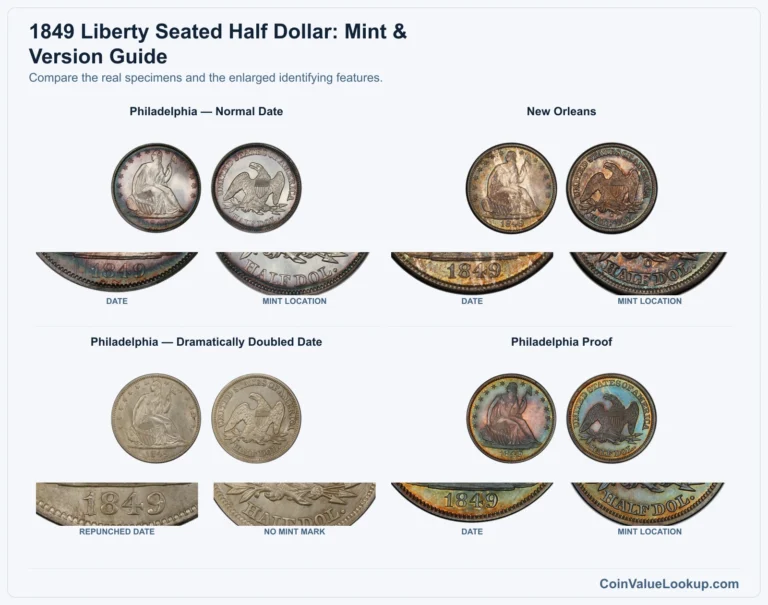
Philadelphia-struck coins carry no mintmark. New Orleans issues display an "O" mintmark on the obverse, above the date.
If you see a small O there, you may have something special, particularly if the surfaces look unusually sharp and reflective.
The coin is 90% silver and 10% copper, with a standard weight of about 13.36 grams. Do not assume high purity from a bright appearance alone; cleaning and environmental exposure change how silver looks over time.
A proof or presentation strike is a method of manufacture, not a higher grade than Mint State. Bright, well-preserved regular strikes can fool you, so professional certification is the only reliable way to confirm proof status.
Step 2: Check Your 1838 Capped Bust Half Dollar Grade
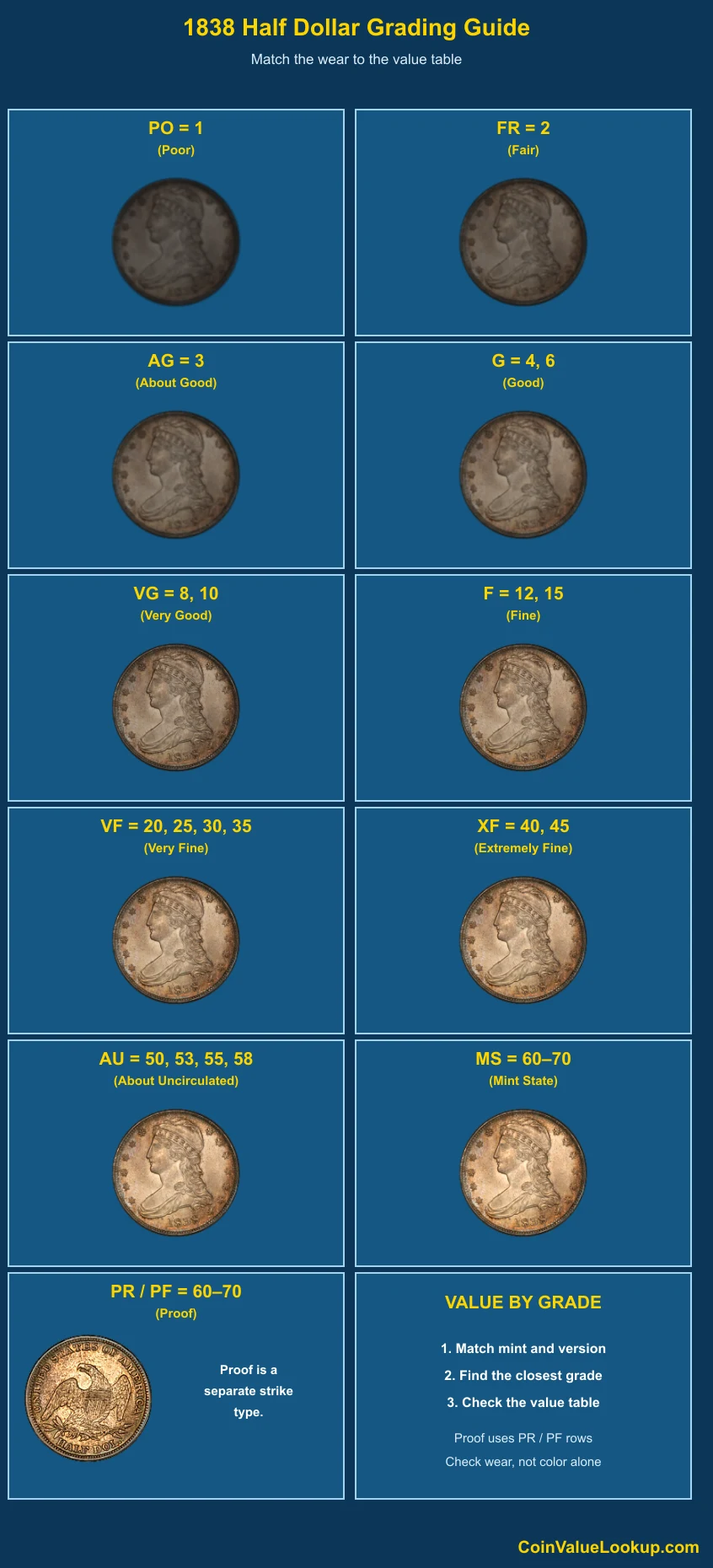
Start with the obverse. On well-worn examples, Liberty's hair curls above the ear flatten first, followed by the cap detail and the cheek.
At G4, the portrait outline is clear but most fine detail is gone. By VF20, you can see individual curls and cap lines, though high points show obvious smoothing.
Flip to the reverse. The eagle's breast feathers and wing tips lose definition before the lower shield and claws.
Compare your coin against type-matched photographs showing circulated through Mint State examples to gauge where yours falls.
Uneven strikes were common on this type, so a soft spot on one area does not always mean wear. Look at the surrounding surfaces for flow lines or luster breaks to distinguish a weak strike from actual circulation loss.
Cleaning, holes, scratches, and tooled surfaces all reduce value significantly. If your coin has been cleaned, the surfaces will show a slightly unnatural brightness or fine hairlines under magnification.
The best advice anyone can give: do not clean your coins.
Step 3: Check 1838 Capped Bust Half Dollar Value by Mint and Version
1838 Capped Bust Half Dollar — Philadelphia — Regular Strike
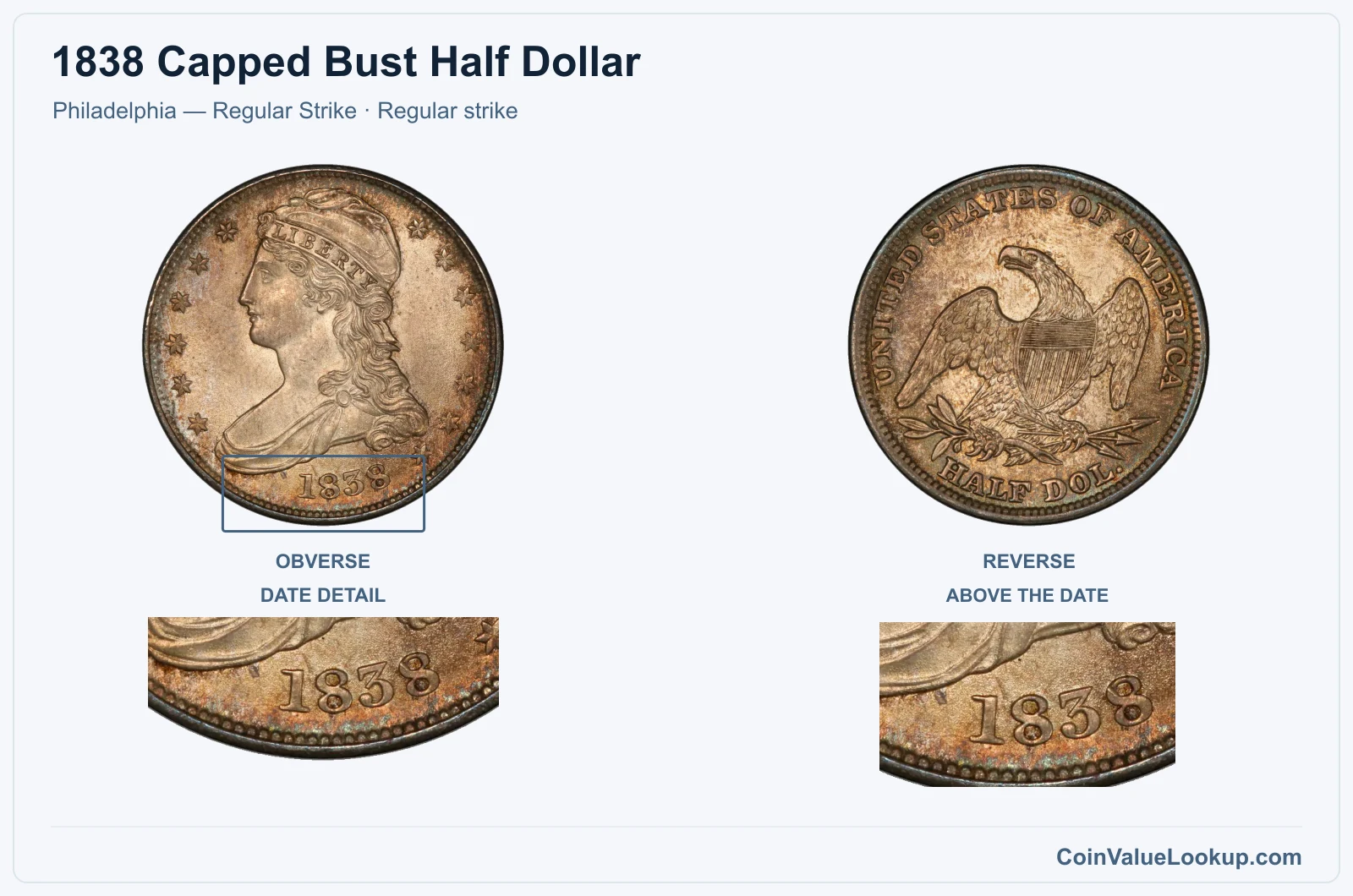
This is the version most people will own. Struck at Philadelphia with no mintmark, the regular issue features the reeded edge and HALF DOL reverse that distinguish it from the 1836–37 lettered-edge predecessors.
Guide estimates from USA Coin Book place it around $100 in G4, $173 in VF20, and $575 in AU50.
These are not rare coins in lower grades, but they get scarce in original, uncleaned condition above VF. If yours still shows sharp curls and luster in the fields, it is worth having professionally graded.
Range Grade
Price Auction Records Appraisal PO PO 1
—
Coin Identifier FR FR 2
Coin Identifier AG AG 3
Coin Identifier G G 4
—
Coin Identifier
G 6
—
Coin Identifier VG VG 8
—
Coin Identifier
VG 10
Coin Identifier F F 12
Coin Identifier
F 15
Coin Identifier VF VF 20
Coin Identifier
VF 25
Coin Identifier
VF 30
Coin Identifier
VF 35
Coin Identifier XF XF 40
Coin Identifier
XF 45
Coin Identifier AU AU 50
Coin Identifier
AU 53
Coin Identifier
AU 55
Coin Identifier
AU 58
Coin Identifier MS MS 60
Coin Identifier
MS 61
Coin Identifier
MS 62
Coin Identifier
MS 63
Coin Identifier
MS 64
Coin Identifier
MS 65
Coin Identifier
MS 66
Coin Identifier
MS 67
Coin Identifier
MS 68
—
—
—
MS 69
—
—
—
MS 70
—
—
—
1838 Capped Bust Half Dollar — Philadelphia Proof
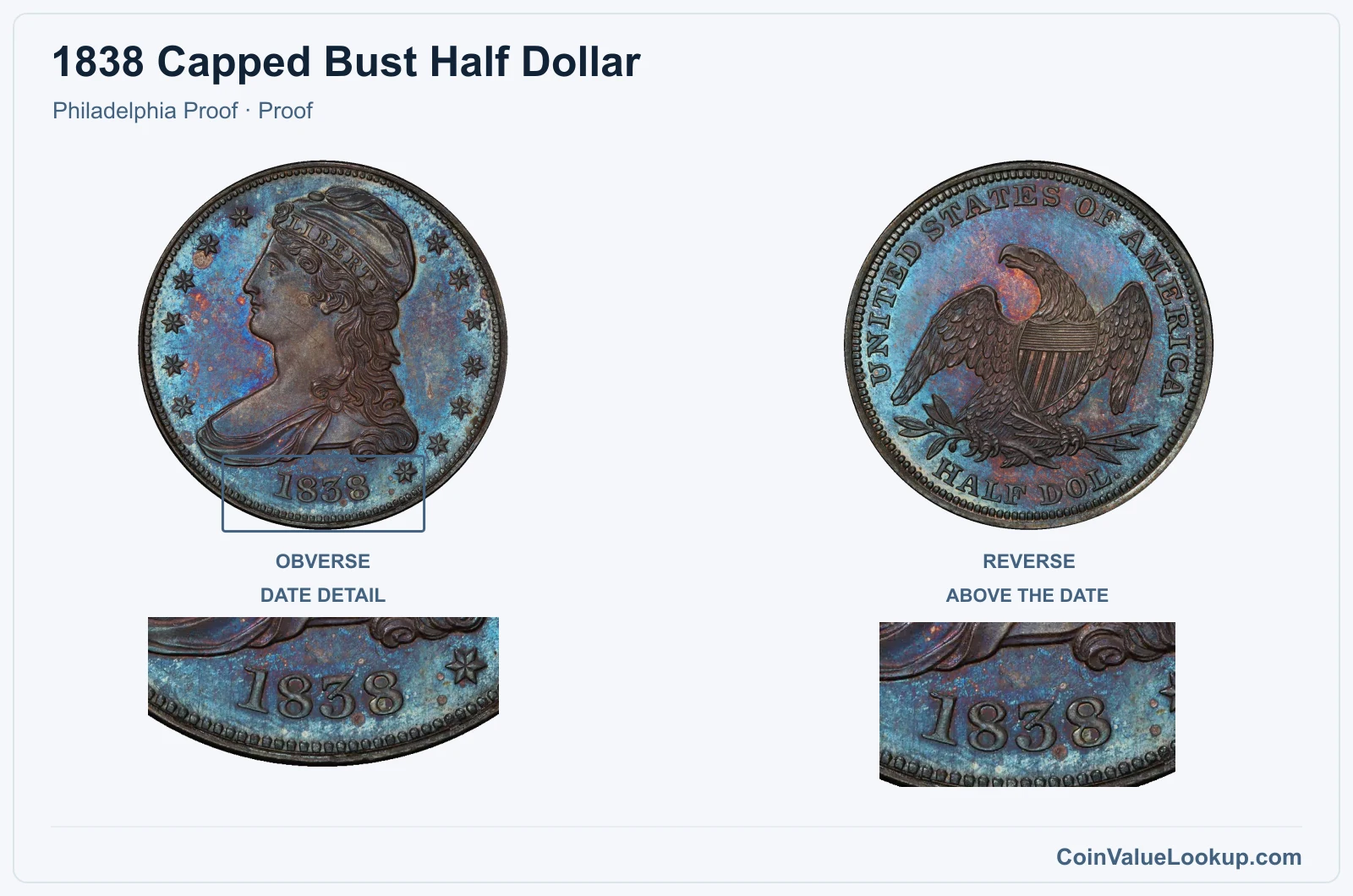
Philadelphia Proof strikes of the 1838 half dollar are genuine rarities. These require professional attribution because a bright, well-preserved business strike can superficially resemble a proof.
Certification services may designate these as PR (Proof) based on manufacturing diagnostics like deeply mirrored fields and squared rims.
For context, a single example graded PR66+ by a major service sold through Heritage Auctions in August 2018 for $336,000. That is one historical sale, not a current market range.
If you believe you have a proof 1838 half dollar, submit it to a professional grading service with detailed photos of both faces, the edge, and any diagnostic rim or surface features.
Coin Value Lookup is a good starting point if you want to look up guides for other dates and denominations in this series before deciding on next steps.
Range Grade
Price Auction Records Appraisal PR PR 1
—
Coin Identifier
PR 2
—
Coin Identifier
PR 3
—
Coin Identifier
PR 4
—
Coin Identifier
PR 6
—
Coin Identifier
PR 8
—
Coin Identifier
PR 10
—
Coin Identifier
PR 12
—
Coin Identifier
PR 15
—
Coin Identifier
PR 20
—
Coin Identifier
PR 25
—
Coin Identifier
PR 30
—
Coin Identifier
PR 35
—
Coin Identifier
PR 40
—
Coin Identifier
PR 45
—
Coin Identifier
PR 50
—
Coin Identifier
PR 53
—
Coin Identifier
PR 55
—
Coin Identifier
PR 58
—
Coin Identifier
PR 60
—
Coin Identifier
PR 61
—
Coin Identifier
PR 62
—
Coin Identifier
PR 63
—
Coin Identifier
PR 64
Coin Identifier
PR 65
—
Coin Identifier
PR 66
Coin Identifier
PR 67
—
—
—
PR 68
—
—
—
PR 69
—
—
—
PR 70
—
—
—
1838 Capped Bust Half Dollar — New Orleans Presentation / Proof Issue
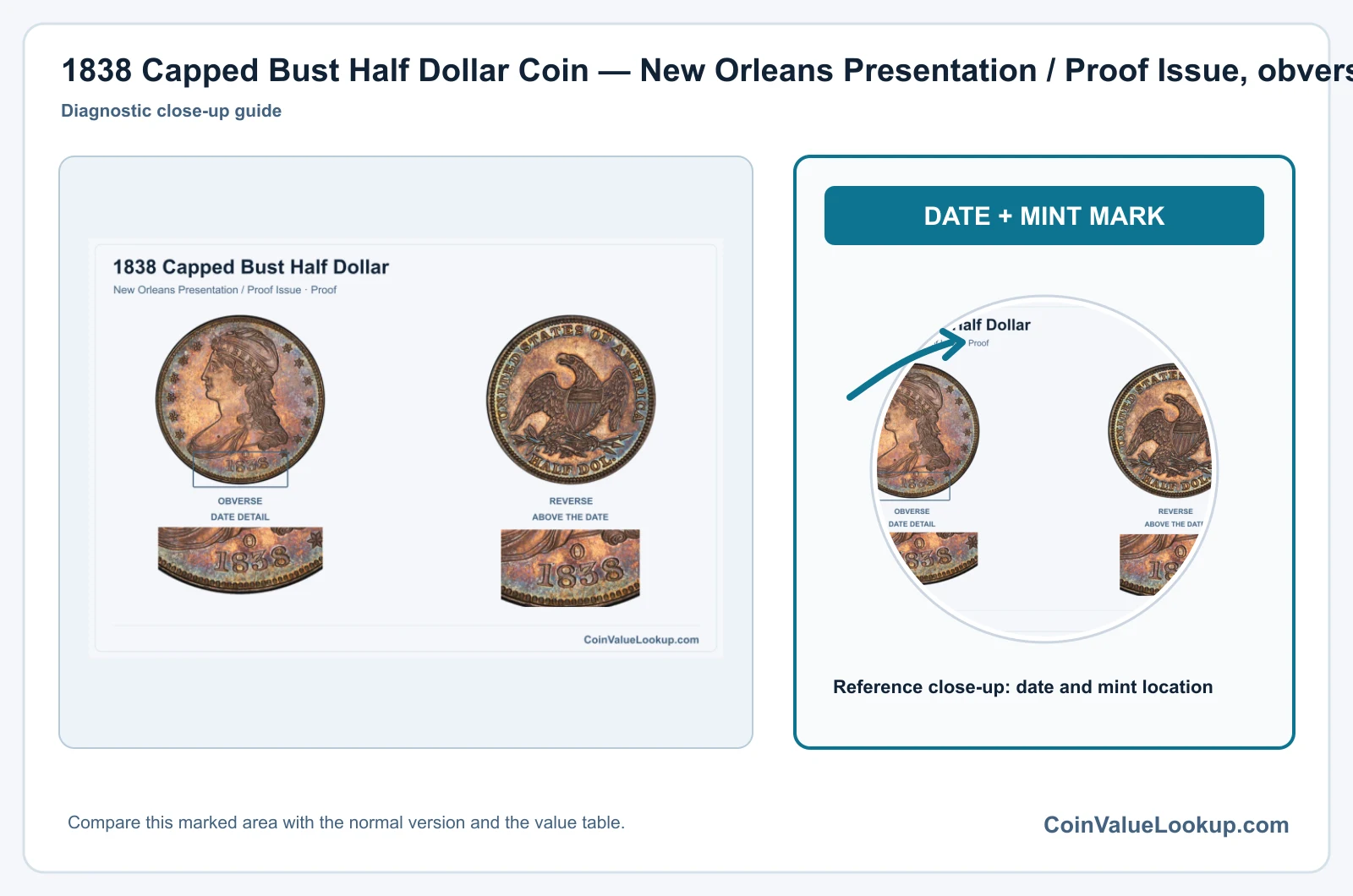
The New Orleans Mint struck a small number of presentation or proof-quality 1838 half dollars, and these are among the most coveted early American coins. They carry an "O" mintmark on the obverse above the date.
Certification services may catalog them as PR (Proof) or SP (Specimen) depending on the diagnostics observed.
A single example graded SP64 sold through Heritage Auctions in January 2014 for $763,750. That figure reflects one individual transaction, not a repeatable market price.
Coins like this are so rare that each one is essentially its own market.
If you suspect you have one, do not attempt to clean or handle it more than necessary. Professional attribution is essential because no amount of online comparison can confirm proof manufacture on a coin this old and this valuable.
Range Grade
Price Auction Records Appraisal PR PR 1
—
Coin Identifier
PR 2
—
Coin Identifier
PR 3
—
Coin Identifier
PR 4
—
Coin Identifier
PR 6
—
Coin Identifier
PR 8
—
Coin Identifier
PR 10
—
Coin Identifier
PR 12
—
Coin Identifier
PR 15
—
Coin Identifier
PR 20
—
Coin Identifier
PR 25
—
Coin Identifier
PR 30
—
Coin Identifier
PR 35
—
Coin Identifier
PR 40
—
Coin Identifier
PR 45
—
Coin Identifier
PR 50
Coin Identifier
PR 60
—
—
—
PR 61
—
—
—
PR 62
—
—
—
PR 63
Coin Identifier
PR 64
Coin Identifier
PR 65
—
—
—
PR 66
—
—
—
PR 67
—
—
—
PR 68
—
—
—
PR 69
—
—
—
PR 70
—
—
—
1838 Capped Bust Half Dollar Error List
1. 1838 Capped Bust Half Dollar — Die Crack / Die Chip
Die cracks on the 1838 half dollar appear as thin, raised lines on the coin's surface, caused by fractures in the steel die during production. One documented variety shows a roughly horizontal crack running through the shield on the reverse, while other examples display peripheral cracks around the reverse rim.
These raised lines follow a specific path and are consistent from coin to coin struck by the same cracked die. That consistency is what separates a genuine die crack from a random scratch or corrosion line.
Incuse scratches cut into the surface rather than sitting above it, and corrosion tends to be irregular and pitted rather than linear.
No specific price range is available for die crack varieties on this date. The value depends on the crack's visibility, the coin's overall condition, and collector demand for that particular die state.
If you spot a raised line that follows a clear path, compare both sides carefully and consider professional evaluation.