1838 Coronet Head Cent Coin Value: How Much Is It Worth?
An 1838 Coronet Head Cent in well-worn condition starts around $30 at the G4 grade level, while a mint-state example at MS63 can reach roughly $692 according to USA Coin Book guide estimates. Those anchors cover ordinary business strikes only.
Proof specimens and major mint errors fall outside that range entirely and need individual assessment based on authenticated identity and condition.
Fast Way to Identify Your 1838 Coronet Head Cent
Want a quick read on your 1838 cent? Upload clear photos of the front and back, and the identifier can offer a preliminary take on which variety you may have.
Good lighting and a sharp image of the date, portrait, and wreath go a long way toward sorting out what you are holding.
1838 Coronet Head Cent Value
Upload both sides of your 1838 Coronet Head Cent.
Front Obverse
Upload photo
Back Reverse
Upload photo
Which 1838 Coronet Head Cent Versions Are Worth Money?
- Business strikes range from about $30 in G4 to roughly $692 in MS63 per USA Coin Book; higher-grade or original-surface examples command the strongest premiums.
- Proof 1838 Coronet Head Cents are very scarce and require professional authentication of die characteristics, rims, and surfaces before any value can be assigned.
- Coins with documented mint errors such as die cracks, cuds, or laminations deserve closer inspection, though each piece needs individual evaluation.
Step 1: Identify Your 1838 Coronet Head Cent Mint Mark and Version
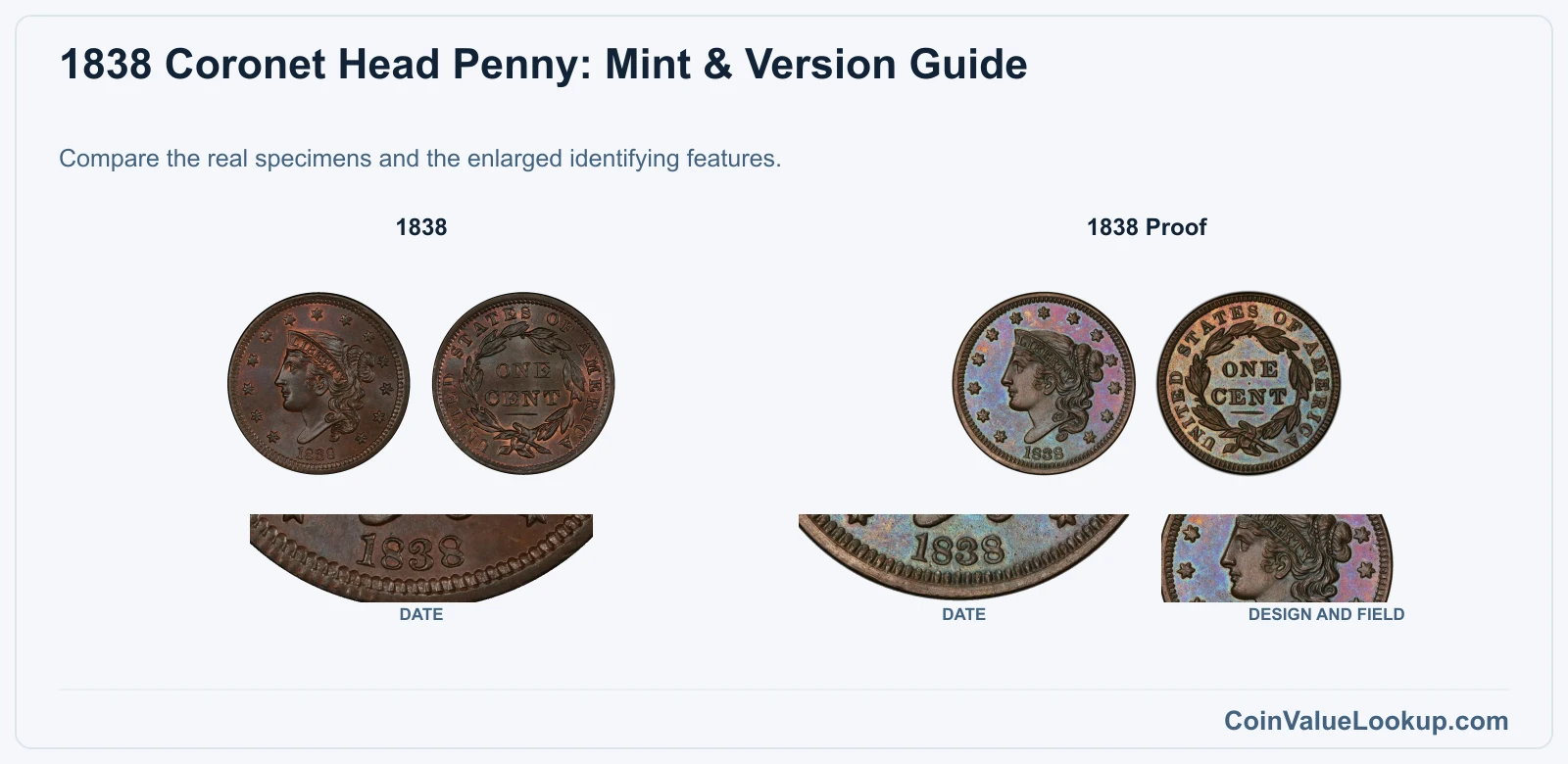
The Coronet Head design shows Liberty facing left wearing a hair band inscribed LIBERTY, surrounded by thirteen stars and the date below. Flip the coin over and you will find ONE CENT inside a wreath with UNITED STATES OF AMERICA around the border.
All 1838 cents were struck at the Philadelphia Mint, so there is no mintmark to hunt for. If someone offers you an 1838 with a mintmark, walk away.
Look at the surfaces carefully. A business strike will show flow lines and contact marks typical of coins that entered circulation, while a genuine proof will display sharp, squared rims and mirror-like fields from specially prepared dies.
Polishing a business strike does not turn it into a proof.
Weight should be around 10.89 grams in copper, but wear, corrosion, and the production tolerances of the 1830s mean weight alone cannot prove authenticity. Use it as supporting evidence alongside the visual details.
Step 2: Check Your 1838 Coronet Head Cent Grade
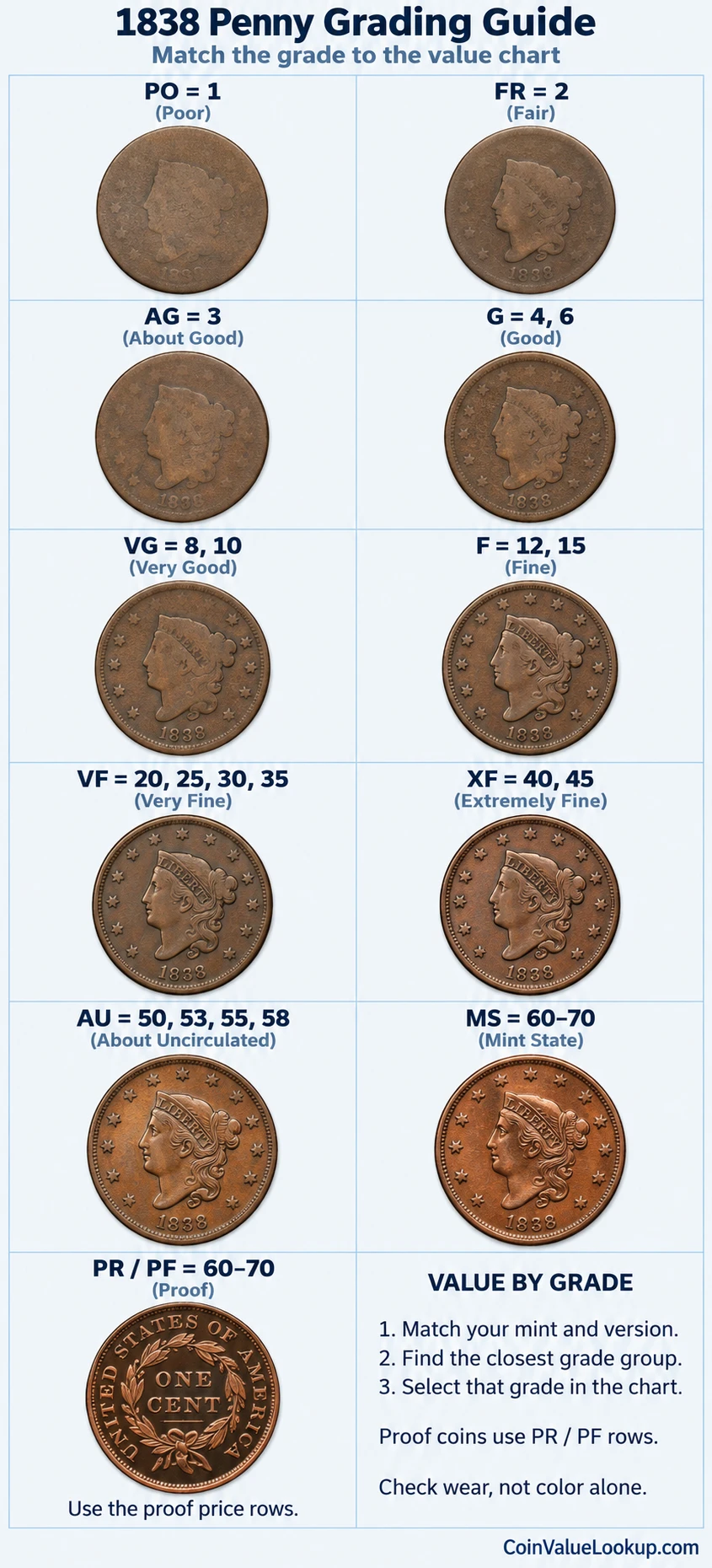
Start with Liberty's hair above the ear and the cheek area. On a well-worn coin those features blend together, while a lightly circulated piece retains individual hair strands and a distinct cheekbone.
The wreath leaves on the reverse lose their vein detail early, so check those too.
Do not confuse a weak strike with heavy wear. Some 1838 cents left the press without full detail, especially near the stars.
Compare your coin against the reference image of a like-type example to separate strike weakness from actual circulation loss.
Surface problems matter a lot on early copper. Corrosion, porosity, and old cleaning can knock a coin well below what its remaining detail would otherwise suggest.
A porous coin with sharp detail is not the same as a problem-free coin at that grade.
On copper cents, BN, RB, and RD refer to color, not different metals. A full red coin simply retained more original luster.
Most survivors from 1838 show brown toning, and that is perfectly normal for a coin pushing two centuries old.
Step 3: Check 1838 Coronet Head Cent Value by Mint and Version
1838 Coronet Head Cent
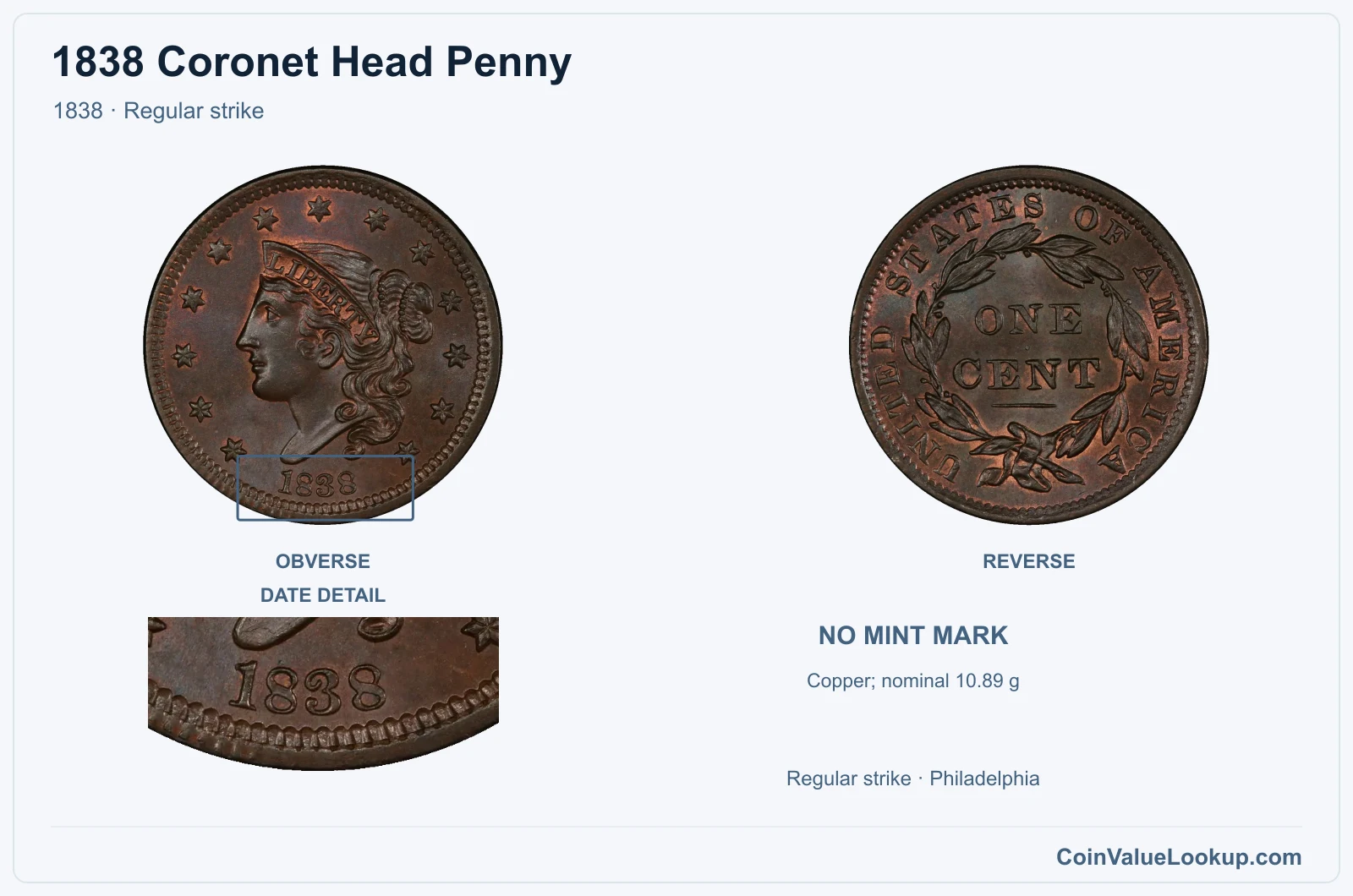
The standard 1838 business strike is a copper cent weighing nominally 10.89 grams, produced at Philadelphia with no mintmark. Guide estimates from USA Coin Book place a G4 example around $30 and an MS63 near $692.
In between, value climbs steadily with the sharpness of Liberty's hair detail and the completeness of the wreath.
Original, problem-free surfaces add significant appeal over cleaned or corroded examples at the same technical grade. A brown coin with smooth, even toning will almost always outsell a brighter piece that has been scrubbed.
Look for clear, undamaged legends and a sharp date punch when evaluating your piece.
Coin Value Lookup is a handy starting point if you want to look up guide values for other dates in this series or compare across denominations.
| Range | Grade | Price | Auction Records | Appraisal |
|---|---|---|---|---|
| PO | PO 1 | — | Coin Identifier | |
| FR | FR 2 | — | Coin Identifier | |
| AG | AG 3 | — | Coin Identifier | |
| G | G 4 | — | Coin Identifier | |
| G 6 | Coin Identifier | |||
| VG | VG 8 | — | Coin Identifier | |
| VG 10 | Coin Identifier | |||
| F | F 12 | Coin Identifier | ||
| F 15 | Coin Identifier | |||
| VF | VF 20 | Coin Identifier | ||
| VF 25 | Coin Identifier | |||
| VF 30 | Coin Identifier | |||
| VF 35 | Coin Identifier | |||
| XF | XF 40 | Coin Identifier | ||
| XF 45 | Coin Identifier | |||
| AU | AU 50 | Coin Identifier | ||
| AU 53 | Coin Identifier | |||
| AU 55 | Coin Identifier | |||
| AU 58 | Coin Identifier | |||
| MS | MS 60 | Coin Identifier | ||
| MS 61 | Coin Identifier | |||
| MS 62 | Coin Identifier | |||
| MS 63 | Coin Identifier | |||
| MS 64 | Coin Identifier | |||
| MS 65 | Coin Identifier | |||
| MS 66 | Coin Identifier | |||
| MS 67 | Coin Identifier | |||
| MS 68 | — | — | — | |
| MS 69 | — | — | — | |
| MS 70 | — | — | — |
1838 Coronet Head Cent — Proof
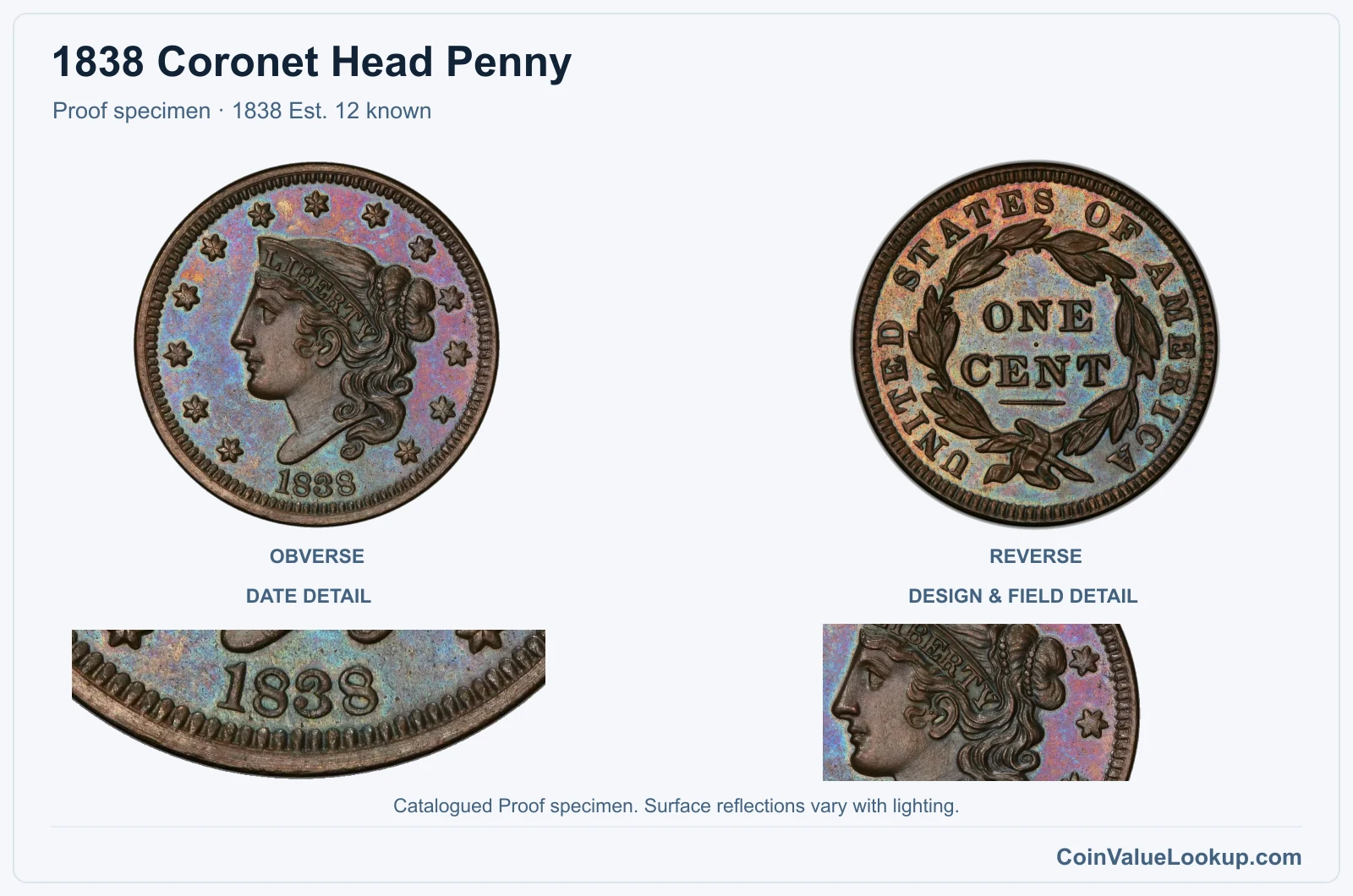
A proof 1838 Coronet Head Cent is a genuinely rare item. These were struck on specially prepared planchets using polished dies, producing sharply detailed devices and mirror-like fields that a business strike simply cannot replicate.
No numeric price range has been adopted here because each proof trades on its own merits: authenticated identity, surface quality, rim characteristics, and overall eye appeal all factor in. A third-party grading service attribution is essentially mandatory before anyone should assign serious value.
The most common mistake is assuming a polished or lightly circulated business strike is a proof. True proofs show squared, knife-edge rims and a specific die finish across the fields.
If your coin just looks shiny, that is not enough. Professional authentication is the path forward for any suspected proof from this era.
| Range | Grade | Price | Auction Records | Appraisal |
|---|---|---|---|---|
| PR | PR 1 | — | Coin Identifier | |
| PR 2 | — | Coin Identifier | ||
| PR 3 | — | Coin Identifier | ||
| PR 4 | — | Coin Identifier | ||
| PR 6 | — | Coin Identifier | ||
| PR 8 | — | Coin Identifier | ||
| PR 10 | — | Coin Identifier | ||
| PR 12 | — | Coin Identifier | ||
| PR 15 | — | Coin Identifier | ||
| PR 20 | — | Coin Identifier | ||
| PR 25 | — | Coin Identifier | ||
| PR 30 | — | Coin Identifier | ||
| PR 35 | — | Coin Identifier | ||
| PR 40 | — | Coin Identifier | ||
| PR 45 | — | Coin Identifier | ||
| PR 50 | — | Coin Identifier | ||
| PR 53 | — | Coin Identifier | ||
| PR 55 | — | Coin Identifier | ||
| PR 58 | — | Coin Identifier | ||
| PR 60 | — | Coin Identifier | ||
| PR 61 | — | Coin Identifier | ||
| PR 62 | — | Coin Identifier | ||
| PR 63 | — | Coin Identifier | ||
| PR 64 | Coin Identifier | |||
| PR 65 | Coin Identifier | |||
| PR 66 | — | — | — | |
| PR 67 | — | — | — | |
| PR 68 | — | — | — | |
| PR 69 | — | — | — | |
| PR 70 | — | — | — |
1838 Coronet Head Cent Error List
1. 1838 Coronet Head Cent — Die Crack
A die crack shows up as a thin, raised line running across the surface of the coin. It follows the path of a fracture in the steel die, so it appears in relief rather than incised into the metal.
On an 1838 cent, look for these lines crossing the fields between stars, through the portrait, or across the reverse wreath.
The key distinction from a scratch is direction and texture. A scratch is cut into the surface and often shows a bright groove, while a die crack sits above the field and matches the coin's overall patina.
Corrosion lines and tool marks can also mimic cracks, so compare the suspect area under magnification.
No specific pricing has been adopted for die cracks on this date. Value depends on the crack's size, location, and visual impact, combined with the coin's overall grade and surface quality.
A dramatic crack through Liberty's face draws more collector interest than a hairline near the rim.
2. 1838 Coronet Head Cent — Die Break / Cud
A cud is a raised blob of metal, usually connected to the rim, caused by a piece of the die breaking away entirely. The missing die section cannot impress a design, so that area of the coin fills with unshaped metal during striking.
On an 1838 cent, a cud might obscure part of a star, a letter, or a section of the wreath.
Do not confuse a cud with a rim bump from post-mint damage. A genuine cud has a smooth, rounded boundary that follows the shape of the broken die fragment, and the displaced design stops cleanly at the cud's edge.
A dent will show disturbed metal and usually an opposite-side depression.
Smaller interior die breaks also exist but lack the rim connection that defines a true cud. No numeric price has been adopted for cuds on this date; each piece requires individual evaluation based on size, location, and overall coin condition.
3. 1838 Coronet Head Cent — Lamination / Split Planchet
A lamination error appears as peeling, flaking, or splitting within the copper planchet itself. On an 1838 cent, you might see a retained flap of metal lifting away from the surface, or a visible seam along the edge where the planchet has begun to separate into layers.
Photograph both the affected face and the edge together, because the edge view often reveals the separation most clearly. This is important for distinguishing a genuine lamination from deliberate scraping or surface corrosion, both of which can look superficially similar.
Corrosion tends to be uneven and pitted, while a lamination follows the plane of the metal and typically has smooth interior surfaces. A deliberately cut or filed coin will show tool marks under magnification.
No specific price range has been adopted for lamination errors on this date, so value depends entirely on the individual coin's authenticated condition and the extent of the defect.