1825 Coronet Head Cent Coin Value: How Much Is It Worth?
The 1825 Coronet Head Cent is a copper classic from the early Philadelphia Mint. Guide estimates for ordinary business strikes range from around $50 in G4 condition to roughly $3,999 in MS63, according to USA Coin Book.
Your actual value depends on the exact variety, surface quality and grade, so identifying what you have is the essential first step.
Fast Way to Identify Your 1825 Coronet Head Cent
The quickest way to start figuring out what your 1825 cent is worth is to upload clear photos of the front and back. Our identifier can give you a preliminary read on the coin's type and variety from those images alone.
Snap both sides in good lighting, avoiding glare, and you will have a solid starting point before diving deeper.
1825 Coronet Head Cent Value
Upload both sides of your 1825 Coronet Head Cent.
Front Obverse
Upload photo
Back Reverse
Upload photo
Which 1825 Coronet Head Cent Versions Are Worth Money?
- Business strikes range from about $50 in G4 to $3,999 in MS63 per USA Coin Book, making higher-grade survivors the ones to watch.
- Proof examples exist but require expert attribution of surfaces, rims and die characteristics; no standard business-strike price applies to them.
- Prominent mint errors such as die breaks, off-center strikes or rotated dies deserve closer inspection and individual assessment.
- Original, problem-free surfaces on any grade can meaningfully affect desirability compared to cleaned or corroded examples.
Step 1: Identify Your 1825 Coronet Head Cent Mint Mark and Version
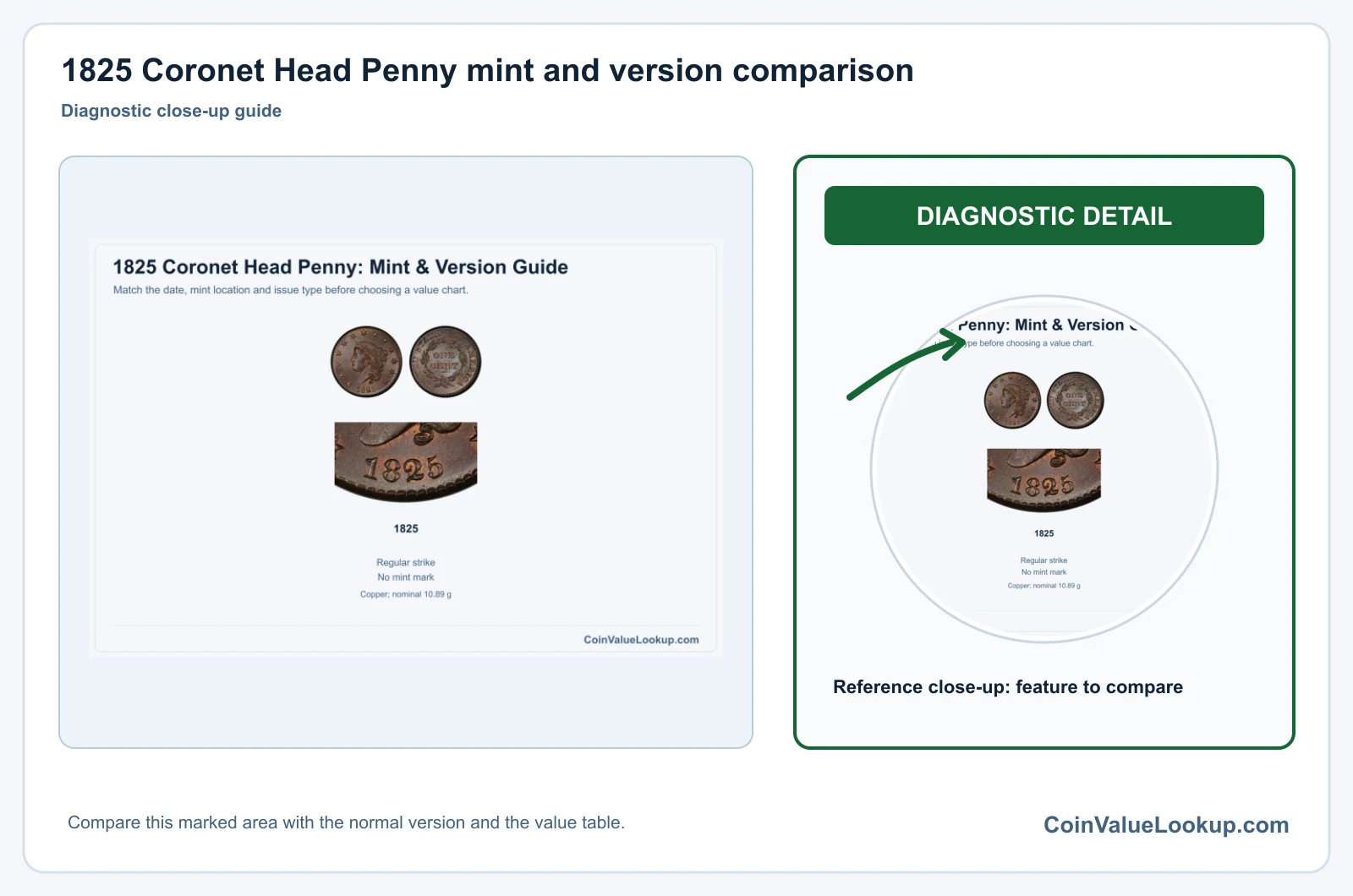
The 1825 Coronet Head Cent features Liberty wearing a coronet inscribed LIBERTY on the obverse, with a wreath and denomination on the reverse. All were struck at the Philadelphia Mint, so there is no mintmark to hunt for.
Do not assume any branch-mint version exists for this date.
Look at the portrait carefully. The hair curls, star arrangement and date-punch style should match known Coronet Head examples.
If the portrait or wreath design looks different, you may have a misidentified type entirely.
Weight can help as supporting evidence; the nominal spec is about 10.89 grams of copper. But wear, corrosion and period production tolerances mean weight alone will not prove authenticity.
Check both faces and the edge for date-punch shape, legend wording and wreath details, since these can change the correct category.
Separate ordinary business strikes from any cataloged proof. Original surfaces and legible detail matter far more than brightness.
A shiny coin is not automatically valuable, and a dark coin is not automatically worthless.
Step 2: Check Your 1825 Coronet Head Cent Grade
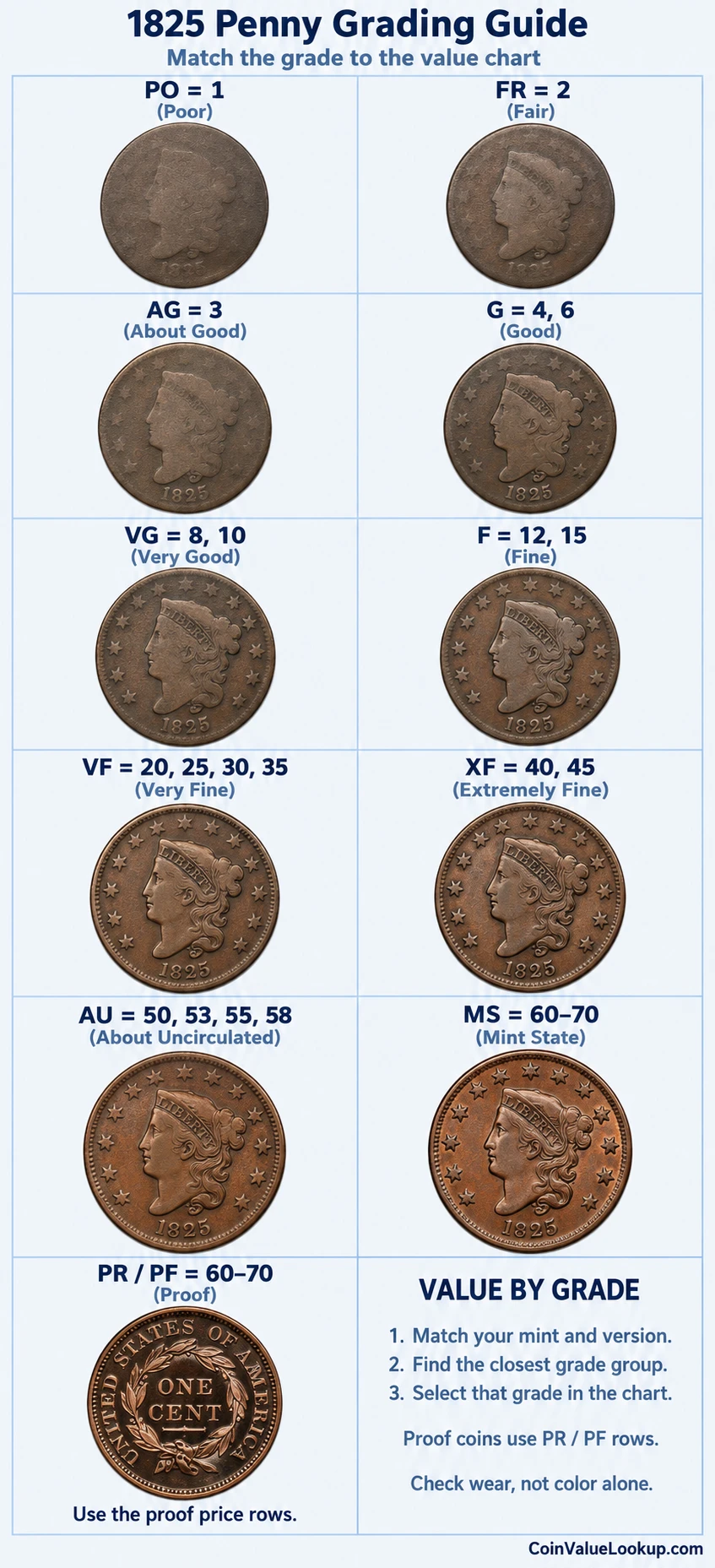
Compare your coin's portrait hair, cheek detail, wreath leaf relief and lettering sharpness against like-type grade references. The comparison image is your best friend here.
Hair curls above the ear and leaf veins on the wreath are among the first areas to show wear.
Do not confuse circulation wear with a weak strike or surface damage. Porosity and corrosion eat detail in ways that look different from honest wear, and they can lower market value substantially.
On copper cents, BN, RB and RD refer to color designations, not different alloys. A brown coin and a red coin can share the same numerical grade; color simply describes how much original mint luster remains.
Proof is a manufacturing method, not a grade above Mint State. A proof-finish coin still receives its own numerical condition score.
Coin Value Lookup is a handy place to look up guides for other dates and denominations in the Coronet Head series. If you are working through a collection, it can save you a lot of individual searching.
Step 3: Check 1825 Coronet Head Cent Value by Mint and Version
1825 Coronet Head Cent
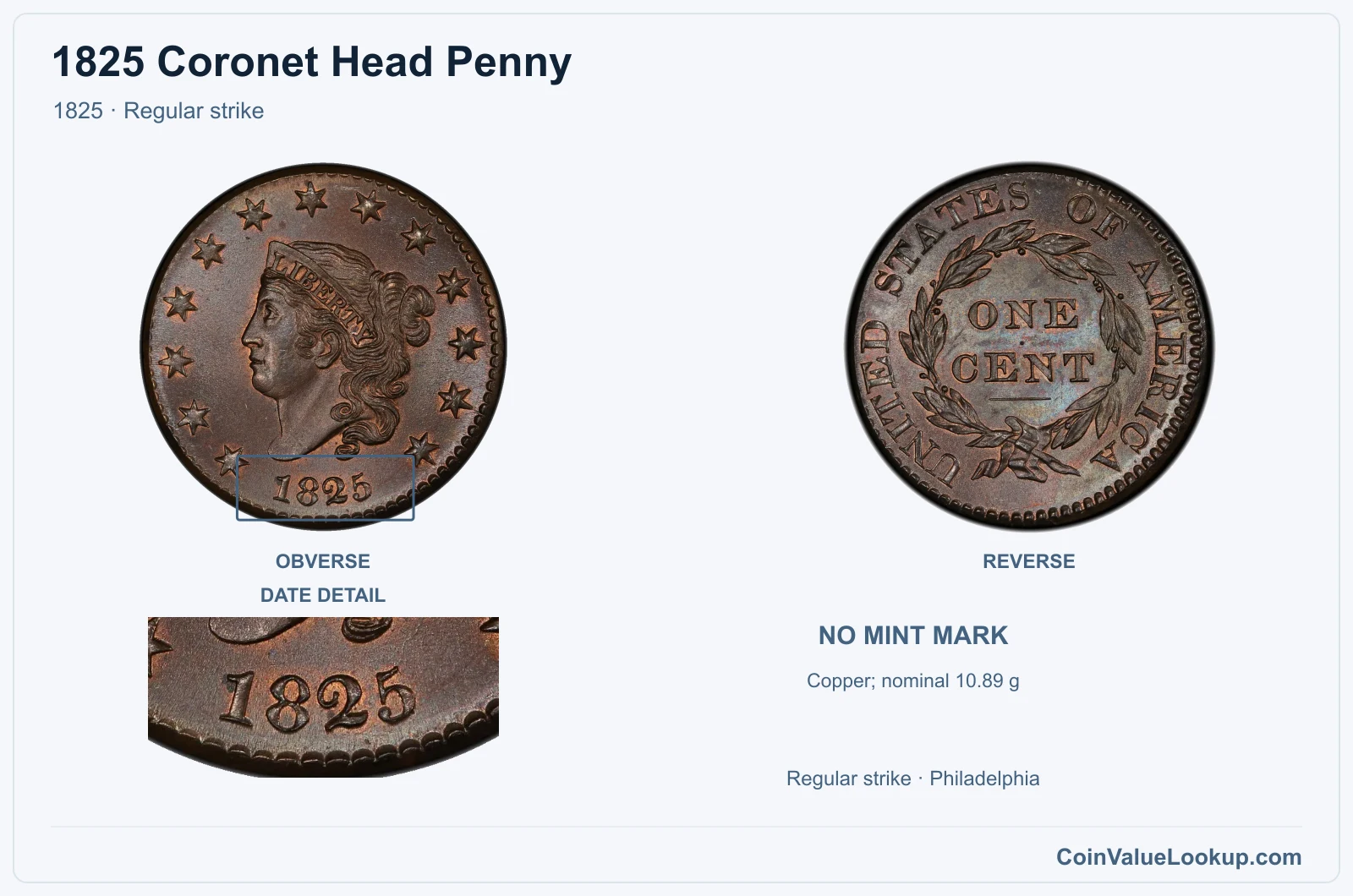
This is the standard 1825 Coronet Head Cent, struck for circulation at Philadelphia with no mintmark. The copper planchet weighs nominally 10.89 grams.
USA Coin Book guide estimates place it around $50 in G4, climbing to roughly $3,999 in MS63.
To confirm you have a genuine business strike, check for normal die finish across both faces. Original surfaces with natural brown or mixed toning are typical.
Bright orange-red color at this age is unusual and worth closer examination, not automatic celebration.
| Range | Grade | Price | Auction Records | Appraisal |
|---|---|---|---|---|
| PO | PO 1 | — | Coin Identifier | |
| FR | FR 2 | — | Coin Identifier | |
| AG | AG 3 | — | Coin Identifier | |
| G | G 4 | Coin Identifier | ||
| G 6 | — | Coin Identifier | ||
| VG | VG 8 | — | Coin Identifier | |
| VG 10 | Coin Identifier | |||
| F | F 12 | — | Coin Identifier | |
| F 15 | Coin Identifier | |||
| VF | VF 20 | Coin Identifier | ||
| VF 25 | Coin Identifier | |||
| VF 30 | Coin Identifier | |||
| VF 35 | Coin Identifier | |||
| XF | XF 40 | Coin Identifier | ||
| XF 45 | Coin Identifier | |||
| AU | AU 50 | Coin Identifier | ||
| AU 53 | Coin Identifier | |||
| AU 55 | Coin Identifier | |||
| AU 58 | Coin Identifier | |||
| MS | MS 60 | — | Coin Identifier | |
| MS 61 | Coin Identifier | |||
| MS 62 | Coin Identifier | |||
| MS 63 | Coin Identifier | |||
| MS 64 | Coin Identifier | |||
| MS 65 | Coin Identifier | |||
| MS 66 | Coin Identifier | |||
| MS 67 | — | — | — | |
| MS 68 | — | — | — | |
| MS 69 | — | — | — | |
| MS 70 | — | — | — |
1825 Coronet Head Cent — Proof
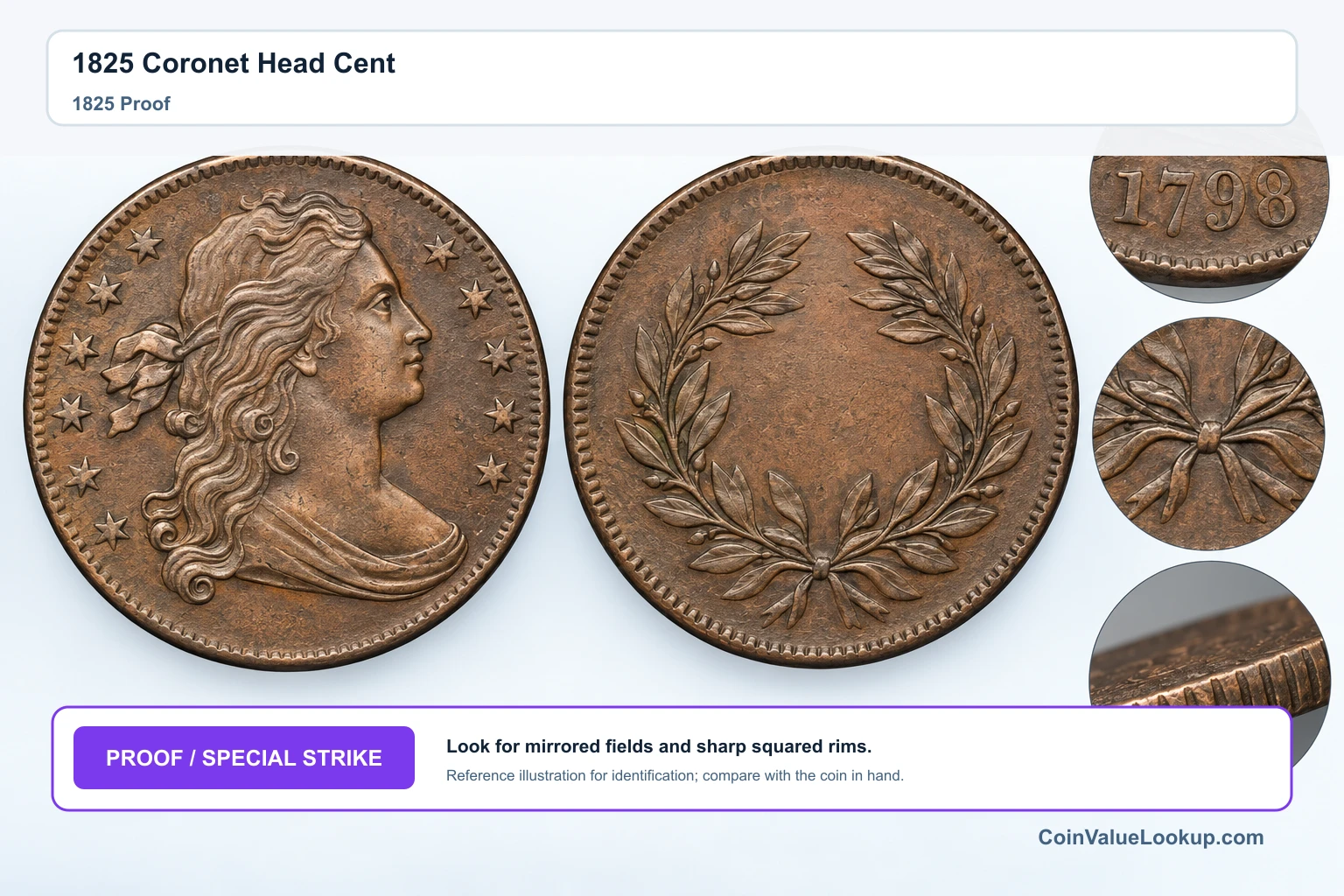
Proof 1825 Coronet Head Cents are rare early copper proofs that demand careful attribution. A proof is identified by its die characteristics, surface quality, rim sharpness and overall manufacture, not simply by a shiny appearance.
Polishing a business strike does not create a proof, no matter how mirror-like it looks afterward.
No standard business-strike price transfers to a proof. Each example requires individual assessment based on authenticated identity, condition and any issues present.
If you suspect you have one, professional authentication through a recognized grading service is the appropriate next step. Catalog listings confirm the variety exists, but a listing alone does not confirm a recent market price.
Values by grade are not available for this coin yet.
1825 Coronet Head Cent Error List
1. 1825 Coronet Head Cent — Rotated Dies
A rotated-die error means the obverse and reverse are misaligned relative to normal US coin orientation. To check, hold the obverse upright and flip the coin top to bottom.
On a normal cent, the reverse should appear upright as well. If it is tilted, you may have a rotation error.
Be careful with photographs. A picture rotated in editing or a coin simply turned sideways in your hand can mimic this error.
Confirm with the coin itself, not just an image. No specific price range is adopted for rotated-die 1825 cents; value depends on the degree of rotation, the coin's grade and overall condition, so individual assessment is needed.
2. 1825 Coronet Head Cent — Die Break / Cud
A die break or cud appears as a raised, irregular blob on the coin's surface. A true cud connects to the rim and represents a chunk of the die that broke away during production.
The displaced design in that area will be missing or distorted, replaced by a flat or lumpy raised mass.
Do not confuse this with a rim dent, localized corrosion or a small interior die chip. Rim damage from contact pushes metal inward, while a cud projects outward from the die break.
Examine the boundary of the feature closely. No adopted price range exists for this error on the 1825 cent; each piece needs individual evaluation based on size, location and the coin's overall condition.
3. 1825 Coronet Head Cent — Die Crack
Die cracks show up as thin, raised lines running across the coin's surface. They follow the path of a crack that developed in the steel die during use, so the line is raised on the coin rather than incised into it.
Look for lines that cross open fields or cut through design elements like letters or stars.
A scratch from post-mint damage is typically incuse, meaning it dips below the surface. Corrosion lines and tool marks also differ in texture and depth.
Run a fingernail or toothpick lightly across the line; a die crack should feel slightly raised. No specific price data is adopted for die cracks on the 1825 cent.
Value depends on prominence, location and the coin's overall grade.
4. 1825 Coronet Head Cent — Off-Center Strike
An off-center strike happens when the planchet is not properly seated between the dies at the moment of striking. The result is a displaced design with an unstruck crescent of blank metal on one side.
The date should remain visible for the coin to be readily attributable.
Do not mistake a clipped planchet, one-sided die misalignment or post-mint flattening for an off-center strike. A clip removes a curved section of the planchet before striking, while post-mint damage typically shows tooling marks or uneven compression.
No adopted price range exists for off-center 1825 Coronet Head Cents. Each example must be assessed individually based on the percentage of off-center shift, date visibility and surface condition.