1798 Draped Bust Cent Coin Value: How Much Is It Worth?
A 1798 Draped Bust Cent is a coin that gets attention in any collection. Guide estimates from USA Coin Book range from about $217 in G4 to around $14,877 in EF40, depending on the exact variety.
That spread is not the entire market picture — rare varieties, major errors and exceptional condition pieces can land well outside those anchors.
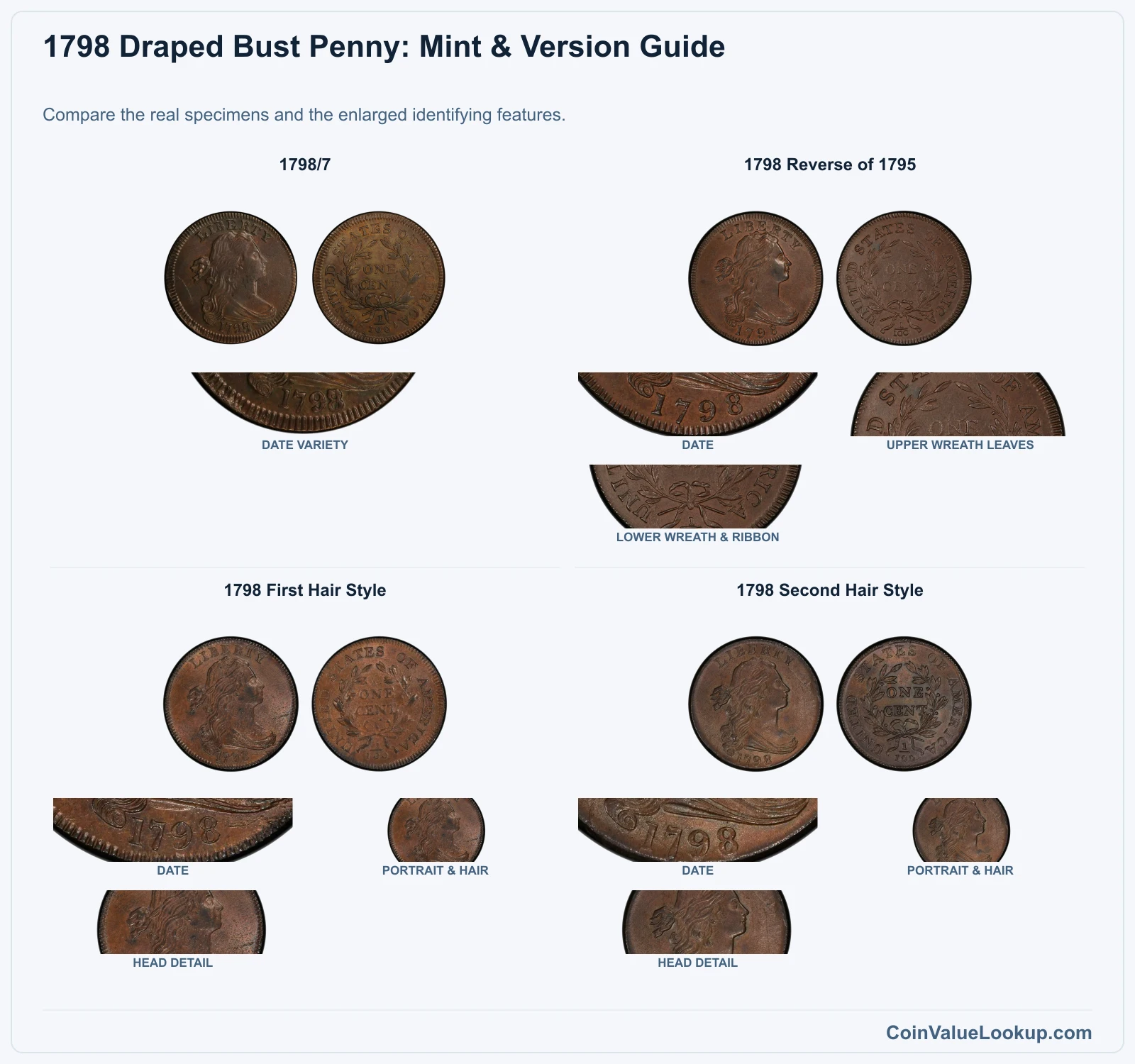
Identifying your specific variety is the first step before thinking about value. Four distinct branches exist for this date, and each carries its own price structure.
Grab a magnifier and good lighting before you start.
Fast Way to Identify Your 1798 Draped Bust Cent
The quickest way to begin figuring out what you have is to upload clear photos of both the front and back of your coin. Our identifier can offer a preliminary identification based on those images, helping you narrow down the variety and approximate condition.
It is not a substitute for professional authentication, but it gives you a solid starting point.
1798 Draped Bust Cent Value
Upload both sides of your 1798 Draped Bust Cent.
Front Obverse
Upload photo
Back Reverse
Upload photo
Which 1798 Draped Bust Cent Versions Are Worth Money?
- The 1798 Reverse of 1795 carries the highest guide anchors of the four varieties, listed at about $612 in G4 and $14,877 in EF40 per USA Coin Book.
- The 1798/7 overdate commands strong premiums — roughly $498 in G4 and $10,013 in EF40 — because the visible underdate makes it a distinct die variety.
- First Hair Style and Second Hair Style pieces are the more common branches but still start around $217 in G4 and reach $3,083–$3,427 in EF40.
- Mint errors such as off-center strikes, brockages and die breaks on any 1798 cent can add significant value depending on severity and authentication.
Step 1: Identify Your 1798 Draped Bust Cent Mint Mark and Version
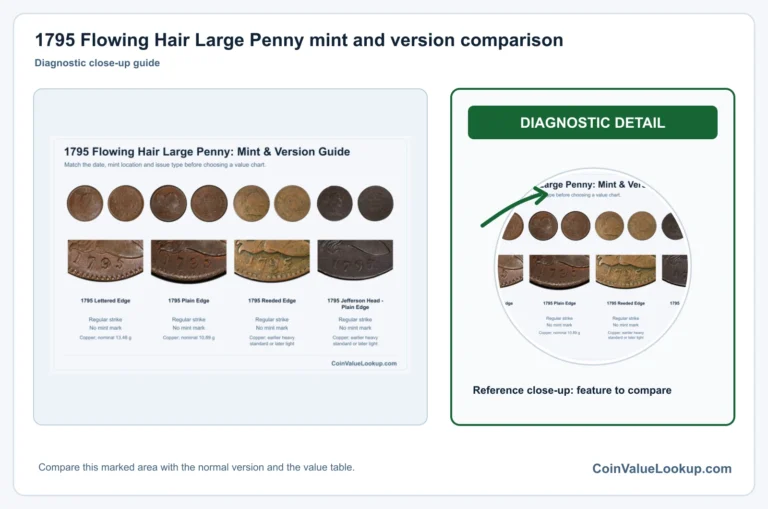
All 1798 Draped Bust Cents were struck at Philadelphia, so there is no mintmark to look for. The key task is separating four varieties: the 1798/7 overdate, the Reverse of 1795, the First Hair Style and the Second Hair Style.
For the overdate, look closely at the date digits — remnants of the underlying "7" must be visible beneath the final "8." If you cannot see traces of an earlier numeral, you do not have an overdate.
The Reverse of 1795 uses an earlier reverse die. Compare the wreath style, the fraction layout and the legend spacing against known examples of both reverse types.
The differences are subtle but consistent.
The two hair styles differ in how Liberty's hair is rendered above and behind the ear. Style 1 hair tends to show a wider, more flowing arrangement, while Style 2 is tighter and more compact.
Examine the hair strands carefully under magnification.
Weight can serve as supporting evidence — the nominal spec is 10.89 grams of copper — but wear, corrosion and original production tolerances mean weight alone cannot prove authenticity. Both faces and the edge should be inspected together.
Step 2: Check Your 1798 Draped Bust Cent Grade
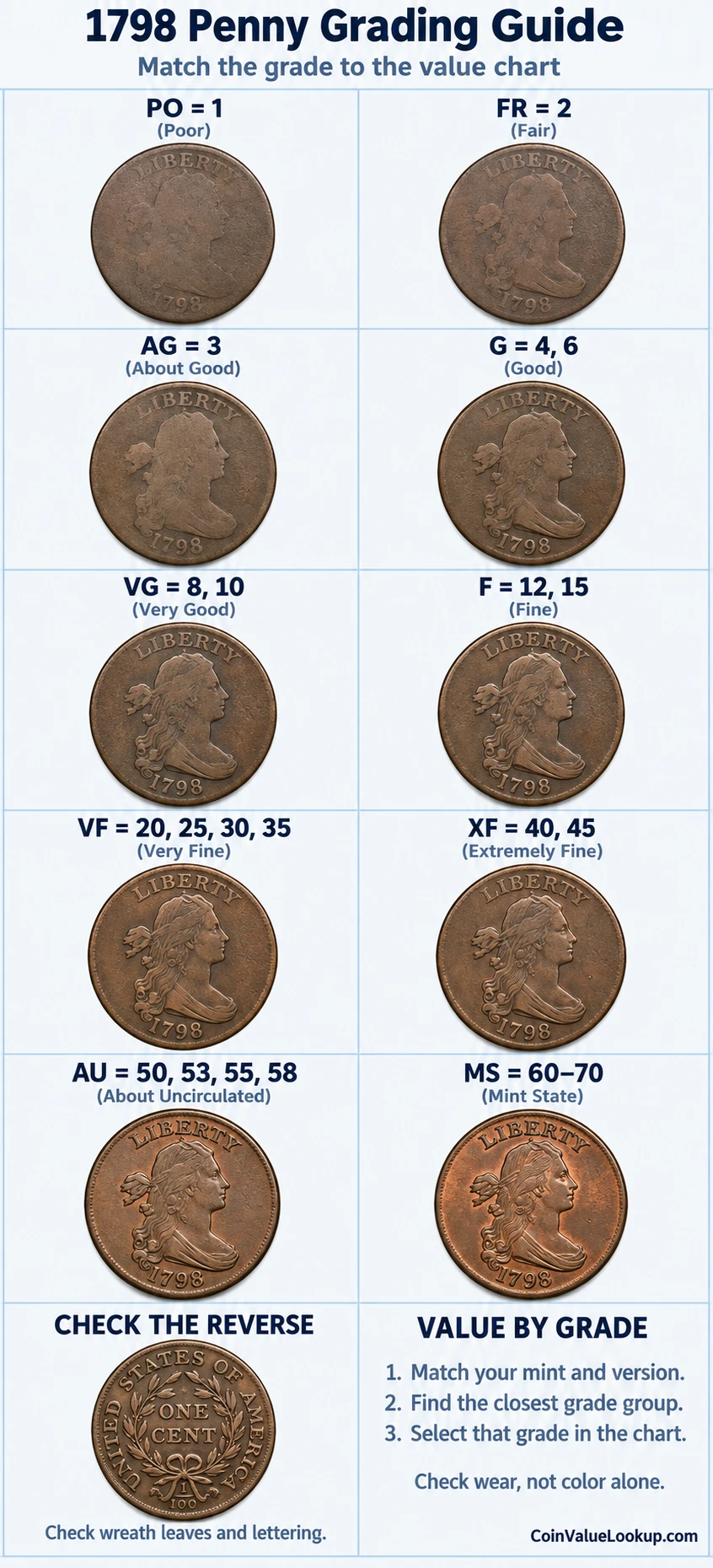
Compare your coin's portrait against known grade examples of the same type. On the obverse, focus on Liberty's hair detail above the forehead and behind the ear, plus the smoothness of the cheek.
Those areas lose definition first.
On the reverse, check the individual leaf detail in the wreath and the sharpness of the lettering. A coin in G4 will show a clear outline of Liberty but almost no interior hair detail, while an EF40 piece retains most fine hair strands with only slight wear on the highest points.
Do not confuse a weak original strike with circulation wear. Some 1798 cents left the press with soft areas that were never sharp.
Porosity, corrosion and old cleaning can also mimic wear patterns but actually reduce a coin's market appeal regardless of remaining detail.
Use the comparison image alongside your coin under similar lighting. BN, RB and RD designations describe the color of the copper surfaces, not different metals.
A coin described as "proof" refers to a manufacturing method, not a condition automatically superior to Mint State.
Step 3: Check 1798 Draped Bust Cent Value by Mint and Version
1798 Draped Bust Cent — /7
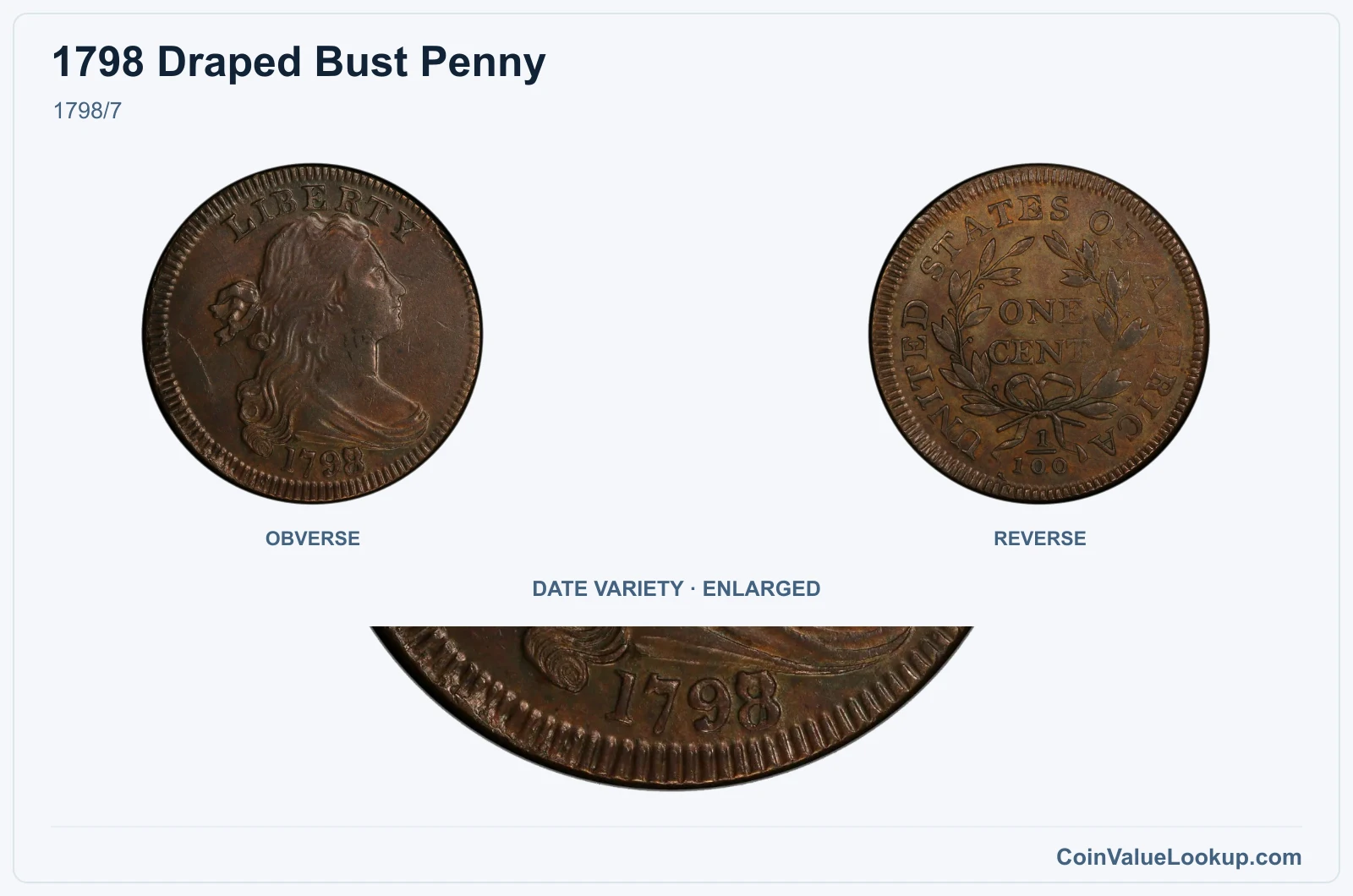
The 1798/7 overdate was created when a die originally punched with a 1797 date was re-entered with an 1798 date. To confirm this variety, you need to see traces of the "7" lurking beneath the final "8" in the date.
A loupe at 5x or better usually reveals the leftover curves.
USA Coin Book lists this branch at about $498 in G4 and around $10,013 in EF40. Those guide figures sit well above the standard-date varieties, reflecting genuine collector demand for visible overdates.
The coin is copper, struck at Philadelphia with no mintmark, and weighs nominally 10.89 grams. Condition and surface quality matter enormously — a corroded or cleaned overdate will not command the same attention as one with honest, original surfaces.
| Range | Grade | Price | Auction Records | Appraisal |
|---|---|---|---|---|
| PO | PO 1 | — | Coin Identifier | |
| FR | FR 2 | Coin Identifier | ||
| AG | AG 3 | Coin Identifier | ||
| G | G 4 | Coin Identifier | ||
| G 6 | Coin Identifier | |||
| VG | VG 8 | Coin Identifier | ||
| VG 10 | — | Coin Identifier | ||
| F | F 12 | Coin Identifier | ||
| F 15 | — | Coin Identifier | ||
| VF | VF 20 | Coin Identifier | ||
| VF 25 | Coin Identifier | |||
| VF 30 | Coin Identifier | |||
| VF 35 | — | Coin Identifier | ||
| XF | XF 40 | Coin Identifier | ||
| XF 45 | — | Coin Identifier | ||
| AU | AU 50 | Coin Identifier | ||
| AU 53 | Coin Identifier | |||
| AU 55 | — | Coin Identifier | ||
| AU 58 | Coin Identifier | |||
| MS | MS 60 | — | Coin Identifier | |
| MS 61 | — | Coin Identifier | ||
| MS 62 | Coin Identifier | |||
| MS 63 | — | Coin Identifier | ||
| MS 64 | — | — | — | |
| MS 65 | — | — | — | |
| MS 66 | — | — | — | |
| MS 67 | — | — | — | |
| MS 68 | — | — | — | |
| MS 69 | — | — | — | |
| MS 70 | — | — | — |
1798 Draped Bust Cent — Reverse of 1795
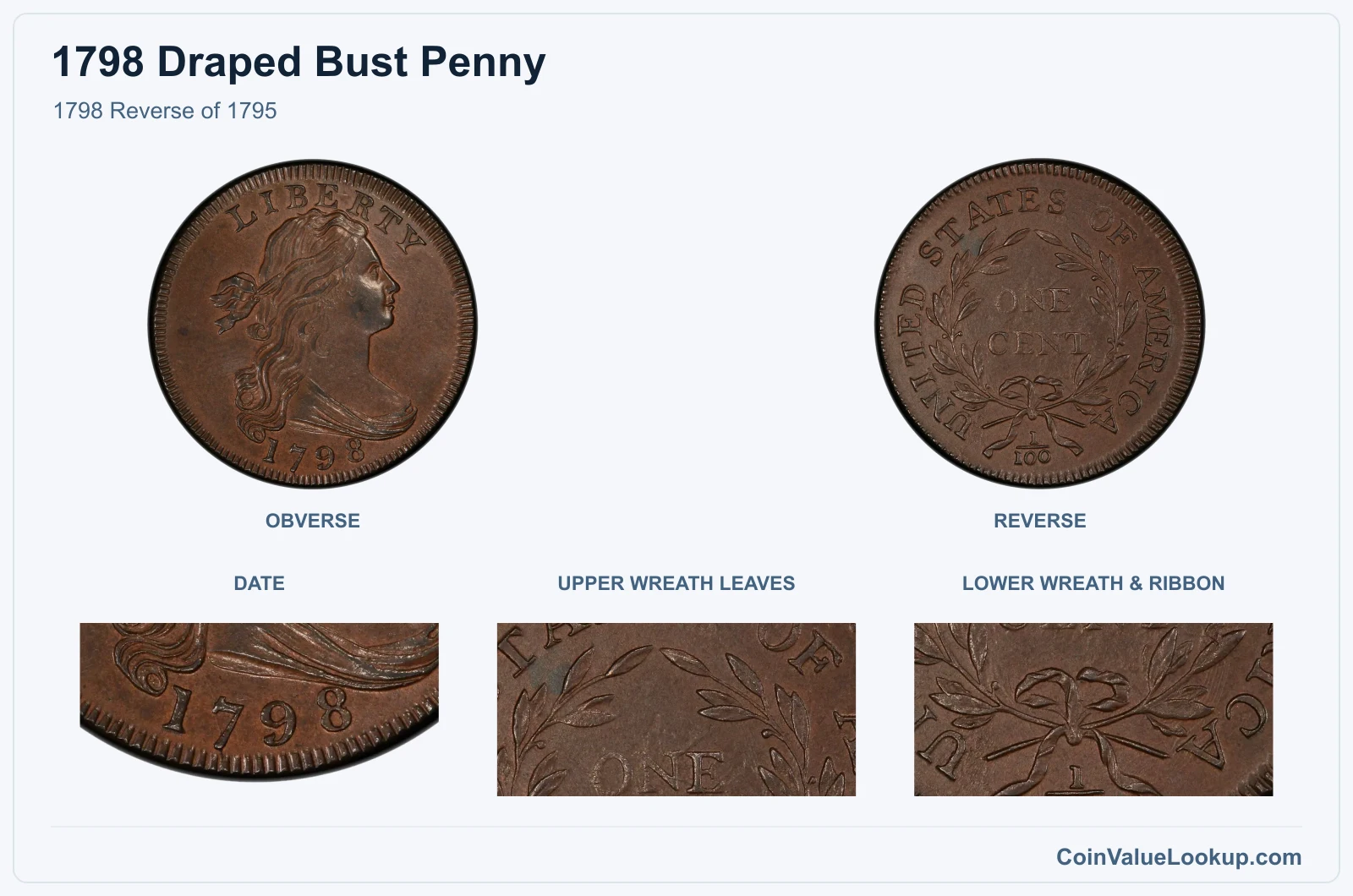
The 1798 Reverse of 1795 pairs the 1798-dated obverse with an earlier reverse die originally used for 1795 production. Differences show up in the wreath design, fraction layout and legend spacing when you compare it side by side with the standard 1798 reverse.
This is the priciest of the four listed varieties. USA Coin Book anchors it at about $612 in G4 and roughly $14,877 in EF40.
The combination of an out-of-sequence reverse die and relative scarcity drives the premium. All examples are copper, Philadelphia-struck, with no mintmark.
If you are trying to sort out other Draped Bust dates or want to compare values across different large-cent series, Coin Value Lookup is a useful place to start. You can look up guide information for a wide range of U.S. coin types organized by year and denomination.
| Range | Grade | Price | Auction Records | Appraisal |
|---|---|---|---|---|
| PO | PO 1 | — | Coin Identifier | |
| FR | FR 2 | — | Coin Identifier | |
| AG | AG 3 | — | Coin Identifier | |
| G | G 4 | — | Coin Identifier | |
| G 6 | Coin Identifier | |||
| VG | VG 8 | Coin Identifier | ||
| VG 10 | Coin Identifier | |||
| F | F 12 | — | Coin Identifier | |
| F 15 | — | Coin Identifier | ||
| VF | VF 20 | — | Coin Identifier | |
| VF 25 | Coin Identifier | |||
| VF 30 | Coin Identifier | |||
| VF 35 | — | Coin Identifier | ||
| XF | XF 40 | — | Coin Identifier | |
| XF 45 | — | Coin Identifier | ||
| AU | AU 50 | — | Coin Identifier | |
| AU 53 | — | Coin Identifier | ||
| AU 55 | Coin Identifier | |||
| AU 58 | — | Coin Identifier | ||
| MS | MS 60 | — | Coin Identifier | |
| MS 61 | — | Coin Identifier | ||
| MS 62 | — | Coin Identifier | ||
| MS 63 | — | Coin Identifier | ||
| MS 64 | — | Coin Identifier | ||
| MS 65 | — | Coin Identifier | ||
| MS 66 | — | — | — | |
| MS 67 | — | — | — | |
| MS 68 | — | — | — | |
| MS 69 | — | — | — | |
| MS 70 | — | — | — |
1798 Draped Bust Cent — First Hair Style
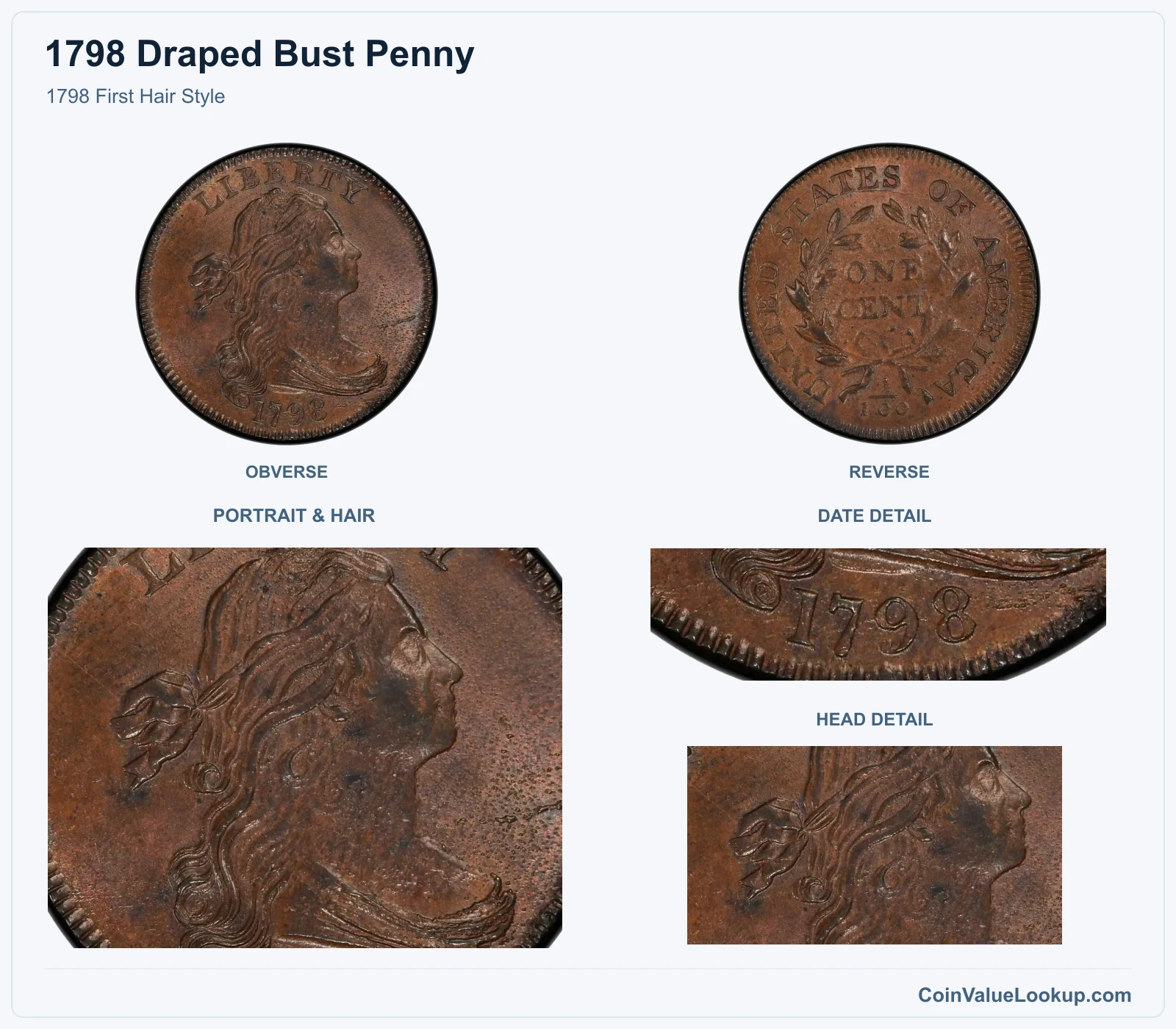
The 1798 First Hair Style shows Liberty's hair in a broader, more flowing arrangement behind the ear and along the neck. This is one of the two standard varieties for the date — no overdate, no mismatched reverse.
USA Coin Book lists it at about $217 in G4 and roughly $3,427 in EF40. While those figures are lower than the overdate or Reverse of 1795, this is still a 225-plus-year-old copper coin.
It was struck at Philadelphia in copper at a nominal 10.89 grams, with no mintmark. Distinguishing it from the Second Hair Style requires comparing how the hair strands flow above Liberty's ear.
| Range | Grade | Price | Auction Records | Appraisal |
|---|---|---|---|---|
| PO | PO 1 | — | Coin Identifier | |
| FR | FR 2 | Coin Identifier | ||
| AG | AG 3 | Coin Identifier | ||
| G | G 4 | Coin Identifier | ||
| G 6 | Coin Identifier | |||
| VG | VG 8 | Coin Identifier | ||
| VG 10 | Coin Identifier | |||
| F | F 12 | Coin Identifier | ||
| F 15 | Coin Identifier | |||
| VF | VF 20 | Coin Identifier | ||
| VF 25 | Coin Identifier | |||
| VF 30 | Coin Identifier | |||
| VF 35 | Coin Identifier | |||
| XF | XF 40 | Coin Identifier | ||
| XF 45 | Coin Identifier | |||
| AU | AU 50 | Coin Identifier | ||
| AU 53 | Coin Identifier | |||
| AU 55 | Coin Identifier | |||
| AU 58 | Coin Identifier | |||
| MS | MS 60 | — | Coin Identifier | |
| MS 61 | — | Coin Identifier | ||
| MS 62 | Coin Identifier | |||
| MS 63 | Coin Identifier | |||
| MS 64 | — | Coin Identifier | ||
| MS 65 | — | Coin Identifier | ||
| MS 66 | — | — | — | |
| MS 67 | — | — | — | |
| MS 68 | — | — | — | |
| MS 69 | — | — | — | |
| MS 70 | — | — | — |
1798 Draped Bust Cent — Second Hair Style
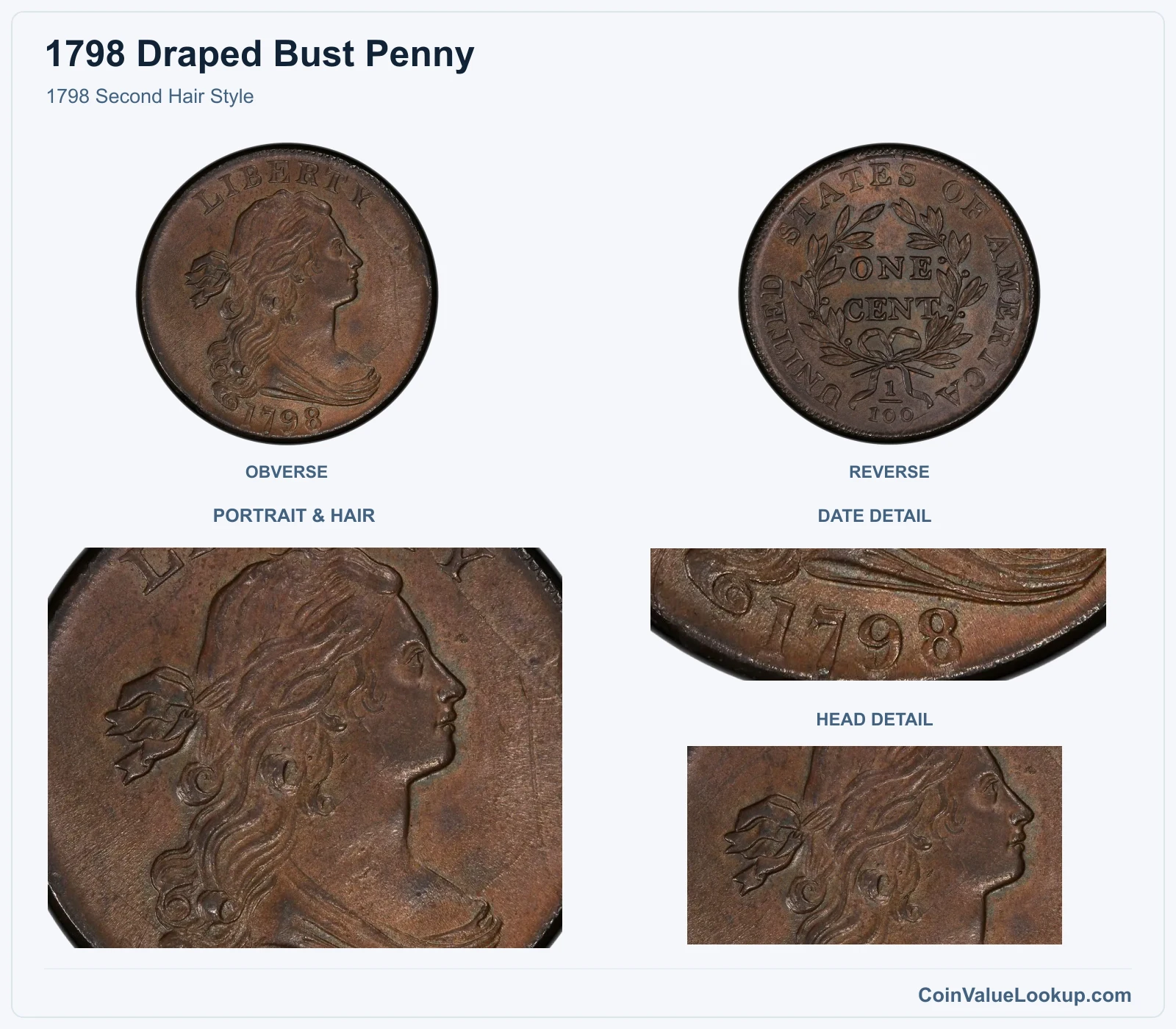
The 1798 Second Hair Style features a tighter, more compact rendering of Liberty's hair compared to the First Hair Style. The strands behind the ear sit closer together and appear less dramatic under magnification.
USA Coin Book places this variety at about $217 in G4 and around $3,083 in EF40 — very close to the First Hair Style, though slightly lower at the upper end. Like all 1798 cents, it is copper, produced at Philadelphia without a mintmark, and nominally weighs 10.89 grams.
Getting the hair-style call right matters mostly for cataloging accuracy; the price difference between the two styles is modest in most circulated grades.
| Range | Grade | Price | Auction Records | Appraisal |
|---|---|---|---|---|
| PO | PO 1 | Coin Identifier | ||
| FR | FR 2 | Coin Identifier | ||
| AG | AG 3 | Coin Identifier | ||
| G | G 4 | Coin Identifier | ||
| G 6 | Coin Identifier | |||
| VG | VG 8 | Coin Identifier | ||
| VG 10 | Coin Identifier | |||
| F | F 12 | Coin Identifier | ||
| F 15 | Coin Identifier | |||
| VF | VF 20 | Coin Identifier | ||
| VF 25 | Coin Identifier | |||
| VF 30 | Coin Identifier | |||
| VF 35 | Coin Identifier | |||
| XF | XF 40 | Coin Identifier | ||
| XF 45 | Coin Identifier | |||
| AU | AU 50 | Coin Identifier | ||
| AU 53 | Coin Identifier | |||
| AU 55 | Coin Identifier | |||
| AU 58 | Coin Identifier | |||
| MS | MS 60 | — | Coin Identifier | |
| MS 61 | Coin Identifier | |||
| MS 62 | Coin Identifier | |||
| MS 63 | Coin Identifier | |||
| MS 64 | — | Coin Identifier | ||
| MS 65 | Coin Identifier | |||
| MS 66 | — | — | — | |
| MS 67 | — | — | — | |
| MS 68 | — | — | — | |
| MS 69 | — | — | — | |
| MS 70 | — | — | — |
1798 Draped Bust Cent Error List
1. 1798 Draped Bust Cent — Die Crack
A die crack appears as a thin, raised line running across the coin's surface. It can cross open fields, cut through lettering, or trace along a device.
The line is raised because the crack in the die created a recessed channel that filled with metal during striking.
Do not confuse a die crack with an incuse scratch, a corrosion line or a tool mark. Scratches are recessed into the surface, while a genuine die crack sits above it.
Under magnification, the crack should show consistent width and follow a path that makes sense for a brittle steel die fracture.
No specific price premium has been adopted for die-crack examples on 1798 cents. Value depends on the crack's size, location and visual impact, along with the coin's authenticated identity and overall condition.
2. 1798 Draped Bust Cent — Die Break / Cud
A cud is a specific type of die break where a piece of the die rim has broken away, leaving a raised, featureless blob of metal connected to the coin's rim. Smaller interior die breaks can also occur but are not true cuds unless they touch the rim.
Look for a smooth, raised area that interrupts the normal design and connects to the edge. It should displace the expected design detail in that zone.
Do not mistake a rim dent, corrosion buildup or a small interior die chip for a cud — those lack the characteristic connection to the rim and the flat, blobby profile.
No adopted price range exists for cud errors on 1798 cents. Each piece requires individual assessment based on the break's size, location and the coin's authenticated condition.
3. 1798 Draped Bust Cent — Defective Planchet
A defective planchet error means the copper blank itself had a flaw before the dies struck it. This can show up as a void, a lamination, an irregular edge or a strip of missing metal that is clearly part of the original blank rather than something that happened later.
The key diagnostic is that the struck design wraps around or up to the defect, proving the flaw existed before striking. Post-mint gouges, corrosion holes and deliberate metal removal will interrupt the design without that telltale flow of struck detail.
Examine both faces and the edge together. No specific price data has been adopted for defective-planchet 1798 cents.
Value hinges on how dramatic the flaw is, whether the date remains visible and the coin's overall authenticated condition.
4. 1798 Draped Bust Cent — Off-Center Strike
An off-center strike happens when the planchet is not properly seated between the dies, producing a displaced design and an unstruck crescent of blank metal on one side. The farther off center, the more dramatic the visual — but you want the date to remain visible for identification and collector appeal.
Do not confuse this with a clipped planchet, a one-sided die misalignment or post-mint flattening. A genuine off-center strike shows the entire design shifted in one direction with a smooth, unstruck area opposite it.
The struck portion should still be sharp relative to the coin's grade.
No adopted price range exists for off-center 1798 cents. Each example is valued individually based on the degree of displacement, date visibility, authenticated variety and surface condition.
5. 1798 Draped Bust Cent — Brockage
A brockage occurs when a previously struck coin remains stuck in a die and impresses its design into the next blank. The result is one normal side and one side with an incuse, mirror-image design.
On a 1798 cent this would typically show an incuse, reversed Liberty portrait or wreath.
Look carefully at the direction and relief of the mirror image. A genuine brockage is incuse and reversed.
A die clash produces faint design traces but not a full, deeply impressed mirror image, and post-mint pressing of two coins together tends to look flatter and less uniform.
No specific price has been adopted for brockage 1798 Draped Bust Cents. These are rare errors on early copper, and value depends entirely on the piece's authenticated identity, the completeness of the brockage impression and overall condition.
6. 1798 Draped Bust Cent — Double / Multiple Strike
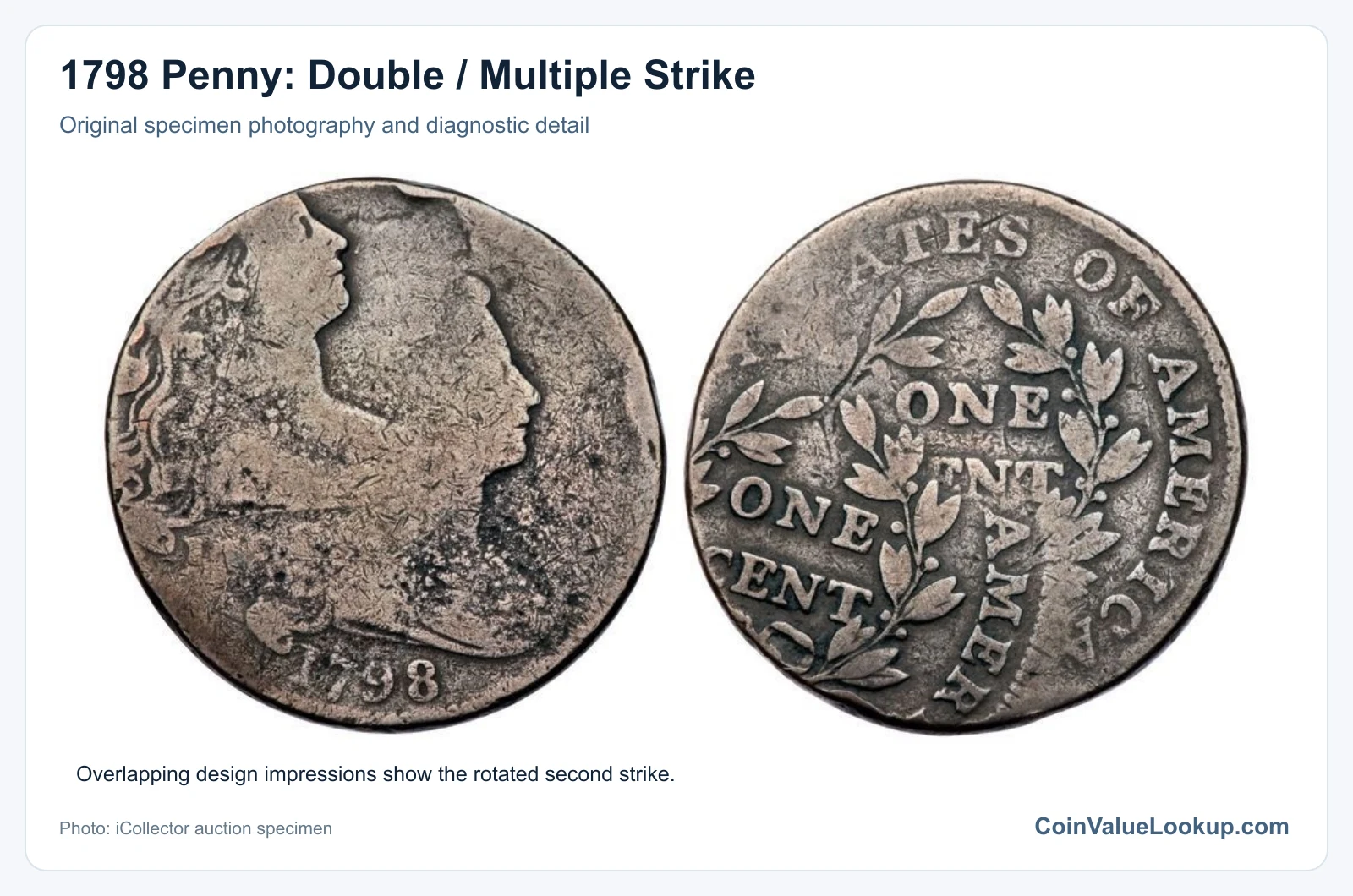
A double or multiple strike shows two or more distinct impressions of the design, usually displaced or rotated relative to each other. You will see separate outlines of Liberty's portrait, duplicate lettering or a second wreath impression overlapping the first.
The key distinction is that each impression is a complete strike event, not just thickened or split lettering. Doubled dies produce consistent doubling in the same direction across the whole coin from a single strike.
Machine doubling creates flat, shelf-like distortions. A true double strike shows independent, often rotated design images.
No adopted price range exists for double-struck 1798 cents. Value depends on the number of strikes, their displacement, date visibility and the coin's authenticated condition and variety.
7. 1798 Draped Bust Cent — Indented Strike
An indented strike happens when a second planchet or foreign object overlaps the coin blank during striking, leaving a bounded depressed area on one side. Inside the depression, the design is either absent or much weaker than the surrounding struck detail.
The depression has a defined boundary matching the shape of whatever was sitting on top. This separates it from a post-mint dent, which tends to show sharper edges and distortion of already-struck design.
It also differs from a brockage, which carries a mirrored design impression inside the affected area rather than a plain depression.
No price data has been adopted for indented-strike 1798 cents. Assessment depends on the indent's size, location, date visibility and the coin's overall authenticated condition.
8. 1798 Draped Bust Cent — Overdate
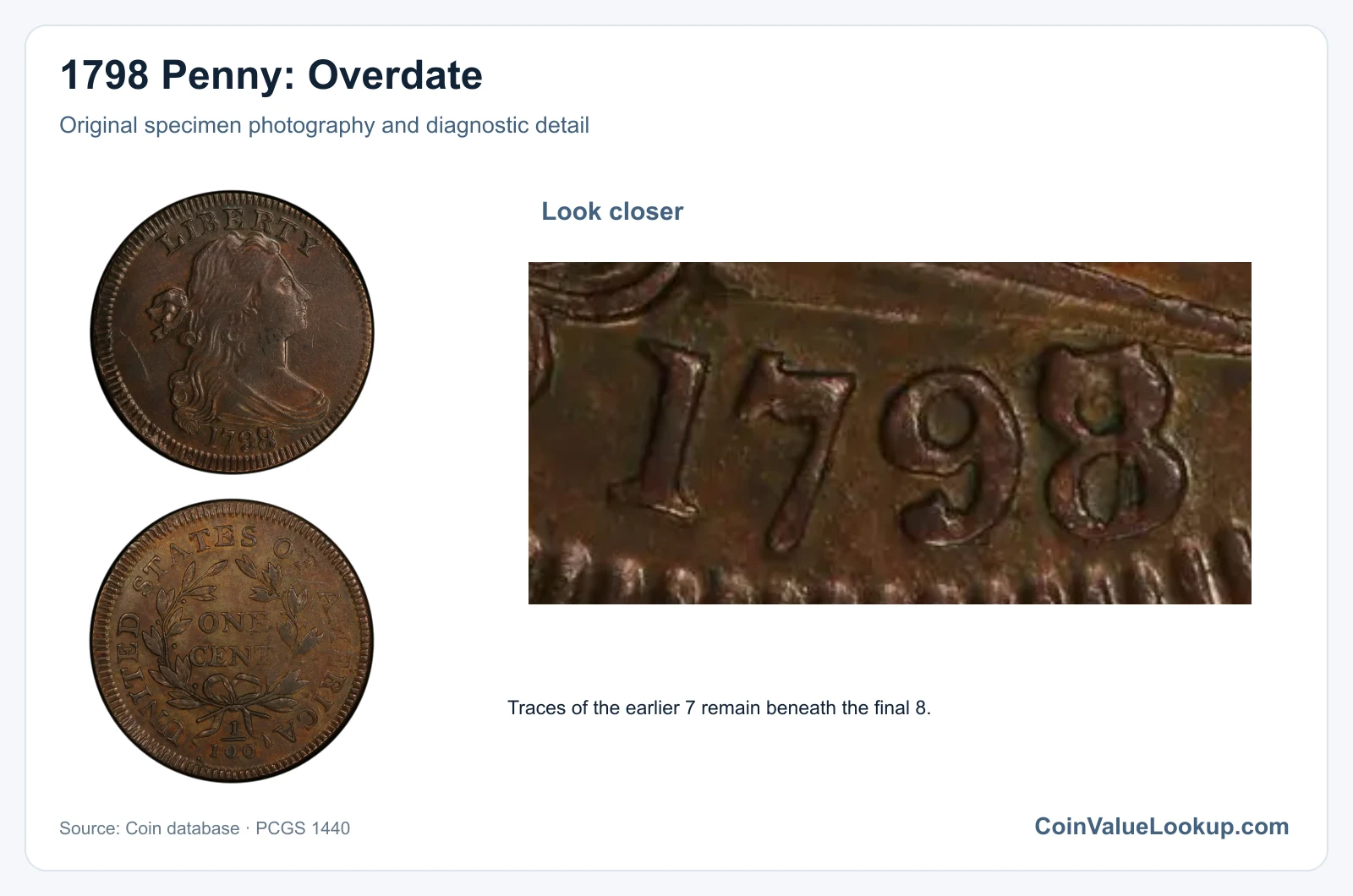
An overdate on a 1798 cent means the die was originally punched with a different year and then re-punched with 1798 numerals. The listed variety is the 1798/7, where traces of a "7" are visible beneath the "8." You need to see actual remnants of the earlier digit — curves, serifs or outlines that do not belong to the final date.
Ordinary date-punch shapes and minor positional differences are not overdates. Damaged or corroded dates can mimic extra contours, so compare what you see against confirmed examples.
Machine doubling can also thicken date numerals, but it produces flat, shelf-like offsets rather than the distinct underlying digit contours of a true overdate.
No separate error-category price has been adopted for overdates beyond the variety-specific guide figures already listed for the 1798/7 branch. Authentication by a recognized grading service is strongly recommended before assigning overdate status.