1806 Draped Bust Cent Coin Value: How Much Is It Worth?
The 1806 Draped Bust Cent is a genuine early American copper coin, and its value reflects that age. USA Coin Book guide estimates place an ordinary business strike between roughly $186 in G4 and $3,999 in EF40.
Your actual coin's worth depends on its exact variety, surface condition, and authenticated grade, so identifying those details is the first step.
Fast Way to Identify Your 1806 Draped Bust Cent
Snap a clear photo of both the front and back of your 1806 cent and upload them here for a preliminary identification. Good lighting and a steady hand help — try to capture the full rim and any surface irregularities.
This is not a substitute for professional authentication, but it can point you in the right direction quickly.
1806 Draped Bust Cent Value
Upload both sides of your 1806 Draped Bust Cent.
Front Obverse
Upload photo
Back Reverse
Upload photo
Which 1806 Draped Bust Cent Versions Are Worth Money?
- Business strikes from Philadelphia range from about $186 in G4 to $3,999 in EF40 per USA Coin Book guide estimates — exact value depends on authenticated grade and surface quality.
- Original, problem-free surfaces add significant appeal; cleaned or corroded examples often sell for less than guide figures suggest.
- Cataloged mint errors such as off-center strikes, laminations, or die breaks can carry separate premiums but require individual professional assessment.
Step 1: Identify Your 1806 Draped Bust Cent Mint Mark and Version
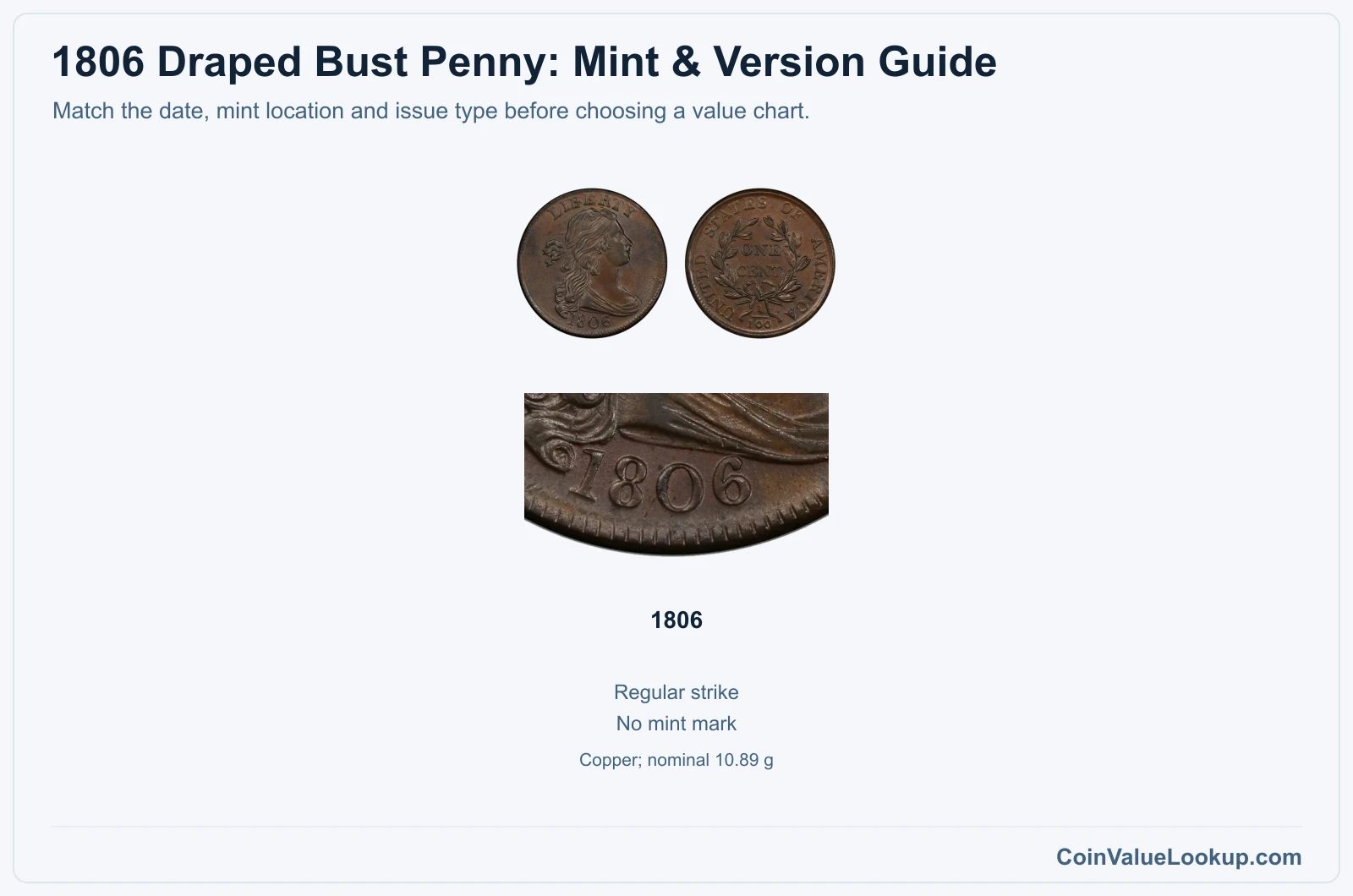
The 1806 Draped Bust Cent was struck at Philadelphia, the only operating mint at the time. There is no mintmark to look for.
On the obverse you should see Liberty facing right with flowing hair and a draped bust. The reverse shows a wreath enclosing the denomination.
Match both sides to confirmed Draped Bust Cent images before assuming you have the right series, because some later large cents can look similar at a glance.
Check the date carefully. Worn digits can make an 1806 look like an 1800 or 1808.
The shape of each numeral matters.
Weight can help support your identification — the nominal spec is about 10.89 grams of copper — but wear, corrosion, and original production tolerances mean weight alone does not prove authenticity. Edge inspection is also useful; compare yours to known examples.
Original surfaces and legible detail matter far more than brightness. A dark, crusty coin with sharp features can be more desirable than a bright one that has been cleaned or tooled.
Step 2: Check Your 1806 Draped Bust Cent Grade
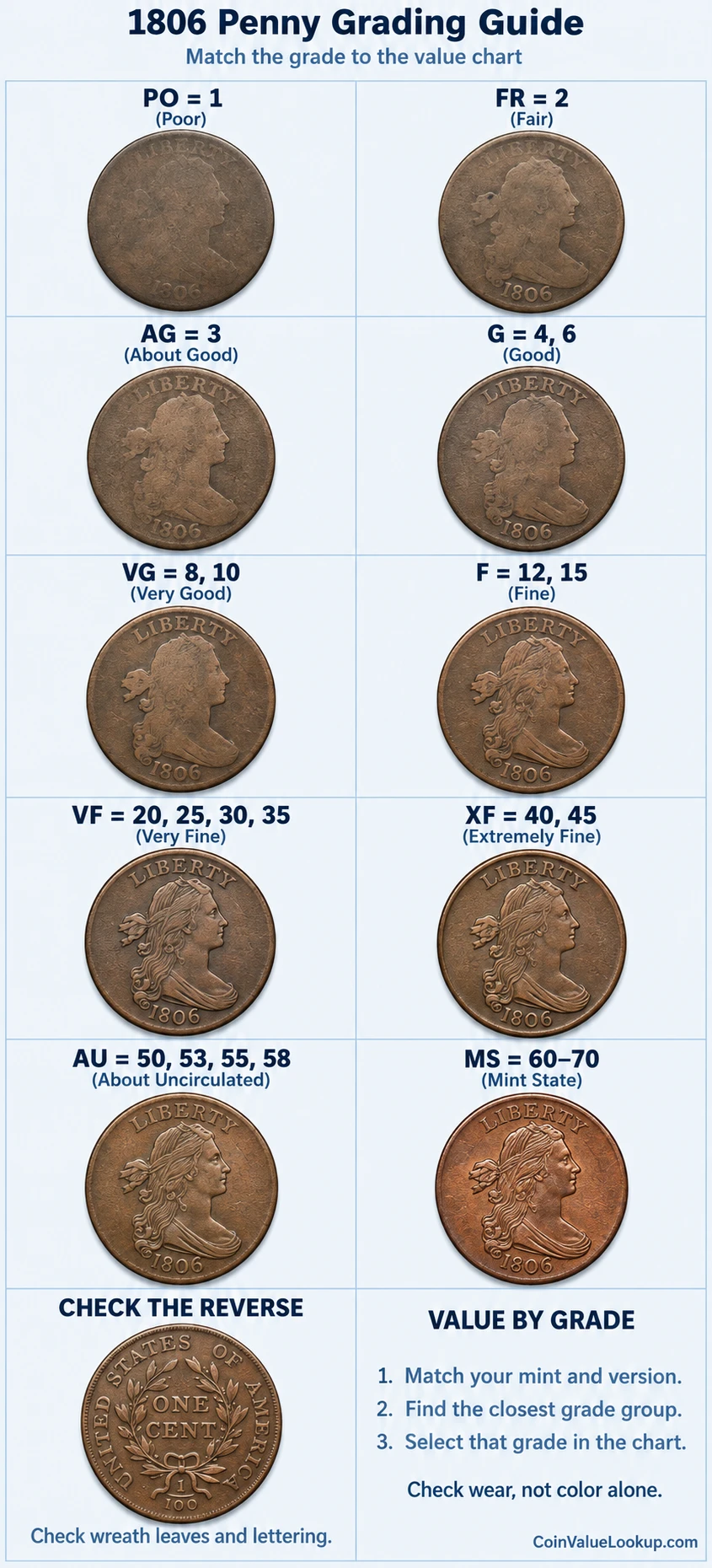
Start by looking at Liberty's hair above the forehead and near the ear. In lower grades those strands merge into a flat mass, while a sharp example shows individual curls.
The cheek and jawline lose definition early in a coin's circulating life, so compare those areas closely.
On the reverse, check the individual leaves of the wreath. Higher-grade coins show distinct veins and separation between leaves.
Flattened, mushy leaves suggest heavier wear.
Use the comparison image to match your coin against like-type examples at each grade level. A coin that looks "in between" two reference images usually falls at the lower grade.
Do not confuse weak strike with wear. Some 1806 cents left the press with soft details, especially near the centers.
Porosity and corrosion also eat away at detail without the smooth, even loss that circulation produces. Surface problems like these can lower market value well below what the grade number alone would suggest.
Color designations like BN, RB, and RD describe how much original red copper color remains. They are color attributes, not separate alloys or bonus grades.
Most surviving 1806 cents are solidly brown.
Step 3: Check 1806 Draped Bust Cent Value by Mint and Version
1806 Draped Bust Cent
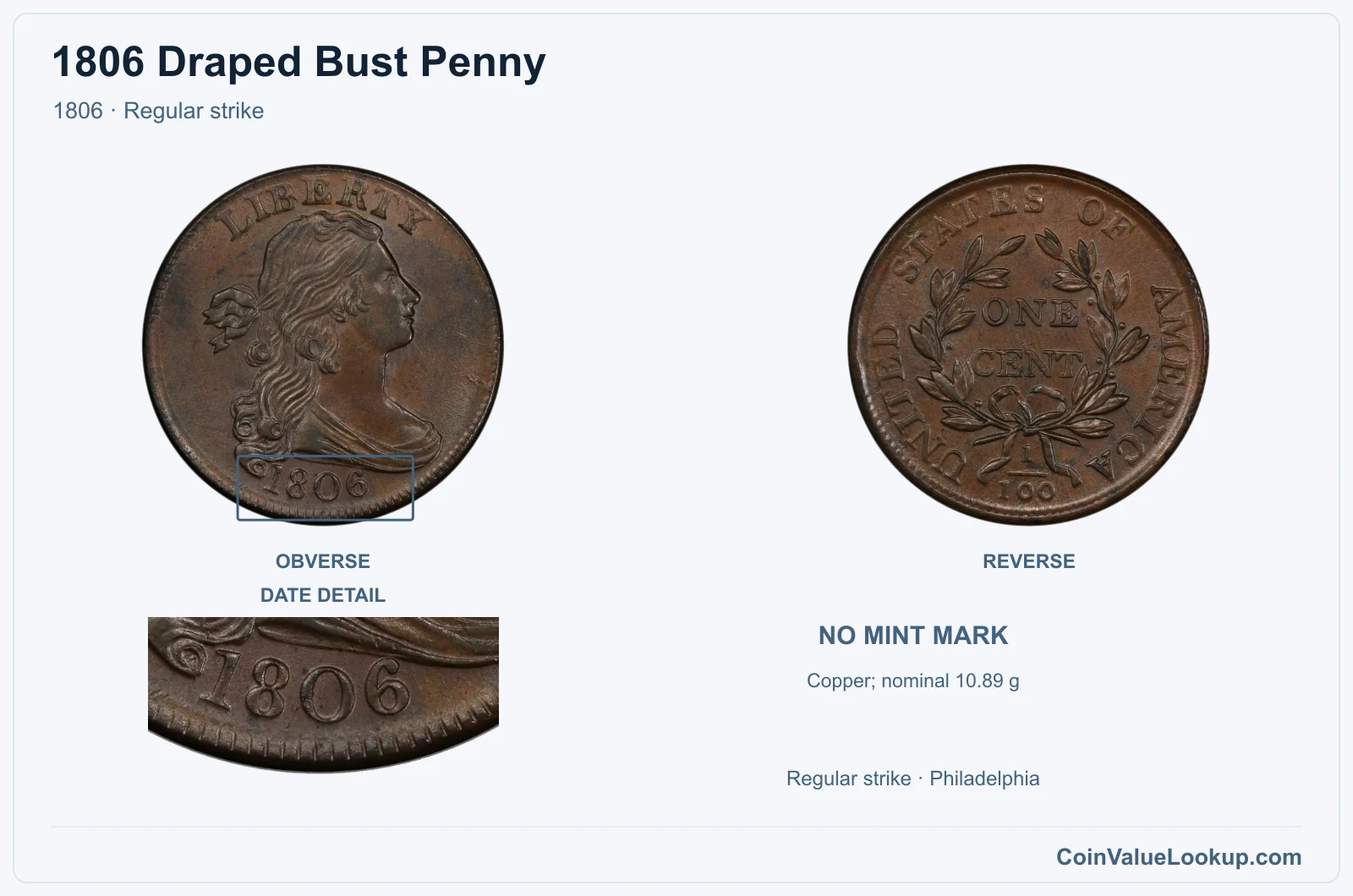
The 1806 Draped Bust Cent was struck in copper at the Philadelphia Mint with no mintmark. USA Coin Book guide estimates range from about $186 at G4 to $3,999 at EF40.
These figures assume a problem-free, business-strike example.
To confirm this variety, match the obverse portrait — Liberty facing right with draped fabric at the shoulder — and the reverse wreath and denomination layout against known references. Original brown surfaces with clear detail will command more than a harshly cleaned coin that technically grades higher on sharpness alone.
Coin Value Lookup is a good starting point if you want to look up guides for other early copper dates or different series altogether. You can compare your coin's details against what is listed for neighboring years.
| Range | Grade | Price | Auction Records | Appraisal |
|---|---|---|---|---|
| PO | PO 1 | — | Coin Identifier | |
| FR | FR 2 | Coin Identifier | ||
| AG | AG 3 | Coin Identifier | ||
| G | G 4 | Coin Identifier | ||
| G 6 | Coin Identifier | |||
| VG | VG 8 | Coin Identifier | ||
| VG 10 | Coin Identifier | |||
| F | F 12 | Coin Identifier | ||
| F 15 | Coin Identifier | |||
| VF | VF 20 | Coin Identifier | ||
| VF 25 | Coin Identifier | |||
| VF 30 | Coin Identifier | |||
| VF 35 | Coin Identifier | |||
| XF | XF 40 | Coin Identifier | ||
| XF 45 | Coin Identifier | |||
| AU | AU 50 | Coin Identifier | ||
| AU 53 | Coin Identifier | |||
| AU 55 | Coin Identifier | |||
| AU 58 | Coin Identifier | |||
| MS | MS 60 | — | Coin Identifier | |
| MS 61 | Coin Identifier | |||
| MS 62 | Coin Identifier | |||
| MS 63 | Coin Identifier | |||
| MS 64 | Coin Identifier | |||
| MS 65 | — | Coin Identifier | ||
| MS 66 | — | — | — | |
| MS 67 | — | — | — | |
| MS 68 | — | — | — | |
| MS 69 | — | — | — | |
| MS 70 | — | — | — |
1806 Draped Bust Cent Error List
1. 1806 Draped Bust Cent — Off-Center Strike
An off-center strike happens when the planchet is not seated properly between the dies. On an 1806 Draped Bust Cent this produces a displaced design with an unstruck crescent of blank copper along part of the rim.
The key detail collectors want is a fully visible date — without it, value drops sharply.
Look at the crescent area closely. It should be smooth, original planchet surface, not a rough or damaged edge.
A clipped planchet, one-sided die misalignment, or post-mint flattening can mimic the look of an off-center error, so compare carefully.
No specific price range is adopted for this error on the 1806 cent. Value depends entirely on the authenticated identity, the percentage of off-center displacement, date visibility, and overall condition.
Professional authentication is strongly recommended before assuming premium value.
2. 1806 Draped Bust Cent — Lamination / Split Planchet
A lamination or split planchet error shows peeling metal, a retained flap, or visible separation within the copper. On an 1806 cent, photograph the edge alongside the affected face — this helps demonstrate that the flaw runs through the metal rather than sitting only on the surface.
The distinction matters because scraping, active corrosion, and deliberately cut coins can look similar. Genuine lamination follows the metal's internal layers and typically has smooth, rounded edges at the separation point.
Rough gouges or green crusty patches point elsewhere.
There is no adopted numeric price range for this error on the 1806 Draped Bust Cent. Each example is assessed individually based on its authenticated identity, the severity and visual drama of the separation, and the coin's overall condition.
A professional opinion is the safest route before assigning premium value.
3. 1806 Draped Bust Cent — Die Break / Cud
A die break leaves a raised blob of metal on the coin's surface where a piece of the die crumbled away. When that blob connects to the rim, collectors call it a cud.
On an 1806 Draped Bust Cent, look for a lumpy, raised area that displaces part of the normal design — often along the legend or near the wreath tips.
Do not confuse this with a rim dent, which is depressed rather than raised. Corrosion bumps tend to be rough and irregular without a clean boundary, while interior die chips sit away from the rim and are usually smaller.
A true cud has a distinct edge where the broken die section met intact steel.
No numeric price range is adopted for die breaks on this date. Value depends on the size, location, and visual impact of the cud, plus the coin's authenticated grade and surface quality.
Professional evaluation is the best path forward for any suspected example.