1803 Draped Bust Cent Coin Value: How Much Is It Worth?
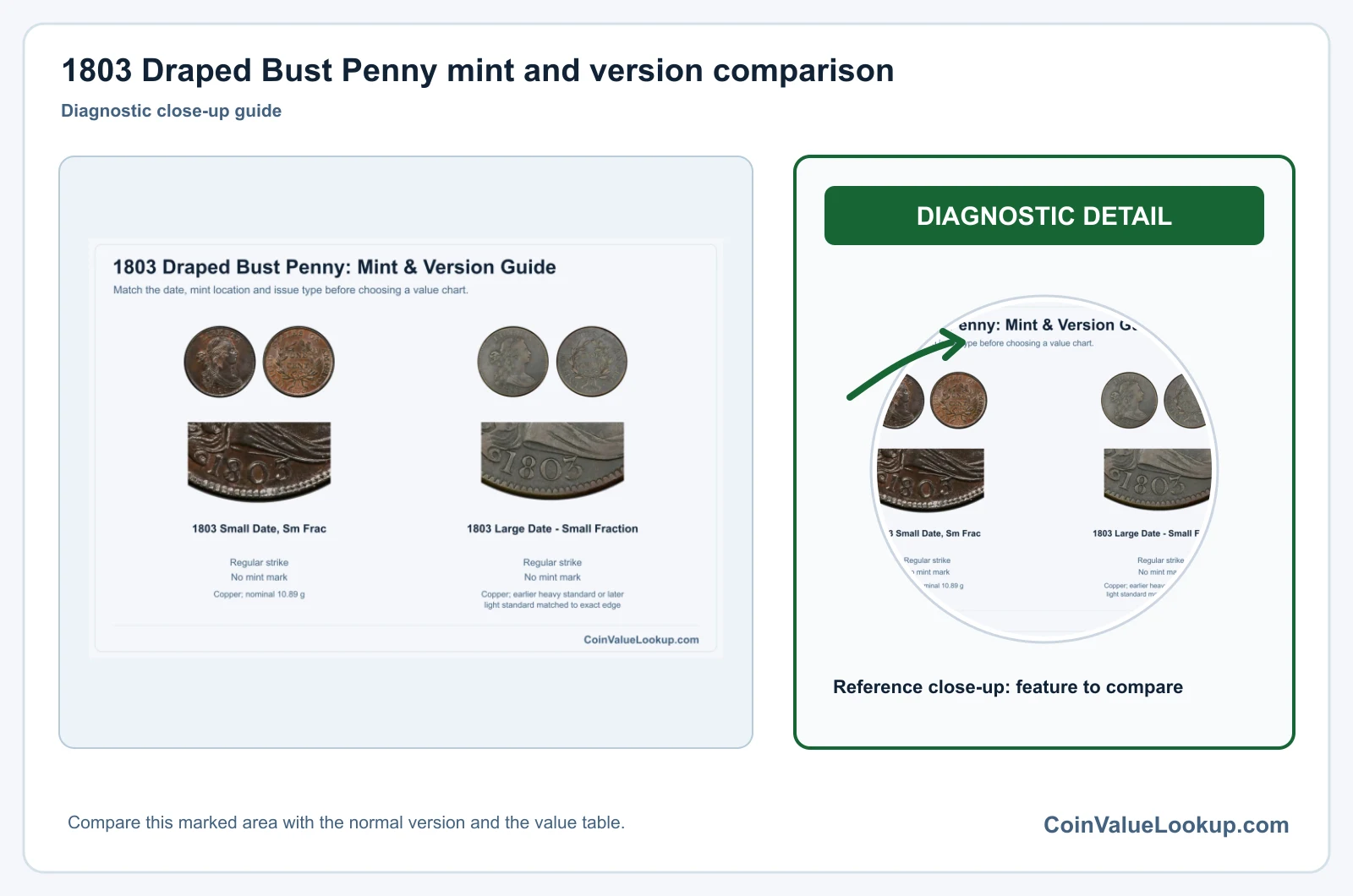
The 1803 Draped Bust Cent comes in several distinct varieties, and knowing which one you have matters a lot. Guide estimates for the ordinary branches start around $103 in G4 and climb to $86,973 in EF40 for the scarce Large Date, Small Fraction variety.
Identify your exact variety first, because the price spread between branches is enormous.
Fast Way to Identify Your 1803 Draped Bust Cent
Snap clear photos of both sides of your coin and upload them here for a preliminary identification. The date size, fraction size, and wreath details all matter, so good lighting on the reverse is essential.
This is not a substitute for professional authentication, but it can point you toward the right variety quickly.
1803 Draped Bust Cent Value
Upload both sides of your 1803 Draped Bust Cent.
Front Obverse
Upload photo
Back Reverse
Upload photo
Which 1803 Draped Bust Cent Versions Are Worth Money?
- The 1803 Large Date, Small Fraction variety lists around $11,083 in G4 and $86,973 in EF40, making it the standout branch to check for among the six listed varieties.
- The 1803 Large Date, Large Fraction variety carries guide estimates of $341 in G4 and $6,827 in EF40, well above the common Small Date branches.
- The 1803 1/100 Over 1/000 corrected fraction lists around $217 in G4 and $4,245 in EF40, a meaningful premium tied to the visible overdate in the fraction.
- The 1803 Stemless Wreath variety commands roughly $186 in G4 and $2,171 in EF40, distinguished by the absence of stems at the wreath base.
- Blundered fraction and brockage errors are reported for this date and may carry additional premiums requiring individual assessment.
Step 1: Identify Your 1803 Draped Bust Cent Mint Mark and Version
All 1803 Draped Bust Cents were struck at Philadelphia. There is no mintmark to look for.
The key task is comparing two features independently: the size of the date numerals on the obverse, and the size of the fraction (1/100) on the reverse. Large Date and Small Date are separate punches, and each can appear with either a Small Fraction or a Large Fraction.
Beyond date and fraction size, check for a corrected fraction where extra or misplaced digits appear beneath the final strike. Also inspect the wreath on the reverse for stems at the base of the bow; the Stemless Wreath variety omits them entirely.
Weight can offer supporting evidence. Copper cents of this era have a nominal weight of about 10.89 grams, but production tolerances varied and wear, corrosion, or cleaning can shift the number.
Weight alone does not prove authenticity or variety.
Step 2: Check Your 1803 Draped Bust Cent Grade
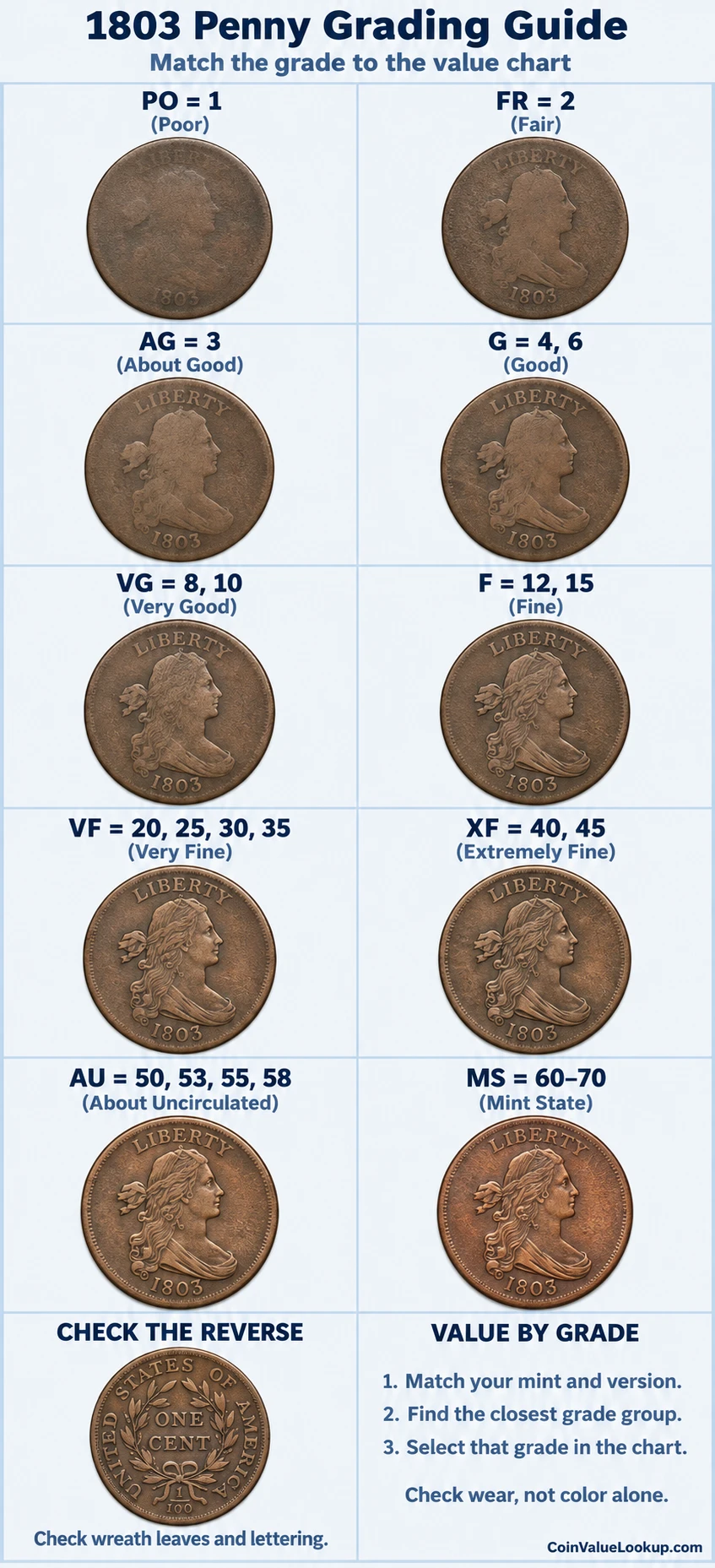
Focus on the portrait first. In higher grades, individual hair strands above the forehead and behind the ear remain sharp, and the cheek shows no flattening.
As wear progresses, those strands merge into smooth waves, and the cheek develops a uniform flat spot.
On the reverse, leaf veins in the wreath vanish early. By G4 the wreath is an outline and the fraction may be partly worn away.
Compare your coin against like-type grade images rather than guessing.
Surface problems are common on early copper. Corrosion pitting, porosity, and old cleaning can mimic wear or hide detail that was never struck sharply.
These issues lower market value well below what the technical grade alone would suggest.
Color designations like BN, RB, and RD describe the remaining original red surface on copper. They are color attributes, not separate alloys or automatic upgrades.
A proof designation, if it ever applies, describes a manufacturing method, not a grade above Mint State.
Step 3: Check 1803 Draped Bust Cent Value by Mint and Version
1803 Draped Bust Cent — Small Date, Sm Frac
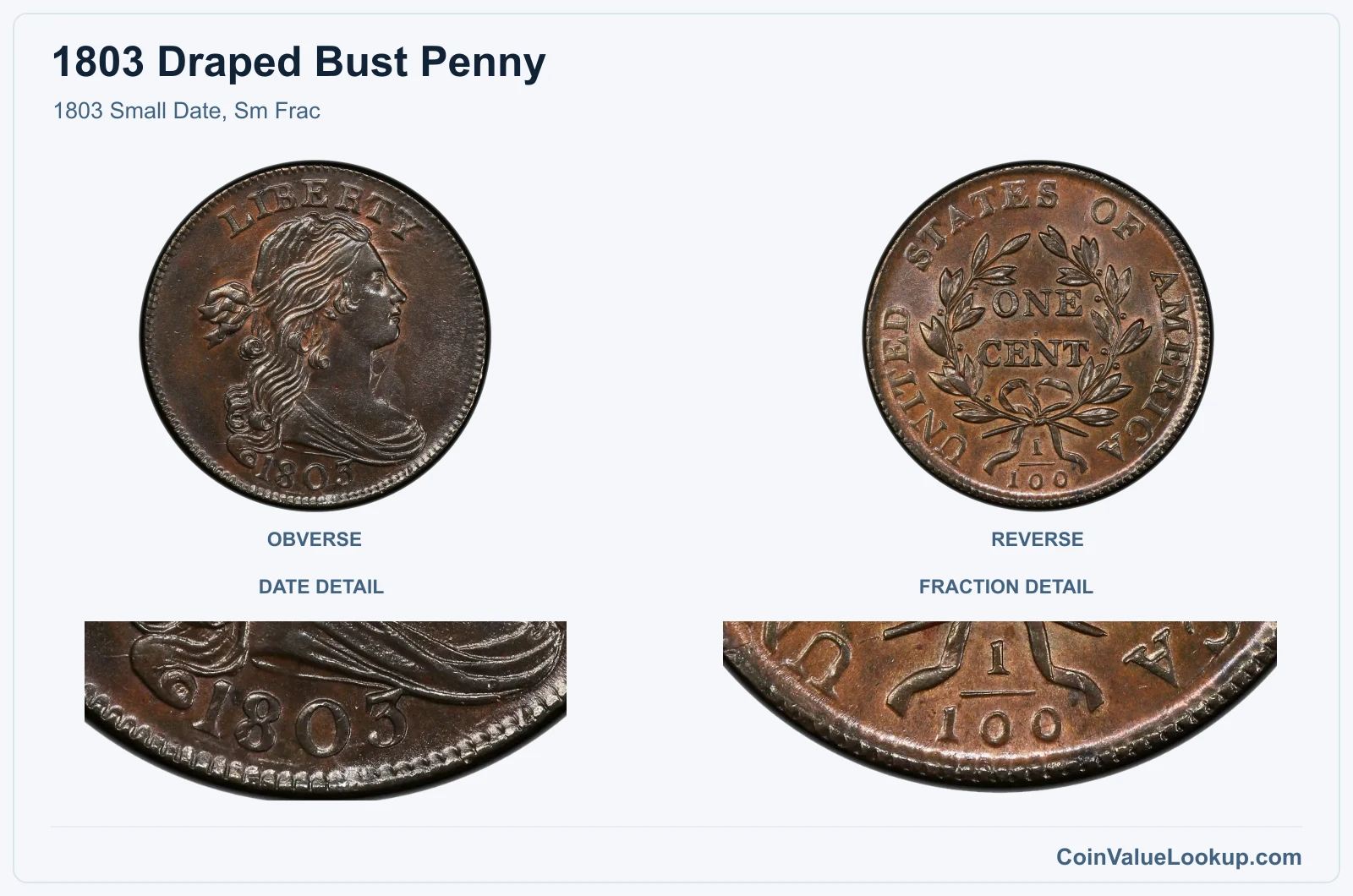
The Small Date, Small Fraction is one of the more available 1803 varieties. Look for compact, closely spaced date numerals and a small-sized 1/100 fraction on the reverse.
Guide estimates run about $103 in G4 and $1,599 in EF40 per USA Coin Book. Even the common variety is over two centuries old, so expect some surface issues on most survivors.
| Range | Grade | Price | Auction Records | Appraisal |
|---|---|---|---|---|
| PO | PO 1 | Coin Identifier | ||
| FR | FR 2 | Coin Identifier | ||
| AG | AG 3 | Coin Identifier | ||
| G | G 4 | Coin Identifier | ||
| G 6 | Coin Identifier | |||
| VG | VG 8 | Coin Identifier | ||
| VG 10 | Coin Identifier | |||
| F | F 12 | Coin Identifier | ||
| F 15 | Coin Identifier | |||
| VF | VF 20 | Coin Identifier | ||
| VF 25 | Coin Identifier | |||
| VF 30 | Coin Identifier | |||
| VF 35 | Coin Identifier | |||
| XF | XF 40 | Coin Identifier | ||
| XF 45 | Coin Identifier | |||
| AU | AU 50 | Coin Identifier | ||
| AU 53 | Coin Identifier | |||
| AU 55 | Coin Identifier | |||
| AU 58 | Coin Identifier | |||
| MS | MS 60 | — | Coin Identifier | |
| MS 61 | Coin Identifier | |||
| MS 62 | Coin Identifier | |||
| MS 63 | Coin Identifier | |||
| MS 64 | Coin Identifier | |||
| MS 65 | Coin Identifier | |||
| MS 66 | — | Coin Identifier | ||
| MS 67 | — | — | — | |
| MS 68 | — | — | — | |
| MS 69 | — | — | — | |
| MS 70 | — | — | — |
1803 Draped Bust Cent — Small Date, Lg Frac
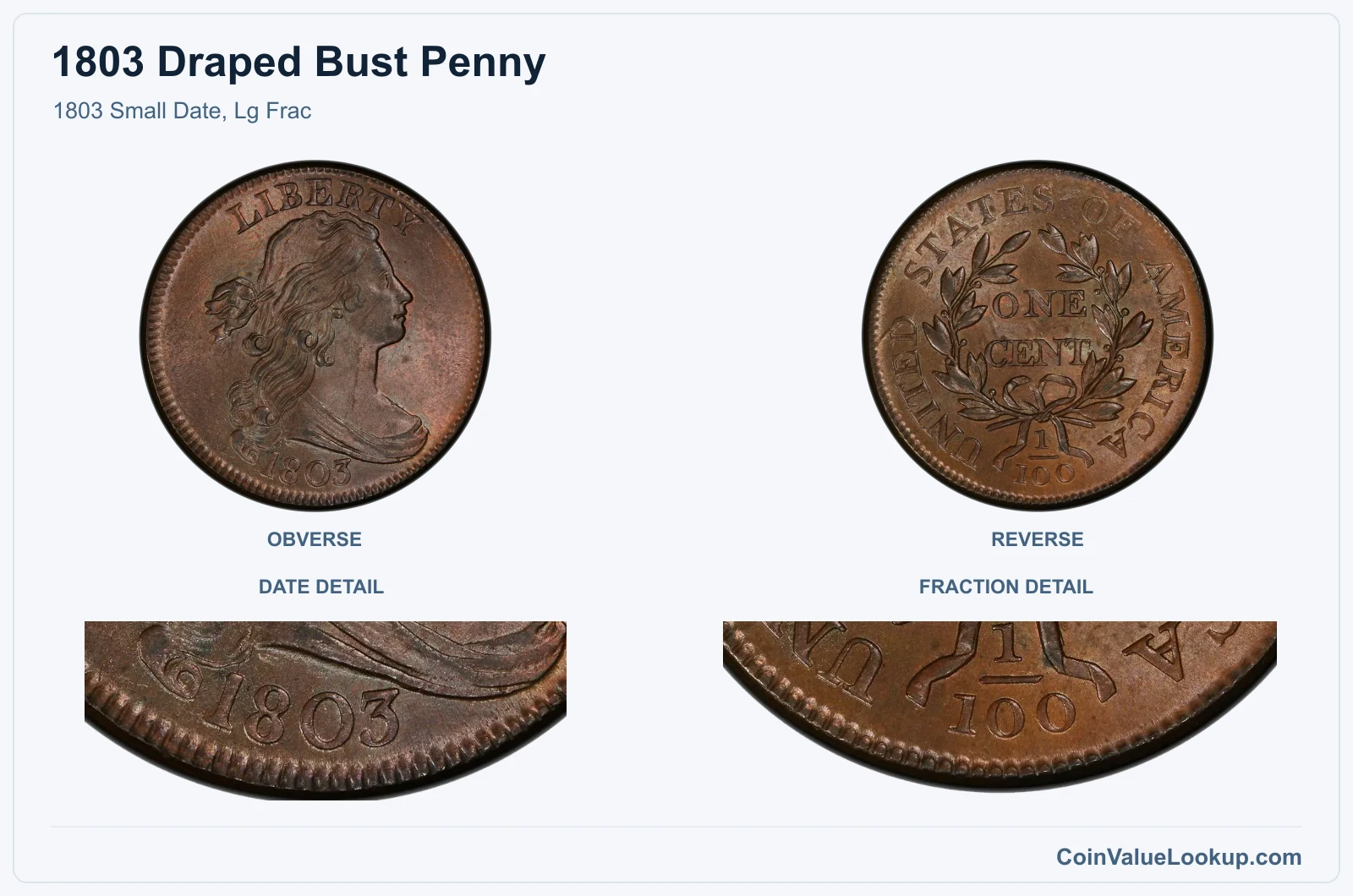
This pairs the same Small Date obverse with a noticeably larger fraction on the reverse. The digits in 1/100 are taller and more spread out compared to the Small Fraction version.
Pricing is similar to its sibling: roughly $103 in G4 and $1,444 in EF40. Side-by-side comparison with the Small Fraction reverse is the surest way to tell them apart.
| Range | Grade | Price | Auction Records | Appraisal |
|---|---|---|---|---|
| PO | PO 1 | — | Coin Identifier | |
| FR | FR 2 | — | Coin Identifier | |
| AG | AG 3 | Coin Identifier | ||
| G | G 4 | Coin Identifier | ||
| G 6 | Coin Identifier | |||
| VG | VG 8 | Coin Identifier | ||
| VG 10 | Coin Identifier | |||
| F | F 12 | Coin Identifier | ||
| F 15 | Coin Identifier | |||
| VF | VF 20 | Coin Identifier | ||
| VF 25 | Coin Identifier | |||
| VF 30 | Coin Identifier | |||
| VF 35 | Coin Identifier | |||
| XF | XF 40 | Coin Identifier | ||
| XF 45 | Coin Identifier | |||
| AU | AU 50 | Coin Identifier | ||
| AU 53 | Coin Identifier | |||
| AU 55 | Coin Identifier | |||
| AU 58 | Coin Identifier | |||
| MS | MS 60 | — | Coin Identifier | |
| MS 61 | Coin Identifier | |||
| MS 62 | Coin Identifier | |||
| MS 63 | Coin Identifier | |||
| MS 64 | Coin Identifier | |||
| MS 65 | Coin Identifier | |||
| MS 66 | Coin Identifier | |||
| MS 67 | — | — | — | |
| MS 68 | — | — | — | |
| MS 69 | — | — | — | |
| MS 70 | — | — | — |
1803 Draped Bust Cent — 100/000
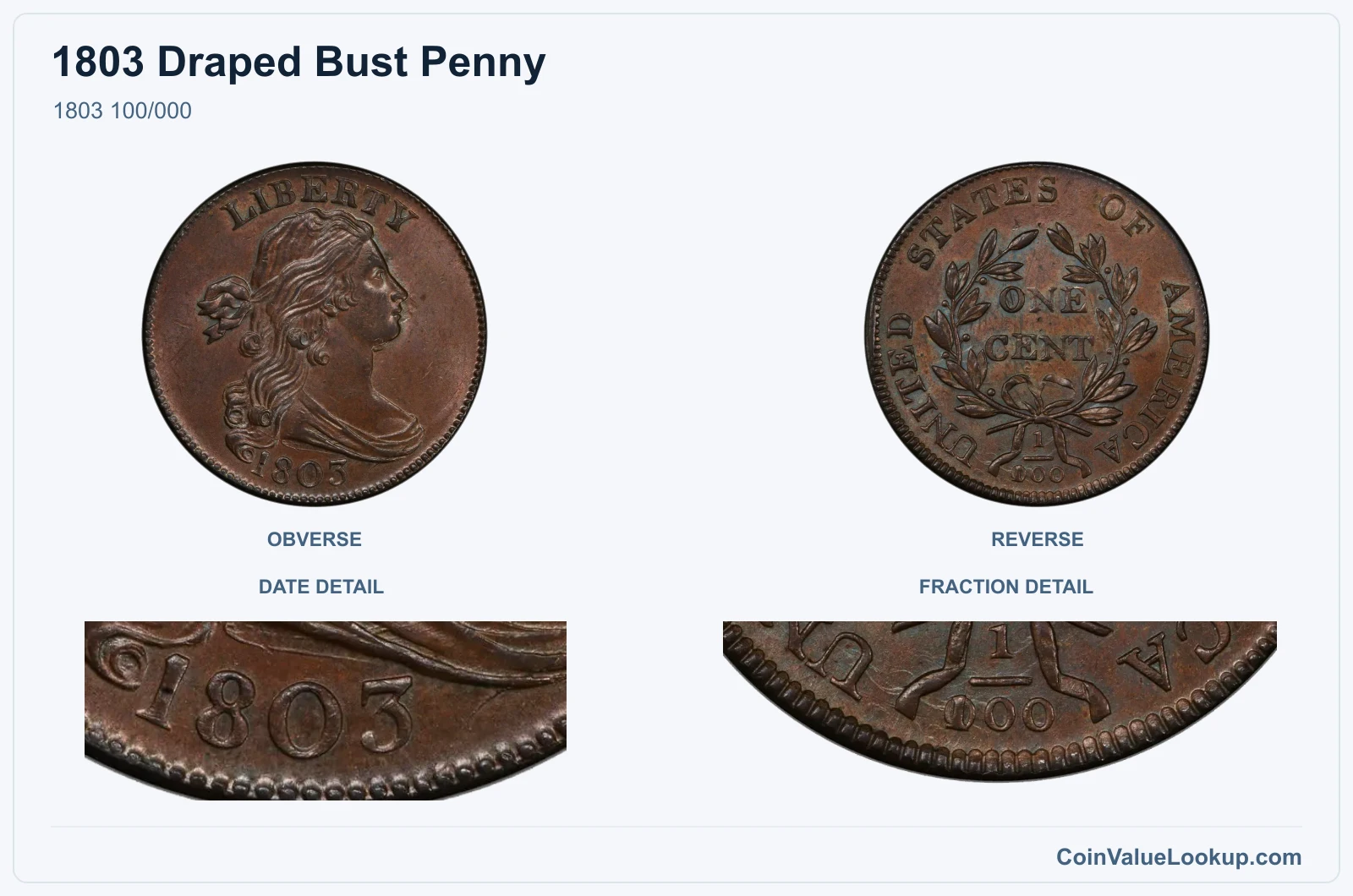
Here the fraction was corrected during die preparation. The original 1/000 was overpunched to read 1/100, and traces of the erroneous digits are visible beneath the final strike.
You will need magnification and good lighting to spot the ghostly zeros under the corrected numerals. Guide estimates sit at about $217 in G4 and $4,245 in EF40, a solid premium over the ordinary Small Date branches.
Attribution matters here, so compare carefully against reference images before assuming you have the corrected die.
| Range | Grade | Price | Auction Records | Appraisal |
|---|---|---|---|---|
| PO | PO 1 | — | Coin Identifier | |
| FR | FR 2 | — | Coin Identifier | |
| AG | AG 3 | Coin Identifier | ||
| G | G 4 | Coin Identifier | ||
| G 6 | Coin Identifier | |||
| VG | VG 8 | Coin Identifier | ||
| VG 10 | — | Coin Identifier | ||
| F | F 12 | Coin Identifier | ||
| F 15 | — | Coin Identifier | ||
| VF | VF 20 | Coin Identifier | ||
| VF 25 | — | Coin Identifier | ||
| VF 30 | Coin Identifier | |||
| VF 35 | Coin Identifier | |||
| XF | XF 40 | Coin Identifier | ||
| XF 45 | Coin Identifier | |||
| AU | AU 50 | — | Coin Identifier | |
| AU 53 | Coin Identifier | |||
| AU 55 | Coin Identifier | |||
| AU 58 | Coin Identifier | |||
| MS | MS 60 | — | Coin Identifier | |
| MS 61 | — | Coin Identifier | ||
| MS 62 | Coin Identifier | |||
| MS 63 | Coin Identifier | |||
| MS 64 | Coin Identifier | |||
| MS 65 | — | — | — | |
| MS 66 | — | — | — | |
| MS 67 | — | — | — | |
| MS 68 | — | — | — | |
| MS 69 | — | — | — | |
| MS 70 | — | — | — |
1803 Draped Bust Cent — No Stems
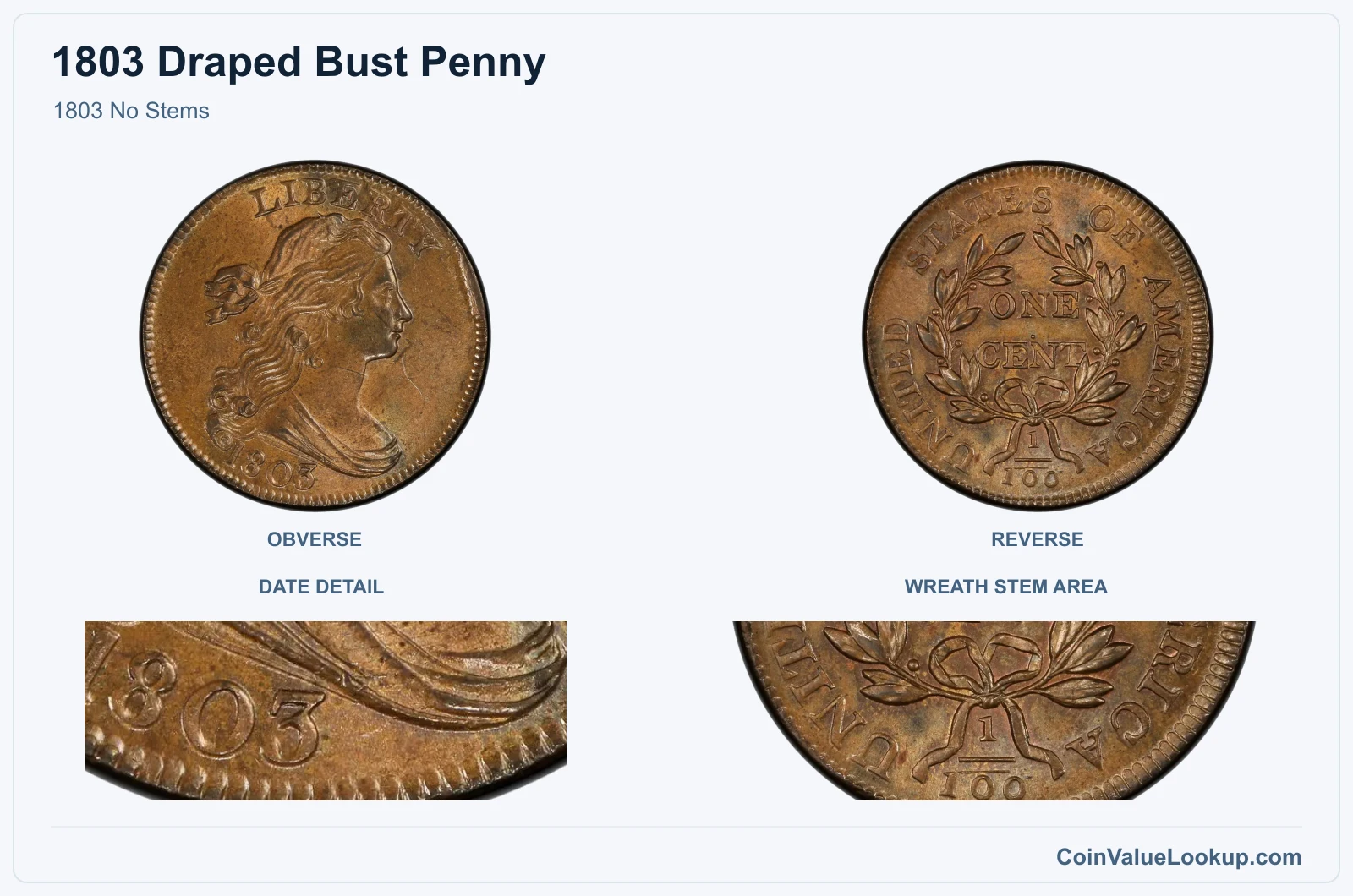
Flip the coin over and look at the base of the wreath bow. On the normal die, small stems extend below the ribbon.
On this variety, those stems are completely absent. It is a small detail but an easy one to confirm once you know where to look.
USA Coin Book lists this at roughly $186 in G4 and $2,171 in EF40. The premium reflects genuine scarcity rather than just a minor cosmetic difference.
If you are sorting through early copper and want to compare values across different denominations and years, Coin Value Lookup is a solid starting point. It brings together coin guides in one place so you can cross-reference varieties without jumping between a dozen sites.
| Range | Grade | Price | Auction Records | Appraisal |
|---|---|---|---|---|
| PO | PO 1 | — | Coin Identifier | |
| FR | FR 2 | — | Coin Identifier | |
| AG | AG 3 | — | Coin Identifier | |
| G | G 4 | — | Coin Identifier | |
| G 6 | — | Coin Identifier | ||
| VG | VG 8 | Coin Identifier | ||
| VG 10 | — | Coin Identifier | ||
| F | F 12 | — | Coin Identifier | |
| F 15 | — | Coin Identifier | ||
| VF | VF 20 | Coin Identifier | ||
| VF 25 | Coin Identifier | |||
| VF 30 | Coin Identifier | |||
| VF 35 | Coin Identifier | |||
| XF | XF 40 | Coin Identifier | ||
| XF 45 | Coin Identifier | |||
| AU | AU 50 | — | Coin Identifier | |
| AU 53 | — | Coin Identifier | ||
| AU 55 | Coin Identifier | |||
| AU 58 | Coin Identifier | |||
| MS | MS 60 | — | Coin Identifier | |
| MS 61 | — | Coin Identifier | ||
| MS 62 | Coin Identifier | |||
| MS 63 | Coin Identifier | |||
| MS 64 | — | Coin Identifier | ||
| MS 65 | — | Coin Identifier | ||
| MS 66 | — | — | — | |
| MS 67 | — | — | — | |
| MS 68 | — | — | — | |
| MS 69 | — | — | — | |
| MS 70 | — | — | — |
1803 Draped Bust Cent — Large Date – Small Fraction
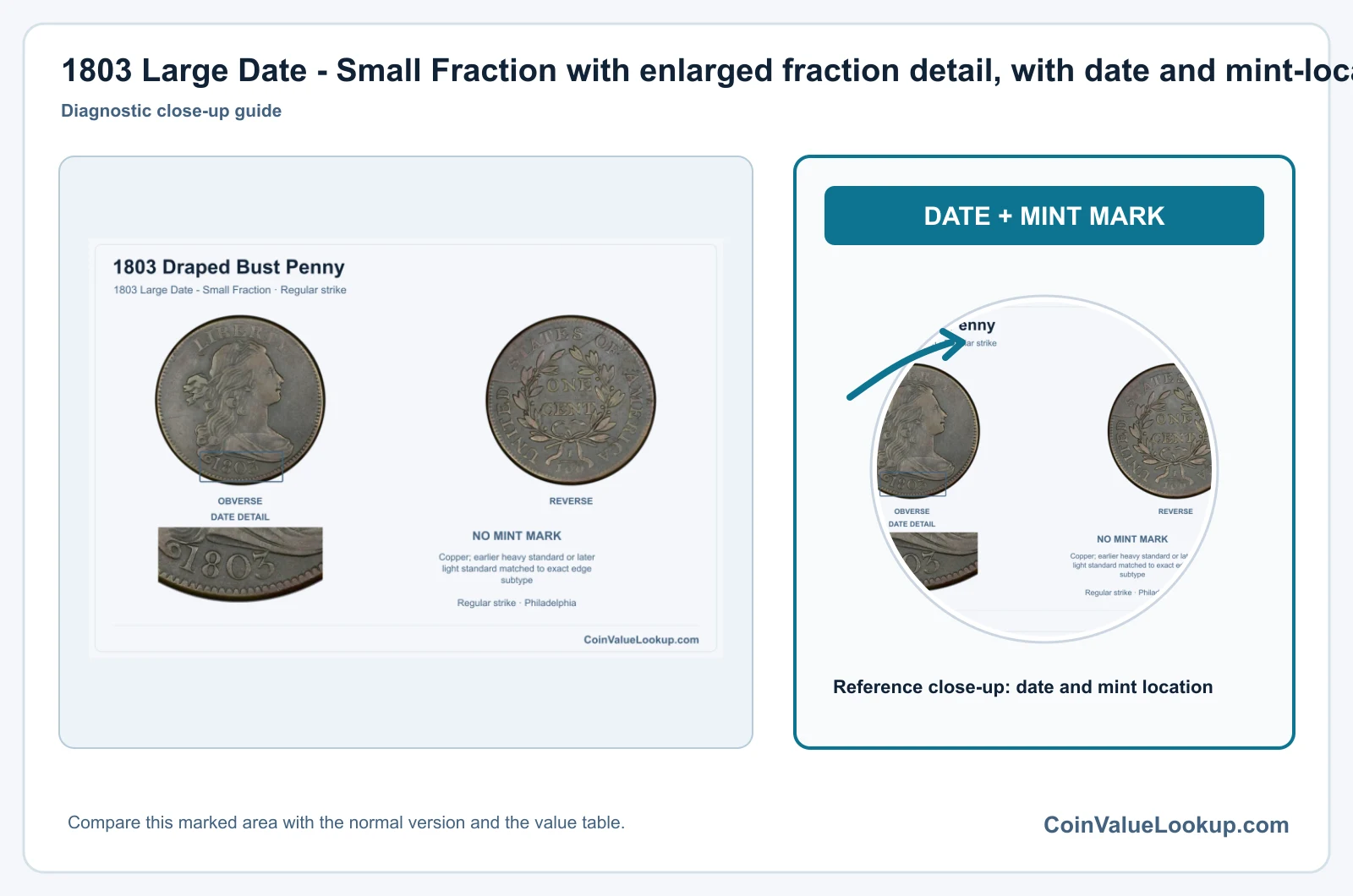
This is the headline variety for 1803. The Large Date obverse uses wider, bolder numerals that are plainly different from the compact Small Date punch when viewed at equal magnification.
Pair that with the Small Fraction reverse and you have the rarest listed combination. Guide estimates are roughly $11,083 in G4 and a striking $86,973 in EF40.
The copper standard for this variety may be the earlier heavy planchet or the later light one, matched to the exact edge subtype. Given the values involved, professional attribution and authentication are strongly recommended before buying or selling.
Range Grade
Price Auction Records Appraisal PO PO 1
—
Coin Identifier FR FR 2
—
Coin Identifier AG AG 3
Coin Identifier G G 4
Coin Identifier
G 6
—
Coin Identifier VG VG 8
—
Coin Identifier
VG 10
Coin Identifier F F 12
—
Coin Identifier
F 15
—
Coin Identifier VF VF 20
Coin Identifier
VF 25
—
Coin Identifier
VF 30
—
Coin Identifier
VF 35
Coin Identifier XF XF 40
—
Coin Identifier
XF 45
—
—
— AU AU 50
—
—
—
AU 53
—
—
—
AU 55
—
—
—
AU 58
—
—
— MS MS 60
—
—
—
MS 61
—
—
—
MS 62
—
—
—
MS 63
—
—
—
MS 64
—
—
—
MS 65
—
—
—
MS 66
—
—
—
MS 67
—
—
—
MS 68
—
—
—
MS 69
—
—
—
MS 70
—
—
—
1803 Draped Bust Cent — Large Date – Large Fraction
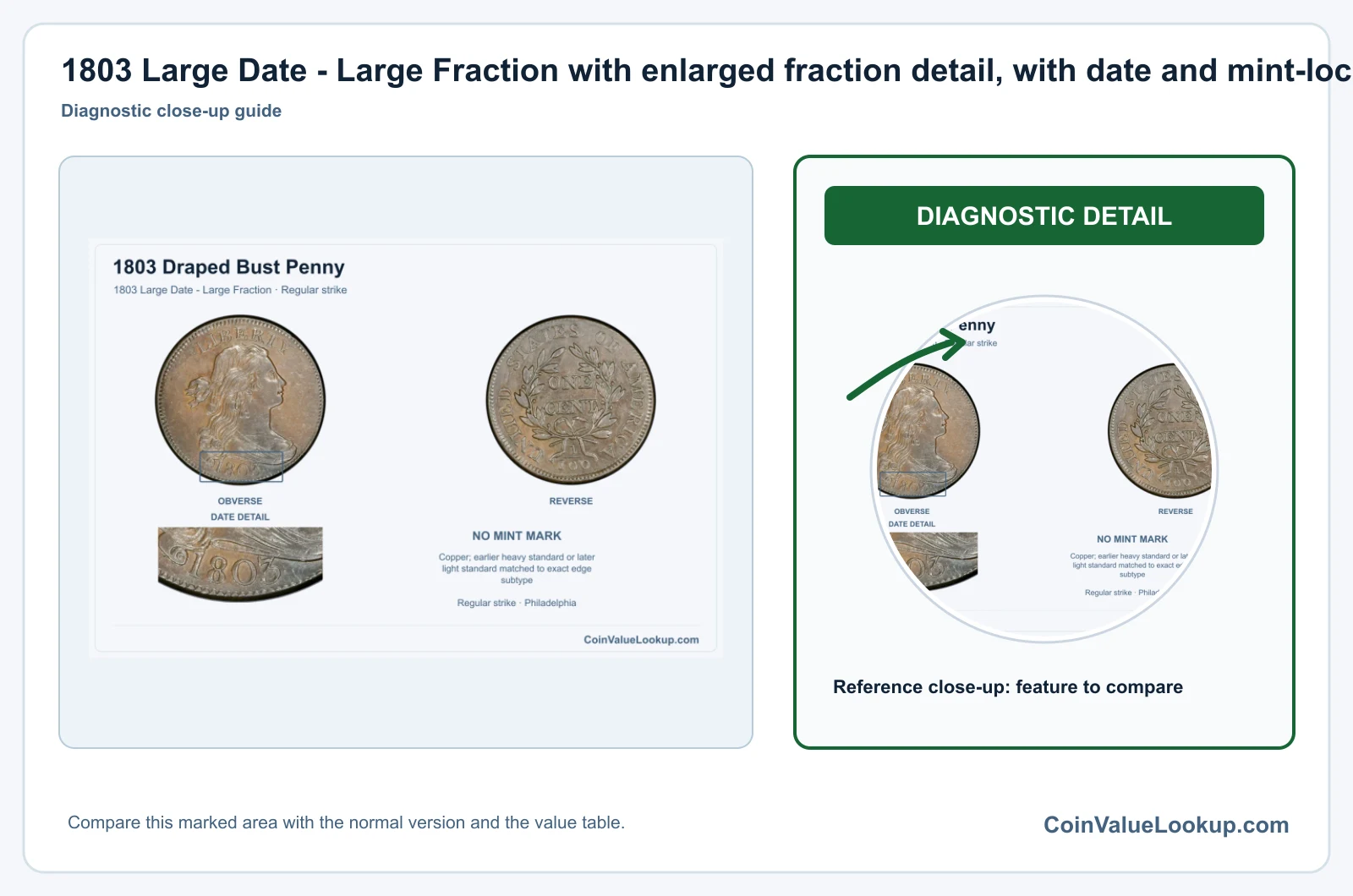
The Large Date paired with a Large Fraction reverse is scarce but far more obtainable than its Small Fraction counterpart. The same bold date numerals appear on the obverse, while the reverse fraction digits are the taller, wider version.
Guide estimates come in around $341 in G4 and $6,827 in EF40. As with the other Large Date variety, the copper planchet weight standard can vary, and exact attribution requires comparing the date and fraction against reference examples at equal scale.
Range Grade
Price Auction Records Appraisal PO PO 1
—
Coin Identifier FR FR 2
—
Coin Identifier AG AG 3
—
Coin Identifier G G 4
—
Coin Identifier
G 6
Coin Identifier VG VG 8
Coin Identifier
VG 10
—
Coin Identifier F F 12
—
Coin Identifier
F 15
Coin Identifier VF VF 20
Coin Identifier
VF 25
—
Coin Identifier
VF 30
Coin Identifier
VF 35
—
Coin Identifier XF XF 40
Coin Identifier
XF 45
—
Coin Identifier AU AU 50
—
Coin Identifier
AU 53
Coin Identifier
AU 55
—
Coin Identifier
AU 58
Coin Identifier MS MS 60
—
—
—
MS 61
—
—
—
MS 62
—
—
—
MS 63
—
—
—
MS 64
—
—
—
MS 65
—
—
—
MS 66
—
—
—
MS 67
—
—
—
MS 68
—
—
—
MS 69
—
—
—
MS 70
—
—
—
1803 Draped Bust Cent Error List
1. 1803 Draped Bust Cent — Blundered Fraction / Reverse Lettering
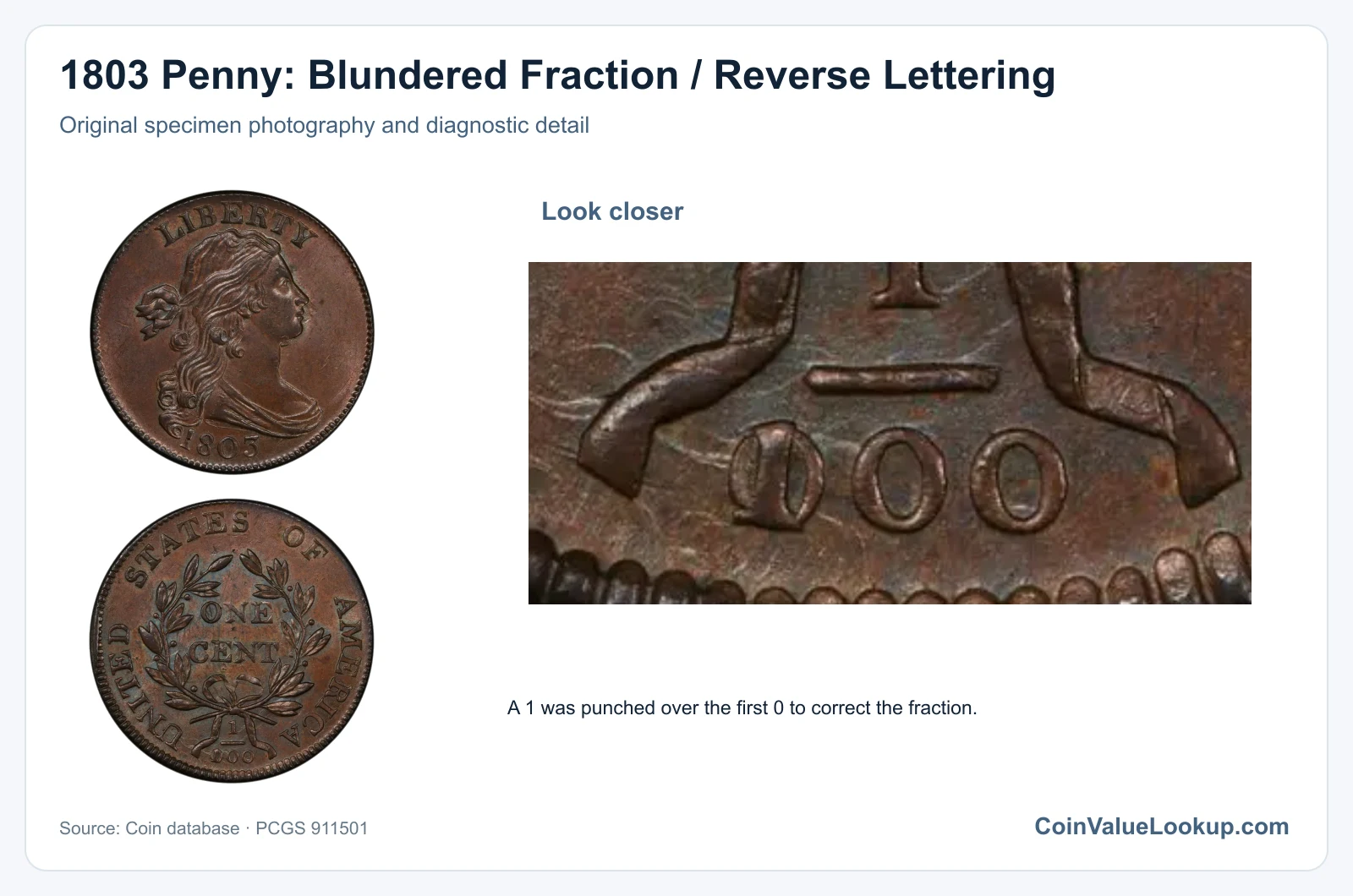
A blundered fraction or reverse lettering error on an 1803 Draped Bust Cent involves extra, missing, or misplaced digits in the 1/100 denomination or irregularities in the UNITED STATES inscription. To spot it, compare your reverse closely against a known normal example.
Look for ghost digits, doubled fraction bars, or letters that seem shifted or partially corrected.
Wear that obscures the fraction or a scratch across the denomination bar can mimic this error, so magnification and careful lighting are important. Old copper surfaces love to hide details in pitting and corrosion.
No specific price range is adopted for this category; value depends on the authenticated identity of the error, its severity, and the coin's overall condition. Professional evaluation is the safest route.
2. 1803 Draped Bust Cent — Brockage
A brockage occurs when a previously struck coin sticks to a die and impresses its design into the next blank. The result is one normal side and one side showing an incuse, mirror-image version of the opposite design.
On an 1803 cent, you would see the Draped Bust portrait or the wreath sunk into the planchet in reverse relief.
Die clashes and post-mint damage from coins pressed together can produce vaguely similar marks, but a genuine brockage shows a complete, spread mirror image with consistent depth. No specific price is adopted for this error on the 1803 cent.
Each example would need individual assessment based on its authenticated identity, the completeness of the brockage impression, and the coin's physical condition.