1893 Indian Head Penny Coin Value: How Much Is It Worth?
A circulated 1893 Indian Head penny in Good-4 condition carries a guide value around $3.62, while an uncirculated example at MS63 can reach roughly $100. Proof strikes are a different animal entirely, with PR63 pieces listed near $313.
These are retail guide estimates from USA Coin Book, not guaranteed buy prices. Actual results depend on your coin's exact condition, surfaces and originality.
Fast Way to Identify Your 1893 Indian Head Penny
Want a quick read on what you have? Upload clear photos of both the front and back of your 1893 Indian Head cent.
Our identifier can offer a preliminary take on the version and general condition, helping you figure out what to research next. It works best with good lighting and a sharp, centered image of each side.
1893 Indian Head Penny Value
Upload both sides of your 1893 Indian Head Penny.
Front Obverse
Upload photo
Back Reverse
Upload photo
Which 1893 Indian Head Penny Versions Are Worth Money?
- Business strikes jump sharply from circulated to uncirculated grades; an MS63 example lists near $100 versus $3.62 at G4.
- Proof 1893 Indian cents, struck specially at Philadelphia, carry a PR63 guide value around $313 and require careful surface verification.
- Coins retaining original red or red-brown color in Mint State grades are typically more desirable than fully brown examples.
- Recognized die errors such as doubled die obverse, repunched date or off-center strikes require individual assessment and can add significant value beyond standard pricing.
Step 1: Identify Your 1893 Indian Head Penny Mint Mark and Version
Every regular-issue 1893 Indian Head cent was struck at the Philadelphia Mint. There is no mintmark on this coin, and the small "L" on the ribbon behind the neck is the designer's initial, not a mint identifier.
The obverse shows a Liberty portrait wearing a feathered headdress, while the reverse features an oak wreath enclosing the denomination with a small shield at the top. If your coin has wheat ears on the back or a plain flying eagle, you are looking at a different series entirely.
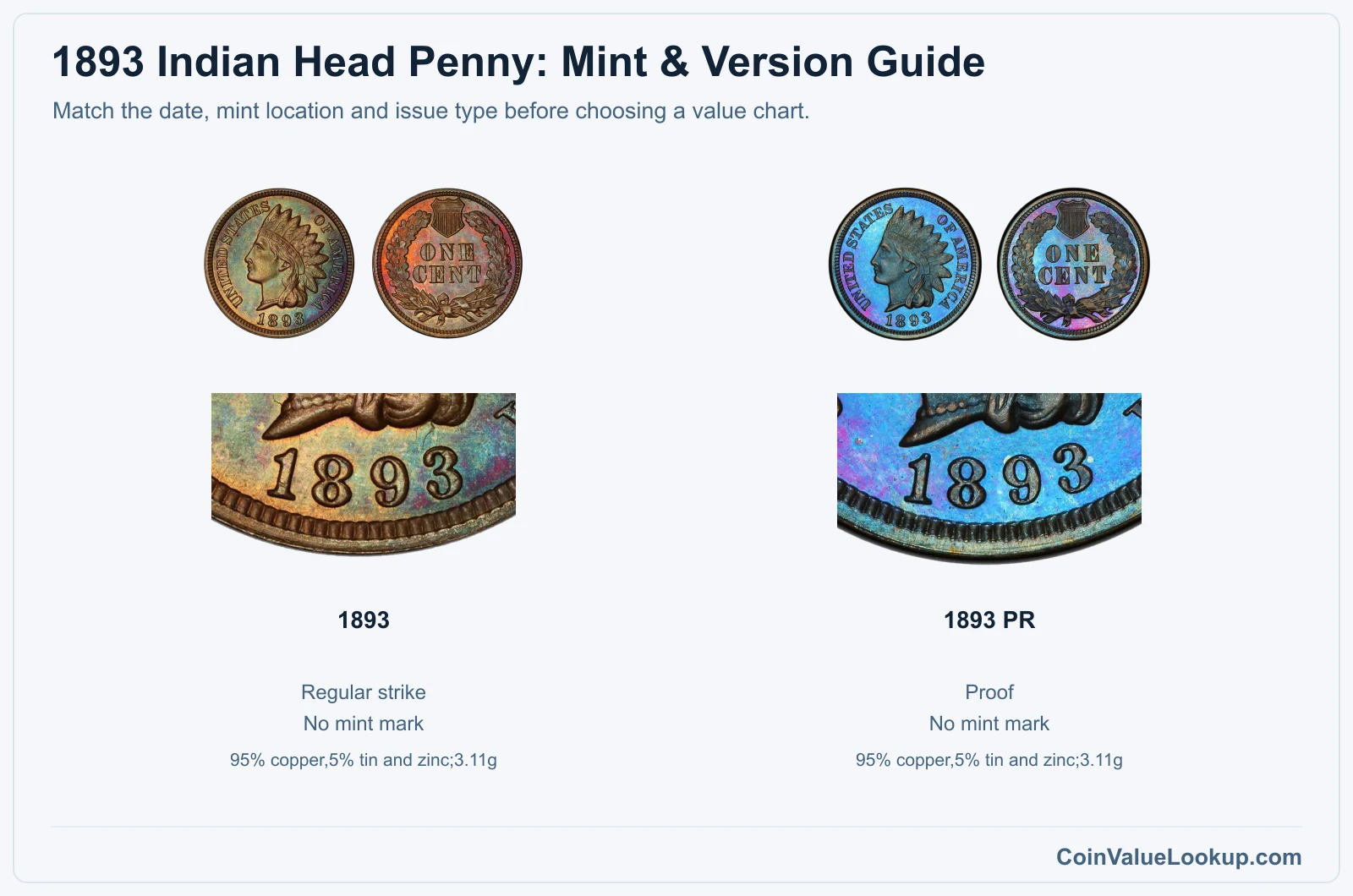
Two main branches exist for 1893: the standard business strike made for circulation and the proof, a specially manufactured coin with mirrored surfaces intended for collectors. A proof is a method of manufacture, not a higher grade than Mint State.
Polishing a business strike at home does not create a proof; genuine proofs show squared rims, fully struck details and a distinctive surface finish from specially prepared dies and planchets.
Before looking up any value, confirm you have the correct year, the Indian Head design and whether the coin's surfaces suggest business-strike or proof origin. That narrows you to the right price column immediately.
Step 2: Check Your 1893 Indian Head Penny Grade
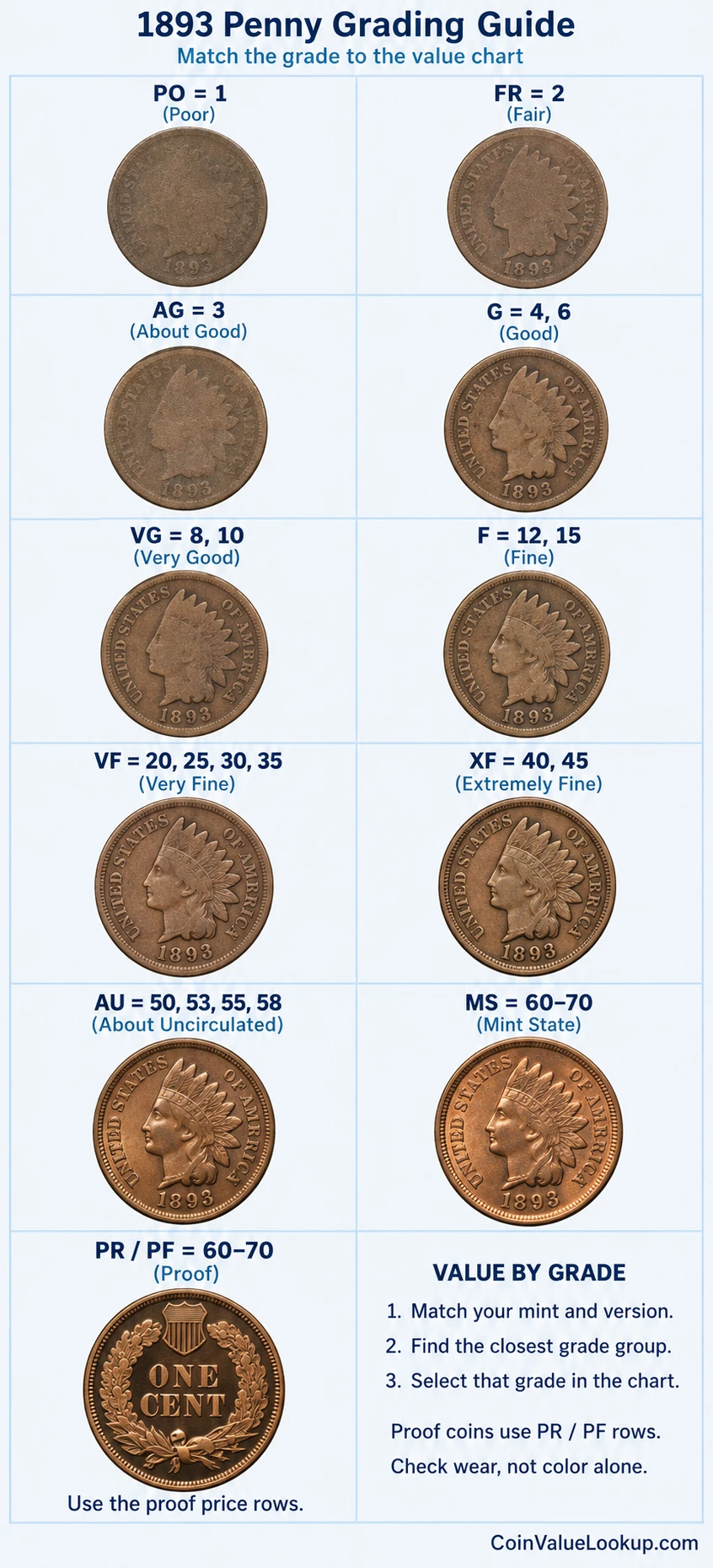
Start with the headband. On a well-struck 1893 cent, the word LIBERTY is incused into the band across the forehead.
In lower grades, these letters gradually disappear from the ends inward, with "L" and "Y" fading first.
Check the feather tips above the headband and the hair curls below the ear. These are high points that show wear earliest.
A coin grading around Good-4 will have a smooth portrait outline with almost no interior detail.
Move to the reverse wreath. The individual leaf veins wear away before the main leaf shapes do.
At Very Fine and above, most veins should still be visible.
Luster matters once you get into About Uncirculated and Mint State territory. Original mint luster on a bronze Indian cent can range from brown (BN) to red-brown (RB) to full red (RD).
These color designations describe how much original copper tone remains; they are not separate metals.
One trap: the 1893 can come softly struck at the feather tips and diamond pearls even on high-grade pieces. A weak strike is not the same as wear.
Compare your coin to the reference image and look for the smooth, rounded loss of metal that real circulation creates, versus the flat-but-sharp appearance of a soft original strike. Cleaning, scratches and corrosion all reduce a coin's market appeal regardless of the technical grade.
Step 3: Check 1893 Indian Head Penny Value by Mint and Version
1893 Indian Head Penny
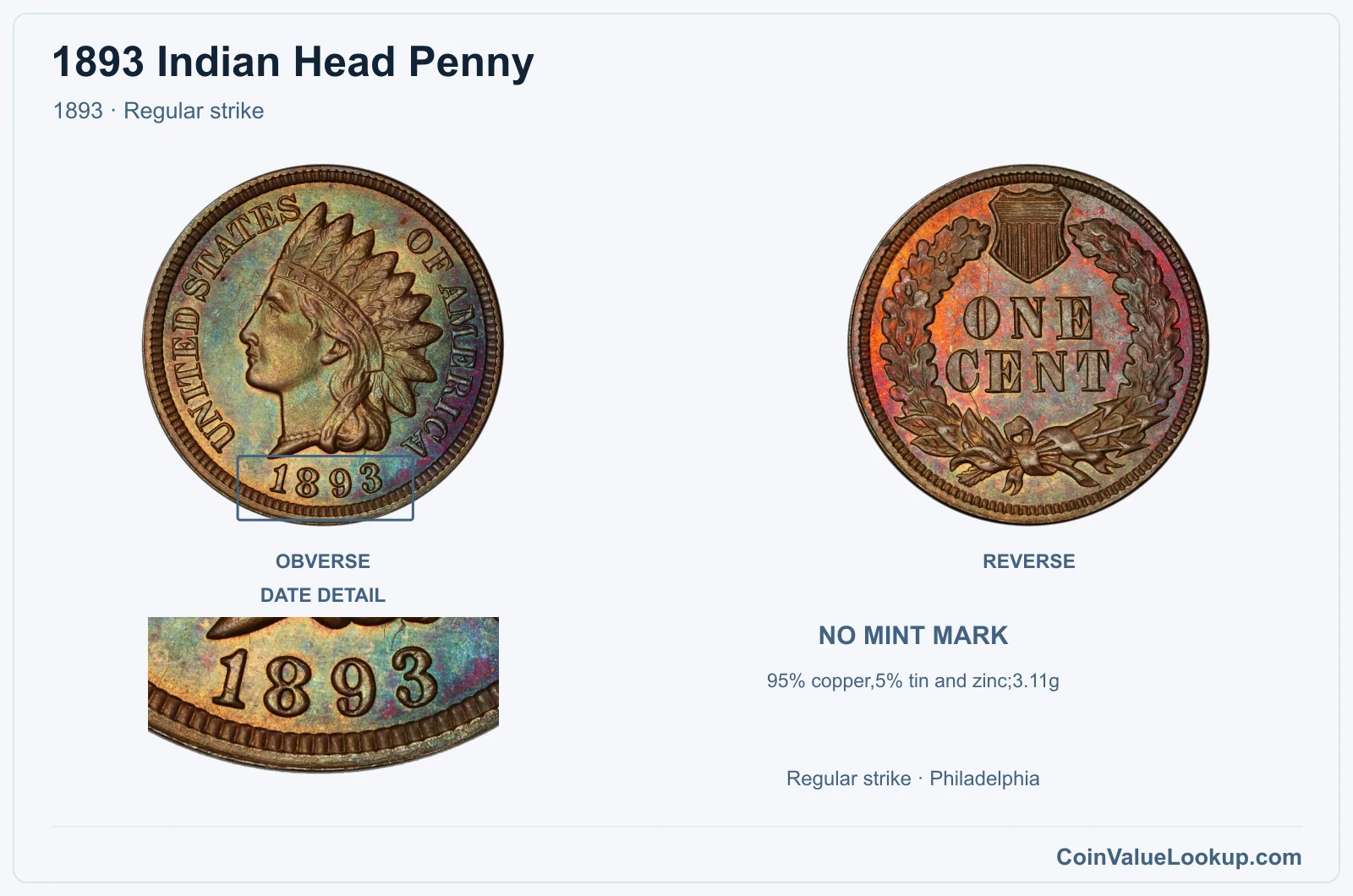
The standard 1893 Indian Head cent is a Philadelphia business strike, composed of 95% copper with 5% tin and zinc, weighing 3.11 grams. No mintmark appears on the coin.
Guide values run from about $3.62 in G4 to around $100 at MS63, per USA Coin Book.
That jump from a few dollars to triple digits is almost entirely about surface preservation. A coin with full LIBERTY, sharp feather detail and unbroken original luster lands in a completely different bracket than a smooth, dark pocket piece.
Watch for cleaned or artificially toned examples masquerading as higher grades; original surfaces sell more readily. Do not borrow pricing from proof or rare-variety listings when evaluating a regular strike.
| Range | Grade | Price | Auction Records | Appraisal |
|---|---|---|---|---|
| PO | PO 1 | — | Coin Identifier | |
| FR | FR 2 | — | Coin Identifier | |
| AG | AG 3 | — | Coin Identifier | |
| G | G 4 | — | Coin Identifier | |
| G 6 | Coin Identifier | |||
| VG | VG 8 | — | Coin Identifier | |
| VG 10 | — | Coin Identifier | ||
| F | F 12 | — | Coin Identifier | |
| F 15 | — | Coin Identifier | ||
| VF | VF 20 | — | Coin Identifier | |
| VF 25 | — | Coin Identifier | ||
| VF 30 | Coin Identifier | |||
| VF 35 | — | Coin Identifier | ||
| XF | XF 40 | — | Coin Identifier | |
| XF 45 | Coin Identifier | |||
| AU | AU 50 | — | Coin Identifier | |
| AU 53 | — | Coin Identifier | ||
| AU 55 | Coin Identifier | |||
| AU 58 | Coin Identifier | |||
| MS | MS 60 | — | Coin Identifier | |
| MS 61 | — | Coin Identifier | ||
| MS 62 | Coin Identifier | |||
| MS 63 | Coin Identifier | |||
| MS 64 | Coin Identifier | |||
| MS 65 | Coin Identifier | |||
| MS 66 | Coin Identifier | |||
| MS 67 | — | Coin Identifier | ||
| MS 68 | — | — | — | |
| MS 69 | — | — | — | |
| MS 70 | — | — | — |
1893 Indian Head Penny — PR
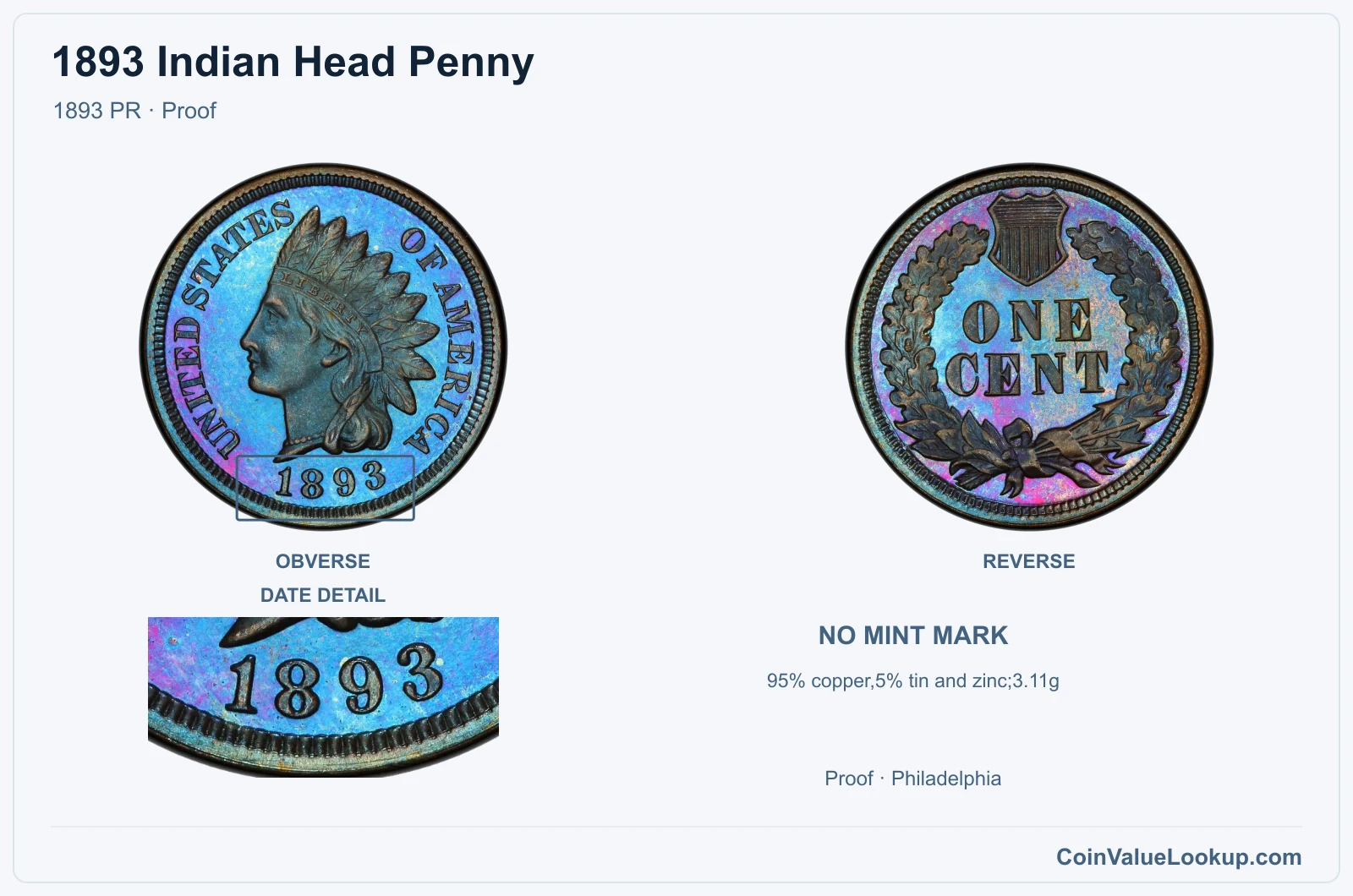
The 1893 proof Indian Head cent was also struck at Philadelphia with the same bronze composition and weight as the business strike. The difference is manufacturing: proof coins were made on polished planchets using specially prepared dies, producing mirrored fields and sharp, squared rims.
A PR63 example carries a guide value near $313, per USA Coin Book. That is a significant step up from the regular strike at the same approximate quality level.
Confirming proof status is the critical step. Look for reflective, glass-like fields, knife-edge rims and full design detail that goes beyond what even a choice uncirculated business strike shows.
If you're exploring values for other dates and denominations, Coin Value Lookup is a good starting point for browsing coin guides organized by series and year. Never assume a shiny business strike is a proof; post-mint polishing flattens luster and leaves hairlines that genuine proofs struck from fresh dies do not share.
| Range | Grade | Price | Auction Records | Appraisal |
|---|---|---|---|---|
| PR | PR 1 | — | Coin Identifier | |
| PR 2 | — | Coin Identifier | ||
| PR 3 | — | Coin Identifier | ||
| PR 4 | — | Coin Identifier | ||
| PR 6 | — | Coin Identifier | ||
| PR 8 | — | Coin Identifier | ||
| PR 10 | — | Coin Identifier | ||
| PR 12 | — | Coin Identifier | ||
| PR 15 | — | Coin Identifier | ||
| PR 20 | — | Coin Identifier | ||
| PR 25 | — | Coin Identifier | ||
| PR 30 | — | Coin Identifier | ||
| PR 35 | — | Coin Identifier | ||
| PR 40 | — | Coin Identifier | ||
| PR 45 | — | Coin Identifier | ||
| PR 50 | — | Coin Identifier | ||
| PR 53 | — | Coin Identifier | ||
| PR 55 | — | Coin Identifier | ||
| PR 58 | — | Coin Identifier | ||
| PR 60 | — | Coin Identifier | ||
| PR 61 | — | Coin Identifier | ||
| PR 62 | Coin Identifier | |||
| PR 63 | Coin Identifier | |||
| PR 64 | Coin Identifier | |||
| PR 65 | Coin Identifier | |||
| PR 66 | Coin Identifier | |||
| PR 67 | — | Coin Identifier | ||
| PR 68 | — | — | — | |
| PR 69 | — | — | — | |
| PR 70 | — | — | — |
1893 Indian Head Penny Error List
1. 1893 Indian Head Penny — Die Break / Cud
A cud on an 1893 Indian Head cent appears as a raised, featureless blob connected to the rim, caused by a piece of the die breaking away entirely. The missing chunk means the corresponding area of the coin receives no design impression, just a smooth lump of metal flowing outward to the rim edge.
To confirm a cud, check that the raised area connects to the rim and that the surrounding design elements stop cleanly at its boundary. A rim dent pushed inward, interior corrosion or a small die chip that does not reach the rim are common lookalikes.
Authenticated identity, the size and location of the break, and overall coin condition all factor into value; no standard price range applies across all examples.
2. 1893 Indian Head Penny — Misplaced Date
A misplaced date on the 1893 Indian cent shows partial impressions of one or more date digits in the wrong location, typically embedded among the denticles near the rim or partially hidden by the portrait. This happened when the date punch landed in an unintended spot before being correctly positioned.
The key diagnostic is recognizing the shape of an actual numeral, such as part of an "8" or "9," in an area where no date digit belongs. Compare any suspicious bump against known examples.
Random die chips, scratches or tiny lumps of displaced metal can mimic date fragments but lack the specific contour of a numeral. Value depends on clarity, position and the coin's overall grade; each piece needs individual assessment.
3. 1893 Indian Head Penny — Repunched Date
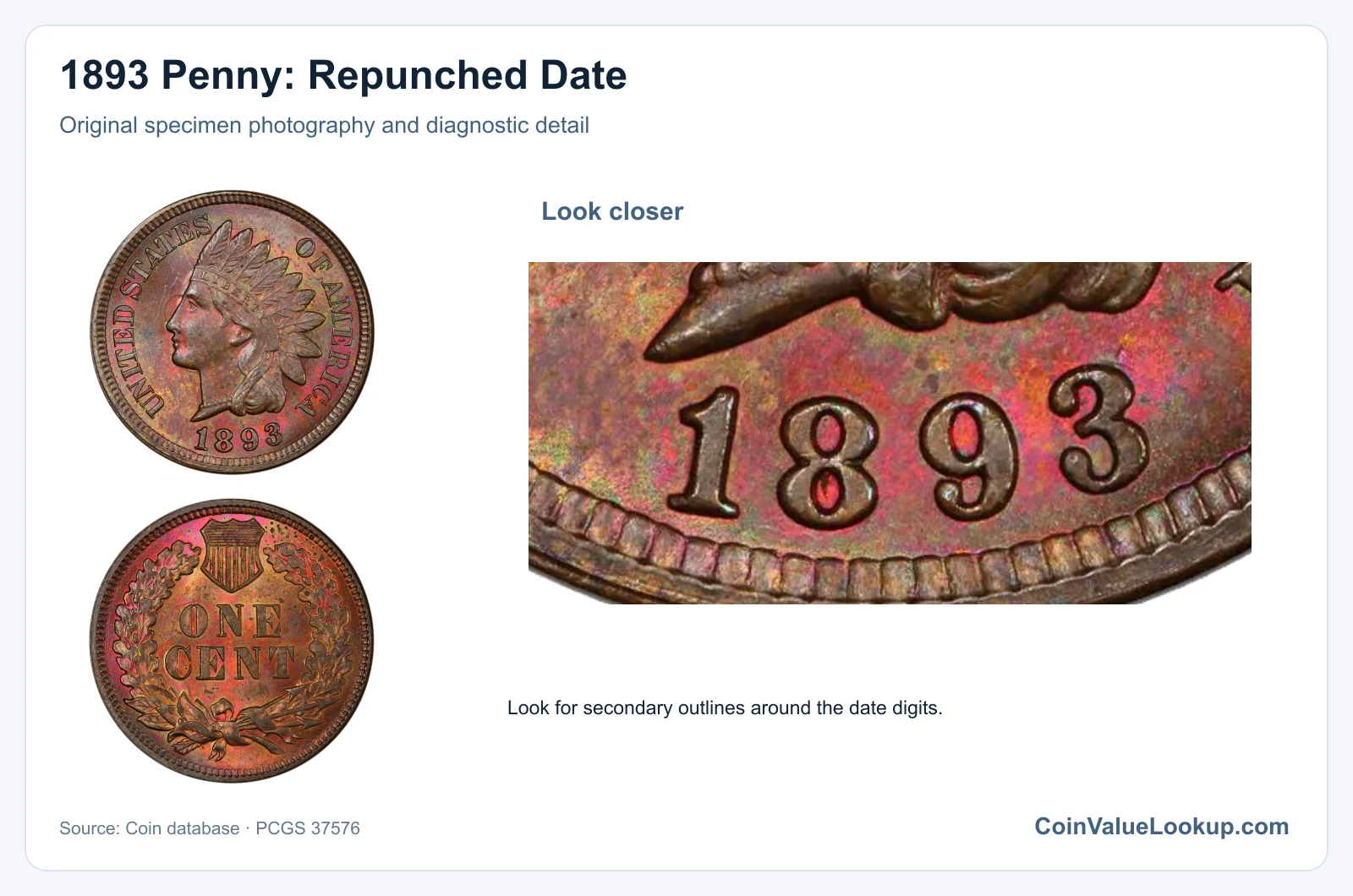
A repunched date variety shows traces of an earlier punch position alongside the final date numerals. On an 1893 cent, you might see a shadow or partial outline of one or more digits slightly offset from the accepted position, most visible under magnification.
This is a die variety, not the same thing as doubled die doubling, which affects the entire obverse hub impression. Repunching is limited to the hand-entered date.
Look for consistent secondary outlines on the numerals rather than the flat, shelf-like distortion typical of machine doubling. A damaged or corroded date can also create confusing outlines.
Confirmed repunched date coins are valued individually based on the clarity of the extra impression and the coin's condition.
4. 1893 Indian Head Penny — Die Crack
Die cracks on an 1893 Indian Head cent appear as thin, raised lines running across the coin's surface. They form when the steel die develops a fracture from repeated striking pressure, and the crack transfers as a ridge onto every coin struck from that die afterward.
The line will be raised above the field, not incised into it. That is the fastest way to distinguish a genuine die crack from a scratch, which cuts into the metal.
Corrosion lines and displaced-metal scrapes can also mimic cracks but lack the consistent, slightly wandering path that follows stress patterns in the die. Location, length and the coin's overall condition all influence desirability; no fixed price range covers every die crack example.
5. 1893 Indian Head Penny — Clashed Dies
Clashed dies occur when the obverse and reverse dies strike each other without a planchet between them. The result is a faint ghost of the opposite design transferred onto each die, which then appears on subsequent coins as subtle extra impressions in the fields.
On an 1893 Indian cent, you might spot faint wreath outlines in the obverse field or traces of the portrait on the reverse. These impressions align with where the opposing design would sit during a normal strike.
Scratches, random raised lines or a brockage (where an entire struck coin acts as a die) can look similar but will not match the expected position of the opposite design. Value varies with clash strength and coin grade; individual assessment is needed.
6. 1893 Indian Head Penny — Die Chip
A die chip shows up as a small, raised lump on the coin's surface, usually filling part of a letter, numeral or nearby field. It forms when a tiny fragment breaks away from the die face, leaving a void that fills with metal during striking.
On an 1893 Indian cent, common spots include inside the loops of letters like "E" or "O" and within the wreath details. The lump should merge smoothly into the surrounding struck design, which distinguishes it from glued debris or a post-mint gouge.
A gouge cuts into the surface, while a die chip rises above it. Most die chips are minor and collected as curiosities, but larger or dramatically placed chips attract more attention.
Value requires individual evaluation based on size, location and condition.
7. 1893 Indian Head Penny — Off-Center Strike
An off-center strike happens when the planchet is not properly seated between the dies, resulting in a displaced design and an unstruck crescent of blank metal along one edge. On an 1893 Indian cent, the degree of misalignment can range from barely noticeable to dramatic.
Collectors generally prefer off-center errors that still show the full date, since the date confirms the coin's year and identity. A clipped planchet, which has a curved missing section but a fully centered design, is a different error.
One-sided die misalignment or post-mint flattening can also create confusing appearances. Each off-center coin is valued individually based on the percentage of displacement, date visibility and overall preservation.
8. 1893 Indian Head Penny — Doubled Die Obverse
A doubled die obverse on the 1893 Indian Head cent shows consistent doubling on obverse design elements such as letters, the date or portrait details. This doubling originates during die manufacture, so it appears identically on every coin struck from that die.
The hallmark of genuine hub doubling is separation or notching on affected elements that stays consistent across the design. Machine doubling, by contrast, produces a flat, shelf-like distortion typically strongest on one side of the affected feature.
Reflections under certain lighting and worn die contours can also trick the eye. Examine the coin under steady, angled light and compare each letter to a known normal example.
Confirmed doubled die pieces need individual assessment for value based on doubling strength and coin condition.