1893 Barber Dime Coin Value: How Much Is It Worth?
The 1893 Barber Dime spans three business-strike mints and a proof issue, with guide estimates running from about $14 at G4 for a Philadelphia coin up to $725 at MS63 for the New Orleans or San Francisco strikes. A traditionally labelled 1893/2 overdate variety commands significantly higher prices.
Condition matters enormously here, so understanding what you actually have is the first step.
Fast Way to Identify Your 1893 Barber Dime
The quickest way to start figuring out your 1893 Barber Dime is to upload clear photos of the front and back. Our identifier can offer a preliminary identification of your coin's mint and general type based on those images.
It will not authenticate errors, assign an exact grade, or guarantee a price, but it gives you a solid starting point for further research.
1893 Barber Dime Value
Upload both sides of your 1893 Barber Dime.
Front Obverse
Upload photo
Back Reverse
Upload photo
Which 1893 Barber Dime Versions Are Worth Money?
- The 1893/2 overdate variety (Philadelphia) lists around $181 at G4 and $2,501 at MS63 in guide estimates, far above the ordinary Philadelphia strike.
- New Orleans and San Francisco business strikes both reach roughly $725 at MS63, considerably more than the Philadelphia issue at the same grade.
- A repunched mintmark on the 1893-S and a die cap error on the 1893-O are recognized error types that can add value depending on condition and visibility.
Step 1: Identify Your 1893 Barber Dime Mint Mark and Version
The 1893 Barber Dime shows Charles Barber's right-facing Liberty head on the obverse and the words ONE DIME inside a cereal wreath on the reverse. Do not confuse this with a Mercury Dime or a Seated Liberty design; the Barber has a distinctly classical profile with a Liberty cap and laurel.
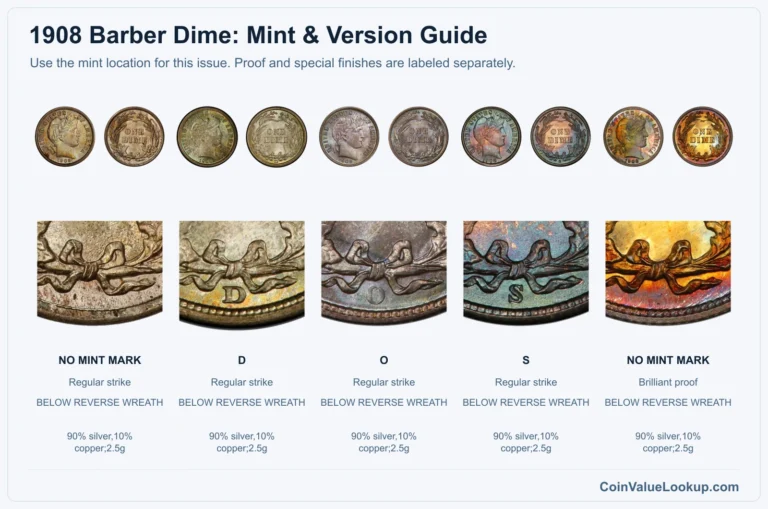
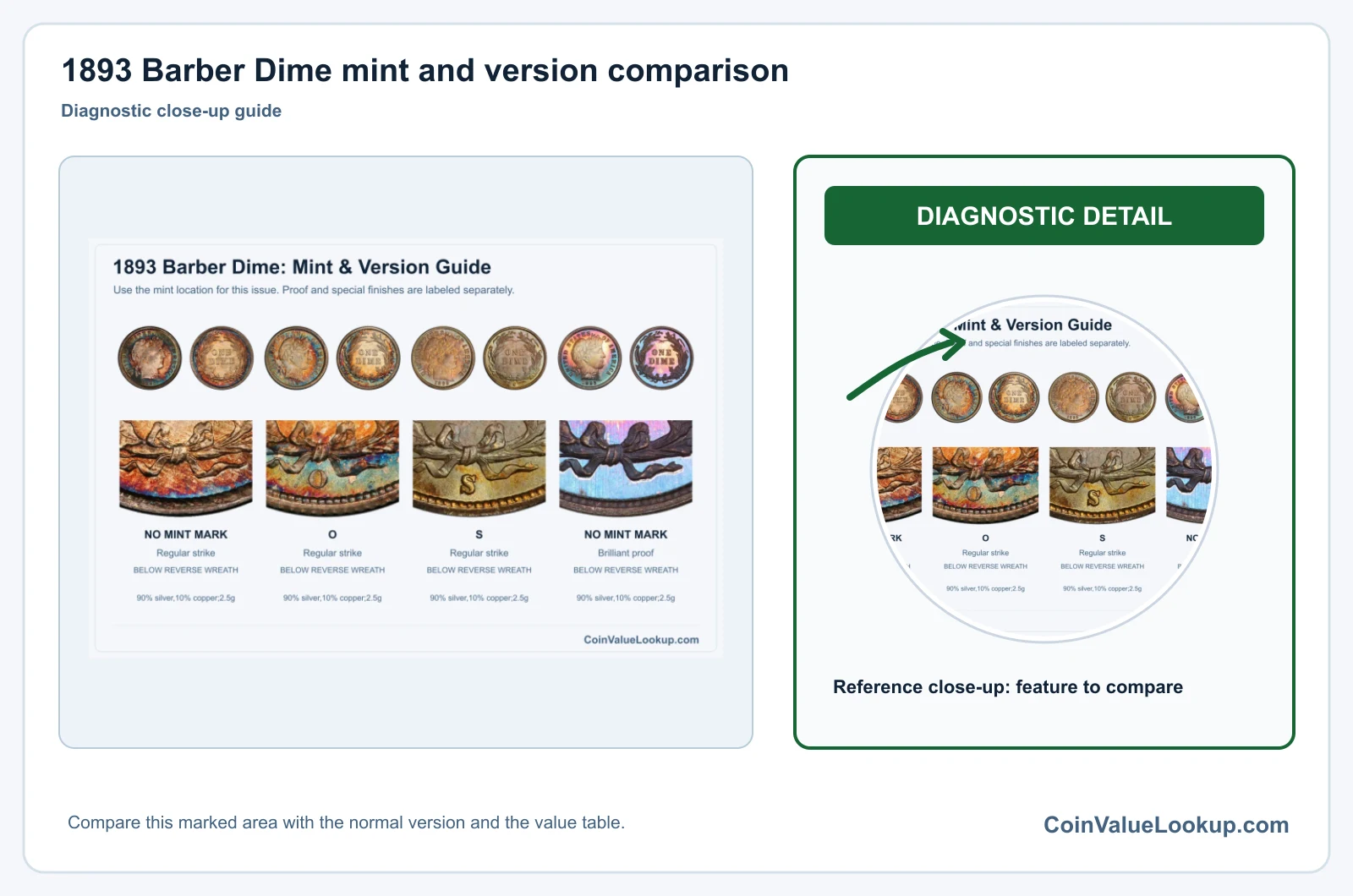
Three mints produced business strikes this year: Philadelphia, New Orleans, and San Francisco. The mintmark sits below the wreath's ribbon bow on the reverse.
No mintmark means Philadelphia; an "O" means New Orleans; an "S" means San Francisco.
All standard 1893 Barber Dimes are struck in 90% silver and 10% copper, weigh 2.5 grams, measure 17.9 mm across, and have a reeded edge. These specs are consistent across all three mints.
One important variety to watch for is the traditionally labelled 1893/2 overdate, struck at Philadelphia. Look closely at the last digit of the date; a remnant of a "2" may be visible beneath the "3." This is a recognized variety, not a simple error, and it carries a meaningful premium.
A repunched mintmark on the S-mint and a die cap error on the O-mint are covered in the error section below.
Step 2: Check Your 1893 Barber Dime Grade
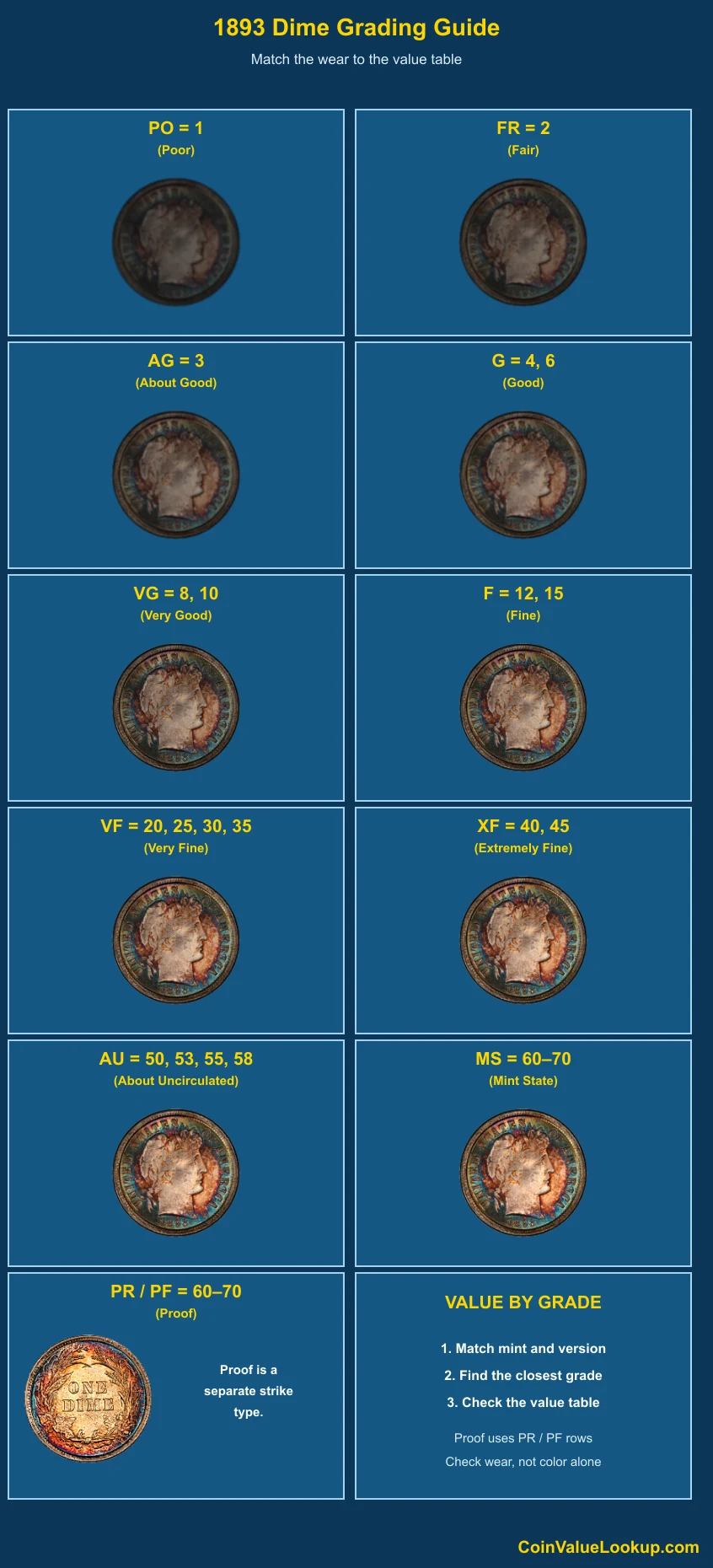
Grading a Barber Dime means evaluating the entire coin, not just counting visible letters in the LIBERTY headband. Yes, that headband is important, but also check the hair detail above the ear, the smoothness of the cheek, the wreath leaves, and the rim sharpness.
A coin in Good (G4) condition will have a smooth portrait outline with most interior detail worn away. The date and mintmark should still be legible.
Fine and Very Fine grades show progressively more headband lettering and hair strands.
Mint State requires unbroken original luster across both sides. Look carefully under good light for hairlines from old cleaning or for small scratches that break the cartwheel effect.
Cleaned coins are not Mint State coins, no matter how shiny they look.
New Orleans pieces deserve extra patience. They can come with a softer strike from the factory, which means less headband detail even on a higher-grade coin.
Do not automatically downgrade an O-mint just because LIBERTY looks mushy; compare it against the comparison image and consider whether the weakness is from wear or from a soft impression.
Proof is a manufacturing method, not a grade above Mint State. Proofs have mirrored fields and sharp rims produced by specially prepared dies and planchets.
An attractive circulated coin is not a proof.
Step 3: Check 1893 Barber Dime Value by Mint and Version
1893 Barber Dime — No Mint Mark — Silver Circulation
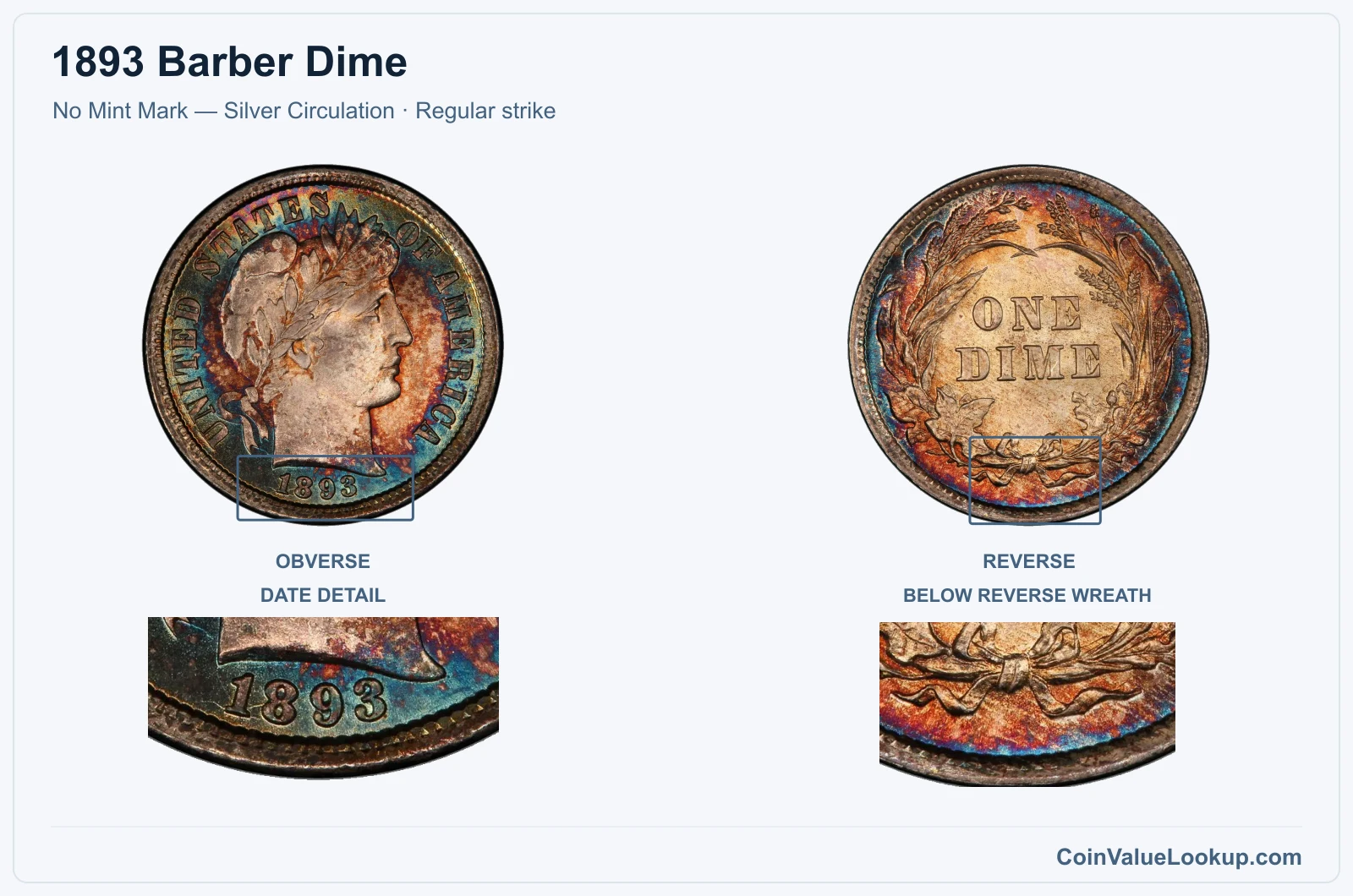
The ordinary 1893 Philadelphia Barber Dime has no mintmark. Look at the reverse below the wreath bow; if the space is clean, you have a Philly coin.
Guide estimates place this issue at about $14 in G4 and around $348 in MS63.
This is the most accessible 1893 Barber Dime for collectors. Even so, a genuinely uncirculated example with full luster is not common, and that jump from $14 to $348 reflects real scarcity in higher grades.
Make sure you are not confusing this coin with the 1893/2 overdate variety, which also lacks a mintmark but shows date-punch remnants.
Range Grade
Price Auction Records Appraisal PO PO 1
—
Coin Identifier FR FR 2
—
Coin Identifier AG AG 3
—
Coin Identifier G G 4
—
Coin Identifier
G 6
—
Coin Identifier VG VG 8
—
Coin Identifier
VG 10
—
Coin Identifier F F 12
Coin Identifier
F 15
—
Coin Identifier VF VF 20
—
Coin Identifier
VF 25
—
Coin Identifier
VF 30
—
Coin Identifier
VF 35
—
Coin Identifier XF XF 40
Coin Identifier
XF 45
Coin Identifier AU AU 50
—
Coin Identifier
AU 53
—
Coin Identifier
AU 55
Coin Identifier
AU 58
Coin Identifier MS MS 60
—
Coin Identifier
MS 61
Coin Identifier
MS 62
Coin Identifier
MS 63
Coin Identifier
MS 64
Coin Identifier
MS 65
Coin Identifier
MS 66
Coin Identifier
MS 67
Coin Identifier
MS 68
—
—
—
MS 69
—
—
—
MS 70
—
—
—
1893 Barber Dime — O — Silver Circulation
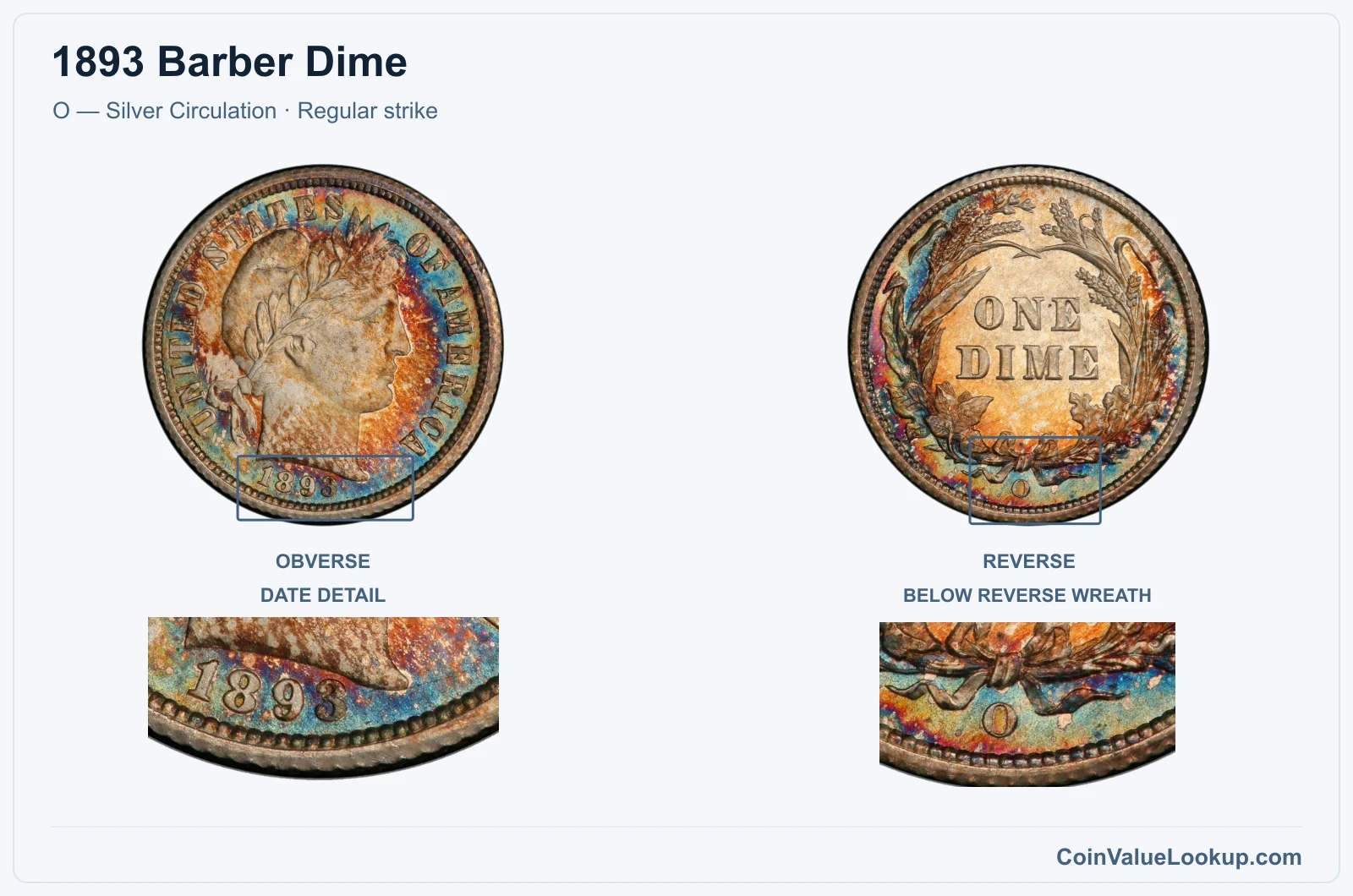
The 1893-O carries a small "O" mintmark below the wreath bow on the reverse. Guide estimates run from about $43 at G4 to roughly $725 at MS63, making it pricier than Philadelphia across the board.
New Orleans Barber Dimes are notorious for soft strikes, so do not panic if the headband letters are not razor-sharp. That softness was baked in at the mint.
Still, a true MS63 example needs full, unbroken luster and no post-mint damage. Finding one that checks every box is the hard part.
Range Grade
Price Auction Records Appraisal PO PO 1
—
Coin Identifier FR FR 2
—
Coin Identifier AG AG 3
—
Coin Identifier G G 4
Coin Identifier
G 6
—
Coin Identifier VG VG 8
—
Coin Identifier
VG 10
—
Coin Identifier F F 12
Coin Identifier
F 15
Coin Identifier VF VF 20
Coin Identifier
VF 25
Coin Identifier
VF 30
Coin Identifier
VF 35
Coin Identifier XF XF 40
Coin Identifier
XF 45
Coin Identifier AU AU 50
Coin Identifier
AU 53
Coin Identifier
AU 55
Coin Identifier
AU 58
Coin Identifier MS MS 60
—
Coin Identifier
MS 61
Coin Identifier
MS 62
Coin Identifier
MS 63
Coin Identifier
MS 64
Coin Identifier
MS 65
Coin Identifier
MS 66
Coin Identifier
MS 67
Coin Identifier
MS 68
—
—
—
MS 69
—
—
—
MS 70
—
—
—
1893 Barber Dime — S — Silver Circulation
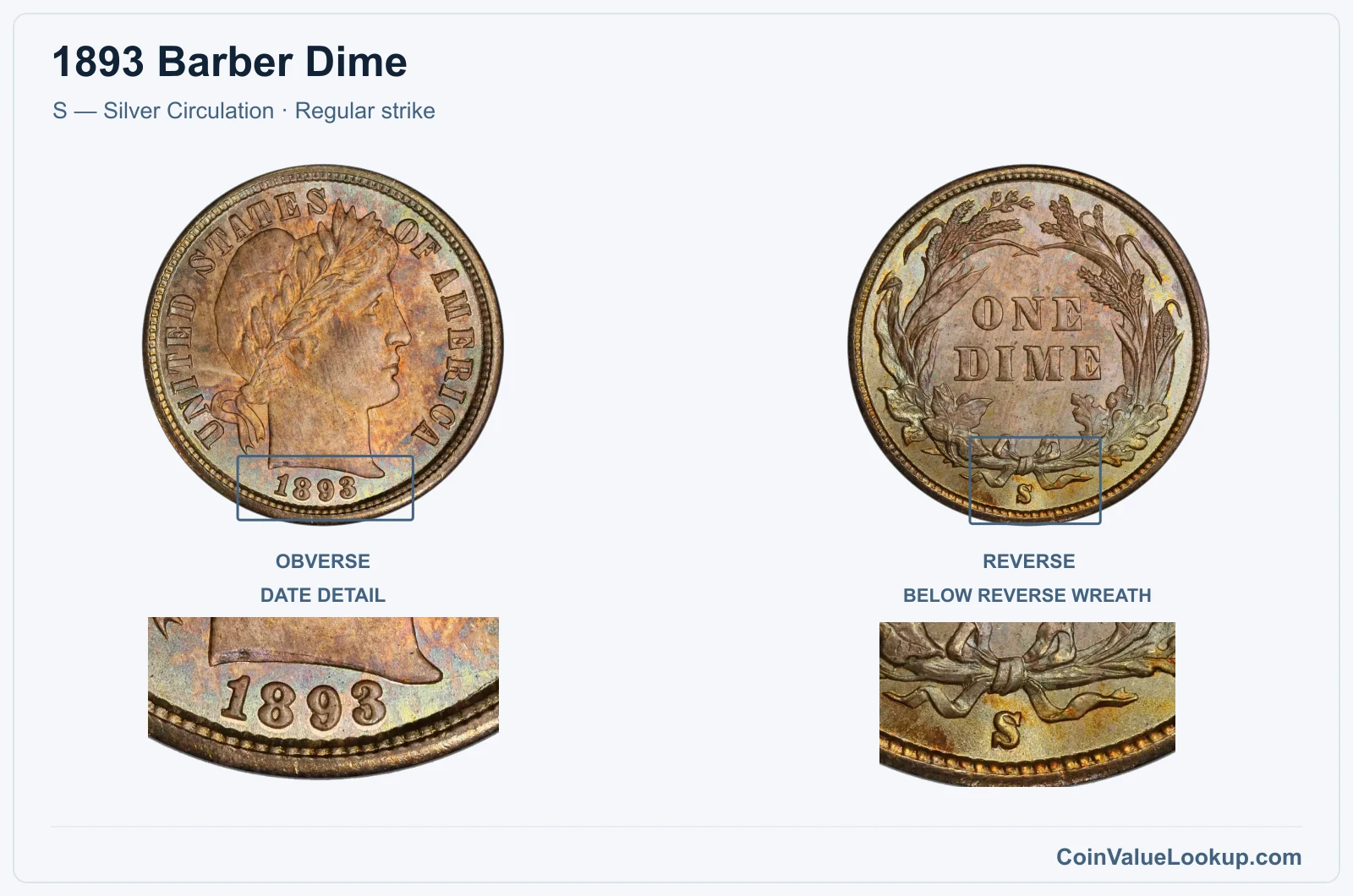
San Francisco's 1893 dime is marked with an "S" below the reverse wreath bow. Guide estimates sit at about $23 in G4 and around $725 at MS63, matching the New Orleans coin at the top end.
The S-mint tends to come better struck than New Orleans, so you may see crisper headband detail at comparable grades. That said, MS63 examples are still genuinely scarce.
Also inspect the mintmark carefully; a repunched mintmark variety exists on this date and is discussed in the error section.
Range Grade
Price Auction Records Appraisal PO PO 1
—
Coin Identifier FR FR 2
—
Coin Identifier AG AG 3
—
Coin Identifier G G 4
Coin Identifier
G 6
—
Coin Identifier VG VG 8
—
Coin Identifier
VG 10
Coin Identifier F F 12
Coin Identifier
F 15
Coin Identifier VF VF 20
—
Coin Identifier
VF 25
Coin Identifier
VF 30
—
Coin Identifier
VF 35
Coin Identifier XF XF 40
Coin Identifier
XF 45
Coin Identifier AU AU 50
Coin Identifier
AU 53
Coin Identifier
AU 55
Coin Identifier
AU 58
Coin Identifier MS MS 60
—
Coin Identifier
MS 61
Coin Identifier
MS 62
Coin Identifier
MS 63
Coin Identifier
MS 64
Coin Identifier
MS 65
Coin Identifier
MS 66
Coin Identifier
MS 67
Coin Identifier
MS 68
—
—
—
MS 69
—
—
—
MS 70
—
—
—
1893 Barber Dime — No Mint Mark — Brilliant Silver Proof
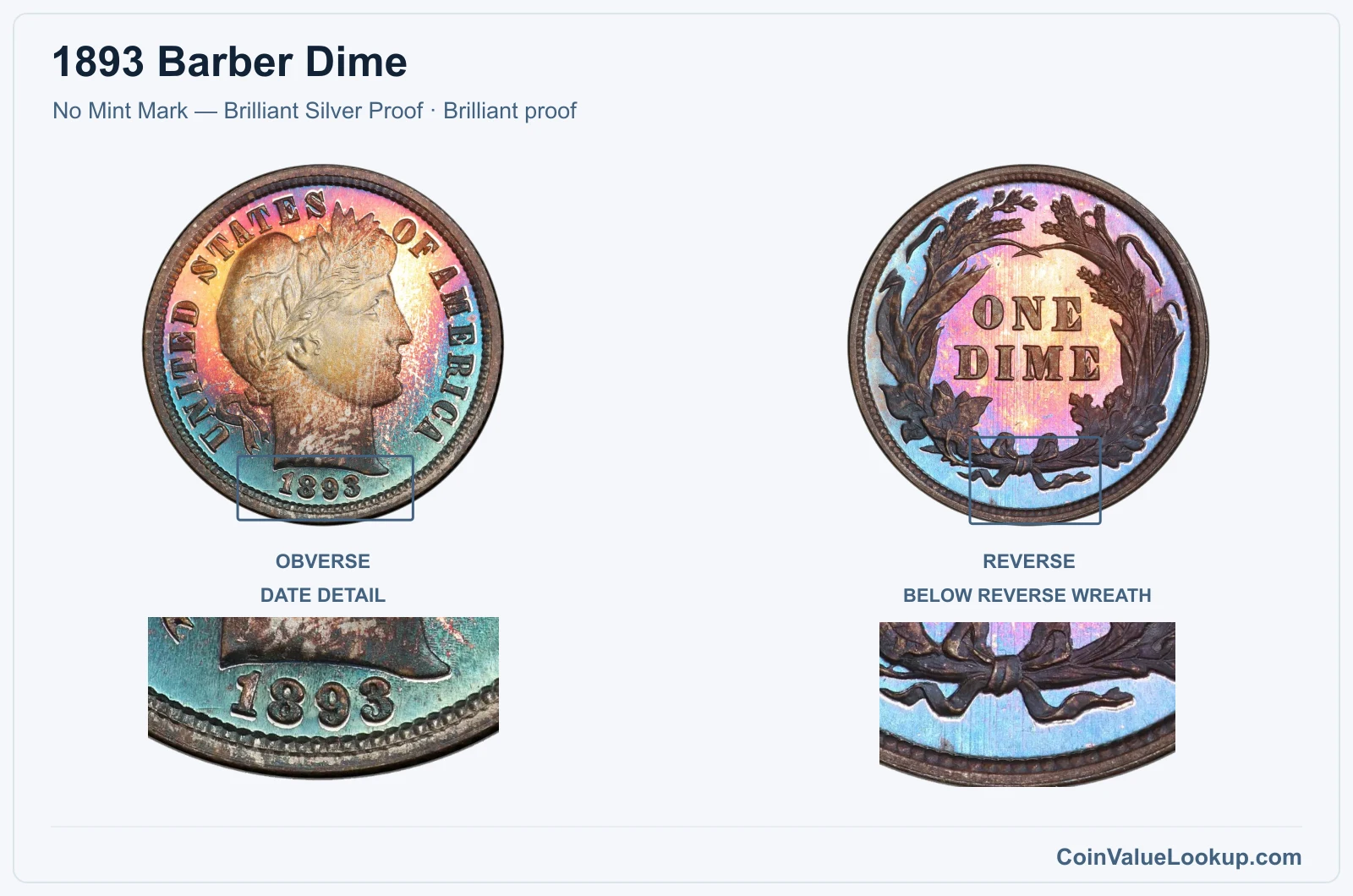
Philadelphia struck proof Barber Dimes with mirrored fields and precisely impressed details. A 1893 proof in PR63 carries a guide estimate of about $616.
These were made for collectors, not for circulation, using polished dies and carefully prepared planchets. Do not confuse a well-preserved business strike with a proof; true proofs have distinctly reflective, glass-like fields.
Cameo and Deep Cameo designations describe the contrast between frosted devices and mirrored fields and carry their own market; do not assume an ordinary PR63 price applies to a contrast piece.
Coin Value Lookup is a handy place to look up guide values for other Barber Dime dates and denominations if you are working through a collection.
Range Grade
Price Auction Records Appraisal PR PR 1
—
Coin Identifier
PR 2
—
Coin Identifier
PR 3
—
Coin Identifier
PR 4
—
Coin Identifier
PR 6
—
Coin Identifier
PR 8
—
Coin Identifier
PR 10
—
Coin Identifier
PR 12
—
Coin Identifier
PR 15
—
Coin Identifier
PR 20
—
Coin Identifier
PR 25
—
Coin Identifier
PR 30
—
Coin Identifier
PR 35
—
Coin Identifier
PR 40
—
Coin Identifier
PR 45
—
Coin Identifier
PR 50
—
Coin Identifier
PR 53
—
Coin Identifier
PR 55
—
Coin Identifier
PR 58
Coin Identifier
PR 60
Coin Identifier
PR 61
Coin Identifier
PR 62
Coin Identifier
PR 63
Coin Identifier
PR 64
Coin Identifier
PR 65
Coin Identifier
PR 66
Coin Identifier
PR 67
Coin Identifier
PR 68
Coin Identifier
PR 69
—
—
—
PR 70
—
—
—
1893 Barber Dime — No Mint Mark — Traditionally Labelled1893/2
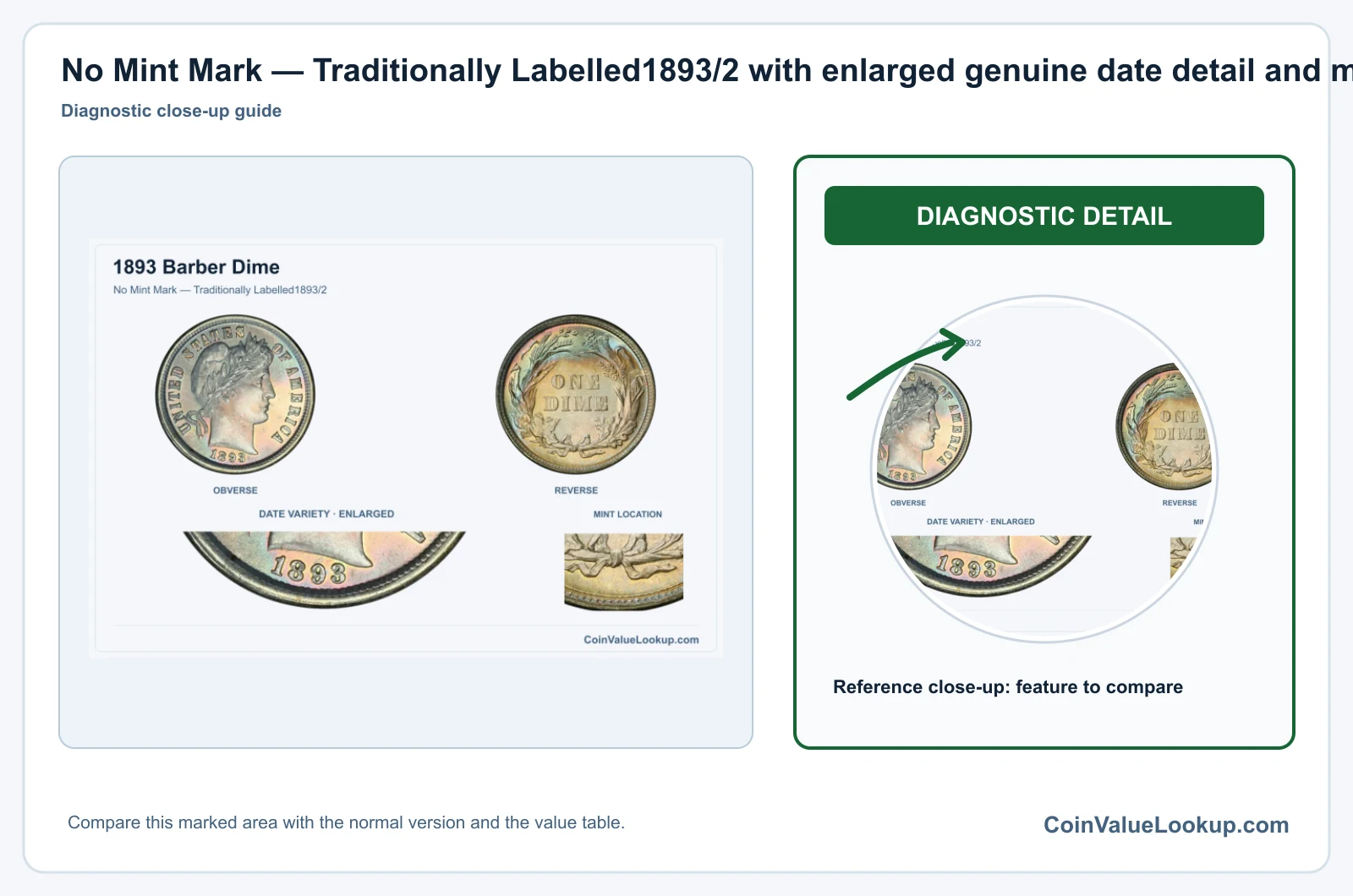
This is the traditionally labelled 1893/2 variety, a Philadelphia strike where traces of a "2" appear beneath the final digit "3" in the date. It is a recognized catalog variety, and the price difference is substantial: guide estimates put it at about $181 in G4 and around $2,501 in MS63.
To identify it, examine the bottom curve and crossbar area of the "3" under magnification. You should see remnants that do not belong to a normal "3." Compare your coin's date at the same scale against an ordinary 1893 Philadelphia dime.
The traditional catalog name is preserved here; no specific mint record explaining how this overdate was created has been supplied. If you suspect you have one, professional attribution from a grading service is the safest route to confirmation.
Range Grade
Price Auction Records Appraisal PO PO 1
—
Coin Identifier FR FR 2
—
Coin Identifier AG AG 3
—
Coin Identifier G G 4
—
Coin Identifier
G 6
—
Coin Identifier VG VG 8
—
Coin Identifier
VG 10
—
Coin Identifier F F 12
—
Coin Identifier
F 15
—
Coin Identifier VF VF 20
—
Coin Identifier
VF 25
—
Coin Identifier
VF 30
—
Coin Identifier
VF 35
—
Coin Identifier XF XF 40
—
Coin Identifier
XF 45
—
Coin Identifier AU AU 50
—
Coin Identifier
AU 53
—
Coin Identifier
AU 55
Coin Identifier
AU 58
Coin Identifier MS MS 60
Coin Identifier
MS 61
—
Coin Identifier
MS 62
Coin Identifier
MS 63
Coin Identifier
MS 64
Coin Identifier
MS 65
Coin Identifier
MS 66
Coin Identifier
MS 67
—
—
—
MS 68
—
—
—
MS 69
—
—
—
MS 70
—
—
—
1893 Barber Dime Error List
1. 1893 Barber Dime — Repunched Mintmark
A repunched mintmark (RPM) on the 1893-S Barber Dime means the "S" mintmark was punched into the die more than once, leaving a visible ghost or secondary impression near the primary mark. To spot it, examine the mintmark area below the reverse wreath bow under at least 5x magnification.
Look for a doubled outline, an extra serif, or a shifted secondary impression beside or beneath the main "S."
Do not confuse this with machine doubling, which produces flat shelf-like distortion, or with a small die chip or corrosion that can mimic a second punch. A genuine RPM shows a distinctly shaped secondary letter impression.
No specific price range is available for this variety; value depends on the coin's overall condition, the visibility and clarity of the repunching, and which specific RPM it represents. Professional attribution helps confirm the diagnosis.
2. 1893 Barber Dime — Die Cap / Capped-Die Strike
A die cap or capped-die strike on the 1893-O Barber Dime occurs when a struck coin sticks to one of the dies and is driven into subsequent blanks like a secondary die. The stuck coin becomes cupped or cap-shaped, while coins struck through that cap show a distorted, spread impression of the design transferred through the cap's metal.
These are two different collectibles: the cap itself and the coins struck through it. Both sides of the coin need to be examined.
A genuine die cap will have a distinctly cupped shape with one side showing brockage-like detail.
Do not mistake a coin that was simply bent, squeezed in a vise, or weakly struck for a die cap. Post-mint damage lacks the characteristic spreading and mirror-image transfer.
No specific price has been adopted for this error; value depends on the coin's preservation, the clarity of the error characteristics, and collector demand for the specific piece.