1865 Liberty Seated Dime Coin Value: How Much Is It Worth?
The 1865 Liberty Seated Dime is a scarce Civil War-era coin that draws serious collector attention. USA Coin Book guide estimates range from about $151 at G4 for the San Francisco mint issue up through $20,097 at MS63 for that same mint, while Philadelphia strikes and Proofs carry their own separate pricing.
Condition, mint, and finish all matter here, so read on before assuming a value.
Fast Way to Identify Your 1865 Liberty Seated Dime
The quickest way to start identifying your 1865 Seated Dime is to upload clear photos of both the front and back of the coin. Our identifier can offer a preliminary read on the mint, design type, and general condition from those images alone.
It does not authenticate, certify, or guarantee a grade, but it gives you a useful starting point before you dig deeper.
1865 Liberty Seated Dime Value
Upload both sides of your 1865 Liberty Seated Dime.
Front Obverse
Upload photo
Back Reverse
Upload photo
Which 1865 Liberty Seated Dime Versions Are Worth Money?
- Philadelphia business strikes (no mintmark) are scarce for 1865; a USA Coin Book guide estimate of about $616 at G4 reflects that scarcity relative to the San Francisco issue.
- San Francisco S-mint pieces can reach very high guide values in top grades, with about $20,097 listed at MS63 by USA Coin Book.
- Philadelphia Proofs carry a PCGS guide estimate near $863 at PR63 and represent a distinct collector finish worth confirming through attribution.
- Repunched Date varieties, clashed dies, and a reported 180-degree rotated die alignment are documented for this date and can affect value depending on visibility and condition.
- A rusted-die surface variety and a reverse die defect near the D of DIME have been reported, making close inspection of surfaces worthwhile.
Step 1: Identify Your 1865 Liberty Seated Dime Mint Mark and Version
First, confirm you have a Liberty Seated Dime and not a half dime. The reverse should read ONE DIME inside a large agricultural wreath.
The obverse shows a seated Liberty figure with the legend around the rim rather than stars, which is the Legend Obverse subtype used for this date.
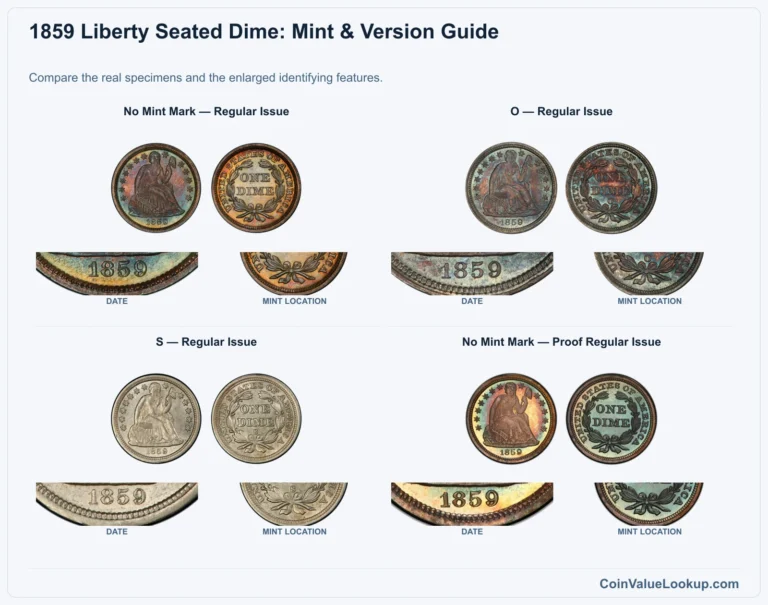
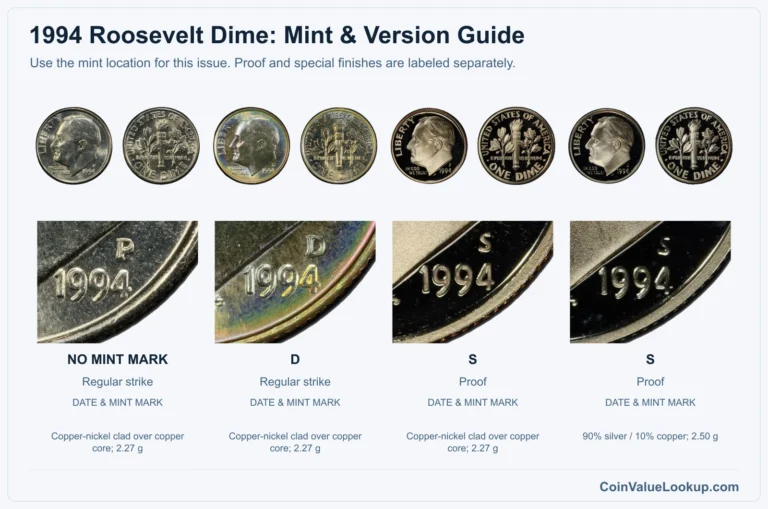
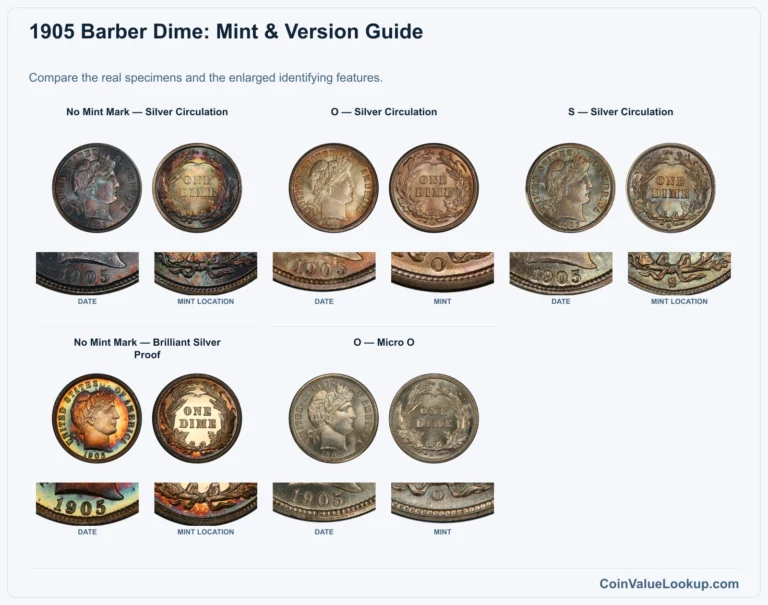
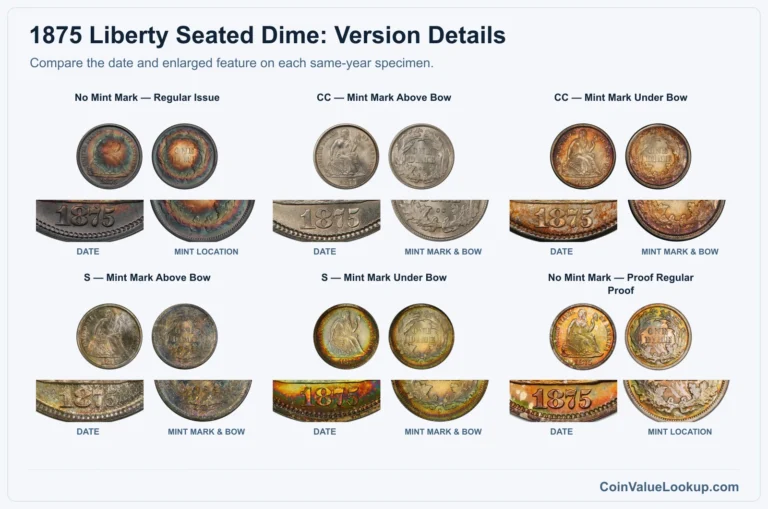
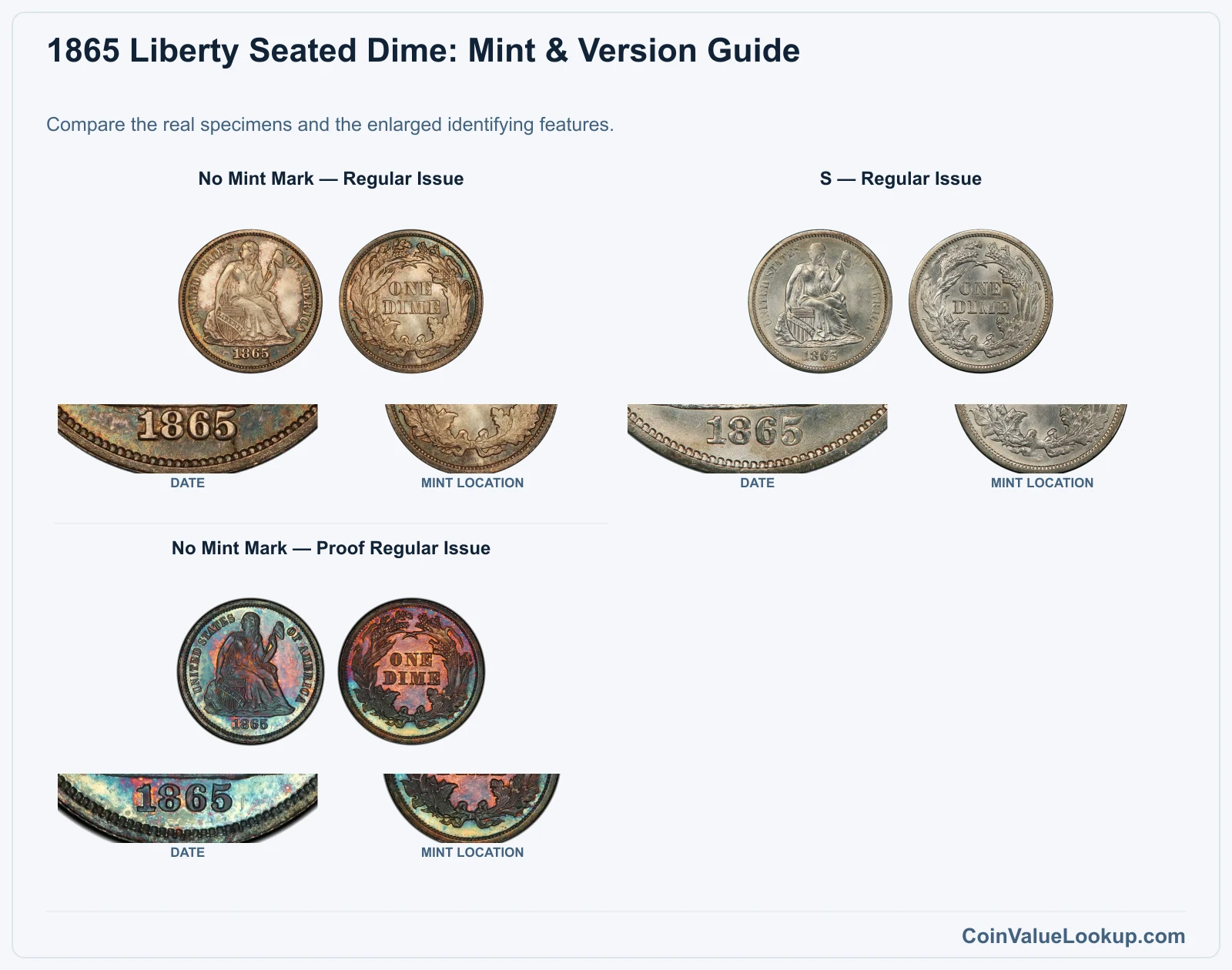
Next, check the mintmark. Flip the coin over and look just below the wreath on the reverse.
A small "S" means San Francisco. No letter at all means Philadelphia.
That distinction matters a lot for value.
The coin is 90% silver and 10% copper, with a nominal weight of 2.49 grams, a diameter of 17.9 mm, and a reeded edge. If your coin feels too light or the edge is smooth, something is off.
Philadelphia circulation strikes are genuinely scarce for this date. Be aware that weak or thin S mintmarks on San Francisco coins are a die characteristic, not a missing-mintmark error.
A faint S is still an S.
Step 2: Check Your 1865 Liberty Seated Dime Grade
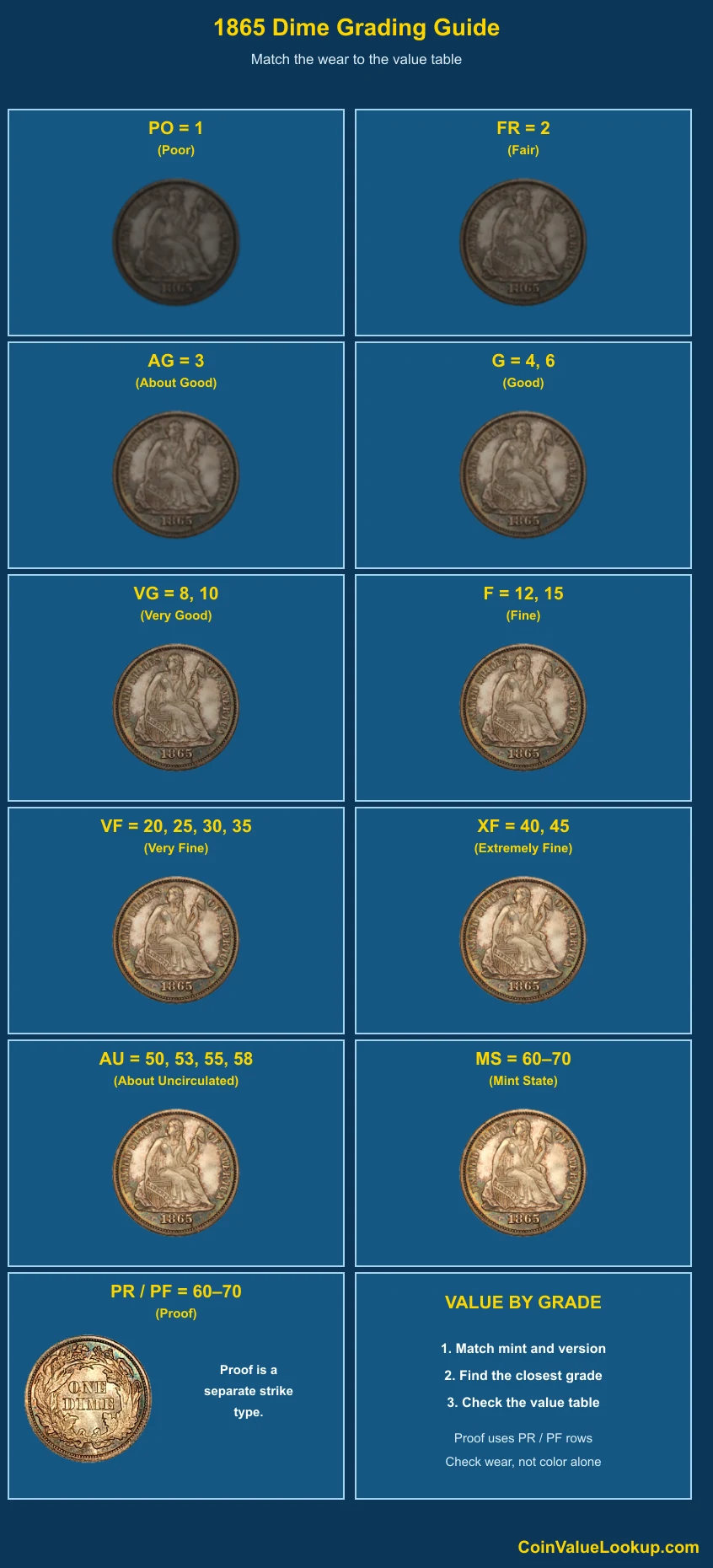
When grading your 1865 Seated Dime, focus on the shield detail, the folds of Liberty's gown, her head, and her feet on the obverse. On the reverse, check the wreath for sharpness.
Use the comparison image for the correct Legend Obverse subtype so you are matching apples to apples.
Separate actual circulation wear from original strike weakness or worn dies. A softly struck coin is not the same as a heavily circulated one.
Look at the luster in the protected areas: if it is gone everywhere, that is wear.
Proof coins have mirrored fields and are a separate category from Mint State business strikes. A polished circulation coin is not a Proof, no matter how shiny someone made it.
Hairlines from cleaning are a red flag, not a sign of Proof manufacture.
Step 3: Check 1865 Liberty Seated Dime Value by Mint and Version
1865 Liberty Seated Dime — No Mint Mark — Regular Issue
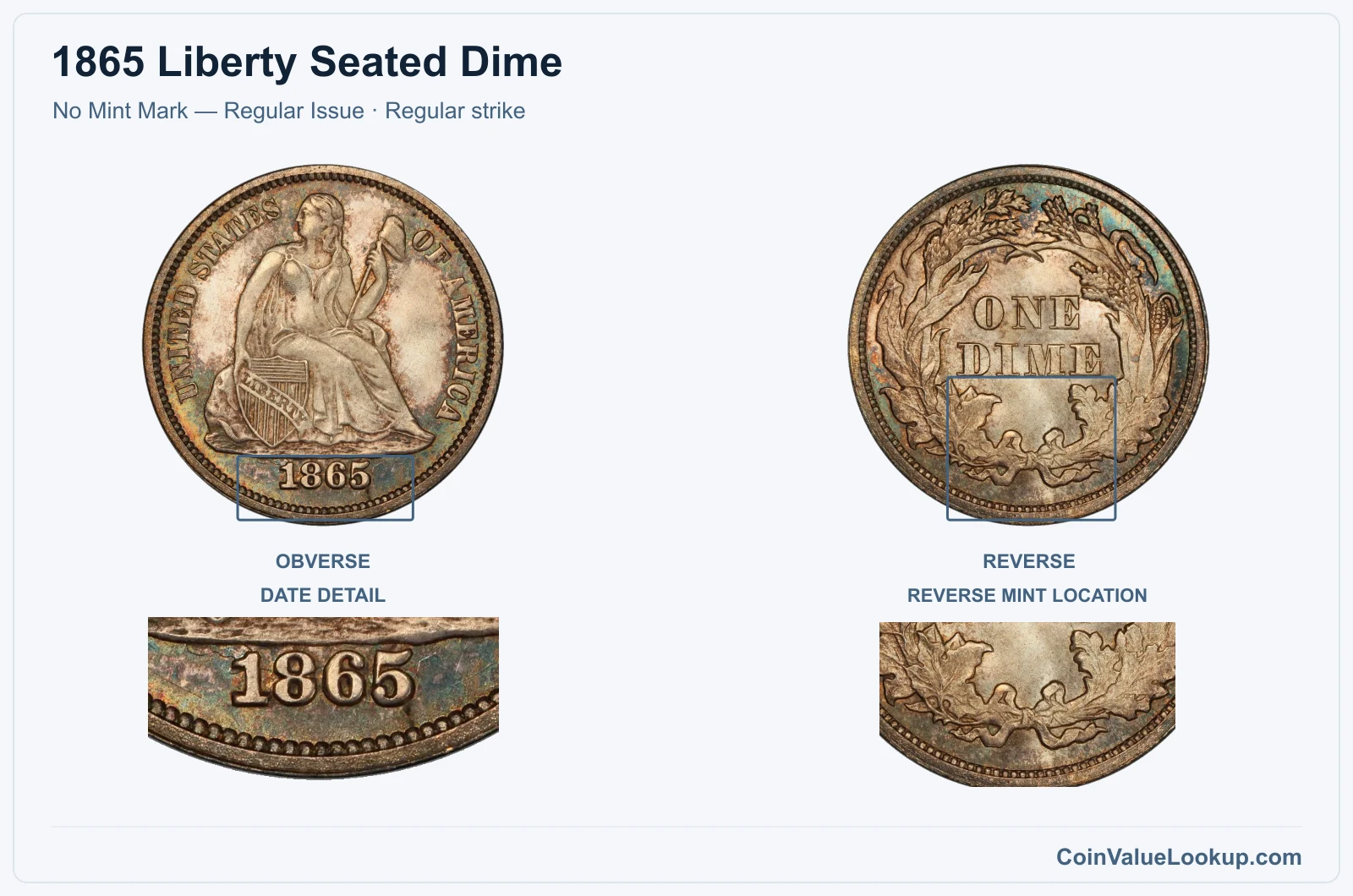
The 1865 Philadelphia Dime carries no mintmark. It uses the Legend Obverse paired with a large agricultural wreath reverse, struck in 90% silver at a nominal 2.49 grams.
Philadelphia business strikes of this date are scarce, which is reflected in the guide pricing.
USA Coin Book lists about $616 at G4 and roughly $4,674 at MS63. Those are guide estimates, not guaranteed sale prices.
Condition, originality of surfaces, and proper attribution all influence what a specific coin brings.
If you see a faint outline where a mintmark would sit, look carefully. That area should be completely blank on a genuine Philadelphia piece.
Range Grade
Price Auction Records Appraisal PO PO 1
—
Coin Identifier FR FR 2
—
Coin Identifier AG AG 3
Coin Identifier G G 4
Coin Identifier
G 6
—
Coin Identifier VG VG 8
—
Coin Identifier
VG 10
Coin Identifier F F 12
Coin Identifier
F 15
Coin Identifier VF VF 20
Coin Identifier
VF 25
Coin Identifier
VF 30
Coin Identifier
VF 35
Coin Identifier XF XF 40
Coin Identifier
XF 45
—
Coin Identifier AU AU 50
—
Coin Identifier
AU 53
—
Coin Identifier
AU 55
—
Coin Identifier
AU 58
Coin Identifier MS MS 60
—
Coin Identifier
MS 61
Coin Identifier
MS 62
Coin Identifier
MS 63
Coin Identifier
MS 64
Coin Identifier
MS 65
Coin Identifier
MS 66
Coin Identifier
MS 67
Coin Identifier
MS 68
Coin Identifier
MS 69
—
—
—
MS 70
—
—
—
1865 Liberty Seated Dime — S — Regular Issue
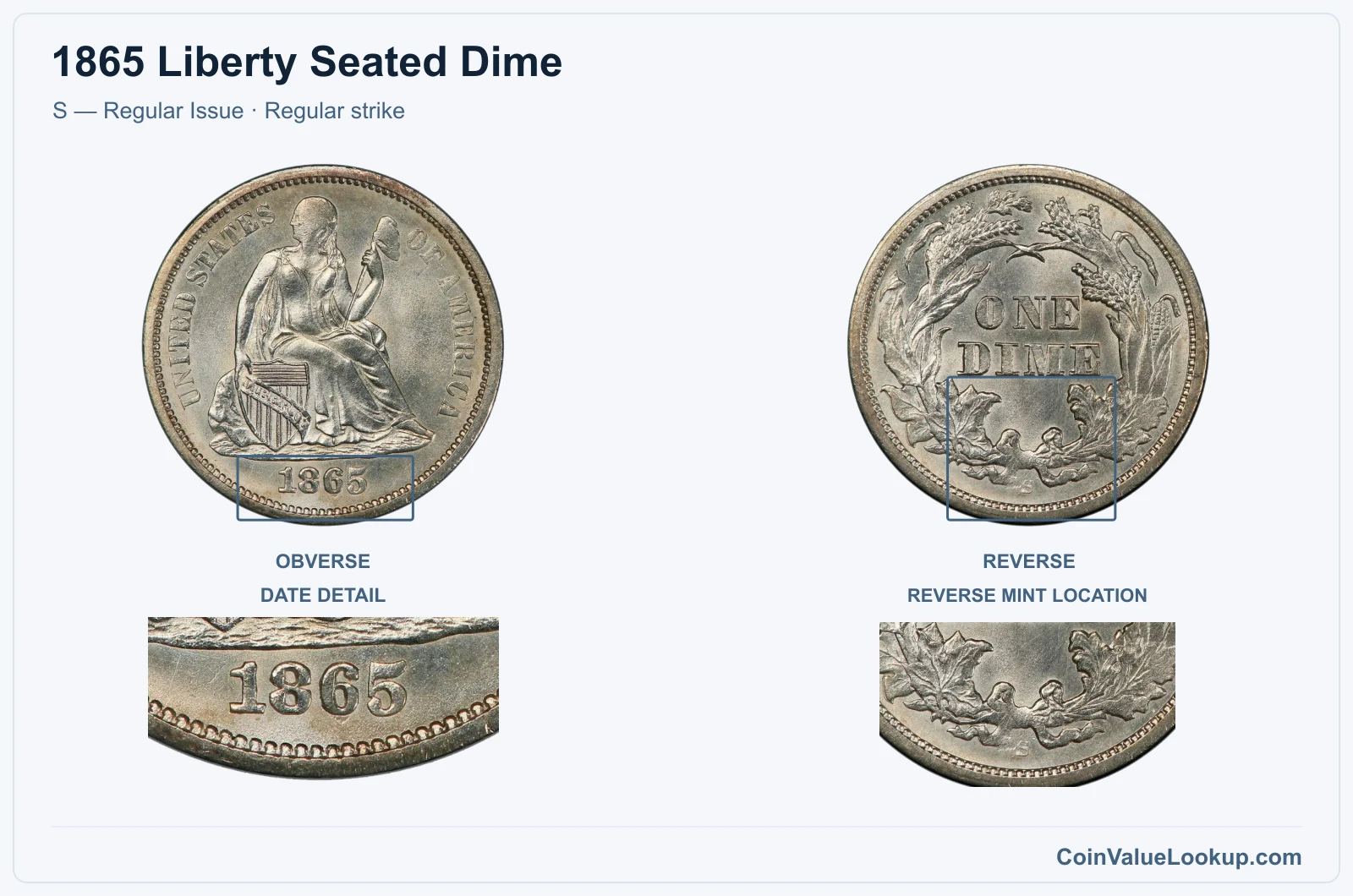
The San Francisco issue shows a small S below the wreath on the reverse. Same specs as the Philadelphia coin: 90% silver, 10% copper, 2.49 grams nominal, Legend Obverse design.
USA Coin Book estimates about $151 at G4 and approximately $20,097 at MS63. That high-grade figure reflects serious rarity in uncirculated condition, not a typical find.
Most survivors are well worn.
Weak or thin S mintmarks are a die characteristic on some 1865-S dimes. Do not confuse a faint S with a missing mintmark.
Under magnification, remnants of the letter are usually visible. Coin Value Lookup can help you explore additional Seated Dime dates and mints if you want to compare values across the series.
Range Grade
Price Auction Records Appraisal PO PO 1
—
Coin Identifier FR FR 2
—
Coin Identifier AG AG 3
—
Coin Identifier G G 4
—
Coin Identifier
G 6
—
Coin Identifier VG VG 8
—
Coin Identifier
VG 10
Coin Identifier F F 12
Coin Identifier
F 15
Coin Identifier VF VF 20
Coin Identifier
VF 25
Coin Identifier
VF 30
Coin Identifier
VF 35
Coin Identifier XF XF 40
Coin Identifier
XF 45
Coin Identifier AU AU 50
Coin Identifier
AU 53
Coin Identifier
AU 55
Coin Identifier
AU 58
Coin Identifier MS MS 60
—
Coin Identifier
MS 61
—
Coin Identifier
MS 62
Coin Identifier
MS 63
Coin Identifier
MS 64
Coin Identifier
MS 65
Coin Identifier
MS 66
—
—
—
MS 67
—
—
—
MS 68
—
—
—
MS 69
—
—
—
MS 70
—
—
—
1865 Liberty Seated Dime — No Mint Mark — Proof Regular Issue
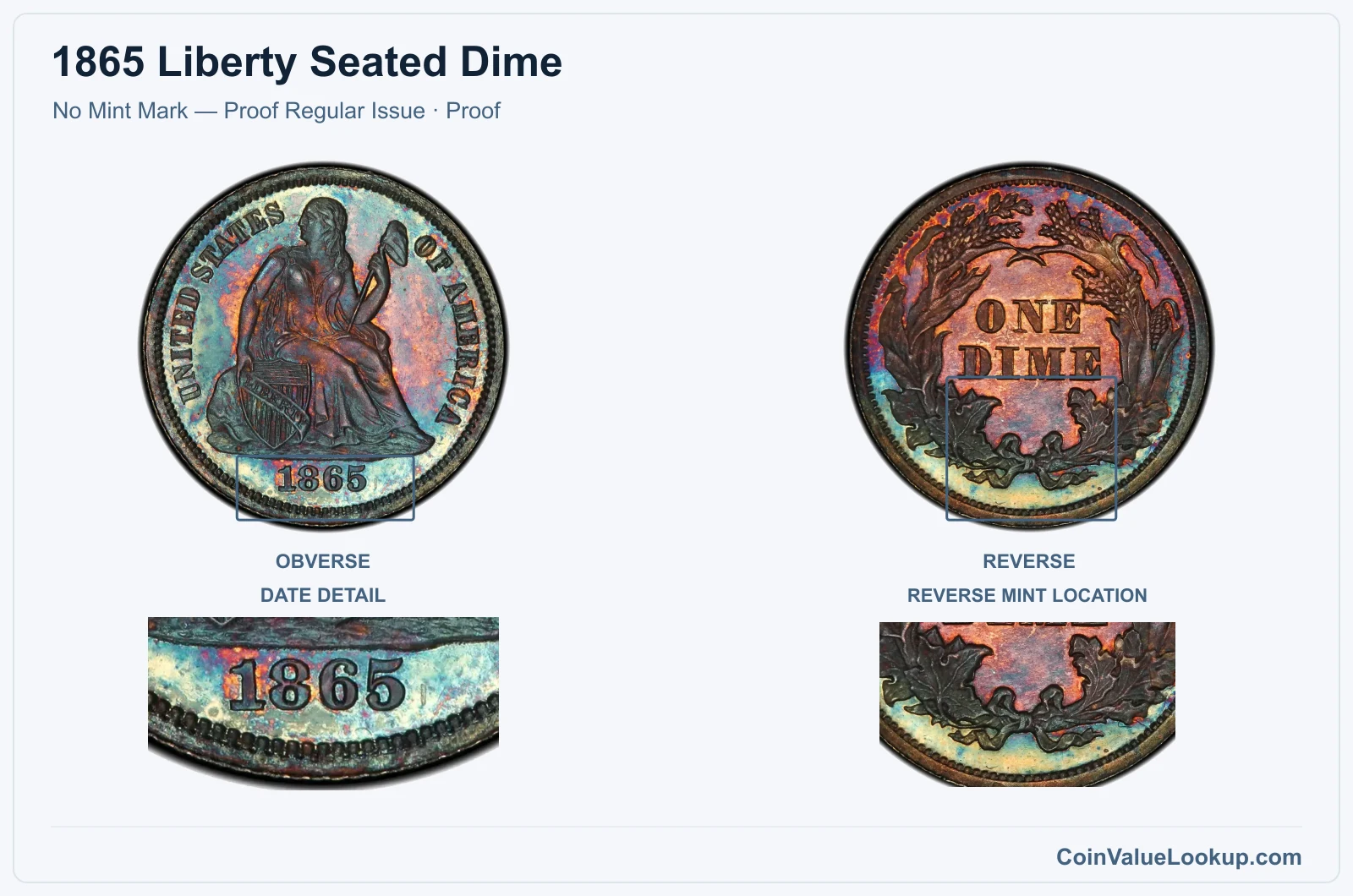
Philadelphia Proofs from 1865 were struck with polished dies on polished planchets, producing mirrored fields. These are not ordinary annual collector products in the modern sense.
They are genuinely rare early Proof issues.
PCGS lists a guide value near $863 at PR63. That is a single-grade reference point, not a market range.
Cameo contrast, when the devices appear frosty against mirror fields, is a visual characteristic some collectors pursue, but it is a grading filter, not a separate mint or variety.
Authentication matters here. A polished circulated coin can look shiny, but it will not have the flat, reflective field quality or the sharp, squared-off rim profile of a genuine Proof.
If you suspect you have one, professional attribution is the right next step.
Range Grade
Price Auction Records Appraisal PR PR 1
—
Coin Identifier
PR 2
—
Coin Identifier
PR 3
—
Coin Identifier
PR 4
—
Coin Identifier
PR 6
—
Coin Identifier
PR 8
—
Coin Identifier
PR 10
—
Coin Identifier
PR 12
—
Coin Identifier
PR 15
—
Coin Identifier
PR 20
—
Coin Identifier
PR 25
—
Coin Identifier
PR 30
—
Coin Identifier
PR 35
—
Coin Identifier
PR 40
—
Coin Identifier
PR 45
—
Coin Identifier
PR 50
Coin Identifier
PR 60
Coin Identifier
PR 61
Coin Identifier
PR 62
Coin Identifier
PR 63
Coin Identifier
PR 64
Coin Identifier
PR 65
Coin Identifier
PR 66
Coin Identifier
PR 67
Coin Identifier
PR 68
—
—
—
PR 69
—
—
—
PR 70
—
—
—
1865 Liberty Seated Dime Error List
1. 1865 Liberty Seated Dime — Repunched Date
A repunched date on an 1865 Seated Dime shows remnants of an earlier date-punch position visible beside the final numerals. You are looking for faint ghosting or doubling specifically in the digits themselves, not across the entire design.
This variety has been reported on both Philadelphia and San Francisco issues, and the specific punch remnants differ by mint. Compare your coin to known examples under magnification.
Do not confuse a repunched date with machine doubling, which produces flat, shelf-like distortion, or with simple damage to the date area. A true repunched date shows a clear secondary impression in a slightly offset position.
Value depends on condition, the visibility of the remnants, and the specific die pairing involved.
2. 1865 Liberty Seated Dime — Clashed Dies
Clashed dies occur when the obverse and reverse dies strike each other without a planchet between them. The result is faint traces of the opposite design transferred onto each die, which then appear on subsequent coins as ghost-like impressions in the fields.
On an 1865 Dime, look for unexpected outlines in the open areas of each side that correspond to features from the other side. The transferred images should align consistently with the normal die orientation.
Do not mistake random scratches, raised lines from debris, or a brockage for a die clash. Clash marks follow a predictable pattern matching the opposing die.
Value depends on how strong the clash impression is and the overall condition of the coin.
3. 1865 Liberty Seated Dime — Rotated Dies
A 180-degree rotated die alignment has been reported for the 1865 Philadelphia Dime. Normally, if you hold the obverse upright and flip the coin on its vertical axis, the reverse should also appear upright.
A 180-degree rotation means the reverse appears upside down.
However, this particular variety carries attribution caveats. The source discusses possible medal-turn or special-strike origin, so it should be treated as an alignment variety rather than a confirmed accidental production error.
Professional attribution is important here.
Make sure you are not simply rotating your photographs. Hold the physical coin and flip it naturally.
Value depends on confirmed attribution, condition, and whether the alignment is verified as a die-setting characteristic rather than an intentional manufacturing choice.
4. 1865 Liberty Seated Dime — Rusted-Die Surface Variety
A rusted-die surface variety has been reported for the 1865 Dime. Rust forms on the die face between uses, and when that die strikes a planchet, the corroded areas produce raised, rough-textured patches on the finished coin.
Look for a repeated, granular texture on the obverse that appears raised above the normal field level. This texture should be consistent across multiple examples from the same die, which distinguishes it from damage to an individual coin.
Environmental corrosion or pitting that happened after the coin left the mint sits in the surface of the coin itself and typically appears recessed or irregular. A rusted-die impression is raised and patterned.
Value depends on visibility, condition, and the specific die involved.
5. 1865 Liberty Seated Dime — Reverse Die Defect at DIME
A reverse die defect has been reported near the D of DIME on 1865 Dimes. This is a small anomaly in the die itself that transferred onto struck coins, appearing as an unusual mark or distortion at that specific location.
Think of it as a die-state marker rather than guaranteed valuable damage. Many die defects are minor curiosities.
Still, they help specialists identify which specific die pair struck a given coin, and some collectors value that information.
Do not confuse this with an incuse scratch, post-mint damage, or an unrelated die crack running through the area. The reported defect is localized near the D and should match reference images for this specific die state.
Value depends on the coin's overall condition and the visibility of the defect.