1994 Roosevelt Dime Coin Value: How Much Is It Worth?
Most 1994 Roosevelt dimes you pull from pocket change are worth face value — ten cents. Mint-state examples graded MS65 carry a guide value around $2.50 according to USA Coin Book, while the S clad proof at PR65 is about $6.25 and the S silver proof at PR65 roughly $13.
Special finishes, higher grades, and authenticated mint errors can push values well beyond those starting points.
Fast Way to Identify Your 1994 Roosevelt Dime
Snap a clear photo of both the front and back of your 1994 dime and upload them to our identifier. It will give you a preliminary read on your coin's mint, version, and general condition.
This is not a substitute for professional authentication, but it is a solid first step before deciding whether to send your coin in for grading.
1994 Roosevelt Dime Value
Upload both sides of your 1994 Roosevelt Dime.
Front Obverse
Upload photo
Back Reverse
Upload photo
Which 1994 Roosevelt Dime Versions Are Worth Money?
- 1994-P or 1994-D in uncirculated condition with strong, fully separated torch bands can bring more than face value.
- 1994-S clad proof with deep cameo contrast — guide value around $6.25 at PR65.
- 1994-S silver proof at 90% silver — guide value around $13 at PR65; verify the metal before assuming silver pricing.
- Off-center strike on a 1994-P: one authenticated MS65 example sold for $74 in December 2020.
- Double clipped planchet, brockage, and broadstrike errors on authenticated 1994-P dimes are collected as mint-error pieces.
- Missing clad layer, doubled die, and die crack varieties have been reported for this date and may carry premiums when confirmed.
Step 1: Identify Your 1994 Roosevelt Dime Mint Mark and Version
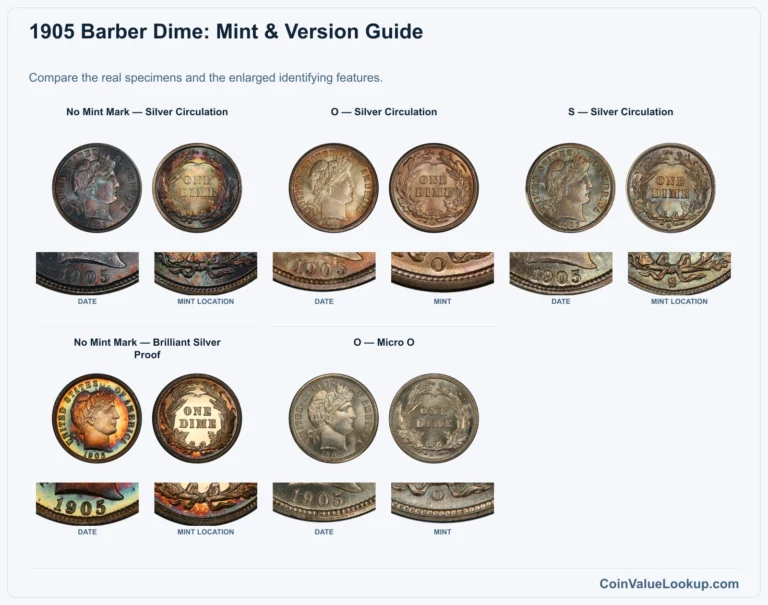
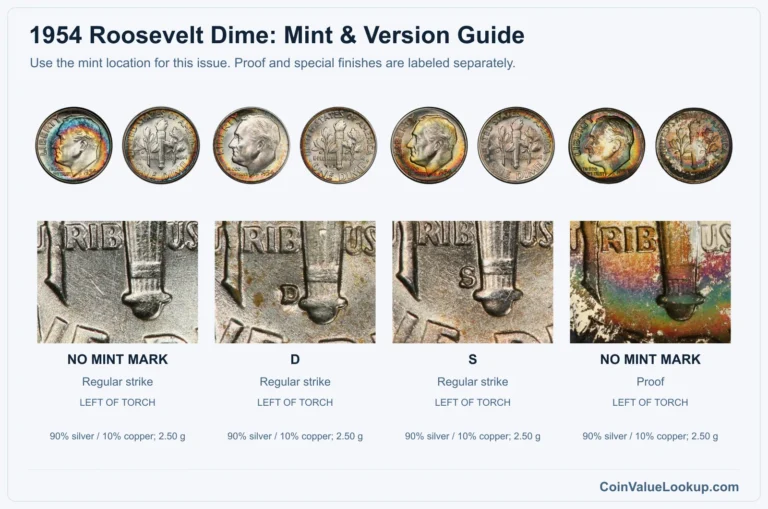
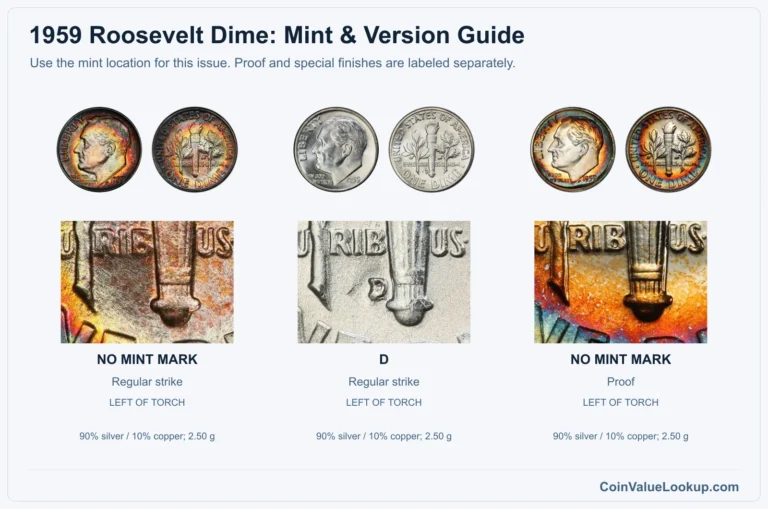
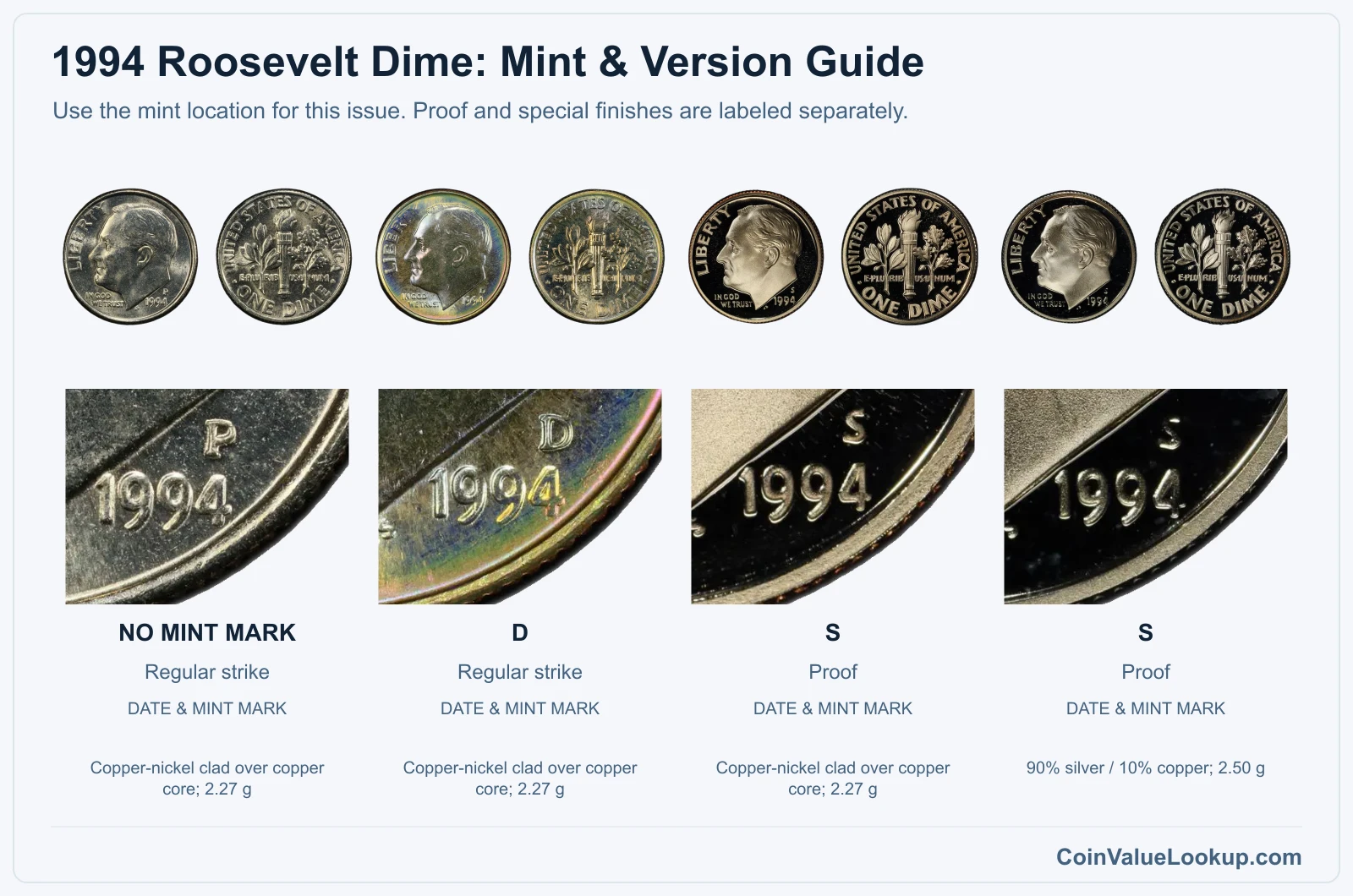
Start with the basics: confirm the 1994 date, Roosevelt's portrait on the front, and the torch-and-branches design on the back. The mintmark sits on the obverse near the date — look for a P (Philadelphia), D (Denver), or S (San Francisco).
Both S-mint versions carry the same mintmark and design, so seeing an "S" alone does not tell you which metal you have. The clad version weighs 2.27 grams; the silver proof weighs 2.50 grams.
That difference is small but measurable on a precise scale.
Edge color helps too. A clad dime shows a visible copper stripe along its edge, while the silver proof edge appears uniformly silver-gray.
If you still cannot tell, original government packaging (standard proof set vs. silver proof set) is the easiest confirmation. Ambiguous coins should be authenticated by a grading service.
Step 2: Check Your 1994 Roosevelt Dime Grade
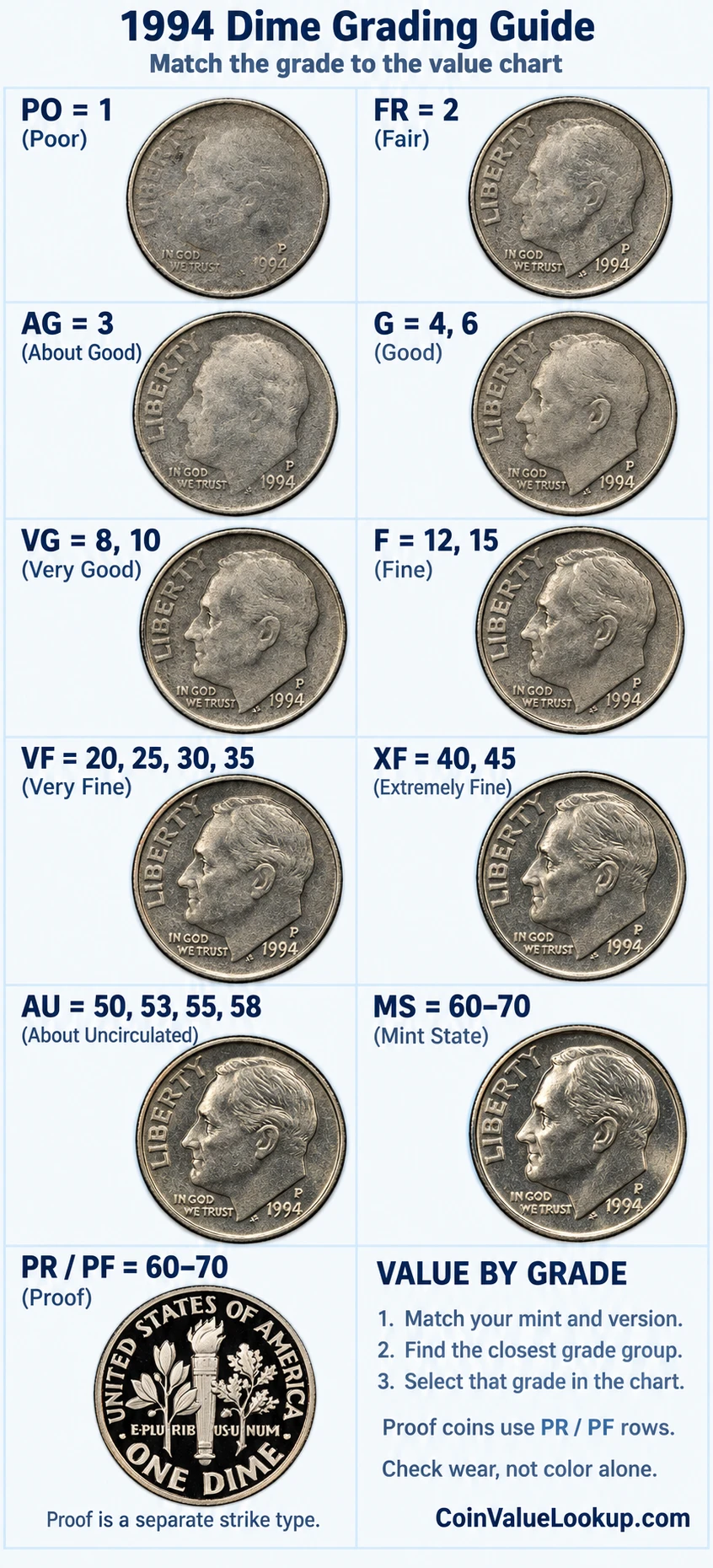
Focus on Roosevelt's cheek, jawline, and the hair detail just above the ear — these are the first areas to lose definition from circulation wear. On the reverse, inspect the horizontal bands on the torch and the leaf details.
A coin with full original luster and no contact marks is heading toward Mint State territory. A dull, slick cheek with flattened hair strands means heavy wear and a lower grade.
Do not confuse a weakly struck coin with a worn one; a weak strike still shows luster in the fields.
Cleaning, scratches, and corrosion all reduce a coin's appeal regardless of how much design detail remains. The comparison image on this page shows typical wear stages so you can match your coin's condition to a rough grade range.
For proofs, look at field quality and whether the original mirror finish is intact; cameo contrast — frosted devices against mirrored fields — is a separate designation.
Step 3: Check 1994 Roosevelt Dime Value by Mint and Version
1994 Roosevelt Dime — P Business Strike
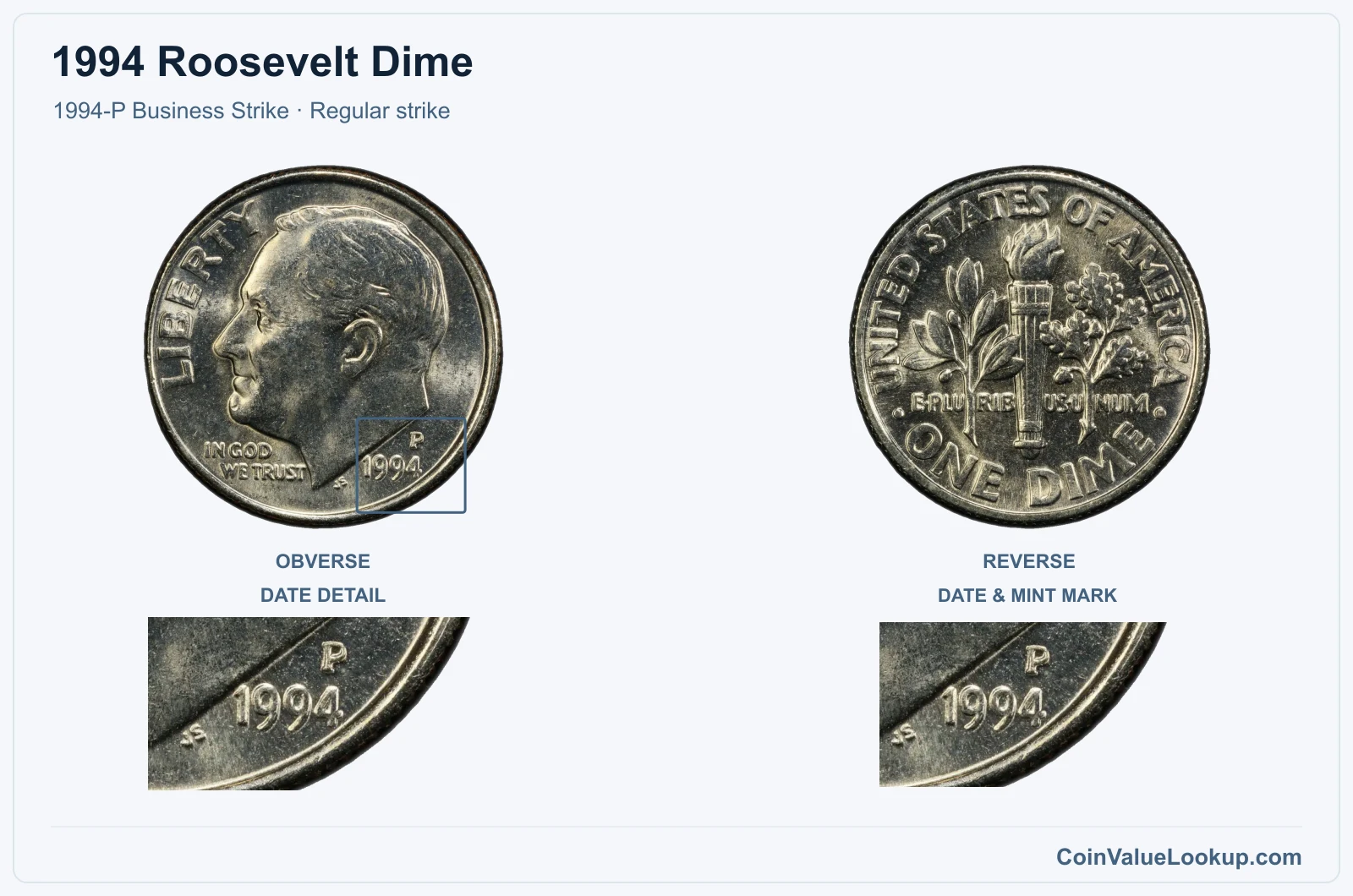
The 1994-P is a standard business-strike dime from Philadelphia, made of copper-nickel clad over a copper core at 2.27 grams. Look for the small "P" mintmark on the obverse near the date.
In circulated condition these are worth ten cents; the USA Coin Book guide places an MS65 example at about $2.50.
Coins with fully separated horizontal torch bands — called Full Bands — are graded under a separate designation. Compare your coin's bands carefully; a weak strike can mimic wear but the luster will still be present in the fields.
Range Grade
Price Auction Records Appraisal PO PO 1
—
Coin Identifier FR FR 2
—
Coin Identifier AG AG 3
—
Coin Identifier G G 4
—
Coin Identifier
G 6
—
Coin Identifier VG VG 8
—
Coin Identifier
VG 10
—
Coin Identifier F F 12
—
Coin Identifier
F 15
—
Coin Identifier VF VF 20
—
Coin Identifier
VF 25
—
Coin Identifier
VF 30
—
Coin Identifier
VF 35
—
Coin Identifier XF XF 40
—
Coin Identifier
XF 45
—
Coin Identifier AU AU 50
—
Coin Identifier
AU 53
—
Coin Identifier
AU 55
—
Coin Identifier
AU 58
—
Coin Identifier MS MS 60
—
Coin Identifier
MS 61
—
Coin Identifier
MS 62
—
Coin Identifier
MS 63
—
Coin Identifier
MS 64
Coin Identifier
MS 65
—
Coin Identifier
MS 66
—
Coin Identifier
MS 67
Coin Identifier
MS 68
Coin Identifier
MS 69
—
—
—
MS 70
—
—
—
1994 Roosevelt Dime — D Business Strike
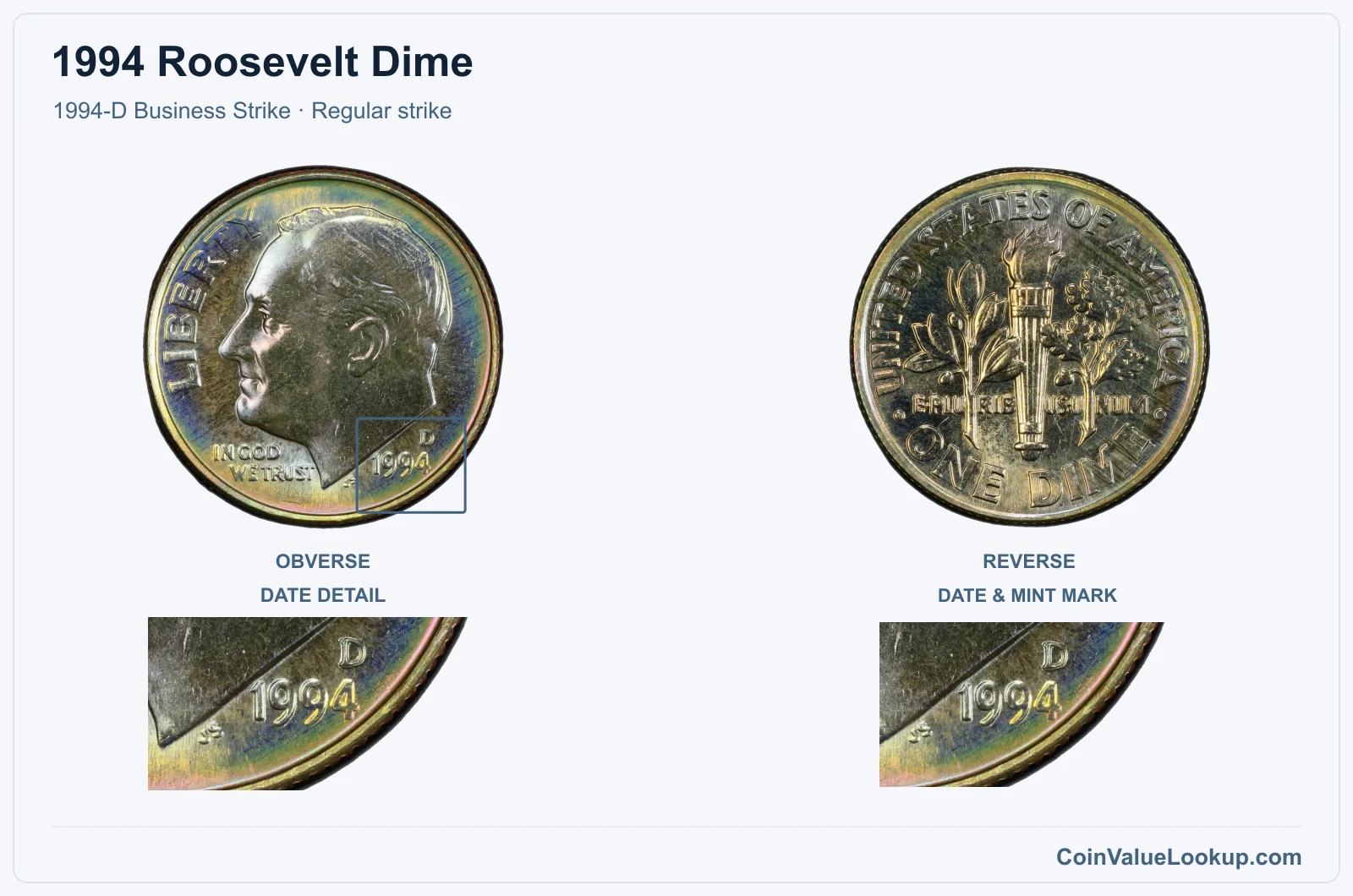
Denver's 1994-D dime shares the same copper-nickel clad composition and 2.27-gram weight as its Philadelphia sibling. The "D" mintmark appears on the obverse near the date.
At MS65 the guide value is also around $2.50.
These are common coins in lower circulated grades and worth face value there. If yours has clean, lustrous surfaces and sharp torch bands, it becomes more collectible.
Full Bands designation applies the same way as on the P mint — both horizontal band pairs must show clear separation.
Range Grade
Price Auction Records Appraisal PO PO 1
—
Coin Identifier FR FR 2
—
Coin Identifier AG AG 3
—
Coin Identifier G G 4
—
Coin Identifier
G 6
—
Coin Identifier VG VG 8
—
Coin Identifier
VG 10
—
Coin Identifier F F 12
—
Coin Identifier
F 15
—
Coin Identifier VF VF 20
—
Coin Identifier
VF 25
—
Coin Identifier
VF 30
—
Coin Identifier
VF 35
—
Coin Identifier XF XF 40
—
Coin Identifier
XF 45
—
Coin Identifier AU AU 50
—
Coin Identifier
AU 53
—
Coin Identifier
AU 55
—
Coin Identifier
AU 58
—
Coin Identifier MS MS 60
—
Coin Identifier
MS 61
—
Coin Identifier
MS 62
—
Coin Identifier
MS 63
—
Coin Identifier
MS 64
Coin Identifier
MS 65
Coin Identifier
MS 66
—
Coin Identifier
MS 67
Coin Identifier
MS 68
—
—
—
MS 69
—
—
—
MS 70
—
—
—
1994 Roosevelt Dime — S Clad Proof
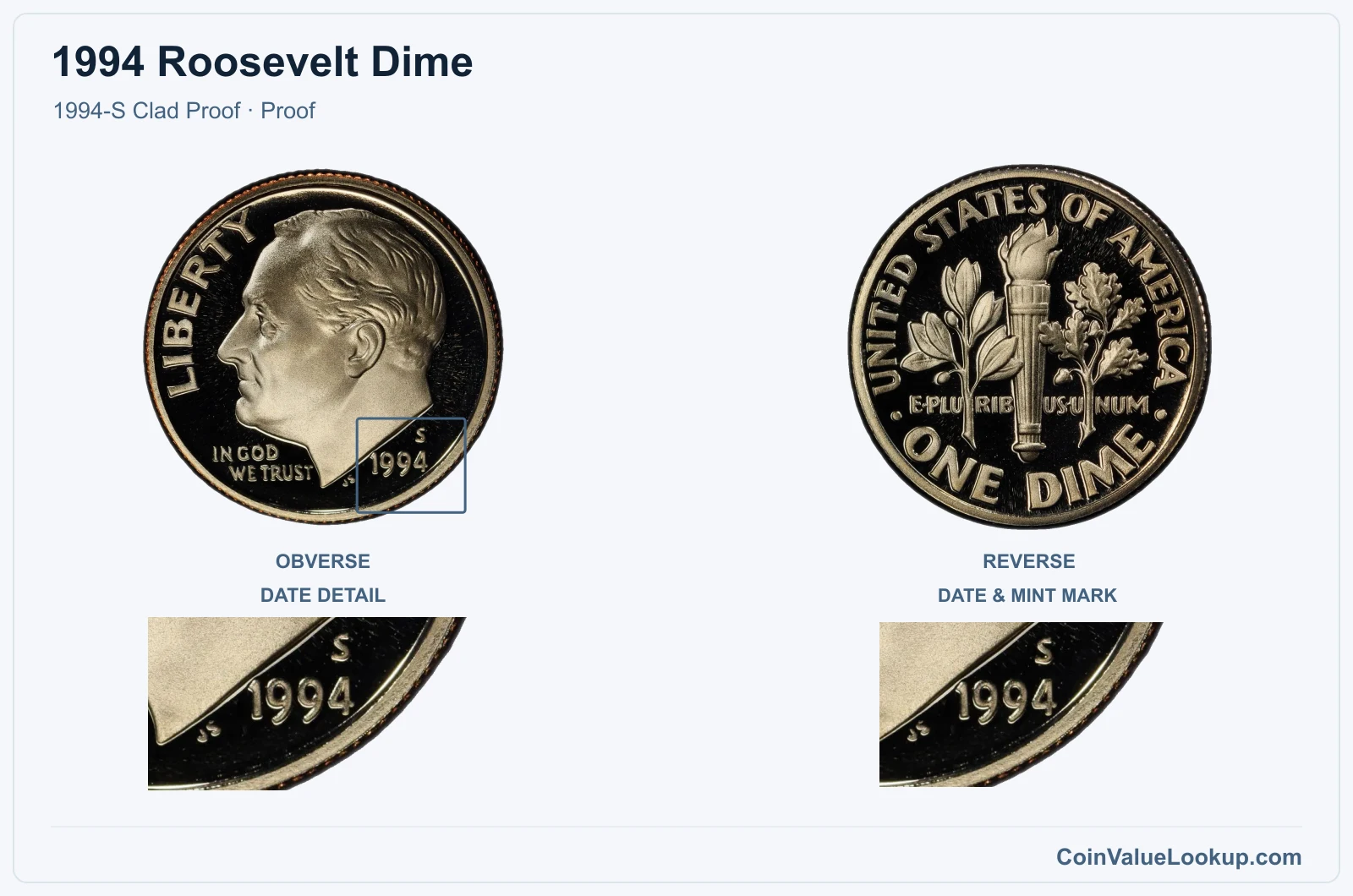
The 1994-S clad proof was struck at San Francisco using the same copper-nickel clad composition as business strikes but with polished dies and specially prepared planchets. The result is mirror-like fields and sharp design detail.
At PR65 the USA Coin Book guide estimates about $6.25. Remember that the "S" mintmark alone does not confirm whether your proof is clad or silver — check the edge for a copper stripe, weigh the coin, or refer to the original proof set packaging.
These proofs were sold in standard proof sets, not the separate silver proof sets introduced in 1992.
Coin Value Lookup is a good place to look up guides for other Roosevelt dime dates and mints if you are working through a collection.
Range Grade
Price Auction Records Appraisal PR PR 1
—
Coin Identifier
PR 2
—
Coin Identifier
PR 3
—
Coin Identifier
PR 4
—
Coin Identifier
PR 6
—
Coin Identifier
PR 8
—
Coin Identifier
PR 10
—
Coin Identifier
PR 12
—
Coin Identifier
PR 15
—
Coin Identifier
PR 20
—
Coin Identifier
PR 25
—
Coin Identifier
PR 30
—
Coin Identifier
PR 35
—
Coin Identifier
PR 40
—
Coin Identifier
PR 45
—
Coin Identifier
PR 50
—
Coin Identifier
PR 53
—
Coin Identifier
PR 55
—
Coin Identifier
PR 58
—
Coin Identifier
PR 60
—
Coin Identifier
PR 61
—
Coin Identifier
PR 62
—
Coin Identifier
PR 63
—
Coin Identifier
PR 64
—
Coin Identifier
PR 65
—
Coin Identifier
PR 66
—
Coin Identifier
PR 67
—
Coin Identifier
PR 68
—
Coin Identifier
PR 69
Coin Identifier
PR 70
Coin Identifier
1994 Roosevelt Dime — S Silver Proof
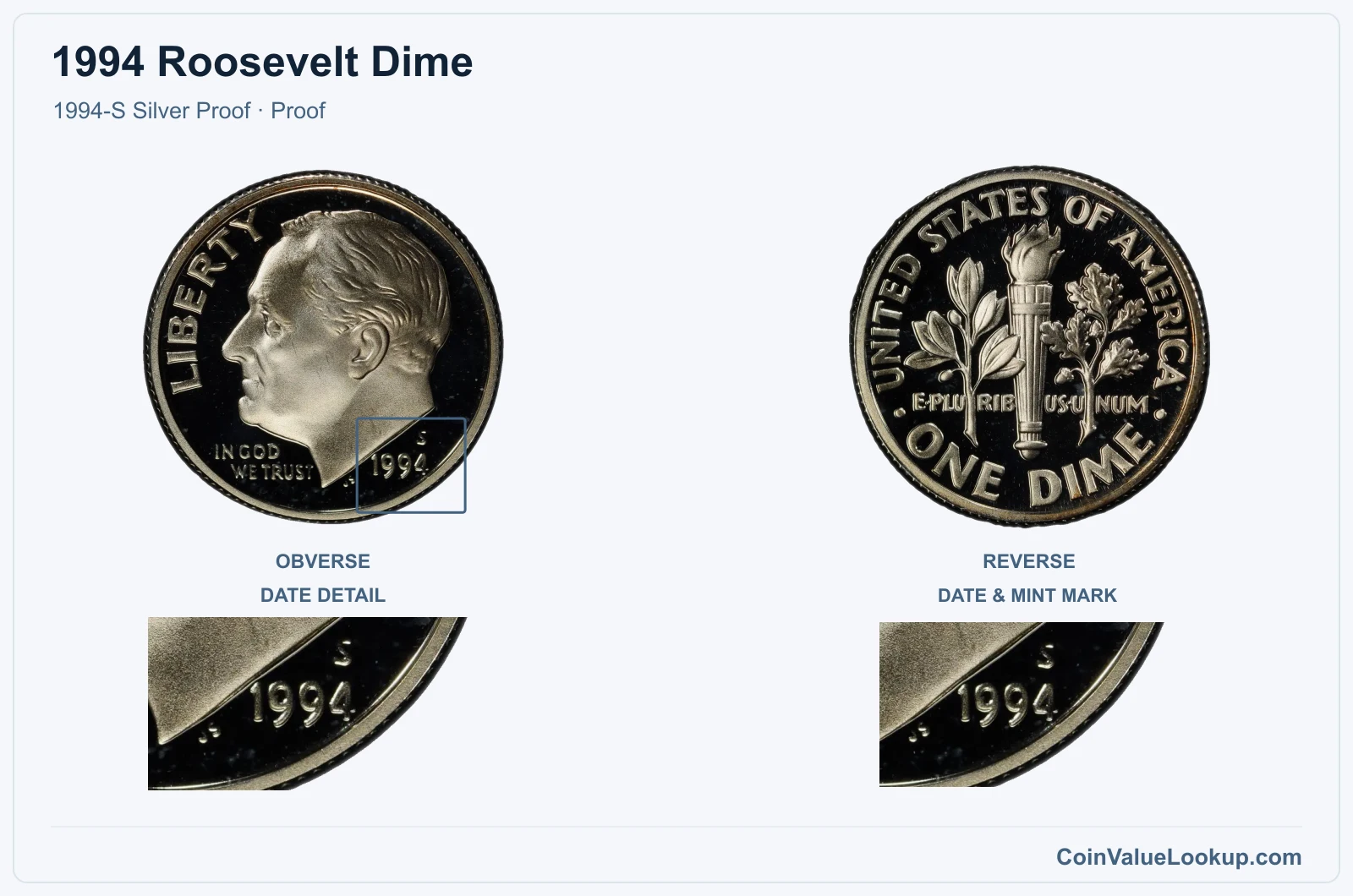
San Francisco also struck a 90% silver, 10% copper proof dime in 1994, weighing 2.50 grams — slightly heavier than the 2.27-gram clad version. It was packaged in the Silver Proof Set, which the Mint reintroduced in 1992.
The USA Coin Book guide places the PR65 silver proof at about $13. Silver content gives this version inherent metal value that fluctuates with the market, so its floor price moves.
To confirm you have the silver version, check the edge: no copper stripe should be visible. A precise scale reading of 2.50 grams versus 2.27 grams also separates the two.
When in doubt, professional authentication settles it.
Range Grade
Price Auction Records Appraisal PR PR 1
—
Coin Identifier
PR 2
—
Coin Identifier
PR 3
—
Coin Identifier
PR 4
—
Coin Identifier
PR 6
—
Coin Identifier
PR 8
—
Coin Identifier
PR 10
—
Coin Identifier
PR 12
—
Coin Identifier
PR 15
—
Coin Identifier
PR 20
—
Coin Identifier
PR 25
—
Coin Identifier
PR 30
—
Coin Identifier
PR 35
—
Coin Identifier
PR 40
—
Coin Identifier
PR 45
—
Coin Identifier
PR 50
—
Coin Identifier
PR 53
—
Coin Identifier
PR 55
—
Coin Identifier
PR 58
—
Coin Identifier
PR 60
—
Coin Identifier
PR 61
—
Coin Identifier
PR 62
—
Coin Identifier
PR 63
—
Coin Identifier
PR 64
—
Coin Identifier
PR 65
—
Coin Identifier
PR 66
—
Coin Identifier
PR 67
—
Coin Identifier
PR 68
—
Coin Identifier
PR 69
Coin Identifier
PR 70
Coin Identifier
1994 Roosevelt Dime Error List
1. 1994 Roosevelt Dime — Off-Center Strike
An off-center strike happens when the planchet is not seated properly in the collar before the dies come together, shifting the design away from center and leaving a blank crescent. For the 1994-P, look for roughly 45% of the design shifted while the date and P mintmark still survive on the struck portion — the date must be readable for the coin to be attributed to this year.
One NGC-graded MS65 example with about a 45% off-center shift sold for $74 in December 2020 at Heritage Auctions. That is a single documented sale, not a guaranteed market range.
Do not confuse a slight die misalignment — where the design is complete but off-center — with a true off-center strike that leaves a visible blank area.
2. 1994 Roosevelt Dime — Double Clipped Planchet
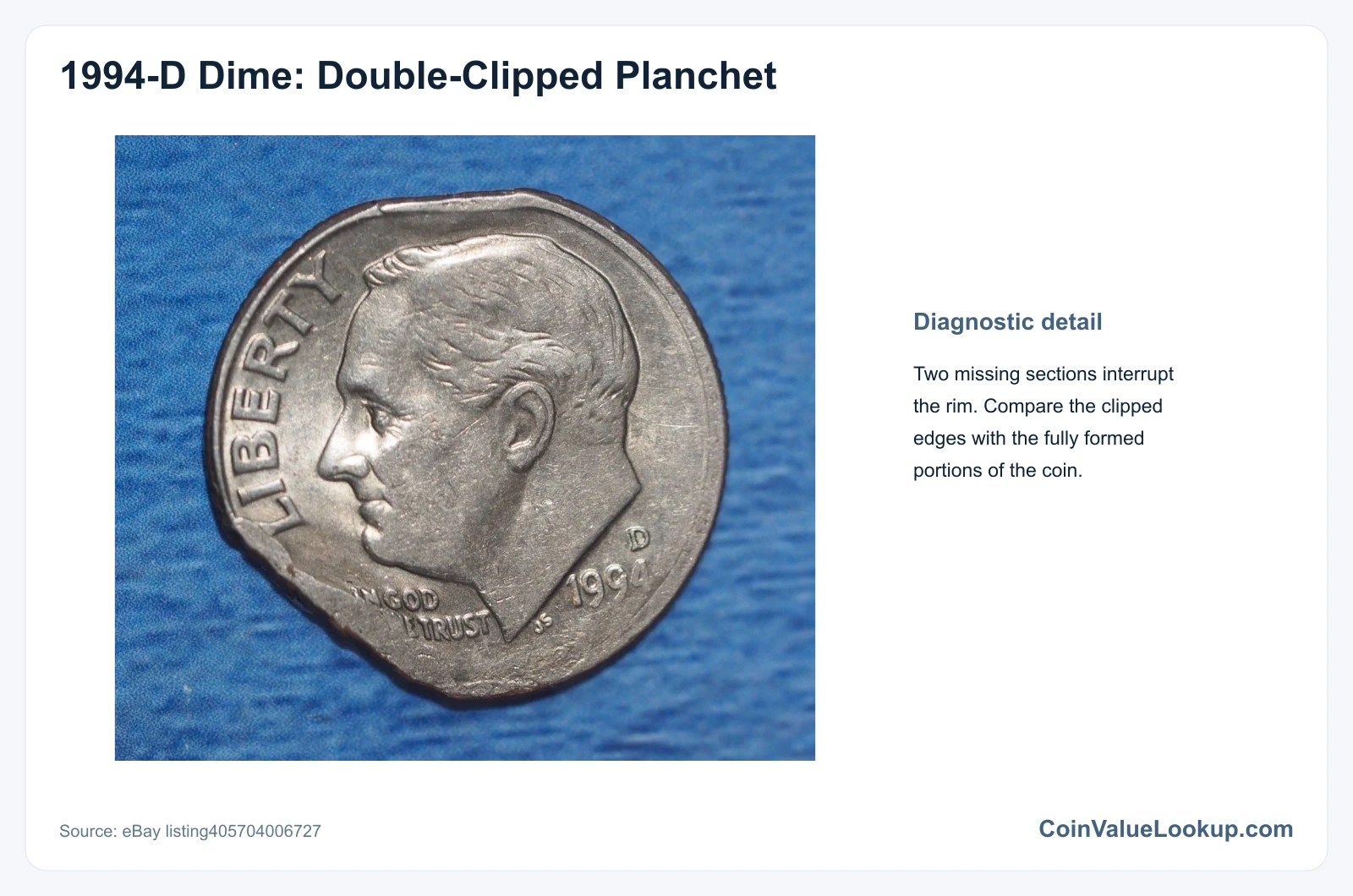
A double clipped planchet occurs when the blanking press overlaps a previously punched area of the metal strip, removing two bites from the planchet before striking. One authenticated 1994-P example graded AU55 by ANACS weighed only 2.08 grams, well below the normal 2.27 grams, confirming missing metal.
On a genuine clip you should see two curved indentations with natural, unstruck edges on both sides of the coin. The Blakesley effect — a weak area opposite each clip — often appears as well.
Post-mint cuts look different: they leave sharp, shiny edges and do not reduce striking pressure opposite the missing area. No specific price range is available; value depends on the authenticated identity, condition, and severity of the clips.
3. 1994 Roosevelt Dime — Brockage and Broadstrike
A brockage combined with a broadstrike is a dramatic error. It happens when an already-struck coin stays on a die and impresses a mirror-image incuse design onto the next planchet, while a collar failure simultaneously allows that planchet to spread beyond its normal diameter.
For the 1994-P, look for an incuse, reversed image on one side, a broader-than-normal rim, and a date context consistent with 1994. One cataloged specimen is a 40% brockage and broadstrike graded MS65.
Die clashes and flat strikes can superficially resemble brockage but lack the incuse mirror image and expanded diameter. No general price range is available — these are individually assessed based on authentication, the degree of brockage, and overall condition.
4. 1994 Roosevelt Dime — Missing Clad Layer
A missing clad layer error means one of the outer copper-nickel layers was absent from the planchet before striking. The result is a coin that appears copper-colored on the affected face because the core is exposed.
To check, compare the edge of your 1994 dime to a normal one: you should see only one clad layer sandwich instead of two. The coin will also weigh less than the standard 2.27 grams.
Toning, corrosion, environmental damage, and deliberate acid removal of the clad layer can all mimic this error, so surface texture matters — a genuine missing-layer coin was struck that way and should show normal design sharpness on the affected side. No specific price range is available; value depends on condition, how visible the error is, and professional authentication.
5. 1994 Roosevelt Dime — Doubled Die Obverse
A doubled die obverse on a 1994 dime shows consistent doubling in the obverse lettering or design elements, visible as separation or notching when compared to a normal coin under good lighting and magnification.
The key word is consistent. True hub doubling repeats identically on every coin struck from that die, and the doubled area shows a distinct raised profile rather than a flat mechanical shelf.
Machine doubling — caused by die bounce — produces flat, shelf-like distortion and is far more common but far less collectible. Examine letters like LIBERTY and IN GOD WE TRUST closely.
No specific price range is established for this date; value depends on the strength and visibility of the doubling and the coin's overall condition.
6. 1994 Roosevelt Dime — Die Crack / Die Chip
Die cracks appear as thin raised lines on the coin's surface, formed when a working die develops a fracture during production. A die chip is a small raised blob where a piece of the die face broke away.
If a crack reaches the rim and a large section of the die collapses, the result is called a cud — a flat, featureless raised area at the edge.
On a 1994 dime, look for raised lines or blobs that are part of the coin's metal, not scratched into it. Scratches are incuse; die cracks are raised.
Corrosion deposits and foreign material stuck to the surface can also fool you, so tilt the coin under a light. No established price range exists for this date; significance depends on the size, location, and type of the crack or chip.
7. 1994 Roosevelt Dime — Doubled Die Reverse
A doubled die reverse on a 1994 dime shows consistent doubling in the reverse legends or torch design, similar in principle to the obverse version but located on the back of the coin. Compare your coin's reverse lettering — especially UNITED STATES OF AMERICA and ONE DIME — against a normal example under magnification.
Genuine doubled dies display raised, separated profiles that repeat on every coin from the affected die. Machine doubling, by contrast, produces flat shelf-like distortion and is common but not valuable.
Reflections under certain lighting angles can also create an illusion of doubling, so examine the coin from multiple angles. No specific price range is adopted; the value of any confirmed doubled die reverse depends on the clarity of the doubling and the coin's condition.