1994 Jefferson Nickel Coin Value: How Much Is It Worth?
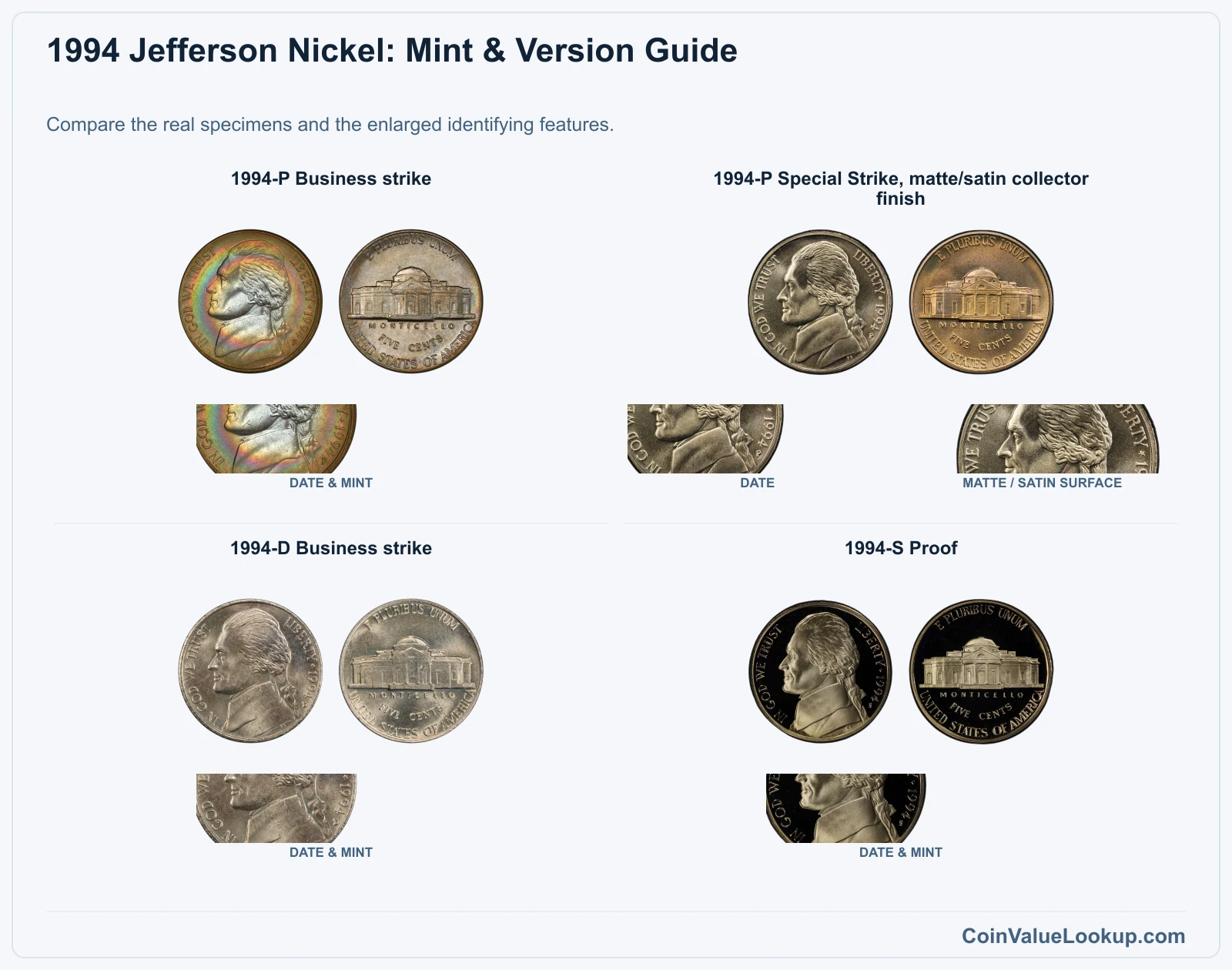
Most 1994 Jefferson nickels from pocket change are worth face value or close to it. For higher-grade uncirculated examples, selected retail guide anchors run from about $0.30 at MS60 to $3.08 at MS65, depending on mint and finish.
Proofs, the special collector strike, and authenticated error coins each occupy their own price lane. These guide figures are not guaranteed cash offers for every coin you pull out of a jar.
Fast Way to Identify Your 1994 Jefferson Nickel
Snap clear photos of both the front and back of your 1994 nickel and upload them here. Our identifier can give you a preliminary read on the mint, finish, and general type.
It works from photos alone, so good lighting and a steady hand help. This is not a substitute for professional authentication or grading, but it is a solid first step.
1994 Jefferson Nickel Value
Upload both sides of your 1994 Jefferson Nickel.
Front Obverse
Upload photo
Back Reverse
Upload photo
Which 1994 Jefferson Nickel Versions Are Worth Money?
- The 1994-P special collector finish nickel, from the Jefferson Coin and Currency Set, is distinct from ordinary Philadelphia strikes and requires authenticated provenance.
- High-grade certified 1994-P or 1994-D business strikes with Full Steps designations can command premiums above standard uncirculated prices.
- 1994-S proofs, especially with strong cameo contrast, trade in a separate market from business strikes.
- Confirmed striking errors such as wrong-planchet, partial collar, or rotated double strikes have sold individually at auction for significant premiums.
Step 1: Identify Your 1994 Jefferson Nickel Mint Mark and Version
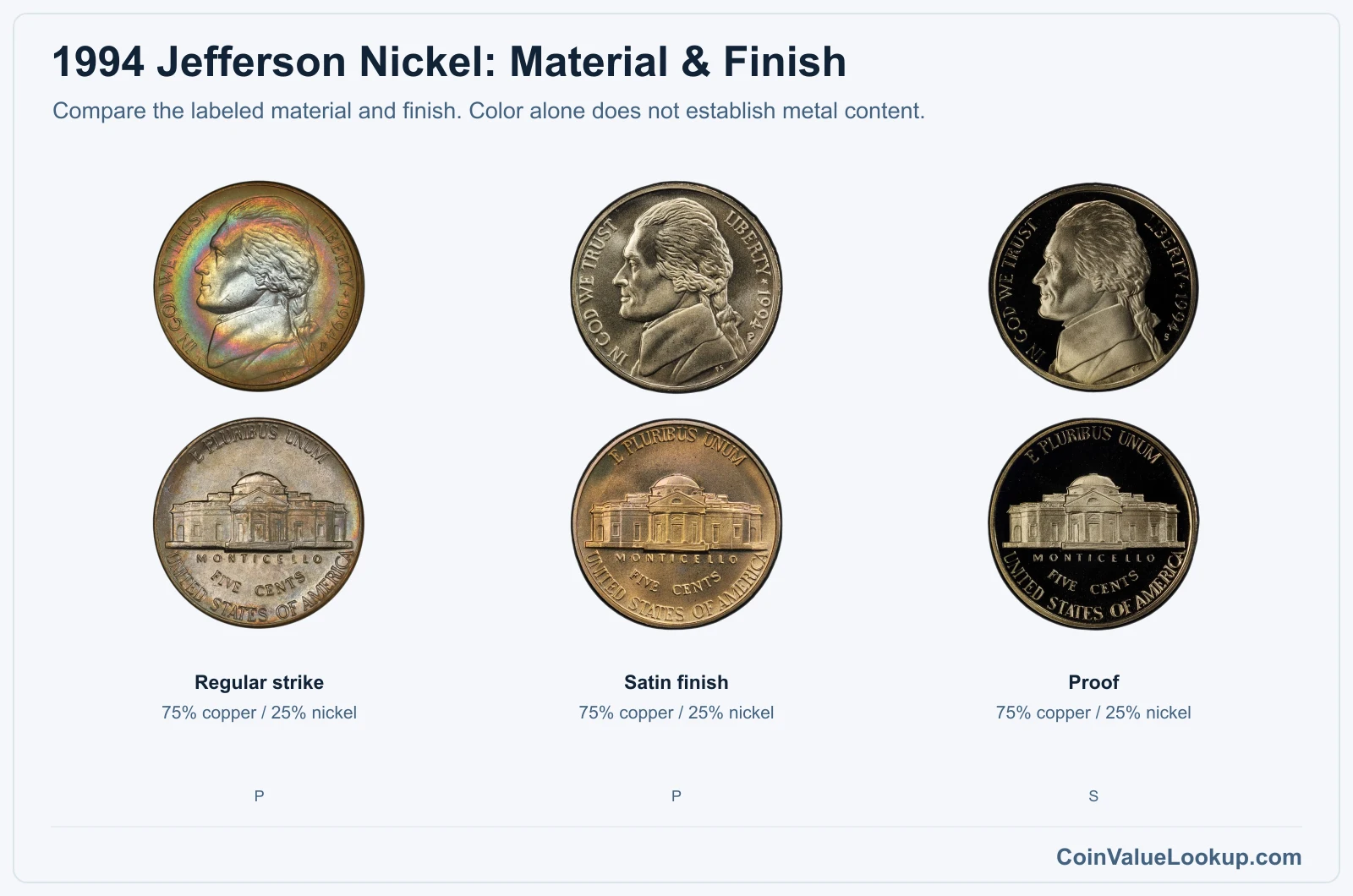
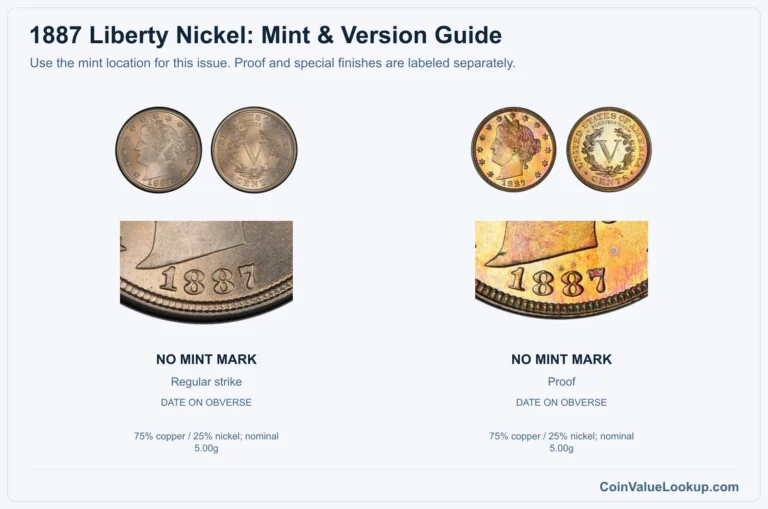
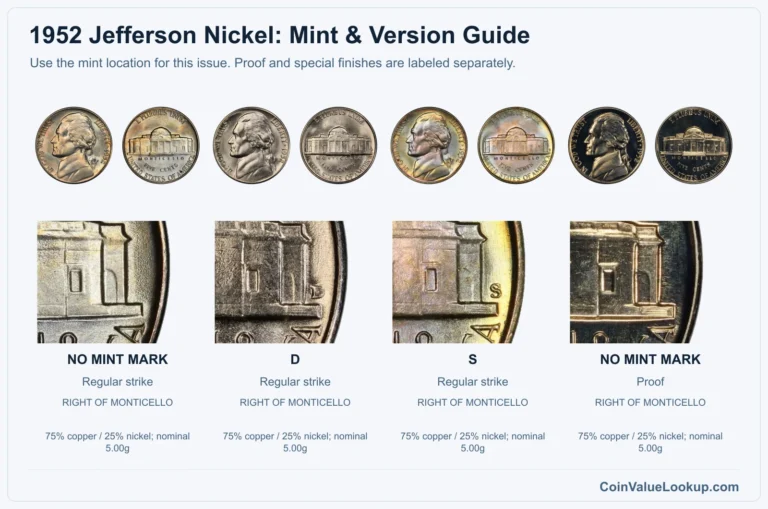
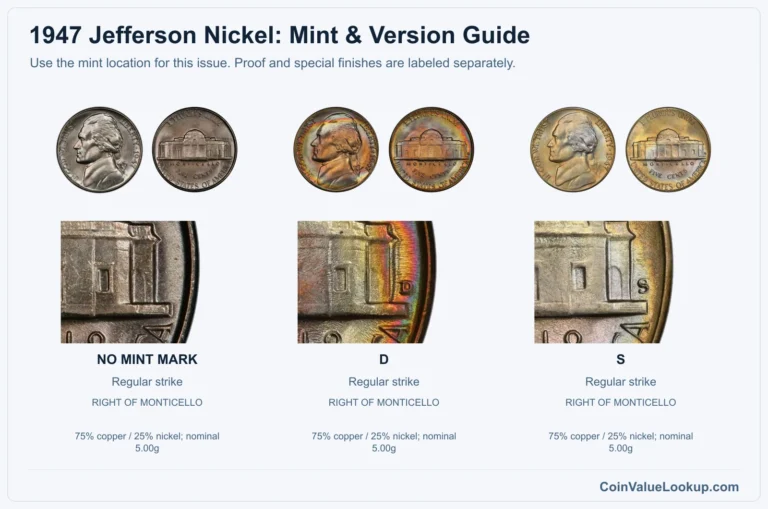
Flip to the obverse and look just to the right of the date. A small "P" means Philadelphia, "D" means Denver, and "S" means San Francisco proof.
Every regular 1994 nickel is 75% copper and 25% nickel, weighs about 5 grams, measures 21.2 mm across, and has a plain edge. It is not silver.
The 1994-P special collector finish is a separate animal. These were distributed in the Jefferson Coin and Currency Set alongside a 1993 silver dollar and a 1976 $2 note, with a mintage of 167,703 nickels.
They carry a matte or satin surface that differs noticeably from ordinary business strikes. Do not diagnose one simply because your nickel looks shiny; proper attribution requires comparison against authenticated examples and ideally the original packaging or provenance.
Record the date, mintmark, edge appearance, and surface finish before you try to price anything. A proof from San Francisco has mirrored fields and sharp rims, while a business strike from Denver will show cartwheel luster when tilted under a light.
Step 2: Check Your 1994 Jefferson Nickel Grade
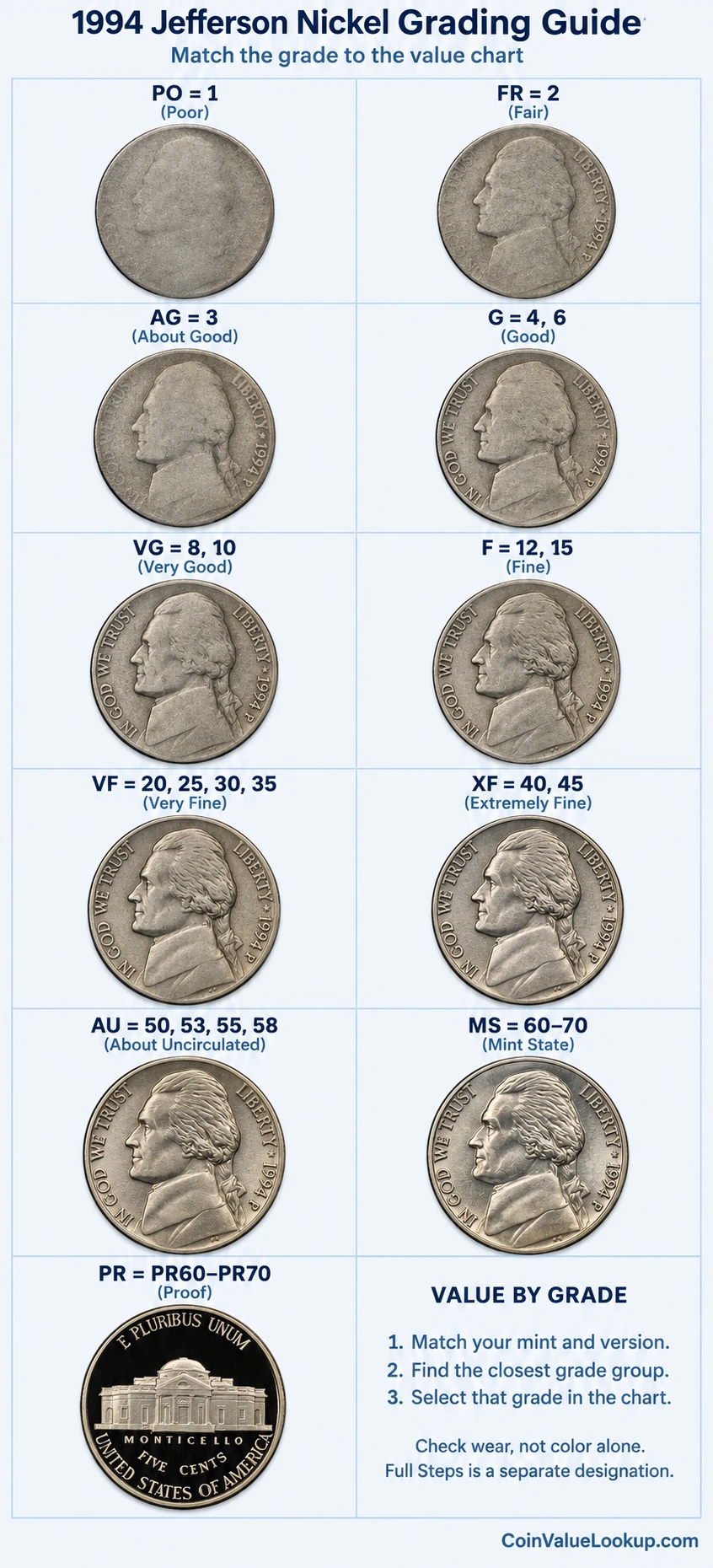
Focus on Jefferson's cheekbone and the hair above his ear. These are the first areas to lose detail as a coin circulates.
A coin with full luster and no wear on those high points is a candidate for Mint State. On the reverse, check the columns and steps of Monticello for completeness.
Use the comparison image to match your coin's wear pattern against known grade levels. A coin grading MS60 may have full luster but noticeable contact marks, while an MS65 will look clean and well-struck with minimal distractions.
Full Steps is a separate designation, not a numerical grade. It describes whether the horizontal lines on Monticello's base are fully formed and uninterrupted.
A coin can grade MS65 without Full Steps if the strike was weak in that area. Similarly, proof cameo and deep cameo describe contrast between frosted devices and mirrored fields, not a step above proof.
Step 3: Check 1994 Jefferson Nickel Value by Mint and Version
1994 Jefferson Nickel — P Business strike
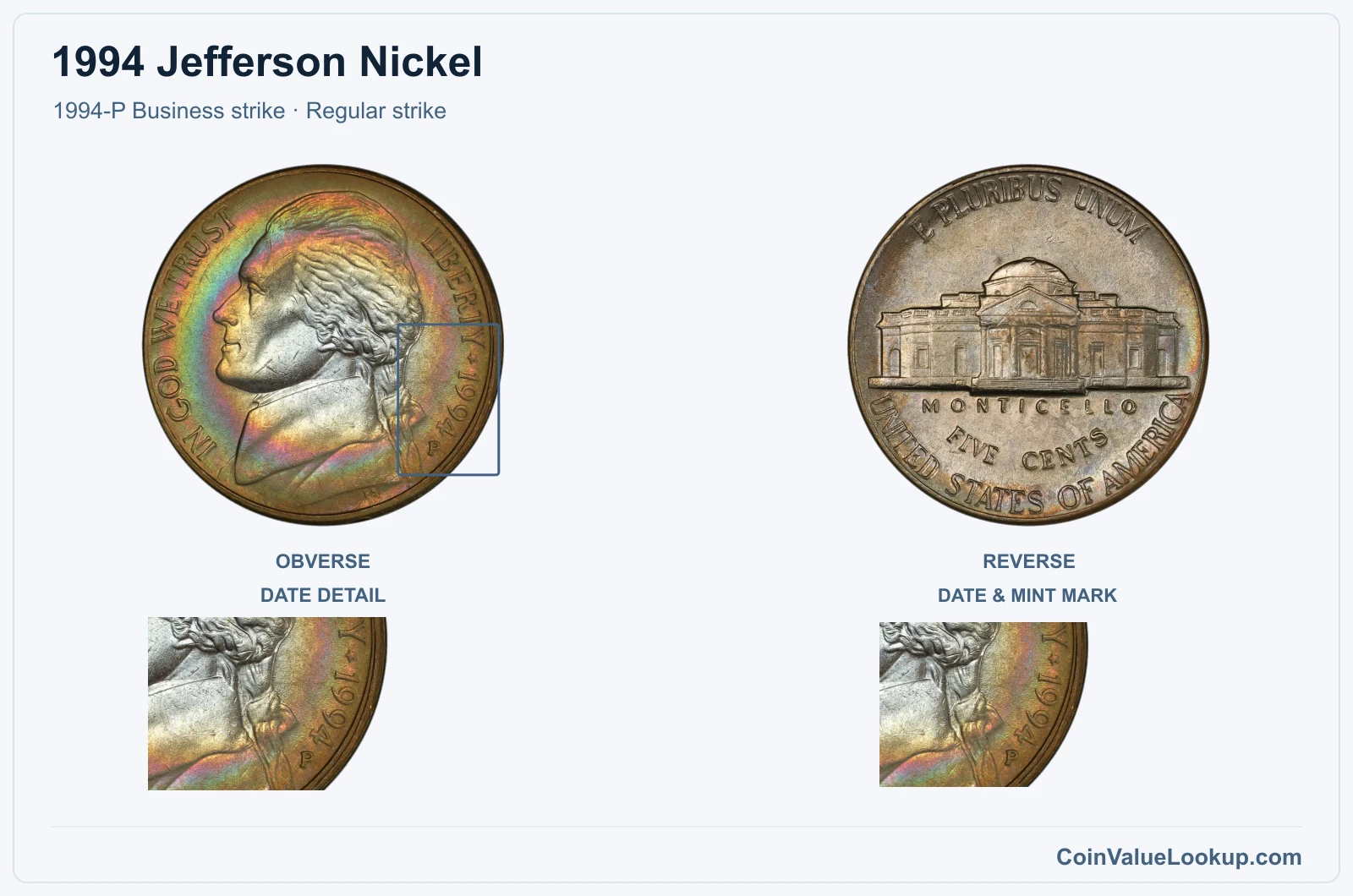
The 1994-P is your standard Philadelphia business strike. Jefferson portrait on the front, Monticello on the back, 75% copper and 25% nickel, plain edge.
Millions were made and most circulated examples are worth five cents.
In uncirculated condition, USA Coin Book lists a guide value of about $0.30 at MS60 and $3.08 at MS65. Those are retail guide estimates, not dealer buy prices.
Coins certified with a Full Steps designation can trade above those anchors, but a worn pocket coin does not inherit those premiums just because it has a P mintmark.
| Range | Grade | Price | Auction Records | Appraisal |
|---|---|---|---|---|
| PO | PO 1 | — | Coin Identifier | |
| FR | FR 2 | — | Coin Identifier | |
| AG | AG 3 | — | Coin Identifier | |
| G | G 4 | — | Coin Identifier | |
| G 6 | — | Coin Identifier | ||
| VG | VG 8 | — | Coin Identifier | |
| VG 10 | — | Coin Identifier | ||
| F | F 12 | — | Coin Identifier | |
| F 15 | — | Coin Identifier | ||
| VF | VF 20 | — | Coin Identifier | |
| VF 25 | — | Coin Identifier | ||
| VF 30 | — | Coin Identifier | ||
| VF 35 | — | Coin Identifier | ||
| XF | XF 40 | — | Coin Identifier | |
| XF 45 | — | Coin Identifier | ||
| AU | AU 50 | — | Coin Identifier | |
| AU 53 | — | Coin Identifier | ||
| AU 55 | — | Coin Identifier | ||
| AU 58 | — | Coin Identifier | ||
| MS | MS 60 | — | Coin Identifier | |
| MS 61 | — | Coin Identifier | ||
| MS 62 | — | Coin Identifier | ||
| MS 63 | — | Coin Identifier | ||
| MS 64 | — | Coin Identifier | ||
| MS 65 | — | Coin Identifier | ||
| MS 66 | — | Coin Identifier | ||
| MS 67 | — | — | — | |
| MS 68 | — | — | — | |
| MS 69 | — | — | — | |
| MS 70 | — | — | — |
1994 Jefferson Nickel — P Special Strike, matte/satin collector finish
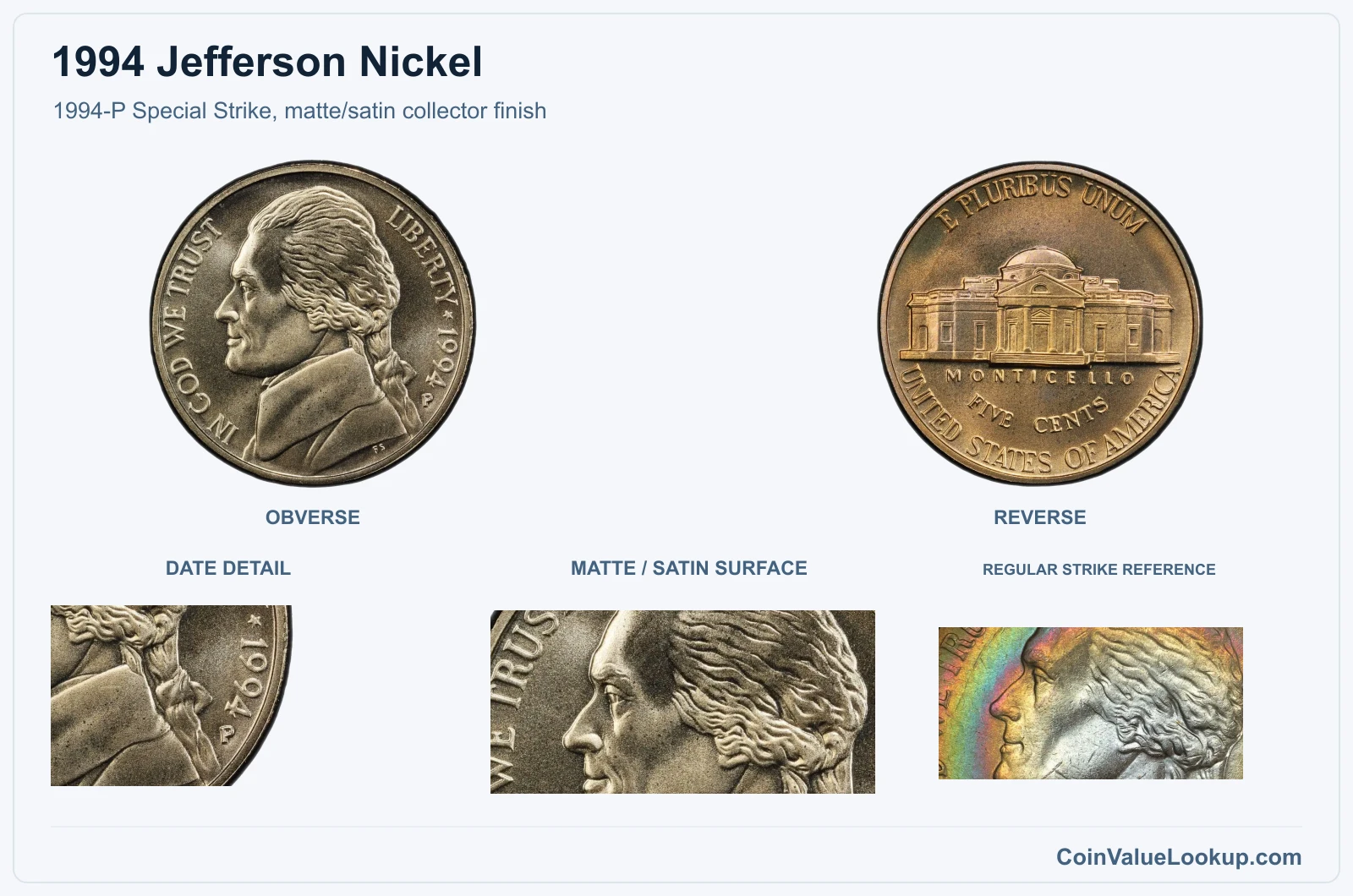
This is the 1994-P special collector finish nickel, sometimes described as a matte or satin strike. It was produced exclusively for the Jefferson Coin and Currency Set, which also included a 1993 Thomas Jefferson silver dollar and a 1976 $2 note.
Total nickel mintage for this set was 167,703 pieces.
The surface is different from a regular business strike. It lacks the cartwheel luster of a normal uncirculated coin and the mirrored fields of a proof.
Think of it as a quieter, flatter finish. No supported numeric price range has been adopted here, so value depends on the individual coin's authenticated identity, condition, and any error it may carry.
If you think you have one, compare it against known examples and look for original set provenance before drawing conclusions.
Coin Value Lookup is a handy starting point if you want to look up guides for other Jefferson nickel years or denominations while you research your set.
| Range | Grade | Price | Auction Records | Appraisal |
|---|---|---|---|---|
| SP | SP 1 | — | Coin Identifier | |
| SP 2 | — | Coin Identifier | ||
| SP 3 | — | Coin Identifier | ||
| SP 4 | — | Coin Identifier | ||
| SP 6 | — | Coin Identifier | ||
| SP 8 | — | Coin Identifier | ||
| SP 10 | — | Coin Identifier | ||
| SP 12 | — | Coin Identifier | ||
| SP 15 | — | Coin Identifier | ||
| SP 20 | — | Coin Identifier | ||
| SP 25 | — | Coin Identifier | ||
| SP 30 | — | Coin Identifier | ||
| SP 35 | — | Coin Identifier | ||
| SP 40 | — | Coin Identifier | ||
| SP 45 | — | Coin Identifier | ||
| SP 50 | — | Coin Identifier | ||
| SP 53 | — | Coin Identifier | ||
| SP 55 | — | Coin Identifier | ||
| SP 58 | — | Coin Identifier | ||
| SP 60 | — | Coin Identifier | ||
| SP 61 | — | Coin Identifier | ||
| SP 62 | — | Coin Identifier | ||
| SP 63 | — | Coin Identifier | ||
| SP 64 | — | Coin Identifier | ||
| SP 65 | — | Coin Identifier | ||
| SP 66 | — | Coin Identifier | ||
| SP 67 | Coin Identifier | |||
| SP 68 | Coin Identifier | |||
| SP 69 | Coin Identifier | |||
| SP 70 | Coin Identifier |
1994 Jefferson Nickel — D Business strike
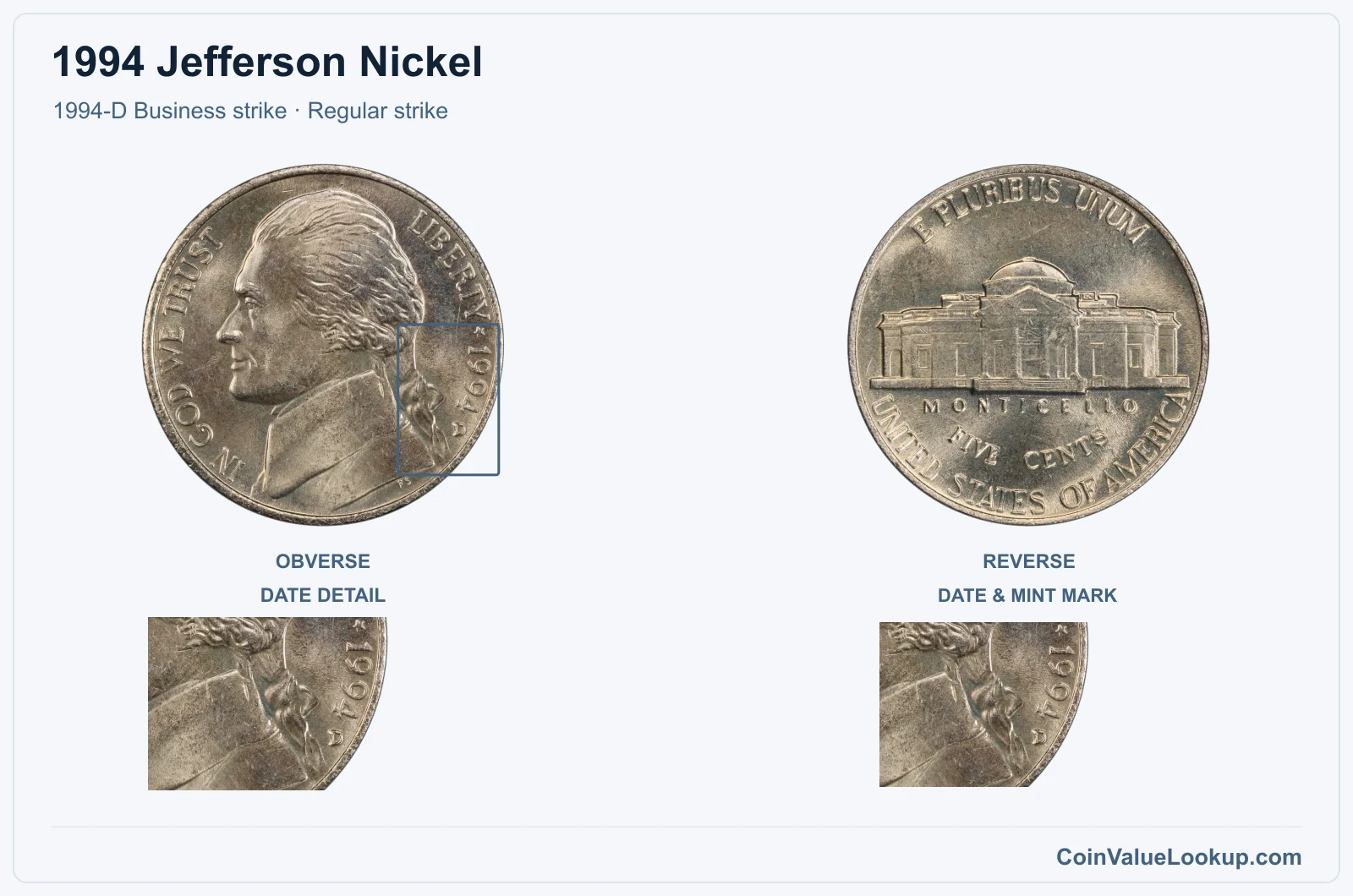
The 1994-D came from the Denver Mint. Same copper-nickel composition, same design, same weight and diameter as the Philadelphia issue.
Most are common in any grade you will encounter in change.
USA Coin Book guide estimates place the 1994-D at roughly $0.30 in MS60 and $1.24 in MS65. The MS65 anchor is lower than the Philadelphia version, which is typical for Denver nickels of this era.
Full Steps examples, if authenticated, can bring more. As always, these are guide figures, not binding offers.
| Range | Grade | Price | Auction Records | Appraisal |
|---|---|---|---|---|
| PO | PO 1 | — | Coin Identifier | |
| FR | FR 2 | — | Coin Identifier | |
| AG | AG 3 | — | Coin Identifier | |
| G | G 4 | — | Coin Identifier | |
| G 6 | — | Coin Identifier | ||
| VG | VG 8 | — | Coin Identifier | |
| VG 10 | — | Coin Identifier | ||
| F | F 12 | — | Coin Identifier | |
| F 15 | — | Coin Identifier | ||
| VF | VF 20 | — | Coin Identifier | |
| VF 25 | — | Coin Identifier | ||
| VF 30 | — | Coin Identifier | ||
| VF 35 | — | Coin Identifier | ||
| XF | XF 40 | — | Coin Identifier | |
| XF 45 | — | Coin Identifier | ||
| AU | AU 50 | — | Coin Identifier | |
| AU 53 | — | Coin Identifier | ||
| AU 55 | — | Coin Identifier | ||
| AU 58 | — | Coin Identifier | ||
| MS | MS 60 | — | Coin Identifier | |
| MS 61 | — | Coin Identifier | ||
| MS 62 | — | Coin Identifier | ||
| MS 63 | — | Coin Identifier | ||
| MS 64 | — | Coin Identifier | ||
| MS 65 | — | Coin Identifier | ||
| MS 66 | Coin Identifier | |||
| MS 67 | — | — | — | |
| MS 68 | — | — | — | |
| MS 69 | — | — | — | |
| MS 70 | — | — | — |
1994 Jefferson Nickel — S Proof
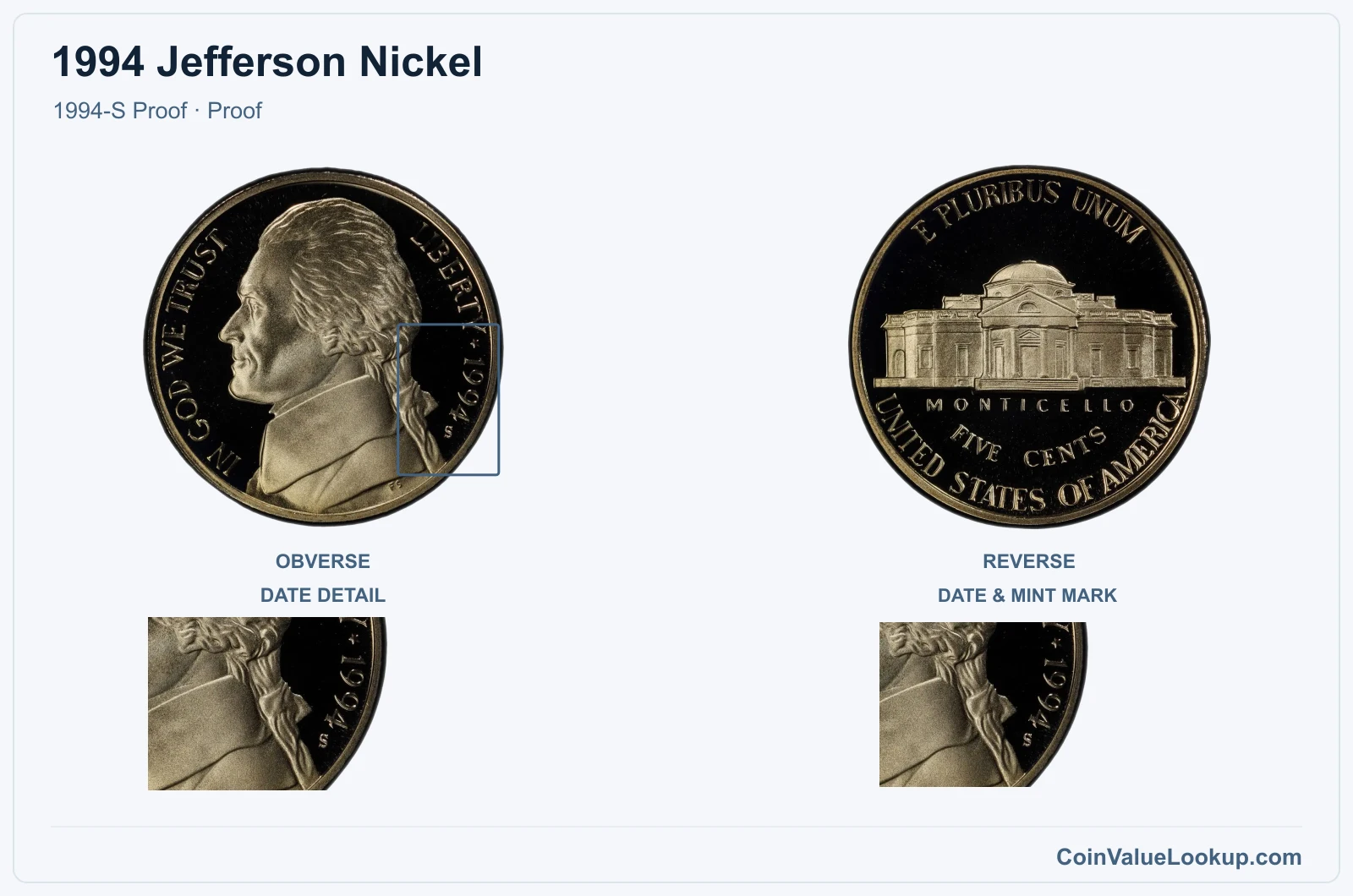
The 1994-S proof was struck at San Francisco for collector sets. It features mirrored fields and sharply detailed devices on the standard copper-nickel planchet.
You will not find these in circulation unless someone broke open a set.
A USA Coin Book guide anchor sits at about $4.27 in PR65. That figure is a general proof estimate and is not specific to cameo or deep cameo designations, which typically command higher prices.
Cameo contrast is about the frosted-versus-mirrored look on the devices and fields, not a separate grade number.
| Range | Grade | Price | Auction Records | Appraisal |
|---|---|---|---|---|
| PR | PR 1 | — | Coin Identifier | |
| PR 2 | — | Coin Identifier | ||
| PR 3 | — | Coin Identifier | ||
| PR 4 | — | Coin Identifier | ||
| PR 6 | — | Coin Identifier | ||
| PR 8 | — | Coin Identifier | ||
| PR 10 | — | Coin Identifier | ||
| PR 12 | — | Coin Identifier | ||
| PR 15 | — | Coin Identifier | ||
| PR 20 | — | Coin Identifier | ||
| PR 25 | — | Coin Identifier | ||
| PR 30 | — | Coin Identifier | ||
| PR 35 | — | Coin Identifier | ||
| PR 40 | — | Coin Identifier | ||
| PR 45 | — | Coin Identifier | ||
| PR 50 | — | Coin Identifier | ||
| PR 53 | — | Coin Identifier | ||
| PR 55 | — | Coin Identifier | ||
| PR 58 | — | Coin Identifier | ||
| PR 60 | — | Coin Identifier | ||
| PR 61 | — | Coin Identifier | ||
| PR 62 | — | Coin Identifier | ||
| PR 63 | — | Coin Identifier | ||
| PR 64 | — | Coin Identifier | ||
| PR 65 | — | Coin Identifier | ||
| PR 66 | — | Coin Identifier | ||
| PR 67 | — | Coin Identifier | ||
| PR 68 | Coin Identifier | |||
| PR 69 | Coin Identifier | |||
| PR 70 | Coin Identifier |
1994 Jefferson Nickel Error List
1. 1994 Jefferson Nickel — Struck on clad blank
A 1994-P nickel struck on a clad planchet instead of its normal solid copper-nickel alloy is a wrong-planchet error. The edge is the giveaway: a standard nickel has a uniform gray edge, while a clad planchet shows visible layering.
The weight may also differ from the expected 5 grams.
One example, graded NGC MS63, sold through Heritage Auctions in April 2013 for $881.25. That is a single auction result, not a standing price for every example.
Do not confuse ordinary edge discoloration, environmental toning, or a plated coin for a genuine wrong-planchet strike. Authentication by a major grading service is the reliable way to confirm this error.
2. 1994 Jefferson Nickel — Partial collar on special collector strike
A partial collar error on the 1994-P special collector finish nickel shows a raised shelf or stepped rim on part of the edge where the collar die did not fully contain the planchet during striking. This is a striking error combined with the scarce special finish, which makes it a distinct collectible.
One example, graded ICG MS69 Full Steps, sold through Heritage Auctions in March 2008 for $161. Because the special finish is already limited to 167,703 coins, an error on top of that is uncommon.
Do not confuse a filed or damaged rim with a genuine partial collar. A partial collar produces a consistent, smooth raised section, not rough scratches or dents.
3. 1994 Jefferson Nickel — Rotated second strike with partial collar
A rotated second strike with partial collar means the coin was hit twice by the dies, with the second impression rotated relative to the first. The result is overlapping but offset design elements.
The edge also shows evidence of incomplete collar restraint. This is not a doubled die, which involves a single strike from a defective die.
One 1994-P example was graded PCGS MS64, but no supported price range is available here. Value depends on the degree of rotation, the visibility of the doubled design, and the coin's overall condition.
Machine doubling, which produces flat shelf-like doubling without the depth of a true second strike, is a common lookalike. Post-mint damage from being squeezed or flattened can also mimic a double strike to the untrained eye.
4. 1994 Jefferson Nickel — Double / Multiple Strike
Double or multiple strike errors on 1994 nickels occur when the planchet receives more than one impression from the dies. You will see separate, displaced, or rotated design elements.
Sometimes the second strike lands off-center, creating a dramatic spread between the two impressions.
No numerical price range is adopted for this category. Value varies widely based on how visible and dramatic the extra strike is, the coin's grade, and the specific mint and finish involved.
A slight rotation might bring modest interest, while a fully separated second strike with an off-center element commands far more attention. Do not confuse a doubled die, which involves a single strike from an improperly made die, with a genuine multiple strike.
Post-mint impressions added outside the coining press also mimic this error.
5. 1994 Jefferson Nickel — Die Crack / Die Chip
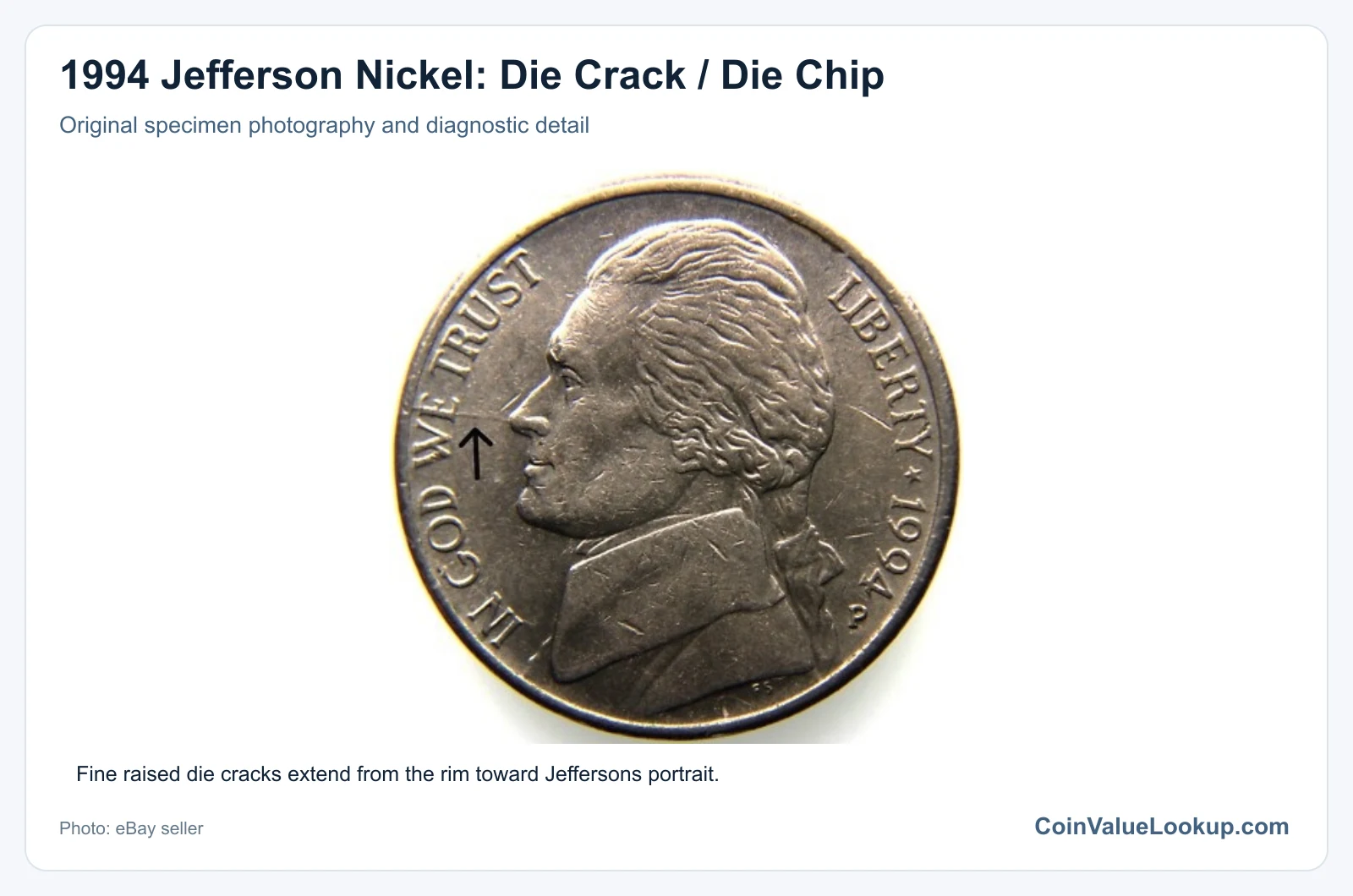
Die cracks and die chips on 1994 nickels appear as raised lines or small raised blobs on the coin's surface. They are reported specifically on the reverse of 1994-P special collector finish (SMS) nickels.
A die crack is a raised line connecting two points, sometimes running from the rim into the design. A die chip is a small raised lump where a piece of the die broke away.
No numerical price range is adopted. The value depends on the size, location, and prominence of the crack or chip, plus the coin's overall condition.
A large rim-connected break, sometimes called a cud, tends to be worth more than a thin hairline crack. Do not mistake incuse scratches, surface corrosion, or dried foreign material for a genuine die crack.
Die cracks are always raised above the surrounding surface.
6. 1994 Jefferson Nickel — Struck-Through Error
A struck-through error occurs when debris, grease, or a foreign object sits between the die and the planchet during striking. The result is a localized depression or incomplete design area where the obstruction blocked the die's impression.
On 1994 nickels, these have been reported as obstruction-type strike-throughs.
No numerical price range is adopted. Value depends on the size of the affected area, what the obstruction was, and whether it remains embedded in the coin.
A large, clearly defined struck-through area is more desirable than a subtle grease-filled detail. Do not confuse normal wear, cleaning marks, or a weakly struck area with a true struck-through error.
Genuine examples show a distinct impression boundary rather than gradual fading of detail.
7. 1994 Jefferson Nickel — Lamination / Split Planchet
Lamination errors on 1994 nickels show as peeling metal, a retained flap, or a visible separation within the alloy. These happen when impurities or gas pockets in the planchet cause layers to split apart.
Photograph both the affected face and the edge together, because the edge view often reveals the depth of the separation.
No numerical price range is adopted here. Value depends on the size of the lamination, whether the flap is still attached, and the coin's overall grade.
A large retained flap that exposes underlying metal is typically more desirable than a tiny peel. Do not confuse deliberate scraping, surface corrosion, or a coin that has been cut or gouged with a genuine lamination.
Lamination separations follow the metal's internal structure and have a natural, layered appearance.