1880 Shield Nickel Coin Value: How Much Is It Worth?
The 1880 Shield Nickel is a genuinely scarce coin. Philadelphia struck only about 16,000 for circulation that year, making the business strike far harder to find than the proof.
Guide estimates from USA Coin Book place an ordinary circulation strike around $2,257 in G4 and up to roughly $30,929 in MS63, while a normal proof sits near $468 in PR63. These are retail guide figures, not guaranteed sale prices.
Correctly identifying whether your coin is a business strike or a proof is the single biggest factor in its value.
Fast Way to Identify Your 1880 Shield Nickel
Snap a clear photo of the front and back of your 1880 Shield Nickel and upload both images. Our identifier can give you a preliminary read on what you have, including the strike type and general condition.
This is not a certification or exact grade, just a helpful starting point before you decide on next steps.
1880 Shield Nickel Value
Upload both sides of your 1880 Shield Nickel.
Front Obverse
Upload photo
Back Reverse
Upload photo
Which 1880 Shield Nickel Versions Are Worth Money?
- The business strike had a mintage of only about 16,000 coins, making it far scarcer than the proof and worth considerably more at every grade level.
- Correctly distinguishing a business strike from a proof is the most important step, since the value gap between the two is substantial.
- A repunched date variety exists for both business and proof strikes, though each is a separate attribution with its own diagnostics.
Step 1: Identify Your 1880 Shield Nickel Mint Mark and Version
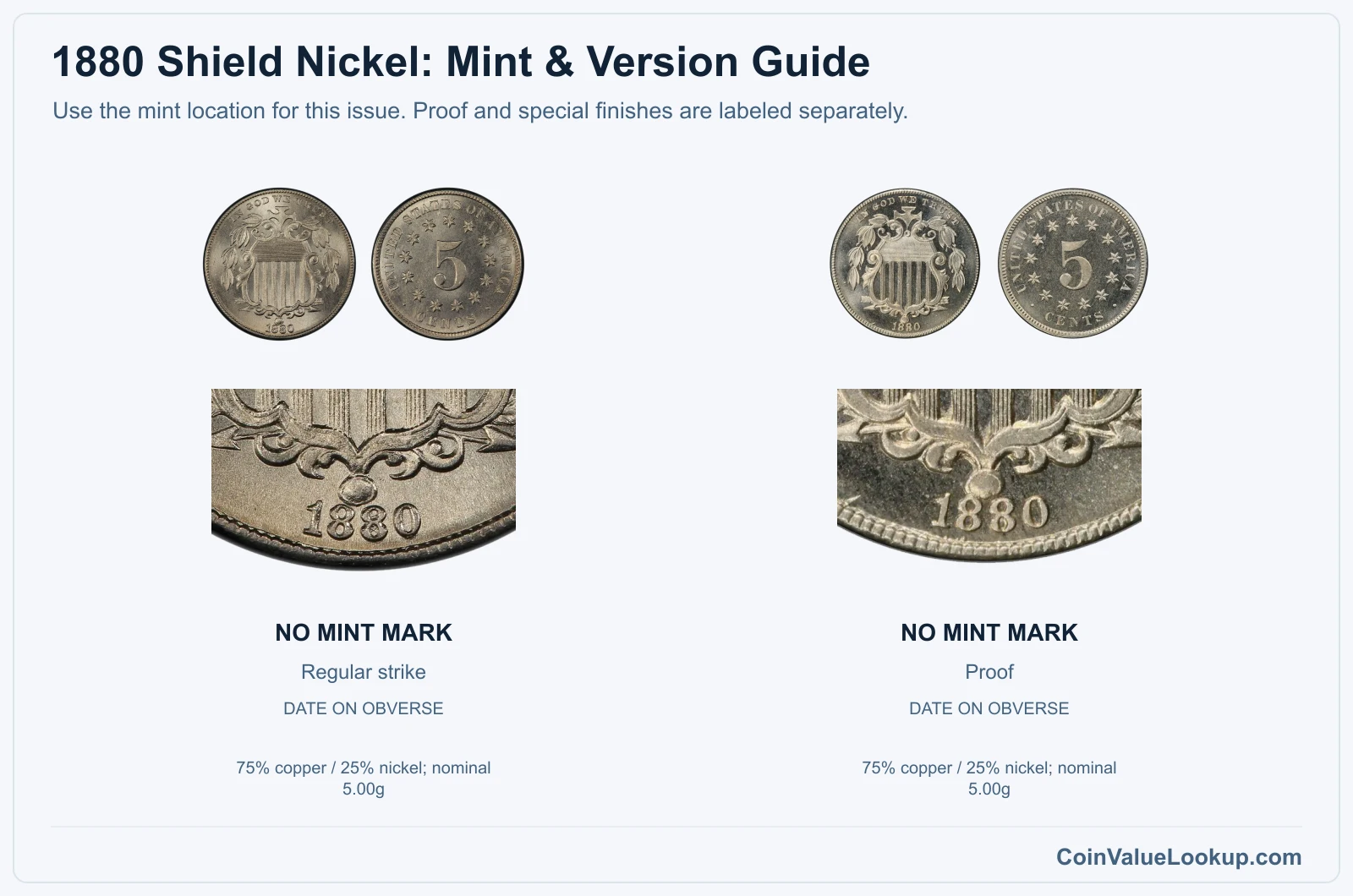
Every 1880 Shield Nickel was struck in Philadelphia. There is no mintmark, and the absence of a mint letter is completely normal for this issue.
The coin is copper-nickel, 75% copper and 25% nickel, weighing about 5 grams with a plain edge and a diameter of 20.5 mm. No silver version exists.
The design is the "No Rays" type, which applies to all Shield Nickels from 1867 onward. The obverse shows a prominent federal shield, and the reverse features a large numeral 5 surrounded by stars without the radiating lines seen on the earlier 1866–1867 With Rays subtype.
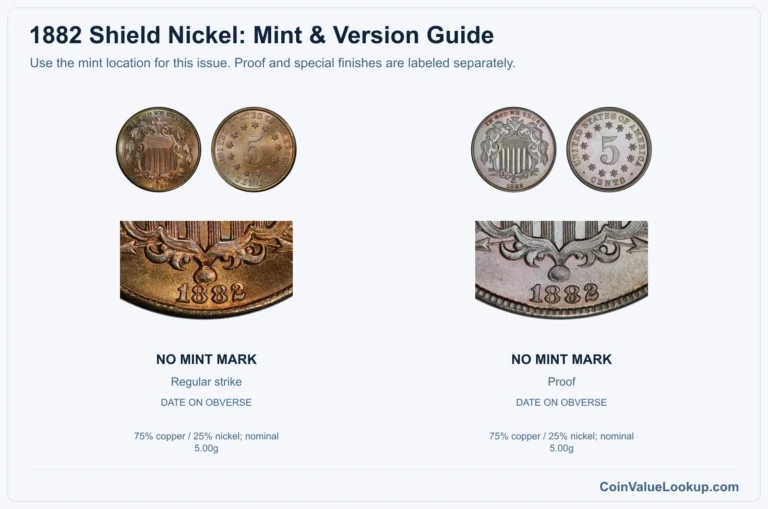
The critical identification question is whether your coin is a business strike or a proof. Both look similar because they share the same dies and metal.
A proof will typically show squared-off rims, mirror-like fields, and sharper design details, while a business strike tends to have more flow lines and softer rims. If you are unsure, professional attribution is worth pursuing, because the value difference is enormous.
Step 2: Check Your 1880 Shield Nickel Grade
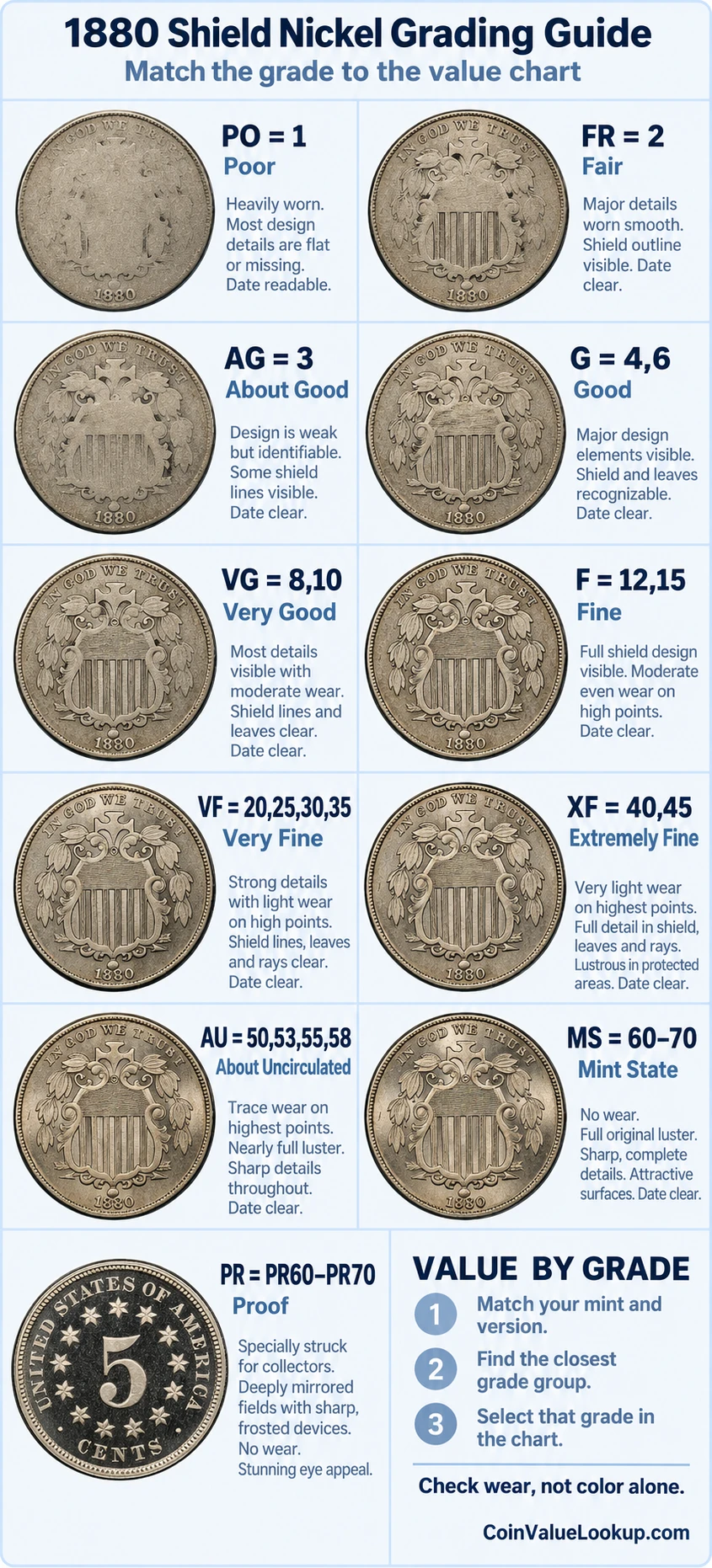
Start by examining the shield on the obverse. The horizontal and vertical lines within the shield are the first areas to lose definition from wear.
Check the cross at the top and the leaves flanking the shield as well. In lower grades, these details blend together.
Be aware that weak strikes on this series can mimic wear. A softly struck coin in higher grade may still show mushy details, so look at the fields and high points together.
If the fields retain original luster but the design is soft, you may have a strike issue rather than actual circulation wear.
Proofs require their own evaluation. Look for hairlines from old cleanings, which are common on 19th-century proofs that were stored loosely.
Compare both the obverse and reverse fields under good light to assess reflectivity before deciding between a circulated, About Uncirculated, or Mint State attribution.
Never clean the coin. A cleaned or damaged piece needs separate valuation and will not match the guide figures mentioned here.
Use the comparison image to match your coin's overall sharpness to a known grade reference.
Step 3: Check 1880 Shield Nickel Value by Mint and Version
1880 Shield Nickel — No Mint Mark — Circulation Strike
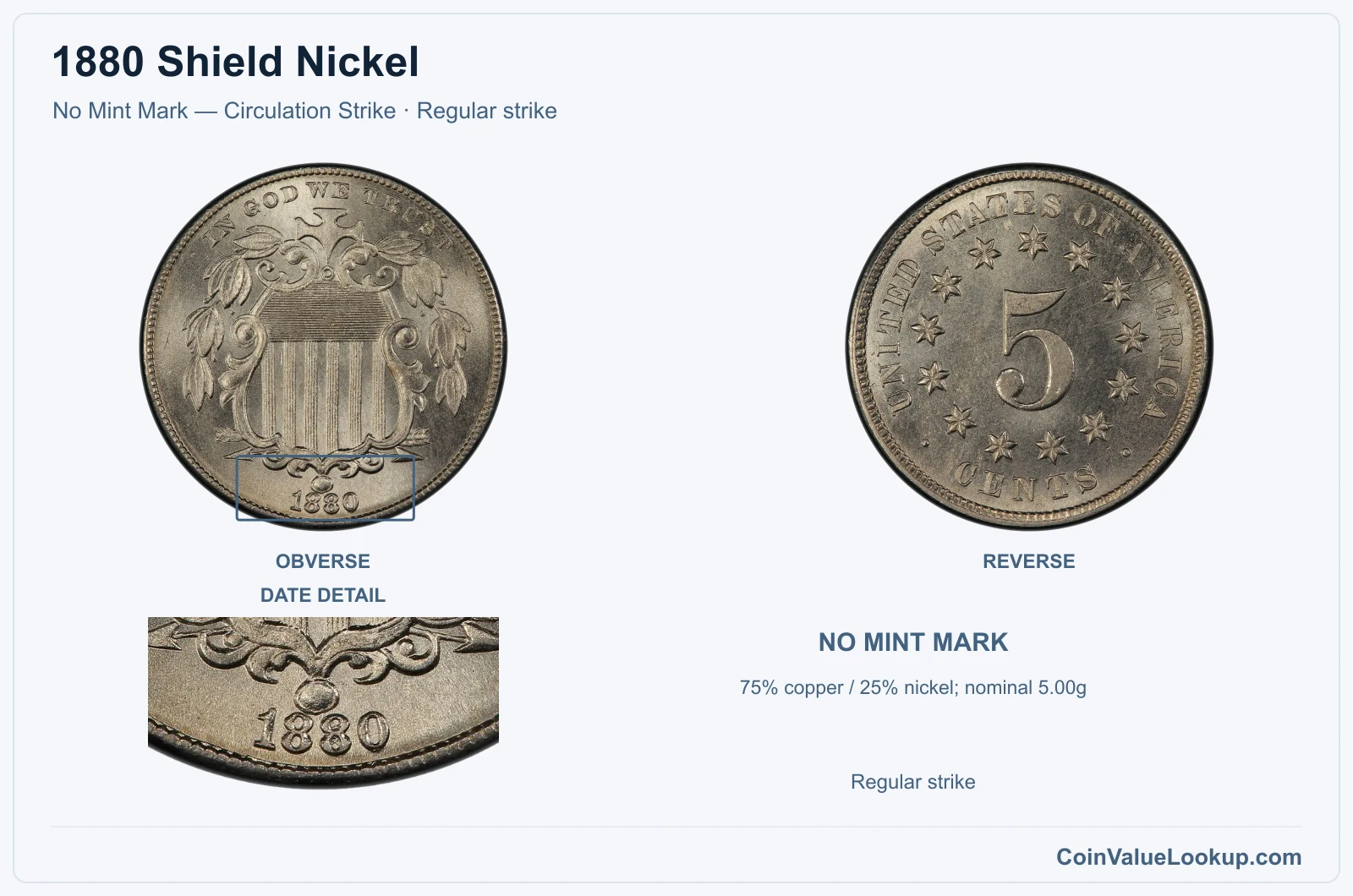
The 1880 Shield Nickel business strike is the key to this date. With roughly 16,000 produced, it is one of the lowest-mintage circulation issues in the entire Shield Nickel series.
USA Coin Book estimates place it around $2,257 in G4, a well-worn but identifiable grade, and near $30,929 in MS63, which represents a coin with full mint luster and only minor contact marks.
If you find one of these in a junk box, pause. The proof is far more common for this date, so many surviving 1880 Shield Nickels are actually proofs that circulated.
Look for squared rims and mirror fields to rule out a proof. A true business strike will typically show cartwheel luster rather than deep reflectivity.
Coin Value Lookup is a good place to start when you need quick reference guides for series like this. It can help you compare your coin's characteristics against known types before deciding on professional grading.
Range Grade
Price Auction Records Appraisal PO PO 1
—
Coin Identifier FR FR 2
—
Coin Identifier AG AG 3
Coin Identifier G G 4
Coin Identifier
G 6
Coin Identifier VG VG 8
—
Coin Identifier
VG 10
—
Coin Identifier F F 12
—
Coin Identifier
F 15
Coin Identifier VF VF 20
—
Coin Identifier
VF 25
Coin Identifier
VF 30
—
Coin Identifier
VF 35
Coin Identifier XF XF 40
Coin Identifier
XF 45
Coin Identifier AU AU 50
Coin Identifier
AU 53
Coin Identifier
AU 55
Coin Identifier
AU 58
Coin Identifier MS MS 60
—
Coin Identifier
MS 61
—
Coin Identifier
MS 62
—
Coin Identifier
MS 63
Coin Identifier
MS 64
Coin Identifier
MS 65
Coin Identifier
MS 66
Coin Identifier
MS 67
—
—
—
MS 68
—
—
—
MS 69
—
—
—
MS 70
—
—
—
1880 Shield Nickel — No Mint Mark — Proof
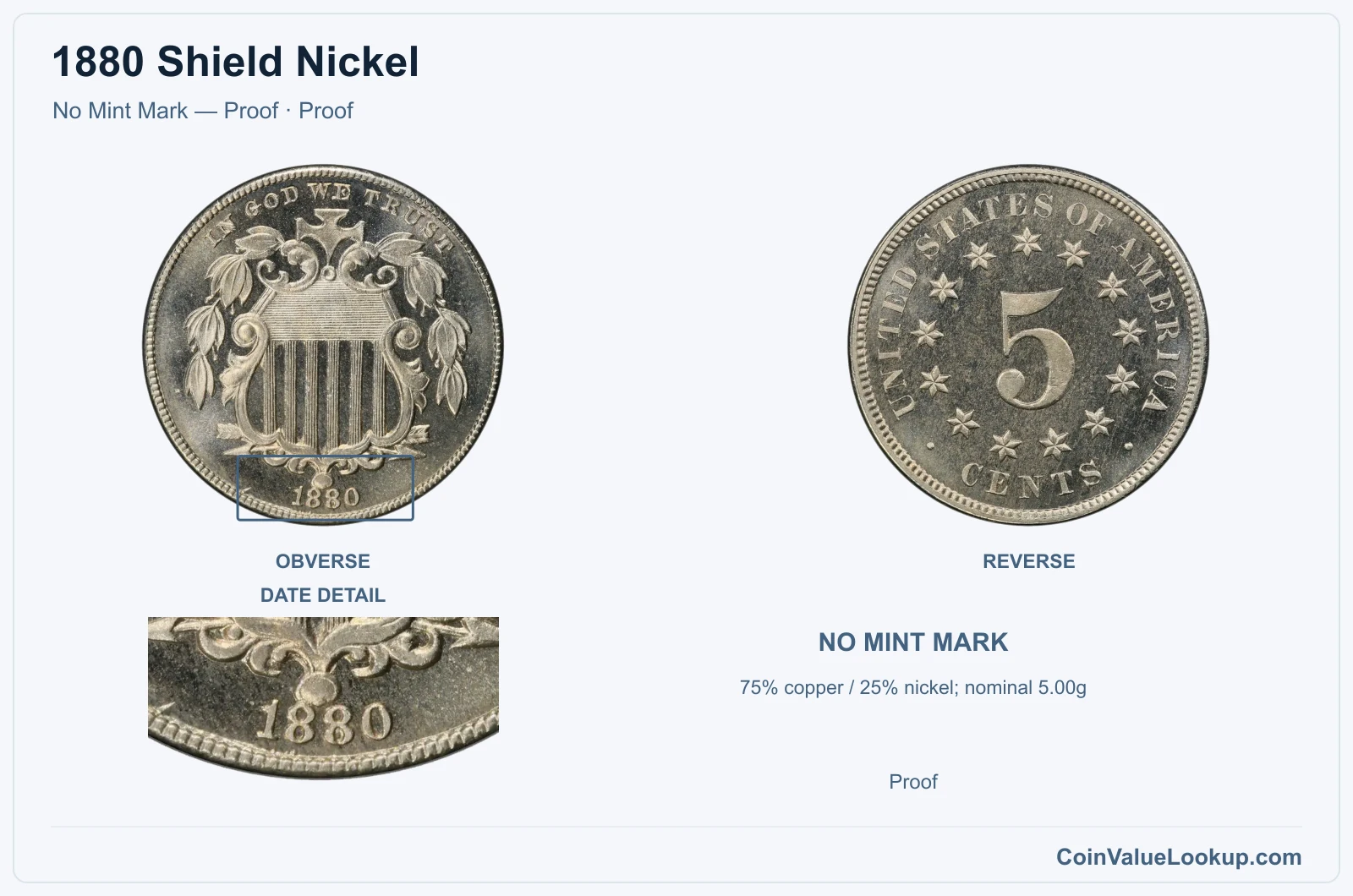
The 1880 proof is actually the more available version of this date, which is unusual for most coin series but normal for late-date Shield Nickels. USA Coin Book estimates a PR63 example at about $468.
Proofs were struck with extra care on polished planchets, producing mirror-like fields and sharp design details. Cameo contrast, where the devices appear frosted against mirror fields, is a separate designation applied during grading and can affect value beyond the base proof price.
Many 1880 proofs entered circulation after purchase, so finding one with wear is not uncommon. Even a worn proof retains its proof identity.
Check the rims and fields carefully under angled light to distinguish a circulated proof from a business strike.
Range Grade
Price Auction Records Appraisal PR PR 1
—
Coin Identifier
PR 2
—
Coin Identifier
PR 3
—
Coin Identifier
PR 4
—
Coin Identifier
PR 6
—
Coin Identifier
PR 8
Coin Identifier
PR 10
Coin Identifier
PR 12
—
Coin Identifier
PR 15
—
Coin Identifier
PR 20
—
Coin Identifier
PR 25
—
Coin Identifier
PR 30
—
Coin Identifier
PR 35
Coin Identifier
PR 40
Coin Identifier
PR 45
—
Coin Identifier
PR 50
Coin Identifier
PR 53
—
Coin Identifier
PR 55
Coin Identifier
PR 58
Coin Identifier
PR 60
Coin Identifier
PR 61
Coin Identifier
PR 62
Coin Identifier
PR 63
Coin Identifier
PR 64
Coin Identifier
PR 65
Coin Identifier
PR 66
Coin Identifier
PR 67
Coin Identifier
PR 68
—
—
—
PR 69
—
—
—
PR 70
—
—
—
1880 Shield Nickel Error List
1. 1880 Shield Nickel — Repunched Date
A repunched date variety is reported for the 1880 Shield Nickel. On the attributed business-strike version, look for a secondary outline of the digit 8 visible below or offset from the primary 8 in the date.
This is sometimes called a "Dropped 8" because the extra impression sits lower than the final position.
A separate repunched date also exists on proof strikes, but it is not the same variety. The diagnostics differ, so do not assume one attribution applies to both strike types.
The key distinction from lookalikes is intent versus damage. A repunched date was created at the mint when the date punch was applied more than once in slightly different positions.
Machine doubling, by contrast, produces flat shelf-like distortion and carries no collector premium. Physical damage to the date area from hits or corrosion can also mimic doubling.
No specific price data is available for this variety. Value depends on the strike type, the visibility of the repunching, and overall coin condition.
Professional attribution is recommended if you believe you have one.