1953 Jefferson Nickel Coin Value: How Much Is It Worth?
The 1953 Jefferson nickel is a common mid-century issue, but condition matters more than you might expect. Most worn examples trade near face value, with no reliable circulated guide price to cite.
Uncirculated coins are another story: guide estimates run from about $1.24 at MS60 up to $30 at MS65, depending on mint. Proofs, Full Steps designations, and authenticated errors each occupy their own pricing tier.
Fast Way to Identify Your 1953 Jefferson Nickel
Want a quick read on what you have? Upload clear photos of the front and back of your 1953 nickel, and our identifier can offer a preliminary take on the mint, finish, and general version.
It is not a substitute for professional certification, but it gives you a solid starting point before you dig deeper.
1953 Jefferson Nickel Value
Upload both sides of your 1953 Jefferson Nickel.
Front Obverse
Upload photo
Back Reverse
Upload photo
Which 1953 Jefferson Nickel Versions Are Worth Money?
- Uncirculated examples (MS65) from any mint carry guide values well above face, with the 1953-S reaching about $30 at MS65.
- Philadelphia proofs graded PR65 have a guide estimate around $56, and cameo or deep cameo contrast can command additional premiums beyond the base proof value.
Step 1: Identify Your 1953 Jefferson Nickel Mint Mark and Version
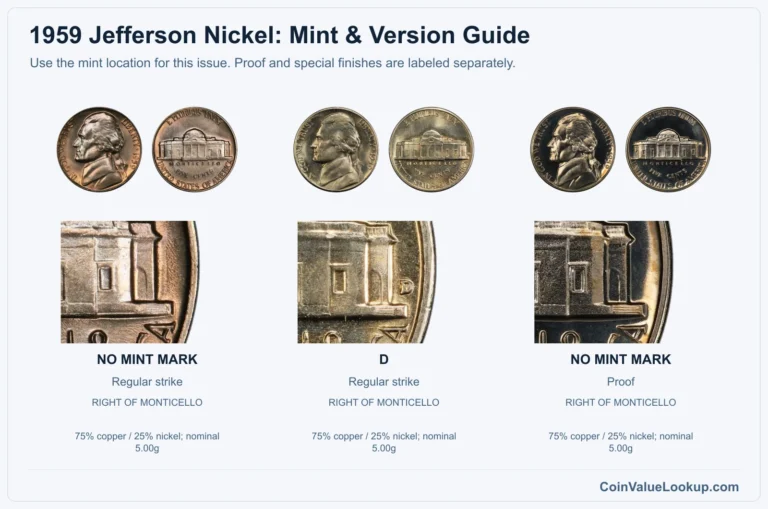
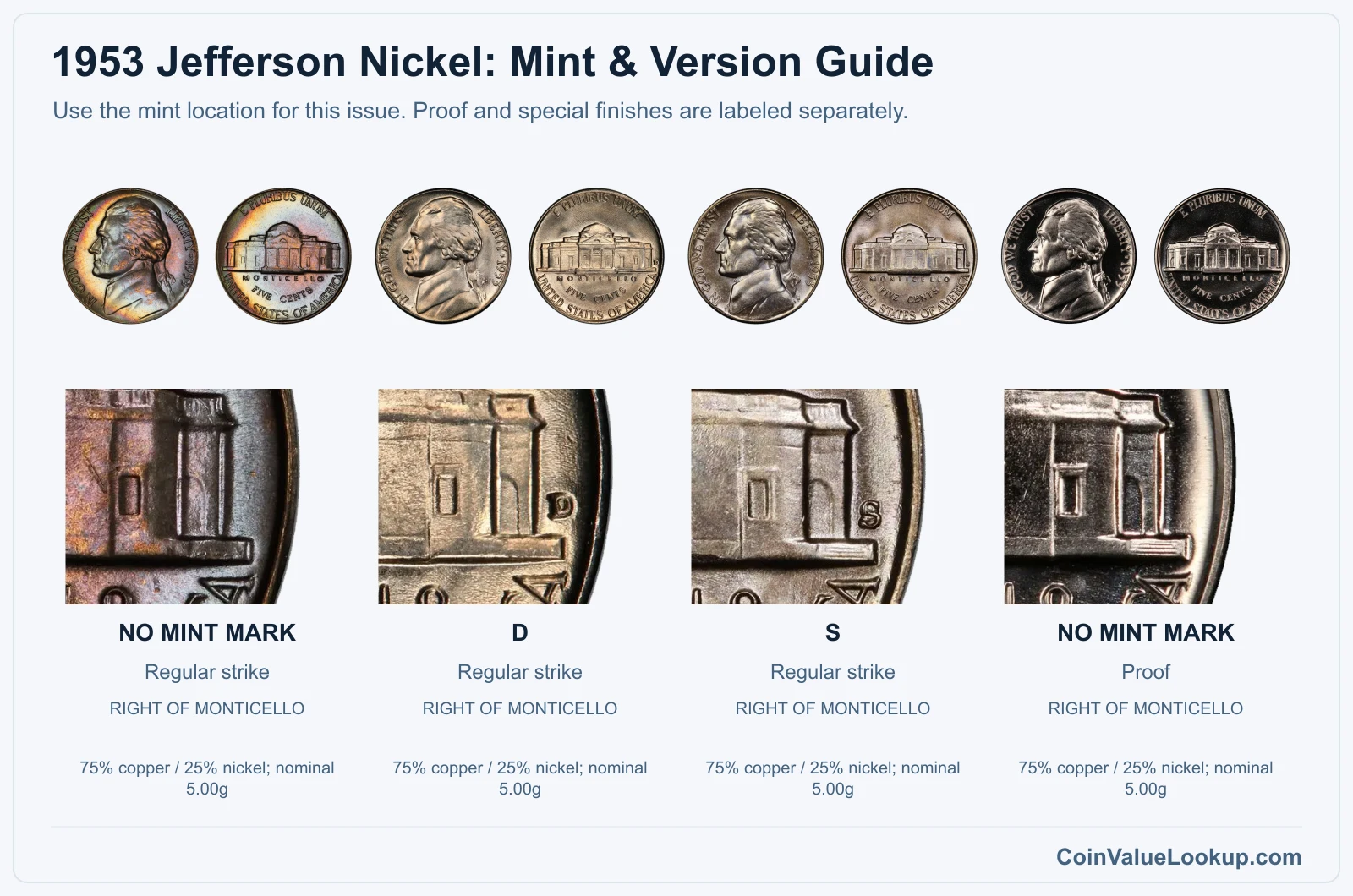
Start with the date on the obverse — all versions say 1953, obviously. The mintmark sits on the reverse, to the right of Monticello's building.
Philadelphia coins carry no mintmark at all. A small "D" means Denver, and a small "S" means San Francisco.
All regular 1953 nickels are struck in 75% copper and 25% nickel, weigh 5.00 grams, and measure 21.2 mm with a plain edge. There is no silver content in normal issues; a silvery look is just toning, not an off-metal strike.
Separate your coin into three categories: circulated business strikes (worn), uncirculated business strikes (full original luster), and proofs (mirrored fields from special Philadelphia production). A polished business strike is not a proof — proofs have a distinctly different surface quality created during manufacture, not after.
Step 2: Check Your 1953 Jefferson Nickel Grade
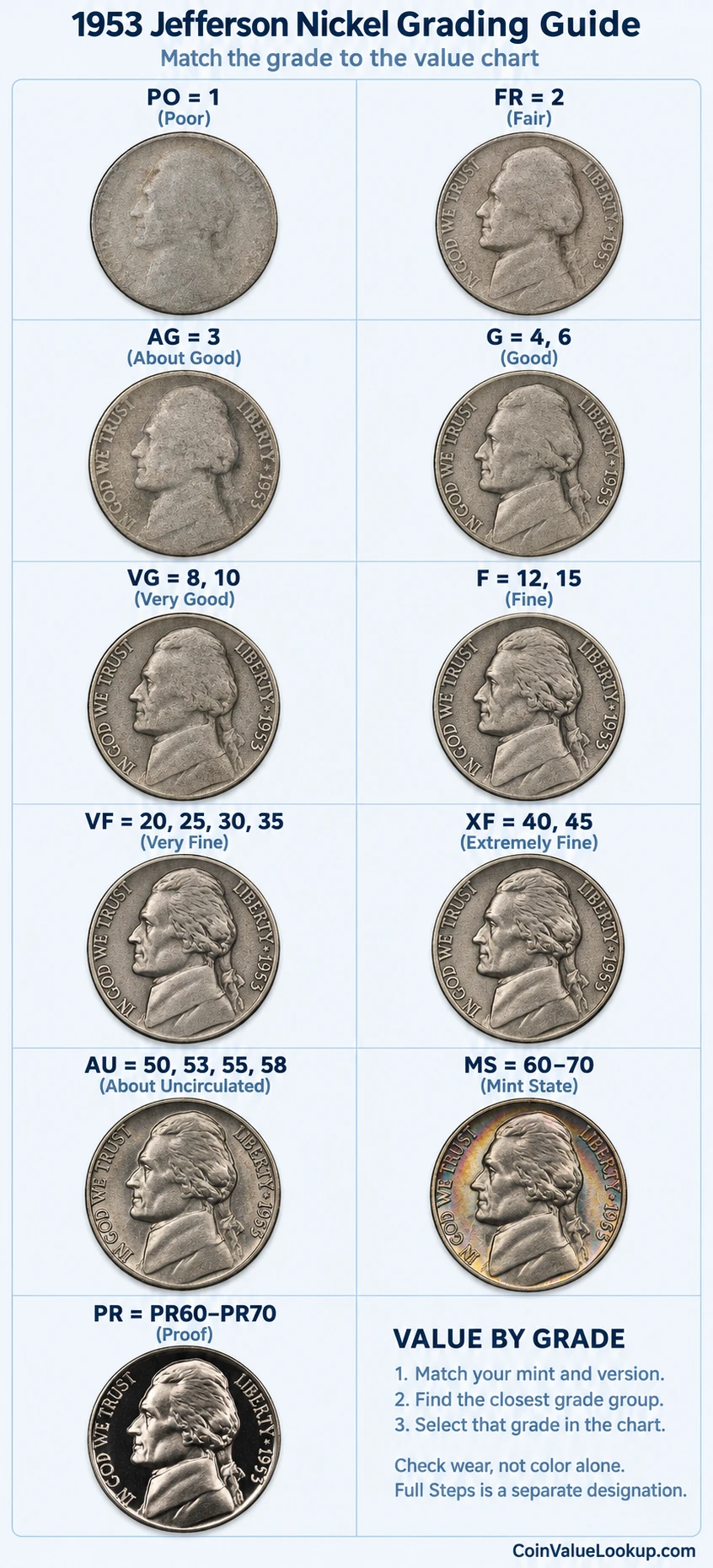
Check Jefferson's cheek first. On a lightly circulated coin the cheek loses its rounded luster early, and the hair detail just above the ear flattens next.
Flip the coin over and examine Monticello's roof and the four columns — these are high points that show contact quickly.
In Mint State, luster is your main tool. A coin with full cartwheel luster and only minor bag marks grades differently from one with dull, abraded surfaces even if both technically never circulated.
Use the comparison image to match your coin's wear pattern against known grade benchmarks.
The steps at the base of Monticello deserve special attention. Five or more fully separated, uninterrupted steps qualify for the PCGS Full Steps designation on MS60 and above coins.
Weak or broken steps are a strike issue, not necessarily wear, but they do prevent that premium designation. Do not confuse a weakly struck step with an abraded one — magnification and lighting angle help.
Step 3: Check 1953 Jefferson Nickel Value by Mint and Version
1953 Jefferson Nickel — No mintmark (Philadelphia)
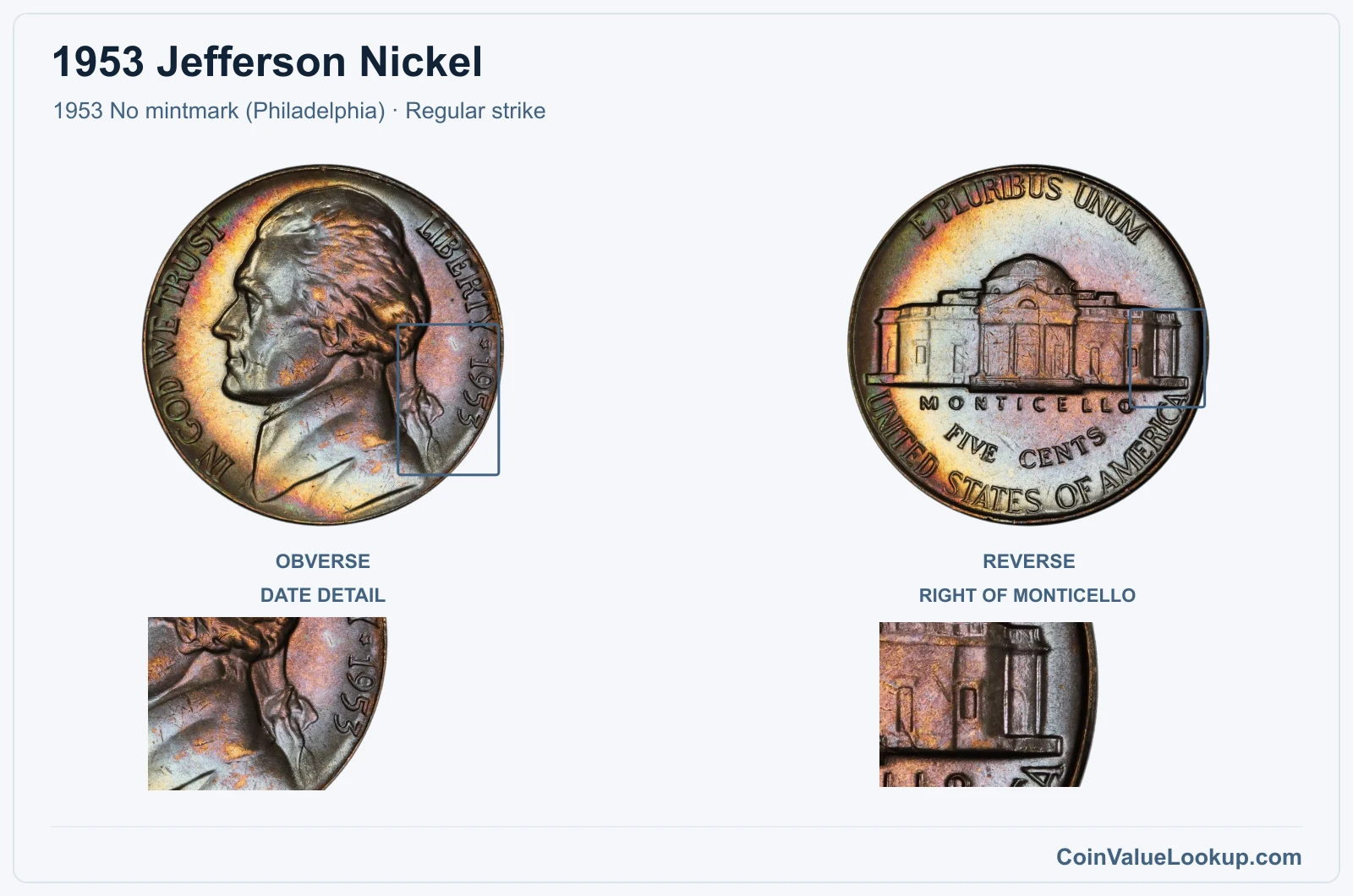
The 1953 Philadelphia nickel has no mintmark — look to the right of Monticello and you should see bare metal. This is a business strike, 75% copper and 25% nickel, weighing 5.00 grams.
Guide estimates place this coin at about $1.24 in MS60 condition and around $25 at MS65. Worn examples do not carry a reliable guide price and generally trade near face value.
Full Steps pieces command separate premiums that are not reflected in those figures, so keep that distinction in mind if your coin has clean, unbroken steps.
| Range | Grade | Price | Auction Records | Appraisal |
|---|---|---|---|---|
| PO | PO 1 | — | Coin Identifier | |
| FR | FR 2 | — | — | — |
| AG | AG 3 | — | — | — |
| G | G 4 | — | — | — |
| G 6 | — | — | — | |
| VG | VG 8 | — | — | — |
| VG 10 | — | — | — | |
| F | F 12 | — | — | — |
| F 15 | — | — | — | |
| VF | VF 20 | — | — | — |
| VF 25 | — | — | — | |
| VF 30 | — | — | — | |
| VF 35 | — | — | — | |
| XF | XF 40 | — | Coin Identifier | |
| XF 45 | — | Coin Identifier | ||
| AU | AU 50 | — | Coin Identifier | |
| AU 53 | — | Coin Identifier | ||
| AU 55 | — | Coin Identifier | ||
| AU 58 | — | Coin Identifier | ||
| MS | MS 60 | — | Coin Identifier | |
| MS 61 | — | Coin Identifier | ||
| MS 62 | — | Coin Identifier | ||
| MS 63 | — | Coin Identifier | ||
| MS 64 | Coin Identifier | |||
| MS 65 | Coin Identifier | |||
| MS 66 | Coin Identifier | |||
| MS 67 | Coin Identifier | |||
| MS 68 | — | — | — | |
| MS 69 | — | — | — | |
| MS 70 | — | — | — |
1953 Jefferson Nickel — No mintmark (Philadelphia) Proof
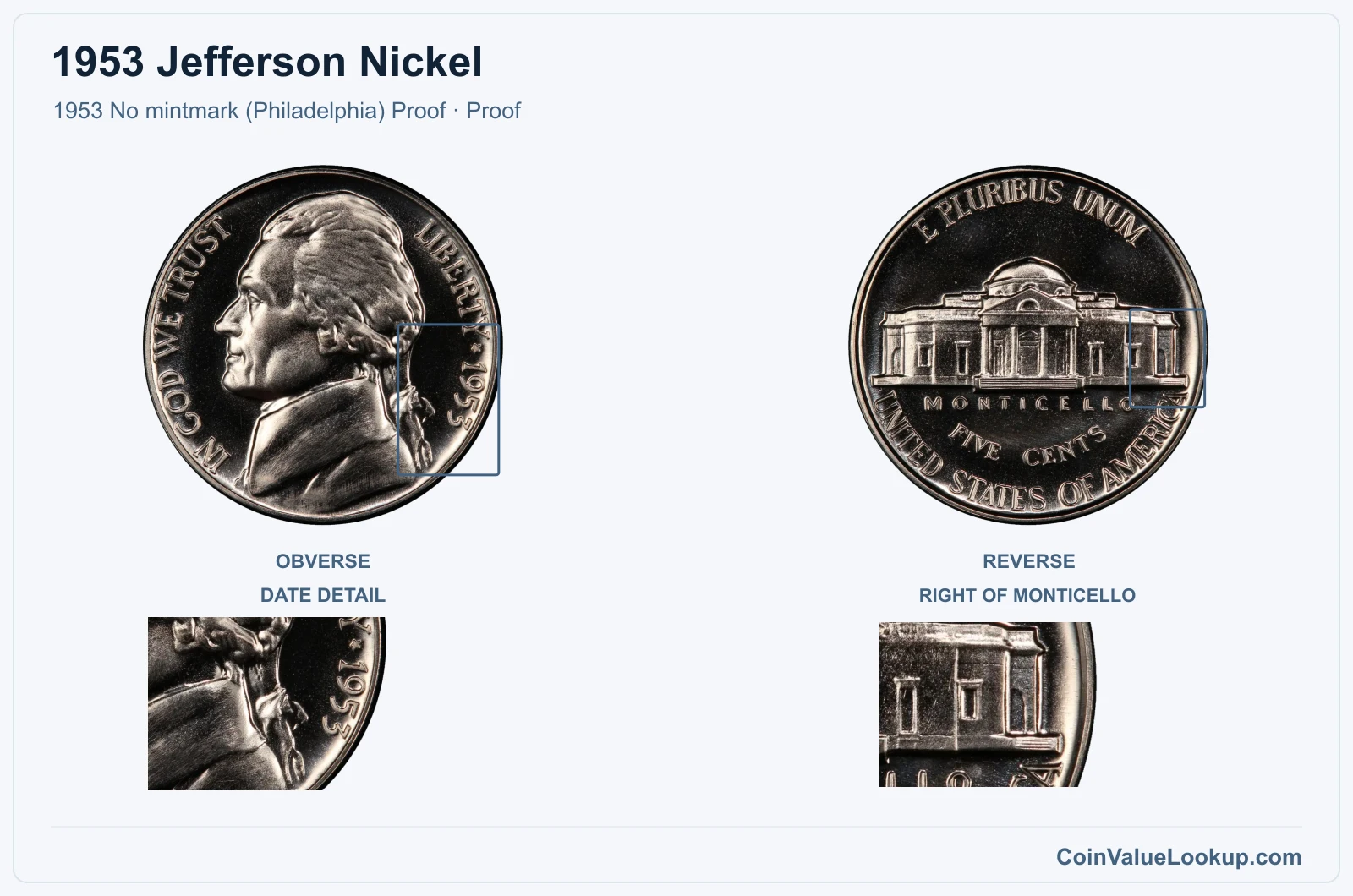
Philadelphia also produced collector proofs in 1953, again with no mintmark. These are not simply nice business strikes — genuine proofs have deeply mirrored fields and fully detailed devices produced by specially prepared dies.
A PR65 example carries a guide estimate of about $56.
Cameo and Deep Cameo designations, which describe frosted devices contrasting against mirror fields, trade at their own premium levels beyond base proof pricing. Hairlines from improper handling reduce proof grades fast.
If your coin has mirror-like surfaces, examine it under a single directed light source to check for fine lines across the fields. Do not compare proofs to business-strike images; the surfaces behave completely differently.
Coin Value Lookup is a good starting point if you want to compare your proof's characteristics against other Jefferson nickel years and mints.
| Range | Grade | Price | Auction Records | Appraisal |
|---|---|---|---|---|
| PR | PR 1 | — | Coin Identifier | |
| PR 2 | — | Coin Identifier | ||
| PR 3 | — | Coin Identifier | ||
| PR 4 | — | Coin Identifier | ||
| PR 6 | — | Coin Identifier | ||
| PR 8 | — | Coin Identifier | ||
| PR 10 | — | Coin Identifier | ||
| PR 12 | — | Coin Identifier | ||
| PR 15 | — | Coin Identifier | ||
| PR 20 | — | Coin Identifier | ||
| PR 25 | — | Coin Identifier | ||
| PR 30 | — | Coin Identifier | ||
| PR 35 | — | Coin Identifier | ||
| PR 40 | — | Coin Identifier | ||
| PR 45 | — | Coin Identifier | ||
| PR 50 | — | Coin Identifier | ||
| PR 53 | — | Coin Identifier | ||
| PR 55 | — | Coin Identifier | ||
| PR 58 | — | Coin Identifier | ||
| PR 60 | — | Coin Identifier | ||
| PR 61 | — | Coin Identifier | ||
| PR 62 | — | Coin Identifier | ||
| PR 63 | Coin Identifier | |||
| PR 64 | Coin Identifier | |||
| PR 65 | Coin Identifier | |||
| PR 66 | Coin Identifier | |||
| PR 67 | Coin Identifier | |||
| PR 68 | Coin Identifier | |||
| PR 69 | Coin Identifier | |||
| PR 70 | — | — | — |
1953 Jefferson Nickel — D
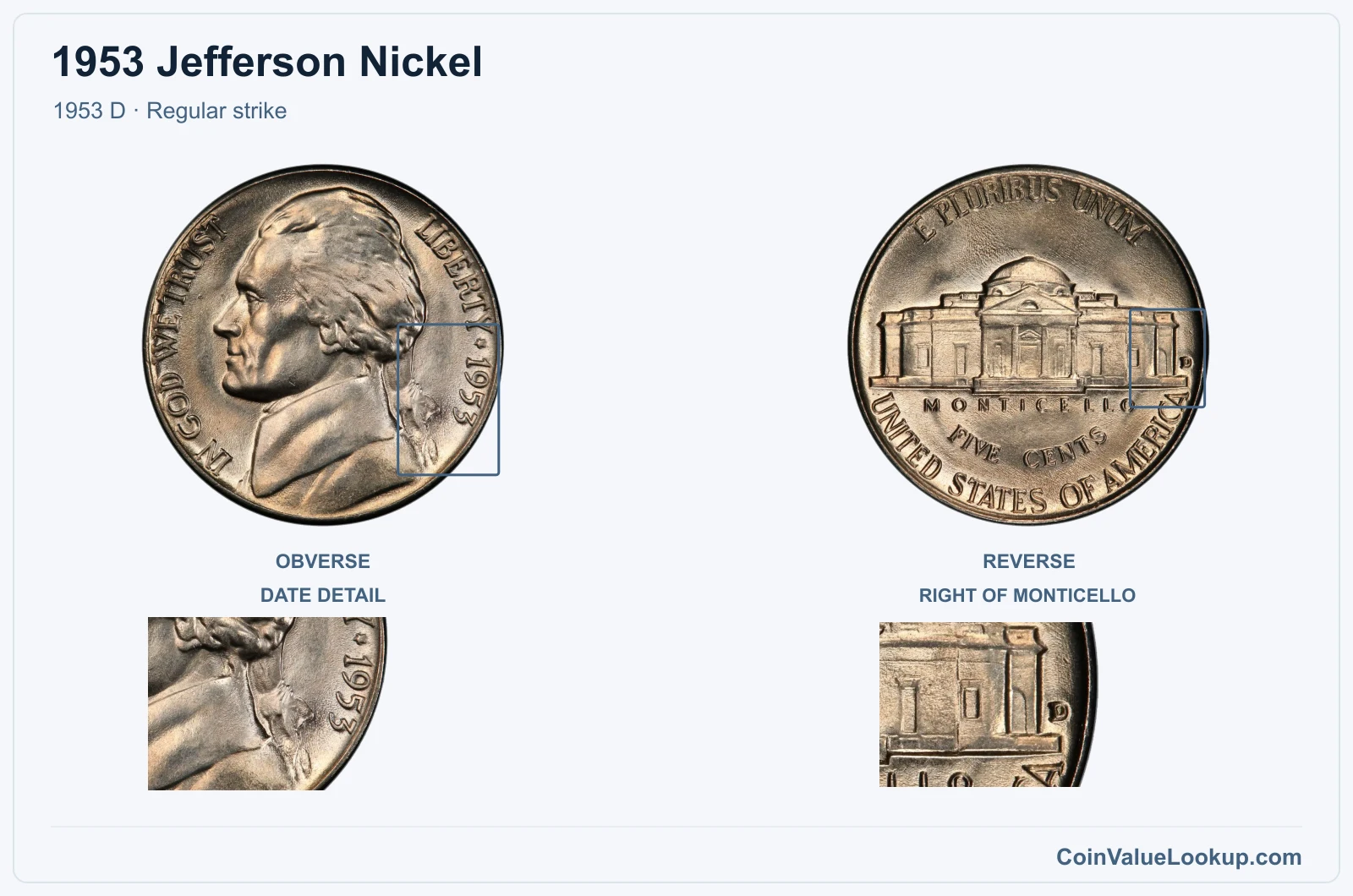
The 1953-D carries a small "D" mintmark on the reverse, right of Monticello. Same composition — 75% copper, 25% nickel at 5.00 grams.
Guide estimates sit at about $1.24 for MS60 and $25 for MS65, identical to the Philadelphia business strike at these grades. Circulated pieces generally trade at or near face value.
As with all 1953 nickels, Full Steps coins are a separate category and are not priced under the standard MS65 column.
| Range | Grade | Price | Auction Records | Appraisal |
|---|---|---|---|---|
| PO | PO 1 | — | Coin Identifier | |
| FR | FR 2 | — | — | — |
| AG | AG 3 | — | — | — |
| G | G 4 | — | — | — |
| G 6 | — | — | — | |
| VG | VG 8 | — | — | — |
| VG 10 | — | — | — | |
| F | F 12 | — | — | — |
| F 15 | — | — | — | |
| VF | VF 20 | — | — | — |
| VF 25 | — | — | — | |
| VF 30 | — | — | — | |
| VF 35 | — | — | — | |
| XF | XF 40 | — | Coin Identifier | |
| XF 45 | — | Coin Identifier | ||
| AU | AU 50 | — | Coin Identifier | |
| AU 53 | — | Coin Identifier | ||
| AU 55 | — | Coin Identifier | ||
| AU 58 | — | Coin Identifier | ||
| MS | MS 60 | — | Coin Identifier | |
| MS 61 | — | Coin Identifier | ||
| MS 62 | — | Coin Identifier | ||
| MS 63 | — | Coin Identifier | ||
| MS 64 | Coin Identifier | |||
| MS 65 | Coin Identifier | |||
| MS 66 | Coin Identifier | |||
| MS 67 | Coin Identifier | |||
| MS 68 | — | — | — | |
| MS 69 | — | — | — | |
| MS 70 | — | — | — |
1953 Jefferson Nickel — S
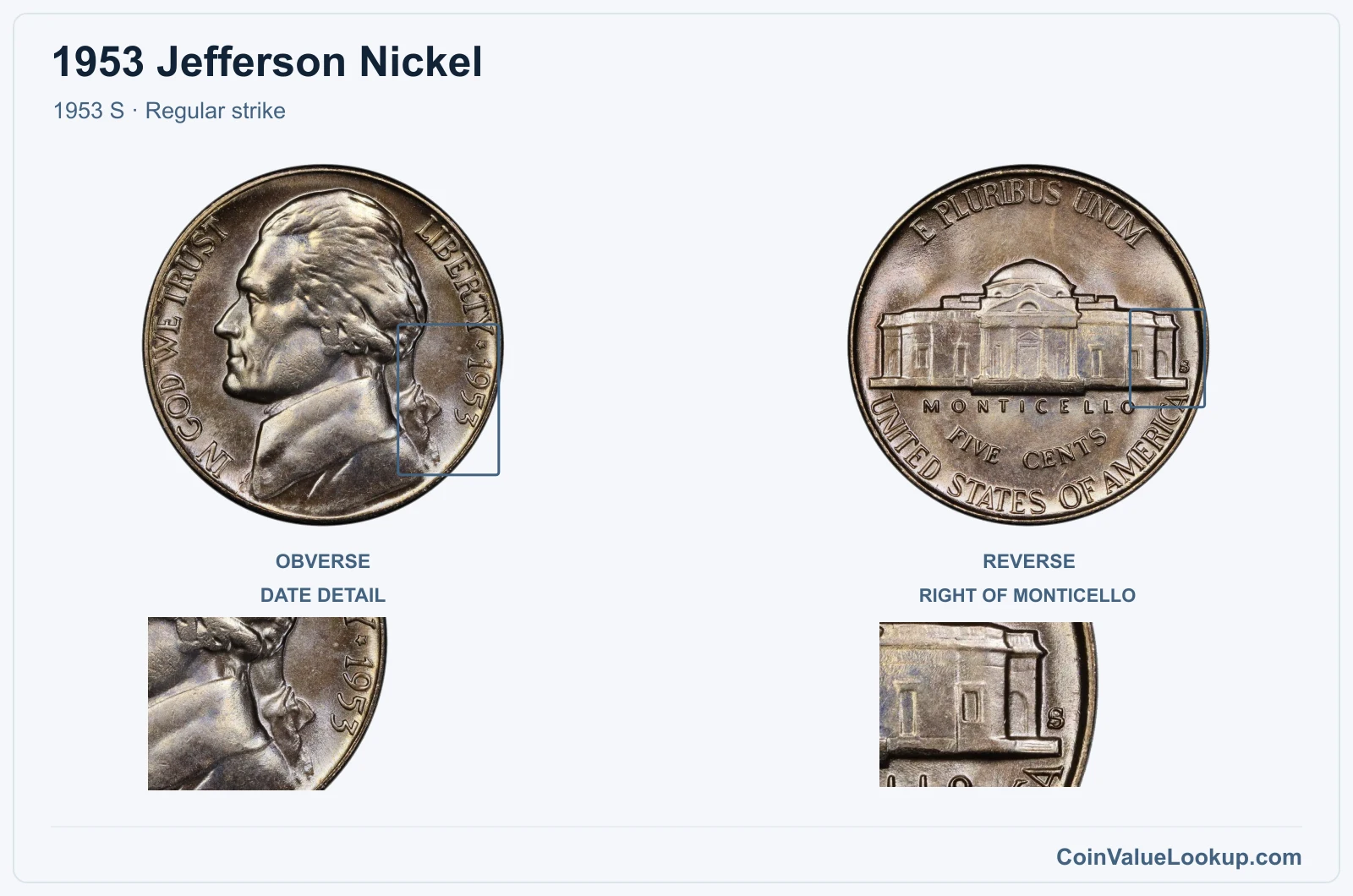
San Francisco's 1953-S nickel shows a small "S" mintmark to the right of Monticello. It edges slightly ahead in guide estimates: about $1.56 at MS60 and roughly $30 at MS65, making it the highest-valued regular business strike among the three mints at the gem level.
The difference is modest, but it is consistent across the grade range. As always, these figures apply to standard Mint State coins, not Full Steps examples, and worn coins are not priced from the uncirculated columns.
| Range | Grade | Price | Auction Records | Appraisal |
|---|---|---|---|---|
| PO | PO 1 | — | Coin Identifier | |
| FR | FR 2 | — | — | — |
| AG | AG 3 | — | — | — |
| G | G 4 | — | — | — |
| G 6 | — | — | — | |
| VG | VG 8 | — | — | — |
| VG 10 | — | — | — | |
| F | F 12 | — | — | — |
| F 15 | — | — | — | |
| VF | VF 20 | — | — | — |
| VF 25 | — | — | — | |
| VF 30 | — | — | — | |
| VF 35 | — | — | — | |
| XF | XF 40 | — | Coin Identifier | |
| XF 45 | — | Coin Identifier | ||
| AU | AU 50 | — | Coin Identifier | |
| AU 53 | — | Coin Identifier | ||
| AU 55 | — | Coin Identifier | ||
| AU 58 | — | Coin Identifier | ||
| MS | MS 60 | — | Coin Identifier | |
| MS 61 | — | Coin Identifier | ||
| MS 62 | — | Coin Identifier | ||
| MS 63 | — | Coin Identifier | ||
| MS 64 | Coin Identifier | |||
| MS 65 | Coin Identifier | |||
| MS 66 | Coin Identifier | |||
| MS 67 | Coin Identifier | |||
| MS 68 | — | — | — | |
| MS 69 | — | — | — | |
| MS 70 | — | — | — |
1953 Jefferson Nickel Error List
1. 1953 Jefferson Nickel — Split planchet before strike
A split-before-strike planchet means the metal blank separated internally before the dies struck it. The result is a coin that is noticeably thin and underweight — a reported 1953-D example weighed only 2.4 grams versus the standard 5.00 grams.
The central design looks soft and mushy, and parts of the surface may show a granular, raw-metal texture where the internal layers were exposed.
Do not confuse this with post-strike grinding or acid erosion, both of which remove metal from the outside rather than exposing an internal split. A genuine split planchet typically retains full rim definition on one side.
One Heritage Auctions lot in October 2010 sold for $126.50, but that lot included two coins (a 1953-D and a 1960-D together), so no individual price for the 1953-D alone can be stated.
2. 1953 Jefferson Nickel — Nickel struck over a Lincoln cent
This is one of the more dramatic errors reported for 1953 nickels. A 1953-S Jefferson nickel was struck on a planchet that had already been struck as a 1953-S Lincoln cent.
The result shows elements of both designs — Lincoln's portrait and the wheat reverse lurking beneath Jefferson and Monticello.
Both denomination designs must be visible or established by professional attribution for this error to hold. Do not confuse it with a nickel struck on an unstruck cent blank, which would show no prior design, or with glued coins and vise impressions that leave incuse rather than struck impressions.
A Heritage Auctions example graded NGC MS65 RB sold for $4,025 in September 2010, reflecting how unusual and visually striking this type of error is.
3. 1953 Jefferson Nickel — Off-center strike
An off-center strike happens when the planchet is not seated properly between the dies. The design shifts to one side, leaving an unstruck crescent of blank metal and an incomplete rim on the opposite edge.
A reported 1953-S example was only about 5% off-center, graded NGC MS65 with Five Full Steps, and sold at Heritage Auctions in September 2010 for $546.25.
Small percentages like 5% can look subtle. Compare both sides of your coin — the shift should appear in the same direction on obverse and reverse.
Do not mistake a single-die misalignment, ordinary weak strike, or a physically cut coin for an off-center error. The unstruck crescent of raw planchet metal is the key diagnostic.
4. 1953 Jefferson Nickel — Wrong foreign planchet
A 1953 nickel struck on a wrong foreign planchet will differ in weight and possibly composition from the standard 5.00-gram, 75% copper / 25% nickel specification. One example graded NGC MS64 weighed 4.1 grams and was cataloged as 80% copper and 20% nickel.
The auction listing compared it to a Haitian planchet, but the alloy does not match Haiti's reported specifications, so the exact foreign denomination is not firmly established.
A Heritage Auctions example sold for $444 in March 2023. When evaluating a suspected wrong-planchet error, weigh your coin carefully and look for any unusual color or surface texture.
A normal dark-toned nickel is not the same thing — weight is the hard evidence.
5. 1953 Jefferson Nickel — Doubled Die Obverse
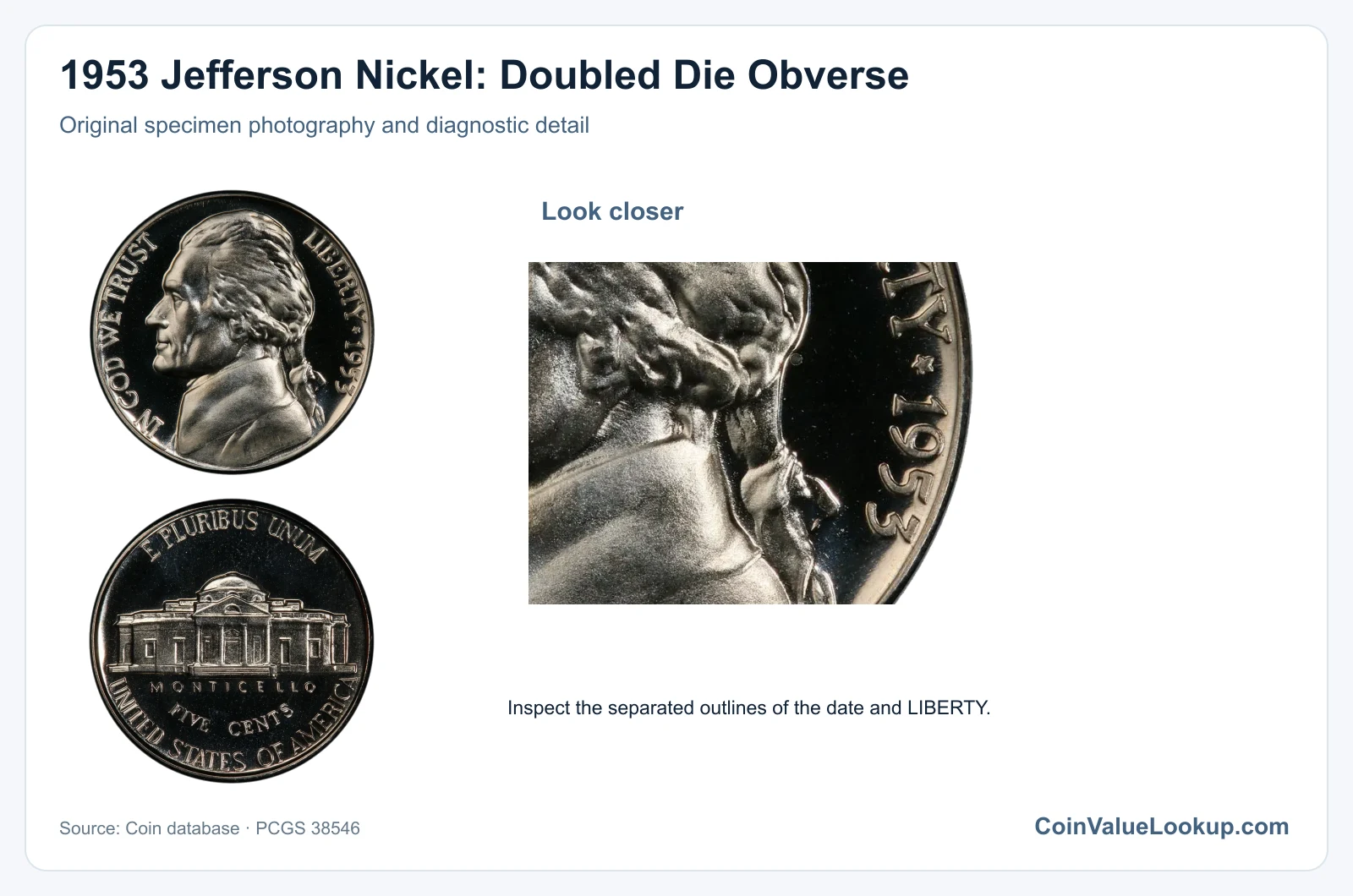
A Doubled Die Obverse has been reported for 1953 nickels. The diagnostic to look for is consistent doubling — separation or notching — on obverse lettering or design elements.
Compare your coin's letters to a normal 1953 nickel under the same lighting and magnification.
Genuine doubled dies show a repeatable pattern across multiple letters or features, whereas machine doubling tends to produce a flat, shelf-like distortion on one side of the raised design. Reflections and worn die contours can also mimic doubling to the untrained eye.
The value of a doubled die depends on the specific variety, the visibility of the doubling, and the coin's overall condition. No numerical price range is available for this variety from the supplied references.
6. 1953 Jefferson Nickel — Repunched Mintmark
Repunched mintmark varieties exist for 1953 nickels. These occur when the mintmark punch was applied more than once in slightly different positions, leaving traces of the earlier impression visible near or beneath the final mintmark.
Inspect the D or S mintmark under magnification and compare it to a normal example at the same angle. You are looking for remnants — a ghost outline, a notch, or a partial second letter overlapping the primary mark.
Machine doubling around a mintmark can look similar but tends to produce a flat shelf rather than a distinct second impression. Die chips and corrosion near the mintmark are also common lookalikes.
Value depends on the specific repunched variety, its visibility, and coin condition; no numerical price is available from the sources used here.
7. 1953 Jefferson Nickel — Die Crack / Die Chip
Die crack and die chip (cud) varieties have been reported for 1953 nickels. A die crack shows up on the coin as a thin raised line — metal was forced into the crack in the die face during striking.
A die chip appears as a small raised blob where a piece of the die broke away. A cud is a larger break connected to the rim, producing a raised, featureless lump at the coin's edge.
These are raised features, which distinguishes them from incuse scratches, corrosion pitting, or foreign material stuck to the surface. Look at the whole coin in context: a genuine die crack follows a consistent path and appears on every coin struck by that die in the same position.
Value depends on size, location, and the coin's overall condition; no specific price data is available from the references used here.