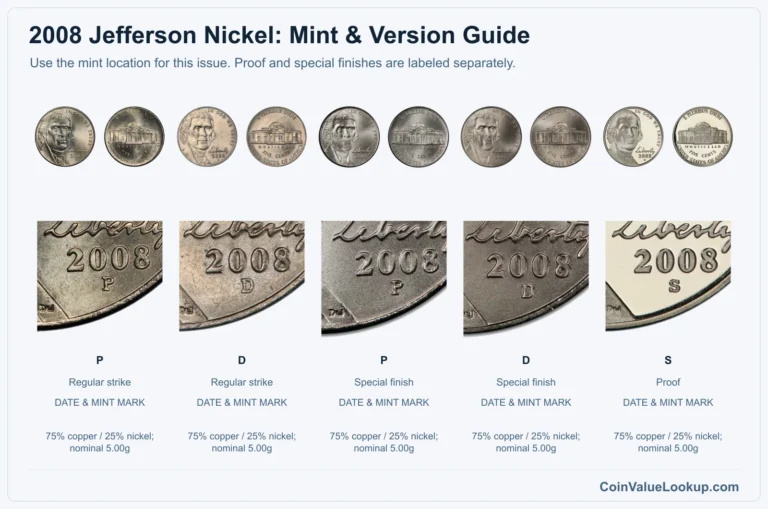
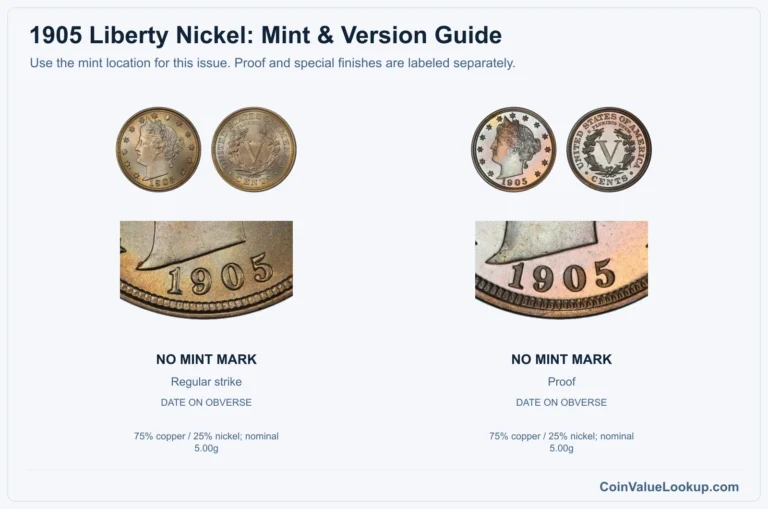
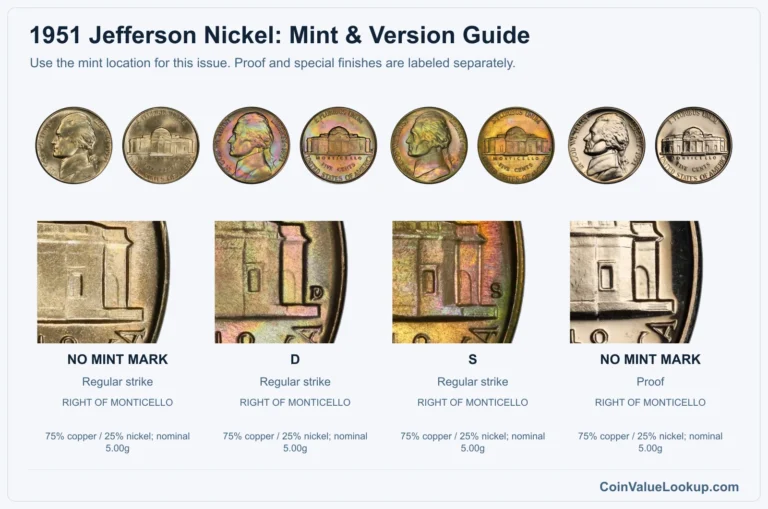
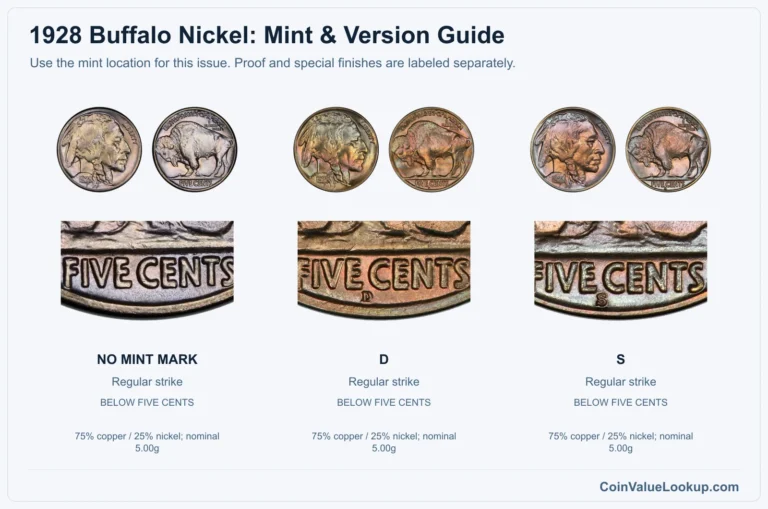
1957 Jefferson Nickel Coin Value: How Much Is It Worth?
The 1957 Jefferson Nickel is a common late-series date, and most circulated examples carry only modest collector interest. Uncirculated coins are where the action starts: guide estimates range from about $0.61 at MS60 up to $19 at MS65, depending on luster and surface quality.
Proofs, Full Steps designations, and authenticated mint errors each follow their own pricing tracks.
Fast Way to Identify Your 1957 Jefferson Nickel
Snap clear, well-lit photos of both sides of your coin and upload them here. A front-and-back image lets us give you a preliminary identification of mint, finish, and any obvious variety markers.
This is not a substitute for professional certification, but it is a solid first step toward understanding what you have.
1957 Jefferson Nickel Value
Upload both sides of your 1957 Jefferson Nickel.
Front Obverse
Upload photo
Back Reverse
Upload photo
Which 1957 Jefferson Nickel Versions Are Worth Money?
- Uncirculated 1957 Philadelphia and Denver business strikes with strong original luster can reach guide values up to $19 at MS65, well above their five-cent face value.
- Philadelphia proofs with mirrored fields deserve separate evaluation; a PR65 example carries a guide estimate around $4.96, and cameo contrast or higher grades may affect value independently.
Step 1: Identify Your 1957 Jefferson Nickel Mint Mark and Version
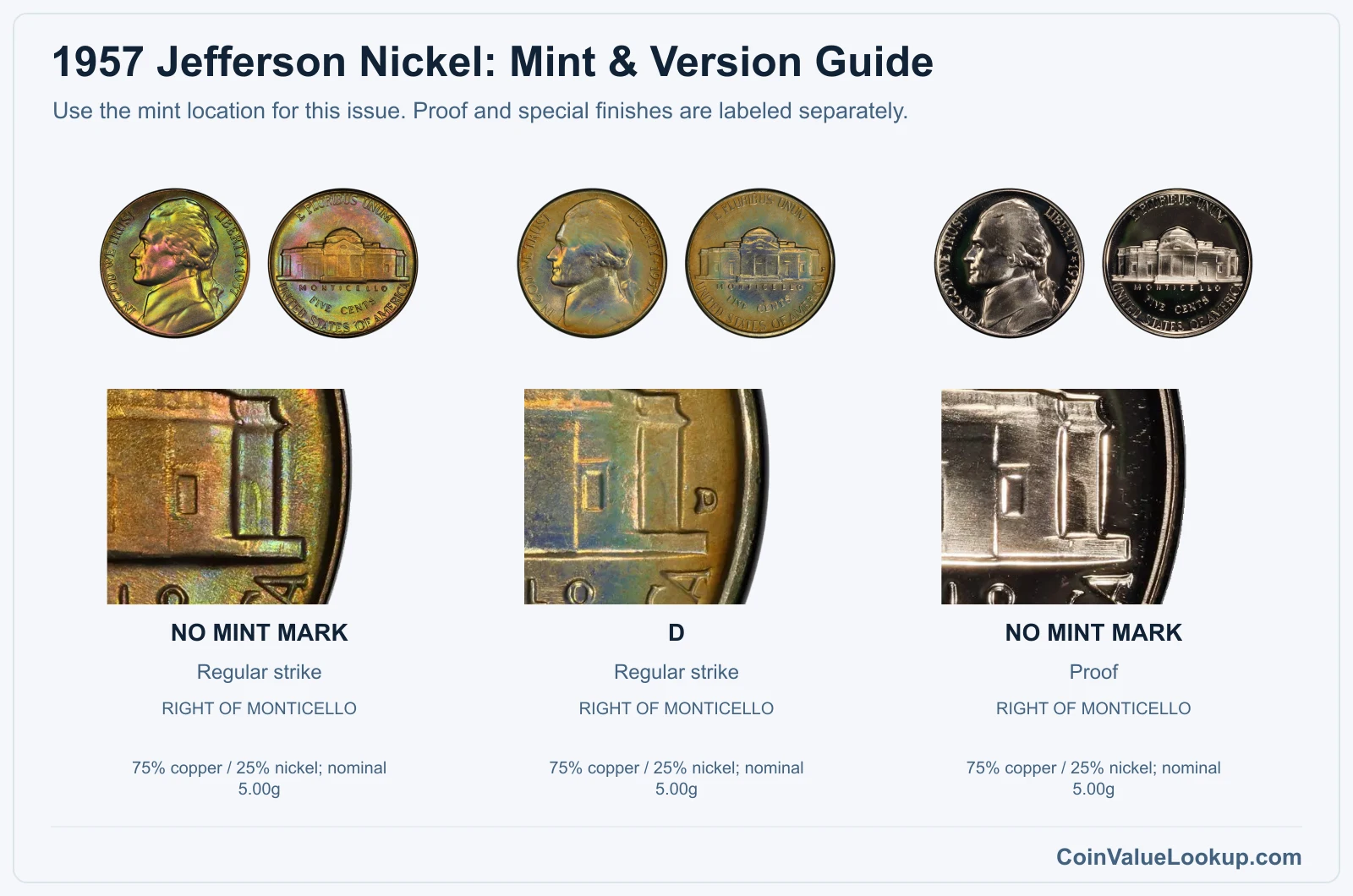
Start with the obverse. The date sits on the lower right near Jefferson's shoulder.
Philadelphia strikes carry no mintmark at all, while Denver coins show a small "D" on the reverse, just to the right of Monticello.
All standard 1957 nickels are 75% copper and 25% nickel, weigh 5.00 grams, and measure 21.2 mm across with a plain edge. If your coin is noticeably lighter, smaller, or a different color, that is worth investigating further.
Separate your coin into one of three categories: circulated business strike, uncirculated business strike, or proof. Proofs were struck at Philadelphia and have mirror-like fields with sharp device edges.
A polished business strike is not a proof, no matter how shiny someone made it. Compare the fields under angled light: a genuine proof reflects like a dark mirror, while a polished coin shows fine directional scratches.
Step 2: Check Your 1957 Jefferson Nickel Grade
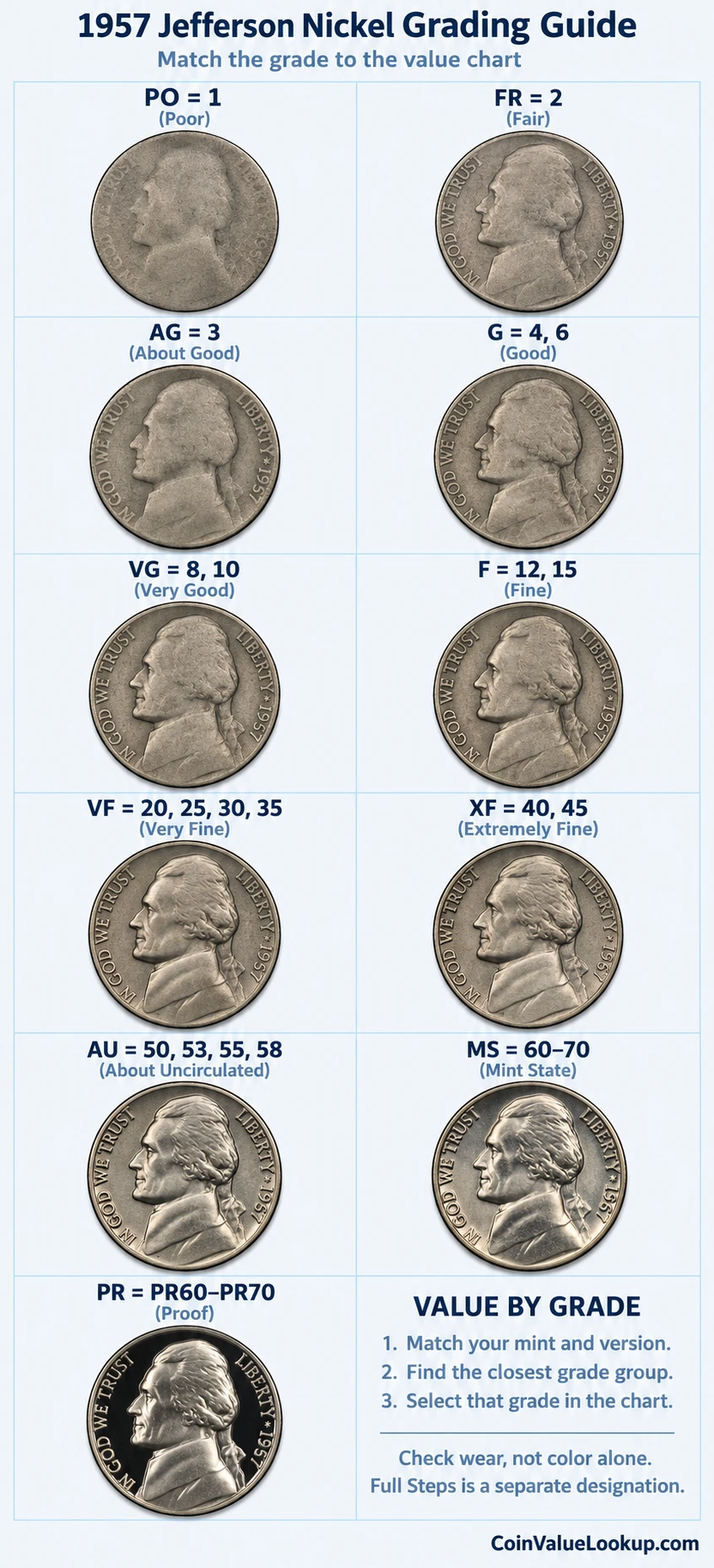
Check Jefferson's cheekbone first. On a well-worn coin the cheek blends into the surrounding field, and the hair detail above the ear flattens into a smooth lump.
Lightly circulated pieces still show individual hair strands and a distinct cheek contour.
Flip the coin over and look at Monticello's roof line and the four columns. As wear progresses, the columns merge with the building wall and the triangular roof pediment loses definition.
Use the comparison image to match your coin's detail level against known grades. Luster matters as much as design sharpness: a coin with full detail but dull, cleaned surfaces grades lower than a blast-white piece with equivalent wear.
Monticello's steps deserve special attention. The PCGS Full Steps designation requires at least five clearly separated steps on coins grading MS60 or above.
Weak separation is often a strike issue, not wear, so a coin can be technically uncirculated yet still miss the Full Steps threshold. Full Steps coins command separate premiums beyond ordinary Mint State values.
Step 3: Check 1957 Jefferson Nickel Value by Mint and Version
1957 Jefferson Nickel — No mintmark (Philadelphia)
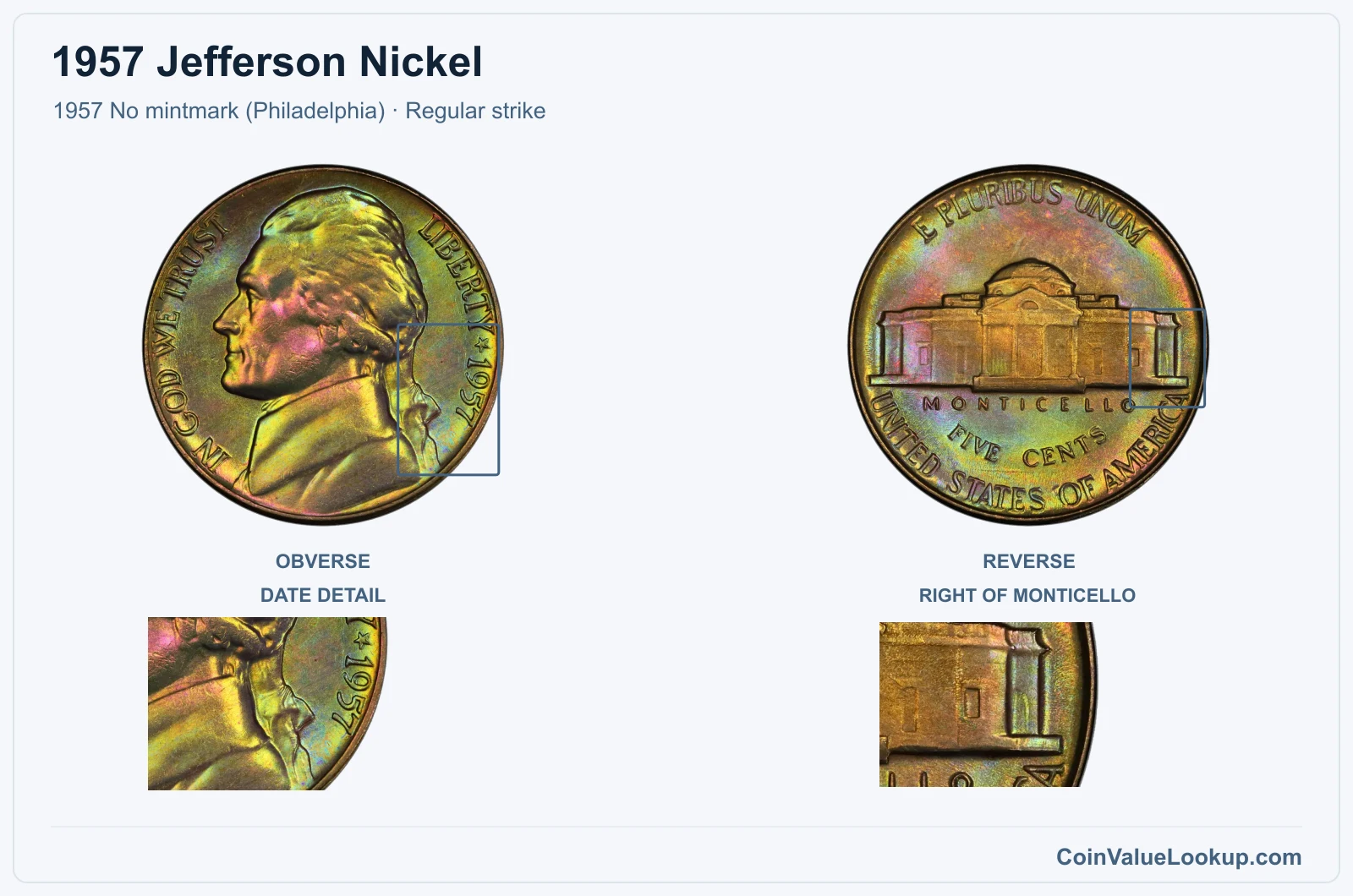
The 1957 Philadelphia business strike has no mintmark anywhere on the coin. Guide estimates place uncirculated examples at roughly $0.61 around MS60 and up to $19 at MS65.
Those are retail guide figures from USA Coin Book, not guaranteed buy prices.
Worn examples pulled from circulation trade near face value; no reliable guide price is available for lower circulated grades. The jump in value comes with original mint luster and clean surfaces.
Coins with five or more fully separated Monticello steps qualify for the PCGS Full Steps designation and carry their own premium tier beyond these standard Mint State figures.
| Range | Grade | Price | Auction Records | Appraisal |
|---|---|---|---|---|
| PO | PO 1 | — | Coin Identifier | |
| FR | FR 2 | — | — | — |
| AG | AG 3 | — | — | — |
| G | G 4 | — | — | — |
| G 6 | — | — | — | |
| VG | VG 8 | — | — | — |
| VG 10 | — | — | — | |
| F | F 12 | — | — | — |
| F 15 | — | — | — | |
| VF | VF 20 | — | — | — |
| VF 25 | — | — | — | |
| VF 30 | — | — | — | |
| VF 35 | — | — | — | |
| XF | XF 40 | — | Coin Identifier | |
| XF 45 | — | Coin Identifier | ||
| AU | AU 50 | — | Coin Identifier | |
| AU 53 | — | Coin Identifier | ||
| AU 55 | — | Coin Identifier | ||
| AU 58 | — | Coin Identifier | ||
| MS | MS 60 | Coin Identifier | ||
| MS 61 | — | Coin Identifier | ||
| MS 62 | — | Coin Identifier | ||
| MS 63 | — | Coin Identifier | ||
| MS 64 | Coin Identifier | |||
| MS 65 | Coin Identifier | |||
| MS 66 | Coin Identifier | |||
| MS 67 | Coin Identifier | |||
| MS 68 | — | — | — | |
| MS 69 | — | — | — | |
| MS 70 | — | — | — |
1957 Jefferson Nickel — No mintmark (Philadelphia) Proof
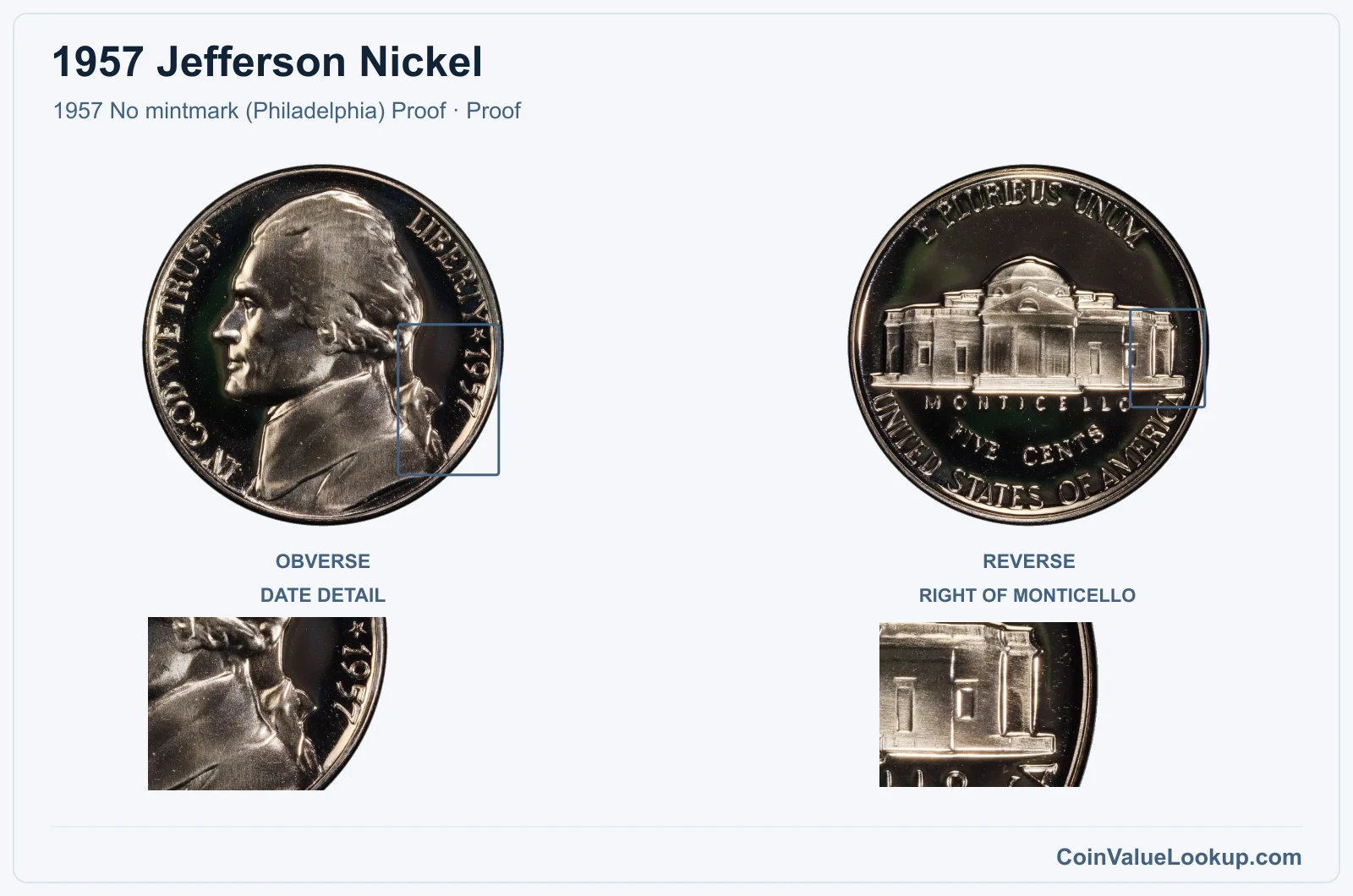
Philadelphia also produced collector proofs in 1957, struck with polished dies on specially prepared planchets. These coins have deeply mirrored fields and razor-sharp device edges that no amount of polishing a business strike can replicate.
A PR65 proof carries a guide estimate of about $4.96 according to USA Coin Book. Cameo and Deep Cameo designations, which reflect frosted devices against mirror fields, are graded separately and can shift value considerably.
Hairlines from mishandling are the most common grade limiter on proofs, so check the open fields around Jefferson's portrait under angled light.
Coin Value Lookup is a handy starting point if you want to compare proof values across other Jefferson Nickel dates or different denominations entirely.
| Range | Grade | Price | Auction Records | Appraisal |
|---|---|---|---|---|
| PR | PR 1 | — | Coin Identifier | |
| PR 2 | — | Coin Identifier | ||
| PR 3 | — | Coin Identifier | ||
| PR 4 | — | Coin Identifier | ||
| PR 6 | — | Coin Identifier | ||
| PR 8 | — | Coin Identifier | ||
| PR 10 | — | Coin Identifier | ||
| PR 12 | — | Coin Identifier | ||
| PR 15 | — | Coin Identifier | ||
| PR 20 | — | Coin Identifier | ||
| PR 25 | — | Coin Identifier | ||
| PR 30 | — | Coin Identifier | ||
| PR 35 | — | Coin Identifier | ||
| PR 40 | — | Coin Identifier | ||
| PR 45 | — | Coin Identifier | ||
| PR 50 | — | Coin Identifier | ||
| PR 53 | — | Coin Identifier | ||
| PR 55 | — | Coin Identifier | ||
| PR 58 | — | Coin Identifier | ||
| PR 60 | — | Coin Identifier | ||
| PR 61 | — | Coin Identifier | ||
| PR 62 | — | Coin Identifier | ||
| PR 63 | — | Coin Identifier | ||
| PR 64 | Coin Identifier | |||
| PR 65 | Coin Identifier | |||
| PR 66 | Coin Identifier | |||
| PR 67 | Coin Identifier | |||
| PR 68 | Coin Identifier | |||
| PR 69 | Coin Identifier | |||
| PR 70 | — | — | — |
1957 Jefferson Nickel — D
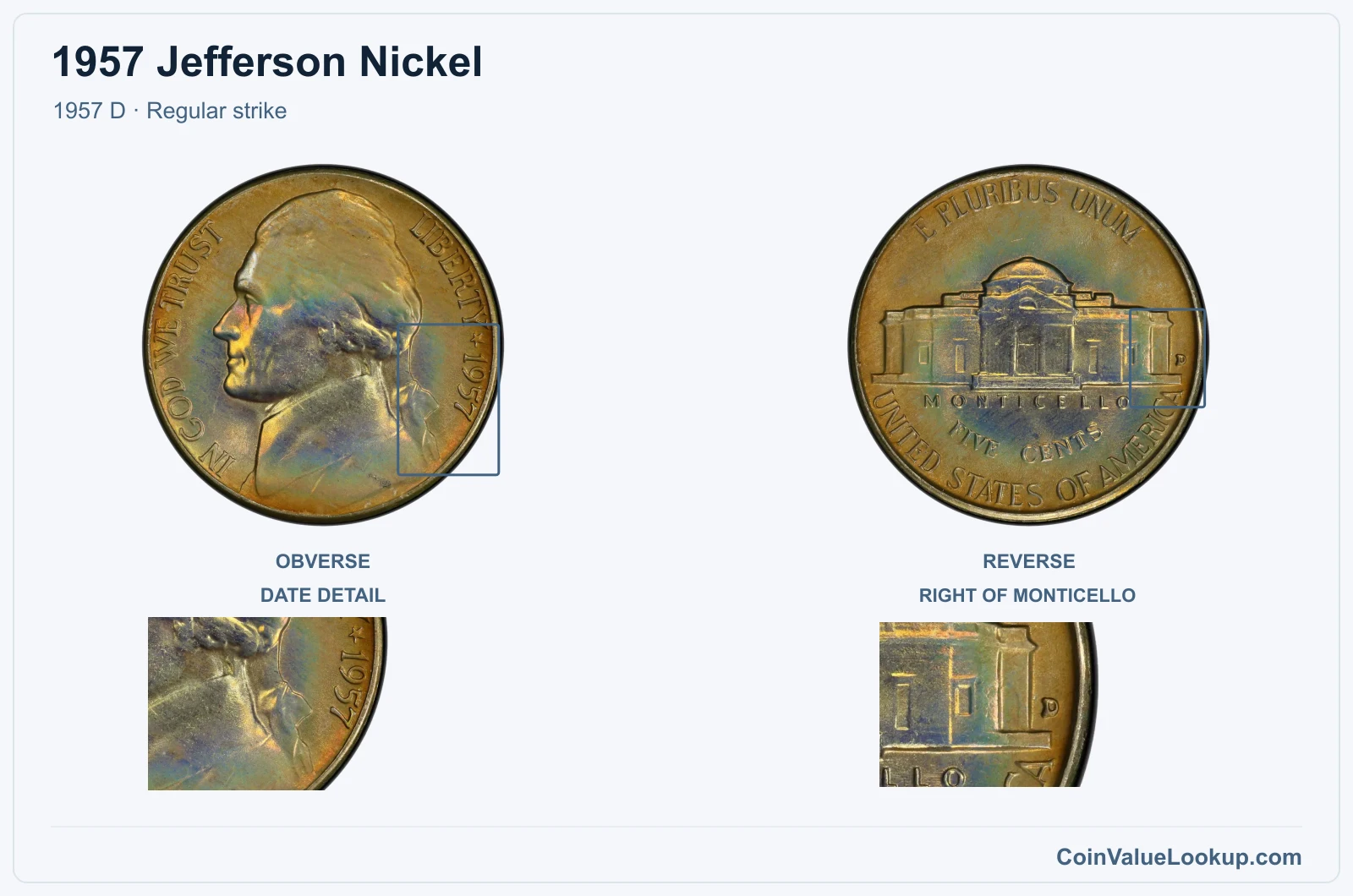
The 1957-D was struck at the Denver Mint and carries a small "D" mintmark on the reverse, positioned to the right of Monticello. Guide estimates mirror the Philadelphia business strike: about $0.61 at MS60 and $19 at MS65.
Denver produced large quantities this year, so circulated pieces are plentiful and trade near face value. As with the Philadelphia issue, Full Steps examples occupy a separate category and should not be valued from the standard MS65 column.
Look for five or more uninterrupted horizontal steps on Monticello's base to assess Full Steps potential.
| Range | Grade | Price | Auction Records | Appraisal |
|---|---|---|---|---|
| PO | PO 1 | — | Coin Identifier | |
| FR | FR 2 | — | — | — |
| AG | AG 3 | — | — | — |
| G | G 4 | — | — | — |
| G 6 | — | — | — | |
| VG | VG 8 | — | — | — |
| VG 10 | — | — | — | |
| F | F 12 | — | — | — |
| F 15 | — | — | — | |
| VF | VF 20 | — | — | — |
| VF 25 | — | — | — | |
| VF 30 | — | — | — | |
| VF 35 | — | — | — | |
| XF | XF 40 | — | Coin Identifier | |
| XF 45 | — | Coin Identifier | ||
| AU | AU 50 | — | Coin Identifier | |
| AU 53 | — | Coin Identifier | ||
| AU 55 | — | Coin Identifier | ||
| AU 58 | — | Coin Identifier | ||
| MS | MS 60 | — | Coin Identifier | |
| MS 61 | — | Coin Identifier | ||
| MS 62 | — | Coin Identifier | ||
| MS 63 | — | Coin Identifier | ||
| MS 64 | Coin Identifier | |||
| MS 65 | Coin Identifier | |||
| MS 66 | Coin Identifier | |||
| MS 67 | Coin Identifier | |||
| MS 68 | — | — | — | |
| MS 69 | — | — | — | |
| MS 70 | — | — | — |
1957 Jefferson Nickel Error List
1. 1957 Jefferson Nickel — Struck on a cent planchet
A 1957 nickel struck on a cent planchet is a dramatic wrong-planchet error. The coin carries the full Jefferson obverse and Monticello reverse, but on a copper blank meant for a Lincoln cent.
It weighs around 3.0 grams instead of the normal 5.0 grams and appears noticeably smaller and lighter in hand, often with peripheral lettering that is cropped or stretched because the planchet was too small for the nickel dies.
The known example is a 1957-D graded NGC MS63 Brown, which sold through Heritage Auctions in January 2023 for $930. Copper color alone is not proof of a wrong-planchet strike.
Copper-plated nickels, chemical toning, and mechanically ground-down coins can all mimic the look. Authentication requires confirming correct alloy, weight, and the presence of the date and mintmark on a properly struck coin.
2. 1957 Jefferson Nickel — Off-center strike
Off-center strikes occur when the planchet is not properly seated between the dies. The result is a crescent-shaped blank area on one side and design elements that run off the edge of the coin.
Both faces shift in the same direction, so the unstruck crescent appears on opposite sides when you flip the coin.
A 1957-D struck 60% off-center has been certified NGC MS67, which gives you an idea of how far these can go. No specific dollar figure is adopted here because value depends heavily on the percentage of offset, whether the date remains visible, and the coin's overall condition.
A physically cut or damaged coin can resemble an off-center strike, so compare both sides carefully. Genuine off-center errors show consistent displacement on obverse and reverse, while a cut coin will have sharp, unnatural edges.
3. 1957 Jefferson Nickel — Doubled / Multiple-Hubbed Obverse
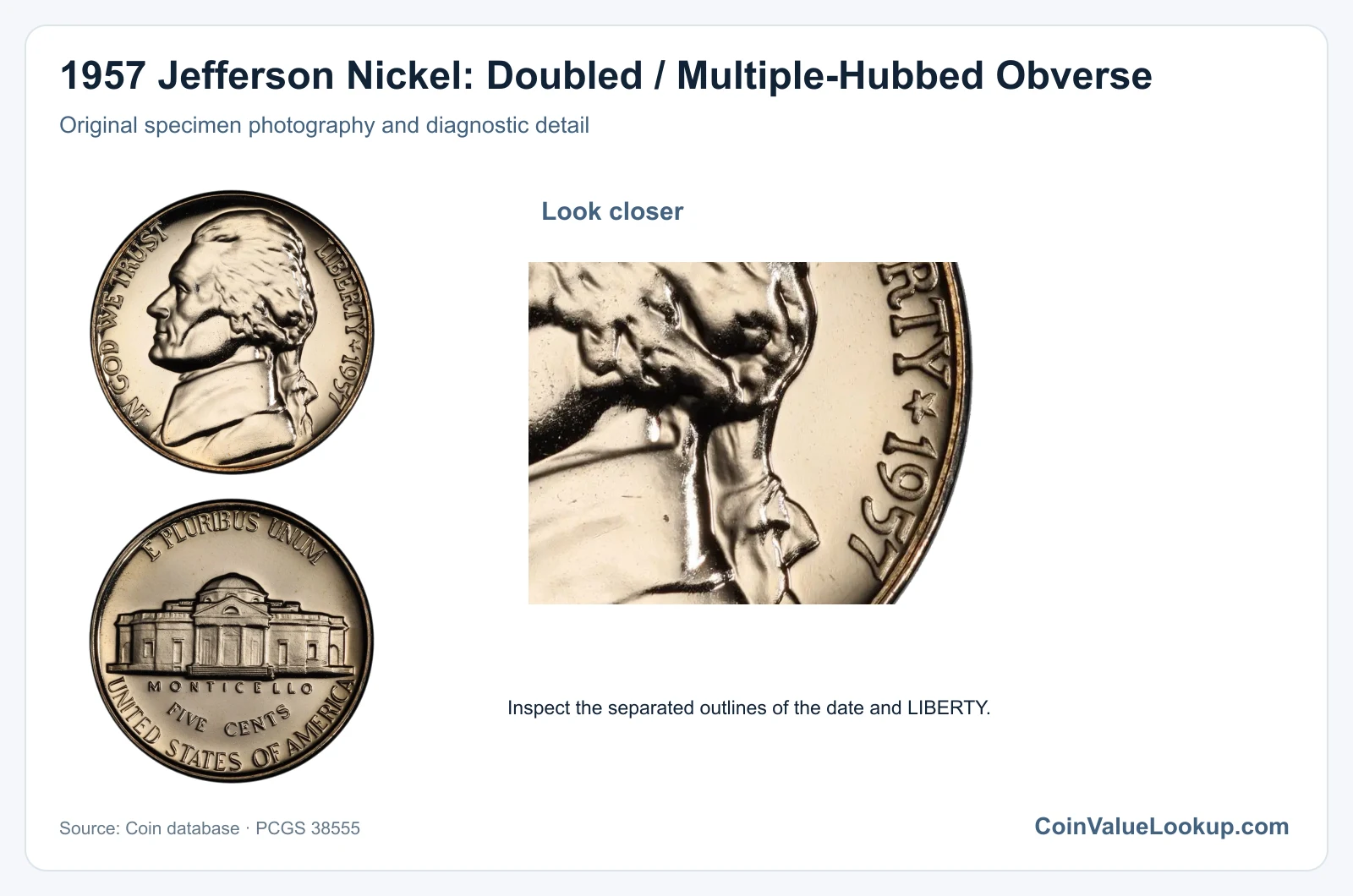
A Proof Quadrupled Die Obverse has been reported for the 1957 nickel. This variety shows consistent doubling or separation on obverse design elements, typically visible in lettering or date numerals.
The key word is consistent: the extra impressions appear in the same direction and spacing across multiple features because the hub impressed the die more than once in slightly shifted positions.
Compare suspected coins against a normal proof under the same magnification and lighting. Look for distinct notching or separation on letter edges rather than a flat, shelf-like distortion.
Machine doubling, which is caused by die bounce during striking, produces a flatter, shinier shelf and lacks the raised, sharp character of a true hub doubling. No specific price is adopted for this variety because value depends on the coin's grade, the visibility of the doubling, and the particular die involved.
4. 1957 Jefferson Nickel — Repunched Mintmark
A 1957-D Repunched Mintmark variety has been reported. In this era, mintmarks were punched into working dies by hand, and occasionally the punch landed slightly off on the first attempt, leaving a remnant of the initial position visible beneath or beside the final "D."
To check for an RPM, examine the mintmark area on the reverse under at least 5x magnification. You are looking for traces of a second "D" that do not align perfectly with the primary mark.
Compare your coin side by side with a normal 1957-D at the same magnification so you can distinguish a true repunch from a die chip, corrosion pit, or machine-doubling artifact around the mintmark. No specific price is adopted for this variety; value depends on the clarity of the repunch, the coin's overall condition, and collector demand for the specific die pair.