1951 Roosevelt Dime Coin Value: How Much Is It Worth?
The 1951 Roosevelt Dime is a 90% silver coin that still turns up in old collections and inherited jars. Guide estimates place ordinary examples from about $5.81 in Good condition up to around $34 for a top-quality uncirculated San Francisco piece, while Philadelphia proofs in PR65 sit near $64.
These are grade-specific retail reference points from a published guide, not guaranteed buy prices, and the underlying silver value shifts with the metal market.
Fast Way to Identify Your 1951 Roosevelt Dime
Want a quick read on your 1951 dime? Upload clear photos of the front and back, and our identifier can give you a preliminary take on which mint version you have.
That first step helps you figure out whether it is worth a deeper look or just a nice silver keepsake.
1951 Roosevelt Dime Value
Upload both sides of your 1951 Roosevelt Dime.
Front Obverse
Upload photo
Back Reverse
Upload photo
Which 1951 Roosevelt Dime Versions Are Worth Money?
- Uncirculated 1951-S dimes can reach around $34 at the MS65 level according to guide estimates, the highest among the three business-strike mints.
- Philadelphia proof dimes from 1951, especially those independently graded with cameo or deep-cameo contrast, trade well above the ordinary PR65 estimate of $64.
- A confirmed Repunched D Mintmark (1951-D) carries a collector premium, but the secondary D must be verified under magnification before assuming extra value.
- A confirmed Repunched S Mintmark (1951-S) is another variety specialists seek; authenticate the doubled S contour before expecting a premium.
- Off-center strikes with a visible date, such as a reported 50% off-center MS62 example that sold for $322, are scarce and collectible.
Step 1: Identify Your 1951 Roosevelt Dime Mint Mark and Version
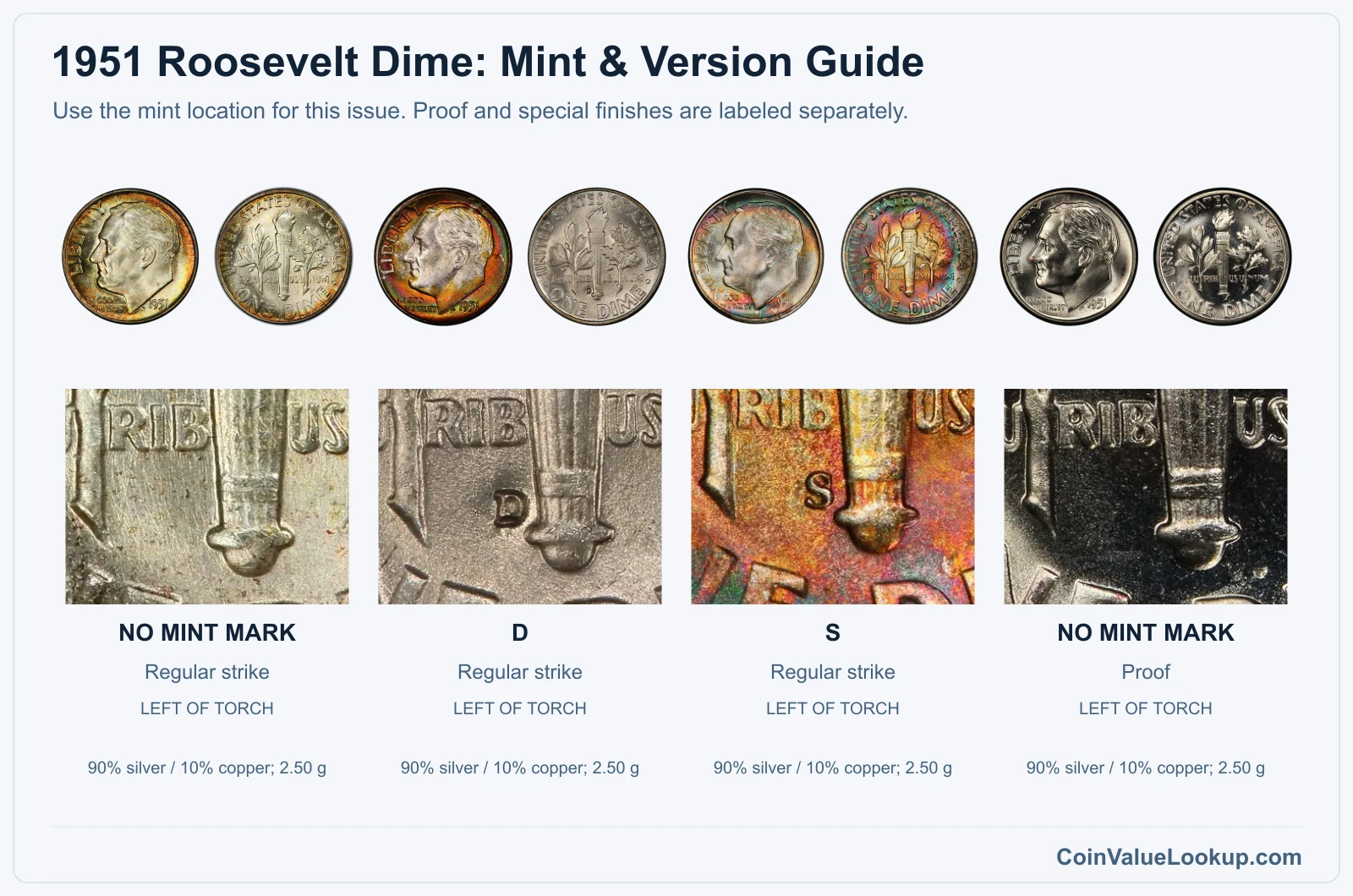
Start with the basics: confirm the date reads 1951 and that you see Roosevelt's portrait on the front with a torch flanked by olive and oak branches on the back. Flip the coin over and look beside the base of the torch for a small letter.
A "D" means Denver, an "S" means San Francisco, and no letter at all means Philadelphia.
The absence of a mintmark on a Philadelphia coin is completely normal, not a missing-mintmark error. Every regular 1951 dime is struck in 90% silver with 10% copper, weighs about 2.50 grams, and measures roughly 17.9 mm across.
If your coin feels unusually light or looks copper-colored at the rim, it may be damaged or a different coin entirely.
Philadelphia also produced proof dimes in 1951, and those carry no mintmark either. A proof has mirror-like fields, sharply squared rims, and crisp device detail that a business strike simply does not match.
Do not confuse a well-preserved circulation coin for a proof just because it is shiny.
Step 2: Check Your 1951 Roosevelt Dime Grade
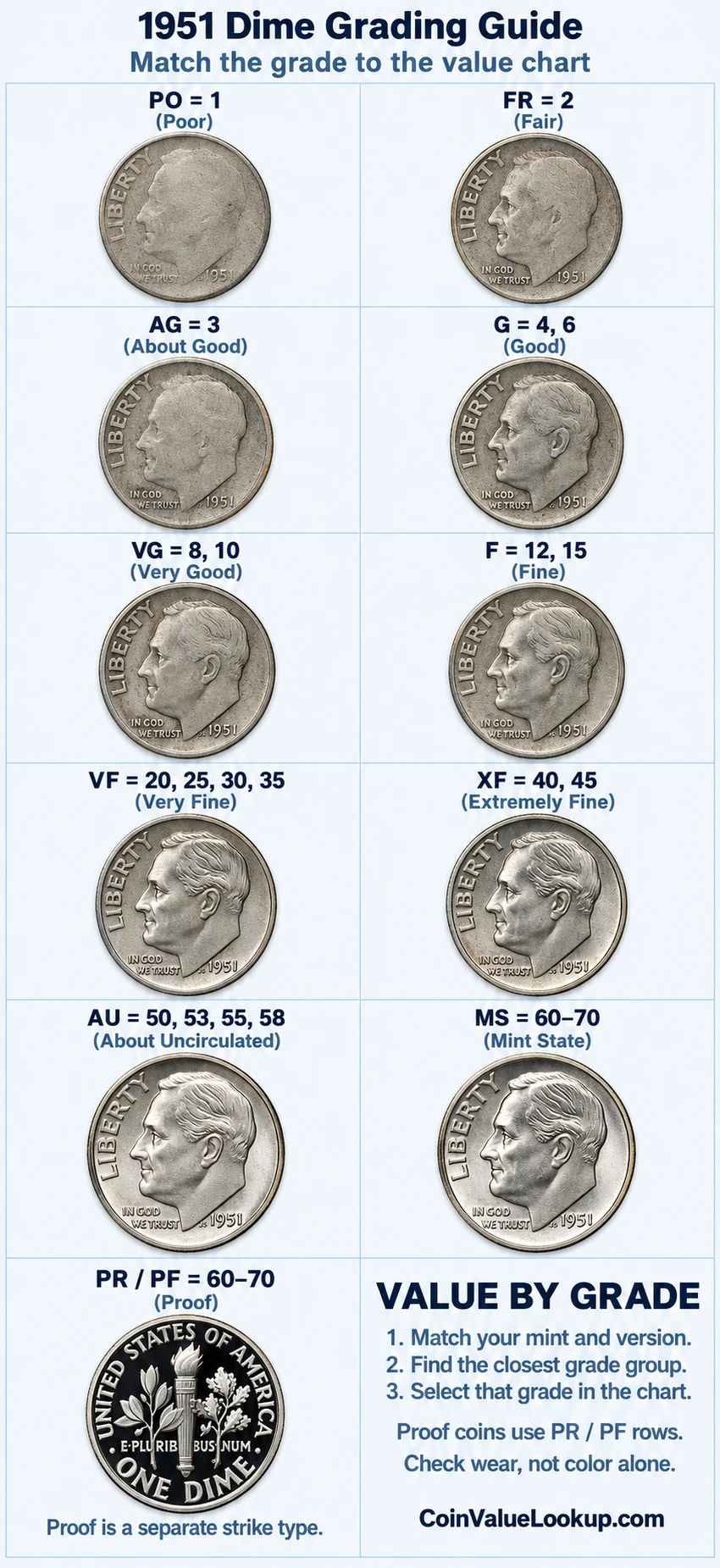
Focus on Roosevelt's cheek, the hair detail above his ear, and the line of his jaw. These are the highest points on the obverse and the first places to show friction.
On the reverse, check the upper torch bands and the leaf tips.
A coin grading Good (G4) will have a smooth, flat portrait with an outline but little interior detail. By Extremely Fine (EF40), most hair strands are visible and the torch bands are nearly complete.
Mint State (MS60 and above) coins show no wear at all, though they may have bag marks or luster breaks.
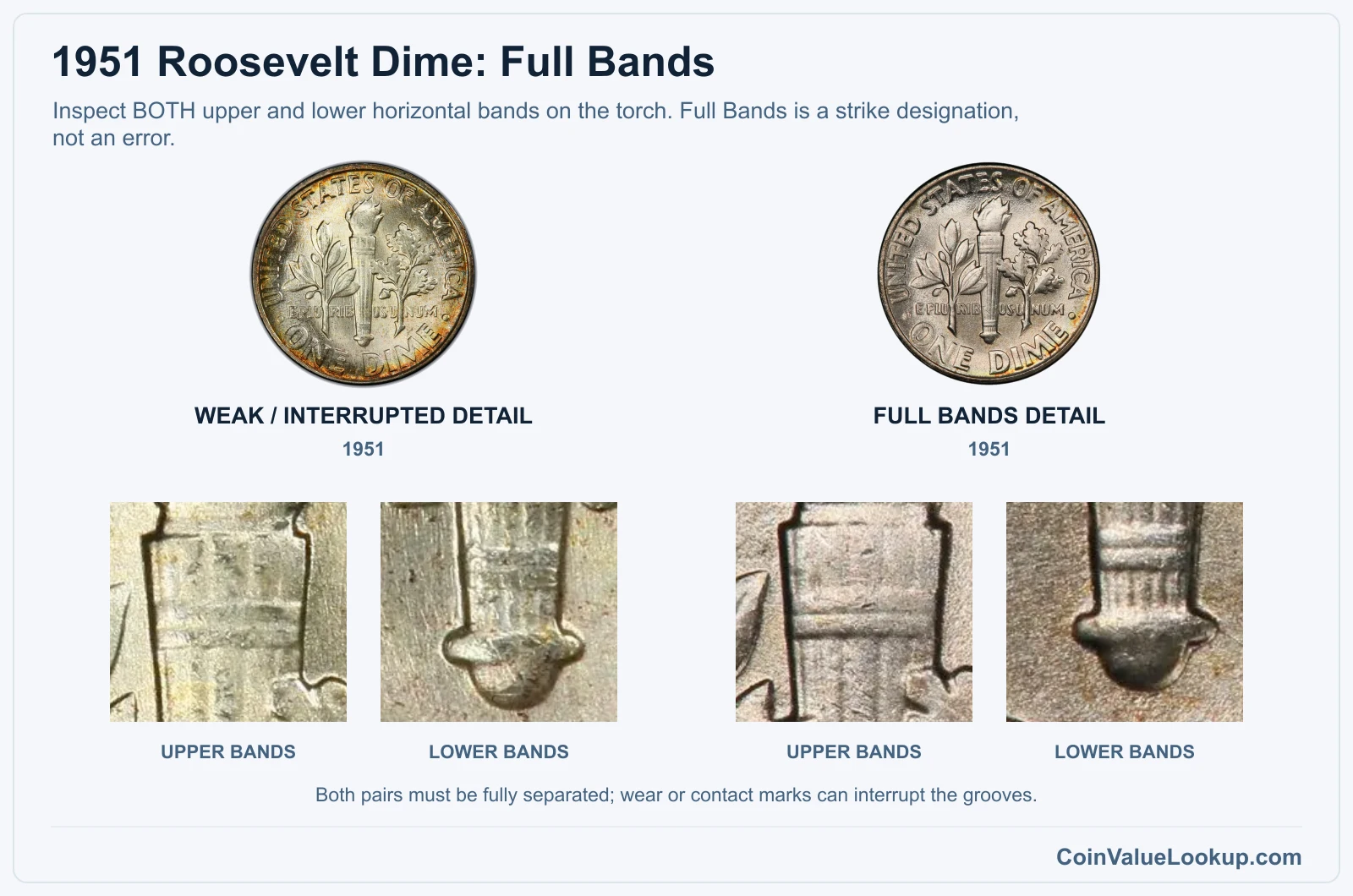
One common trap: a soft or incomplete torch band does not automatically mean the coin circulated. Some 1951 dimes left the press with weak strikes, especially in the horizontal torch-band area.
Compare your coin against the reference image for the same grade before deciding. Full Bands — the complete separation of both horizontal torch-band pairs — is a strike designation that commands its own premium, but it belongs in a comparison within the same mint and numerical grade, not lumped with proof finishes.
Step 3: Check 1951 Roosevelt Dime Value by Mint and Version
1951 Roosevelt Dime — No Mintmark / Philadelphia
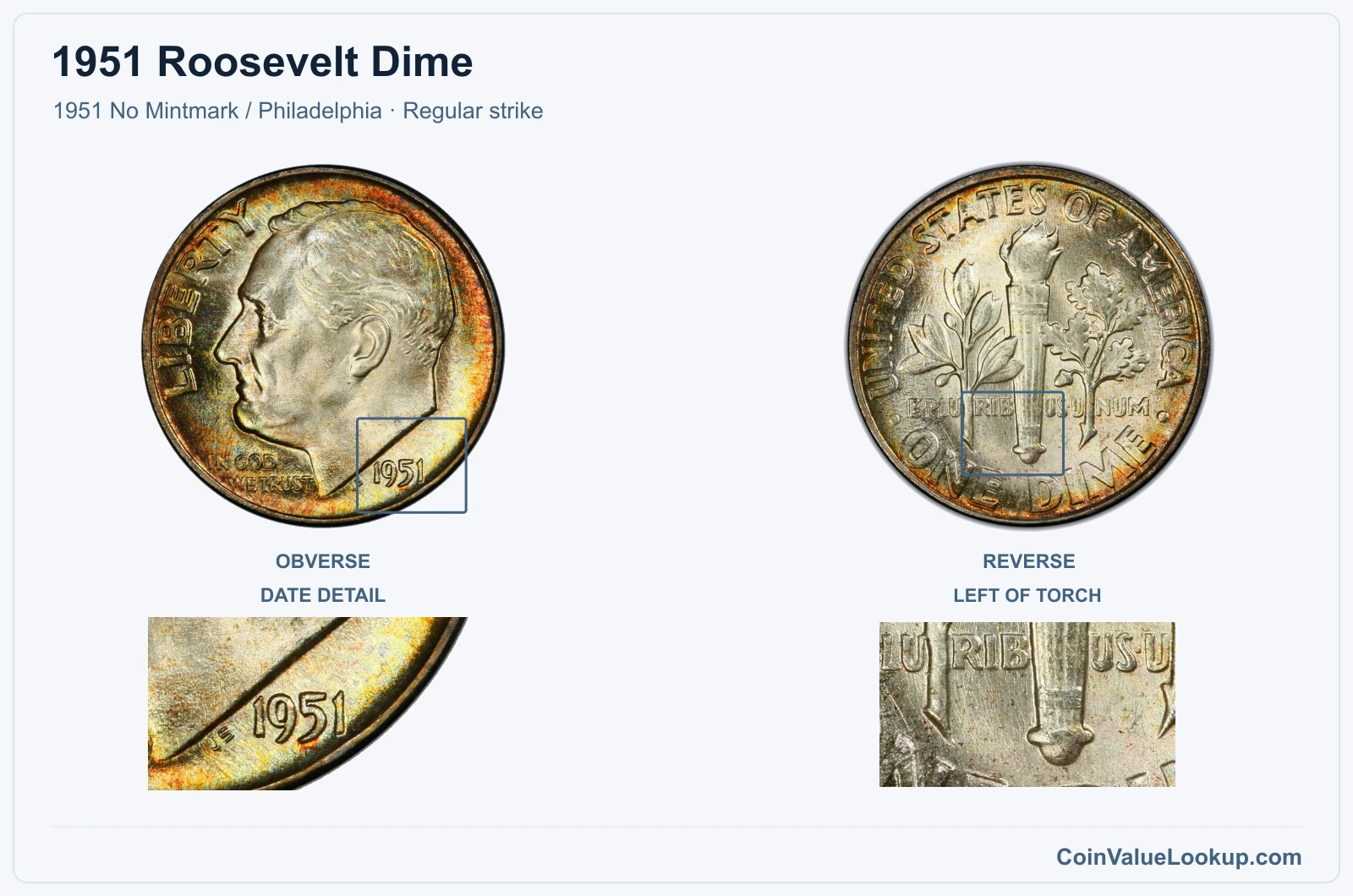
The 1951 Philadelphia dime carries no mintmark. Check the reverse near the torch base and confirm the space is blank.
Guide estimates place this coin at about $5.81 in G4 and around $16 in MS65.
Most survivors are circulated and worth roughly their silver content plus a small numismatic bump. Uncirculated examples with original luster and clean surfaces deserve a closer grade comparison.
Coins with fully separated horizontal torch bands — the Full Bands designation — can command higher prices at the same numerical grade, but a merely shiny coin with mushy bands does not qualify.
Avoid cleaning your coin to make it look brighter; that actually lowers its grade and desirability.
Range Grade
Price Auction Records Appraisal PO PO 1
—
Coin Identifier FR FR 2
—
Coin Identifier AG AG 3
—
Coin Identifier G G 4
—
Coin Identifier
G 6
—
Coin Identifier VG VG 8
—
Coin Identifier
VG 10
—
Coin Identifier F F 12
—
Coin Identifier
F 15
—
Coin Identifier VF VF 20
—
Coin Identifier
VF 25
—
Coin Identifier
VF 30
—
Coin Identifier
VF 35
—
Coin Identifier XF XF 40
—
Coin Identifier
XF 45
—
Coin Identifier AU AU 50
—
Coin Identifier
AU 53
—
Coin Identifier
AU 55
—
Coin Identifier
AU 58
—
Coin Identifier MS MS 60
—
Coin Identifier
MS 61
—
Coin Identifier
MS 62
—
Coin Identifier
MS 63
—
Coin Identifier
MS 64
—
Coin Identifier
MS 65
Coin Identifier
MS 66
Coin Identifier
MS 67
Coin Identifier
MS 68
Coin Identifier
MS 69
—
—
—
MS 70
—
—
—
1951 Roosevelt Dime — D / Denver
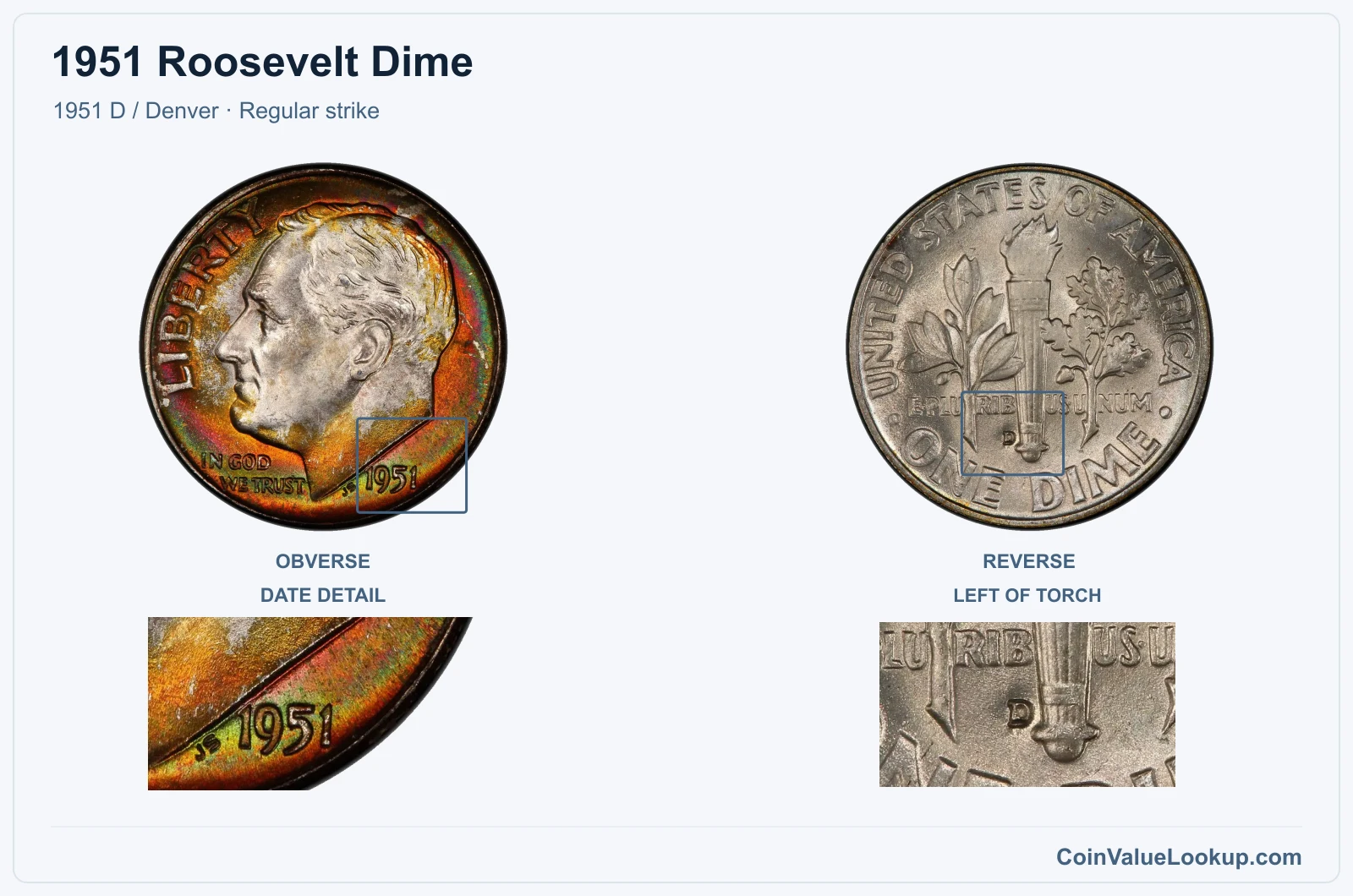
Look for a small "D" on the reverse beside the torch base. The 1951-D is a standard Denver business strike in 90% silver, and guide estimates run from about $5.81 in G4 to roughly $16 in MS65.
Denver dimes from this era are common in circulated grades, so worn examples trade near their silver melt value. The jump in premium happens at higher uncirculated grades, particularly when Full Bands detail is present.
Keep an eye out for the repunched mintmark variety listed in the error section — a secondary D outline sits just below and to the lower-left of the primary letter.
Range Grade
Price Auction Records Appraisal PO PO 1
—
Coin Identifier FR FR 2
—
Coin Identifier AG AG 3
—
Coin Identifier G G 4
—
Coin Identifier
G 6
—
Coin Identifier VG VG 8
—
Coin Identifier
VG 10
—
Coin Identifier F F 12
—
Coin Identifier
F 15
—
Coin Identifier VF VF 20
—
Coin Identifier
VF 25
—
Coin Identifier
VF 30
—
Coin Identifier
VF 35
—
Coin Identifier XF XF 40
—
Coin Identifier
XF 45
—
Coin Identifier AU AU 50
—
Coin Identifier
AU 53
—
Coin Identifier
AU 55
—
Coin Identifier
AU 58
—
Coin Identifier MS MS 60
—
Coin Identifier
MS 61
—
Coin Identifier
MS 62
—
Coin Identifier
MS 63
—
Coin Identifier
MS 64
—
Coin Identifier
MS 65
Coin Identifier
MS 66
Coin Identifier
MS 67
Coin Identifier
MS 68
Coin Identifier
MS 69
—
—
—
MS 70
—
—
—
1951 Roosevelt Dime — S / San Francisco
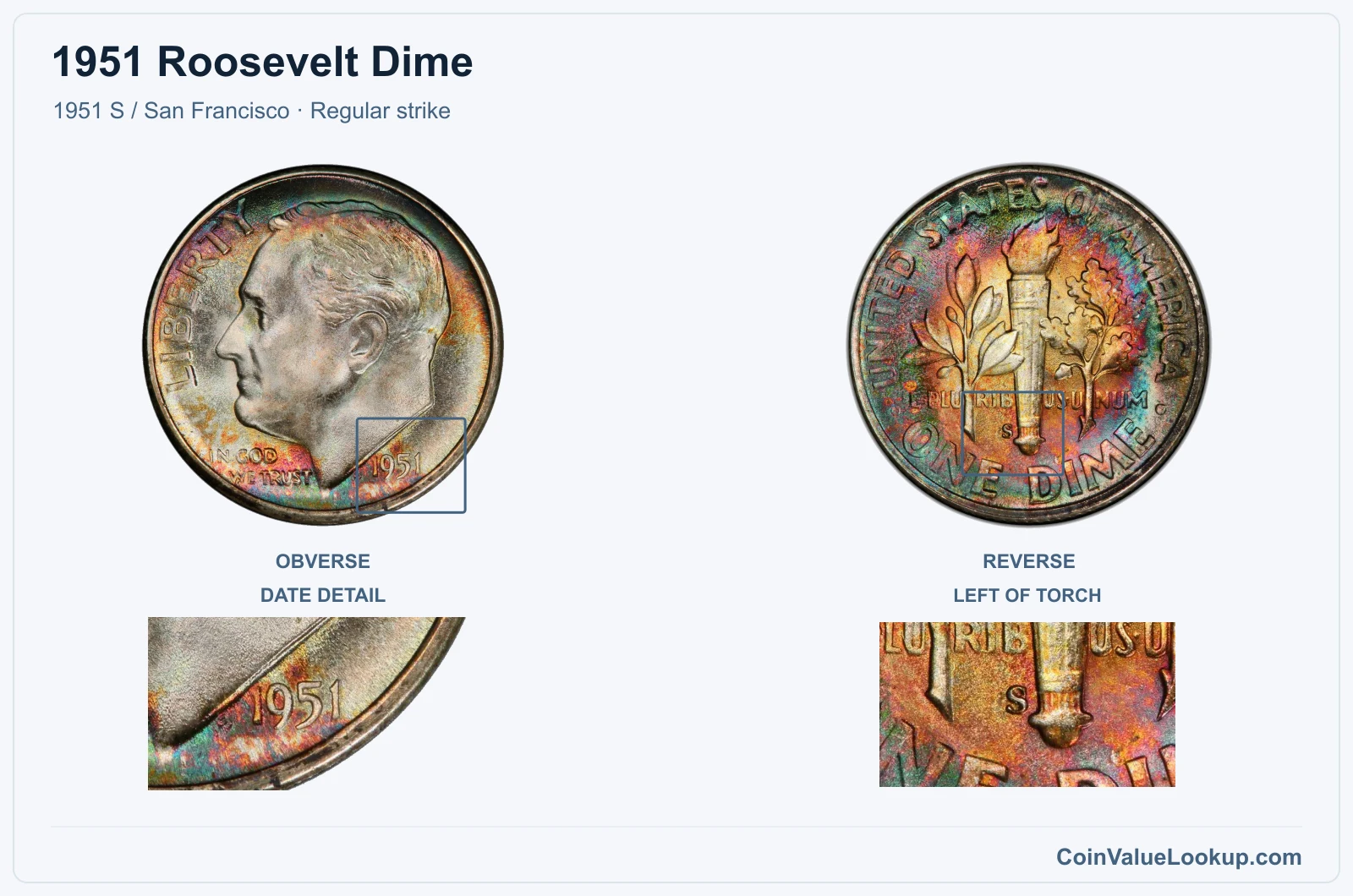
The 1951-S carries a small "S" mintmark on the reverse near the torch. Guide estimates start around $5.81 in G4, but the MS65 figure reaches approximately $34 — the highest among the three business-strike mints for this year.
Coin Value Lookup is a handy place to look up guide values for Roosevelt dimes and other series when you want a quick reference while sorting through a collection.
That MS65 premium reflects the relative difficulty of finding fully lustrous, mark-free San Francisco dimes at the gem level. As with the other mints, Full Bands examples within the same grade will bring more.
Also check the mintmark closely; a repunched S variety exists and is noted separately in the error section.
Range Grade
Price Auction Records Appraisal PO PO 1
—
Coin Identifier FR FR 2
—
Coin Identifier AG AG 3
—
Coin Identifier G G 4
—
Coin Identifier
G 6
—
Coin Identifier VG VG 8
—
Coin Identifier
VG 10
—
Coin Identifier F F 12
—
Coin Identifier
F 15
—
Coin Identifier VF VF 20
—
Coin Identifier
VF 25
—
Coin Identifier
VF 30
—
Coin Identifier
VF 35
—
Coin Identifier XF XF 40
—
Coin Identifier
XF 45
—
Coin Identifier AU AU 50
—
Coin Identifier
AU 53
—
Coin Identifier
AU 55
—
Coin Identifier
AU 58
—
Coin Identifier MS MS 60
—
Coin Identifier
MS 61
—
Coin Identifier
MS 62
—
Coin Identifier
MS 63
—
Coin Identifier
MS 64
Coin Identifier
MS 65
Coin Identifier
MS 66
Coin Identifier
MS 67
Coin Identifier
MS 68
Coin Identifier
MS 69
—
—
—
MS 70
—
—
—
1951 Roosevelt Dime — Philadelphia Proof (No Mintmark)
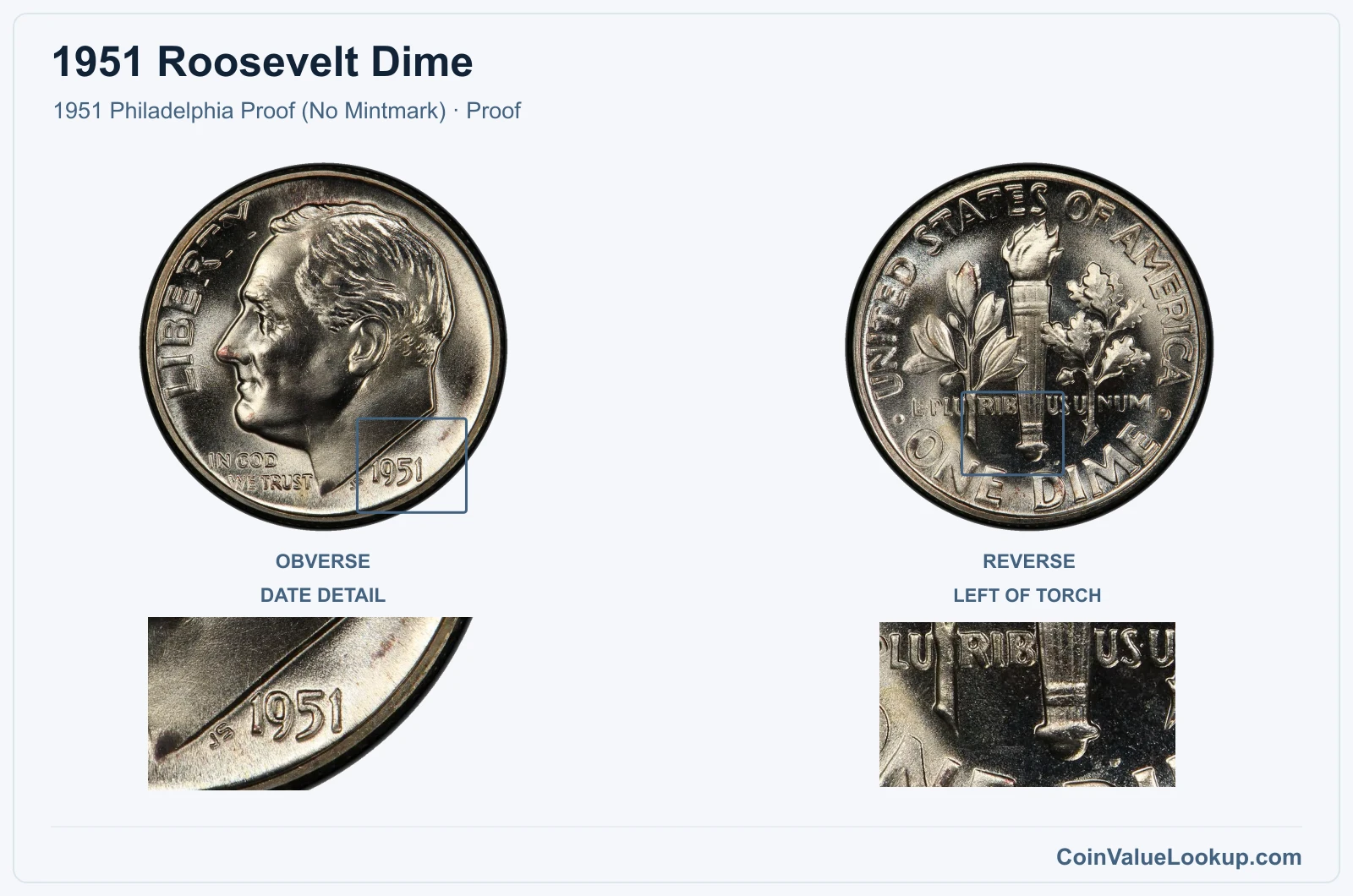
Philadelphia struck proof Roosevelt dimes beginning in 1950, and the 1951 proof continues that run. These coins have mirrored fields, squared rims, and exceptionally sharp device detail.
Like the business strike, they carry no mintmark.
A guide estimate for PR65 is about $64. However, cameo and deep-cameo designations — where frosted devices contrast against mirror fields — are graded and valued separately.
Do not apply the ordinary PR65 figure to a coin that has earned one of those premium labels from an independent grading service.
To tell a proof from a really nice business strike, look at the fields under a light. A proof reflects like a mirror across flat areas, and the rim has a distinctly sharp, squared edge.
A business strike, no matter how well preserved, will show cartwheel luster instead of that deep reflective surface.
Range Grade
Price Auction Records Appraisal PR PR 1
—
Coin Identifier
PR 2
—
Coin Identifier
PR 3
—
Coin Identifier
PR 4
—
Coin Identifier
PR 6
—
Coin Identifier
PR 8
—
Coin Identifier
PR 10
—
Coin Identifier
PR 12
—
Coin Identifier
PR 15
—
Coin Identifier
PR 20
—
Coin Identifier
PR 25
—
Coin Identifier
PR 30
—
Coin Identifier
PR 35
—
Coin Identifier
PR 40
—
Coin Identifier
PR 45
—
Coin Identifier
PR 50
—
Coin Identifier
PR 53
—
Coin Identifier
PR 55
—
Coin Identifier
PR 58
—
Coin Identifier
PR 60
—
Coin Identifier
PR 61
—
Coin Identifier
PR 62
—
Coin Identifier
PR 63
—
Coin Identifier
PR 64
Coin Identifier
PR 65
Coin Identifier
PR 66
Coin Identifier
PR 67
Coin Identifier
PR 68
Coin Identifier
PR 69
Coin Identifier
PR 70
—
—
—
1951 Roosevelt Dime Error List
1. 1951 Roosevelt Dime — Repunched D Mintmark
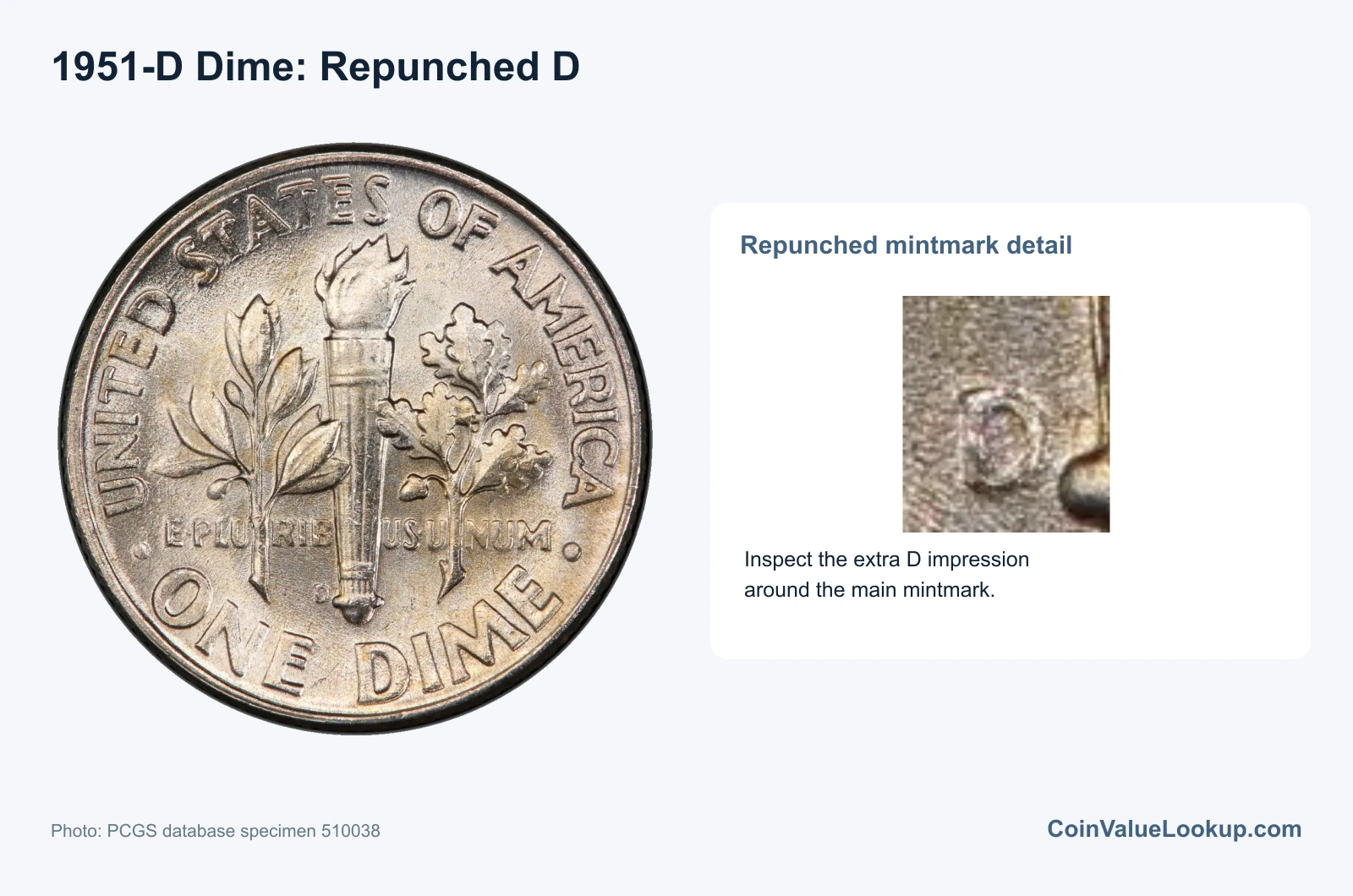
On certain 1951-D dimes, the Denver mintmark was punched into the working die more than once, leaving a visible secondary D below and to the lower-left of the final letter. Under magnification, you should see a separate rounded outline that clearly echoes the shape of the D rather than looking like a random scratch or lump.
This is known as a Repunched Mintmark. A certified example has been graded as high as MS66 with Full Bands.
No specific numeric price range is adopted here because value depends on the authenticated identity of the variety, the coin's condition, and how dramatic the repunching appears. Have the feature independently confirmed before assuming a premium.
Watch out for lookalikes: shelf doubling from die deterioration, corrosion pitting near the mintmark, or a simple scratch can mimic the appearance of a second punch. The key test is whether the secondary image has the same rounded D contour and consistent positioning.
2. 1951 Roosevelt Dime — Repunched S Mintmark
Some 1951-S dimes show a repunched S mintmark — a secondary, slightly offset S contour visible near the primary letter on the reverse. This happened because mintmarks were hand-punched into dies in this era, and occasionally the punch landed slightly off on the first attempt before being corrected.
A certified MS66 example of this variety has been documented by NGC. No firm price range is adopted; the coin's value depends on authenticated attribution, overall grade, and how clearly the repunching shows.
Individual assessment by a grading service or knowledgeable dealer is the safest route.
Do not confuse routine die wear around the S, post-mint damage, or small dings with a true repunched mintmark. A genuine RPM will display a second S contour that follows the same curves as the primary letter, visible under moderate magnification with the full date and surrounding design in frame for context.
3. 1951 Roosevelt Dime — Off-Center Strike
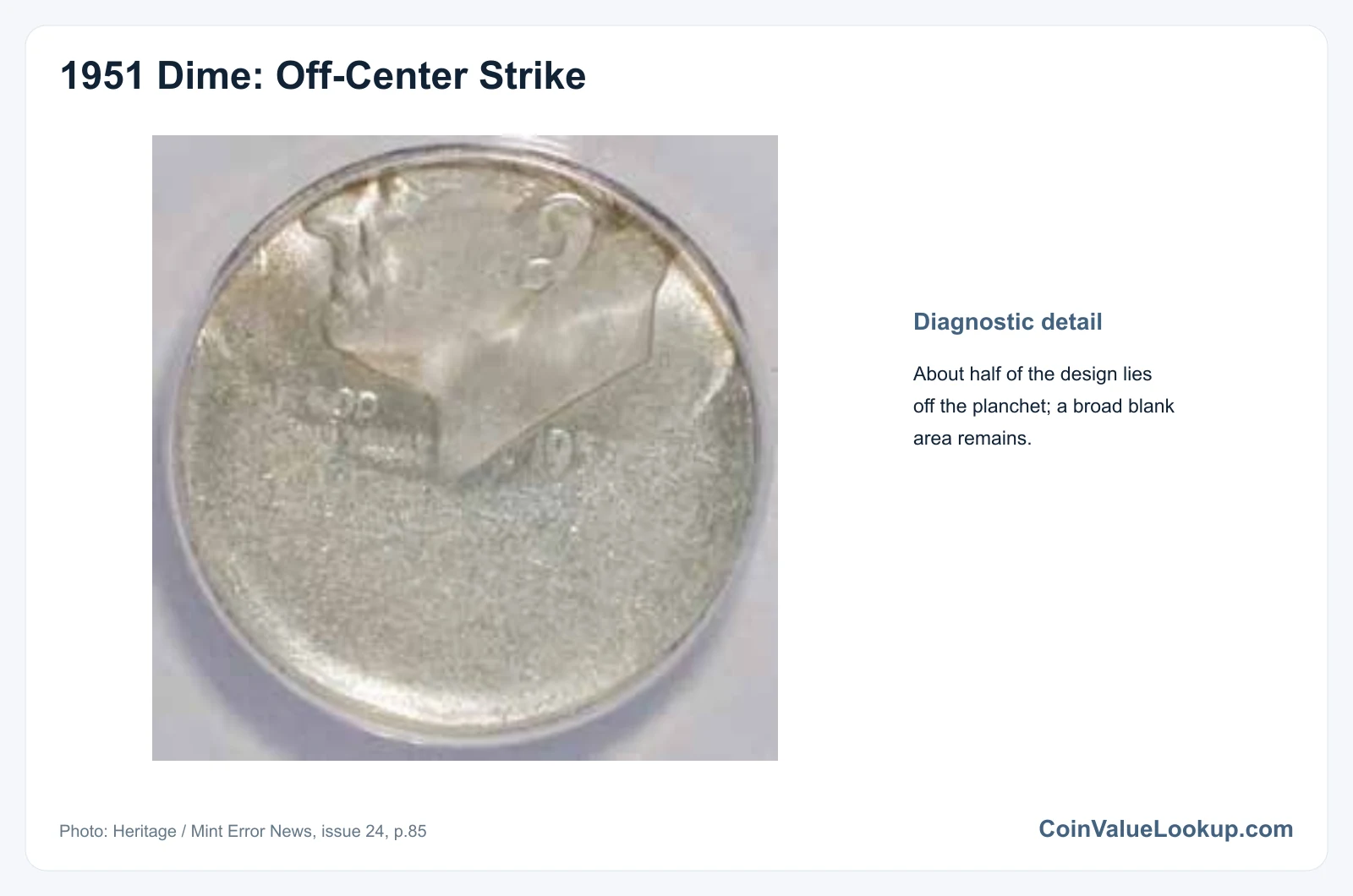
An off-center strike occurs when the planchet is not properly seated between the dies, shifting part of the design off the edge of the blank. The result is a crescent-shaped area of unstruck metal alongside a displaced but otherwise normally detailed design.
A documented 1951 Philadelphia off-center dime, struck approximately 50% off center and graded ANACS MS62, has a published record at $322. That is a single historical result, not a current market range.
Percentage of off-center displacement and whether the date remains fully visible are the two biggest factors in desirability.
Do not confuse an off-center strike with a broadstrike, which retains the full design but lacks a defined rim. Also, one-sided die misalignment that merely weakens part of the design without leaving blank planchet area is a different issue entirely.
A true off-center coin will show obvious unstruck metal on both sides.
4. 1951 Roosevelt Dime — Die Crack / Die Chip
Die cracks and die chips appear as raised lines or small raised blobs on the coin's surface. They form when a working die develops fractures from repeated striking.
A crack that reaches the rim can eventually produce a cud — a larger raised blob of unstruck metal at the edge.
Die-break errors have been reported on 1951 dimes. No specific price range is adopted because the value depends heavily on the size, location, and visual impact of the break, along with the coin's overall condition.
A tiny hairline crack adds very little, while a prominent cud can attract specialist interest.
Before assuming you have a die break, rule out incuse scratches (which sit below the surface, not above it), corrosion, or foreign material stuck to the coin. A genuine die crack will be raised, follow a consistent path, and appear in the same spot on other coins struck from the same die.
5. 1951 Roosevelt Dime — Clipped Planchet
A clipped planchet error means part of the metal blank was missing before the coin was struck. The result is a coin with a curved, straight, or irregular bite taken out of its edge.
You may also notice design weakness on the opposite side of the clip, caused by incomplete metal flow during striking.
Clipped-planchet errors have been reported on 1951 dimes. No specific price range is adopted here; value depends on the type and size of the clip, how much of the design is affected, and the coin's condition.
A tiny curved clip adds modest value, while a dramatic straight clip or multiple clips attract more attention.
To distinguish a genuine clip from post-mint damage, examine the edge closely. A filed notch or deliberate cut will show tool marks and sharp edges.
A true clip has a characteristic flow of metal and often pairs with the Blakesley kick — a weak area of the rim directly opposite the missing section.