1961 Roosevelt Dime Coin Value: How Much Is It Worth?
The 1961 Roosevelt Dime is a 90% silver coin that still turns up in inherited collections and old rolls. Guide estimates from USA Coin Book place ordinary circulated examples around $5.81 at the G4 grade, while uncirculated MS65 pieces run about $10.91.
Standard Philadelphia proofs sit near $9.87 at PR65. Silver content provides a floor, but the real fun starts when you check for mint varieties, strike designations, and legitimate errors.
Fast Way to Identify Your 1961 Roosevelt Dime
The quickest way to start figuring out what you have is to upload clear photos of both sides of your coin. Snap one shot of the obverse (Roosevelt's portrait) and one of the reverse (the torch and branches).
Good lighting and a steady hand help. From there, a preliminary identification can point you toward the right version and flag anything unusual worth investigating further.
1961 Roosevelt Dime Value
Upload both sides of your 1961 Roosevelt Dime.
Front Obverse
Upload photo
Back Reverse
Upload photo
Which 1961 Roosevelt Dime Versions Are Worth Money?
- Philadelphia business strikes in MS65 with Full Bands designation can command more than ordinary examples — check the torch bands carefully.
- Philadelphia proofs with undisturbed mirror fields; cameo contrast coins require separate comparison against like-designated specimens.
- Elliptical Planchet errors on Philadelphia business strikes show a distinctly elongated blank and underweight coin.
- Curved Clipped Planchet errors on 1961-D strikes display a missing curved section and characteristic metal flow.
- Proof Struck Through Thread errors show a thin recessed impression crossing the proof surface, a scarce manufacturing defect.
- 1961-D Doubled Die Reverse varieties may show doubling on reverse legends — compare against a normal coin.
Step 1: Identify Your 1961 Roosevelt Dime Mint Mark and Version
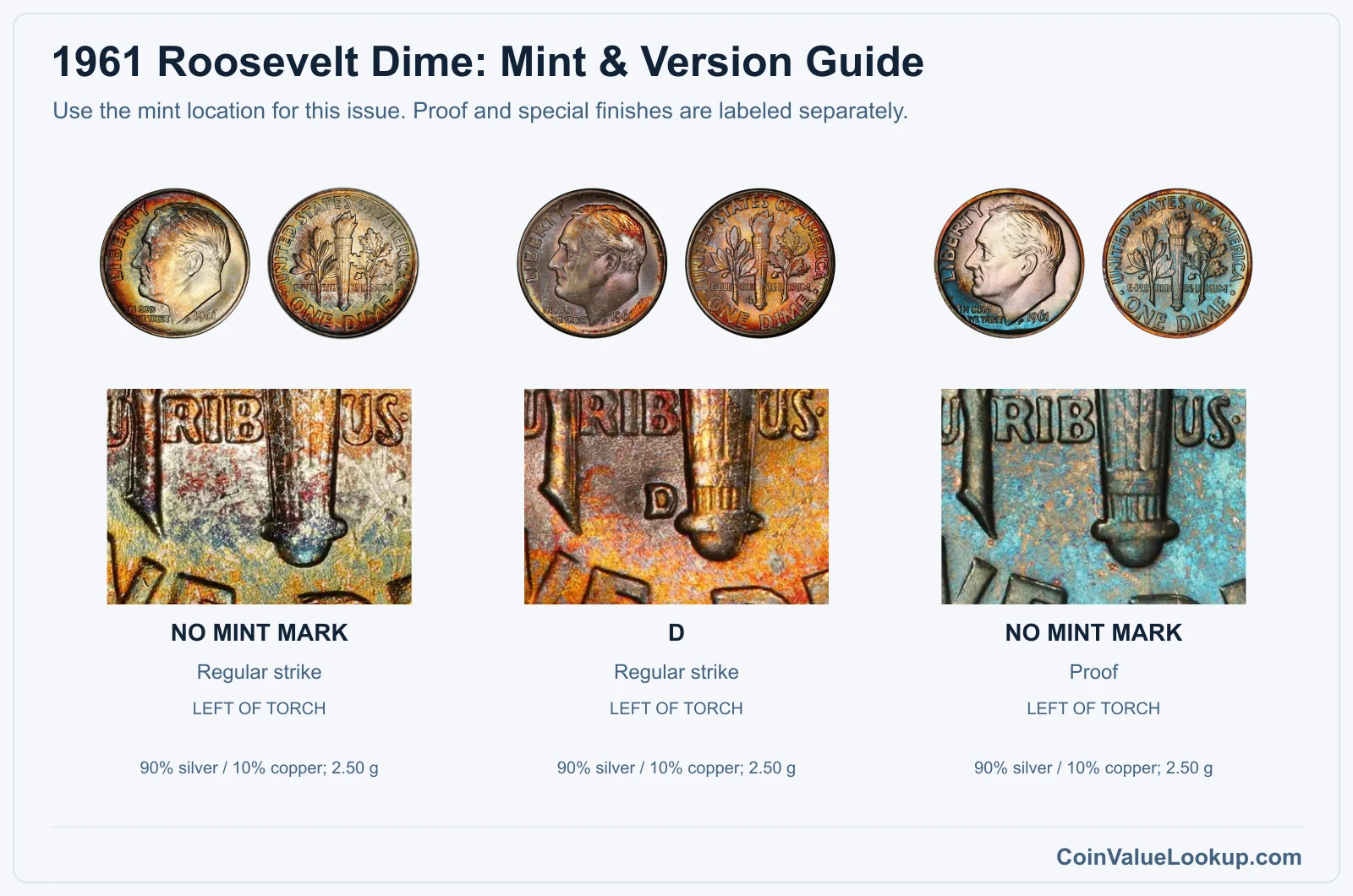
Every 1961 Roosevelt Dime is struck in 90% silver and 10% copper, weighing about 2.50 grams and measuring roughly 17.9 mm across. That makes it part of the final era of silver dimes before the 1965 switch to clad.
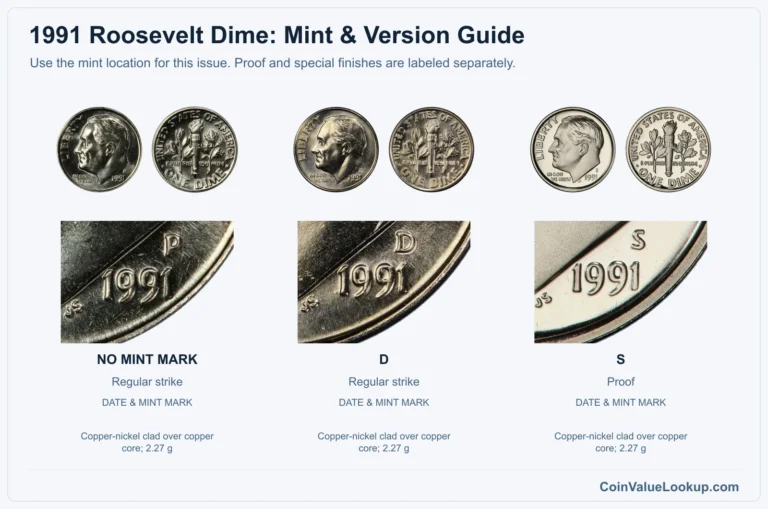
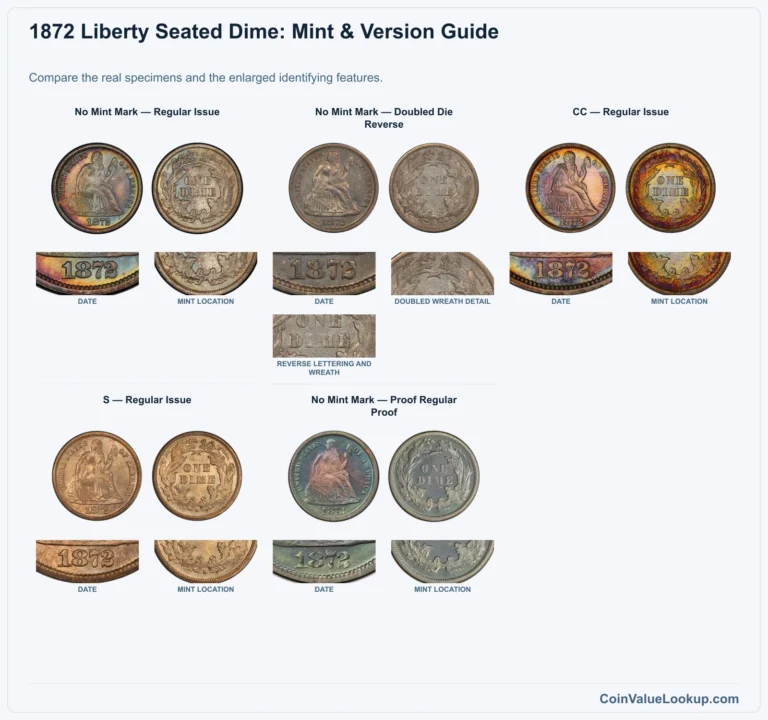
To identify your specific branch, flip to the reverse and look beside the base of the torch. A small "D" means Denver.
No mintmark at all means Philadelphia, which produced both business strikes and proofs that year.
Business strikes have a satiny or frosty luster and were made for circulation. Proofs, on the other hand, show mirror-like fields and sharp detail from specially prepared dies and planchets.
If your coin has deeply reflective surfaces and razor-sharp rims, you likely have a proof. These are two different manufacturing methods, not just different quality levels.
One more thing to check: Full Bands. That refers to clear, complete separation of both horizontal band pairs on the torch.
It is a strike designation, not a grade, and coins with it are compared separately from those without.
Step 2: Check Your 1961 Roosevelt Dime Grade
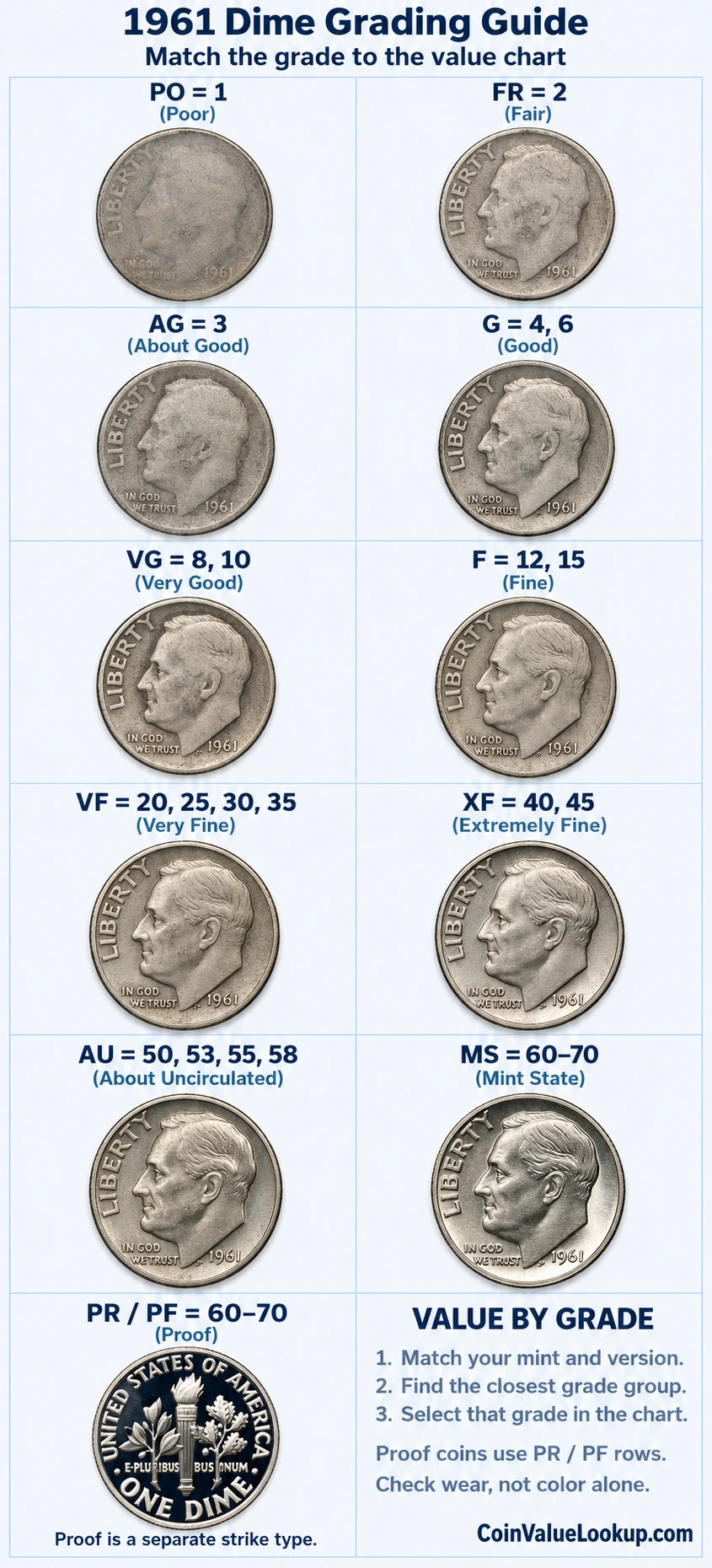
Start at the cheek and jawline on Roosevelt's portrait. These are the highest points and the first to show wear.
Even light friction will dull the original luster there before anywhere else.
Next, check the hair detail above the ear. On a well-struck, unworn coin you should see individual strands.
As the grade drops, those strands merge into a flat area.
On the reverse, the torch and the leaves flanking it lose detail progressively. A coin graded Good (G4) will have a visible outline but most fine detail will be gone.
By MS65, you should see full luster, no wear, and only minor contact marks under magnification.
Tilt the coin under a single light source. This separates genuine unbroken mint luster from a cleaned surface that just looks shiny.
Cleaning hairlines — fine parallel scratches from polishing — are a red flag and reduce value even on a coin that otherwise looks uncirculated. Use the comparison image to match your coin's wear pattern against known grade benchmarks.
Step 3: Check 1961 Roosevelt Dime Value by Mint and Version
1961 Roosevelt Dime — No Mintmark / Philadelphia Business Strike
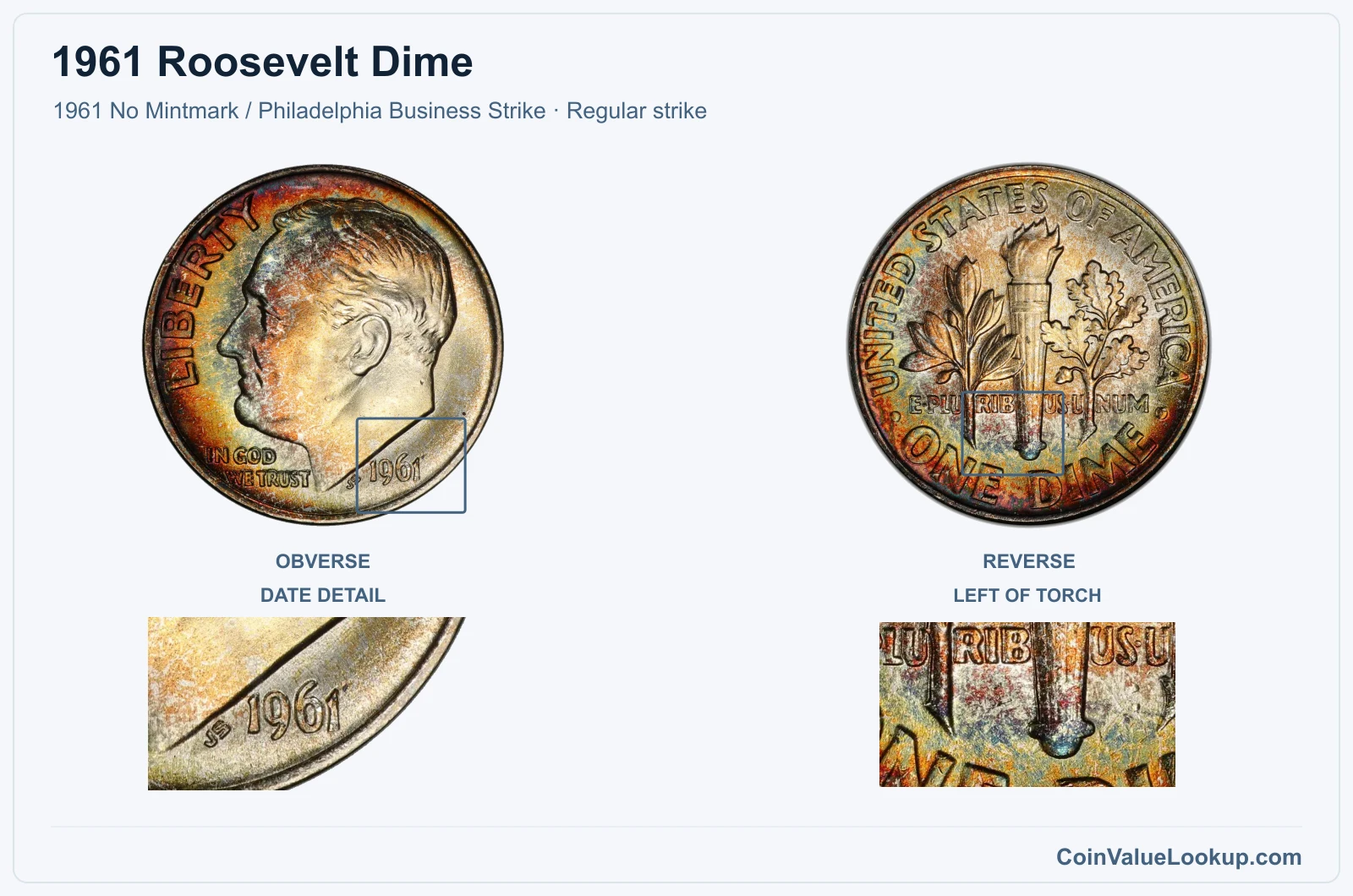
The 1961 Philadelphia business strike carries no mintmark — the area beside the torch base on the reverse is blank. USA Coin Book estimates place this coin around $5.81 at Good-4 and approximately $10.91 at MS65.
Silver melt value shifts with the metal market, so even worn examples hold some intrinsic worth.
For coins grading near the top, check for the Full Bands designation by examining the horizontal bands on the torch under magnification. Coins with fully separated bands are compared against others sharing that designation, not lumped in with regular strikes.
Original, untampered surfaces matter more than raw brightness when evaluating these.
Range Grade
Price Auction Records Appraisal PO PO 1
—
Coin Identifier FR FR 2
—
Coin Identifier AG AG 3
—
Coin Identifier G G 4
—
Coin Identifier
G 6
—
Coin Identifier VG VG 8
—
Coin Identifier
VG 10
—
Coin Identifier F F 12
—
Coin Identifier
F 15
—
Coin Identifier VF VF 20
—
Coin Identifier
VF 25
—
Coin Identifier
VF 30
—
Coin Identifier
VF 35
—
Coin Identifier XF XF 40
—
Coin Identifier
XF 45
—
Coin Identifier AU AU 50
—
Coin Identifier
AU 53
—
Coin Identifier
AU 55
—
Coin Identifier
AU 58
—
Coin Identifier MS MS 60
—
Coin Identifier
MS 61
—
Coin Identifier
MS 62
—
Coin Identifier
MS 63
—
Coin Identifier
MS 64
Coin Identifier
MS 65
Coin Identifier
MS 66
Coin Identifier
MS 67
Coin Identifier
MS 68
—
—
—
MS 69
—
—
—
MS 70
—
—
—
1961 Roosevelt Dime — D Mintmark Business Strike
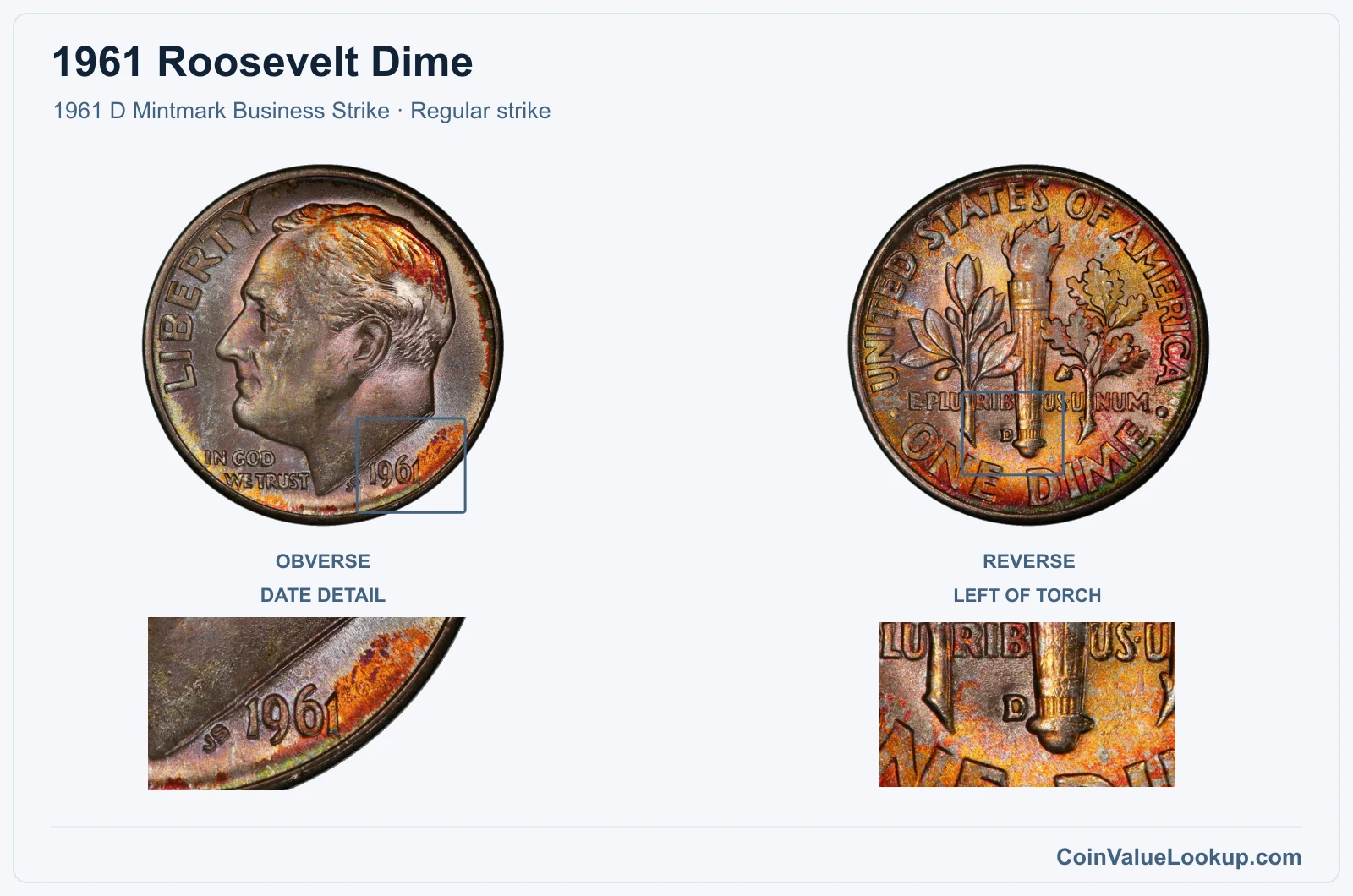
Look for the small "D" mintmark next to the torch base on the reverse. The Denver issue shares the same guide range as its Philadelphia counterpart: about $5.81 at G4 and $10.91 at MS65 per USA Coin Book.
Denver strikes from this era can vary in sharpness, so do not confuse a weak strike with wear. Tilt the coin under light and look for unbroken luster across the high points.
If the luster is intact but the bands on the torch are mushy, that is a strike issue, not circulation damage. Full Bands examples are evaluated separately.
Range Grade
Price Auction Records Appraisal PO PO 1
—
Coin Identifier FR FR 2
—
Coin Identifier AG AG 3
—
Coin Identifier G G 4
—
Coin Identifier
G 6
—
Coin Identifier VG VG 8
—
Coin Identifier
VG 10
—
Coin Identifier F F 12
—
Coin Identifier
F 15
—
Coin Identifier VF VF 20
—
Coin Identifier
VF 25
—
Coin Identifier
VF 30
—
Coin Identifier
VF 35
—
Coin Identifier XF XF 40
—
Coin Identifier
XF 45
—
Coin Identifier AU AU 50
—
Coin Identifier
AU 53
—
Coin Identifier
AU 55
—
Coin Identifier
AU 58
—
Coin Identifier MS MS 60
—
Coin Identifier
MS 61
—
Coin Identifier
MS 62
—
Coin Identifier
MS 63
—
Coin Identifier
MS 64
—
Coin Identifier
MS 65
—
Coin Identifier
MS 66
Coin Identifier
MS 67
Coin Identifier
MS 68
—
—
—
MS 69
—
—
—
MS 70
—
—
—
1961 Roosevelt Dime — No Mintmark / Philadelphia Proof
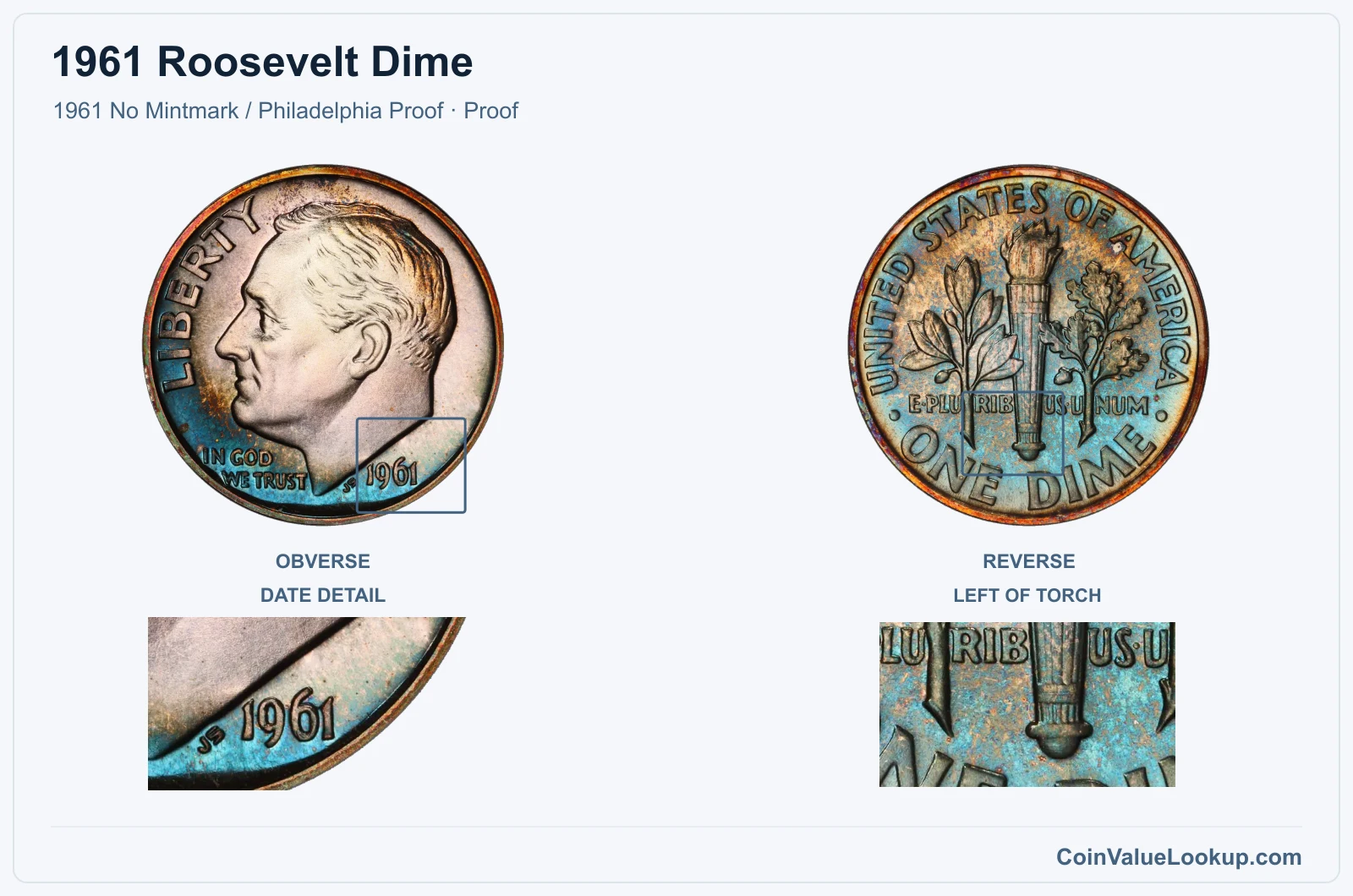
Philadelphia proofs from 1961 were sold in sealed proof sets and exhibit mirror-like fields with sharply struck devices. They carry no mintmark, just like the business strikes, so distinguishing them requires looking at the surface finish rather than a letter.
Coin Value Lookup is a useful starting point if you want to compare your dime against other Roosevelt Dime year guides and identify what branch you are looking at.
USA Coin Book lists the ordinary PR65 proof at around $9.87. Cameo-contrast proofs — those with frosted devices against deep mirror fields — are a separate category and should not be pooled with standard proofs for comparison.
Preserve that mirror surface; fingerprints and improper storage are the biggest enemies of proof coins.
Range Grade
Price Auction Records Appraisal PR PR 1
—
Coin Identifier
PR 2
—
Coin Identifier
PR 3
—
Coin Identifier
PR 4
—
Coin Identifier
PR 6
—
Coin Identifier
PR 8
—
Coin Identifier
PR 10
—
Coin Identifier
PR 12
—
Coin Identifier
PR 15
—
Coin Identifier
PR 20
—
Coin Identifier
PR 25
—
Coin Identifier
PR 30
—
Coin Identifier
PR 35
—
Coin Identifier
PR 40
—
Coin Identifier
PR 45
—
Coin Identifier
PR 50
—
Coin Identifier
PR 53
—
Coin Identifier
PR 55
—
Coin Identifier
PR 58
—
Coin Identifier
PR 60
—
Coin Identifier
PR 61
—
Coin Identifier
PR 62
—
Coin Identifier
PR 63
—
Coin Identifier
PR 64
—
Coin Identifier
PR 65
Coin Identifier
PR 66
Coin Identifier
PR 67
Coin Identifier
PR 68
Coin Identifier
PR 69
Coin Identifier
PR 70
Coin Identifier
1961 Roosevelt Dime Error List
1. 1961 Roosevelt Dime — Elliptical Planchet
An elliptical planchet error means the blank fed into the press was irregularly shaped — stretched or oval rather than round. On a 1961 Philadelphia business strike, this produces a coin with displaced or truncated detail around parts of the rim, and the overall shape looks elongated compared to a normal dime.
One authenticated example, graded NGC MS66 Full Bands, weighed just 1.8 grams against the standard 2.50 grams. That significant weight difference is a key diagnostic.
Weigh your coin if you suspect this error.
Be careful with lookalikes. Post-mint damage like grinding, corrosion, or deliberate reshaping can mimic the silhouette.
A genuine elliptical clip shows consistent metal flow on both faces. Value depends on the individual coin's authenticated identity, condition, and severity of the error.
2. 1961 Roosevelt Dime — Curved Clipped Planchet
A curved clipped planchet occurs when the blanking press punches into an area of strip metal that already had a blank cut from it, leaving a crescent-shaped bite out of the coin. On 1961-D business strikes, look for a missing curved section, typically reported near the 10 o'clock position.
The key diagnostic is the metal flow pattern visible on both sides of the coin adjacent to the clip. The design near the missing section may appear stretched or weakly struck.
Genuine clips also often show a characteristic "Blakesley effect" — weakness on the rim directly opposite the clip.
Do not confuse this with post-mint cutting or deliberate trimming. Authenticated examples confirm the error through consistent die-strike evidence.
Value depends on the specific coin's authenticated identity, condition, and clip size.
3. 1961 Roosevelt Dime — Proof Struck Through Thread
A struck-through-thread error happens when a stray fiber lands on the planchet or die face during striking. The thread blocks metal from filling the die completely, leaving a thin, recessed, thread-shaped impression on the finished coin's surface.
This error has been documented on 1961 Philadelphia proofs specifically. One example was graded ANACS PR65.
On a proof surface, the impression is especially visible because the surrounding mirror field is undisturbed.
Do not confuse this with a scratch or hairline. A scratch removes or displaces metal, creating a groove with sharp edges.
A struck-through impression is recessed but the surrounding metal flows around it naturally. Value for this type of error depends on the individual coin's authenticated identity, proof grade, and how prominent and well-preserved the impression is.
4. 1961 Roosevelt Dime — Doubled Die Reverse
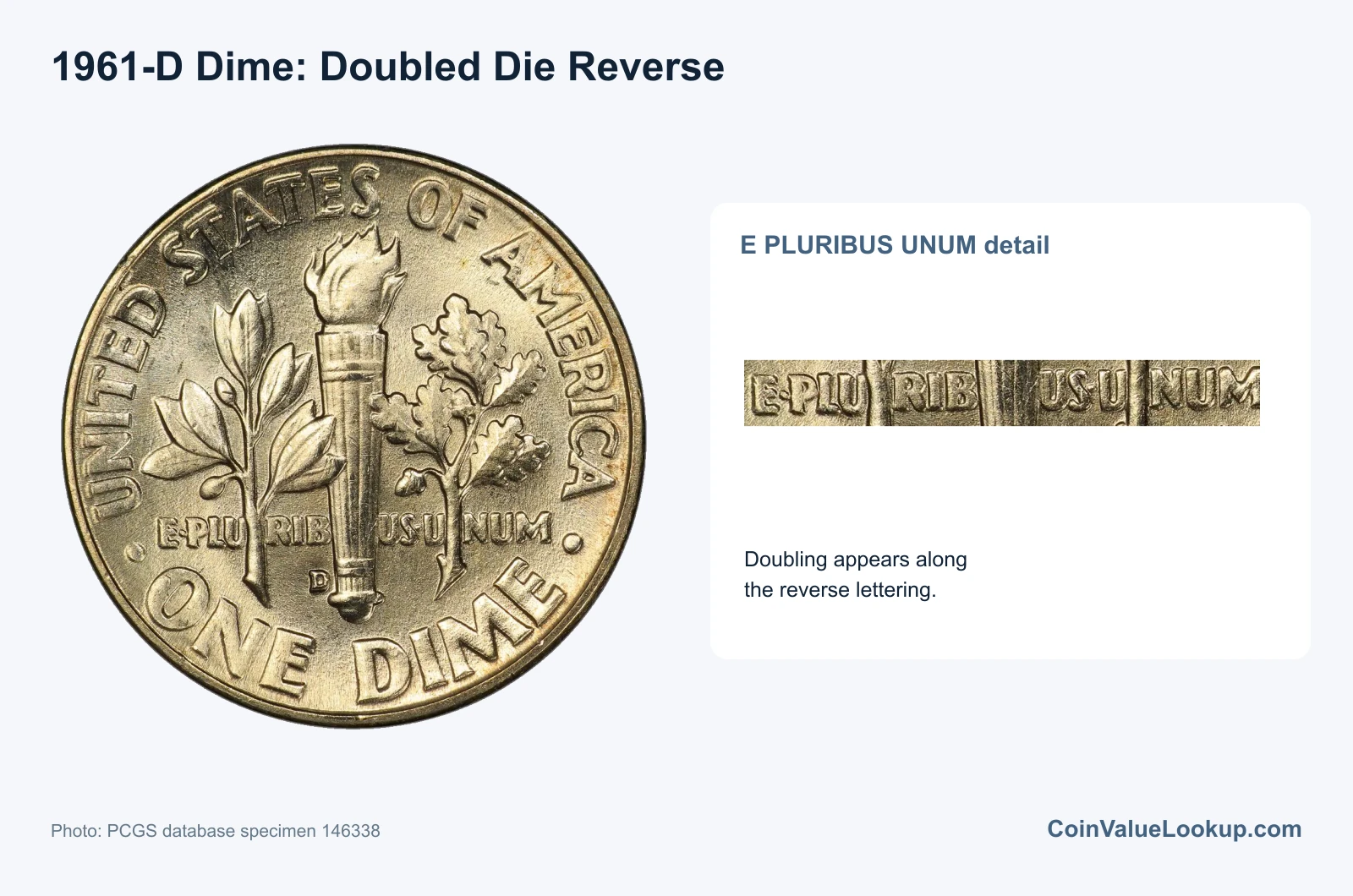
A Doubled Die Reverse on the 1961-D dime shows doubling on reverse design elements — typically letters or other features — created during the die-making process. This is different from machine doubling, which produces flat, shelf-like distortion without true separation.
To check, compare your coin's reverse lettering and design contours against a normal 1961-D dime under matching light and magnification. Look for consistent notching or separation on multiple letters rather than random smearing.
Machine doubling and die deterioration are common lookalikes that carry little premium. Value for a genuine doubled die reverse depends on the coin's condition, the visibility of the doubling, and authenticated confirmation of the specific variety.
5. 1961 Roosevelt Dime — Off-Center Strike
An off-center strike happens when the planchet is not properly seated in the collar before the dies come together. The result is a coin with the design shifted to one side and a blank crescent of unstruck metal on the opposite edge.
The most collectible off-center errors still show the full date, because that confirms the year. The greater the percentage off center while retaining the date, the more desirable the coin generally becomes.
Do not confuse this with a clipped planchet, which removes a section of the blank before striking, or post-mint flattening. A genuine off-center coin has a complete but displaced design.
Value depends on condition, the degree of misalignment, and whether the date remains fully visible.
6. 1961 Roosevelt Dime — Broadstrike
A broadstrike occurs when a coin is struck without the retaining collar that normally confines the planchet and forms the reeded edge. The metal spreads outward freely, making the coin wider and thinner than normal while retaining a complete but slightly expanded design.
Look at the edge profile — a broadstruck dime will lack the normal reeding and the rim will appear spread or distorted. The design itself should be fully present but may look slightly stretched toward the periphery.
Post-mint flattening can create a similar appearance, but it will show damage evidence like tooling marks or uneven surfaces. A legitimate broadstrike has consistent metal flow.
Value depends on the coin's condition, the degree of spread, and authenticated confirmation.
7. 1961 Roosevelt Dime — Die Crack / Die Chip
Die cracks and die chips are raised features on a coin's surface caused by damage to the steel die itself. A crack appears as a thin raised line, often connecting design elements or running from the rim inward.
A chip shows up as a small raised blob where a piece of the die face broke away.
These are distinct from scratches, which are incuse (pressed into the surface). Die cracks and chips are always raised because metal fills the void left in the damaged die.
An interior chip surrounded by normal design is different from a rim-connected break, sometimes called a cud. Check your 1961 dime under magnification for any raised irregularities.
Value depends on the size, location, and visual impact of the defect, along with the coin's overall condition.
8. 1961 Roosevelt Dime — Doubled Die Obverse
A Doubled Die Obverse on a 1961 dime shows doubling on obverse design elements — the date, lettering, or portrait features — created during die production. The doubling appears as consistent separation or notching rather than the flat, shelf-like displacement typical of machine doubling.
Compare your coin's obverse details against a normal 1961 dime under the same lighting. Focus on letters like LIBERTY and IN GOD WE TRUST, as well as the date digits.
True hub doubling will show the same direction and magnitude of separation across multiple elements.
Machine doubling, reflections, and worn-die softness are common lookalikes that do not carry comparable premiums. Value for a genuine doubled die obverse depends on the coin's condition and the prominence of the doubling.