1970 Roosevelt Dime Coin Value: How Much Is It Worth?
Most 1970 Roosevelt dimes you pull from a jar are worth ten cents. Worn clad examples trade at face value, and even uncirculated pieces are modest — a guide estimate places both the no-mintmark and Denver issues around $2.50 in MS 65, with normal S proofs also near $2.50 in PR 65.
The real action starts with the scarce No S proof variety and a handful of authenticated striking errors that can push values far higher.
Fast Way to Identify Your 1970 Roosevelt Dime
Snap a clear photo of the front and back of your 1970 dime and upload both images using the identifier on this page. It will give you a preliminary identification of your coin's mint version and general type.
From there you can compare your coin against the specific varieties and errors described below to narrow down what you have.
1970 Roosevelt Dime Value
Upload both sides of your 1970 Roosevelt Dime.
Front Obverse
Upload photo
Back Reverse
Upload photo
Which 1970 Roosevelt Dime Versions Are Worth Money?
- Uncirculated no-mintmark or Denver coins with fully separated torch bands — the Full Bands designation can add a premium over a regular MS example.
- S proofs with deep mirrored fields and undisturbed surfaces, especially those showing genuine cameo contrast between frosted devices and reflective fields.
- The authenticated 1970 No S proof, a San Francisco proof missing its mintmark — this must be professionally verified, not confused with a normal no-mintmark business strike.
- A 1970 no-mintmark dime struck on a foreign aluminum planchet; one authenticated MS 62 specimen sold for $1,740 in October 2022.
- A 1970-D dime with a straight clipped planchet affecting roughly 35% of the coin — authentication is essential to separate it from post-mint damage.
- A 1970 no-mintmark doubled die reverse, where reverse lettering or design elements show true die doubling rather than machine doubling.
Step 1: Identify Your 1970 Roosevelt Dime Mint Mark and Version
Start with the basics: confirm the 1970 date on the obverse, Roosevelt's portrait facing left, and the torch-and-branches reverse. The coin is copper-nickel clad over a copper core, weighing about 2.27 grams and roughly 17.9 mm across — there is no normal silver version for this year.
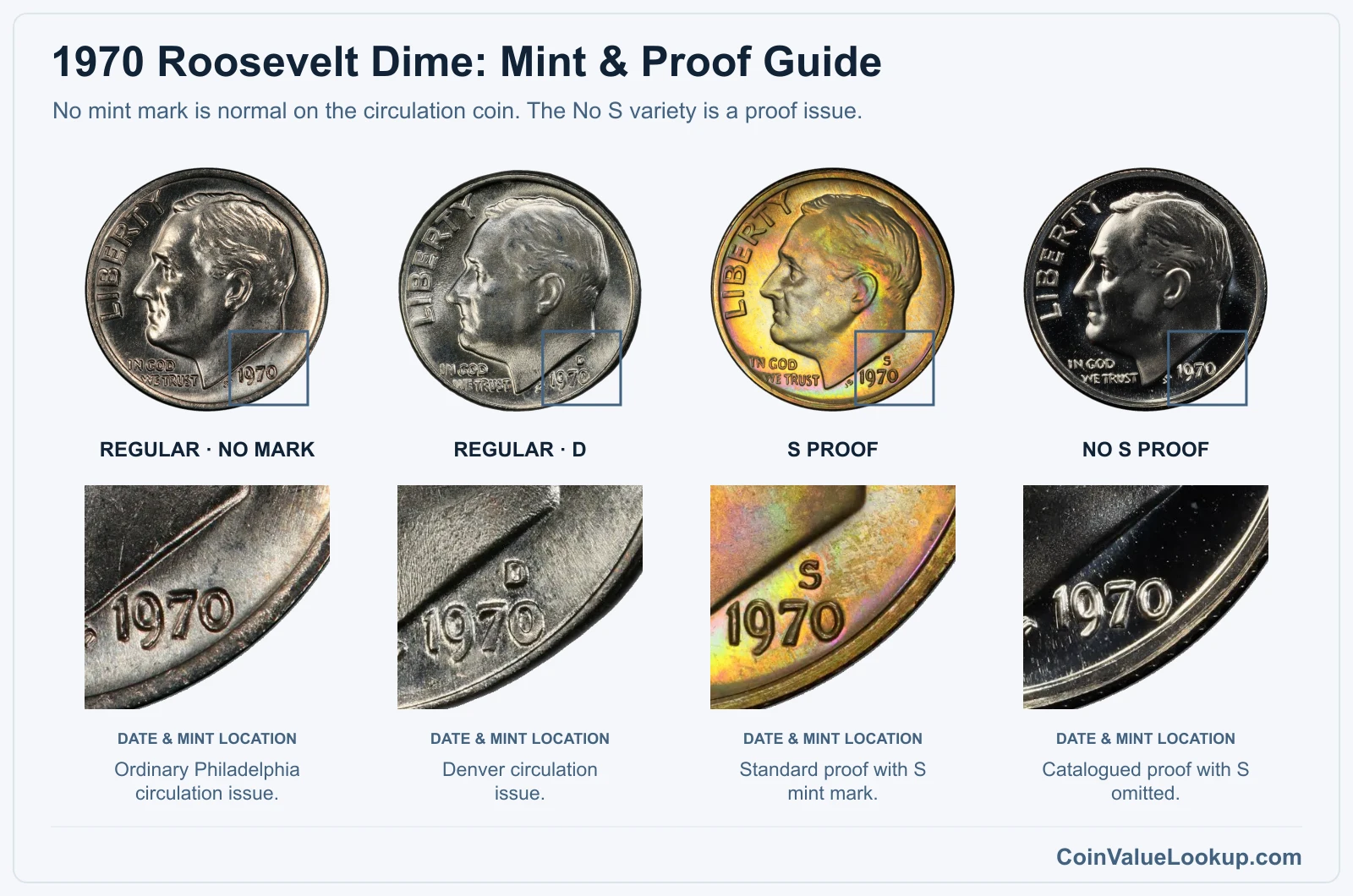
Mintmarks sit on the obverse near the date. No mintmark means a regular Philadelphia business strike.
A "D" means Denver. An "S" means San Francisco proof.
Here is the critical distinction: a 1970 dime with no mintmark from your pocket change is almost certainly a normal Philadelphia coin. The famous 1970 No S proof is a proof-finish coin that was struck at San Francisco but is missing its S mintmark.
These are completely different animals. If your coin doesn't have mirror-like proof surfaces, it is not the No S variety — period.
A polished circulation dime cannot become a proof no matter how shiny you make it.
Step 2: Check Your 1970 Roosevelt Dime Grade
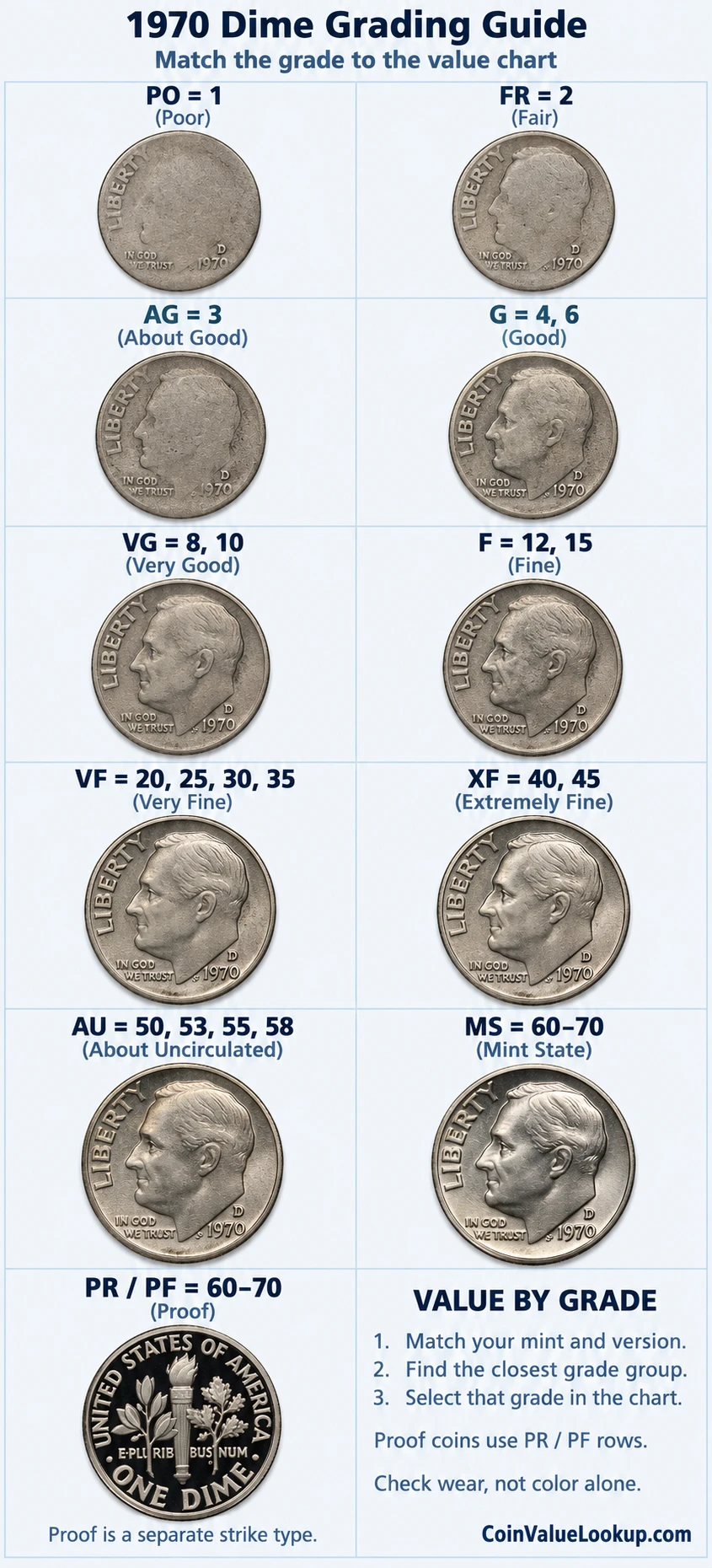
Check Roosevelt's cheekbone and jawline first — these are the highest points and show wear earliest. Then look at the hair detail above the ear and the horizontal bands on the torch.
On a well-struck uncirculated coin, both pairs of horizontal torch bands are fully separated.
Luster matters. A coin can have sharp detail but dull, washed-out surfaces from cleaning or environmental damage, and that will hurt its grade.
Scratches, corrosion and wiping all count against the coin.
Remember that "proof" describes how a coin was made — with specially prepared dies and polished planchets — not a grade above Mint State. A proof can still be damaged or impaired, so assess proof surfaces on their own terms.
Use the comparison image on this page to gauge where your coin's wear level falls relative to known grade examples.
Step 3: Check 1970 Roosevelt Dime Value by Mint and Version
1970 Roosevelt Dime — No Mintmark Business Strike
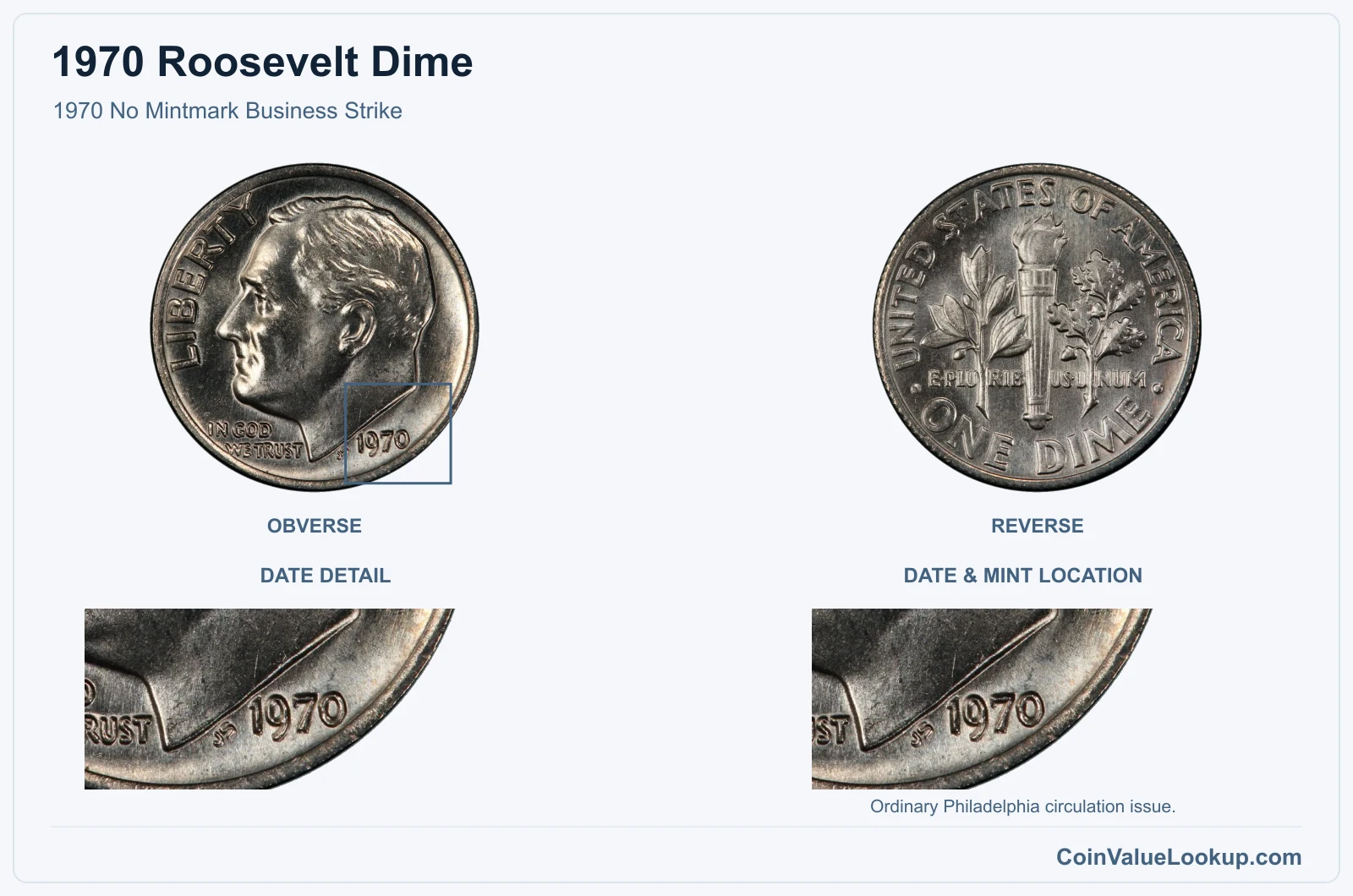
The 1970 no-mintmark Roosevelt dime was struck at Philadelphia on copper-nickel clad planchets. Hundreds of millions entered circulation, so finding one in worn condition is easy and worth face value.
In MS 65, a guide estimate is about $2.50.
Look for no mintmark on the obverse near the date. A coin with strong, fully separated horizontal torch bands on the reverse may qualify for a Full Bands designation, which can carry a premium above a standard uncirculated grade.
Don't confuse this common business strike with the rare No S proof — if your coin lacks mirror-like proof surfaces, it's the regular Philadelphia issue.
Range Grade
Price Auction Records Appraisal PO PO 1
—
Coin Identifier FR FR 2
—
Coin Identifier AG AG 3
—
Coin Identifier G G 4
—
Coin Identifier
G 6
—
Coin Identifier VG VG 8
—
Coin Identifier
VG 10
—
Coin Identifier F F 12
—
Coin Identifier
F 15
—
Coin Identifier VF VF 20
—
Coin Identifier
VF 25
—
Coin Identifier
VF 30
—
Coin Identifier
VF 35
—
Coin Identifier XF XF 40
—
Coin Identifier
XF 45
—
Coin Identifier AU AU 50
—
Coin Identifier
AU 53
—
Coin Identifier
AU 55
—
Coin Identifier
AU 58
—
Coin Identifier MS MS 60
—
Coin Identifier
MS 61
—
Coin Identifier
MS 62
—
Coin Identifier
MS 63
—
Coin Identifier
MS 64
Coin Identifier
MS 65
—
Coin Identifier
MS 66
Coin Identifier
MS 67
—
Coin Identifier
MS 68
—
—
—
MS 69
—
—
—
MS 70
—
—
—
1970 Roosevelt Dime — D Business Strike
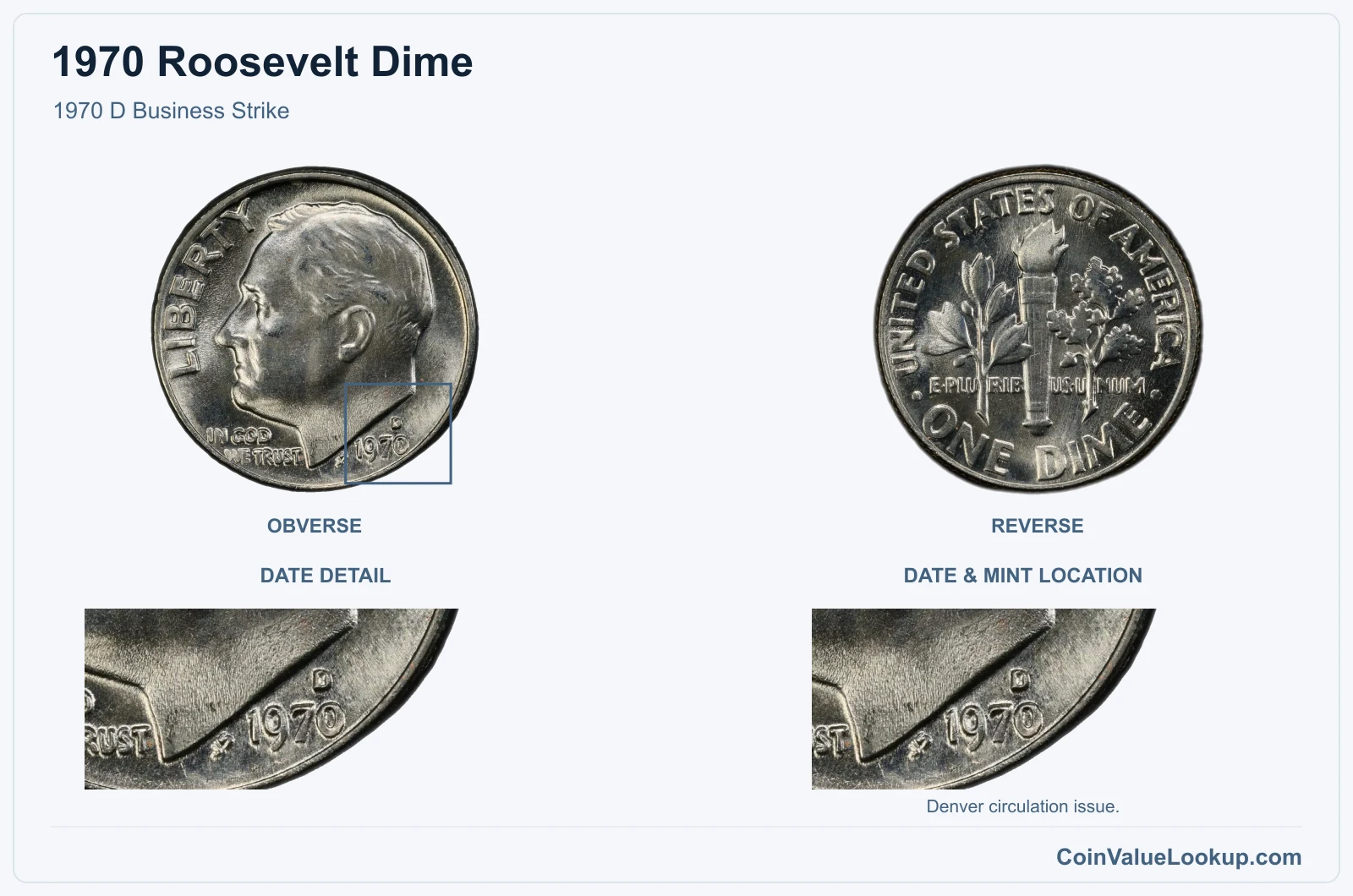
Denver's 1970-D dime carries a small "D" mintmark on the obverse near the date. Same copper-nickel clad composition, same 2.27-gram weight.
In circulated grades, it's a face-value coin.
A guide estimate places the MS 65 value around $2.50. As with the Philadelphia issue, coins displaying fully separated horizontal torch bands may earn a Full Bands premium.
Check the mintmark carefully under magnification — a worn or filled D can look like no mintmark at first glance, and that distinction matters when evaluating variety claims.
Range Grade
Price Auction Records Appraisal PO PO 1
—
Coin Identifier FR FR 2
—
Coin Identifier AG AG 3
—
Coin Identifier G G 4
—
Coin Identifier
G 6
—
Coin Identifier VG VG 8
—
Coin Identifier
VG 10
—
Coin Identifier F F 12
—
Coin Identifier
F 15
—
Coin Identifier VF VF 20
—
Coin Identifier
VF 25
—
Coin Identifier
VF 30
—
Coin Identifier
VF 35
—
Coin Identifier XF XF 40
—
Coin Identifier
XF 45
—
Coin Identifier AU AU 50
—
Coin Identifier
AU 53
—
Coin Identifier
AU 55
—
Coin Identifier
AU 58
—
Coin Identifier MS MS 60
—
Coin Identifier
MS 61
—
Coin Identifier
MS 62
—
Coin Identifier
MS 63
Coin Identifier
MS 64
Coin Identifier
MS 65
Coin Identifier
MS 66
Coin Identifier
MS 67
Coin Identifier
MS 68
—
—
—
MS 69
—
—
—
MS 70
—
—
—
1970 Roosevelt Dime — S Proof
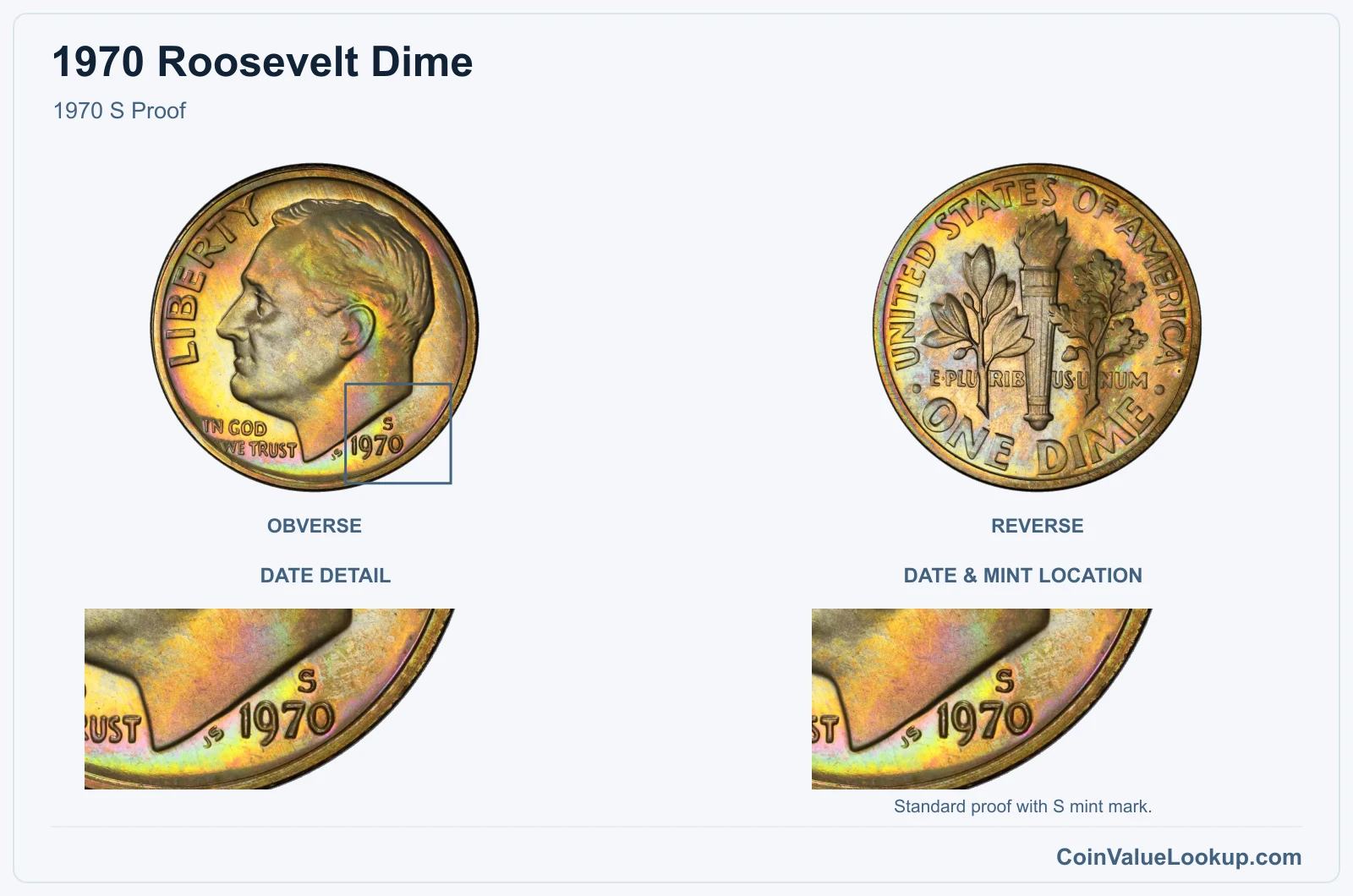
The 1970 S proof was struck at San Francisco with polished planchets and specially prepared dies, producing sharp mirrored fields. The "S" mintmark appears on the obverse near the date.
A guide estimate for PR 65 is about $2.50.
Coin Value Lookup is a good starting point if you want to compare your proof's details against other Roosevelt dime years and mints. Proofs with strong cameo contrast — frosted raised devices against deeply reflective fields — can be worth more than a standard proof, but that contrast needs to be genuine and consistent across both sides of the coin.
Range Grade
Price Auction Records Appraisal PR PR 1
—
Coin Identifier
PR 2
—
Coin Identifier
PR 3
—
Coin Identifier
PR 4
—
Coin Identifier
PR 6
—
Coin Identifier
PR 8
—
Coin Identifier
PR 10
—
Coin Identifier
PR 12
—
Coin Identifier
PR 15
—
Coin Identifier
PR 20
—
Coin Identifier
PR 25
—
Coin Identifier
PR 30
—
Coin Identifier
PR 35
—
Coin Identifier
PR 40
—
Coin Identifier
PR 45
—
Coin Identifier
PR 50
—
Coin Identifier
PR 53
—
Coin Identifier
PR 55
—
Coin Identifier
PR 58
—
Coin Identifier
PR 60
—
Coin Identifier
PR 61
—
Coin Identifier
PR 62
—
Coin Identifier
PR 63
—
Coin Identifier
PR 64
—
Coin Identifier
PR 65
—
Coin Identifier
PR 66
—
Coin Identifier
PR 67
Coin Identifier
PR 68
Coin Identifier
PR 69
—
Coin Identifier
PR 70
—
—
—
1970 Roosevelt Dime — No S Proof
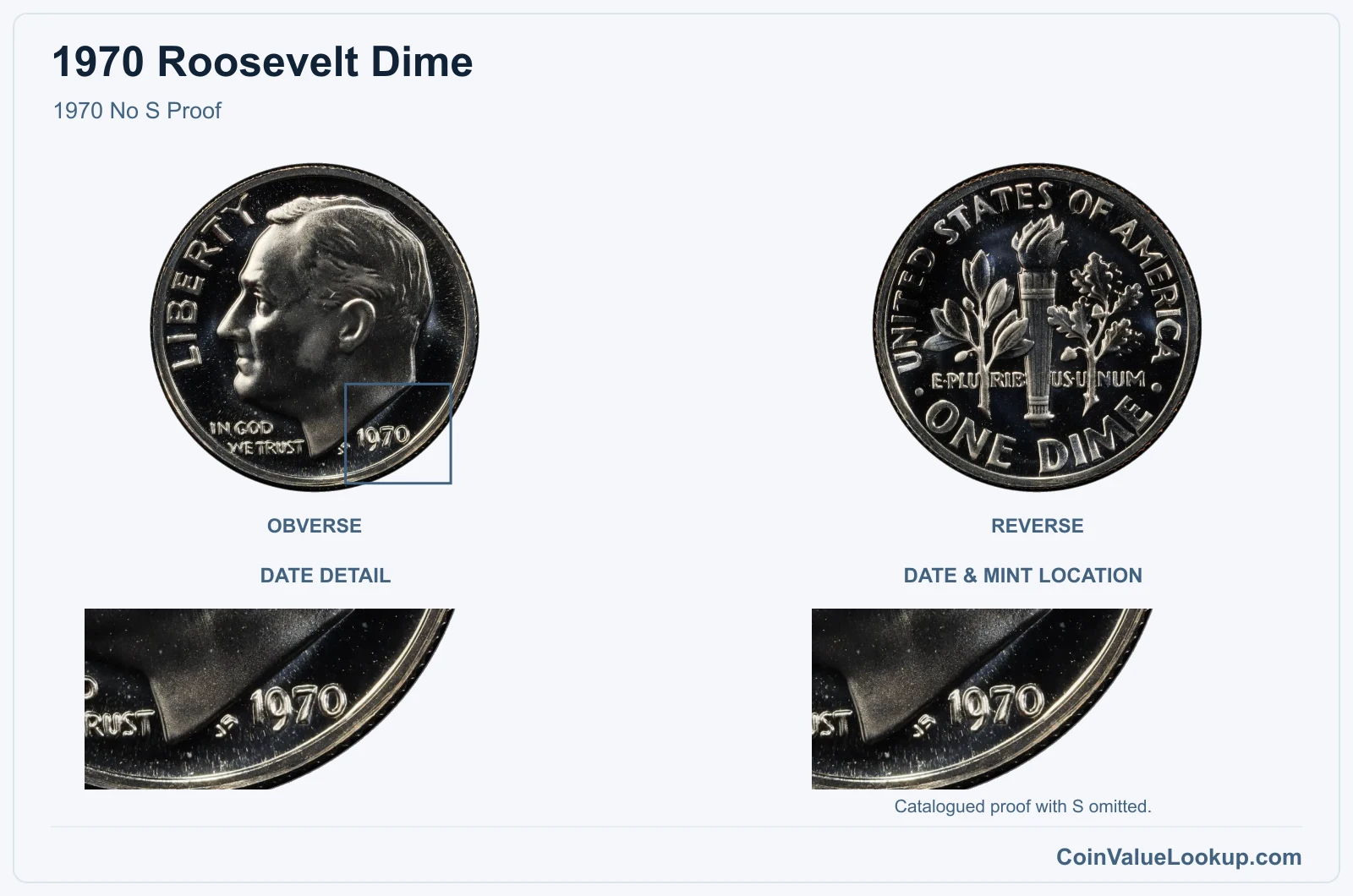
This is the famous one. The 1970 No S proof dime was struck at San Francisco using proof dies, but the S mintmark was left off the obverse die.
It's a legitimate Mint error recognized by major grading services.
To be clear: this coin must show proof characteristics — mirrored fields, sharp squared-off rims, frosted devices. If your dime just happens to lack a mintmark and was pulled from circulation, it's a Philadelphia business strike, not this variety.
The two are not remotely the same thing.
No reliable numeric price range is available in this guide for the No S proof. Value depends heavily on authenticated identity, condition and the specific surfaces of the individual coin.
Professional authentication is not optional here — it's the entire ballgame.
Range Grade
Price Auction Records Appraisal PR PR 1
—
Coin Identifier
PR 2
—
Coin Identifier
PR 3
—
Coin Identifier
PR 4
—
Coin Identifier
PR 6
—
Coin Identifier
PR 8
—
Coin Identifier
PR 10
—
Coin Identifier
PR 12
—
Coin Identifier
PR 15
—
Coin Identifier
PR 20
—
Coin Identifier
PR 25
—
Coin Identifier
PR 30
—
Coin Identifier
PR 35
—
Coin Identifier
PR 40
—
Coin Identifier
PR 45
—
Coin Identifier
PR 50
—
Coin Identifier
PR 53
—
Coin Identifier
PR 55
—
Coin Identifier
PR 58
—
Coin Identifier
PR 60
—
Coin Identifier
PR 61
—
Coin Identifier
PR 62
—
Coin Identifier
PR 63
—
Coin Identifier
PR 64
—
Coin Identifier
PR 65
Coin Identifier
PR 66
Coin Identifier
PR 67
Coin Identifier
PR 68
Coin Identifier
PR 69
Coin Identifier
PR 70
—
—
—
1970 Roosevelt Dime Error List
1. 1970 Roosevelt Dime — No S Proof
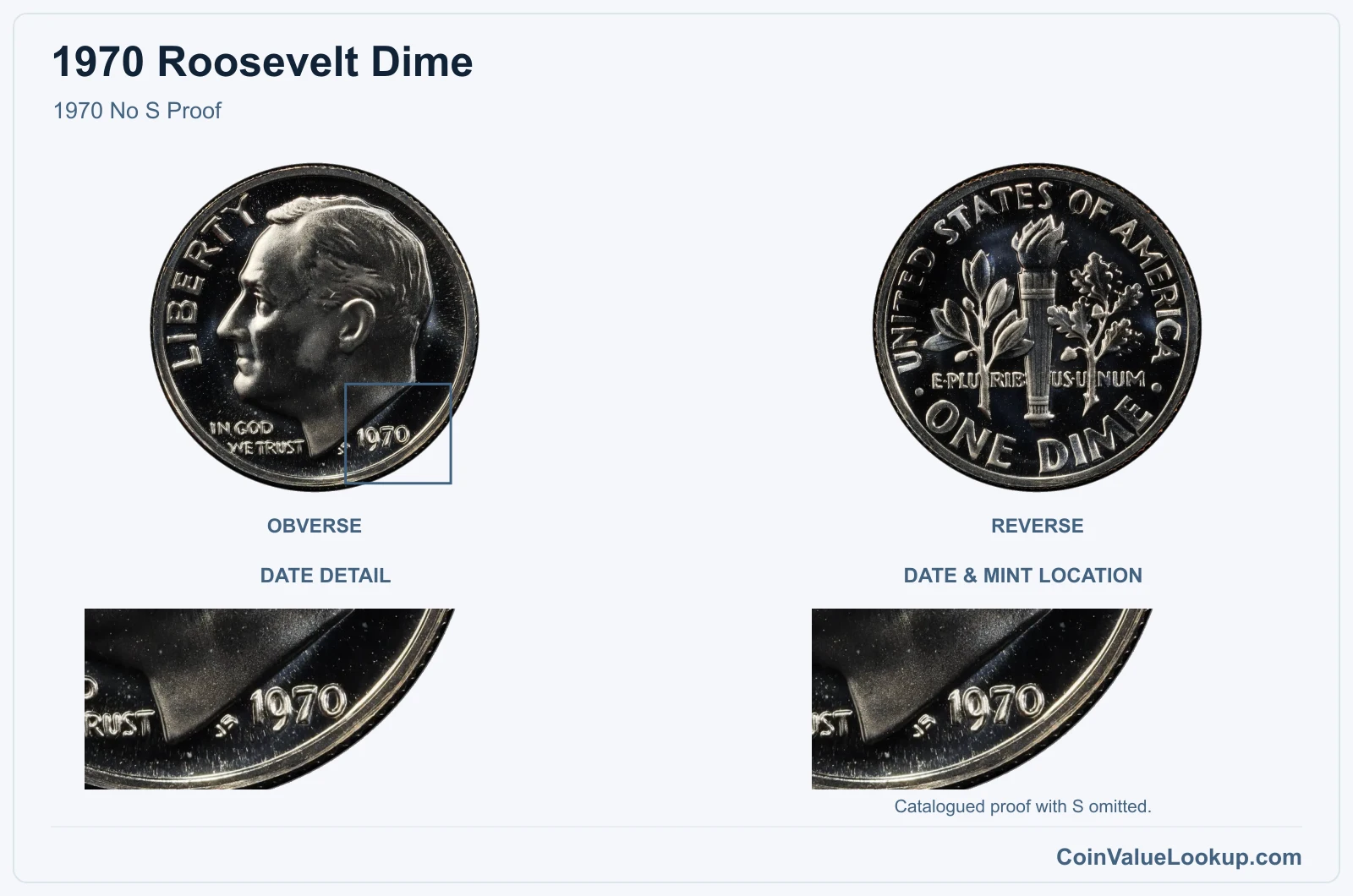
The 1970 No S proof dime is a San Francisco proof struck from a die that was never punched with the S mintmark. The first thing to confirm is proof manufacture: look for deeply mirrored fields, crisp squared rims and frosted design elements.
Then verify the mintmark position on the obverse near the date is genuinely blank.
The most common lookalike is an ordinary Philadelphia business strike, which also has no mintmark. A polished or cleaned circulation dime cannot become a proof.
If the fields look satiny or show any cartwheel luster instead of deep mirror reflection, it's a regular no-mintmark coin.
No supported numeric price range is adopted here. Value depends on authenticated identity, surface quality and overall condition.
Professional third-party authentication is essential before assigning any premium.
2. 1970 Roosevelt Dime — Straight Clipped Planchet
A 1970-D dime with a straight clipped planchet shows a straight-edge metal deficit caused when the blanking press cut into an area already punched. On the documented specimen, roughly 35 percent of the planchet is missing, and the coin weighed only about 1.5 grams instead of the normal 2.27 grams.
Look for the original straight blanking edge — it should be smooth and consistent, not jagged or rough from a saw or file. The date and enough design must remain for attribution.
The cited example was noted as cleaned, which is separate post-mint impairment that affects its desirability.
No supported price range is available. Value depends on the size of the clip, whether the date is readable, the coin's authenticated identity and overall condition.
3. 1970 Roosevelt Dime — Struck on Foreign Aluminum Planchet
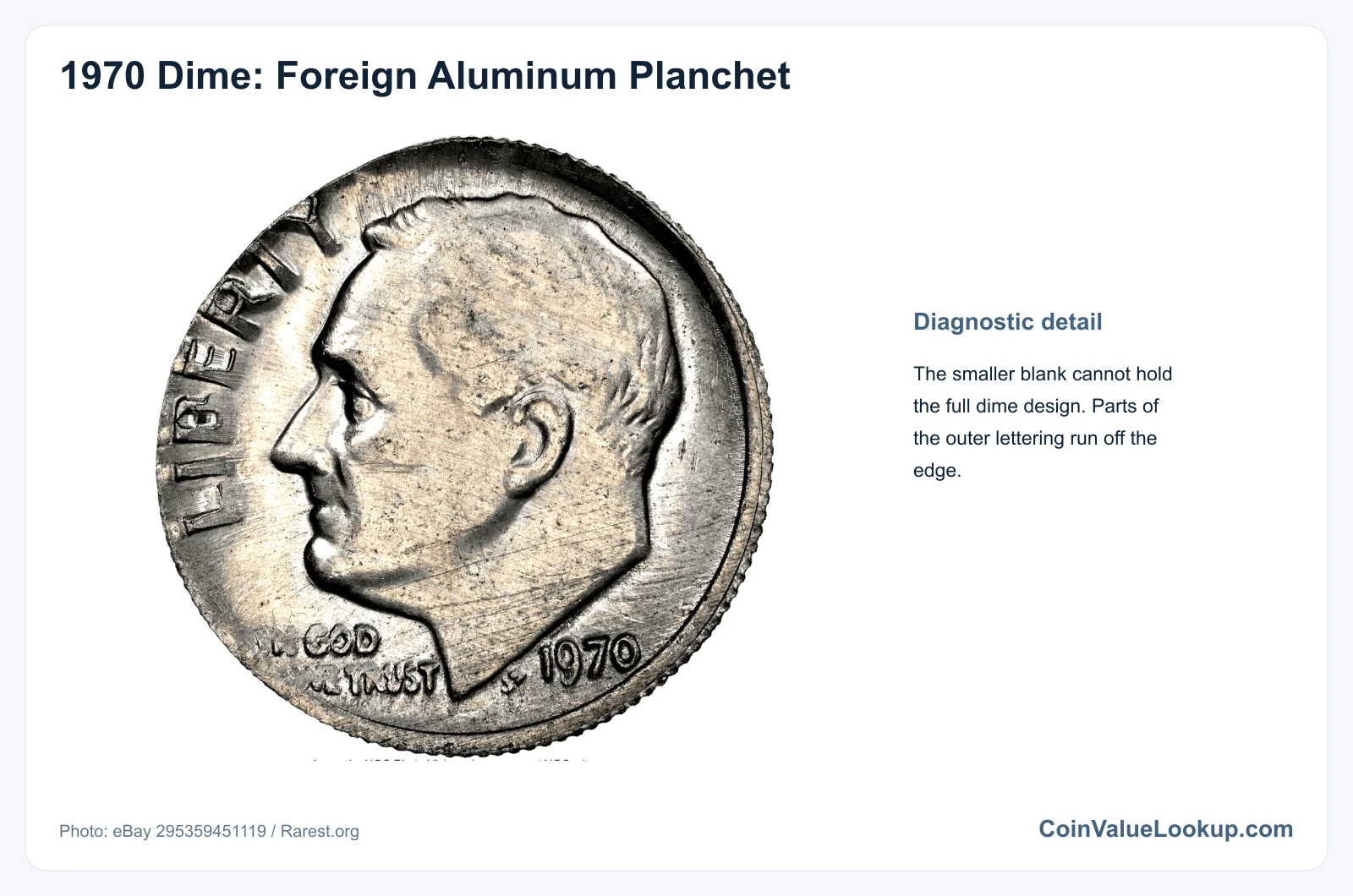
One authenticated 1970 no-mintmark dime was struck on a Philippines 1-sen aluminum blank, producing a coin weighing only about 0.5 grams — dramatically lighter than the normal 2.27 grams. That specific NGC MS 62 specimen sold for $1,740 in October 2022 at auction.
Identification requires more than color. You need to establish the weight, diameter and alloy through professional attribution.
A chemically thinned dime, a plated dime or a foreign coin that doesn't carry the Roosevelt design are all common lookalikes. The sale noted above is an individual result for one authenticated specimen, not a market range applicable to every off-metal claim.
If your dime feels unusually light, weigh it on a precise scale and compare against both the normal 2.27-gram spec and the 0.5-gram figure before seeking professional evaluation.
4. 1970 Roosevelt Dime — Doubled Die Reverse
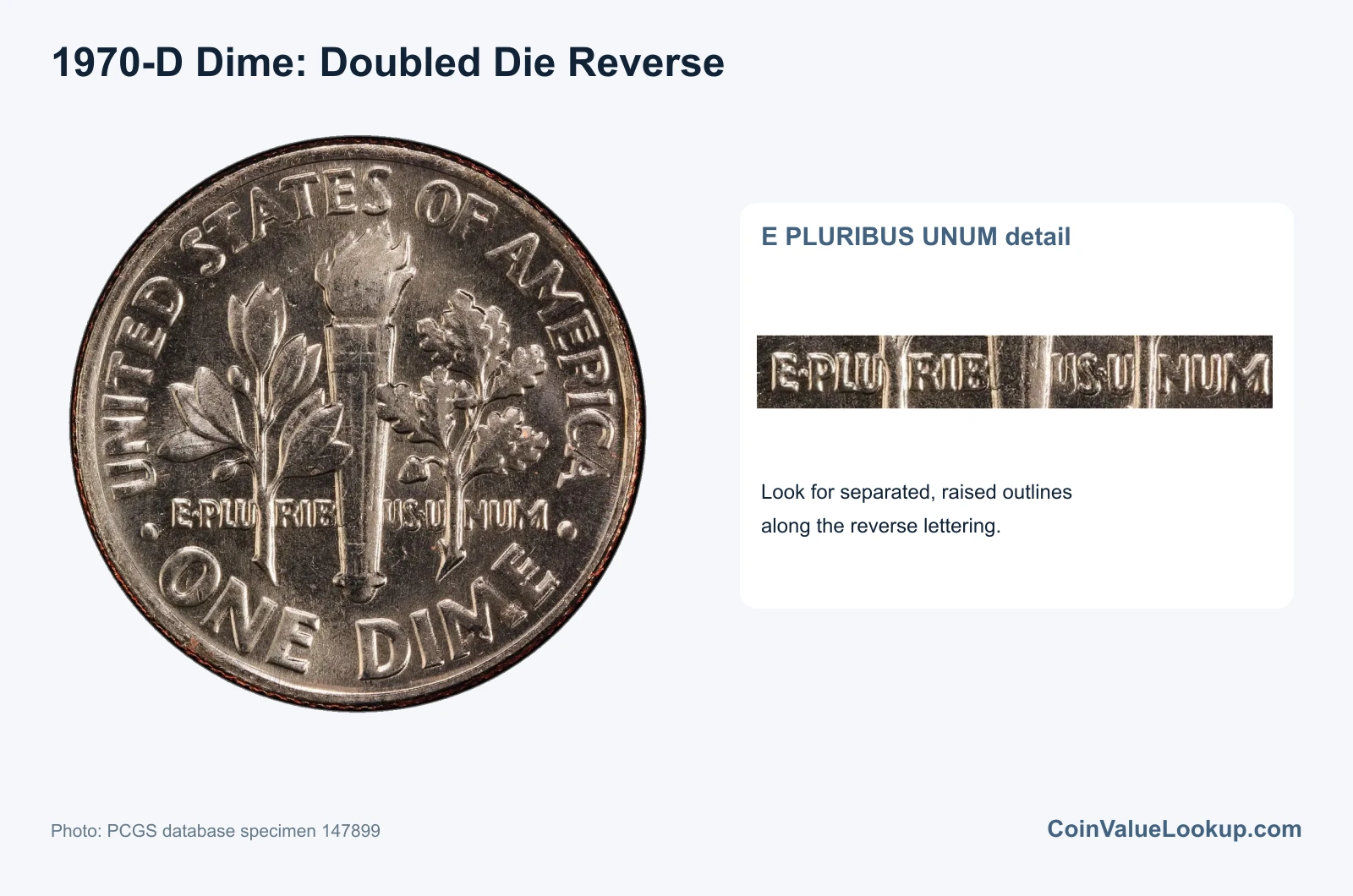
A 1970 no-mintmark doubled die reverse has been reported, where elements of the reverse design — lettering, torch or branch details — show true hub doubling from the die-making process. To check, compare your coin's reverse closely against a normal 1970 dime under magnification, looking for a secondary offset image on design contours or lettering.
Don't confuse this with machine doubling, which produces flat, shelf-like distortion rather than the rounded secondary impression of a genuine doubled die. Reflections and random contact marks can also mimic doubling to the untrained eye.
No numerical price range is adopted here. The value of any doubled die depends on how visible the doubling is, the specific die involved and the coin's overall condition.
Professional attribution helps confirm the variety.
5. 1970 Roosevelt Dime — Off-Center Strike
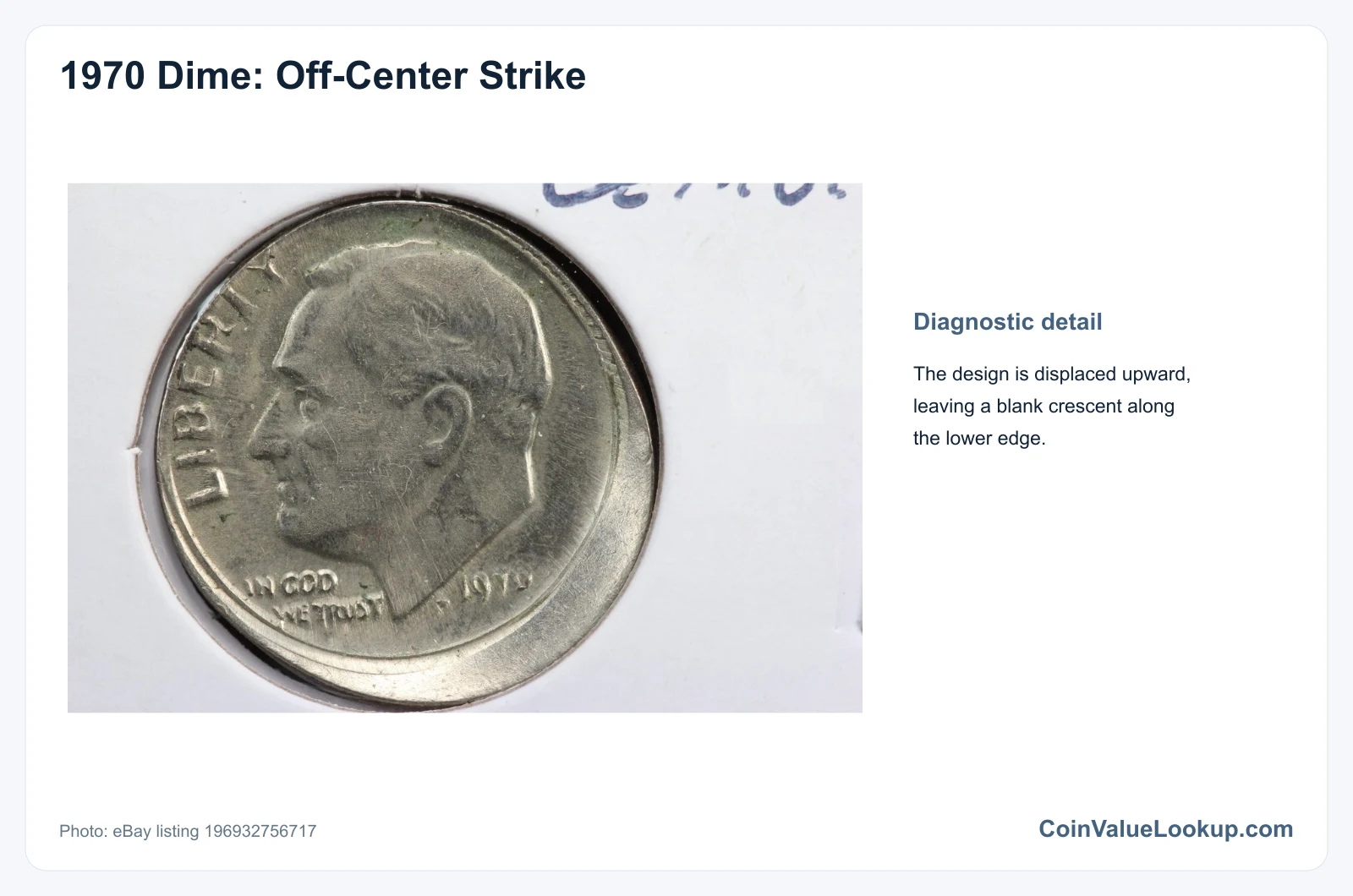
An off-center strike occurs when the planchet is not properly seated between the dies during striking, producing a displaced design with an unstruck crescent of blank metal along one edge. On 1970 dimes, this error has been reported as a known category.
The key to value is keeping the date visible — an off-center coin without a readable date is much harder to attribute and less desirable. The percentage of off-center displacement also matters; a 5% shift looks very different from a 50% shift.
Watch for lookalikes: a clipped planchet removes metal but keeps the design centered, and post-mint flattening can distort a coin's shape without the telltale unstruck crescent. No specific price range is available; value depends on condition, the degree of displacement and whether the date remains legible.
6. 1970 Roosevelt Dime — Broadstrike
A broadstrike happens when a coin is struck without the retaining collar that normally constrains the planchet, allowing metal to spread outward beyond the standard diameter. The result is a coin that's wider and thinner than normal, with a full design but no reeded edge — or a distorted, spread-out edge profile.
On a 1970 dime, look for the design spreading to the very rim or beyond, with the entire obverse and reverse still present. The edge will feel smooth or irregular instead of showing normal reeding.
Don't mistake a coin flattened after minting — by a train, a hammer, or other post-strike abuse — for a genuine broadstrike. Post-mint damage usually shows uneven distortion and surface scarring.
No numerical price range is adopted; value depends on the degree of spread, overall condition and professional authentication.