1965 Jefferson Nickel Coin Value: How Much Is It Worth?
Most 1965 Jefferson nickels you find in pocket change are worth face value — five cents, no more. Guide estimates for uncirculated examples start around $0.30 at MS60 and climb to about $12 at MS65, according to USA Coin Book.
Special Mint Set pieces run roughly $10 at SP65. The real action is in errors and exceptional condition, which we will break down below.
Fast Way to Identify Your 1965 Jefferson Nickel
Want a quick read on your 1965 nickel? Upload clear photos of the front and back, and our identifier can give you a preliminary identification of what you have — version, finish type, and any visible oddities.
It is not a substitute for professional authentication, but it is a solid starting point.
1965 Jefferson Nickel Value
Upload both sides of your 1965 Jefferson Nickel.
Front Obverse
Upload photo
Back Reverse
Upload photo
Which 1965 Jefferson Nickel Versions Are Worth Money?
- SMS coins with cameo contrast (frosted devices against mirrored fields) carry a premium over standard SMS finishes — a PCGS guide lists SP65 Cameo at $18 versus $10 for non-cameo SP65.
- Business strikes grading MS65 or higher are uncommon enough from circulation-era production to reach about $12 at MS65 per USA Coin Book.
- Wrong-planchet errors, such as a nickel struck on a cent blank or a silver dime blank, are scarce and individually assessed — one cent-planchet example sold for $805 at Heritage Auctions.
- Dramatic striking errors like foldovers can reach four figures; a Heritage-sold NGC MS64 foldover brought $4,312.50.
- Double strikes with visible displacement are collected as major mint errors; a PCGS MS65 example sold for $432 at Heritage in 2021.
Step 1: Identify Your 1965 Jefferson Nickel Mint Mark and Version
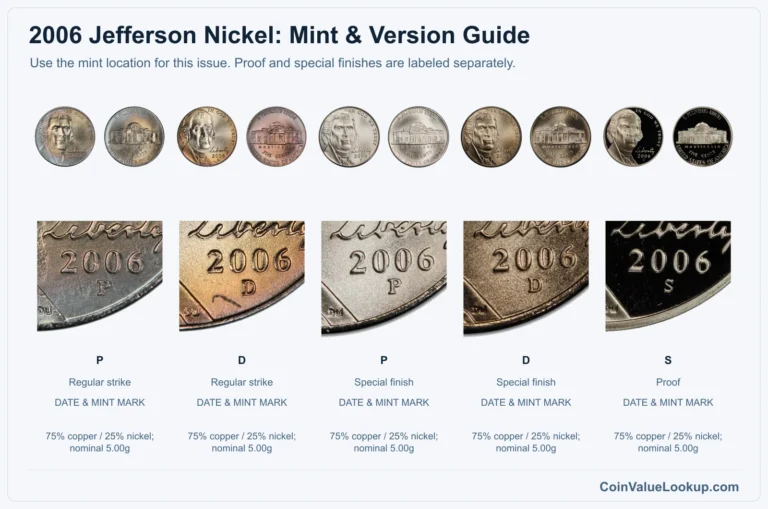
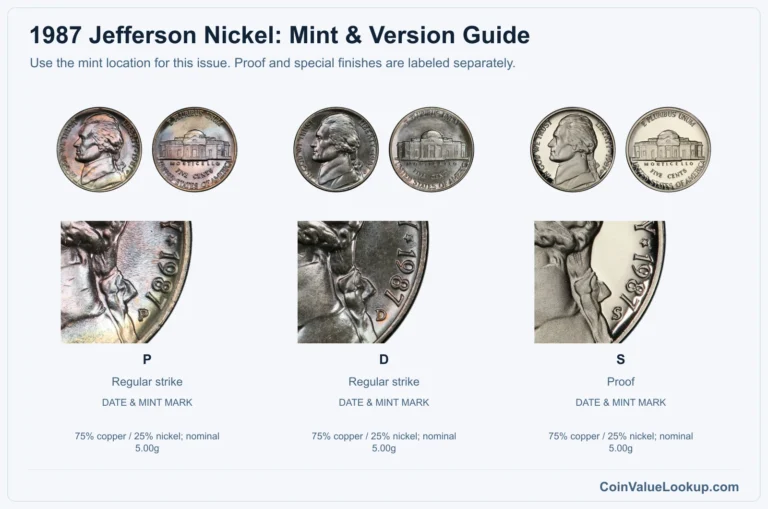
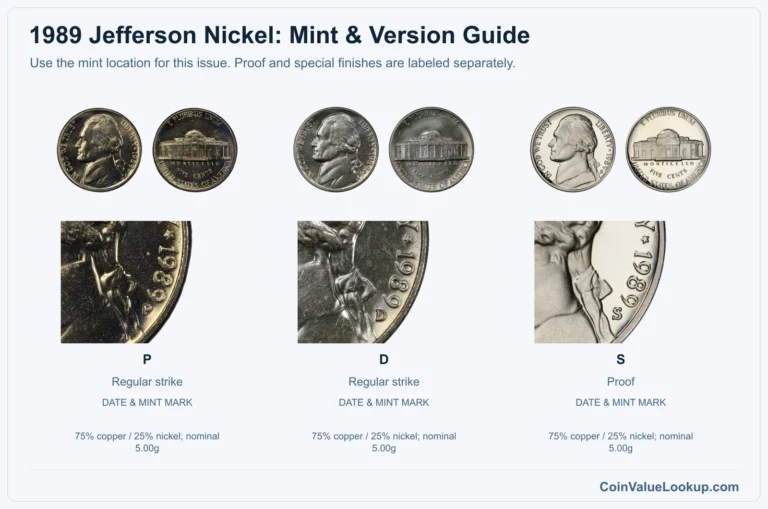
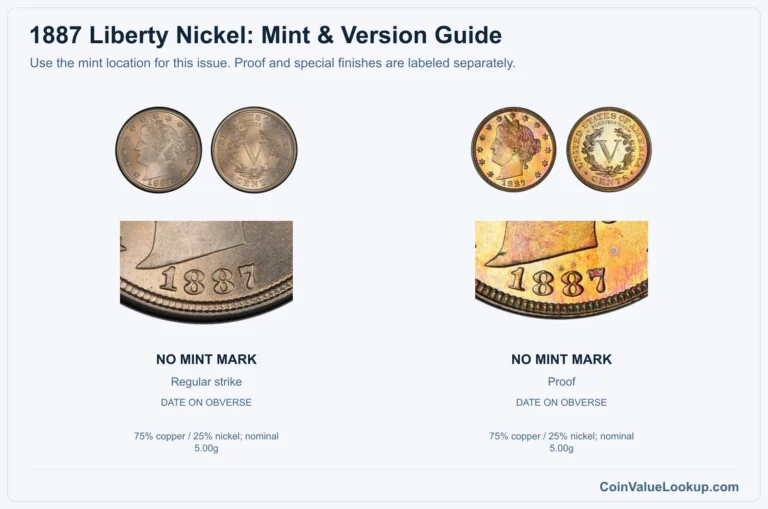
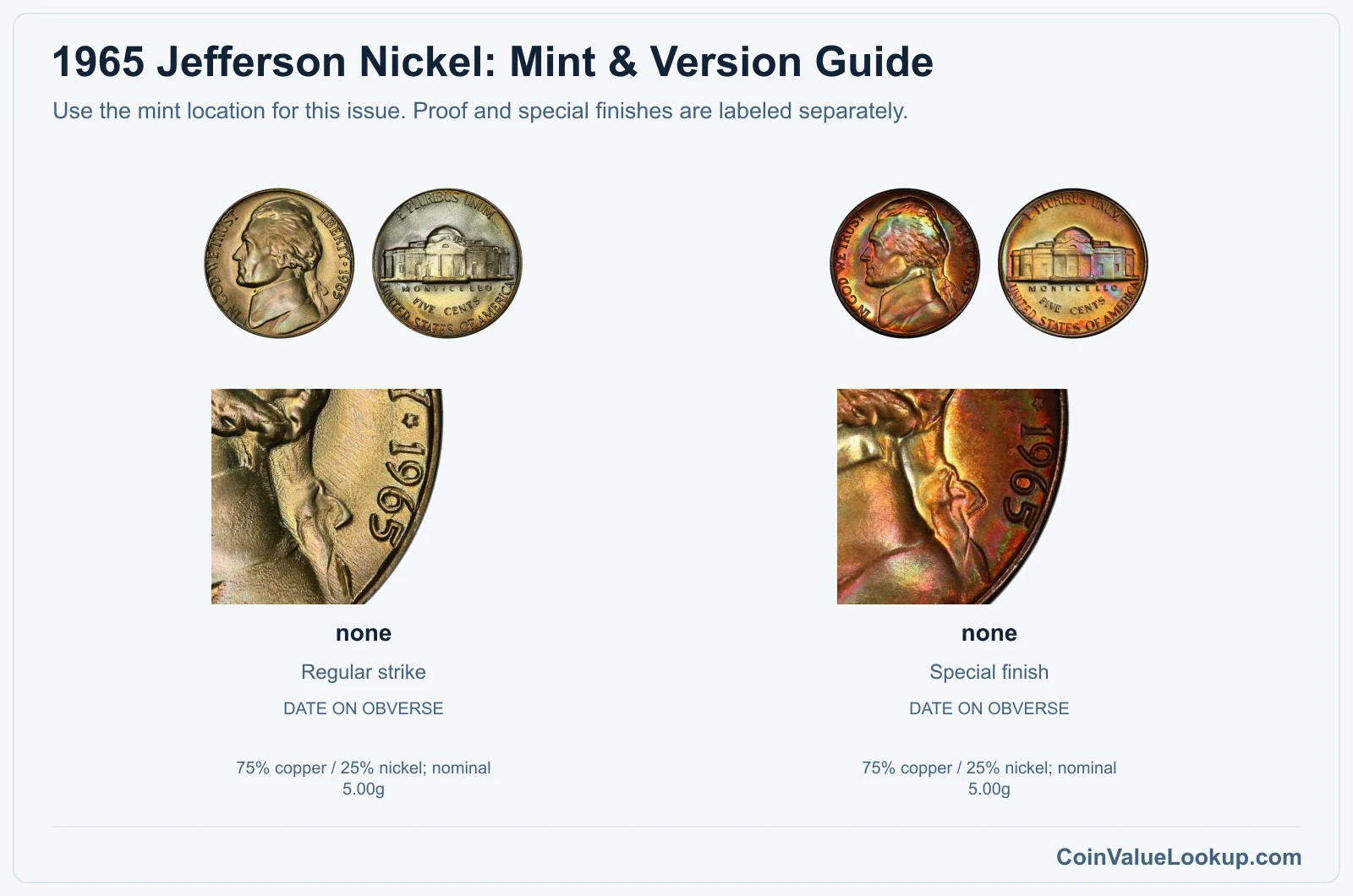
No 1965 nickel carries a mintmark. That is not an error — the U.S. Mint deliberately removed mintmarks from all circulating coins dated 1965 through 1967.
If someone tells you a missing mintmark adds value, they are mistaken.
There are two main categories: regular business-strike circulation coins and Special Mint Set (SMS) coins. SMS pieces were sold in special government sets as replacements for the usual Mint Sets and Proof Sets, which were not produced those years.
An SMS coin has a distinctive finish — sharper details and sometimes a satin or lightly mirrored surface — but shine alone does not make a coin SMS. Proper attribution matters before you assign any premium.
The alloy is standard 75% copper, 25% nickel, weighing a nominal 5.00 grams with a plain edge. This is not a wartime silver nickel; those ended in 1945.
The design is the familiar Jefferson portrait on the obverse and Monticello on the reverse.
Step 2: Check Your 1965 Jefferson Nickel Grade
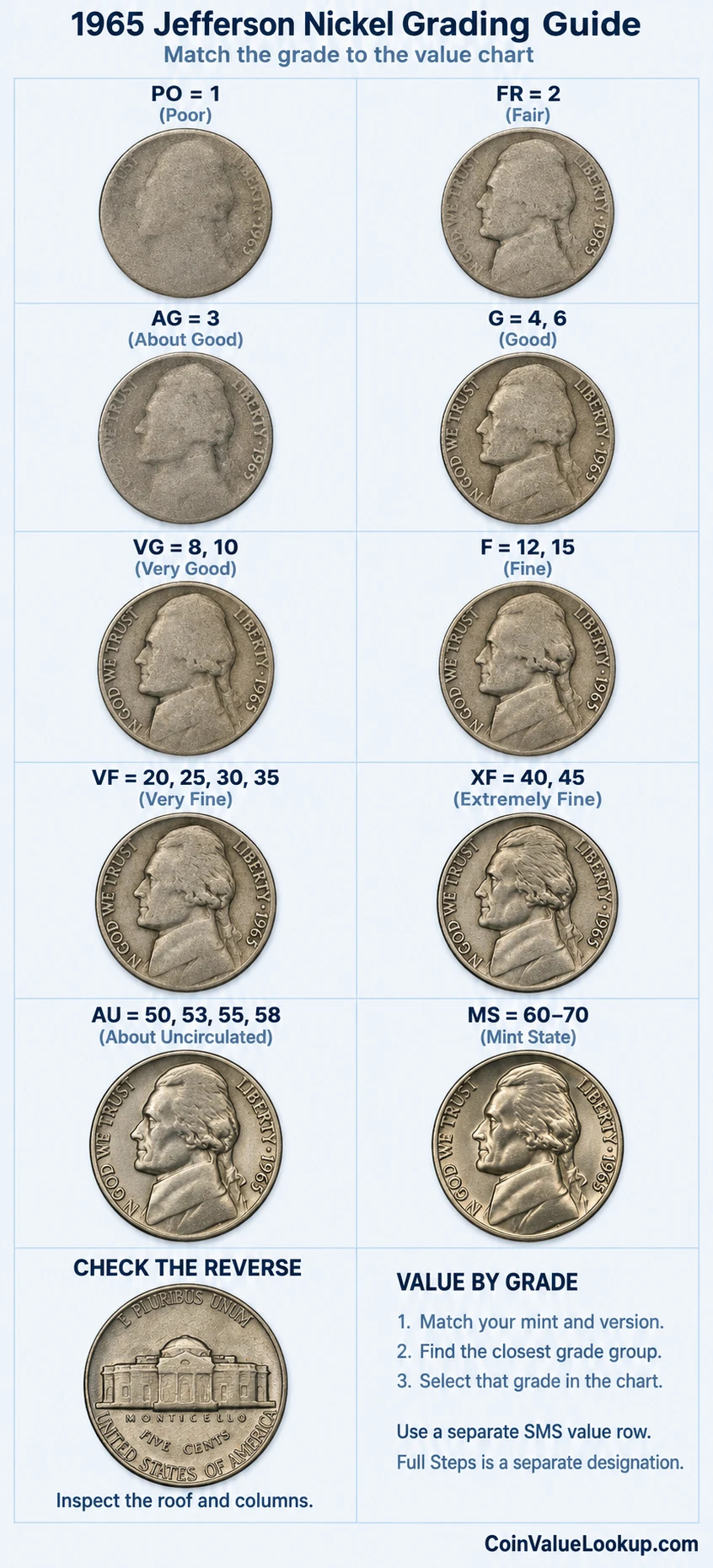
Start with Jefferson's cheek and hair. On an unworn coin these areas show full original texture and luster.
As a nickel circulates, the cheekbone flattens first, then the hair detail above the ear softens.
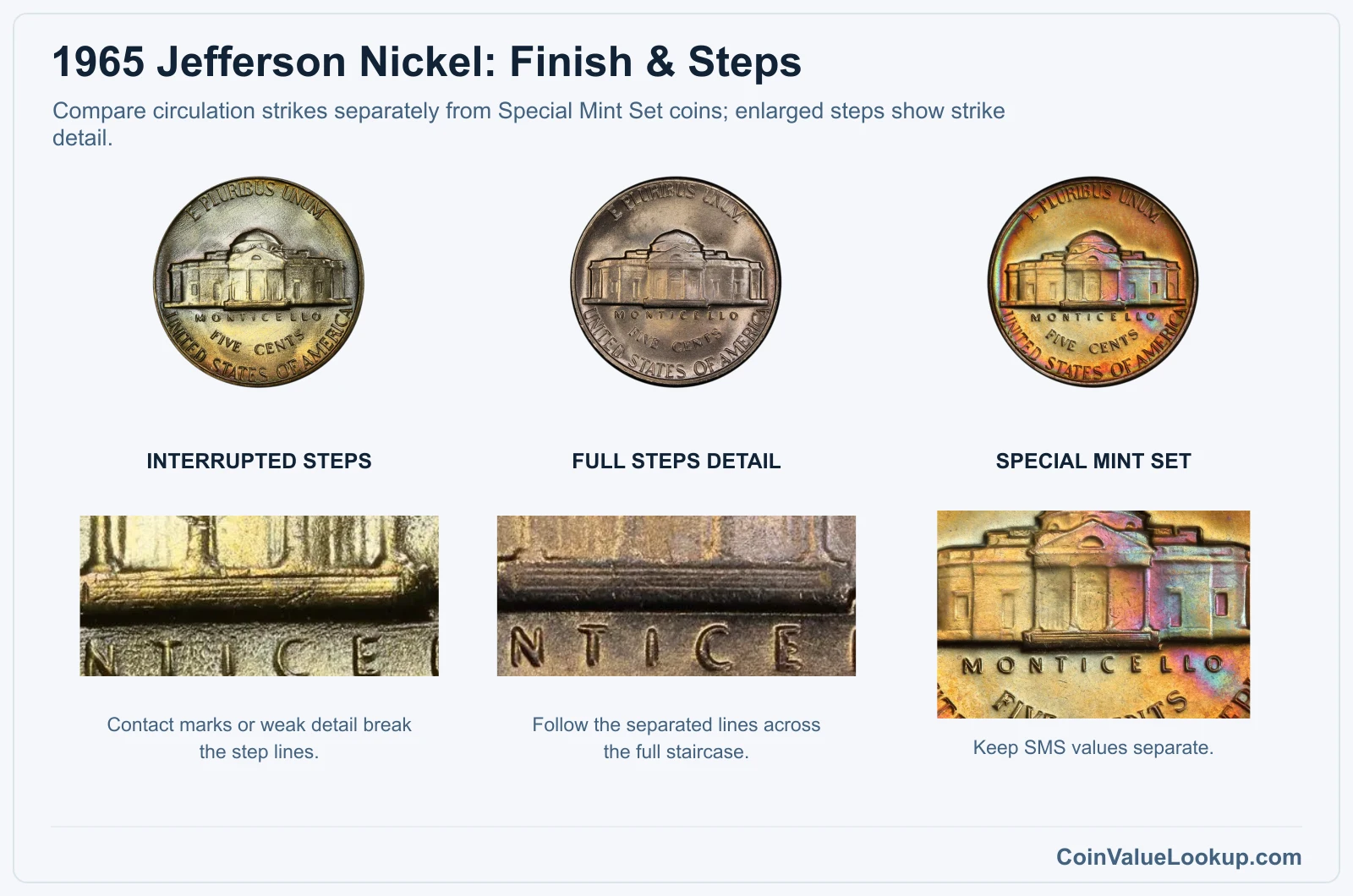
Flip it over. Monticello's steps and pillars are the next wear checkpoints.
A coin with visible steps is not automatically a high-grade or Full Steps coin — Full Steps is a strike-quality designation applied to certified mint-state pieces, not a grade you can assign at home to a worn nickel.
Compare your coin to the grading image nearby. Look at overall luster, not just brightness; a shiny but scratched coin grades lower than a slightly toned coin with original undisturbed surfaces.
Step 3: Check 1965 Jefferson Nickel Value by Mint and Version
1965 Jefferson Nickel — No Mint Mark — Circulation Strike
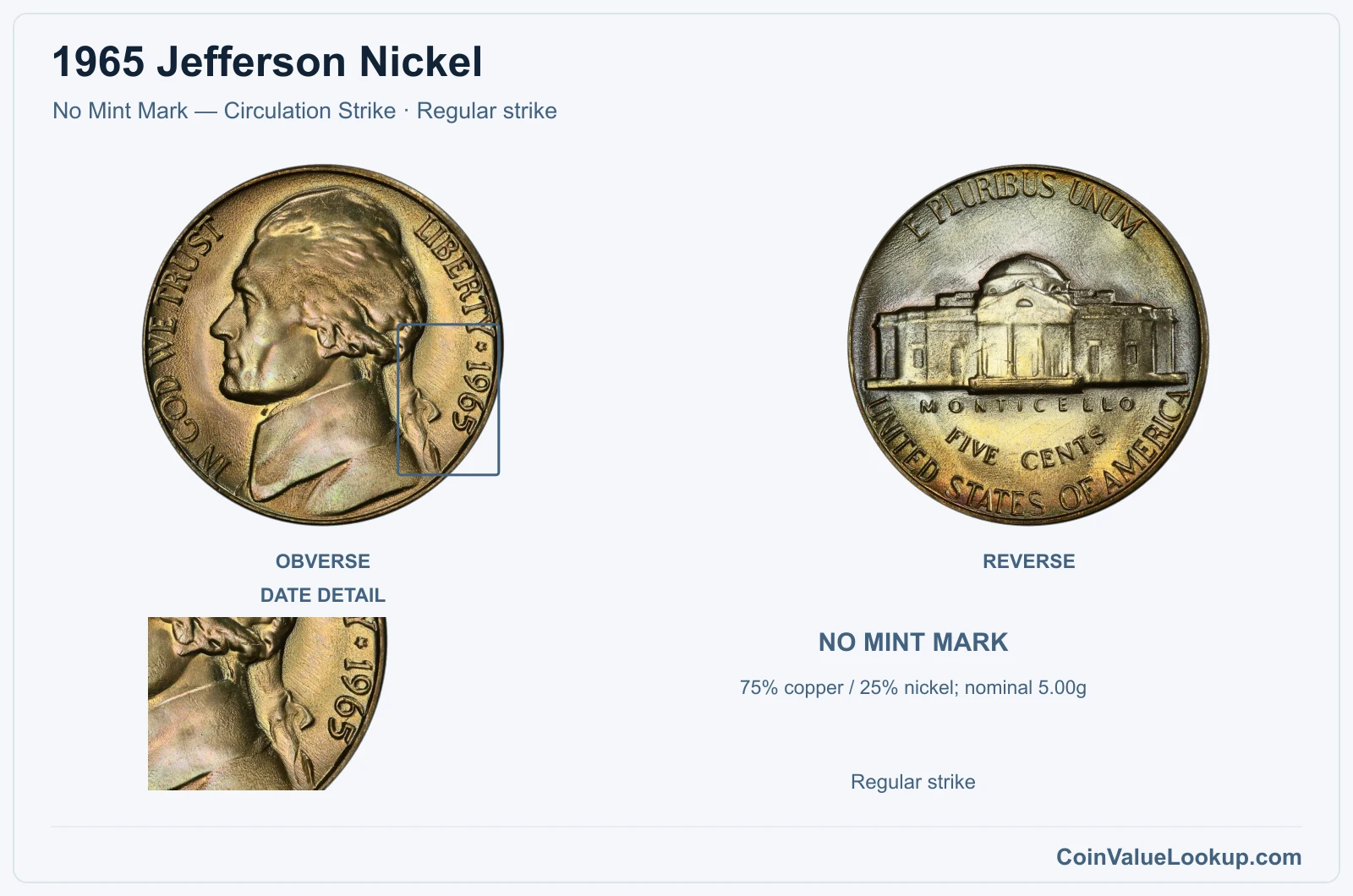
This is the coin you almost certainly have. Struck for circulation with no mintmark, it is the standard 75% copper / 25% nickel composition at 5.00 grams.
Billions were made.
In worn condition it spends for five cents. Uncirculated pieces start around $0.30 at MS60 per USA Coin Book, and a clean MS65 example is estimated at about $12.
Those guide figures assume original surfaces, not a cleaned coin that merely looks shiny. Realistically, finding one worth grading from a jar of change is a long shot, but checking Monticello's steps and Jefferson's hair is always worth a few seconds.
Range Grade
Price Auction Records Appraisal PO PO 1
—
Coin Identifier FR FR 2
—
Coin Identifier AG AG 3
—
Coin Identifier G G 4
—
Coin Identifier
G 6
—
Coin Identifier VG VG 8
—
Coin Identifier
VG 10
—
Coin Identifier F F 12
—
Coin Identifier
F 15
—
Coin Identifier VF VF 20
—
Coin Identifier
VF 25
—
Coin Identifier
VF 30
—
Coin Identifier
VF 35
—
Coin Identifier XF XF 40
—
Coin Identifier
XF 45
—
Coin Identifier AU AU 50
—
Coin Identifier
AU 53
—
Coin Identifier
AU 55
—
Coin Identifier
AU 58
—
Coin Identifier MS MS 60
—
Coin Identifier
MS 61
—
Coin Identifier
MS 62
—
Coin Identifier
MS 63
—
Coin Identifier
MS 64
—
Coin Identifier
MS 65
Coin Identifier
MS 66
Coin Identifier
MS 67
Coin Identifier
MS 68
—
—
—
MS 69
—
—
—
MS 70
—
—
—
1965 Jefferson Nickel — No Mint Mark — Special Mint Set
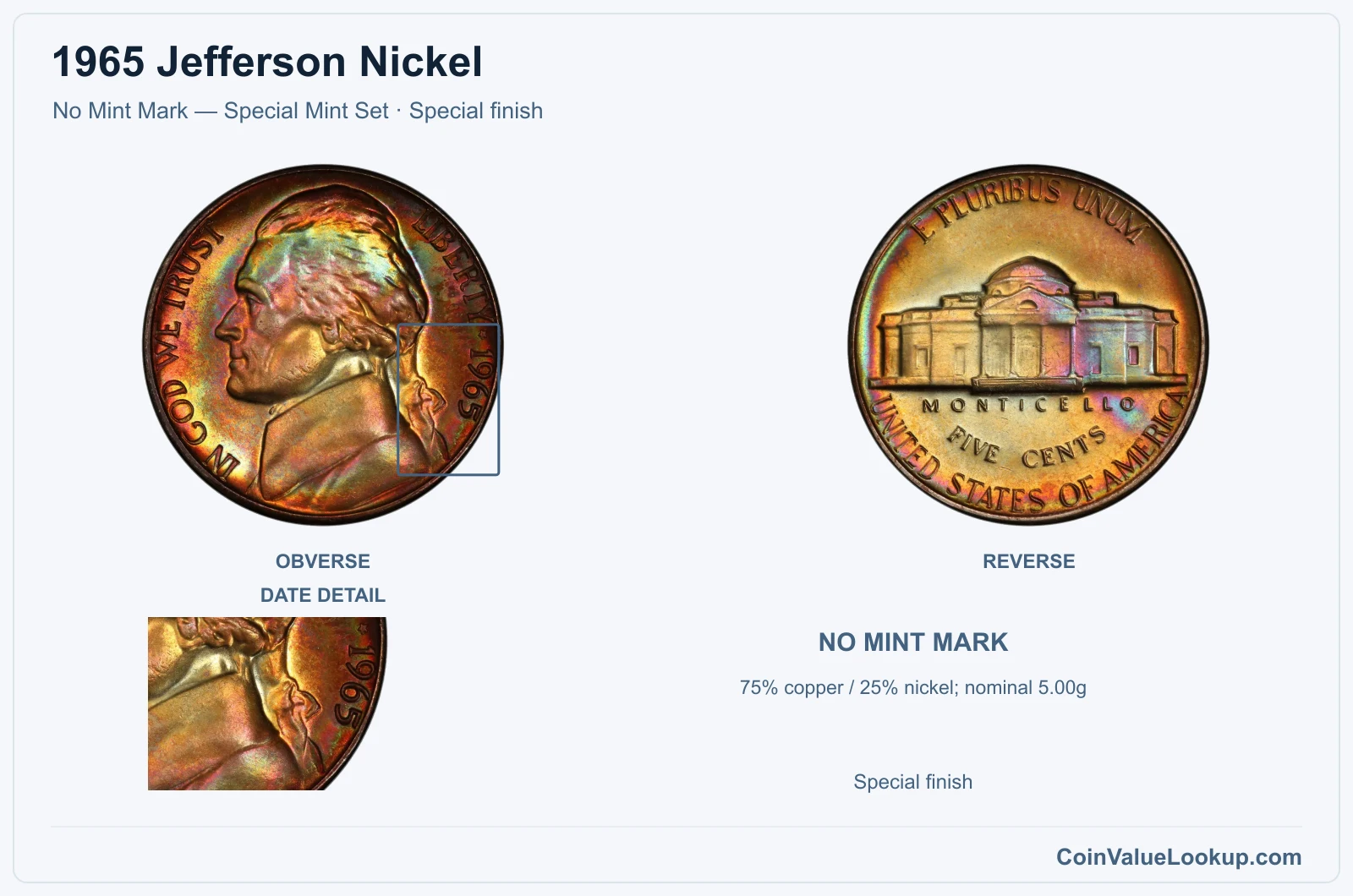
Special Mint Set nickels replaced proof coins for 1965–1967. They share the same alloy and lack a mintmark, just like business strikes, but they were produced with extra care on polished blanks and specially prepared dies.
The PCGS price guide lists the 1965 SMS nickel at about $10 in SP65 without cameo contrast. Add cameo contrast — frosted raised devices against a more reflective field — and SP65 Cameo jumps to roughly $18.
Do not assume every shiny nickel is SMS. Legitimate SMS coins came in sealed government-issued Special Mint Sets; attribution ideally involves provenance or third-party certification.
Coin Value Lookup is a good place to start exploring guides for this and other Jefferson nickel years if you want to compare values across dates and finishes.
Range Grade
Price Auction Records Appraisal SP SP 1
—
Coin Identifier
SP 2
—
Coin Identifier
SP 3
—
Coin Identifier
SP 4
—
Coin Identifier
SP 6
—
Coin Identifier
SP 8
—
Coin Identifier
SP 10
—
Coin Identifier
SP 12
—
Coin Identifier
SP 15
—
Coin Identifier
SP 20
—
Coin Identifier
SP 25
—
Coin Identifier
SP 30
—
Coin Identifier
SP 35
—
Coin Identifier
SP 40
—
Coin Identifier
SP 45
—
Coin Identifier
SP 50
—
Coin Identifier
SP 53
—
Coin Identifier
SP 55
—
Coin Identifier
SP 58
—
Coin Identifier
SP 60
—
Coin Identifier
SP 61
—
Coin Identifier
SP 62
—
Coin Identifier
SP 63
—
Coin Identifier
SP 64
Coin Identifier
SP 65
Coin Identifier
SP 66
Coin Identifier
SP 67
Coin Identifier
SP 68
Coin Identifier
SP 69
—
—
—
SP 70
—
—
—
1965 Jefferson Nickel Error List
1. 1965 Jefferson Nickel — Struck on a Cent Planchet
A 1965 nickel struck on a bronze cent planchet is noticeably smaller than a normal nickel. Peripheral legends and rim details are cut off because the cent blank is too small for the nickel dies.
The color is copper rather than silver-gray.
Authentication matters here. Weight and alloy testing separate a genuine wrong-planchet strike from a copper-plated normal nickel, which is common pocket damage.
The normal nickel weighs about 5 grams; a genuine cent-planchet strike will weigh differently. One PCGS MS64 example sold for $805 at Heritage Auctions in January 2004.
If your nickel looks coppery but weighs five grams, it is almost certainly plating, not an error.
2. 1965 Jefferson Nickel — Struck on a Silver Dime Planchet
This error occurs when a 90% silver dime blank enters the nickel press. The result is a full Jefferson/Monticello design on a noticeably smaller, silver-colored flan — about 2.5 grams based on a referenced example.
Because the blank is undersized, the design extends beyond the edge and peripheral lettering may be incomplete or distorted. A reeded edge is not expected here; a blank planchet does not yet have edge reeding.
Weight is the key diagnostic: a genuine piece weighs far less than a standard 5-gram nickel.
Lookalikes include a normal nickel, a nickel struck on a clad dime blank, or a coin that has been physically trimmed. Value depends on authenticated identity, condition, and the severity of the error, so individual assessment by a grading service is the practical path.
3. 1965 Jefferson Nickel — Off-Center Strike
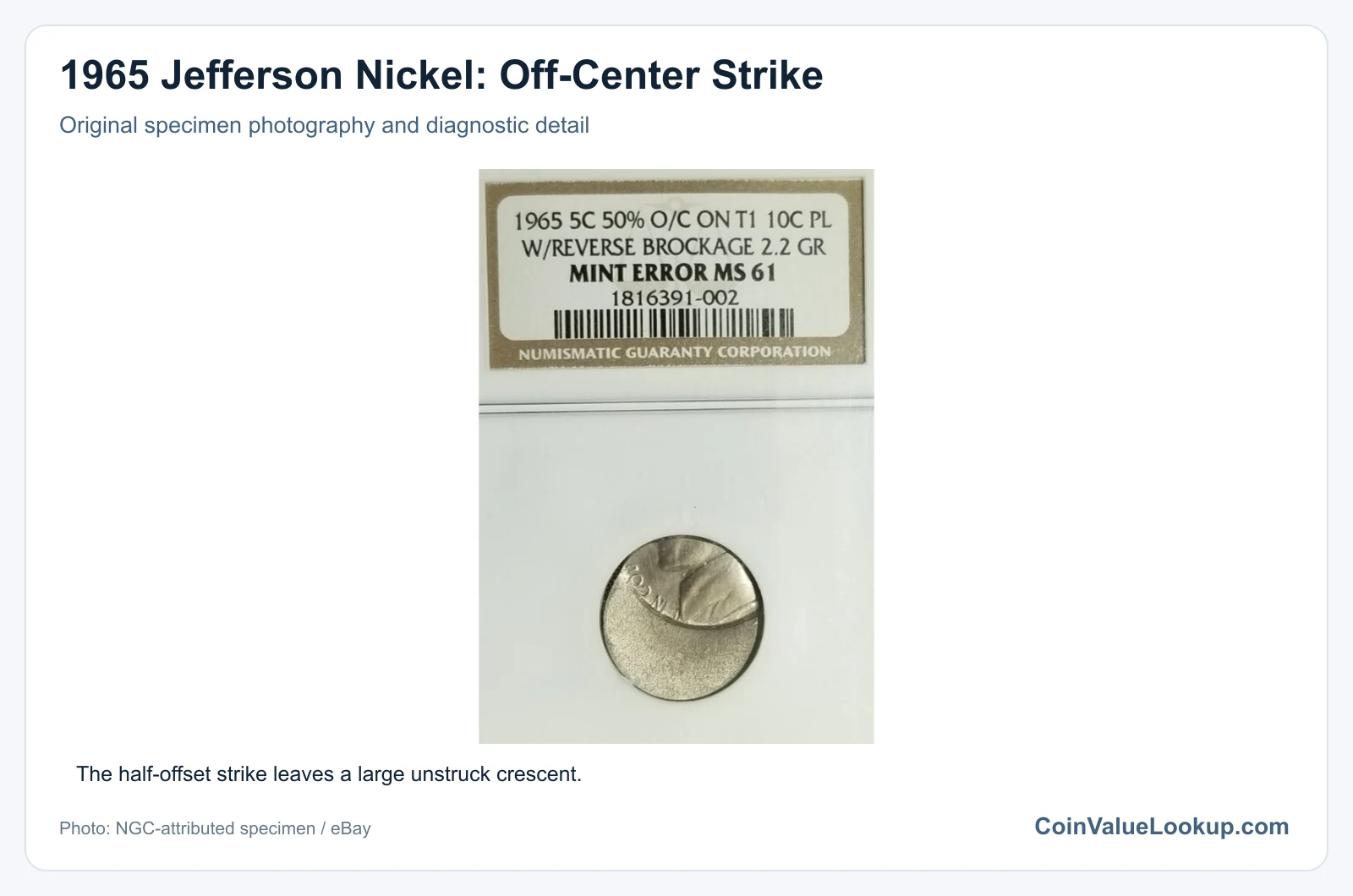
An off-center 1965 nickel shows both obverse and reverse designs shifted in the same direction, leaving a blank crescent where the planchet received no impression from the die. A 10% off-center strike is documented for this date.
The date must remain visible to attribute the coin to 1965. Without the date, the coin loses most of its collectible context.
Value depends on condition, the percentage of offset, and whether the date is fully readable.
Do not confuse an off-center strike with a misaligned die, which shifts only one side slightly while the other remains centered, or with uneven rim wear from circulation. Genuine off-center coins have a corresponding unstruck area on both faces.
4. 1965 Jefferson Nickel — Double Strike
A double-struck 1965 nickel shows two distinct impressions of the Jefferson and Monticello designs. The second strike is displaced — in one documented case, about 25% off-center — creating a dramatic overlapping image that is unmistakable once you know what to look for.
The original strike's date should be readable, and the second impression produces its own partial design nearby. A PCGS MS65 example brought $432 at Heritage Auctions in July 2021.
This is different from a doubled die, where die-level doubling affects specific design elements uniformly across every coin struck by that die. It is also different from machine doubling, which produces flat, shelf-like distortion on individual letters.
A true double strike has two fully formed, displaced complete images.
5. 1965 Jefferson Nickel — Foldover Strike
A foldover strike happens when a blank enters the coining press nearly vertically and gets folded over itself under striking pressure. The result is a coin with a visible seam and heavily distorted design — part of the struck image appears on one folded layer and part on the other.
One authenticated example, graded NGC MS64, shows seam ends at roughly 4 o'clock and 9 o'clock with a complete date. That coin sold for $4,312.50 at Heritage Auctions in August 2010.
The lookalike is simple: a coin bent or heated after it left the mint. Post-mint bending lacks the seam and the struck design extending across both folded faces.
A genuine foldover shows metal flow and design impression consistent with the fold occurring during the strike itself.
6. 1965 Jefferson Nickel — Doubled Die Reverse
A doubled die reverse on a 1965 nickel means the reverse die carried a doubled impression of some design element, and every coin struck by that die shows the same doubling in the same location. This has been reported as a category for this date.
To check, compare your coin's reverse lettering and architectural details on Monticello against a normal 1965 nickel under magnification. True die doubling produces consistent, raised secondary contours.
Machine doubling is the most common lookalike. It creates flat, shelf-like distortion rather than the rounded secondary image of a genuine doubled die.
Reflections and random surface marks can also mimic doubling at first glance. Value depends on the specific die variety, how visible the doubling is, and overall condition.
7. 1965 Jefferson Nickel — Clipped Planchet
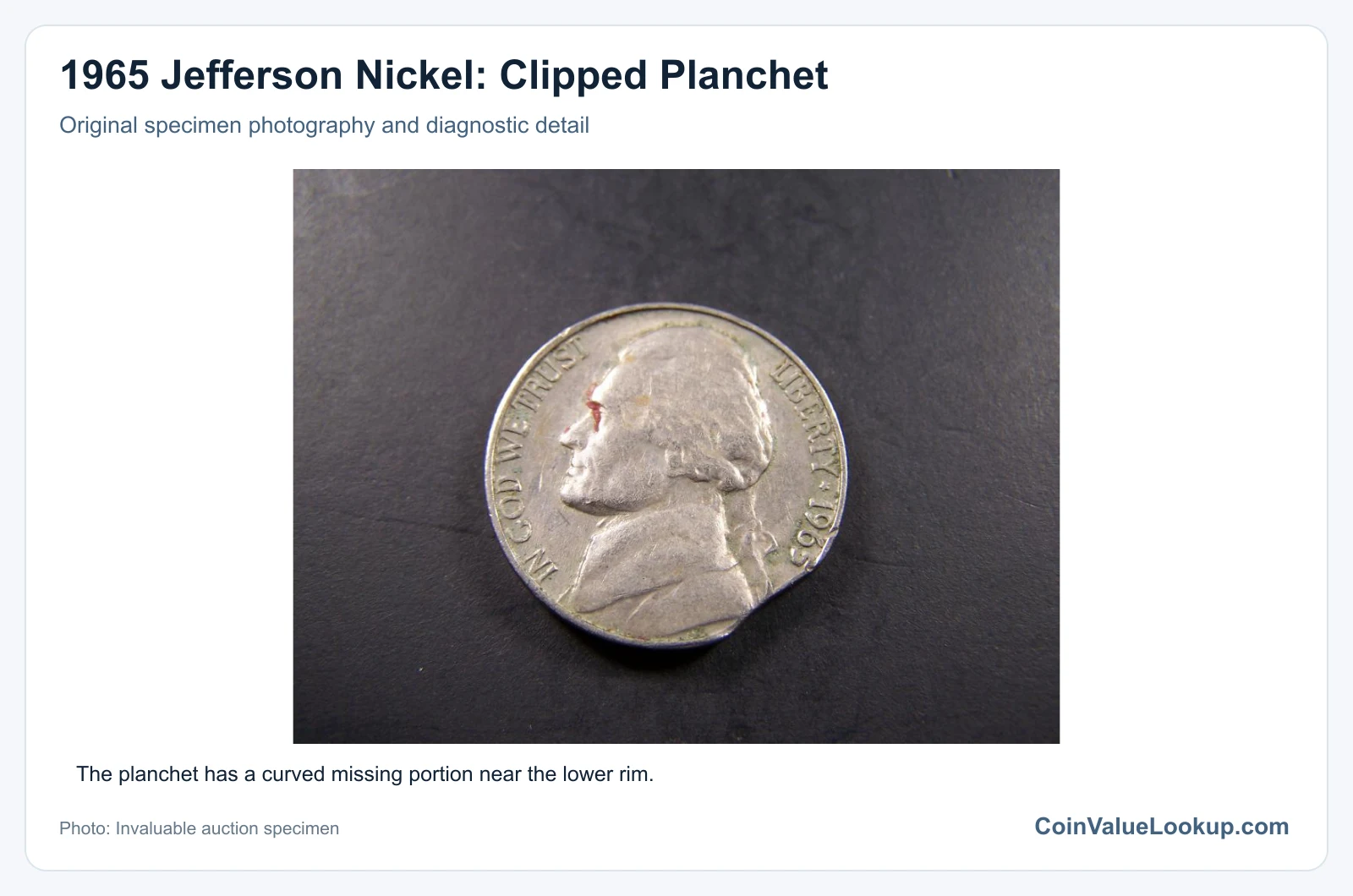
A clipped planchet means the blank was incompletely punched from its metal strip before striking. The result is a coin missing a curved, straight, or ragged section of its edge.
A genuine clip often shows a characteristic weakness in the design directly opposite the missing area, caused by incomplete metal flow during the strike.
Compare the edge texture at the clip boundary. Genuine clips show the raw metal edge of the original blank rather than a cut or filed surface.
Post-mint damage — someone attacking a coin with pliers or a file — tends to produce sharper, more irregular edges without the corresponding opposite-side weakness.
Value depends on the size and type of clip, the coin's condition, and whether the date and design remain identifiable. Each piece is individually assessed.
8. 1965 Jefferson Nickel — Broadstrike
A broadstrike occurs when a coin is struck without the normal restraining collar that forms the edge and controls the coin's diameter. Without that collar, the metal spreads outward freely, producing a coin that is wider and thinner than normal with a smooth, unformed edge profile.
A reported category for 1965 nickels describes a 45% indent broadstrike, sometimes called a mushroom error because of the resulting shape. The full design is present but stretched, and the edge lacks the normal sharp rim.
Do not confuse a broadstrike with an off-center coin, which loses part of its design. A broadstrike retains the complete design but in an expanded form.
Coins flattened after minting by deliberate force or machinery lack the even radial metal spread of a genuine broadstrike. Value is individually assessed based on condition and severity.
9. 1965 Jefferson Nickel — Indented Strike
An indented strike happens when a second blank or foreign object sits on top of the planchet during striking. The area beneath the extra piece receives no design impression, leaving a bounded, depressed region on the finished coin while the rest of the design strikes normally.
This category is reported for 1965 nickels, sometimes in combination with a broadstrike. Look for a clearly defined depressed zone — often curved — that interrupts the normal design.
The unstruck area should have a smooth, blank surface, not the rough texture of a post-mint dent.
A brockage, by contrast, leaves a mirrored impression of a design in the depressed area. A simple dent from handling is irregular, with no relationship to the striking geometry.
Value depends on the size of the indent, overall condition, and authentication.
10. 1965 Jefferson Nickel — Clashed Dies
Clashed dies occur when the obverse and reverse dies strike each other without a blank between them. The impact transfers faint traces of each die's design onto the opposing die.
Every coin subsequently struck by those dies carries ghost-like impressions of the opposite design.
On a 1965 nickel, look for faint outlines of Monticello's structure on the obverse field or traces of Jefferson's portrait on the reverse. These impressions align with where the opposite die would have made contact.
Scratches, random raised lines, and environmental damage are common lookalikes. A true die clash produces features that correspond logically to the opposing design and appear in the same position on multiple coins from the same die pair.
Value depends on the strength of the clash, overall condition, and market demand for the specific variety.