1975 Jefferson Nickel Coin Value: How Much Is It Worth?
A 1975 Jefferson nickel pulled from circulation is worth face value in most cases. The coins that stand out are well-preserved uncirculated examples, where USA Coin Book guide estimates range from about $0.30 at MS60 up to $3.62 at MS65, depending on the mint.
Proofs and authenticated error coins occupy their own markets entirely. Those guide figures apply only to uncirculated grades, not to every worn nickel in your jar.
Fast Way to Identify Your 1975 Jefferson Nickel
The quickest way to start figuring out what you have is to upload clear photos of both the front and back of your coin. Our identifier can give you a preliminary read on the year, mint, and version so you know where to look next.
It is not a substitute for professional grading or authentication, but it gets you pointed in the right direction fast.
1975 Jefferson Nickel Value
Upload both sides of your 1975 Jefferson Nickel.
Front Obverse
Upload photo
Back Reverse
Upload photo
Which 1975 Jefferson Nickel Versions Are Worth Money?
- High-grade Philadelphia or Denver business strikes with certified Full Steps can command premiums above standard uncirculated values.
- San Francisco S proofs trade in a different market from pocket-change coins; cameo and deep-cameo finishes are priced separately from base proofs.
- Several documented error types exist for 1975, including wrong-planchet strikes and off-center errors, some of which have sold for hundreds of dollars at auction.
Step 1: Identify Your 1975 Jefferson Nickel Mint Mark and Version
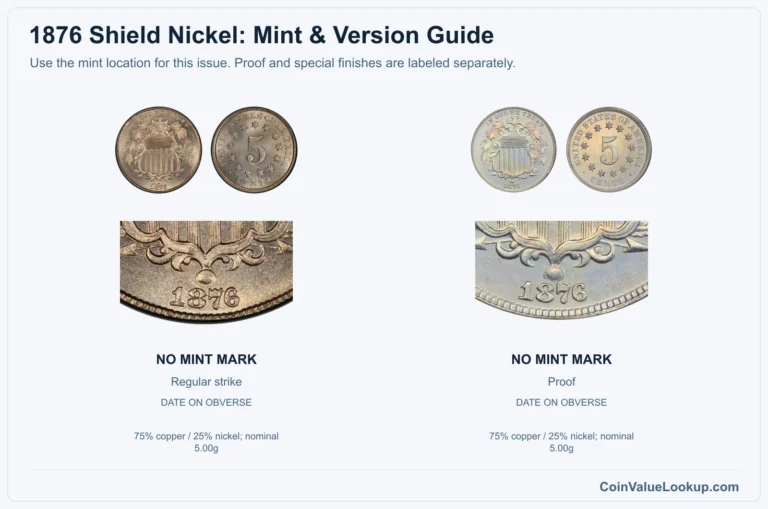
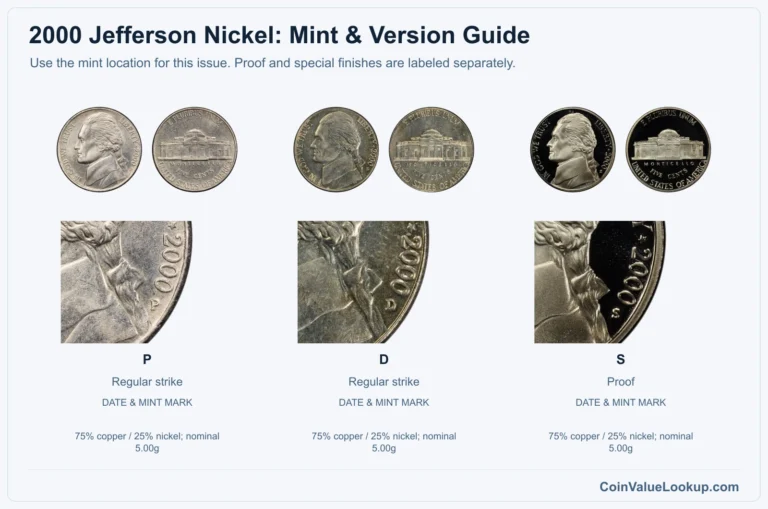
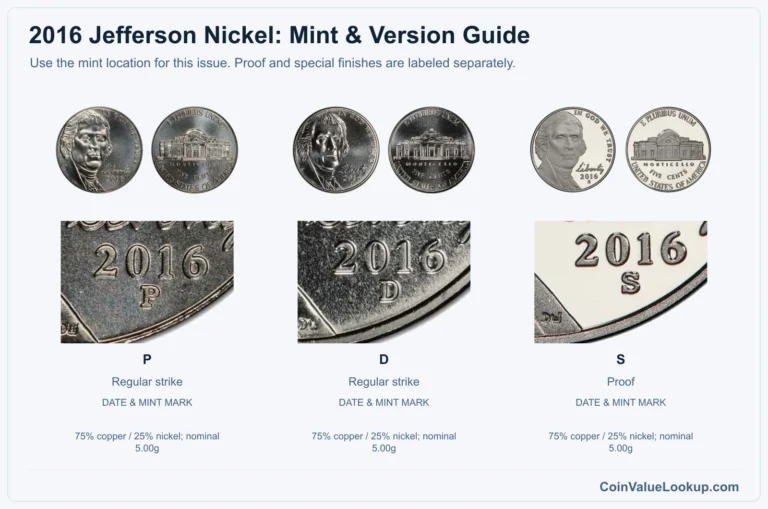
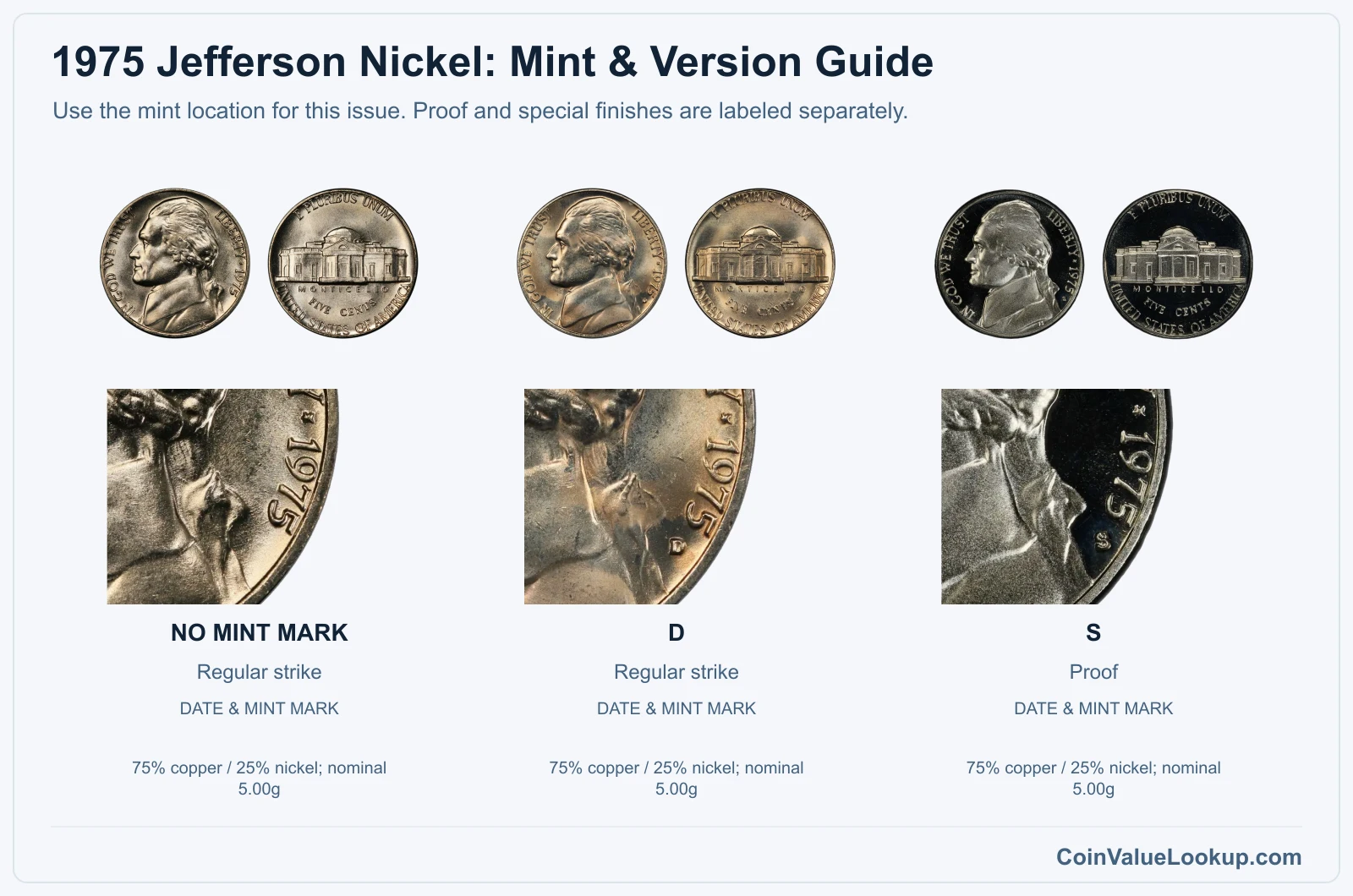
Three versions of the 1975 nickel exist: Philadelphia (no mintmark), Denver (D), and San Francisco (S, proof only). The mintmark sits on the obverse, just below the date.
If you see nothing there, it is a Philadelphia strike. A small "D" means Denver.
An "S" means a San Francisco proof.
All three are struck in 75% copper and 25% nickel, weigh about 5 grams, measure 21.2 mm across, and have a plain edge. This is a solid copper-nickel alloy, not a clad sandwich, so do not mistake normal surface wear for a "missing layer." Record both faces, the date, the mintmark, and whether the coin has the mirror-like fields of a proof or the frosty luster of a business strike.
That distinction matters for value.
Step 2: Check Your 1975 Jefferson Nickel Grade
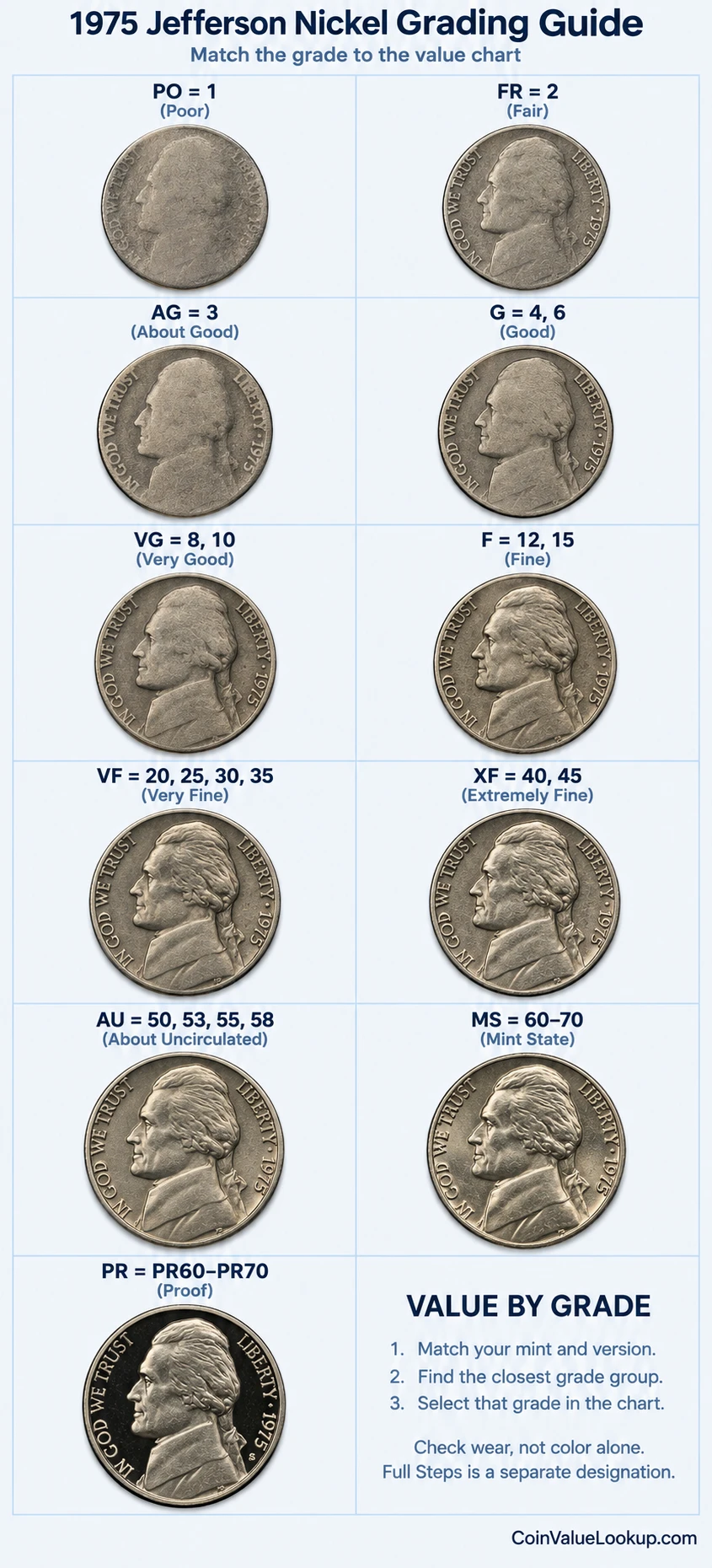
Start with Jefferson's cheek and the hair above his ear on the obverse. Those are the first spots to lose detail as the coin circulates.
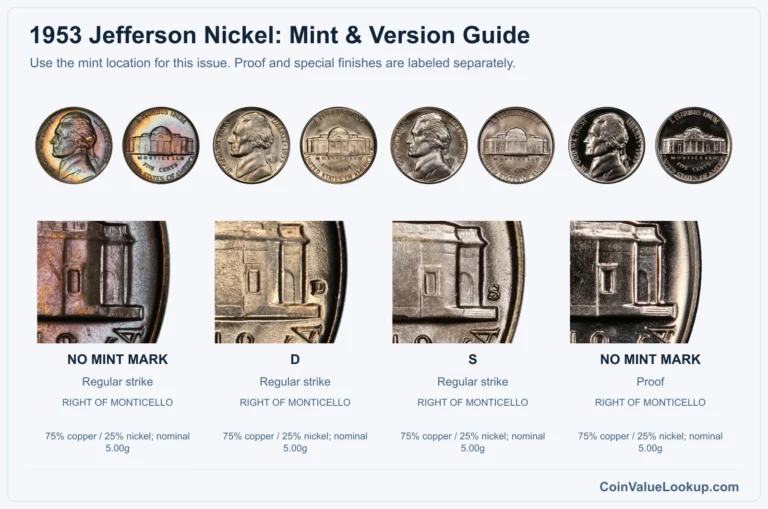
On the reverse, check the pillars and steps of Monticello; they wear progressively from the top down.
Surface luster, contact marks, and overall eye appeal all feed into a coin's grade. Compare your coin to the reference image to judge where it falls.
Full Steps is a separate designation for business strikes where the horizontal lines across the base of Monticello remain sharp and unbroken. That is a strike-quality attribute, not a wear indicator.
A coin can be technically Mint State yet still lack Full Steps because the dies did not impress the design fully. Coins with certified Full Steps can carry a premium above the standard grade.
Step 3: Check 1975 Jefferson Nickel Value by Mint and Version
1975 Jefferson Nickel — No mintmark (Philadelphia) Business strike
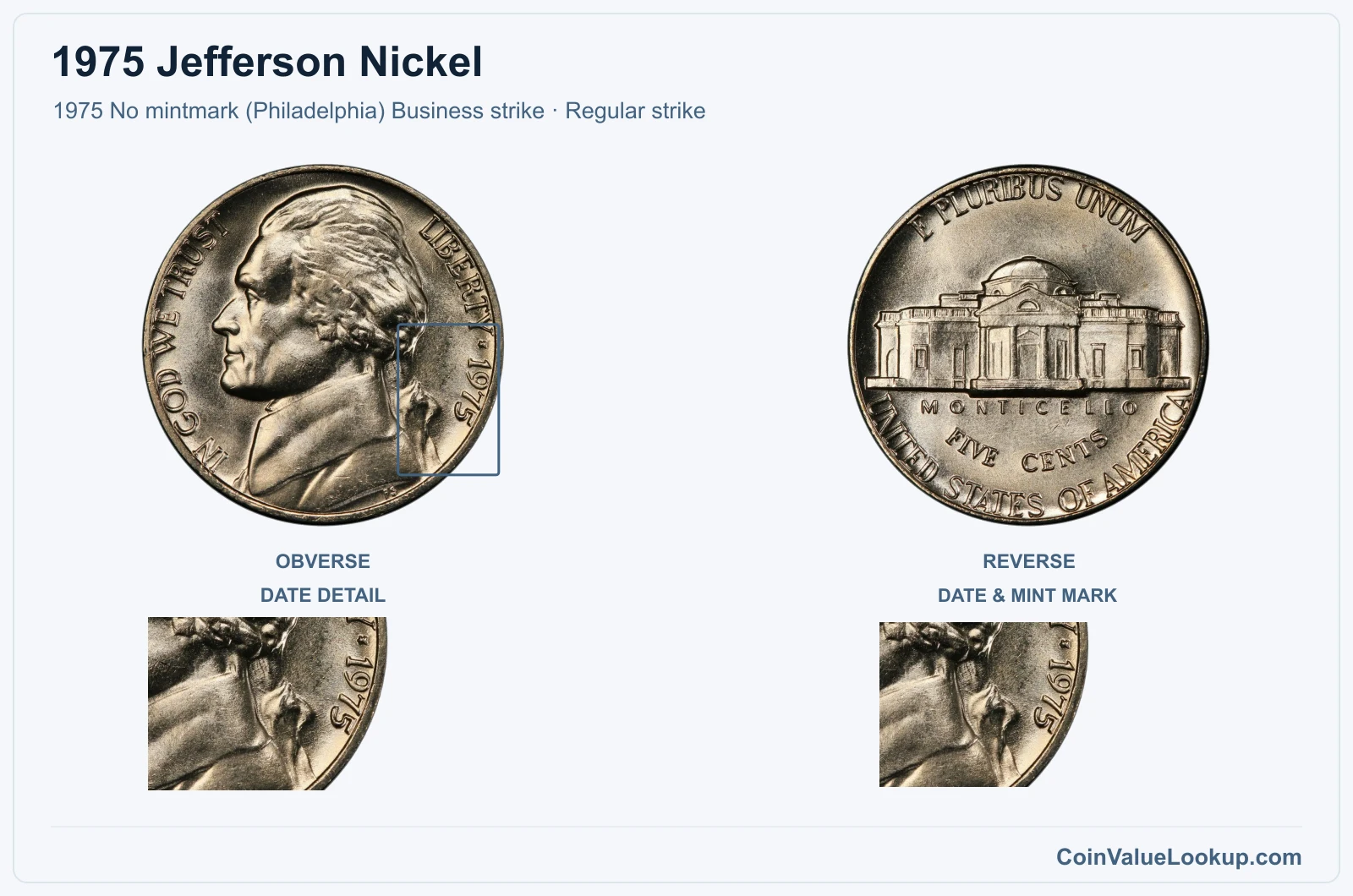
The 1975 Philadelphia nickel has no mintmark. Look on the obverse below the date; if the space is empty, you have this version.
Philadelphia struck a large number of these, so circulated examples are common at face value.
Uncirculated coins are a different story. USA Coin Book lists a guide estimate of about $0.61 at MS60 and $3.62 at MS65.
Pieces with Full Steps attribution can push past those figures. Luster and minimal bag marks are what separate a dollar coin from one worth several times that.
| Range | Grade | Price | Auction Records | Appraisal |
|---|---|---|---|---|
| PO | PO 1 | — | Coin Identifier | |
| FR | FR 2 | — | Coin Identifier | |
| AG | AG 3 | — | Coin Identifier | |
| G | G 4 | — | Coin Identifier | |
| G 6 | — | Coin Identifier | ||
| VG | VG 8 | — | Coin Identifier | |
| VG 10 | — | Coin Identifier | ||
| F | F 12 | — | Coin Identifier | |
| F 15 | — | Coin Identifier | ||
| VF | VF 20 | — | Coin Identifier | |
| VF 25 | — | Coin Identifier | ||
| VF 30 | — | Coin Identifier | ||
| VF 35 | — | Coin Identifier | ||
| XF | XF 40 | — | Coin Identifier | |
| XF 45 | — | Coin Identifier | ||
| AU | AU 50 | — | Coin Identifier | |
| AU 53 | — | Coin Identifier | ||
| AU 55 | — | Coin Identifier | ||
| AU 58 | — | Coin Identifier | ||
| MS | MS 60 | — | Coin Identifier | |
| MS 61 | — | Coin Identifier | ||
| MS 62 | — | Coin Identifier | ||
| MS 63 | — | Coin Identifier | ||
| MS 64 | Coin Identifier | |||
| MS 65 | Coin Identifier | |||
| MS 66 | — | Coin Identifier | ||
| MS 67 | Coin Identifier | |||
| MS 68 | — | — | — | |
| MS 69 | — | — | — | |
| MS 70 | — | — | — |
1975 Jefferson Nickel — S Proof
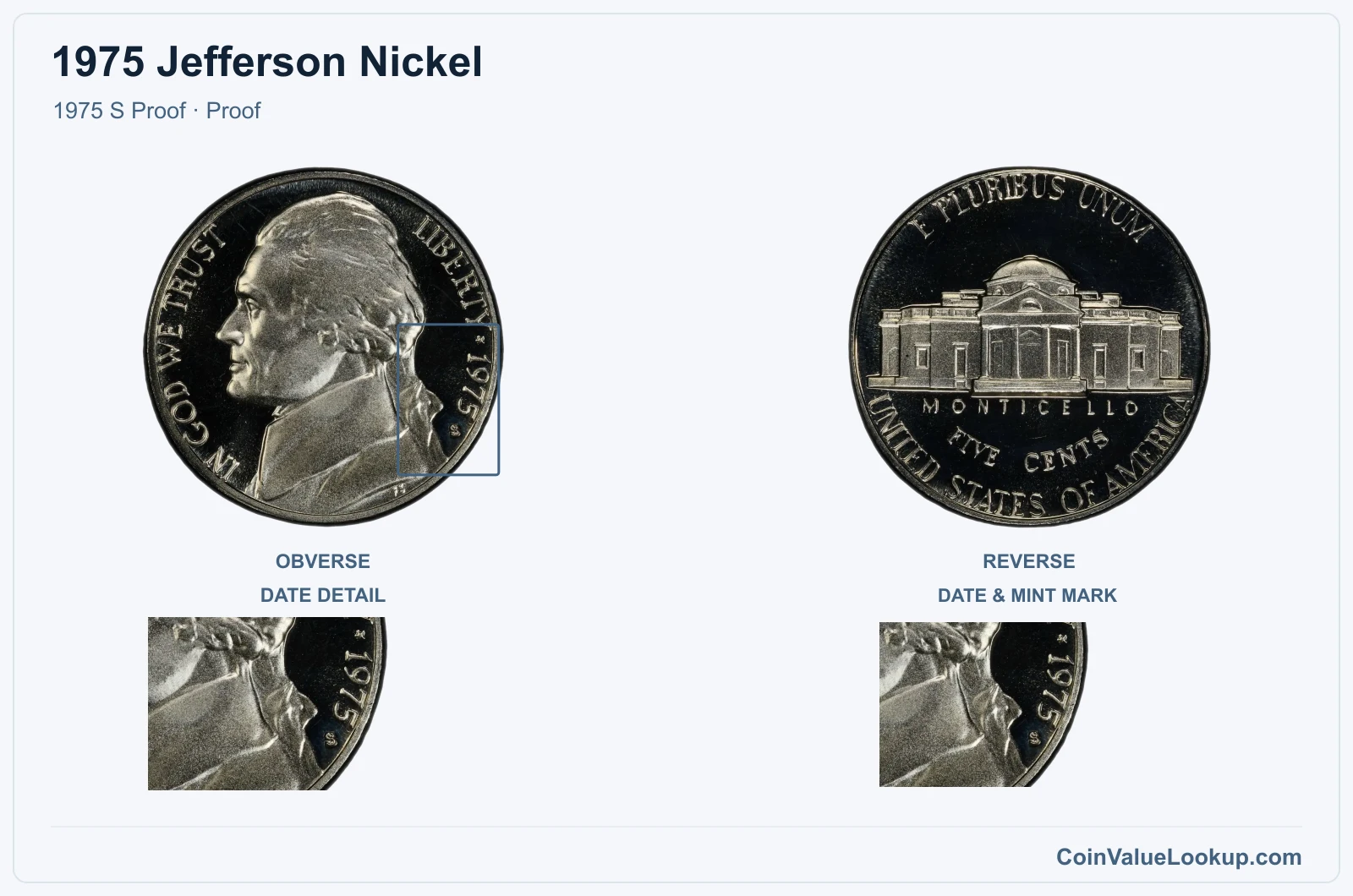
The 1975-S proof was made at San Francisco exclusively for collectors. It carries an "S" mintmark on the obverse below the date and displays the sharp, mirror-field finish characteristic of proof production.
A base proof at PR65 has a USA Coin Book guide estimate of about $3.08. Cameo and deep-cameo examples are graded and valued separately, so do not apply that base figure to every proof finish you encounter.
Proof is a manufacturing method, not a grade above Mint State. A proof can still have hairlines, haze, or toning that lowers its grade.
Coin Value Lookup is a good starting point if you want to compare this proof with other years in the Jefferson series or look up guides for different denominations.
| Range | Grade | Price | Auction Records | Appraisal |
|---|---|---|---|---|
| PR | PR 1 | — | Coin Identifier | |
| PR 2 | — | Coin Identifier | ||
| PR 3 | — | Coin Identifier | ||
| PR 4 | — | Coin Identifier | ||
| PR 6 | — | Coin Identifier | ||
| PR 8 | — | Coin Identifier | ||
| PR 10 | — | Coin Identifier | ||
| PR 12 | — | Coin Identifier | ||
| PR 15 | — | Coin Identifier | ||
| PR 20 | — | Coin Identifier | ||
| PR 25 | — | Coin Identifier | ||
| PR 30 | — | Coin Identifier | ||
| PR 35 | — | Coin Identifier | ||
| PR 40 | — | Coin Identifier | ||
| PR 45 | — | Coin Identifier | ||
| PR 50 | — | Coin Identifier | ||
| PR 53 | — | Coin Identifier | ||
| PR 55 | — | Coin Identifier | ||
| PR 58 | — | Coin Identifier | ||
| PR 60 | — | Coin Identifier | ||
| PR 61 | — | Coin Identifier | ||
| PR 62 | — | Coin Identifier | ||
| PR 63 | — | Coin Identifier | ||
| PR 64 | — | Coin Identifier | ||
| PR 65 | — | Coin Identifier | ||
| PR 66 | — | Coin Identifier | ||
| PR 67 | Coin Identifier | |||
| PR 68 | Coin Identifier | |||
| PR 69 | Coin Identifier | |||
| PR 70 | Coin Identifier |
1975 Jefferson Nickel — D Business strike
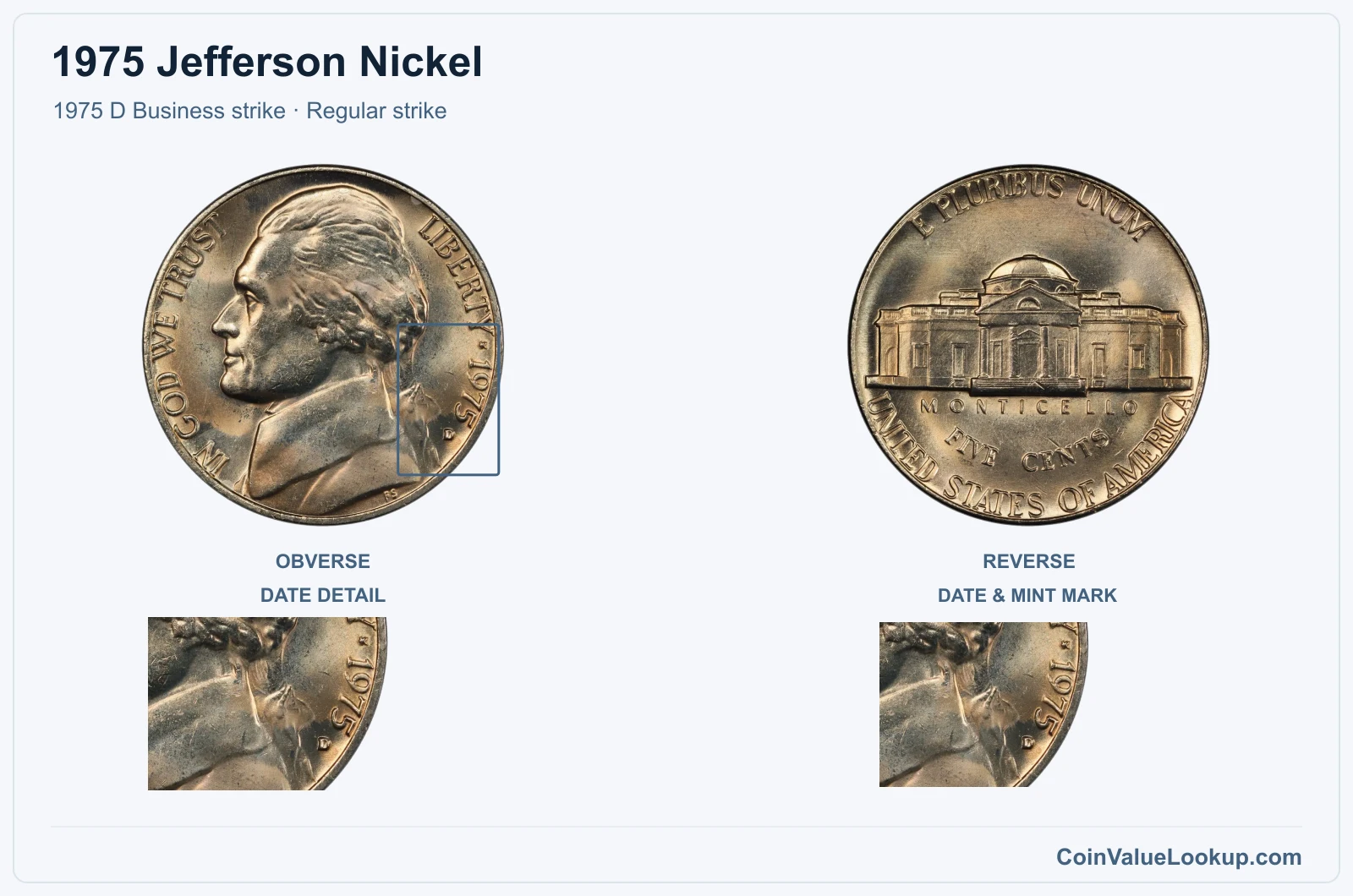
Denver's 1975-D nickel shows a small "D" mintmark on the obverse below the date. Like its Philadelphia counterpart, it is extremely common in circulated grades and worth five cents in a typical pocket.
USA Coin Book guide estimates place uncirculated examples at roughly $0.30 at MS60 and $3.62 at MS65. Those are retail guide figures, not guaranteed sale prices.
Full Steps examples, where the Monticello steps are complete and unbroken, can sell for more. Check your coin's steps under magnification before assuming you have one.
| Range | Grade | Price | Auction Records | Appraisal |
|---|---|---|---|---|
| PO | PO 1 | — | Coin Identifier | |
| FR | FR 2 | — | Coin Identifier | |
| AG | AG 3 | — | Coin Identifier | |
| G | G 4 | — | Coin Identifier | |
| G 6 | — | Coin Identifier | ||
| VG | VG 8 | — | Coin Identifier | |
| VG 10 | — | Coin Identifier | ||
| F | F 12 | — | Coin Identifier | |
| F 15 | — | Coin Identifier | ||
| VF | VF 20 | — | Coin Identifier | |
| VF 25 | — | Coin Identifier | ||
| VF 30 | — | Coin Identifier | ||
| VF 35 | — | Coin Identifier | ||
| XF | XF 40 | — | Coin Identifier | |
| XF 45 | — | Coin Identifier | ||
| AU | AU 50 | — | Coin Identifier | |
| AU 53 | — | Coin Identifier | ||
| AU 55 | — | Coin Identifier | ||
| AU 58 | — | Coin Identifier | ||
| MS | MS 60 | — | Coin Identifier | |
| MS 61 | — | Coin Identifier | ||
| MS 62 | Coin Identifier | |||
| MS 63 | — | Coin Identifier | ||
| MS 64 | Coin Identifier | |||
| MS 65 | Coin Identifier | |||
| MS 66 | Coin Identifier | |||
| MS 67 | Coin Identifier | |||
| MS 68 | — | — | — | |
| MS 69 | — | — | — | |
| MS 70 | — | — | — |
1975 Jefferson Nickel Error List
1. 1975 Jefferson Nickel — Struck over a1975cent
This is a nickel struck over a 1975 Lincoln cent, meaning the cent was already a finished coin when the nickel dies hit it. The diagnostic is seeing remnants of the cent's design beneath the nickel impression.
You should be able to detect traces of the Lincoln Memorial or Lincoln's portrait underneath Jefferson's portrait and Monticello.
Do not confuse this with a nickel struck on a blank cent planchet, which is a different error. A struck-over-cent shows two complete coin designs layered on each other.
A vise job, where someone presses two coins together outside the Mint, can fake this look, but it lacks the proper metal flow and die impression depth.
A Philadelphia example graded NGC MS64 Brown sold through Heritage Auctions in August 2022 for $900. That is one recorded sale, not a guaranteed market price for every example.
2. 1975 Jefferson Nickel — Struck on dime blank
A 1975 nickel struck on a dime planchet is noticeably smaller than normal and weighs about 2.3 grams instead of the standard 5 grams. The nickel design will appear cropped around the edges because the smaller blank could not accommodate the full die impression.
Weight is your first screening tool. If your coin looks small but weighs close to 5 grams, it has probably been ground down after leaving the Mint.
A genuine wrong-planchet strike will also show the incomplete rim and partial lettering that come from a blank that is simply too small for the dies.
A Denver-mint example graded NGC MS66 sold at Heritage Auctions in January 2011 for $488.75. Individual results will vary with grade and demand.
3. 1975 Jefferson Nickel — Struck on cent planchet
Here the nickel dies struck a copper cent planchet instead of the correct copper-nickel blank. The result is a coin that looks like a nickel in design but has the copper color and approximate weight of a cent, around 3.1 grams.
Outer lettering and design details will be cropped because the cent planchet is smaller than a nickel planchet.
Be careful with lookalikes. Copper plating, chemical toning, and grinding can all make a regular nickel appear copper-colored or underweight.
Always check both faces for the cropped-design hallmark and weigh the coin.
A Denver example graded NGC MS64 RB sold through Heritage Auctions in April 2006 for $373.75. Condition, color designation, and the specific mint all affect what a given piece brings.
4. 1975 Jefferson Nickel — Off-center strike
An off-center strike happens when the planchet is not seated properly in the collar and the dies impress the design to one side. The result is a blank crescent on part of the coin and a shifted, incomplete design on the rest.
The more dramatic the displacement, and the more of the date that survives, the more collectors tend to pay.
Do not confuse an off-center strike with a misaligned die, which shifts the design slightly but still fills the planchet, or with rim damage from a coin counter. A true off-center piece has a smooth, unstruck area where metal never contacted the die.
A 1975-D example struck 75% off center, graded PCGS MS64, sold at Heritage Auctions in May 2021 for $114.
5. 1975 Jefferson Nickel — Misplaced Mintmark
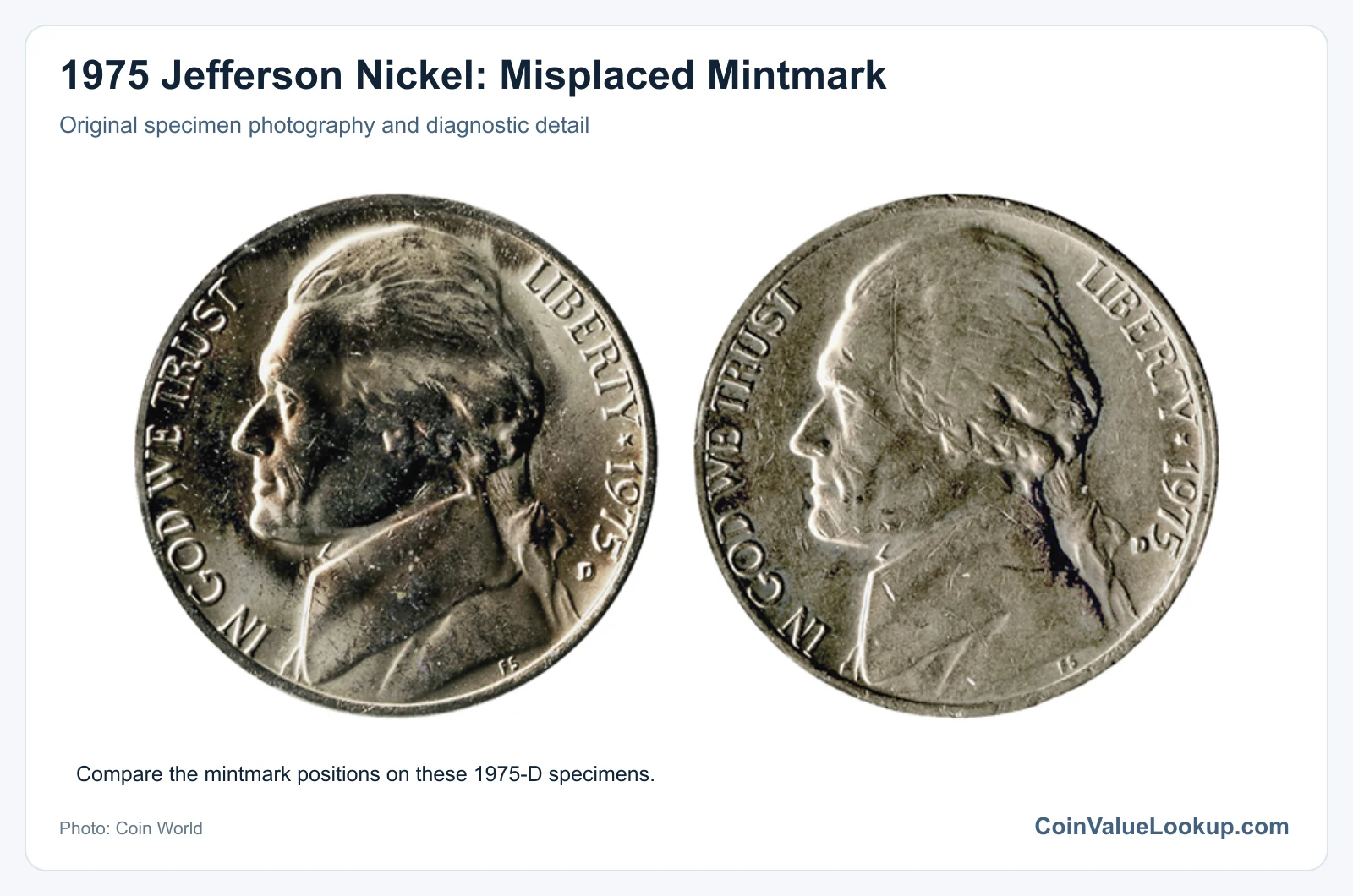
A misplaced mintmark occurs when the mintmark punch lands in an unintended location on the die, leaving a trace of the letter in an area where it should not appear. For 1975, a "High D" variety has been reported on the Denver-mint nickel, where the D sits higher than its normal position below the date.
To check for this, compare your coin's mintmark placement against a normal 1975-D under the same magnification. Look for any partial letter impression in an unusual spot.
Surface marks, corrosion, or die chips near the mintmark can mimic the appearance, so use a known normal example as your baseline.
Condition and the visibility of the misplacement affect what any particular coin is worth. No specific price range is supplied here.
6. 1975 Jefferson Nickel — Doubled Die Obverse
Doubled die obverse varieties for 1975 nickels have been reported, where obverse lettering or design elements show consistent doubling from a die-making error. The doubling appears as separated or notched outlines on letters like LIBERTY or IN GOD WE TRUST, visible under moderate magnification.
The key word is consistent. Every coin struck from that die shows the same doubling in the same spot.
Machine doubling, by contrast, tends to produce a flat shelf on one side of the lettering and varies from strike to strike. Worn dies and reflected light can also create misleading impressions of doubling.
Compare your coin to a normal 1975 nickel of the same mint under matching lighting. Value depends on the specific variety, its visibility, and the coin's overall condition.
7. 1975 Jefferson Nickel — Doubled Die Reverse
Doubled die reverse varieties have also been reported for the 1975 nickel, with doubling visible on reverse legends or Monticello's architectural details. As with the obverse variety, this originates during die production, not during the strike itself.
Look at the reverse lettering, particularly MONTICELLO and E PLURIBUS UNUM, for consistent separation or notching that appears in the same position on every example from that die. Machine doubling produces a different effect, typically a flat, shelf-like distortion rather than a rounded secondary image.
Random damage, corrosion, and die deterioration can all mimic doubling at first glance. A side-by-side comparison with a normal coin under the same magnification is the best starting point.
Value depends on the variety, its strength, and the coin's grade.
8. 1975 Jefferson Nickel — Repunched Mintmark
Repunched mintmark errors on 1975 nickels have been reported, where the mintmark was punched into the working die more than once, leaving overlapping or offset letter impressions. You will typically see a partial second "D" or a slight shadow next to the primary mintmark.
Inspect the mintmark area under at least 5x magnification and compare to a normal 1975-D. The remnant punch should be consistent and appear as part of the metal surface, not sitting on top of it.
Die chips, corrosion, and machine doubling in the mintmark area can produce similar-looking artifacts, so examine the shape carefully.
The value of a repunched mintmark depends on visibility, the specific die variety, and the coin's condition. No specific price range is available here.