2016 Jefferson Nickel Coin Value: How Much Is It Worth?
Most 2016 Jefferson nickels you pull from pocket change are worth close to face value. Ordinary Philadelphia and Denver business strikes carry USA Coin Book retail guide estimates of about $0.30 at MS60 and $0.61 at MS65.
The San Francisco proof is a separate collector issue, and authentic mint errors require individual assessment. Certified coins with exceptional grades or a Full Steps designation can command premiums above those baseline figures.
Fast Way to Identify Your 2016 Jefferson Nickel
The quickest way to start figuring out what you have is to snap clear photos of the front and back of your coin and upload them to our identifier. It can help with preliminary identification of the mint, finish type and general design details.
Keep in mind this is not a substitute for professional authentication, grading or error diagnosis.
2016 Jefferson Nickel Value
Upload both sides of your 2016 Jefferson Nickel.
Front Obverse
Upload photo
Back Reverse
Upload photo
Which 2016 Jefferson Nickel Versions Are Worth Money?
- Certified high-grade P or D business strikes with Full Steps designations can bring premiums well above the ordinary MS60–MS65 guide values.
- The 2016-S proof trades in its own market at around $5.30 at PR65 per USA Coin Book; a reflective circulated coin is not the same thing.
Step 1: Identify Your 2016 Jefferson Nickel Mint Mark and Version
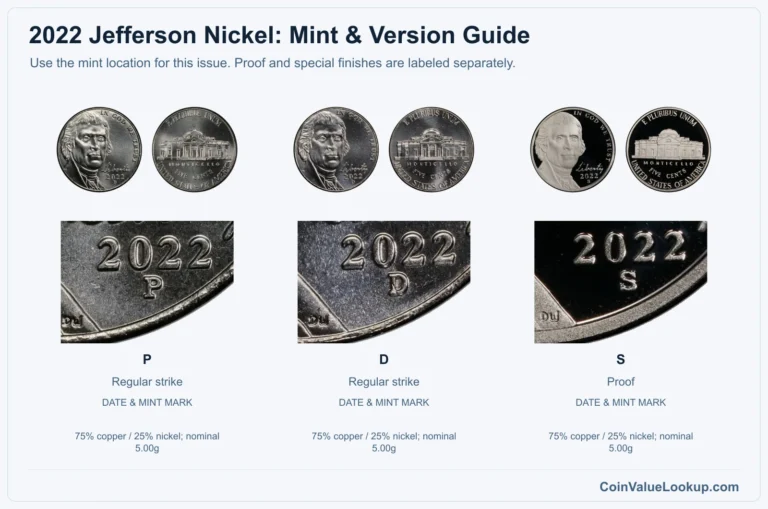
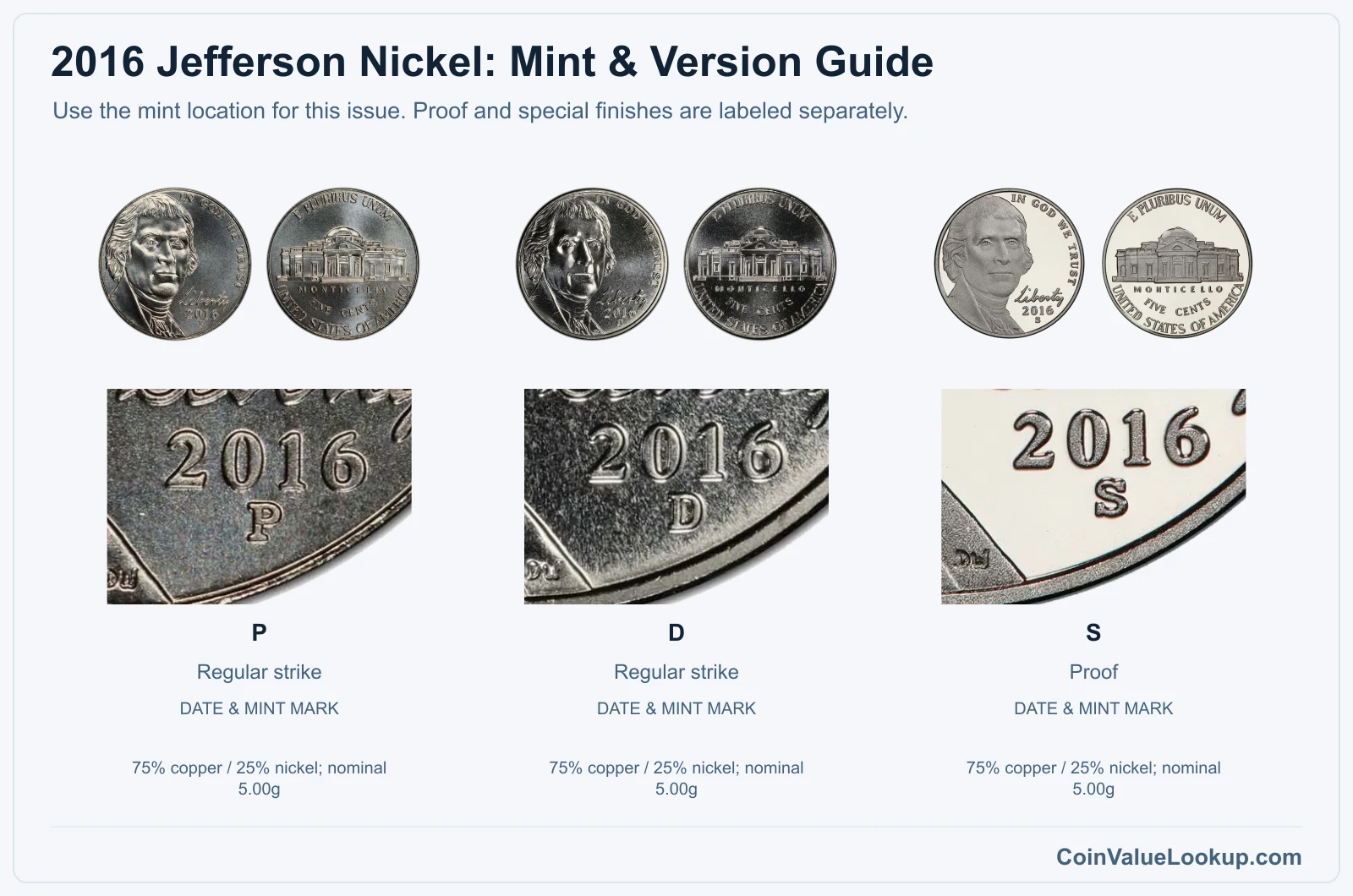
Flip your coin obverse-up and look for the mintmark just below the date. A "P" means Philadelphia, a "D" means Denver, and an "S" indicates a San Francisco proof.
All three share the same forward-facing Jefferson portrait on the obverse and the Monticello reverse.
The standard alloy is 75% copper and 25% nickel, weighing about 5 grams with a 21.2 mm diameter and a plain edge. There is no silver version of this coin.
Before you grade, determine the finish. Business strikes from P and D have a standard brilliant uncirculated surface.
The satin finish that appeared in earlier Mint Sets ended after 2010, so a 2016 nickel will not have that look. Proofs show mirrored fields and are struck at San Francisco only.
A shiny circulated coin is not automatically a proof.
Step 2: Check Your 2016 Jefferson Nickel Grade
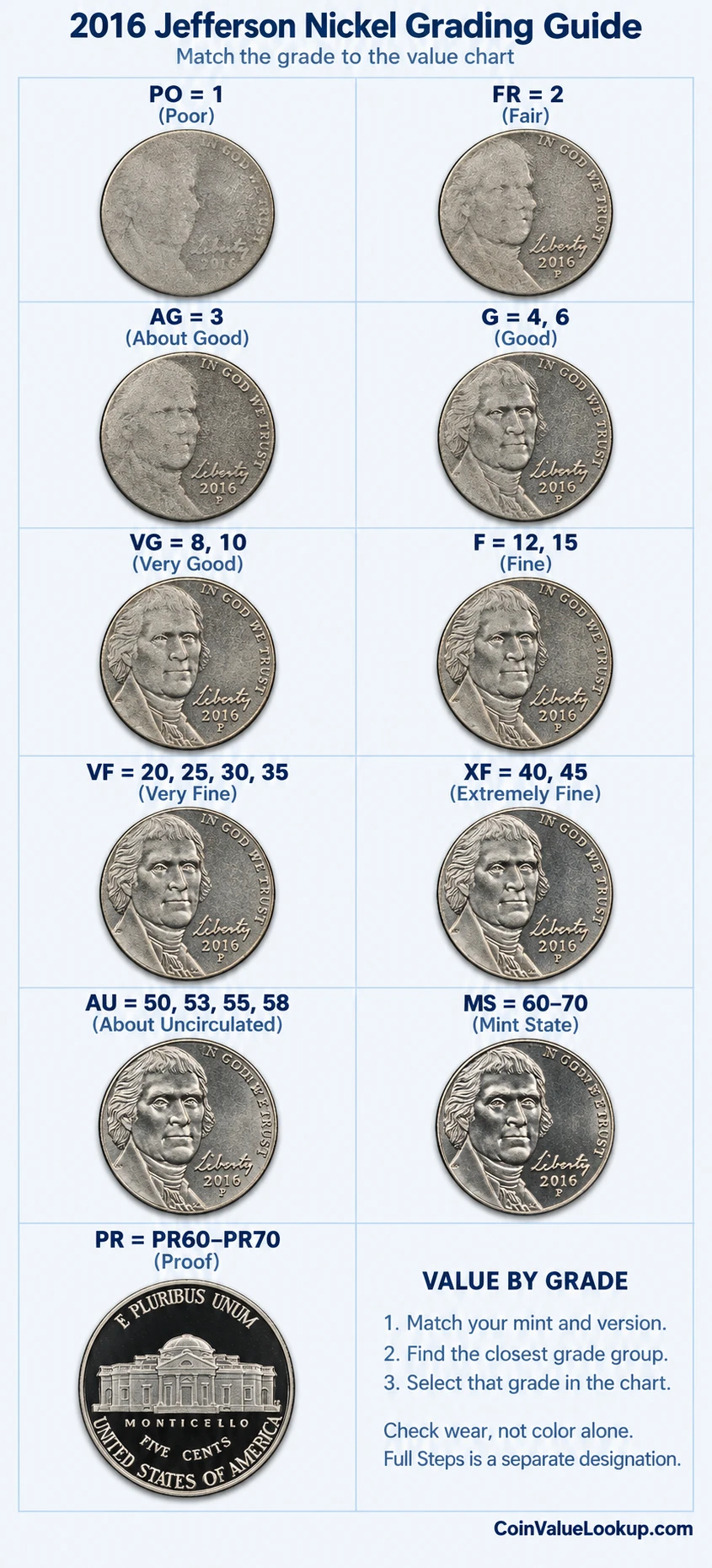
Start on the obverse. Check the highest points first: Jefferson's cheekbone, the hair above the ear, and the shoulder area.
These spots lose detail before anything else, so visible smoothing there tells you the coin has seen circulation. Then look at overall luster and the severity of any contact marks or scratches.
On the reverse, examine Monticello's steps. A Full Steps designation means those steps are sharply struck and fully separated, but that label is about strike quality, not the coin's overall condition grade.
A coin can be MS65 without Full Steps, or MS62 with Full Steps.
Proof coins get their own grading scale (PR). Cameo or deep cameo contrast is a separate designation, not a higher grade number.
Use the comparison image to match your coin's wear level against known examples of the same portrait type.
Step 3: Check 2016 Jefferson Nickel Value by Mint and Version
2016 Jefferson Nickel — P Business strike
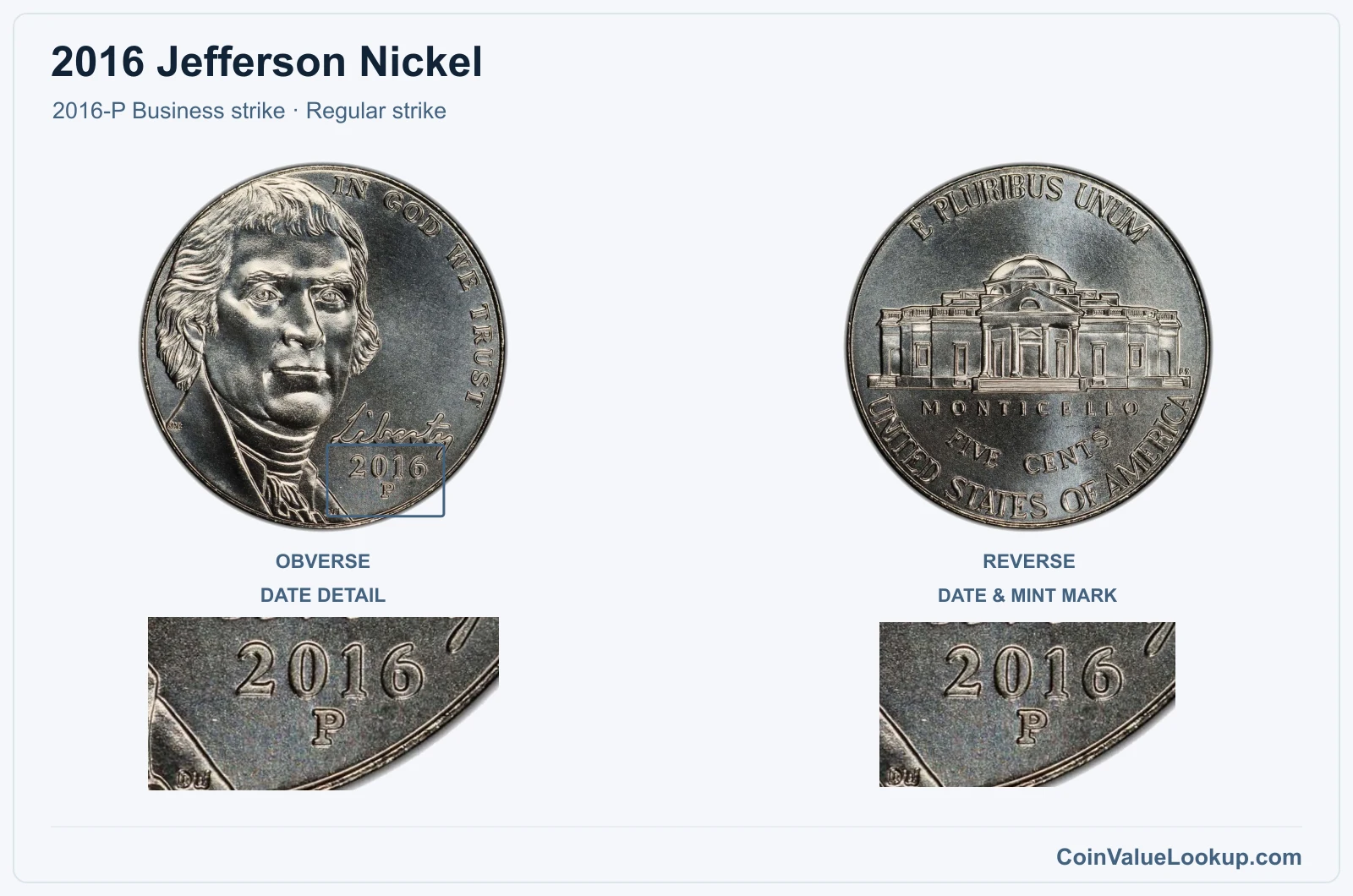
The 2016-P business strike is the Philadelphia issue, carrying a small "P" mintmark below the date. It is struck on a standard 75% copper / 25% nickel planchet weighing about 5 grams.
USA Coin Book lists retail guide estimates of roughly $0.30 at MS60 and $0.61 at MS65 for ordinary examples without special designations.
Those guide figures do not reflect coins certified with Full Steps or deep cameo finishes. A well-struck piece with fully separated Monticello steps and a high grade occupies a different price tier entirely.
Check your coin's step detail carefully before assuming the baseline values apply.
| Range | Grade | Price | Auction Records | Appraisal |
|---|---|---|---|---|
| PO | PO 1 | — | Coin Identifier | |
| FR | FR 2 | — | Coin Identifier | |
| AG | AG 3 | — | Coin Identifier | |
| G | G 4 | — | Coin Identifier | |
| G 6 | — | Coin Identifier | ||
| VG | VG 8 | — | Coin Identifier | |
| VG 10 | — | Coin Identifier | ||
| F | F 12 | — | Coin Identifier | |
| F 15 | — | Coin Identifier | ||
| VF | VF 20 | — | Coin Identifier | |
| VF 25 | — | Coin Identifier | ||
| VF 30 | — | Coin Identifier | ||
| VF 35 | — | Coin Identifier | ||
| XF | XF 40 | — | Coin Identifier | |
| XF 45 | — | Coin Identifier | ||
| AU | AU 50 | — | Coin Identifier | |
| AU 53 | — | Coin Identifier | ||
| AU 55 | — | Coin Identifier | ||
| AU 58 | — | Coin Identifier | ||
| MS | MS 60 | — | Coin Identifier | |
| MS 61 | — | Coin Identifier | ||
| MS 62 | — | Coin Identifier | ||
| MS 63 | — | Coin Identifier | ||
| MS 64 | — | Coin Identifier | ||
| MS 65 | — | Coin Identifier | ||
| MS 66 | — | Coin Identifier | ||
| MS 67 | — | Coin Identifier | ||
| MS 68 | — | — | — | |
| MS 69 | — | — | — | |
| MS 70 | — | — | — |
2016 Jefferson Nickel — D Business strike
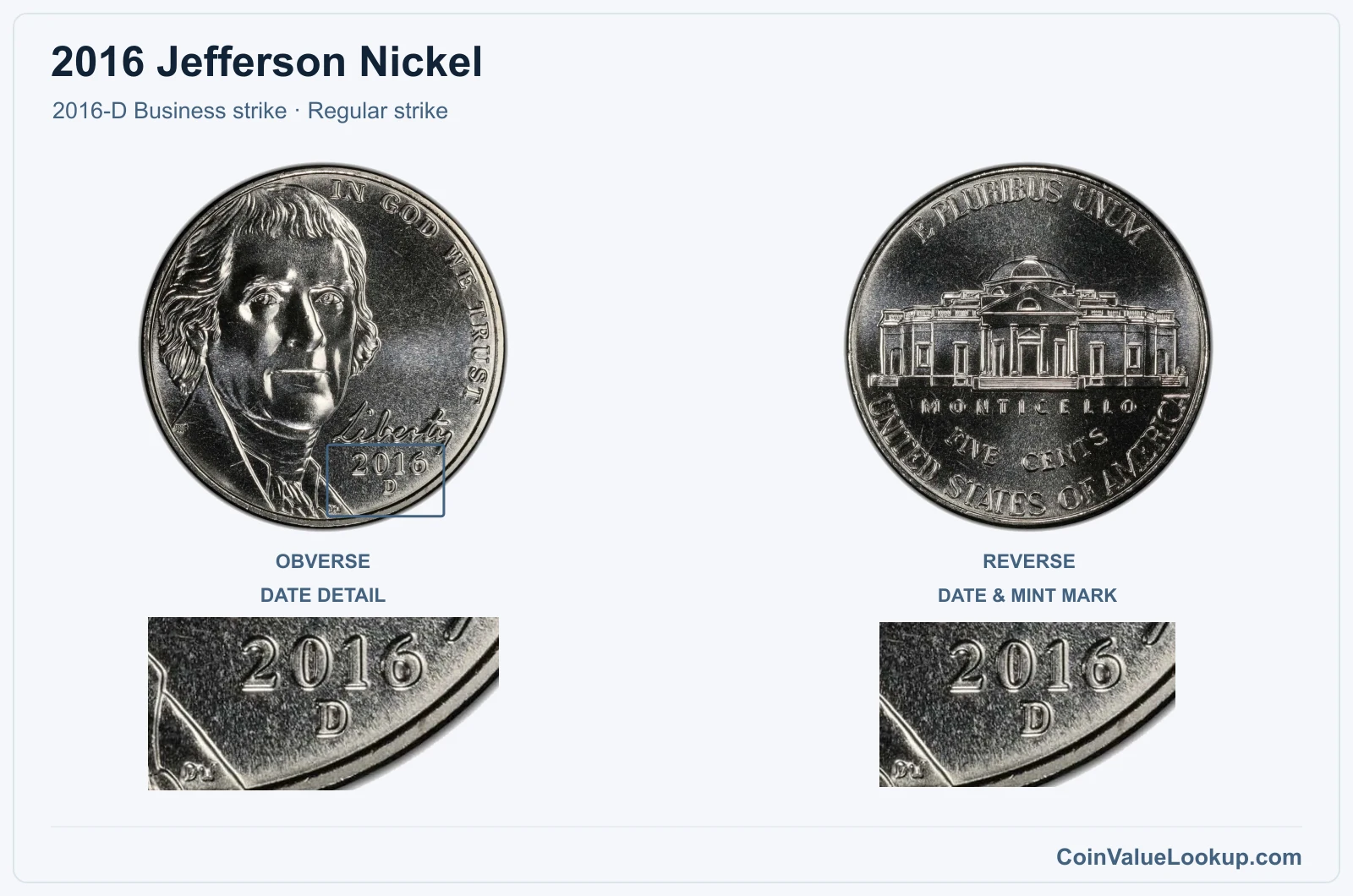
The 2016-D business strike comes from the Denver Mint, identifiable by the "D" below the date. Same alloy, same weight, same design as the Philadelphia issue.
USA Coin Book retail guide estimates sit at about $0.30 in MS60 and $0.61 in MS65 for run-of-the-mill pieces.
As with the P mint, these numbers cover ordinary strikes. Coins that earn a Full Steps label from a grading service can be worth considerably more, depending on the numerical grade.
That step detail is the key variable for collectors chasing this series.
Coin Value Lookup is a good starting point if you want to compare guide values across different years and mints in the Jefferson nickel series.
| Range | Grade | Price | Auction Records | Appraisal |
|---|---|---|---|---|
| PO | PO 1 | — | Coin Identifier | |
| FR | FR 2 | — | Coin Identifier | |
| AG | AG 3 | — | Coin Identifier | |
| G | G 4 | — | Coin Identifier | |
| G 6 | — | Coin Identifier | ||
| VG | VG 8 | — | Coin Identifier | |
| VG 10 | — | Coin Identifier | ||
| F | F 12 | — | Coin Identifier | |
| F 15 | — | Coin Identifier | ||
| VF | VF 20 | — | Coin Identifier | |
| VF 25 | — | Coin Identifier | ||
| VF 30 | — | Coin Identifier | ||
| VF 35 | — | Coin Identifier | ||
| XF | XF 40 | — | Coin Identifier | |
| XF 45 | — | Coin Identifier | ||
| AU | AU 50 | — | Coin Identifier | |
| AU 53 | — | Coin Identifier | ||
| AU 55 | — | Coin Identifier | ||
| AU 58 | — | Coin Identifier | ||
| MS | MS 60 | — | Coin Identifier | |
| MS 61 | — | Coin Identifier | ||
| MS 62 | — | Coin Identifier | ||
| MS 63 | — | Coin Identifier | ||
| MS 64 | — | Coin Identifier | ||
| MS 65 | — | Coin Identifier | ||
| MS 66 | — | Coin Identifier | ||
| MS 67 | — | Coin Identifier | ||
| MS 68 | — | — | — | |
| MS 69 | — | — | — | |
| MS 70 | — | — | — |
2016 Jefferson Nickel — S Proof
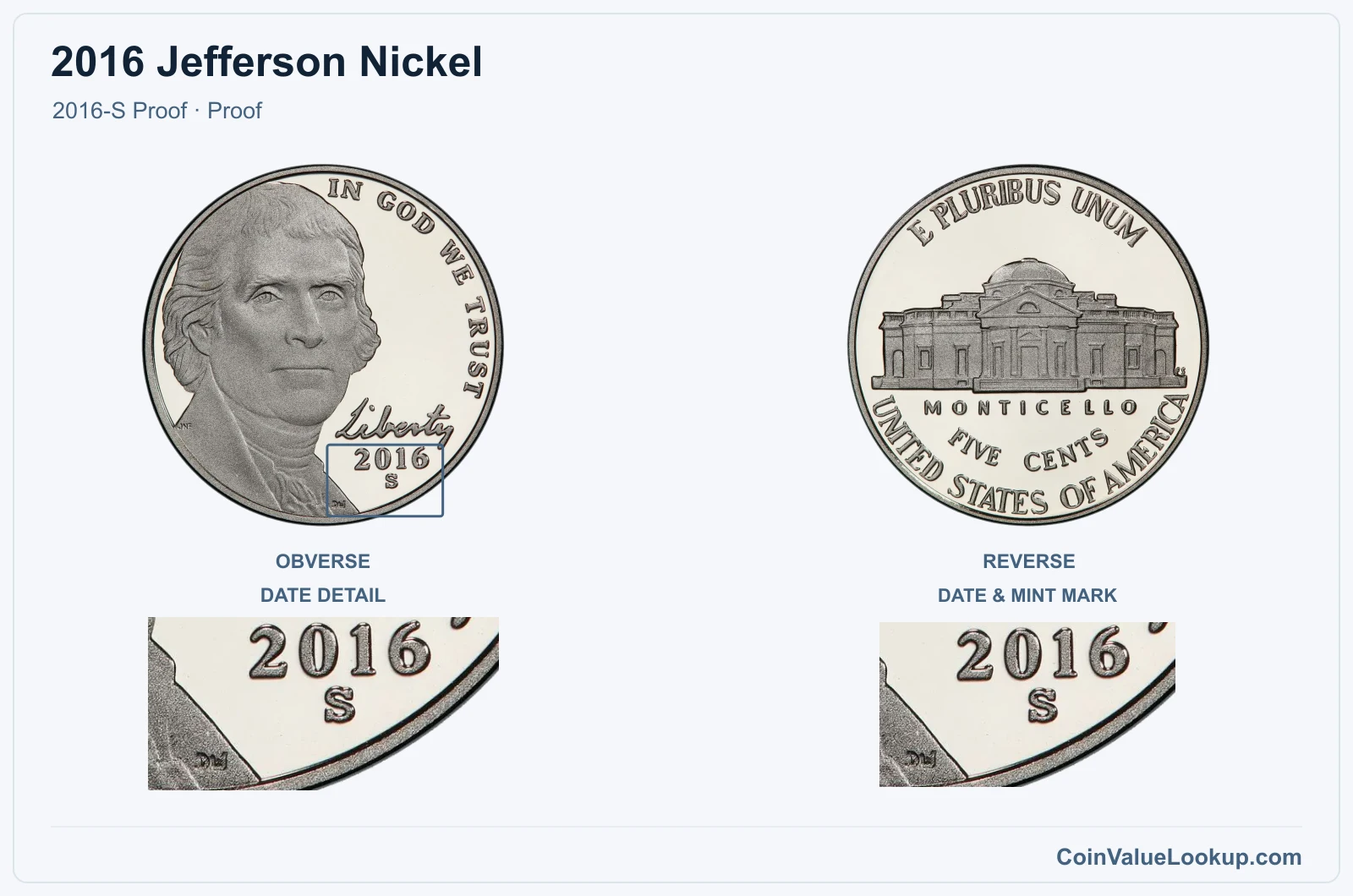
The 2016-S proof was produced at San Francisco exclusively for collector sets. You will find the "S" mintmark on the obverse below the date.
Proof nickels have mirrored fields and sharply struck devices, and they are made on the same 75% copper / 25% nickel planchet as business strikes.
USA Coin Book lists a retail guide estimate of about $5.30 at PR65. Coins with cameo or deep cameo contrast designations carry their own value curves not captured in that single figure.
A proof belongs in the PR grading scale, not the MS scale, so do not compare it directly to a business strike of the same numerical grade.
| Range | Grade | Price | Auction Records | Appraisal |
|---|---|---|---|---|
| PR | PR 1 | — | Coin Identifier | |
| PR 2 | — | Coin Identifier | ||
| PR 3 | — | Coin Identifier | ||
| PR 4 | — | Coin Identifier | ||
| PR 6 | — | Coin Identifier | ||
| PR 8 | — | Coin Identifier | ||
| PR 10 | — | Coin Identifier | ||
| PR 12 | — | Coin Identifier | ||
| PR 15 | — | Coin Identifier | ||
| PR 20 | — | Coin Identifier | ||
| PR 25 | — | Coin Identifier | ||
| PR 30 | — | Coin Identifier | ||
| PR 35 | — | Coin Identifier | ||
| PR 40 | — | Coin Identifier | ||
| PR 45 | — | Coin Identifier | ||
| PR 50 | — | Coin Identifier | ||
| PR 53 | — | Coin Identifier | ||
| PR 55 | — | Coin Identifier | ||
| PR 58 | — | Coin Identifier | ||
| PR 60 | — | Coin Identifier | ||
| PR 61 | — | Coin Identifier | ||
| PR 62 | — | Coin Identifier | ||
| PR 63 | — | Coin Identifier | ||
| PR 64 | — | Coin Identifier | ||
| PR 65 | — | Coin Identifier | ||
| PR 66 | — | Coin Identifier | ||
| PR 67 | — | Coin Identifier | ||
| PR 68 | — | Coin Identifier | ||
| PR 69 | — | Coin Identifier | ||
| PR 70 | — | Coin Identifier |
2016 Jefferson Nickel Error List
1. 2016 Jefferson Nickel — Rotated dies with obverse struck-through
This combined error features rotated dies along with a struck-through obstruction on the obverse. In a normal nickel, the reverse is oriented 180 degrees from the obverse; a rotated-die coin shows the back at a different angle when you flip it top to bottom.
The struck-through component appears as an impressed area on the obverse face where foreign material was trapped between the die and the planchet during striking.
One documented example is a 2016-P graded NGC MS62 with a 5 Full Steps designation (certification 4502396-010). That specific coin had an eBay Buy It Now price of $124.99 in September 2018 as published by PCGS.
Because this is a combination error on a single specimen, that price reflects that particular coin, not a general market range. Watch for lookalikes: post-strike scratches, gouges or a photograph taken at an odd angle can mimic these features.
2. 2016 Jefferson Nickel — Clipped Planchet
A clipped planchet error occurs when the blank is punched incorrectly from the metal strip, leaving a missing curved, straight or ragged section along the edge. On a 2016 nickel, look for a portion of the rim and adjacent design that simply is not there.
The metal opposite the clip may show slight design weakness because the planchet could not fill the die completely in that area.
Edge texture matters. A genuine clip exposes raw planchet metal and often shows a smooth, factory-like break.
Compare that to filed notches, deliberate cuts or corrosion pits, which tend to look rougher or show tool marks. Condition, size of the clip and overall eye appeal all affect value, so each coin needs individual evaluation.
No single price range covers every example.
3. 2016 Jefferson Nickel — Die Crack / Die Chip
Die cracks show up as raised lines on the coin's surface, formed when a crack in the steel die transfers as a ridge of extra metal during striking. A die chip is similar but appears as a small raised blob rather than a line.
The 2016 nickel has a reported variety sometimes called the "Scarface" die crack, referring to a crack running across Jefferson's face.
Raised lines are the key. If the mark is incuse, meaning pressed into the surface, it is probably a scratch or gouge made after the coin left the press.
Corrosion and foreign deposits can also mimic a crack if you are not careful. The value of any die-crack coin depends on how dramatic the crack is, its location, and the coin's overall condition.
Each piece warrants individual assessment.
4. 2016 Jefferson Nickel — Indented Strike
An indented strike happens when another blank or object overlaps the planchet inside the coining chamber. The result is a bounded, depressed area on the finished coin where the design is missing or partially formed.
The rest of the coin typically strikes normally, which helps distinguish this from a broadstrike or a simple dent.
The depression has well-defined edges and sits within the coin's circumference. A post-mint dent, by contrast, usually shows displaced metal and lacks that clean boundary.
A brockage is different again because it carries a mirrored impression of an actual design inside the depression. Value depends on the size and placement of the indent as well as the coin's preservation, so no blanket price applies.
5. 2016 Jefferson Nickel — Off-Center Strike
An off-center strike paired with a partial collar error means the planchet was misaligned in the press and also partially seated in the collar die. You will see a crescent of blank metal on one side where the dies did not reach, and the opposite edge may show an unusual rim profile from the partial collar contact.
For collector appeal, the date needs to be visible. An off-center nickel with the date struck off into oblivion is much harder to attribute and far less desirable.
Lookalikes include clipped planchets, one-sided die misalignment and coins that were flattened after leaving the Mint. Condition and the percentage of off-center displacement both drive value, so individual assessment is necessary.
6. 2016 Jefferson Nickel — Improper Annealing
Improper annealing means the blank was heated incorrectly before striking. The reported result on a 2016 nickel is unusual surface discoloration or texture that differs from a normally prepared planchet.
The coin may look darker, streaky or have an uneven finish that is present across the entire surface rather than in isolated spots.
This is tricky to confirm at home. Environmental toning, corrosion, chemical exposure and deliberate heat application after minting can all produce similar-looking surfaces.
Compare the edge and overall texture to a known normal example. The appearance is a screening clue only, not proof of the cause.
Value depends on how clearly the error presents and the coin's overall condition, so each piece needs its own evaluation.
7. 2016 Jefferson Nickel — Lamination / Split Planchet
A lamination error means the metal separated within the planchet itself. On a 2016 nickel, look for a flap of metal peeling away from the surface, a missing layer exposing a different texture underneath, or a visible split along the edge.
Photograph both the affected face and the edge together so the separation is clear.
Genuine laminations show a natural parting of the alloy. The exposed layer often has a slightly different color or texture compared to deliberate scraping, which leaves tool marks, or corrosion, which tends to pit the surface irregularly.
Deliberately cut or filed coins also lack the organic look of a true lamination. Each coin's value depends on the size and visibility of the flaw and overall preservation.
8. 2016 Jefferson Nickel — Wrong Planchet / Off-Metal Strike
A wrong-planchet error means the nickel dies struck a blank intended for a different denomination or even a different country's coin. The result is a coin that looks like a Jefferson nickel but weighs wrong, measures a different diameter, or has an unusual edge compared to a standard 5-gram, 21.2 mm nickel blank.
To screen for this at home, weigh the coin on a precision scale and measure its diameter. If both match normal specs, it is almost certainly on the correct planchet.
Plating loss, acid treatments and deliberate alterations can make a normal nickel look odd, so do not jump to conclusions based on color alone. Wrong-planchet errors are genuinely scarce, and each one requires professional evaluation to confirm and value.