1969 Jefferson Nickel Coin Value: How Much Is It Worth?
The 1969 Jefferson Nickel is a common date that most people will find worth face value in circulated condition. Uncirculated examples carry modest premiums, with guide estimates from USA Coin Book around $0.30 at MS60 up to $4.96 at MS65 for the Denver mint strike.
Proof and error coins follow their own pricing curves, so correct identification matters before you assume a value.
Fast Way to Identify Your 1969 Jefferson Nickel
Snap clear photos of both the front and back of your 1969 nickel and upload them here for a preliminary identification. This helps narrow down the mintmark, finish type, and any visible anomalies.
It is not a substitute for professional authentication or grading, but it gives you a solid starting point before deciding next steps.
1969 Jefferson Nickel Value
Upload both sides of your 1969 Jefferson Nickel.
Front Obverse
Upload photo
Back Reverse
Upload photo
Which 1969 Jefferson Nickel Versions Are Worth Money?
- The 1969-D business strike in MS65 carries a USA Coin Book guide estimate of $4.96, notably higher than the S-mint equivalent at the same grade.
- A 1969-D nickel struck on a cent planchet sold at Heritage Auctions in August 2010 for $460, showing that dramatic wrong-planchet errors command real premiums.
- A 1969-S struck-through-tape error graded MS64 brought $322 at Heritage Auctions in August 2010, a scarce mint-process error on this date.
Step 1: Identify Your 1969 Jefferson Nickel Mint Mark and Version
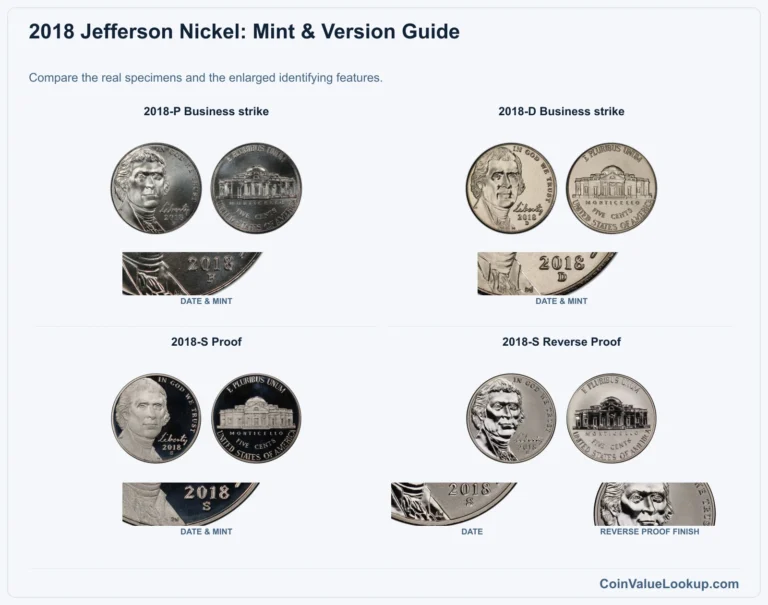
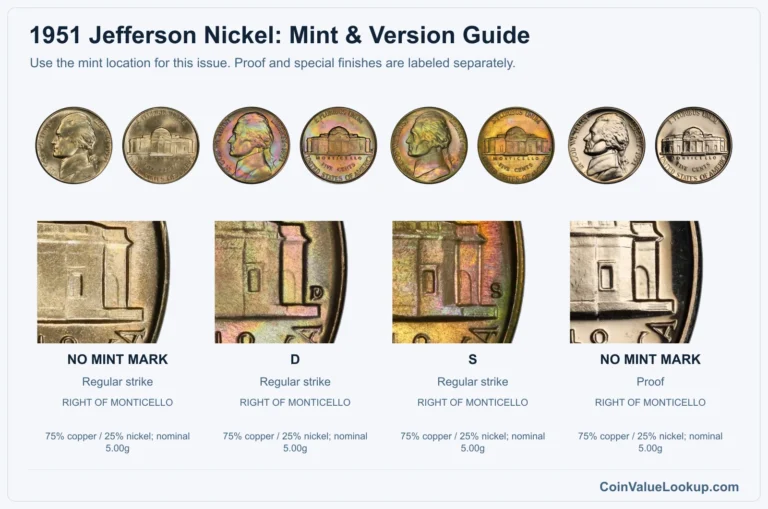
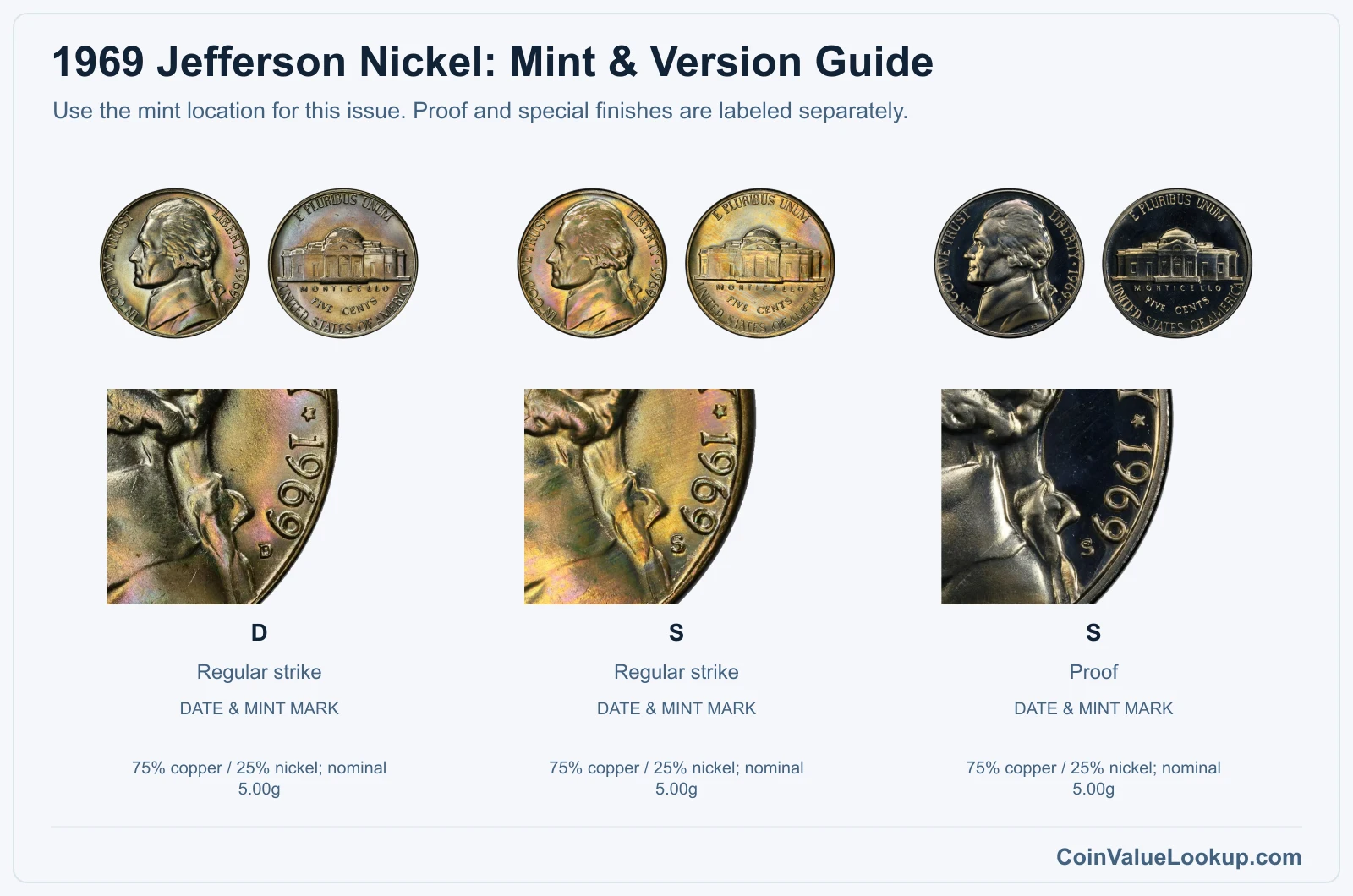
Three distinct versions exist for 1969: the D (Denver) business strike, the S (San Francisco) business strike, and the S proof. Look below the date on the obverse for a small D or S mintmark.
There is no Philadelphia issue this year.
An S mintmark alone does not make your coin a proof. Proofs have mirror-like fields and sharp, squared-off rims from a special striking process.
A circulated S-mint nickel is just a regular coin struck in San Francisco.
All three versions share the same composition: 75% copper and 25% nickel, weighing about 5.00 grams with a plain edge and a diameter of 21.2 mm. If your coin weighs significantly less or more, that could point to an error blank.
Record the date, mintmark, and finish before looking up a value.
Step 2: Check Your 1969 Jefferson Nickel Grade
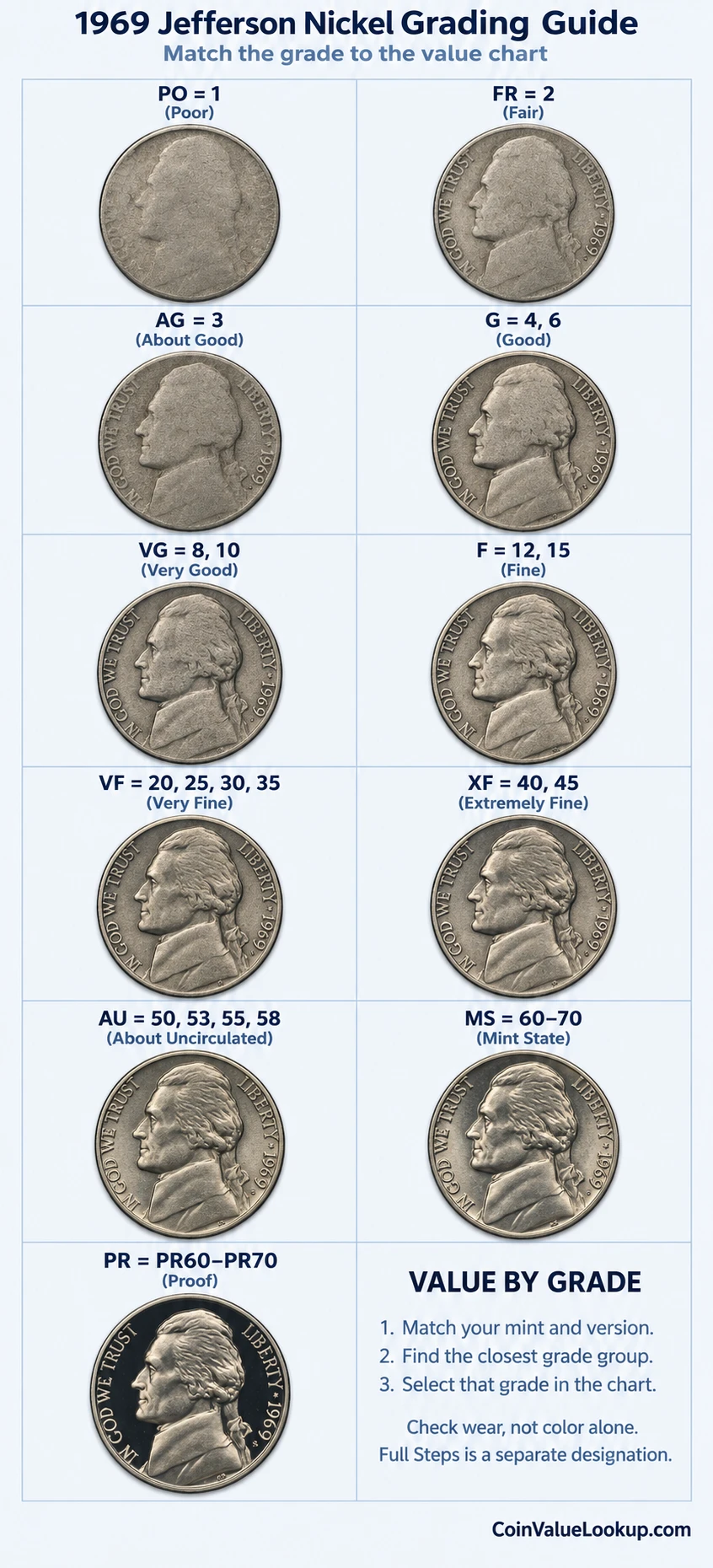
Start with Jefferson's cheek and the hair detail above his ear. On a well-worn coin, the cheek is flat and the hair strands merge into a smooth blob.
A lightly circulated piece retains some texture in the hair but shows dulled luster on high points.
Flip to the reverse and check the roof and columns of Monticello. Wear shows there as softened horizontal lines and mushy pillar edges.
Compare your coin to the grading image for a side-by-side reality check.
Do not confuse a weak strike with actual wear. Some 1969 nickels left the press without fully formed details, especially on the Monticello steps.
Full Steps is a separate strike-quality designation applied only to Mint State coins, meaning the staircase lines on the building are complete and uninterrupted. A shiny surface does not guarantee an uncirculated grade; look for contact marks and luster breaks under good light.
Step 3: Check 1969 Jefferson Nickel Value by Mint and Version
1969 Jefferson Nickel — D Business strike
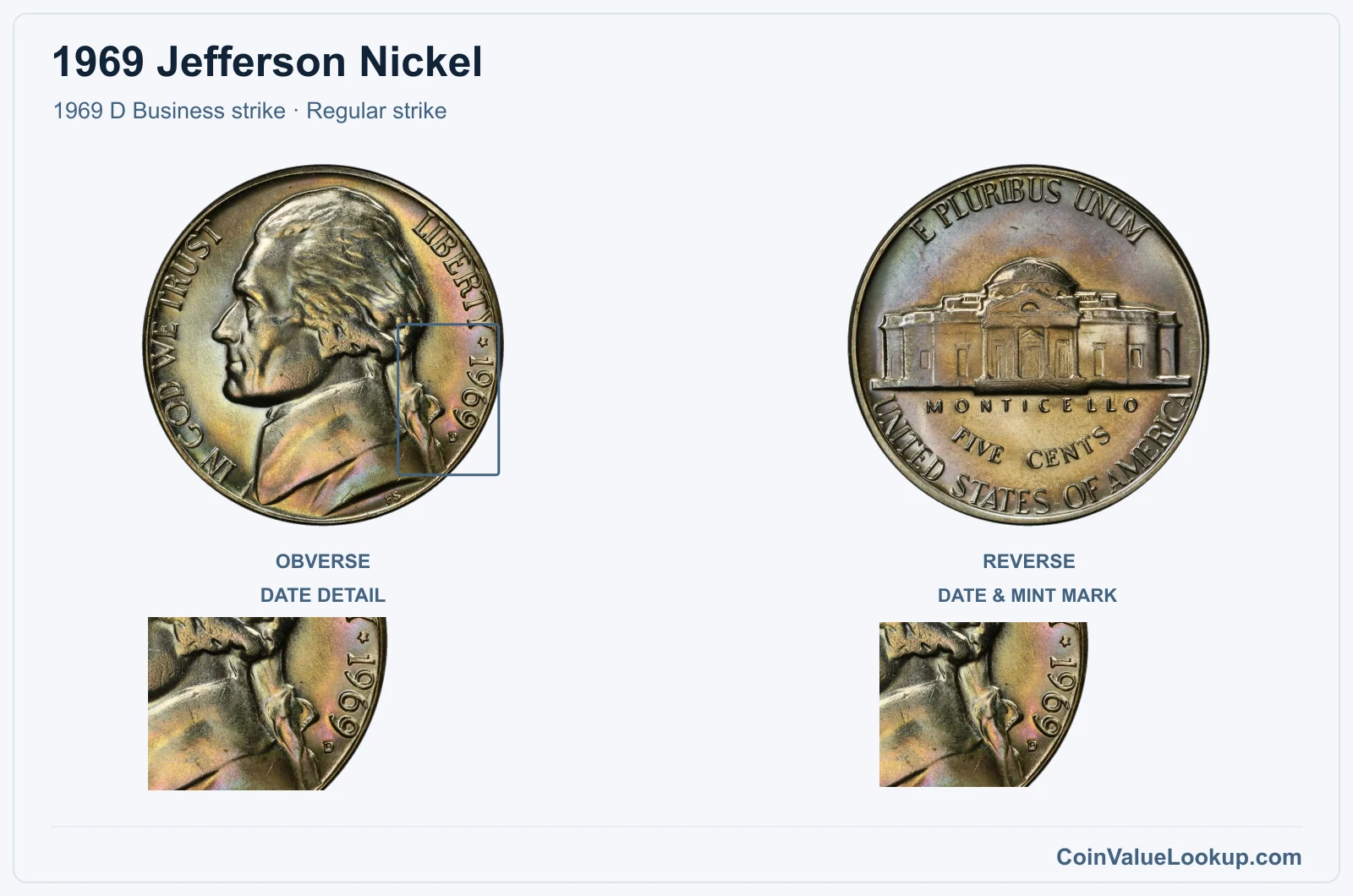
The 1969-D is the Denver mint business strike, identified by the small D below the date. It uses the standard Jefferson portrait obverse and Monticello reverse on a 75% copper, 25% nickel planchet weighing about 5.00 grams.
USA Coin Book guide estimates place it at roughly $0.30 in MS60 and $4.96 in MS65. Circulated examples are worth face value.
Full Steps specimens, where the Monticello staircase lines are fully struck and unbroken, carry a separate premium above these figures.
Coin Value Lookup is a handy place to look up guides for other Jefferson Nickel dates and mintmarks once you have identified your coin.
| Range | Grade | Price | Auction Records | Appraisal |
|---|---|---|---|---|
| PO | PO 1 | — | Coin Identifier | |
| FR | FR 2 | — | Coin Identifier | |
| AG | AG 3 | — | Coin Identifier | |
| G | G 4 | — | Coin Identifier | |
| G 6 | — | Coin Identifier | ||
| VG | VG 8 | — | Coin Identifier | |
| VG 10 | — | Coin Identifier | ||
| F | F 12 | — | Coin Identifier | |
| F 15 | — | Coin Identifier | ||
| VF | VF 20 | — | Coin Identifier | |
| VF 25 | — | Coin Identifier | ||
| VF 30 | — | Coin Identifier | ||
| VF 35 | — | Coin Identifier | ||
| XF | XF 40 | — | Coin Identifier | |
| XF 45 | — | Coin Identifier | ||
| AU | AU 50 | — | Coin Identifier | |
| AU 53 | — | Coin Identifier | ||
| AU 55 | — | Coin Identifier | ||
| AU 58 | — | Coin Identifier | ||
| MS | MS 60 | — | Coin Identifier | |
| MS 61 | — | Coin Identifier | ||
| MS 62 | Coin Identifier | |||
| MS 63 | — | Coin Identifier | ||
| MS 64 | Coin Identifier | |||
| MS 65 | Coin Identifier | |||
| MS 66 | Coin Identifier | |||
| MS 67 | Coin Identifier | |||
| MS 68 | — | — | — | |
| MS 69 | — | — | — | |
| MS 70 | — | — | — |
1969 Jefferson Nickel — S Business strike
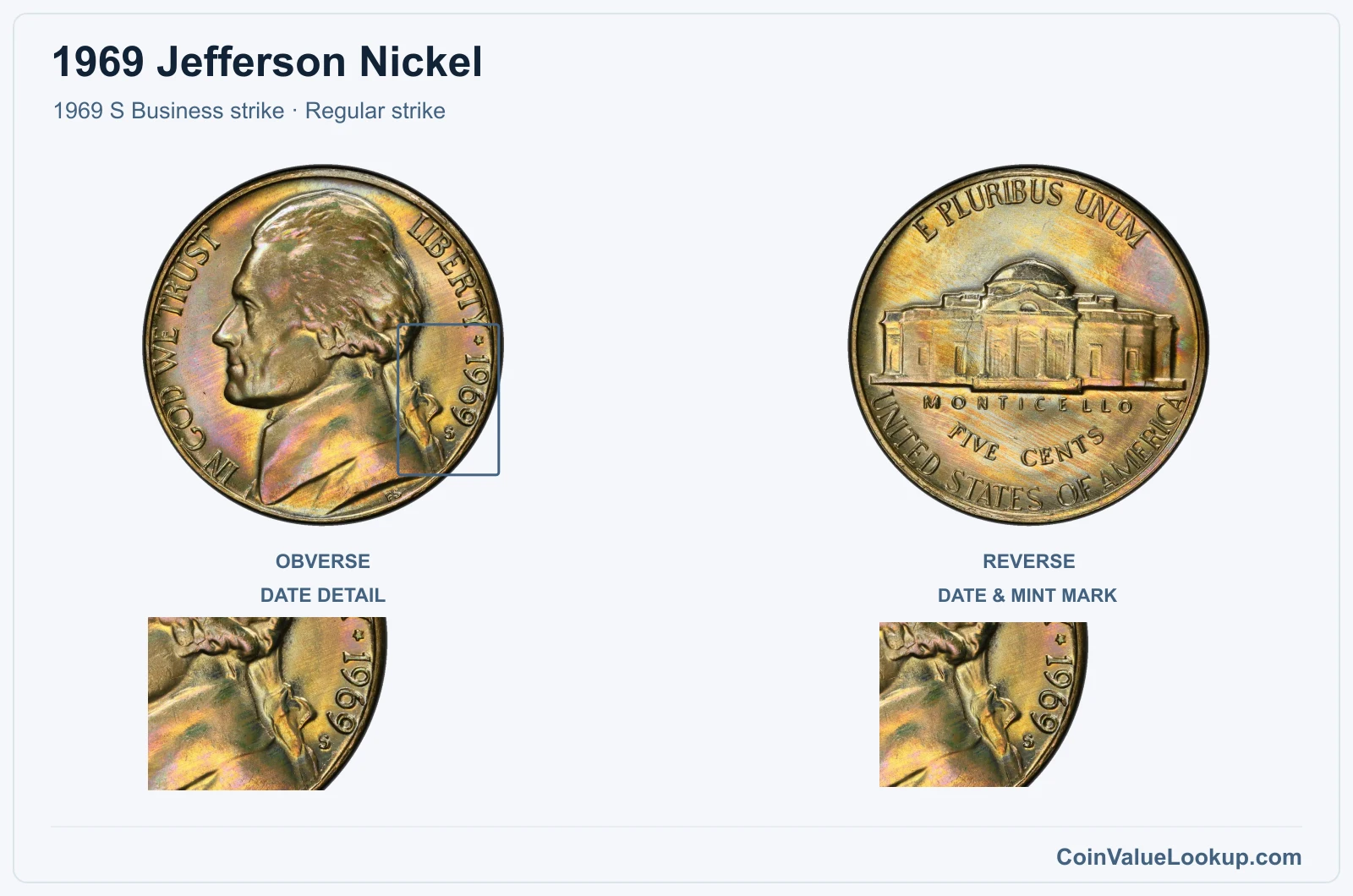
The 1969-S business strike was made in San Francisco for general circulation. You will see an S mintmark below the date on the obverse.
Do not confuse this with a proof; circulation strikes have a normal satin or slightly lustrous finish, not the mirror fields of a proof.
USA Coin Book guide estimates run about $0.30 at MS60 and $2.50 at MS65. That is a lower ceiling than the Denver issue at the same grade.
Worn pieces are common and trade at face value. As always, Full Steps coins are graded separately.
| Range | Grade | Price | Auction Records | Appraisal |
|---|---|---|---|---|
| PO | PO 1 | — | Coin Identifier | |
| FR | FR 2 | — | Coin Identifier | |
| AG | AG 3 | — | Coin Identifier | |
| G | G 4 | — | Coin Identifier | |
| G 6 | — | Coin Identifier | ||
| VG | VG 8 | — | Coin Identifier | |
| VG 10 | — | Coin Identifier | ||
| F | F 12 | — | Coin Identifier | |
| F 15 | — | Coin Identifier | ||
| VF | VF 20 | — | Coin Identifier | |
| VF 25 | — | Coin Identifier | ||
| VF 30 | — | Coin Identifier | ||
| VF 35 | — | Coin Identifier | ||
| XF | XF 40 | — | Coin Identifier | |
| XF 45 | — | Coin Identifier | ||
| AU | AU 50 | — | Coin Identifier | |
| AU 53 | — | Coin Identifier | ||
| AU 55 | — | Coin Identifier | ||
| AU 58 | — | Coin Identifier | ||
| MS | MS 60 | — | Coin Identifier | |
| MS 61 | — | Coin Identifier | ||
| MS 62 | Coin Identifier | |||
| MS 63 | — | Coin Identifier | ||
| MS 64 | Coin Identifier | |||
| MS 65 | — | Coin Identifier | ||
| MS 66 | Coin Identifier | |||
| MS 67 | — | Coin Identifier | ||
| MS 68 | — | — | — | |
| MS 69 | — | — | — | |
| MS 70 | — | — | — |
1969 Jefferson Nickel — S Proof
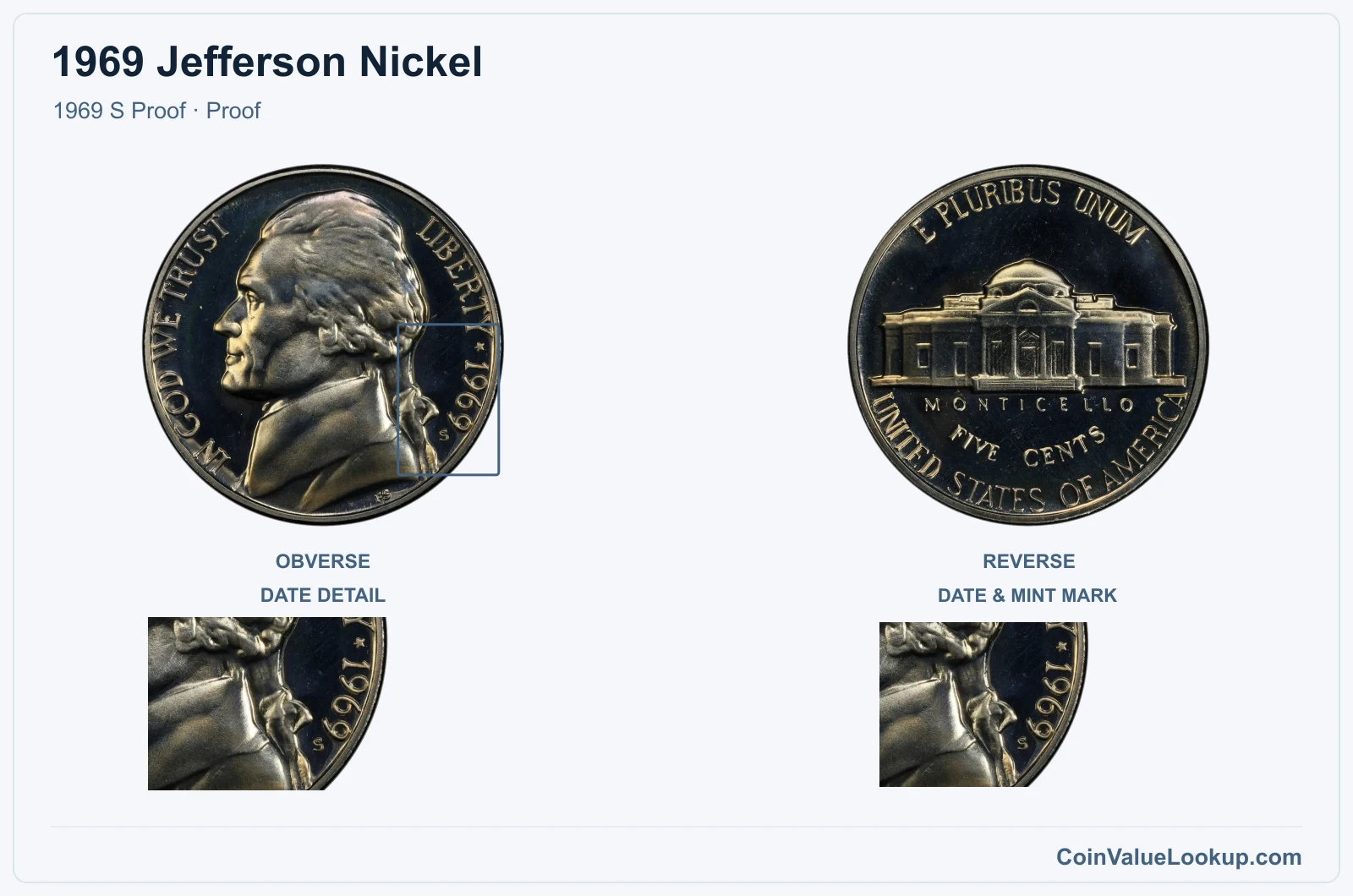
The 1969-S proof was struck at San Francisco with specially prepared dies, producing mirror-like fields and crisp design details. It carries the same S mintmark as the business strike, so the finish is your main clue.
USA Coin Book estimates about $3.62 at PR65. Some certified examples may show cameo contrast, where frosted design elements stand out against the reflective fields.
Proof coins were sold in government sets, so most survivors are in decent shape. Check for haze, hairlines, or toning that might affect the grade.
| Range | Grade | Price | Auction Records | Appraisal |
|---|---|---|---|---|
| PR | PR 1 | — | Coin Identifier | |
| PR 2 | — | Coin Identifier | ||
| PR 3 | — | Coin Identifier | ||
| PR 4 | — | Coin Identifier | ||
| PR 6 | — | Coin Identifier | ||
| PR 8 | — | Coin Identifier | ||
| PR 10 | — | Coin Identifier | ||
| PR 12 | — | Coin Identifier | ||
| PR 15 | — | Coin Identifier | ||
| PR 20 | — | Coin Identifier | ||
| PR 25 | — | Coin Identifier | ||
| PR 30 | — | Coin Identifier | ||
| PR 35 | — | Coin Identifier | ||
| PR 40 | — | Coin Identifier | ||
| PR 45 | — | Coin Identifier | ||
| PR 50 | — | Coin Identifier | ||
| PR 53 | — | Coin Identifier | ||
| PR 55 | — | Coin Identifier | ||
| PR 58 | — | Coin Identifier | ||
| PR 60 | — | Coin Identifier | ||
| PR 61 | — | Coin Identifier | ||
| PR 62 | — | Coin Identifier | ||
| PR 63 | — | Coin Identifier | ||
| PR 64 | — | Coin Identifier | ||
| PR 65 | Coin Identifier | |||
| PR 66 | Coin Identifier | |||
| PR 67 | Coin Identifier | |||
| PR 68 | Coin Identifier | |||
| PR 69 | Coin Identifier | |||
| PR 70 | — | — | — |
1969 Jefferson Nickel Error List
1. 1969 Jefferson Nickel — Struck on a cent planchet
This error occurs when a copper cent blank accidentally enters the nickel press. The result is a coin roughly the size of a penny carrying the full Jefferson nickel design, but the legends and rim are cropped or stretched because the blank is smaller and thinner than intended.
A normal nickel weighs about 5.00 grams; a struck-on-cent-planchet example weighs around 3.1 grams and shows a distinctly copper-colored surface. Check the edge for copper color as well.
A 1969-D example graded NGC MS65 RB sold at Heritage Auctions in August 2010 for $460.
Lookalikes include copper-plated nickels, chemically toned coins, and nickels that have been ground down to reduce their diameter. Weight is your first screening tool.
2. 1969 Jefferson Nickel — Split blank before strike
A split-before-strike error means the planchet delaminated internally before the dies impressed the design. The result is a thinner-than-normal coin, often with a rough, porous texture on one side where the inner metal was exposed, while the struck design appears weak or incomplete.
A 1969-D example authenticated by NGC weighed only 4.2 grams instead of the expected 5.00 grams. It sold at Heritage Auctions in December 2024 for $64; no numeric grade was supplied in the listing.
Be careful with lookalikes. Acid-etched coins, ground-down surfaces, and post-mint peeling can mimic the rough texture of a genuine split blank.
Certification from a major grading service is the safest route for confirmation.
3. 1969 Jefferson Nickel — Struck through tape
A struck-through-tape error happens when a piece of tape gets between the die and the planchet during striking. The tape blocks part of the impression, leaving a distinctive smooth, slightly depressed area on the finished coin, usually visible on both faces.
A 1969-S nickel graded NGC MS64 with tape impressions on both sides sold at Heritage Auctions in August 2010 for $322. That is a strong result for a nickel error, reflecting the clarity of the strike-through across both faces.
Do not confuse this with adhesive residue stuck to a coin after it left the mint, or with scratches and contact marks. Genuine struck-through impressions are pressed into the coin's surface as part of the strike, not sitting on top of it.
4. 1969 Jefferson Nickel — Obverse die break
An obverse die break on the 1969-S nickel shows up as a raised irregular ridge of metal near the rim, in this case spanning roughly the 12 o'clock to 2 o'clock area. The break occurs when part of the die cracks and falls away; metal flows into the gap during striking, producing that characteristic raised blob.
A 1969-S example graded NGC MS65 with a break in that position sold at Heritage Auctions in August 2010 for $94. Size and location of the break affect desirability.
Lookalikes include gouges, solder, or foreign metal glued to the rim after striking. A genuine die break is part of the coin's surface, not a separate piece sitting on top.
Tilt the coin under a light to see whether the raised area has the same luster and metal tone as the surrounding design.
5. 1969 Jefferson Nickel — Repunched Mintmark
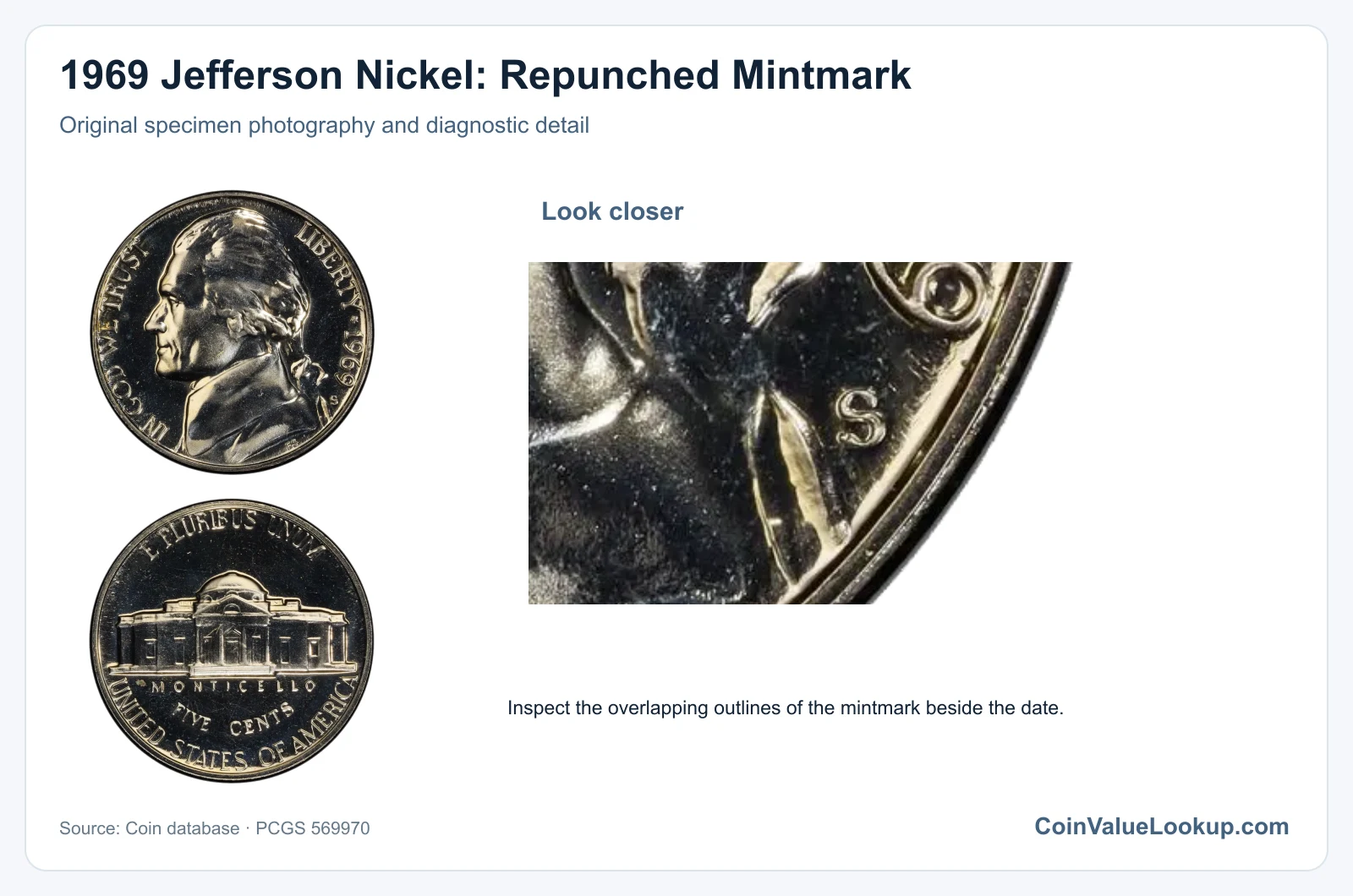
A repunched mintmark on the 1969-S nickel means the S mintmark was impressed into the die more than once in slightly different positions. Under magnification, you can see traces of an earlier punch alongside or beneath the final S.
Compare the mintmark area closely to a normal 1969-S under the same magnification and lighting. Genuine repunching shows consistent extra outlines or notching that follows the shape of the letter.
Condition, the degree of visible separation, and the specific variety all influence what a repunched mintmark example is worth. Machine doubling, small die chips near the mintmark, and corrosion can produce similar-looking marks, so careful comparison is essential before drawing conclusions.
6. 1969 Jefferson Nickel — Doubled Die Obverse
Doubled die obverse varieties for the 1969 nickel show consistent doubling on obverse lettering or design elements. This is a hub-doubling phenomenon, distinct from the flat, shelf-like distortion of machine doubling.
To check, examine the obverse inscriptions and portrait details under magnification. Look for clear, consistent separation or notching on letters.
The doubling should appear the same way on every affected element, not random.
Value depends on the strength of the doubling, the specific variety, and the coin's condition. Reflections, worn die contours, and machine doubling are the most common lookalikes.
If you think you have one, compare directly to a confirmed normal example at the same angle and lighting before seeking professional attribution.
7. 1969 Jefferson Nickel — Doubled Die Reverse
Doubled die reverse varieties on the 1969 nickel affect the Monticello side. Reverse lettering, building details, or denomination text may show consistent, repeatable doubling that results from a misaligned hub impression during die production.
Use magnification and compare the reverse legends on your coin to those on a known normal 1969 nickel. Genuine hub doubling produces raised, separated outlines on affected elements, while machine doubling tends to look flat and shelf-like.
The value of any doubled die reverse depends on the variety, the visibility of the doubling, and overall coin condition. Random damage, reflections from strong lighting, and machine doubling are the usual suspects that mimic a true doubled die.
Professional attribution is the safest path.
8. 1969 Jefferson Nickel — Off-Center Strike
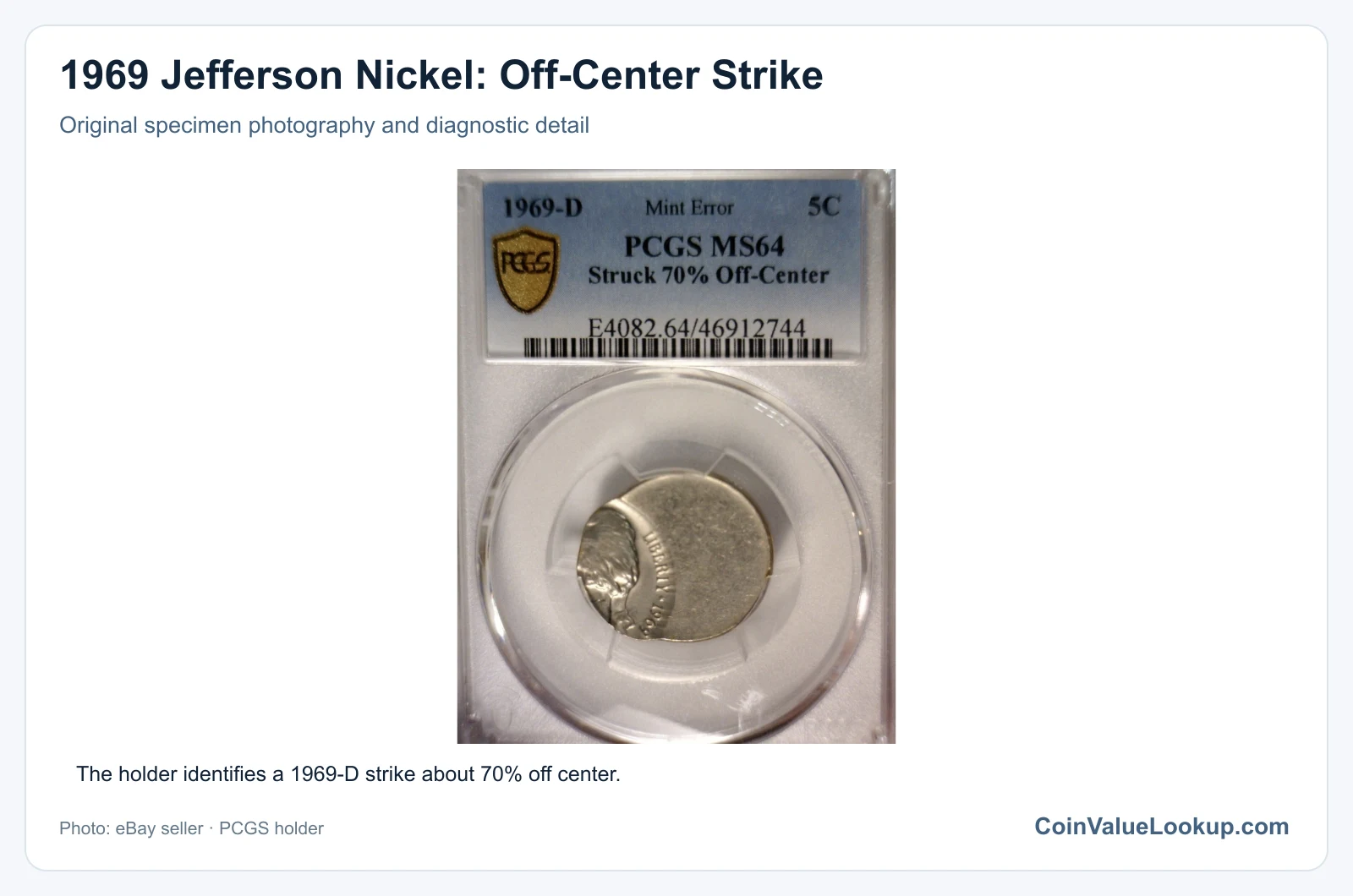
An off-center strike on the 1969-D nickel occurs when the blank is not properly seated between the dies. The result is a coin with a crescent-shaped unstruck area and a displaced design.
The most collectible off-center errors still show a readable date. Without the date, attribution becomes difficult and value drops significantly.
Look at the blank crescent edge, which should be smooth and rounded, consistent with an unstruck planchet edge rather than post-mint damage.
Value depends on the percentage of off-center displacement and the coin's condition. A clipped planchet, one-sided die misalignment, or post-mint flattening can look superficially similar.
A genuine off-center strike shifts the entire design uniformly in one direction.