2018 Jefferson Nickel Coin Value: How Much Is It Worth?
The 2018 Jefferson nickel is a common modern issue, and most circulated examples are worth face value. For Philadelphia and Denver business strikes in typical Mint State grades, retail guide estimates run about $0.30 at MS60 to around $0.61 at MS65.
Proofs and the special Reverse Proof finish carry their own separate pricing. Authentic error coins need individual assessment based on the specific variety, its severity and the coin's condition.
Fast Way to Identify Your 2018 Jefferson Nickel
Snap a clear photo of the front and back of your 2018 nickel and upload both images. Our preliminary identification tool can help you figure out the mint mark, finish type and whether your coin might be a version worth a closer look.
It is not a substitute for professional authentication, but it is a solid first step.
2018 Jefferson Nickel Value
Upload both sides of your 2018 Jefferson Nickel.
Front Obverse
Upload photo
Back Reverse
Upload photo
Which 2018 Jefferson Nickel Versions Are Worth Money?
- Certified high-grade business strikes (MS67 and above) and coins with Full Steps designations can command premiums well beyond the ordinary guide anchors for MS60–MS65.
- The 2018-S Proof is a collector-only issue with a separate market from circulation strikes — a retail guide lists about $5.30 at PR65.
- The 2018-S Reverse Proof, with its inverted contrast pattern, carries a guide estimate of roughly $22 at PR65, making it the priciest standard version of this year's nickel.
- Authenticated error varieties such as doubled dies, broadstrikes and struck-through errors each require individual assessment but can carry meaningful premiums over face value.
Step 1: Identify Your 2018 Jefferson Nickel Mint Mark and Version
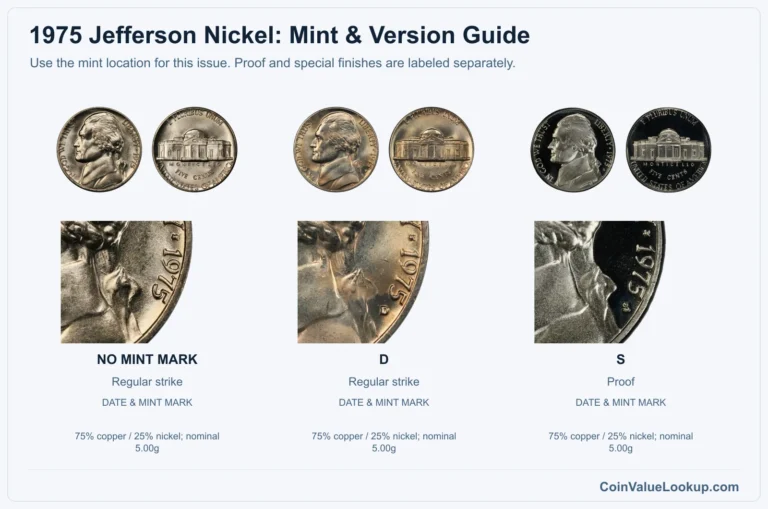
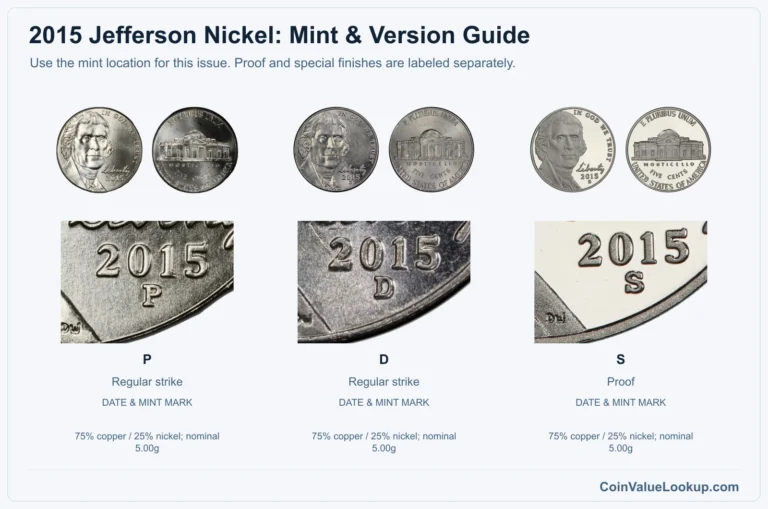
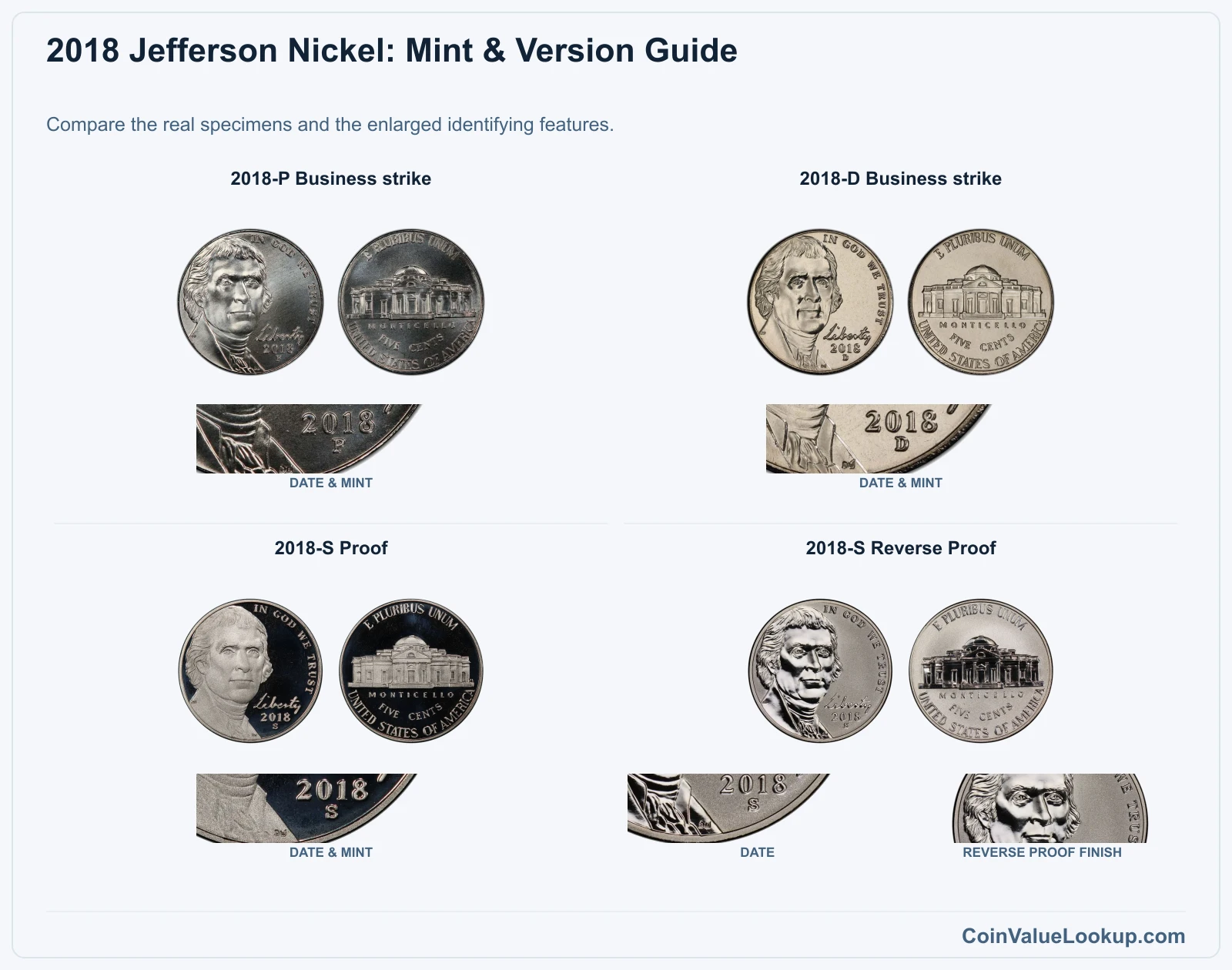
Flip your coin to the obverse — the side with Jefferson facing forward. Look just below the date for the mint mark: P for Philadelphia, D for Denver, or S for San Francisco.
All three mints struck this coin in 75% copper and 25% nickel, weighing 5 grams with a 21.2 mm diameter and a plain edge.
The reverse shows Monticello, Jefferson's Virginia estate. Every 2018 nickel shares this same design, so the key branch points are mint mark and finish.
Business strikes from P and D have a uniform, slightly satiny luster. S-mint coins come in two collector finishes: standard proof (mirrored fields, frosted devices) and reverse proof (frosted fields, mirrored devices).
A shiny coin pulled from pocket change is not a proof — proofs were sold in sealed sets, not released into circulation.
The 2018 nickel is copper-nickel regardless of which set it came from. The San Francisco Silver Reverse Proof Set included this nickel, but the nickel itself contains no silver.
That is a common point of confusion.
Step 2: Check Your 2018 Jefferson Nickel Grade
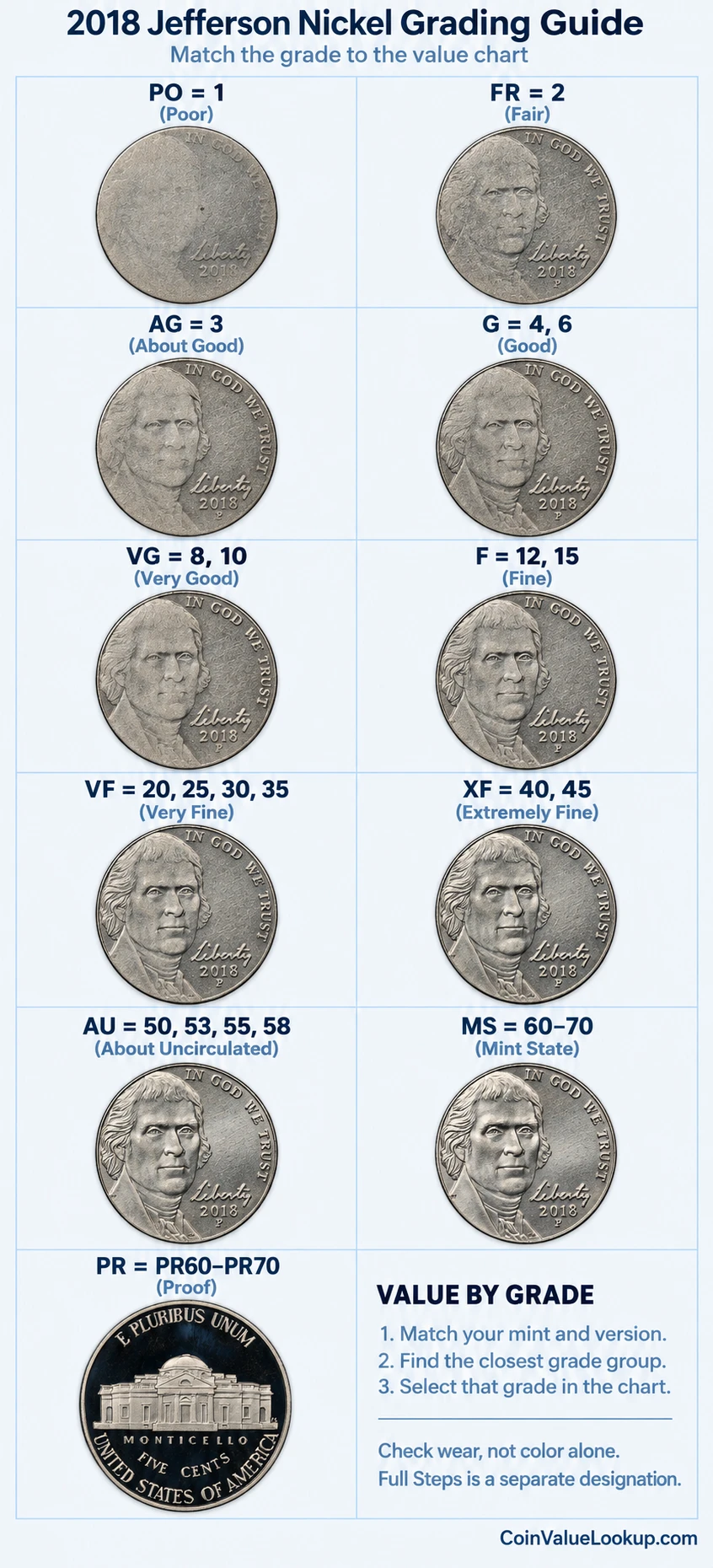
Start with the obverse high points: Jefferson's cheek, the hair detail above his ear and the shoulder line. These wear first.
A coin with full, unbroken luster and no contact marks in the cheek area is a candidate for higher Mint State grades.
On the reverse, examine the steps of Monticello. Strike sharpness here can earn a Full Steps designation from grading services, but that label is independent of the numerical grade — a coin can be MS65 without Full Steps and MS63 with them.
For proofs, look at the mirror quality of the fields and the crispness of the frosted devices. Proof contrast is a finish characteristic, not a bump in grade.
Hairlines and haze are the main enemies of proof grades.
Use the comparison image to match your coin's wear pattern against known grade examples. Compare only within the same finish type; holding a business strike next to a proof will just confuse things.
Step 3: Check 2018 Jefferson Nickel Value by Mint and Version
2018 Jefferson Nickel — P Business strike
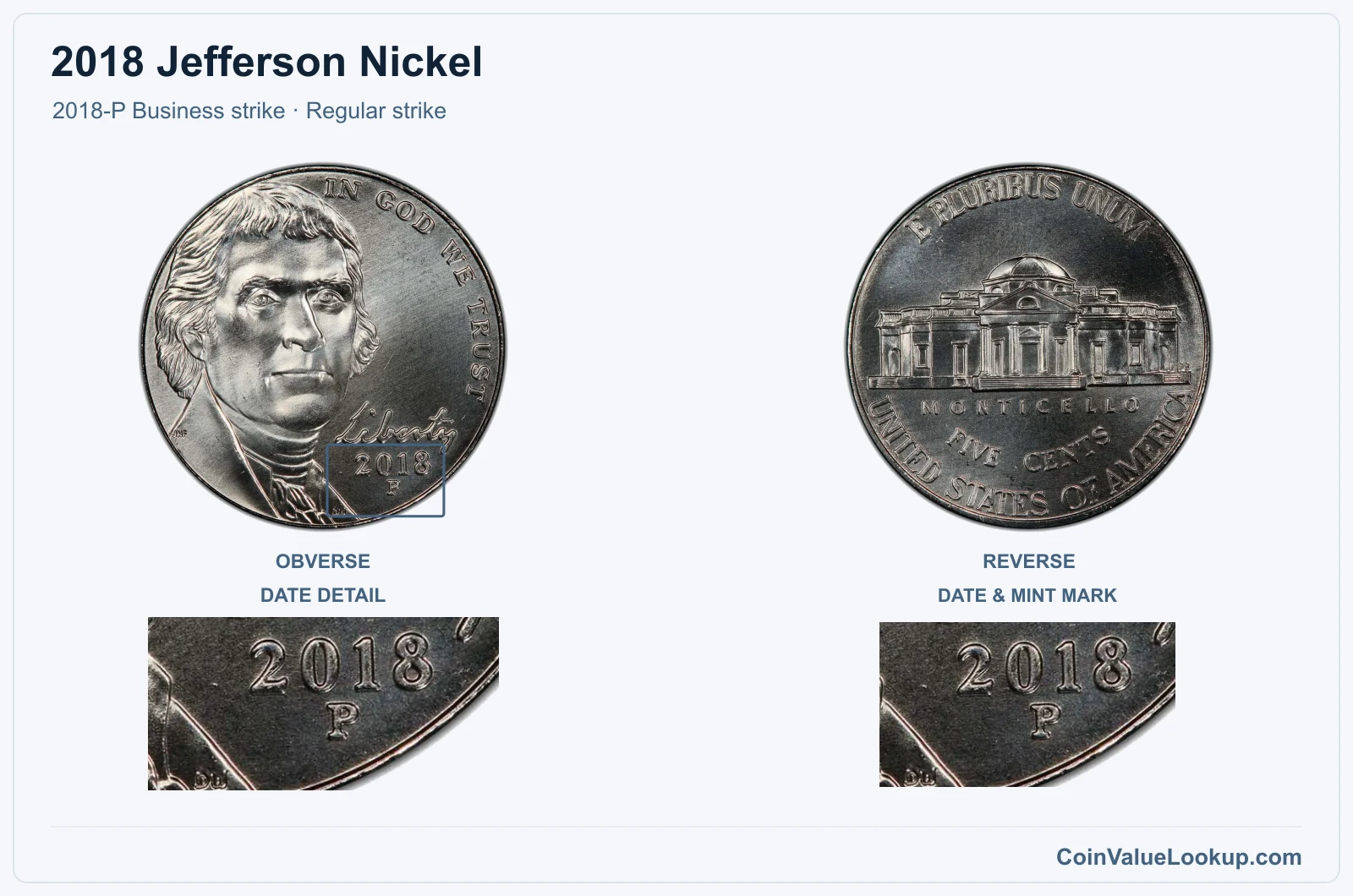
The 2018-P is the Philadelphia business strike. You will find a small "P" below the date on the obverse.
It was struck for everyday commerce, so most survivors show wear and are worth five cents.
In uncirculated condition, a retail guide places this coin around $0.30 at MS60 and about $0.61 at MS65. Those anchors reflect ordinary examples without special designations.
Coins certified at substantially higher grades, or those awarded a Full Steps designation for sharp Monticello steps, trade in a different bracket entirely.
| Range | Grade | Price | Auction Records | Appraisal |
|---|---|---|---|---|
| PO | PO 1 | — | Coin Identifier | |
| FR | FR 2 | — | Coin Identifier | |
| AG | AG 3 | — | Coin Identifier | |
| G | G 4 | — | Coin Identifier | |
| G 6 | — | Coin Identifier | ||
| VG | VG 8 | — | Coin Identifier | |
| VG 10 | — | Coin Identifier | ||
| F | F 12 | — | Coin Identifier | |
| F 15 | — | Coin Identifier | ||
| VF | VF 20 | — | Coin Identifier | |
| VF 25 | — | Coin Identifier | ||
| VF 30 | — | Coin Identifier | ||
| VF 35 | — | Coin Identifier | ||
| XF | XF 40 | — | Coin Identifier | |
| XF 45 | — | Coin Identifier | ||
| AU | AU 50 | — | Coin Identifier | |
| AU 53 | — | Coin Identifier | ||
| AU 55 | — | Coin Identifier | ||
| AU 58 | — | Coin Identifier | ||
| MS | MS 60 | — | Coin Identifier | |
| MS 61 | — | Coin Identifier | ||
| MS 62 | — | Coin Identifier | ||
| MS 63 | — | Coin Identifier | ||
| MS 64 | — | Coin Identifier | ||
| MS 65 | — | Coin Identifier | ||
| MS 66 | — | — | — | |
| MS 67 | — | — | — | |
| MS 68 | — | — | — | |
| MS 69 | — | — | — | |
| MS 70 | — | — | — |
2018 Jefferson Nickel — D Business strike
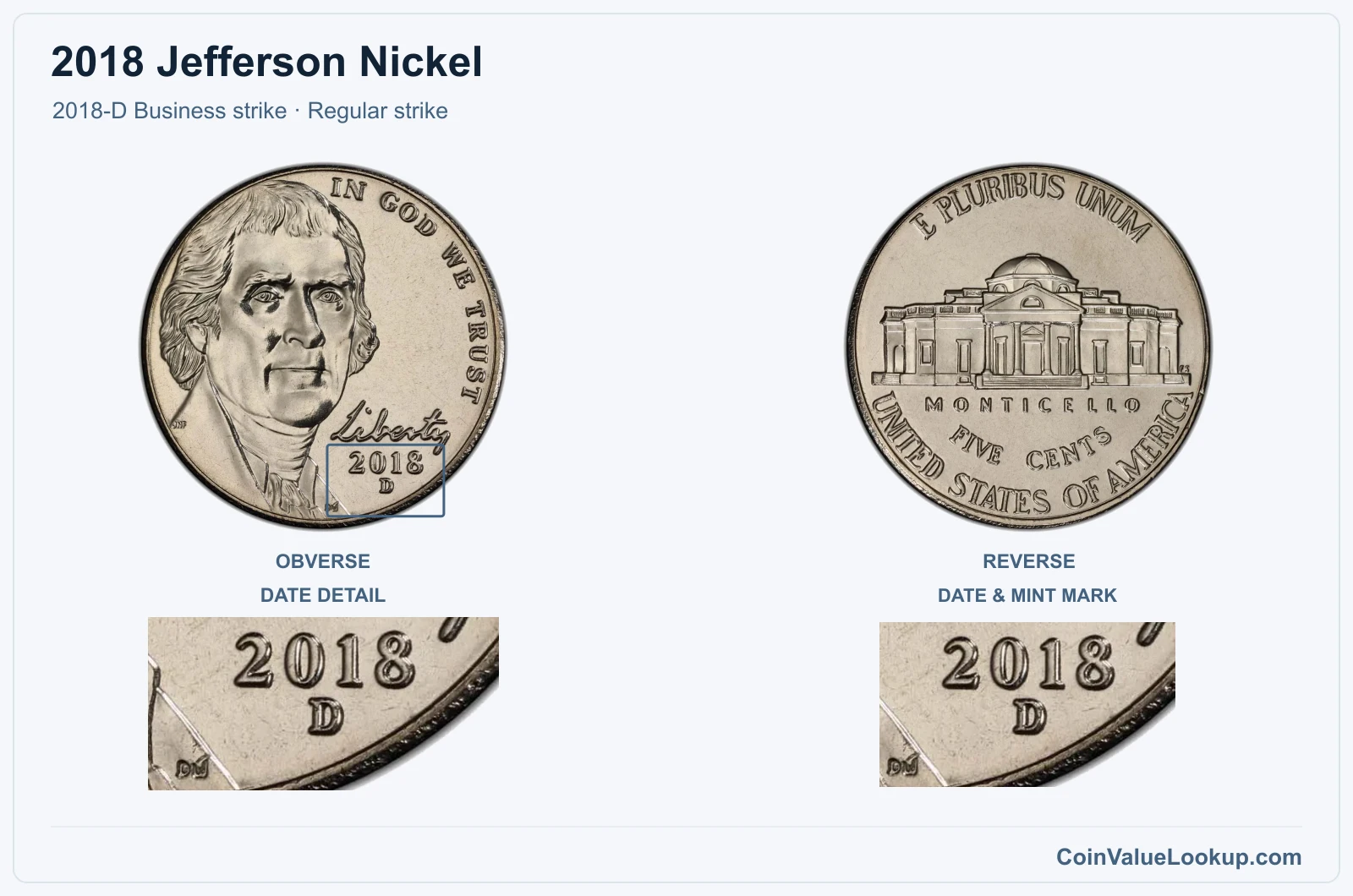
The 2018-D carries a "D" mint mark below the date, indicating it was struck at the Denver Mint. In hand, it looks identical to the Philadelphia issue aside from that letter.
Retail guide anchors match the P: roughly $0.30 at MS60 and $0.61 at MS65. Again, these figures cover ordinary business strikes.
Full Steps examples or coins graded well above MS65 are a separate conversation, and the guide anchors listed here do not represent those premium tiers.
| Range | Grade | Price | Auction Records | Appraisal |
|---|---|---|---|---|
| PO | PO 1 | — | Coin Identifier | |
| FR | FR 2 | — | Coin Identifier | |
| AG | AG 3 | — | Coin Identifier | |
| G | G 4 | — | Coin Identifier | |
| G 6 | — | Coin Identifier | ||
| VG | VG 8 | — | Coin Identifier | |
| VG 10 | — | Coin Identifier | ||
| F | F 12 | — | Coin Identifier | |
| F 15 | — | Coin Identifier | ||
| VF | VF 20 | — | Coin Identifier | |
| VF 25 | — | Coin Identifier | ||
| VF 30 | — | Coin Identifier | ||
| VF 35 | — | Coin Identifier | ||
| XF | XF 40 | — | Coin Identifier | |
| XF 45 | — | Coin Identifier | ||
| AU | AU 50 | — | Coin Identifier | |
| AU 53 | — | Coin Identifier | ||
| AU 55 | — | Coin Identifier | ||
| AU 58 | — | Coin Identifier | ||
| MS | MS 60 | — | Coin Identifier | |
| MS 61 | — | Coin Identifier | ||
| MS 62 | — | Coin Identifier | ||
| MS 63 | — | Coin Identifier | ||
| MS 64 | — | Coin Identifier | ||
| MS 65 | — | Coin Identifier | ||
| MS 66 | — | Coin Identifier | ||
| MS 67 | — | — | — | |
| MS 68 | — | — | — | |
| MS 69 | — | — | — | |
| MS 70 | — | — | — |
2018 Jefferson Nickel — S Proof
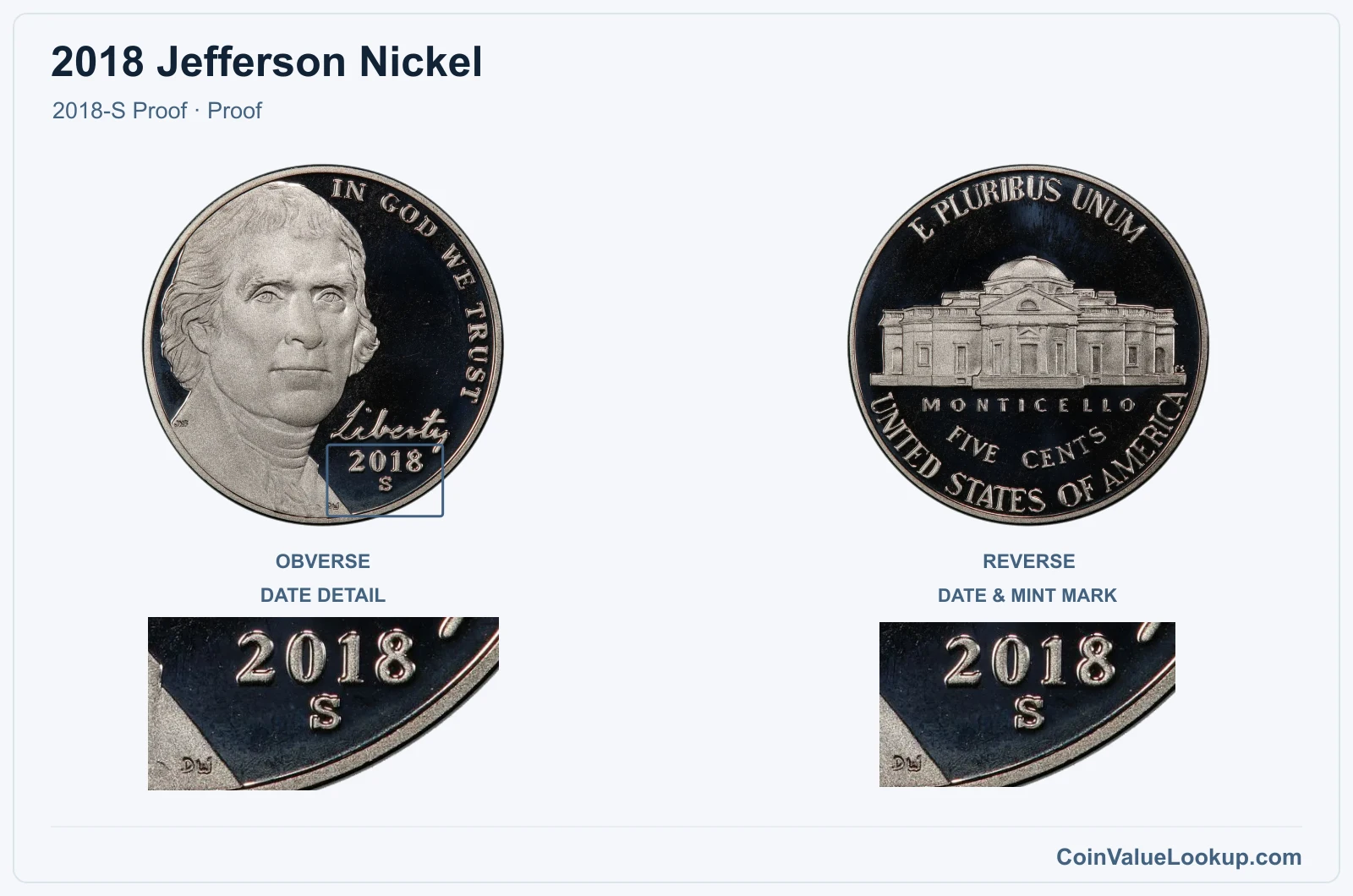
The 2018-S Proof was struck at the San Francisco Mint exclusively for collector sets. It has mirrored fields and frosted raised devices — you can usually spot a proof instantly by its glassy surface.
A retail guide estimates about $5.30 at PR65. Do not confuse a well-preserved business strike with a proof; proofs were never released into circulation.
If your coin came from a cash register, it is not this version.
Coin Value Lookup is a handy place to compare guide values across different years and finishes of the Jefferson nickel series.
| Range | Grade | Price | Auction Records | Appraisal |
|---|---|---|---|---|
| PR | PR 1 | — | Coin Identifier | |
| PR 2 | — | Coin Identifier | ||
| PR 3 | — | Coin Identifier | ||
| PR 4 | — | Coin Identifier | ||
| PR 6 | — | Coin Identifier | ||
| PR 8 | — | Coin Identifier | ||
| PR 10 | — | Coin Identifier | ||
| PR 12 | — | Coin Identifier | ||
| PR 15 | — | Coin Identifier | ||
| PR 20 | — | Coin Identifier | ||
| PR 25 | — | Coin Identifier | ||
| PR 30 | — | Coin Identifier | ||
| PR 35 | — | Coin Identifier | ||
| PR 40 | — | Coin Identifier | ||
| PR 45 | — | Coin Identifier | ||
| PR 50 | — | Coin Identifier | ||
| PR 53 | — | Coin Identifier | ||
| PR 55 | — | Coin Identifier | ||
| PR 58 | — | Coin Identifier | ||
| PR 60 | — | Coin Identifier | ||
| PR 61 | — | Coin Identifier | ||
| PR 62 | — | Coin Identifier | ||
| PR 63 | — | Coin Identifier | ||
| PR 64 | — | Coin Identifier | ||
| PR 65 | — | Coin Identifier | ||
| PR 66 | — | Coin Identifier | ||
| PR 67 | — | Coin Identifier | ||
| PR 68 | — | Coin Identifier | ||
| PR 69 | — | Coin Identifier | ||
| PR 70 | — | Coin Identifier |
2018 Jefferson Nickel — S Reverse Proof
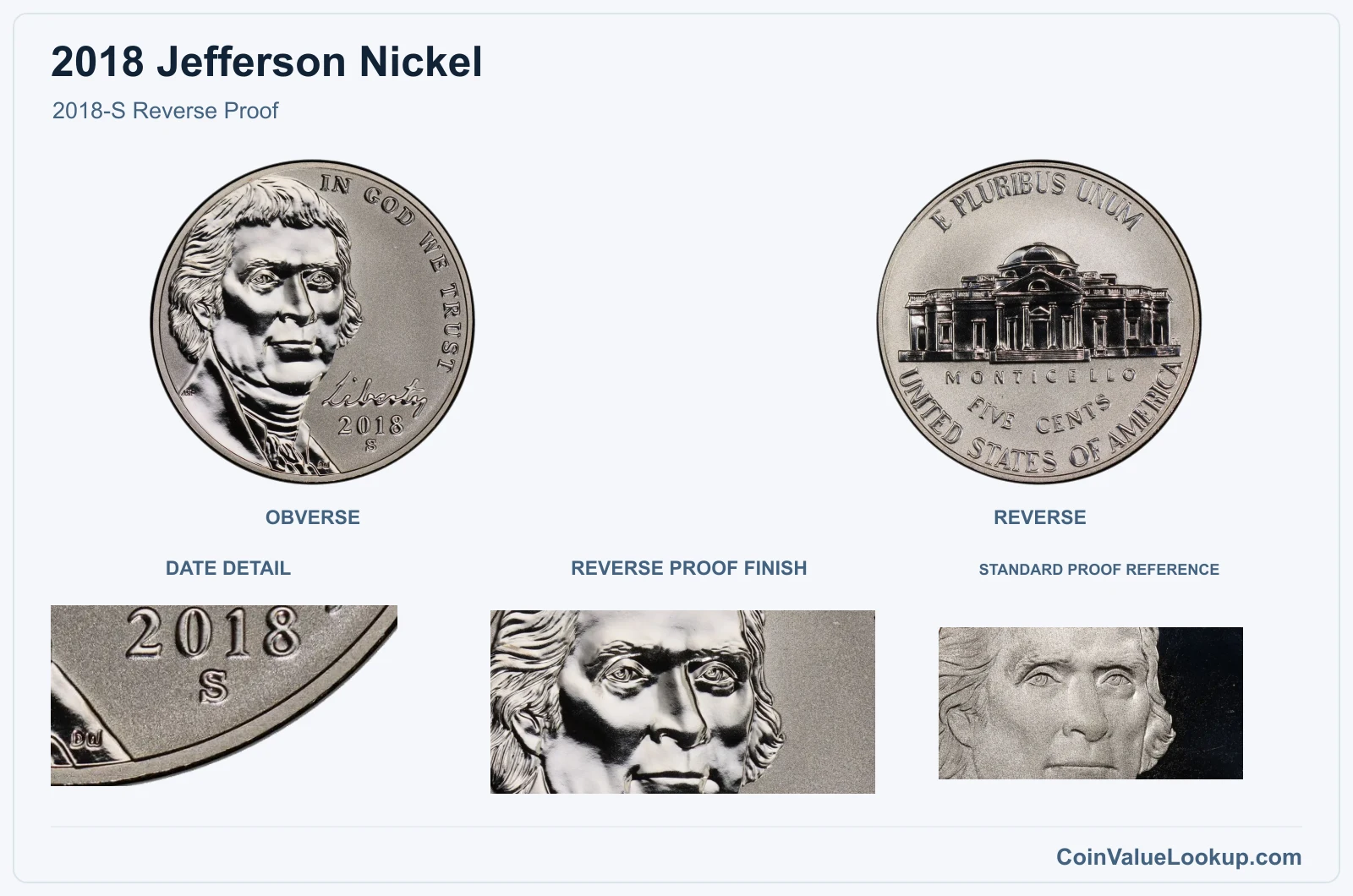
The 2018-S Reverse Proof flips the usual proof contrast: the fields are frosted and the raised design elements are reflective. It was included in the San Francisco Silver Reverse Proof Set, but the nickel itself is standard copper-nickel — the silver designation in the set name applies to other denominations.
A retail guide lists approximately $22 at PR65 for this version. That premium reflects the limited distribution through a specialty set and the distinctive visual effect.
Look for the "S" mint mark and the unmistakable matte-on-mirror appearance to confirm you have a genuine reverse proof rather than a standard proof that has been mishandled.
Range Grade
Price Auction Records Appraisal PR PR 1
—
Coin Identifier
PR 2
—
Coin Identifier
PR 3
—
Coin Identifier
PR 4
—
Coin Identifier
PR 6
—
Coin Identifier
PR 8
—
Coin Identifier
PR 10
—
Coin Identifier
PR 12
—
Coin Identifier
PR 15
—
Coin Identifier
PR 20
—
Coin Identifier
PR 25
—
Coin Identifier
PR 30
—
Coin Identifier
PR 35
—
Coin Identifier
PR 40
—
Coin Identifier
PR 45
—
Coin Identifier
PR 50
—
Coin Identifier
PR 53
—
Coin Identifier
PR 55
—
Coin Identifier
PR 58
—
Coin Identifier
PR 60
—
Coin Identifier
PR 61
—
Coin Identifier
PR 62
—
Coin Identifier
PR 63
—
Coin Identifier
PR 64
—
Coin Identifier
PR 65
—
Coin Identifier
PR 66
—
Coin Identifier
PR 67
—
Coin Identifier
PR 68
—
Coin Identifier
PR 69
—
Coin Identifier
PR 70
—
Coin Identifier
2018 Jefferson Nickel Error List
1. 2018 Jefferson Nickel — Doubled die reverse
A doubled die reverse has been attributed on the 2018-P nickel, with the key diagnostic located below the upper central doorway frame on Monticello. Under magnification, you should see duplicated detail in that area — a clear, consistent secondary image rather than a flat shelf of displaced metal.
Some die chips have been associated with the same die, which can help confirm you are looking at the right variety, but those chips are not the cause of the doubling itself. Machine doubling, surface glare and minor abrasion can all mimic a true doubled die to the naked eye.
No reliable numeric price range is available for this variety. Value depends on the authenticated identity of the die, the severity of the doubling and the coin's overall condition, so individual assessment is necessary.
2. 2018 Jefferson Nickel — Die Crack / Die Chip
Die crack and die chip errors have been reported on 2018 nickels, including a variety sometimes called the "Beehive" die chip. These appear as small raised lumps or thin raised lines on the coin's surface, created when a piece of the die breaks away and fills with metal during striking.
An interior die chip looks like a tiny raised blob, while a crack running to the rim is a die crack. A larger break reaching the rim that displaces the design is called a cud — a different animal.
Look at the coin under good light; raised material from a die break will have a rounded, organic profile.
Do not confuse incuse scratches, corrosion spots or stuck foreign material with genuine die breaks. Value depends on visibility, location and overall coin condition, and no fixed price range applies across all examples.
3. 2018 Jefferson Nickel — Improper Annealing
Improper annealing errors have been reported on 2018 nickels. These result from a problem in the heat-treatment process of the blank planchet before striking.
The coin may show unusual surface discoloration, a streaky or rough texture, or uneven coloring that looks "off" compared to a normal nickel.
The tricky part is distinguishing genuine annealing issues from environmental toning, corrosion or post-mint heat damage. A legitimate annealing error typically affects the surface uniformly or in a pattern consistent with the manufacturing process, and it should appear under the design rather than on top of it.
There is no standard price range for this category. Condition, the degree of the visual anomaly and professional authentication all factor into an individual coin's value.
4. 2018 Jefferson Nickel — Struck-Through Error
Struck-through errors on 2018 nickels occur when foreign material — often grease — sits between the die and the planchet during striking. The result is a localized depression or an area of incomplete design where the obstruction blocked the die's impression.
A grease-filled die typically produces a smooth, slightly sunken blank area, most often on a single design element like a letter or part of Monticello. A struck-through retained object can leave a distinct impression of whatever was trapped.
Do not mistake ordinary wear, weak strike from a worn die, cleaning damage or scratches for a struck-through error. The affected zone on a genuine error will sit below the normal surface plane and have a different character than simple flat wear.
Value varies with the size, location and visual drama of the error, so no fixed price range applies.
5. 2018 Jefferson Nickel — Broadstrike
A broadstrike happens when the collar die — the ring that normally restrains the blank and forms the edge — is absent or out of position during striking. The coin spreads outward under full die pressure, resulting in a slightly larger diameter and a design that reaches closer to (or past) the normal rim area.
Check the edge first: a broadstruck nickel will lack the normal raised rim and may feel slightly wider than a standard 21.2 mm coin. The design should still be roughly centered, which distinguishes a broadstrike from an off-center strike.
Be cautious with coins that simply look flat or wide — a nickel smashed in a vise or run over by a car can mimic the appearance. Genuine broadstrikes show consistent metal flow and full die detail.
No set price range applies; value depends on condition and the degree of spread.
6. 2018 Jefferson Nickel — Doubled Die Obverse
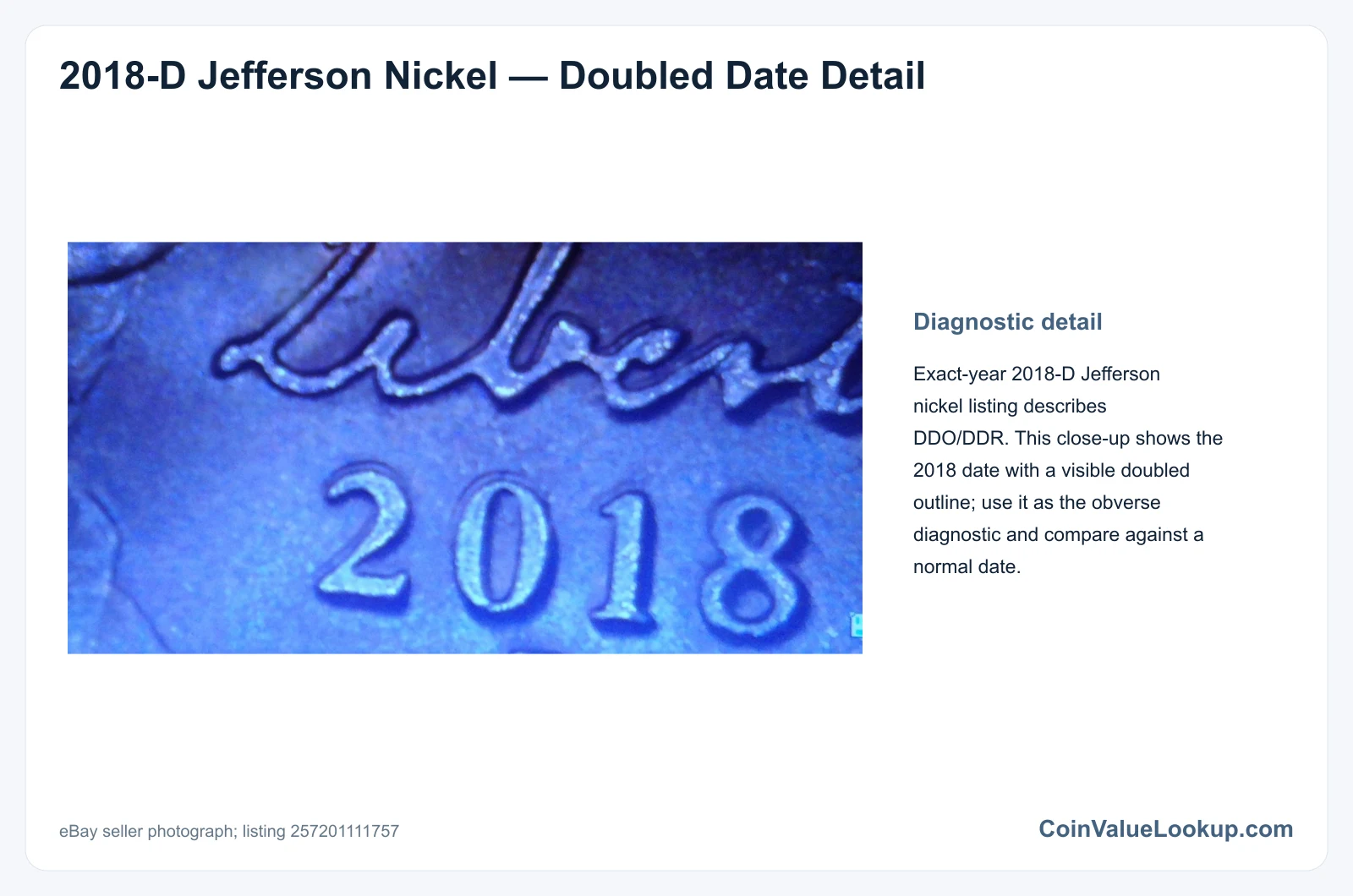
Doubled die obverse errors have been reported for 2018 nickels. The diagnostic to look for is consistent doubling on obverse lettering or design elements — a secondary offset image with clear separation or notching visible under magnification.
Compare your coin to a normal example under the same lighting. True hub doubling produces separation that is uniform across the affected area, while machine doubling tends to create a flat, shelf-like distortion on one side of the device.
Reflections, worn die contours and wishful thinking account for a lot of false positives.
No reliable numeric price range is established for this category. Each example needs to be evaluated on its own based on the strength of the doubling, the die match and the coin's grade.