2015 Jefferson Nickel Coin Value: How Much Is It Worth?
Most 2015 Jefferson nickels you pull from pocket change are worth face value or close to it. According to USA Coin Book guide estimates, ordinary Philadelphia and Denver business strikes range from about $0.30 at MS60 to $0.61 at MS65.
Proofs carry a separate value, and coins with certified exceptional quality, Full Steps designations, or authentic mint errors require individual assessment.
Fast Way to Identify Your 2015 Jefferson Nickel
The quickest way to start figuring out what you have is to upload clear photos of both sides of your coin. A well-lit front and back image lets our identifier give you a preliminary read on the mint, finish, and general type.
It is not a substitute for professional authentication or exact grading, but it points you in the right direction fast.
2015 Jefferson Nickel Value
Upload both sides of your 2015 Jefferson Nickel.
Front Obverse
Upload photo
Back Reverse
Upload photo
Which 2015 Jefferson Nickel Versions Are Worth Money?
- Certified high-grade Mint State coins with Full Steps designations from the P or D mint can command premiums well above face value.
- The 2015-S proof is a distinct collector issue; its market is separate from circulated P and D coins, with a PR65 guide estimate around $5.30.
Step 1: Identify Your 2015 Jefferson Nickel Mint Mark and Version
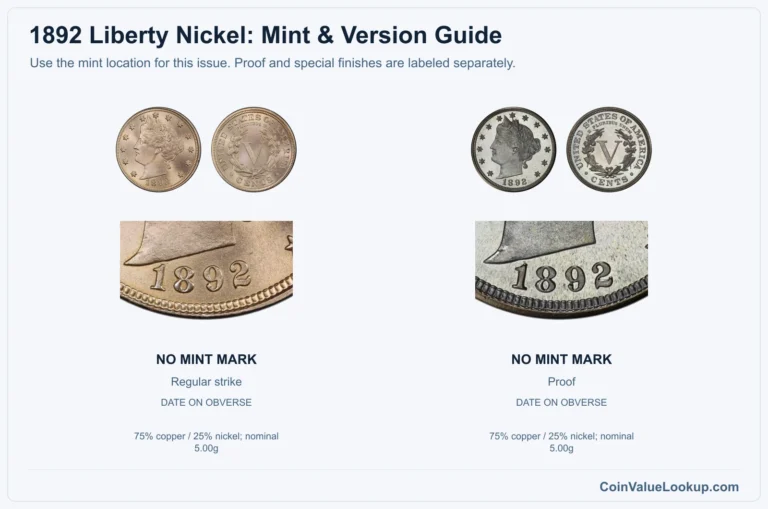
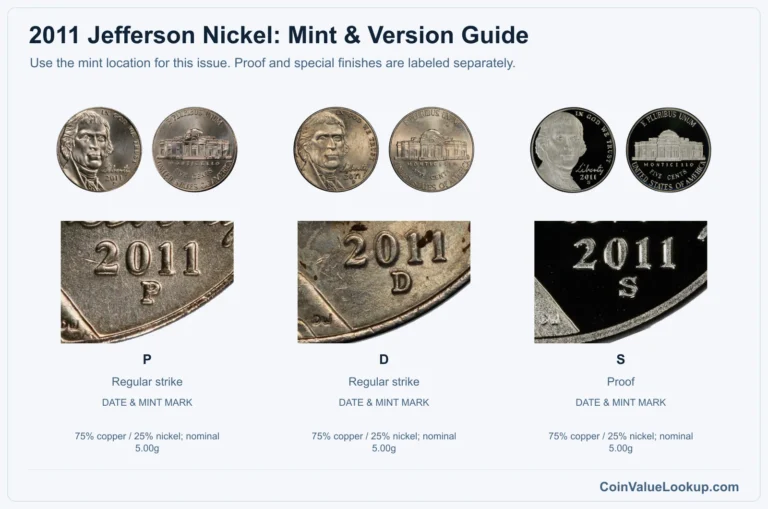
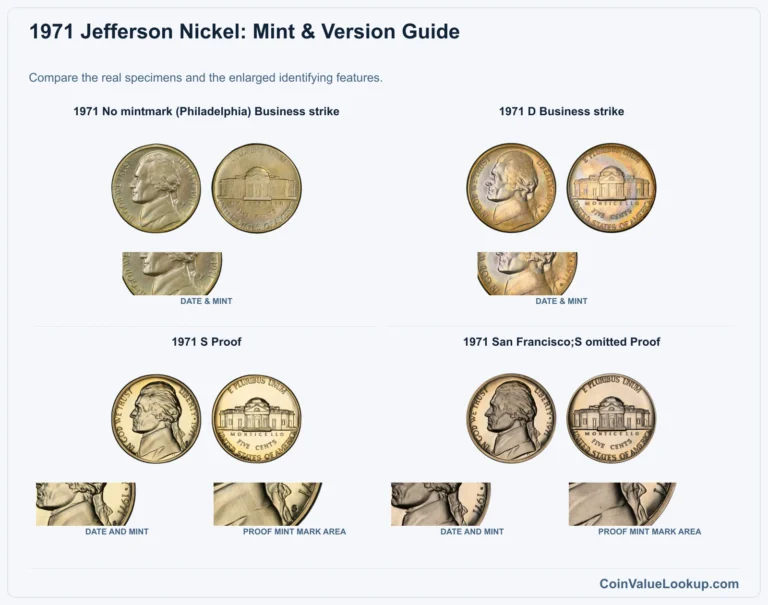
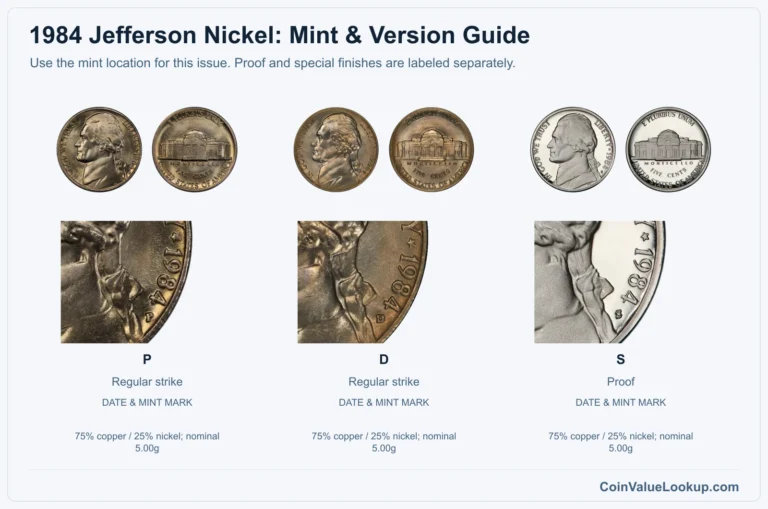
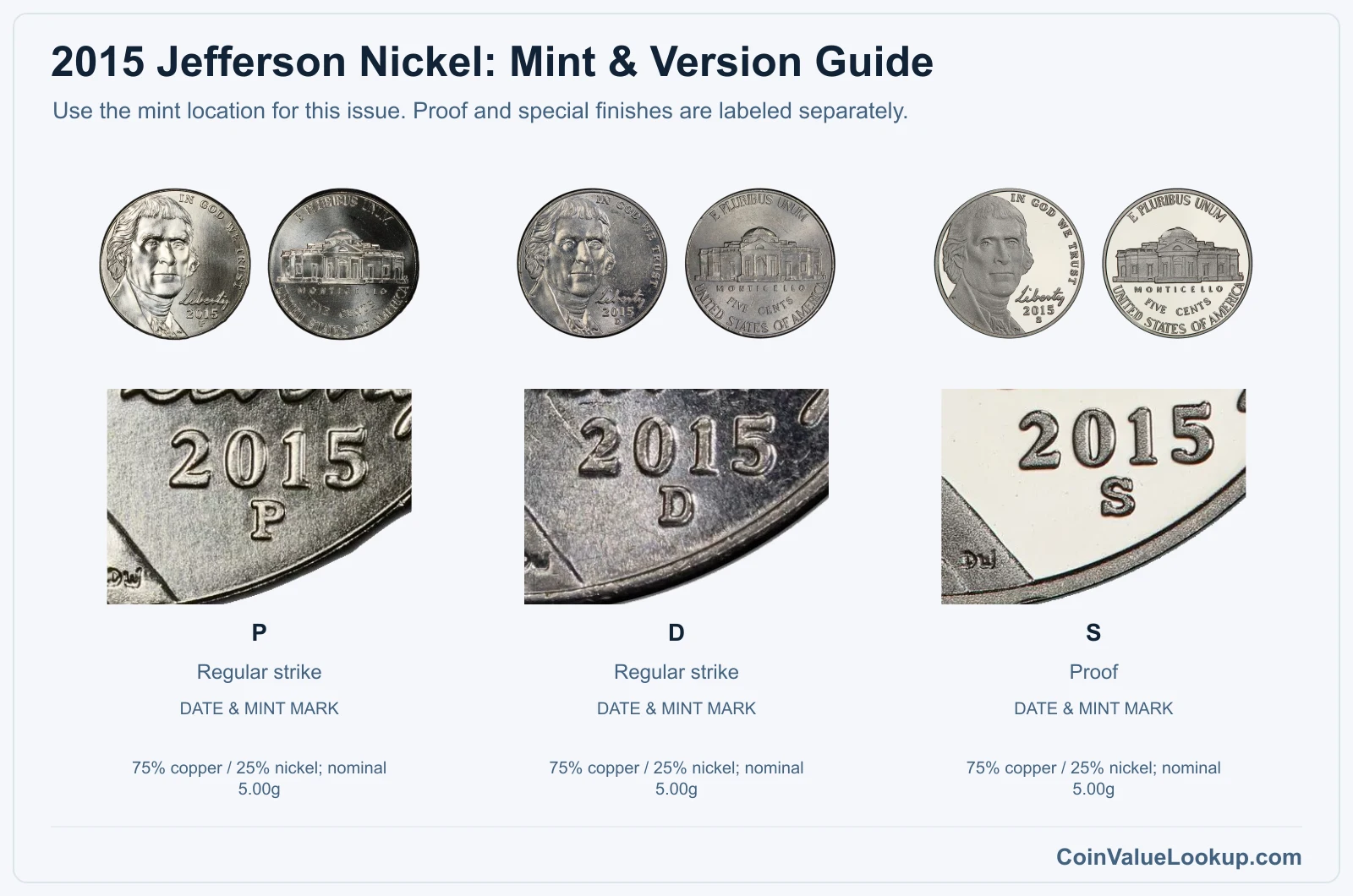
Flip your 2015 nickel obverse-up and look just below the date for a small mintmark letter. You will see P for Philadelphia, D for Denver, or S for San Francisco.
The S mint appears only on proof coins sold in collector sets, so if you found yours in circulation, it is almost certainly a P or D.
All three share the same forward-facing Jefferson portrait on the obverse and a Monticello view on the reverse. The standard alloy is 75% copper and 25% nickel, weighing 5.00 grams with a 21.2 mm diameter and a plain edge.
Before you grade, identify the original finish. Business strikes from P and D have a satiny-to-brilliant luster from high-speed production.
Proof strikes from S show mirror-like fields and sharply detailed devices. A circulated coin that looks shiny from wear is not a proof.
Step 2: Check Your 2015 Jefferson Nickel Grade
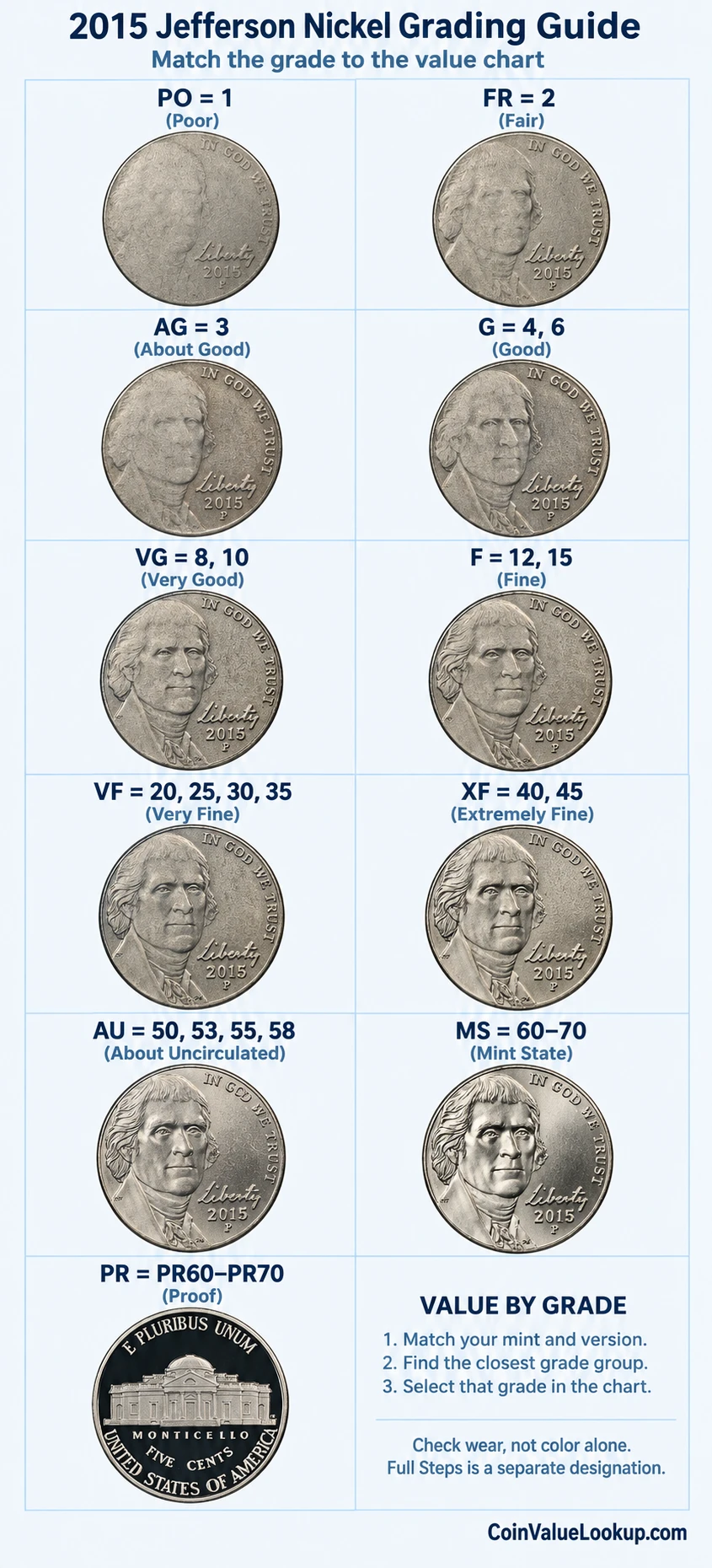
Start on the obverse. Jefferson's cheekbone, the hair above his ear, and the shoulder collar are the first places to lose detail.
Any flattening there tells you the coin has circulated, and the degree of smoothness maps roughly to grade.
On the reverse, check the Monticello steps. Sharp, fully separated steps can earn a Full Steps designation, but that label is about strike quality, not overall grade.
A coin can be MS65 without Full Steps, or have Full Steps at MS63.
Luster matters a lot in Mint State. Look for unbroken cartwheel reflections across the fields under a single light source.
Bag marks, contact hits, and scratches pull the grade down even when no wear is present.
Use the comparison image to match your coin against known grade examples of the same portrait type. Proof coins are graded on a separate scale; deep cameo contrast between frosted devices and mirrored fields is a desirable designation, not a higher numerical grade.
Step 3: Check 2015 Jefferson Nickel Value by Mint and Version
2015 Jefferson Nickel — P Business strike
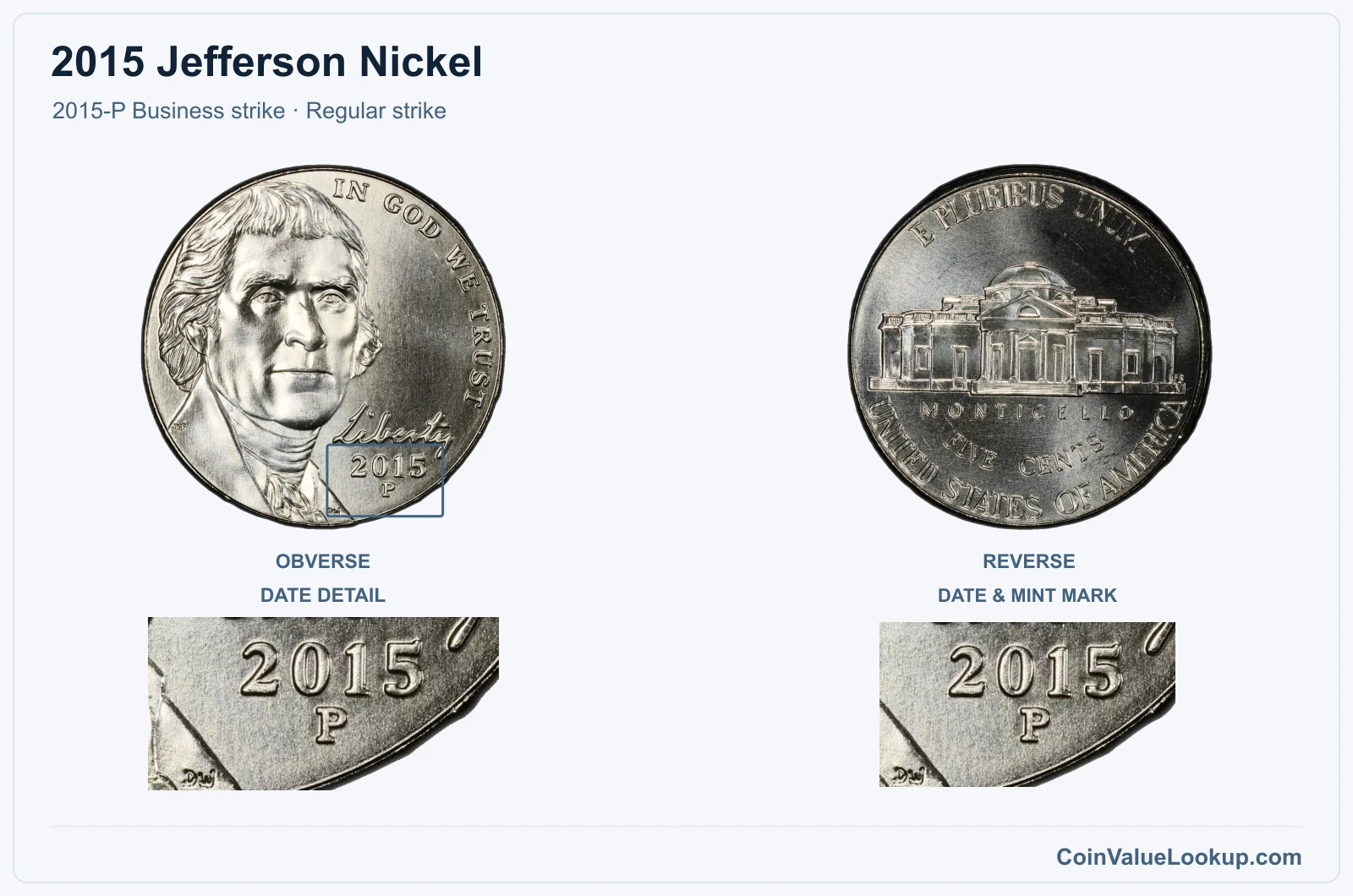
The 2015-P business strike is the Philadelphia issue, struck on a 75% copper / 25% nickel planchet at 5.00 grams. Look for the small P mintmark below the date on the obverse.
USA Coin Book guide estimates place this coin at roughly $0.30 in MS60 and $0.61 in MS65. Those figures reflect ordinary examples without cameo designations or Full Steps labels, which carry separate and generally higher values.
In circulated grades, expect face value. The real upside here is in certified superb Mint State pieces with sharp Monticello steps.
| Range | Grade | Price | Auction Records | Appraisal |
|---|---|---|---|---|
| PO | PO 1 | — | Coin Identifier | |
| FR | FR 2 | — | Coin Identifier | |
| AG | AG 3 | — | Coin Identifier | |
| G | G 4 | — | Coin Identifier | |
| G 6 | — | Coin Identifier | ||
| VG | VG 8 | — | Coin Identifier | |
| VG 10 | — | Coin Identifier | ||
| F | F 12 | — | Coin Identifier | |
| F 15 | — | Coin Identifier | ||
| VF | VF 20 | — | Coin Identifier | |
| VF 25 | — | Coin Identifier | ||
| VF 30 | — | Coin Identifier | ||
| VF 35 | — | Coin Identifier | ||
| XF | XF 40 | — | Coin Identifier | |
| XF 45 | — | Coin Identifier | ||
| AU | AU 50 | — | Coin Identifier | |
| AU 53 | — | Coin Identifier | ||
| AU 55 | — | Coin Identifier | ||
| AU 58 | — | Coin Identifier | ||
| MS | MS 60 | — | Coin Identifier | |
| MS 61 | — | Coin Identifier | ||
| MS 62 | — | Coin Identifier | ||
| MS 63 | — | Coin Identifier | ||
| MS 64 | — | Coin Identifier | ||
| MS 65 | — | Coin Identifier | ||
| MS 66 | — | Coin Identifier | ||
| MS 67 | — | Coin Identifier | ||
| MS 68 | — | — | — | |
| MS 69 | — | — | — | |
| MS 70 | — | — | — |
2015 Jefferson Nickel — D Business strike
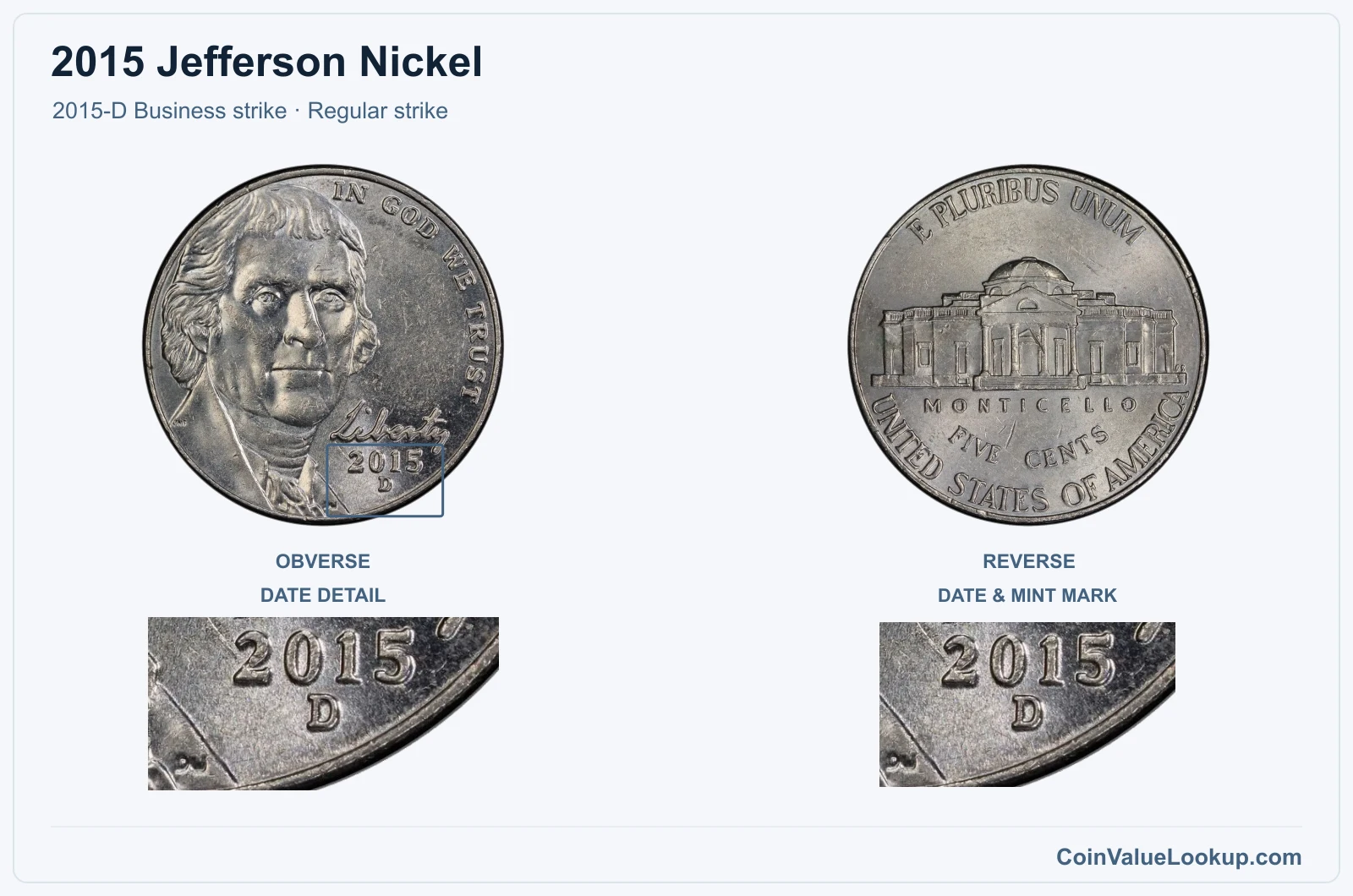
The 2015-D comes from the Denver Mint and shares identical specifications with its Philadelphia sibling: 75% copper / 25% nickel, 5.00 grams, plain edge. The D mintmark sits in the same spot below the date.
Guide estimates from USA Coin Book are about $0.30 at MS60 and $0.61 at MS65 for ordinary strikes. Again, Full Steps and exceptional preservation push values higher.
Circulated pieces are plentiful and worth five cents. If yours is pristine with no bag marks and fully defined steps, it is worth a closer look.
Coin Value Lookup is a useful starting point if you want to compare guide values across different years and mints of the Jefferson nickel series.
| Range | Grade | Price | Auction Records | Appraisal |
|---|---|---|---|---|
| PO | PO 1 | — | Coin Identifier | |
| FR | FR 2 | — | Coin Identifier | |
| AG | AG 3 | — | Coin Identifier | |
| G | G 4 | — | Coin Identifier | |
| G 6 | — | Coin Identifier | ||
| VG | VG 8 | — | Coin Identifier | |
| VG 10 | — | Coin Identifier | ||
| F | F 12 | — | Coin Identifier | |
| F 15 | — | Coin Identifier | ||
| VF | VF 20 | — | Coin Identifier | |
| VF 25 | — | Coin Identifier | ||
| VF 30 | — | Coin Identifier | ||
| VF 35 | — | Coin Identifier | ||
| XF | XF 40 | — | Coin Identifier | |
| XF 45 | — | Coin Identifier | ||
| AU | AU 50 | — | Coin Identifier | |
| AU 53 | — | Coin Identifier | ||
| AU 55 | — | Coin Identifier | ||
| AU 58 | — | Coin Identifier | ||
| MS | MS 60 | — | Coin Identifier | |
| MS 61 | — | Coin Identifier | ||
| MS 62 | — | Coin Identifier | ||
| MS 63 | — | Coin Identifier | ||
| MS 64 | — | Coin Identifier | ||
| MS 65 | — | Coin Identifier | ||
| MS 66 | — | Coin Identifier | ||
| MS 67 | — | Coin Identifier | ||
| MS 68 | — | — | — | |
| MS 69 | — | — | — | |
| MS 70 | — | — | — |
2015 Jefferson Nickel — S Proof
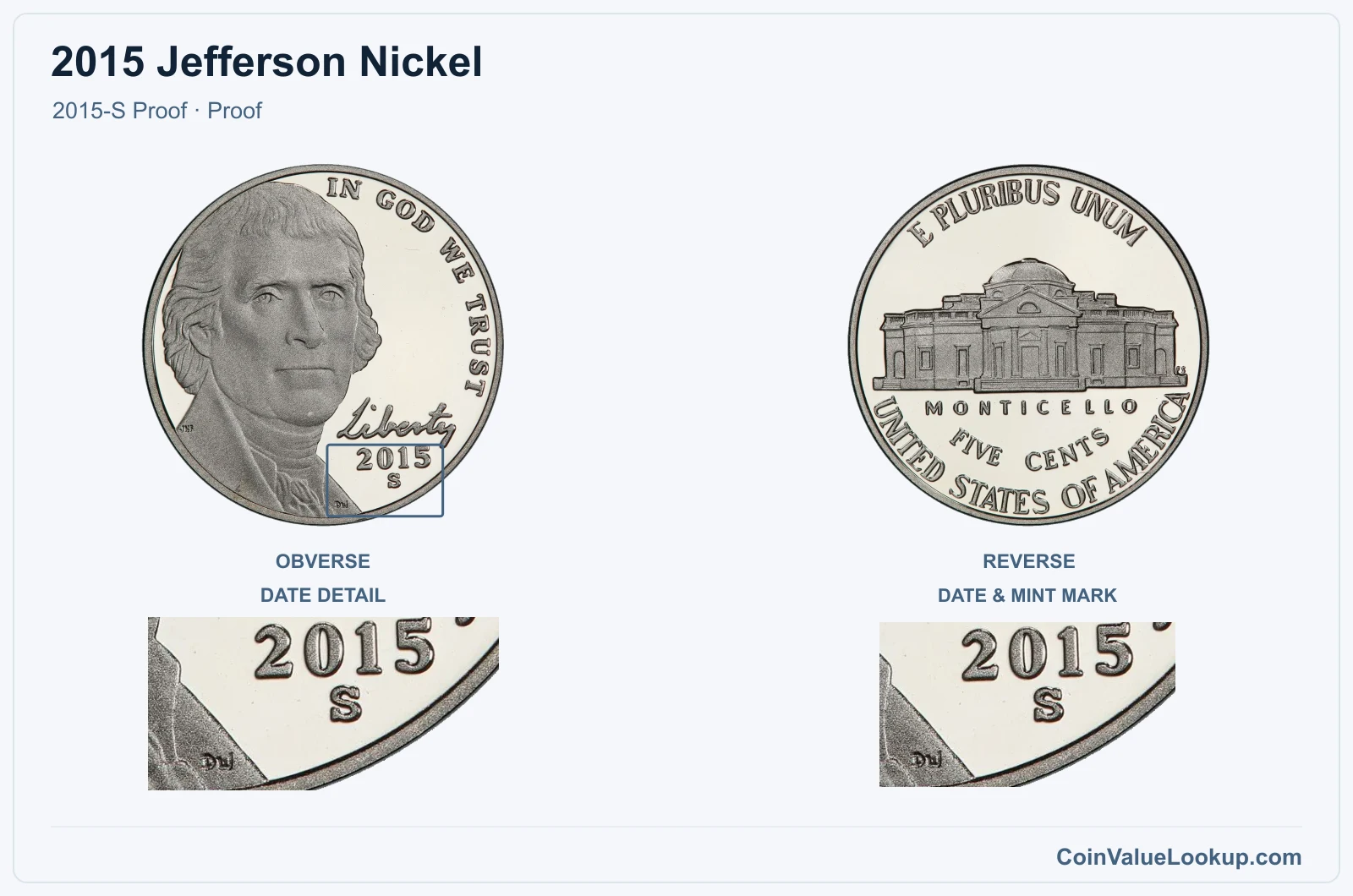
The 2015-S proof was struck at the San Francisco Mint exclusively for collector sets. It features the same copper-nickel alloy and design but with mirror fields and frosted devices that make it visually distinct from business strikes.
The S mintmark on the obverse confirms the origin. USA Coin Book lists a guide estimate of about $5.30 at PR65.
These coins should not show wear; if yours does, it has been mishandled and the grade drops accordingly. Deep cameo contrast is a separate designation that can influence value, but it is not reflected in the basic PR65 figure above.
| Range | Grade | Price | Auction Records | Appraisal |
|---|---|---|---|---|
| PR | PR 1 | — | Coin Identifier | |
| PR 2 | — | Coin Identifier | ||
| PR 3 | — | Coin Identifier | ||
| PR 4 | — | Coin Identifier | ||
| PR 6 | — | Coin Identifier | ||
| PR 8 | — | Coin Identifier | ||
| PR 10 | — | Coin Identifier | ||
| PR 12 | — | Coin Identifier | ||
| PR 15 | — | Coin Identifier | ||
| PR 20 | — | Coin Identifier | ||
| PR 25 | — | Coin Identifier | ||
| PR 30 | — | Coin Identifier | ||
| PR 35 | — | Coin Identifier | ||
| PR 40 | — | Coin Identifier | ||
| PR 45 | — | Coin Identifier | ||
| PR 50 | — | Coin Identifier | ||
| PR 53 | — | Coin Identifier | ||
| PR 55 | — | Coin Identifier | ||
| PR 58 | — | Coin Identifier | ||
| PR 60 | — | Coin Identifier | ||
| PR 61 | — | Coin Identifier | ||
| PR 62 | — | Coin Identifier | ||
| PR 63 | — | Coin Identifier | ||
| PR 64 | — | Coin Identifier | ||
| PR 65 | — | Coin Identifier | ||
| PR 66 | — | Coin Identifier | ||
| PR 67 | — | Coin Identifier | ||
| PR 68 | — | Coin Identifier | ||
| PR 69 | — | Coin Identifier | ||
| PR 70 | Coin Identifier |
2015 Jefferson Nickel Error List
1. 2015 Jefferson Nickel — Rotated dies
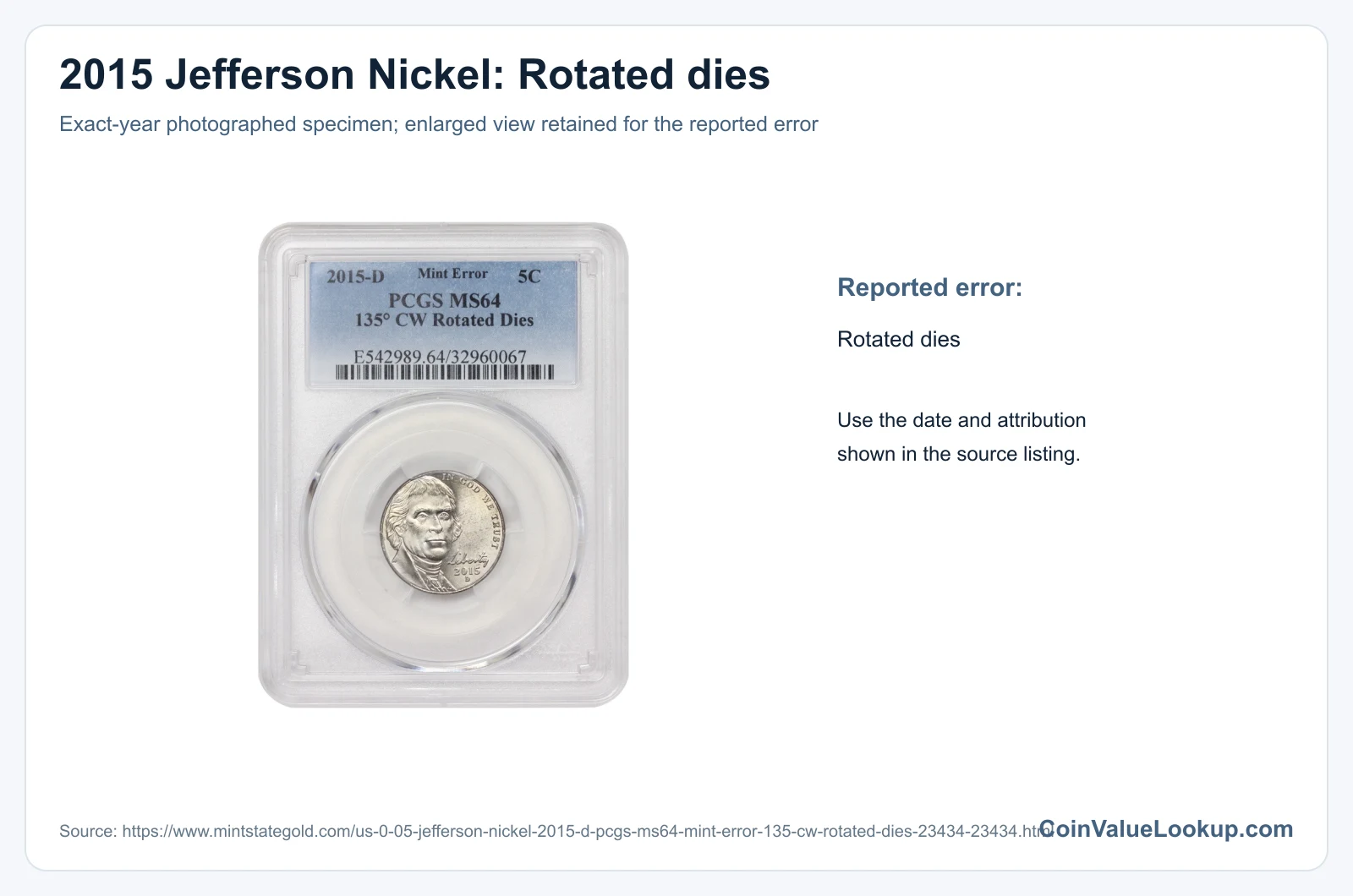
A rotated die error means the obverse and reverse are misaligned from the normal 180-degree coin-turn orientation. To test yours, hold the obverse upright and flip the coin around its vertical axis.
On a normal nickel, Monticello should appear upright. On the known 2015-D rotated die example, the reverse is turned roughly 90 degrees clockwise from the expected position.
That particular coin was graded PCGS MS64.
The degree of rotation matters. A slight tilt of a few degrees is common and not particularly notable.
A quarter-turn or more is a different story. Be careful: a coin photographed at a slight angle can look rotated when it is not, and altered two-piece coins exist.
Individual assessment based on authentication, condition, and the severity of the rotation determines value.
2. 2015 Jefferson Nickel — Struck-Through Error
A struck-through error occurs when foreign material sits between the die and the planchet during striking, leaving a depression or partial impression in the finished coin. On 2015 nickels, struck-through grease errors have been reported, where grease in the die cavity prevents part of the design from fully forming.
Look for a localized soft or missing area that does not match normal wear patterns. The affected zone is often smooth and slightly recessed, not scratched or scraped.
Ordinary weak strikes, cleaning damage, and circulation wear can mimic this error to the untrained eye, so compare the suspicious area against the rest of the coin's detail. Value depends on visibility, location, and overall condition of the coin, so individual assessment is necessary.
3. 2015 Jefferson Nickel — Die Crack / Die Chip
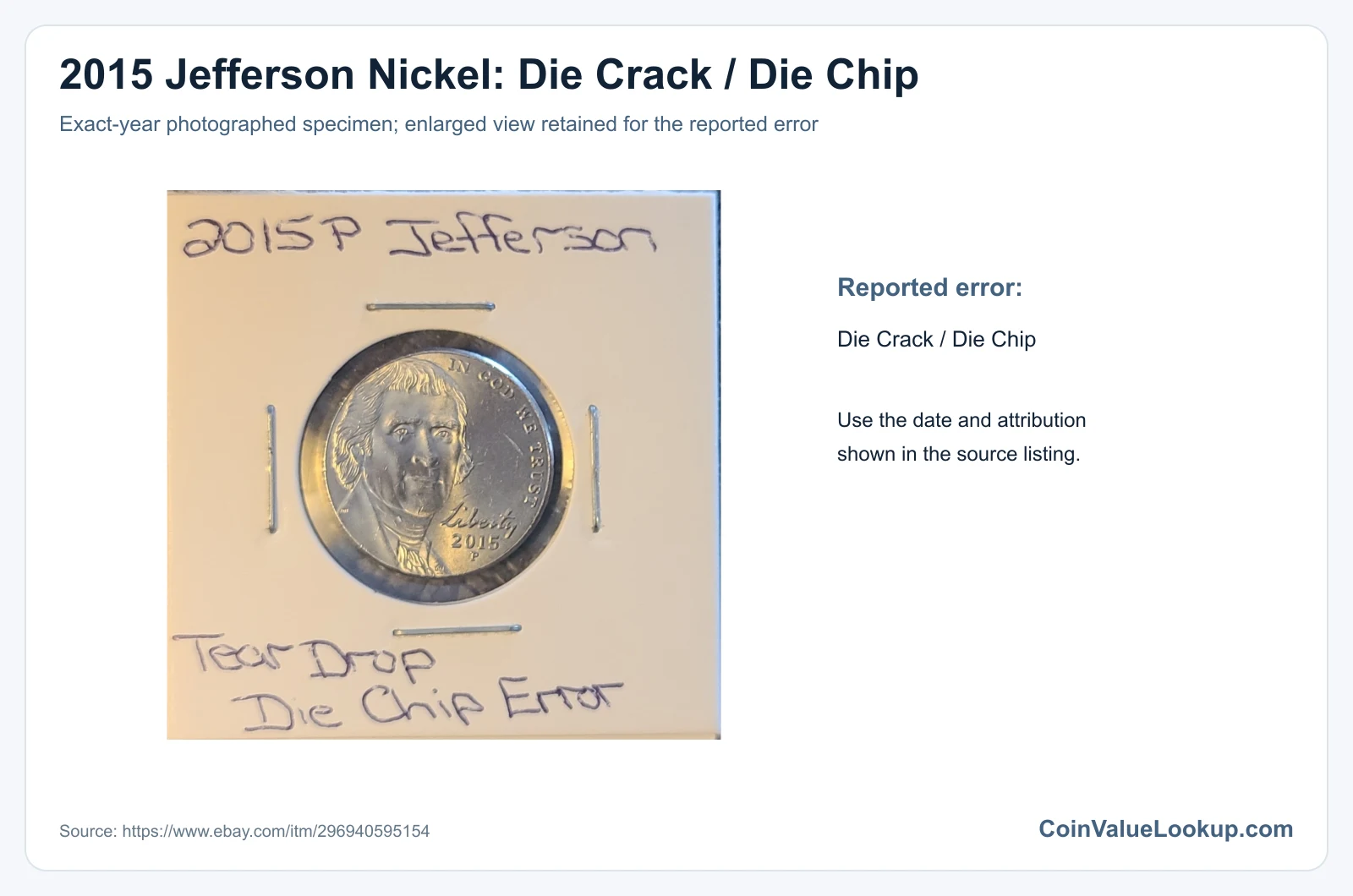
Die cracks show up as thin raised lines on the coin's surface, caused by fractures in the steel die that filled with metal during striking. A die chip is a small raised blob where a piece of the die broke away.
Both are mint-made and part of the coin from birth.
On 2015 nickels, look for raised lines that may connect design elements or run from the rim inward. A crack that reaches the rim and displaces a chunk of metal is called a cud, which is generally more desirable.
The key distinction from damage: die cracks are raised, while scratches are incised into the surface. Corrosion and adhesions from foreign material also sit on top but lack the clean linear profile of a crack.
Value varies with size, location, and coin condition.
4. 2015 Jefferson Nickel — Clipped Planchet
A clipped planchet error happens when the blank is punched incorrectly from the metal strip, taking a bite out of the edge. On 2015 nickels, these have been reported.
The missing portion can be a curved arc, a straight edge, or an irregular shape depending on what went wrong during blanking.
Look at the edge of the coin for any missing section. Genuine clips typically show a smooth, undisturbed edge at the clip boundary with a slight weakness in the design directly opposite the missing area, caused by uneven metal flow during striking.
A filed notch or post-mint cut will show tool marks and sharp, unnatural edges. Corrosion can eat away at the rim but leaves pitting, not a clean absence.
Value depends on clip size, shape, and overall coin condition.
5. 2015 Jefferson Nickel — Clashed Dies
Clashed dies happen when the obverse and reverse dies strike each other without a planchet between them. The impact transfers a ghost impression of each die's design onto the other.
The next coins struck carry faint traces of the opposite design in the wrong places.
On a 2015 nickel, look for faint outlines of Monticello features appearing in Jefferson's fields, or traces of Jefferson's portrait ghosting around Monticello. These impressions will be properly aligned with where the opposite die would have contacted.
Random scratches, raised lines from die polish, or a brockage from a struck coin stuck in the press are not the same thing. True clash marks follow the geometry of the opposing die.
Value depends on how visible the transferred design is and the coin's overall condition.
6. 2015 Jefferson Nickel — Lamination / Split Planchet
A lamination error is a flaw within the metal itself. During alloy preparation, contaminants or gas pockets can create weak layers in the strip.
When the coin is struck, that weakness can cause the surface to peel, flake, or split apart.
On a 2015 nickel, look for a retained flap of metal lifting from the surface, or an area where a layer has already separated and fallen away, exposing a rough underlayer. Photograph the edge if possible; a true lamination often shows visible separation in the coin's cross-section.
Post-mint scraping, corrosion pitting, and deliberately peeled coins are common lookalikes. Genuine laminations have a natural, irregular boundary and the exposed metal underneath typically has a different texture than the struck surface.
Each coin's value depends on severity and condition.
7. 2015 Jefferson Nickel — Broadstrike
A broadstrike occurs when the retaining collar that normally constrains the planchet during striking fails to engage. The coin spreads outward under die pressure, producing a piece that is wider than normal with a complete but slightly expanded design and no defined rim.
On a 2015 nickel, the telltale sign is a coin that measures noticeably larger than the standard 21.2 mm, with the design reaching closer to or past the usual rim boundary. The edge will be flat and squared rather than showing the normal rounded profile.
Do not confuse this with an off-center strike, which shifts the design to one side and leaves a blank crescent. Also rule out coins that were flattened after minting by a train, vise, or hammer.
Value depends on the degree of spread and the coin's preservation.
8. 2015 Jefferson Nickel — Doubled Die Obverse
A doubled die obverse is created during the die-making process, when a misalignment produces a second, slightly shifted impression of the design in the die itself. Every coin struck from that die carries the same doubling.
On a 2015 nickel obverse, compare the lettering in LIBERTY, IN GOD WE TRUST, and the date against a normal example under consistent lighting. True hub doubling shows consistent separation or notching on the affected elements.
It does not appear as a flat shelf on one side of a letter, which is the hallmark of machine doubling, a far less valuable strike artifact. Reflections from proof-like surfaces can also trick you.
Value depends on the strength and visibility of the doubling, plus the coin's overall condition.
9. 2015 Jefferson Nickel — Doubled Die Reverse
A doubled die reverse follows the same mechanism as its obverse counterpart but affects the Monticello side of the coin. The die received a misaligned secondary impression during manufacture, so the doubling is die-specific and repeatable across every coin struck from it.
Compare the reverse lettering, especially MONTICELLO, E PLURIBUS UNUM, and FIVE CENTS, against a confirmed normal coin. Look for consistent notching or separation in the same direction on multiple letters.
Machine doubling tends to flatten and shelf one side of the raised design, while true hub doubling preserves full rounded contours on both images. Random nicks and surface damage will not repeat in a predictable pattern across multiple design elements.
Value hinges on the prominence of the doubling and the coin's condition; individual assessment is needed.