2015 Roosevelt Dime Coin Value: How Much Is It Worth?
Most 2015 Roosevelt dimes you find in pocket change are worth face value — ten cents. Uncirculated examples graded MS65 carry a USA Coin Book guide estimate around $2.50 for both P and D mint marks.
The real premium versions are the silver proofs and the special March of Dimes issues, where a PR65 can range from about $10.69 up to $90 depending on the exact branch.
Fast Way to Identify Your 2015 Roosevelt Dime
Snap a clear photo of both sides of your 2015 dime and upload them for a preliminary identification. This helps confirm the mint mark, finish type, and whether you might have a silver or clad piece.
It is not a substitute for professional authentication, but it is a solid first step toward figuring out which version you actually hold.
2015 Roosevelt Dime Value
Upload both sides of your 2015 Roosevelt Dime.
Front Obverse
Upload photo
Back Reverse
Upload photo
Which 2015 Roosevelt Dime Versions Are Worth Money?
- 2015-W Silver Proof dime from the March of Dimes set — guide estimate around $53 at PR65, struck at West Point in 90% silver.
- 2015-P Silver Reverse Proof dime from the March of Dimes set — guide estimate around $90 at PR65, with distinctive frosted fields and mirrored devices.
- 2015-S Silver Proof with full separation of torch bands — carries a PR65 guide estimate of $10.69 and is worth checking against clad versions.
- Well-preserved P or D business strikes with strong Full Bands detail in MS65 or higher condition.
Step 1: Identify Your 2015 Roosevelt Dime Mint Mark and Version
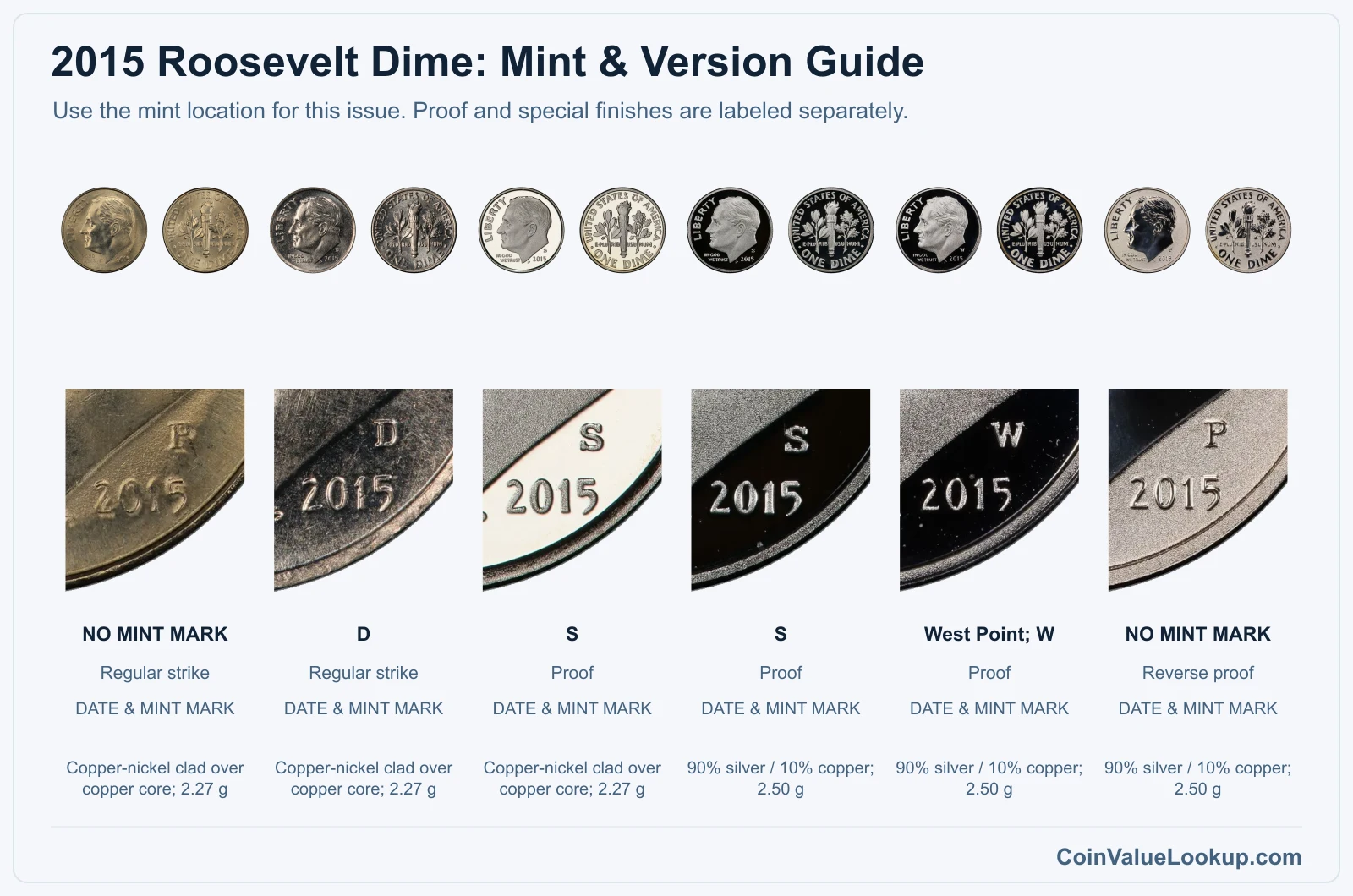
Start with the date. You need "2015" on the obverse below Roosevelt's chin.
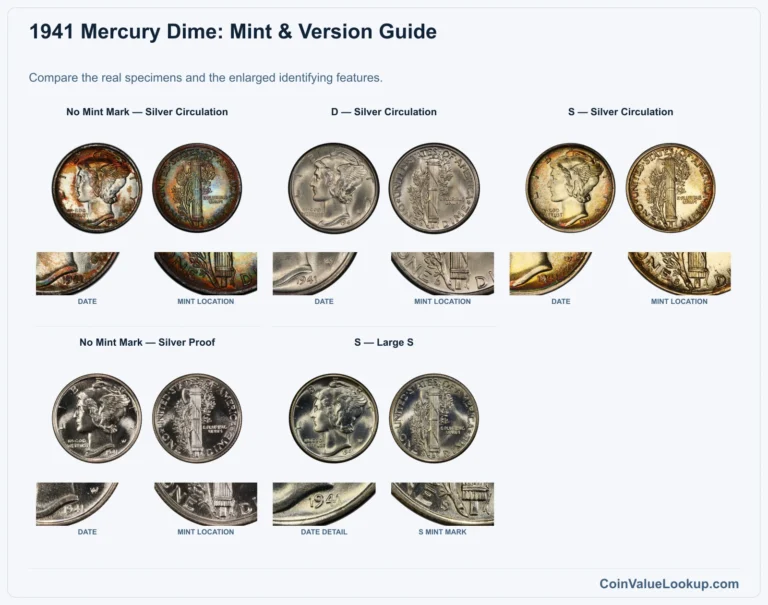
Then look just above the date for the mint mark: P for Philadelphia, D for Denver, S for San Francisco, or W for West Point.
The mint mark alone does not tell you everything. An S could be a clad proof or a silver proof, and they look similar at first glance.
Weigh the coin if possible: clad versions come in at 2.27 grams, while 90% silver proofs weigh 2.50 grams. Check the edge too — a clad coin shows a copper-colored stripe along the rim, while a silver coin has a uniform silver edge.
A P mint mark on a silver coin with frosted fields and mirrored devices means you likely have the reverse proof from the March of Dimes special set. A W mint mark on a silver proof is also from that set.
Both were only available through special Mint packaging, so if you pulled one from a roll, verify carefully — it should not be there.
Finish matters as much as mint mark. Business strikes have a uniform satin-to-lustrous surface.
Standard proofs show mirrored fields with frosted design elements. The reverse proof flips that: frosted fields, mirrored devices.
Compare your coin to known examples of the same finish before drawing conclusions.
Step 2: Check Your 2015 Roosevelt Dime Grade
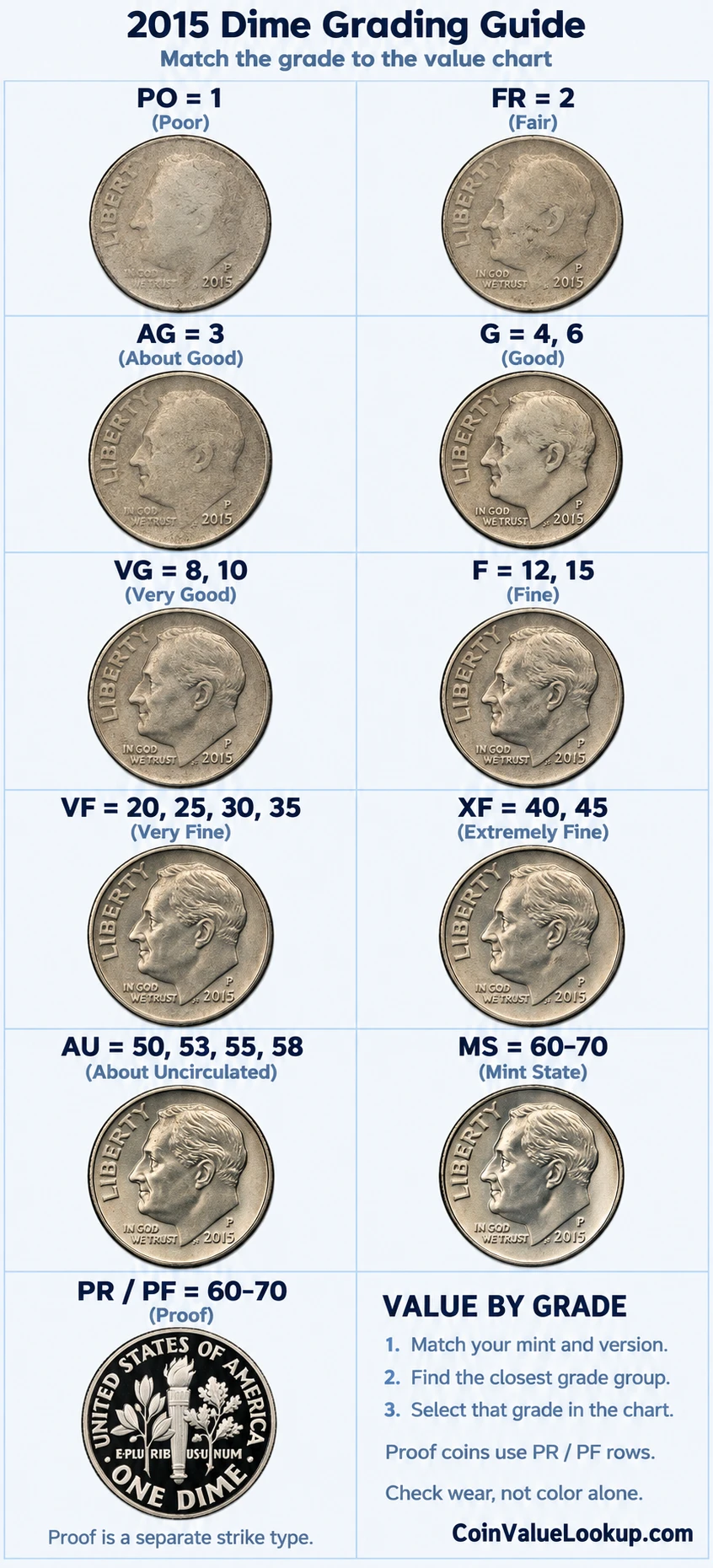
Look at Roosevelt's cheekbone and jawline first — those are the high points that show wear earliest. On the reverse, the torch bands and olive branches lose sharpness before anything else fades.
Full Bands is a strike designation, not a grade. Both horizontal band pairs on the torch must visibly separate.
A weak strike can blur those bands even on an uncirculated coin, so do not confuse soft bands with actual wear.
Original mint luster has a cartwheel effect when you tilt the coin under a light. If the surfaces look shiny but flat, the coin may have been cleaned — that kills the grade.
Use the comparison image to gauge where your coin falls.
For proofs, look at the mirrored fields for hairlines and contact marks. Proof contrast and any frosted finish are intentional manufacturing features, not indicators of a higher grade.
Compare your proof to other same-finish examples rather than mixing proof and business-strike standards.
Step 3: Check 2015 Roosevelt Dime Value by Mint and Version
2015 Roosevelt Dime — P Business Strike
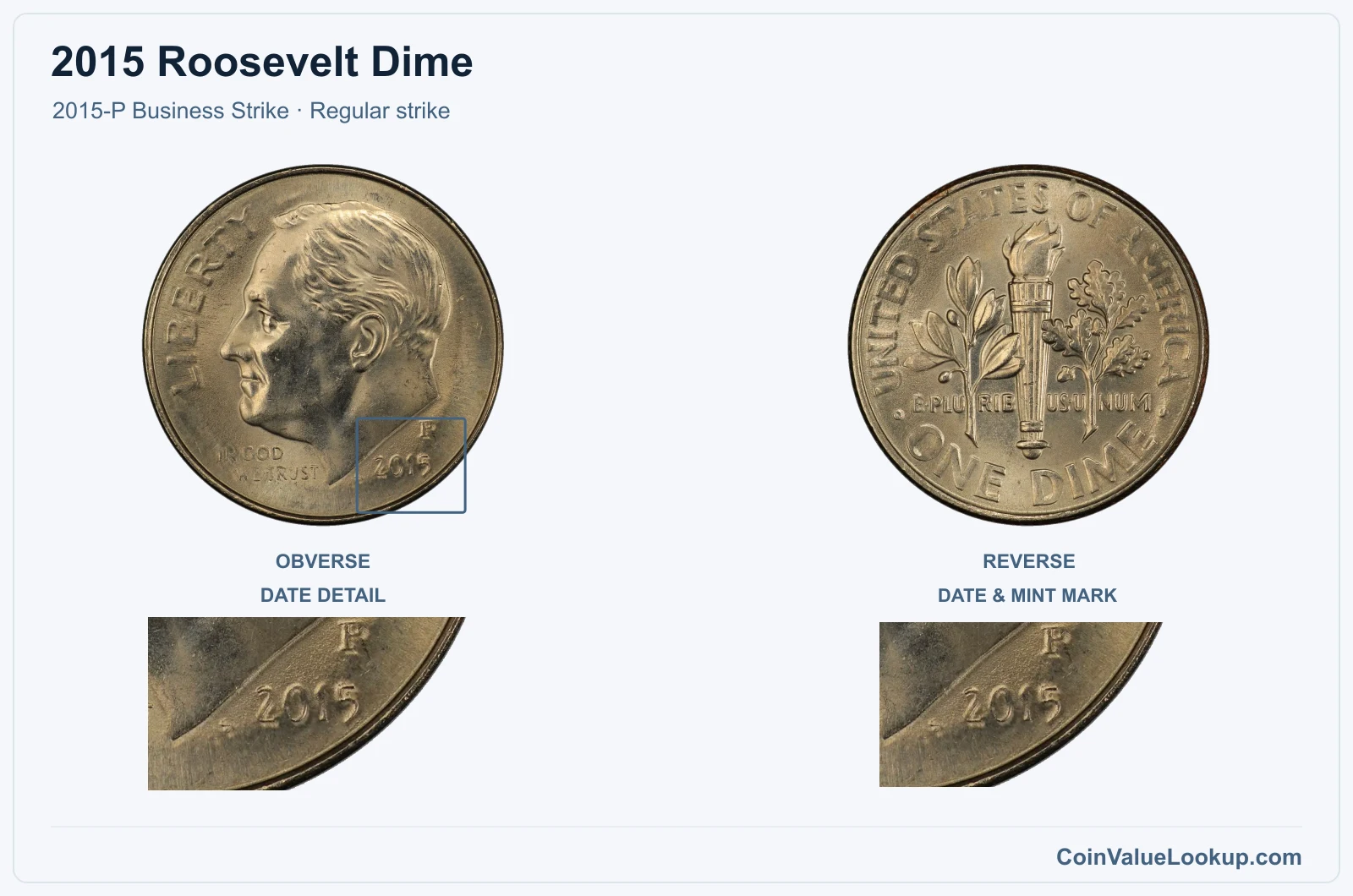
The 2015-P business strike is a copper-nickel clad coin weighing 2.27 grams, struck at Philadelphia with a P mint mark above the date. Most circulated examples are worth face value.
At MS65, the USA Coin Book guide estimate is $2.50.
Look for original cartwheel luster and clean fields. Coins with well-separated torch bands — the Full Bands designation — can command a premium above generic mint-state prices.
This is the most common 2015 dime you will encounter in change.
Range Grade
Price Auction Records Appraisal PO PO 1
—
Coin Identifier FR FR 2
—
Coin Identifier AG AG 3
—
Coin Identifier G G 4
—
Coin Identifier
G 6
—
Coin Identifier VG VG 8
—
Coin Identifier
VG 10
—
Coin Identifier F F 12
—
Coin Identifier
F 15
—
Coin Identifier VF VF 20
—
Coin Identifier
VF 25
—
Coin Identifier
VF 30
—
Coin Identifier
VF 35
—
Coin Identifier XF XF 40
—
Coin Identifier
XF 45
—
Coin Identifier AU AU 50
—
Coin Identifier
AU 53
—
Coin Identifier
AU 55
—
Coin Identifier
AU 58
—
Coin Identifier MS MS 60
—
Coin Identifier
MS 61
—
Coin Identifier
MS 62
—
Coin Identifier
MS 63
—
Coin Identifier
MS 64
—
Coin Identifier
MS 65
—
Coin Identifier
MS 66
—
Coin Identifier
MS 67
—
Coin Identifier
MS 68
—
Coin Identifier
MS 69
—
—
—
MS 70
—
—
—
2015 Roosevelt Dime — D Business Strike
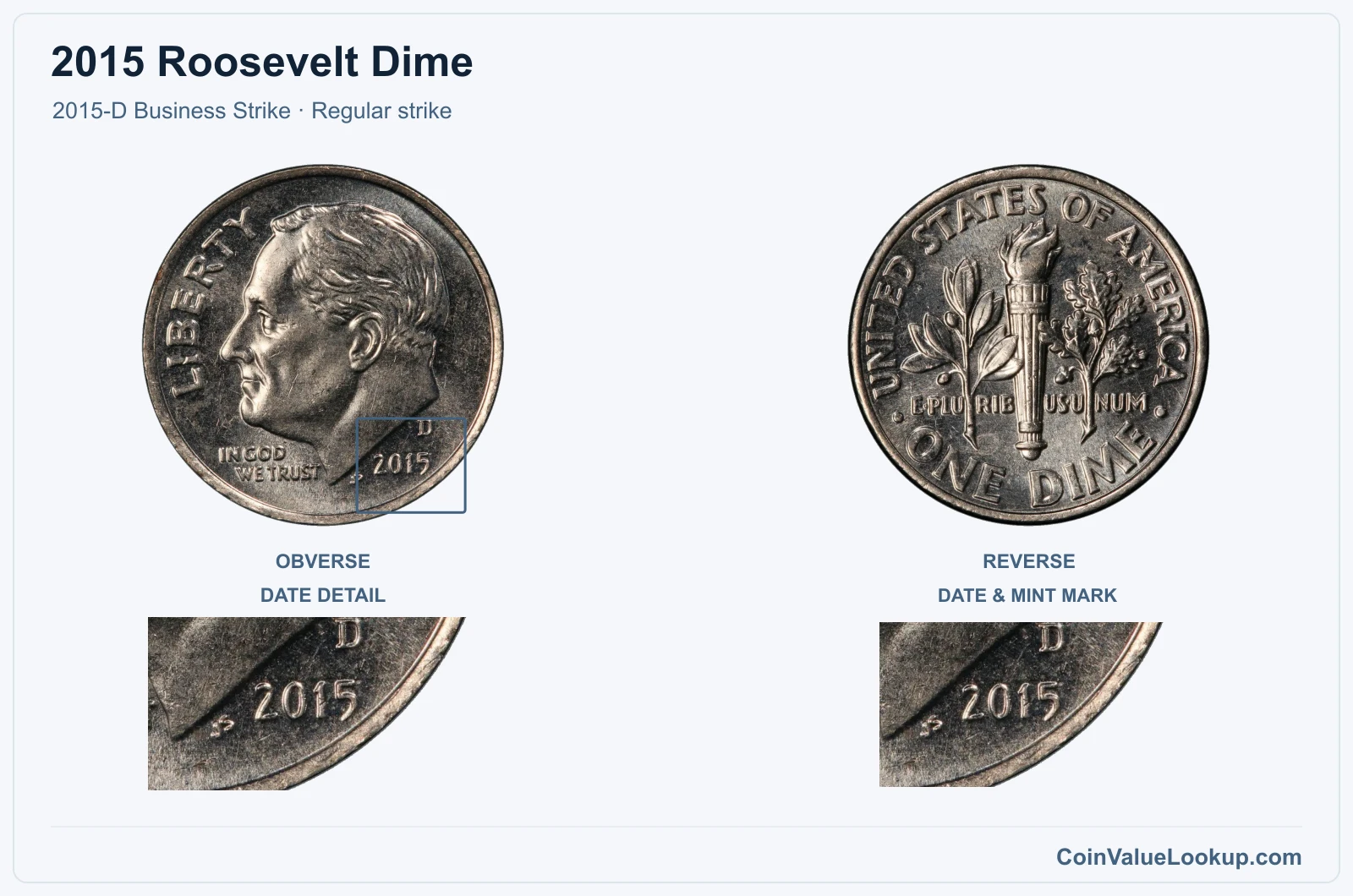
Denver's 2015-D business strike shares the same copper-nickel clad composition and 2.27-gram weight as its Philadelphia counterpart. The D mint mark sits just above the date on the obverse.
The USA Coin Book guide puts MS65 examples at $2.50. In practice, circulated pieces are worth ten cents.
As with the P, coins showing clean Full Bands separation on the torch are the ones worth a closer look in higher grades.
Range Grade
Price Auction Records Appraisal PO PO 1
—
Coin Identifier FR FR 2
—
Coin Identifier AG AG 3
—
Coin Identifier G G 4
—
Coin Identifier
G 6
—
Coin Identifier VG VG 8
—
Coin Identifier
VG 10
—
Coin Identifier F F 12
—
Coin Identifier
F 15
—
Coin Identifier VF VF 20
—
Coin Identifier
VF 25
—
Coin Identifier
VF 30
—
Coin Identifier
VF 35
—
Coin Identifier XF XF 40
—
Coin Identifier
XF 45
—
Coin Identifier AU AU 50
—
Coin Identifier
AU 53
—
Coin Identifier
AU 55
—
Coin Identifier
AU 58
—
Coin Identifier MS MS 60
—
Coin Identifier
MS 61
—
Coin Identifier
MS 62
—
Coin Identifier
MS 63
—
Coin Identifier
MS 64
—
Coin Identifier
MS 65
—
Coin Identifier
MS 66
—
Coin Identifier
MS 67
—
Coin Identifier
MS 68
—
Coin Identifier
MS 69
—
—
—
MS 70
—
—
—
2015 Roosevelt Dime — S Clad Proof
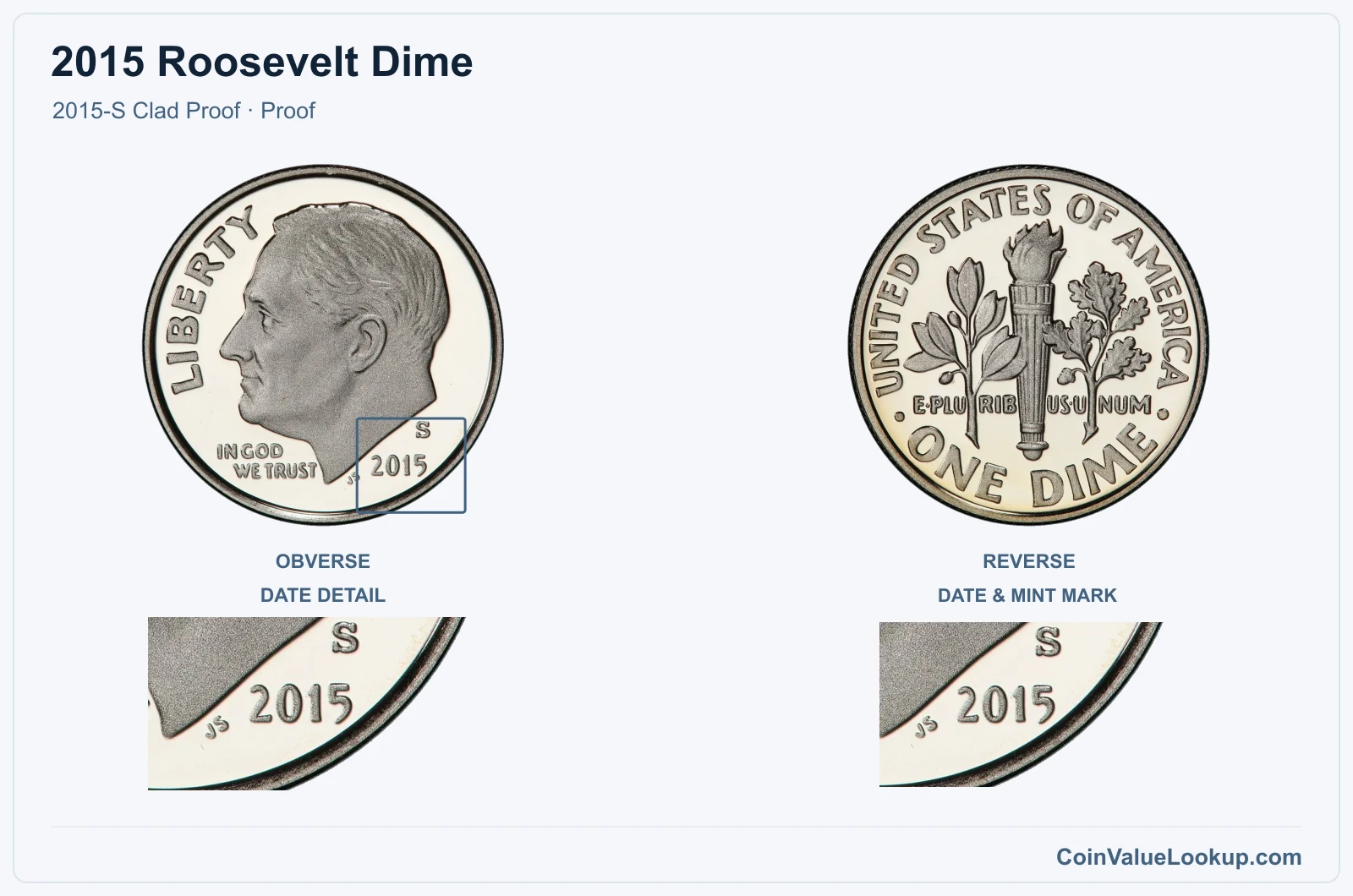
The 2015-S clad proof was struck at San Francisco in copper-nickel clad, same 2.27-gram weight as business strikes. It carries an S mint mark and was sold in the standard proof set.
At PR65, the USA Coin Book guide estimate is $4.96. These have mirrored fields and frosted design elements.
Check the edge for the copper stripe that confirms clad composition — this distinguishes it from the silver proof that also bears an S mint mark.
Coin Value Lookup is a handy place to look up guides for other Roosevelt dime years if you are working through a collection or proof set.
Range Grade
Price Auction Records Appraisal PR PR 1
—
Coin Identifier
PR 2
—
Coin Identifier
PR 3
—
Coin Identifier
PR 4
—
Coin Identifier
PR 6
—
Coin Identifier
PR 8
—
Coin Identifier
PR 10
—
Coin Identifier
PR 12
—
Coin Identifier
PR 15
—
Coin Identifier
PR 20
—
Coin Identifier
PR 25
—
Coin Identifier
PR 30
—
Coin Identifier
PR 35
—
Coin Identifier
PR 40
—
Coin Identifier
PR 45
—
Coin Identifier
PR 50
—
Coin Identifier
PR 53
—
Coin Identifier
PR 55
—
Coin Identifier
PR 58
—
Coin Identifier
PR 60
—
Coin Identifier
PR 61
—
Coin Identifier
PR 62
—
Coin Identifier
PR 63
—
Coin Identifier
PR 64
—
Coin Identifier
PR 65
—
Coin Identifier
PR 66
—
Coin Identifier
PR 67
—
Coin Identifier
PR 68
—
Coin Identifier
PR 69
—
Coin Identifier
PR 70
Coin Identifier
2015 Roosevelt Dime — S Silver Proof
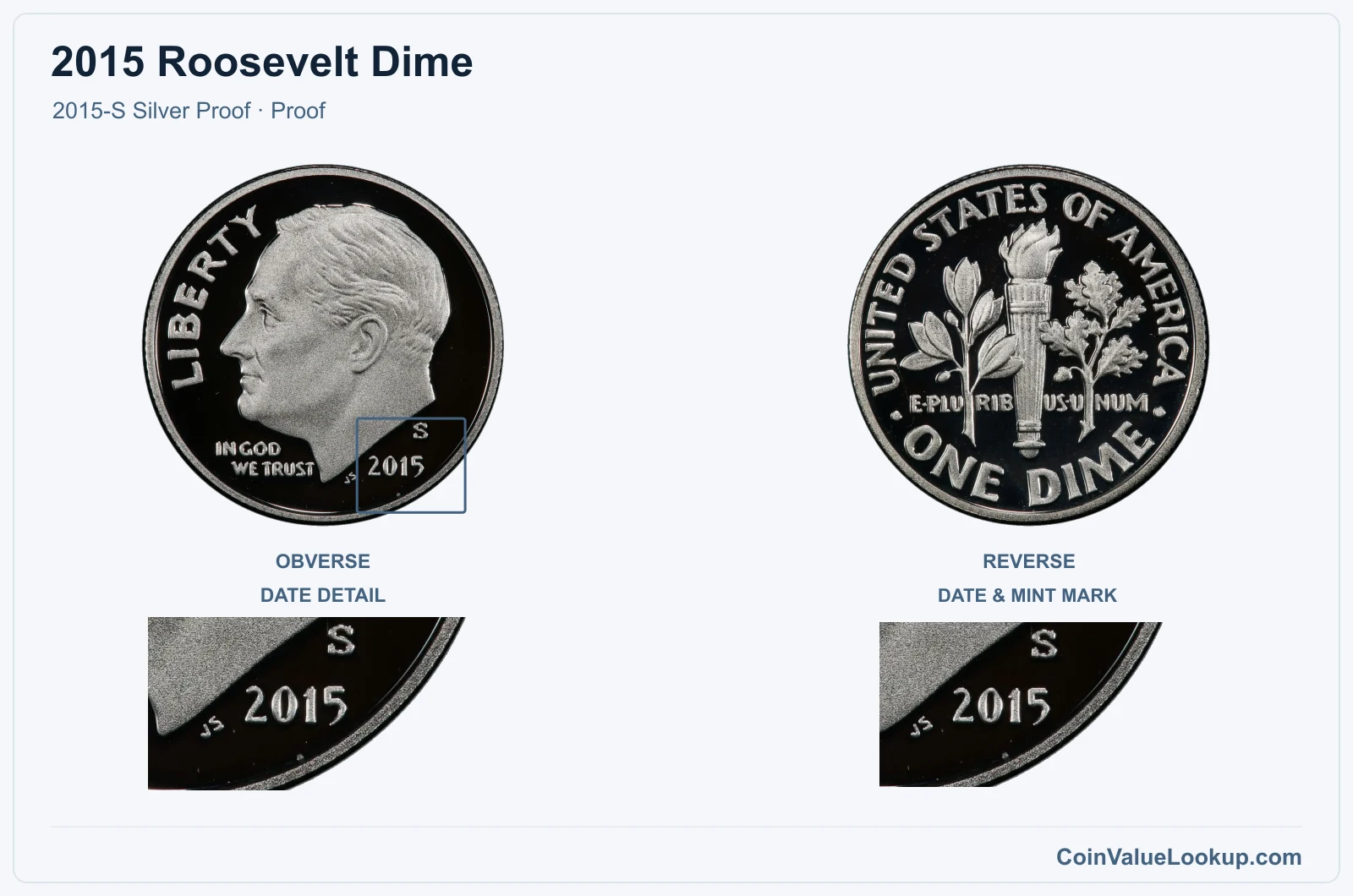
The 2015-S silver proof is struck in 90% silver and 10% copper, weighing 2.50 grams — noticeably heavier than the clad version. It also carries an S mint mark, so weight and edge color are your best friends for telling them apart.
The USA Coin Book guide estimate at PR65 is $10.69. A uniform silver edge with no copper stripe confirms the composition.
These were available in the annual silver proof set from the Mint. The proof finish features mirrored fields and frosted devices, same as the clad proof — only the metal is different.
Range Grade
Price Auction Records Appraisal PR PR 1
—
Coin Identifier
PR 2
—
Coin Identifier
PR 3
—
Coin Identifier
PR 4
—
Coin Identifier
PR 6
—
Coin Identifier
PR 8
—
Coin Identifier
PR 10
—
Coin Identifier
PR 12
—
Coin Identifier
PR 15
—
Coin Identifier
PR 20
—
Coin Identifier
PR 25
—
Coin Identifier
PR 30
—
Coin Identifier
PR 35
—
Coin Identifier
PR 40
—
Coin Identifier
PR 45
—
Coin Identifier
PR 50
—
Coin Identifier
PR 53
—
Coin Identifier
PR 55
—
Coin Identifier
PR 58
—
Coin Identifier
PR 60
—
Coin Identifier
PR 61
—
Coin Identifier
PR 62
—
Coin Identifier
PR 63
—
Coin Identifier
PR 64
—
Coin Identifier
PR 65
—
Coin Identifier
PR 66
—
Coin Identifier
PR 67
—
Coin Identifier
PR 68
—
Coin Identifier
PR 69
—
Coin Identifier
PR 70
Coin Identifier
2015 Roosevelt Dime — W Silver Proof
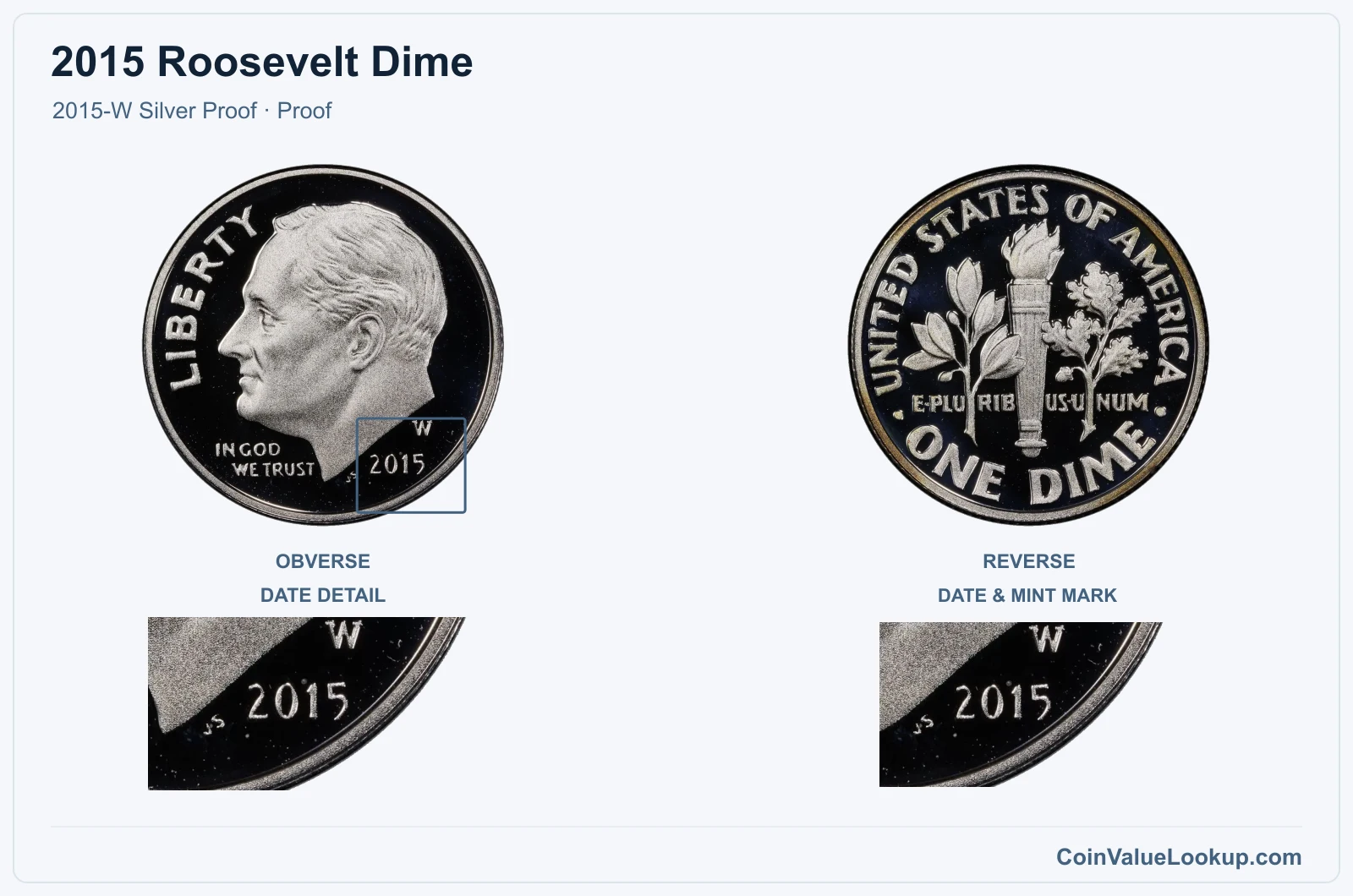
This is one of the special issues from the 2015 March of Dimes Special Silver Set. Struck at West Point in 90% silver, it weighs 2.50 grams and carries a W mint mark — the only 2015 dime with that designation.
At PR65, the USA Coin Book guide estimate is $53. That is a significant jump over the standard S silver proof.
The W mint mark is the key identifier; it sits in the same position above the date where you would normally see P, D, or S. These were only available through the special Mint set, so finding one outside original packaging warrants careful verification.
Range Grade
Price Auction Records Appraisal PR PR 1
—
Coin Identifier
PR 2
—
Coin Identifier
PR 3
—
Coin Identifier
PR 4
—
Coin Identifier
PR 6
—
Coin Identifier
PR 8
—
Coin Identifier
PR 10
—
Coin Identifier
PR 12
—
Coin Identifier
PR 15
—
Coin Identifier
PR 20
—
Coin Identifier
PR 25
—
Coin Identifier
PR 30
—
Coin Identifier
PR 35
—
Coin Identifier
PR 40
—
Coin Identifier
PR 45
—
Coin Identifier
PR 50
—
Coin Identifier
PR 53
—
Coin Identifier
PR 55
—
Coin Identifier
PR 58
—
Coin Identifier
PR 60
—
Coin Identifier
PR 61
—
Coin Identifier
PR 62
—
Coin Identifier
PR 63
—
Coin Identifier
PR 64
—
Coin Identifier
PR 65
—
Coin Identifier
PR 66
—
Coin Identifier
PR 67
—
Coin Identifier
PR 68
—
Coin Identifier
PR 69
—
Coin Identifier
PR 70
—
Coin Identifier
2015 Roosevelt Dime — P Silver Reverse Proof
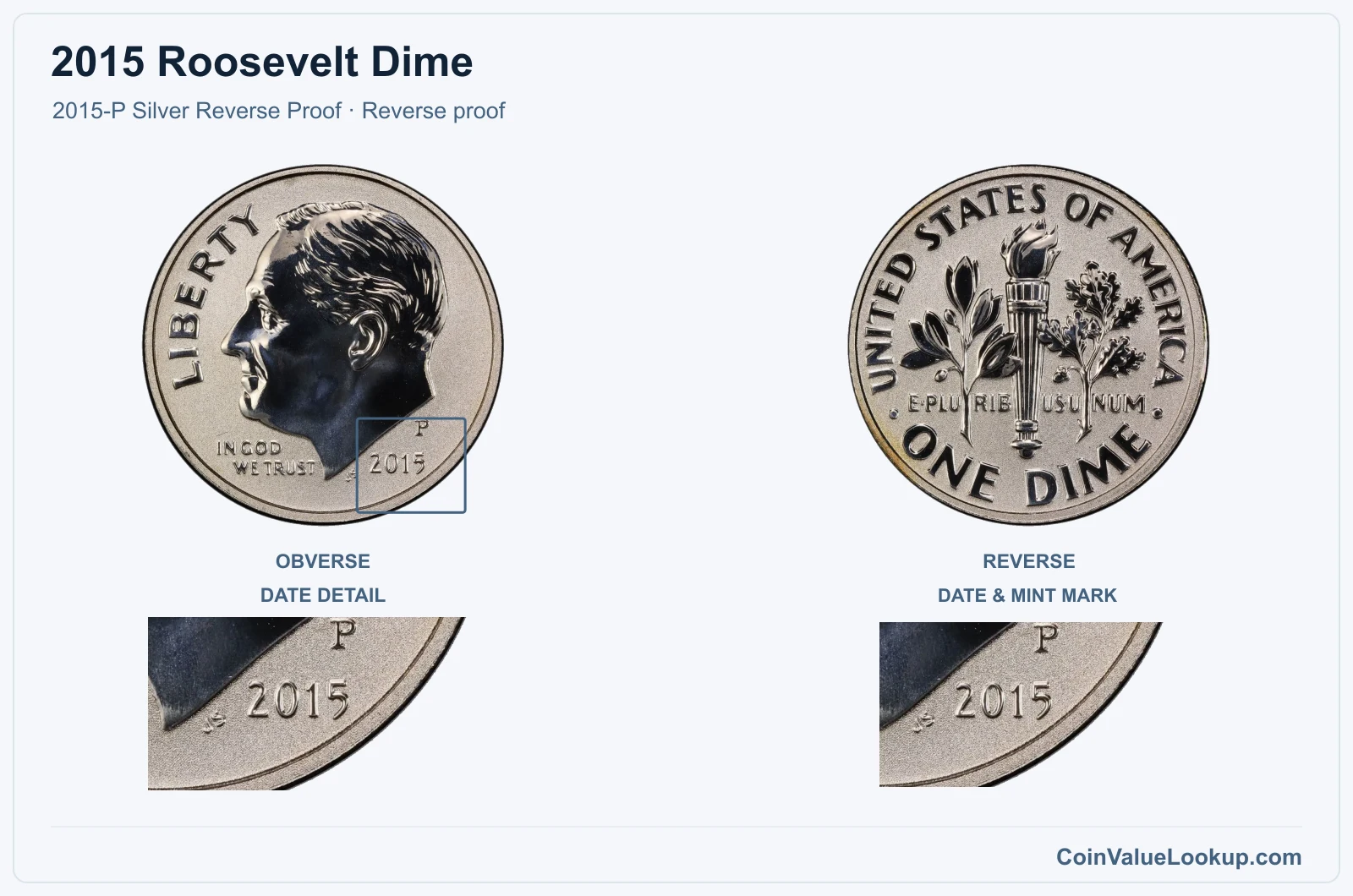
The 2015-P Silver Reverse Proof dime is the standout issue this year. It was included in the March of Dimes Special Silver Set, struck at Philadelphia in 90% silver at 2.50 grams.
A reverse proof flips the usual proof contrast: the fields are frosted and the raised design elements are mirrored, giving the coin a distinctive visual punch.
The P mint mark combined with the reverse proof finish makes this version unmistakable once you know what to look for. At PR65, the guide estimate is approximately $90, the highest among all 2015 dime versions.
Like the W proof, this was only sold in special Mint packaging, not released into circulation.
Range Grade
Price Auction Records Appraisal PR PR 1
—
Coin Identifier
PR 2
—
Coin Identifier
PR 3
—
Coin Identifier
PR 4
—
Coin Identifier
PR 6
—
Coin Identifier
PR 8
—
Coin Identifier
PR 10
—
Coin Identifier
PR 12
—
Coin Identifier
PR 15
—
Coin Identifier
PR 20
—
Coin Identifier
PR 25
—
Coin Identifier
PR 30
—
Coin Identifier
PR 35
—
Coin Identifier
PR 40
—
Coin Identifier
PR 45
—
Coin Identifier
PR 50
—
Coin Identifier
PR 53
—
Coin Identifier
PR 55
—
Coin Identifier
PR 58
—
Coin Identifier
PR 60
—
Coin Identifier
PR 61
—
Coin Identifier
PR 62
—
Coin Identifier
PR 63
—
Coin Identifier
PR 64
—
Coin Identifier
PR 65
—
Coin Identifier
PR 66
—
Coin Identifier
PR 67
—
Coin Identifier
PR 68
—
Coin Identifier
PR 69
—
Coin Identifier
PR 70
Coin Identifier
2015 Roosevelt Dime Error List
1. 2015 Roosevelt Dime — Off-Center Strike
An off-center strike happens when the blank is not properly seated between the dies. The result is a displaced design with an unstruck crescent of bare metal along part of the rim.
For the 2015 dime, this has been reported as a recognized error category.
To identify one, look for the design shifted in one direction with a corresponding blank area on the opposite side. The date should still be visible to confirm it is a 2015 issue.
How far off center the strike landed and whether the date is readable both affect desirability.
Do not confuse this with a clipped planchet, a misaligned die, or post-mint flattening from damage. A true off-center strike shows uniform metal thickness across the struck area with a clean unstruck crescent.
Condition, degree of displacement, and date visibility all influence value — no specific price range is adopted here.
2. 2015 Roosevelt Dime — Doubled Die Reverse
A doubled die reverse on the 2015-P dime has been reported as a recognized variety. This involves doubling visible on the reverse design elements — letters, torch detail, or other contours — caused by a misalignment during die production.
To check for it, compare your coin's reverse lettering and design details closely against a normal 2015-P dime. Use magnification and good lighting.
The doubling should be consistent and repeatable across all coins struck by that die, not random.
Machine doubling, light reflections, and random post-mint damage can mimic a doubled die. Machine doubling tends to look flat and shelf-like, while a true doubled die shows distinct separated impressions with full relief.
The value depends on the visibility of the doubling and overall coin condition. No specific price range is adopted here.
3. 2015 Roosevelt Dime — Missing Clad Layer
A missing clad layer error occurs when one of the outer copper-nickel layers is absent before striking. On a 2015 dime, this would expose a copper-colored surface on the affected side, since the core is copper.
Compare the affected face, edge, and weight to a normal clad dime. A coin missing one clad layer will weigh noticeably less than the standard 2.27 grams.
The edge will also look different — you may see only one layer instead of the usual sandwich appearance.
Be careful with lookalikes. Environmental toning, corrosion, or someone deliberately stripping the surface metal after minting can produce a similar copper appearance.
The key difference is that a genuine missing clad layer coin will show proper strike detail and a consistent weight deficit. Value depends on condition and how dramatically the error presents.
No specific price range is adopted here.
4. 2015 Roosevelt Dime — Lamination / Split Planchet
Lamination errors on 2015 dimes involve the coin's metal separating into layers — peeling flaps, cracks within the planchet, or outright splits. These result from impurities or gas pockets in the metal before striking.
Look for a raised flap of metal that appears to peel away from the surface, or a visible seam along the coin's edge where layers have begun to separate. Photograph both the affected face and the edge together for the clearest documentation.
Post-mint scraping, corrosion, and deliberately cut or altered coins can look similar. A genuine lamination typically follows the contour of the coin's surface rather than showing tool marks or irregular edges.
The size, location, and severity of the separation all affect how collectors value these pieces. No specific price range is adopted here.
5. 2015 Roosevelt Dime — Die Crack / Die Chip
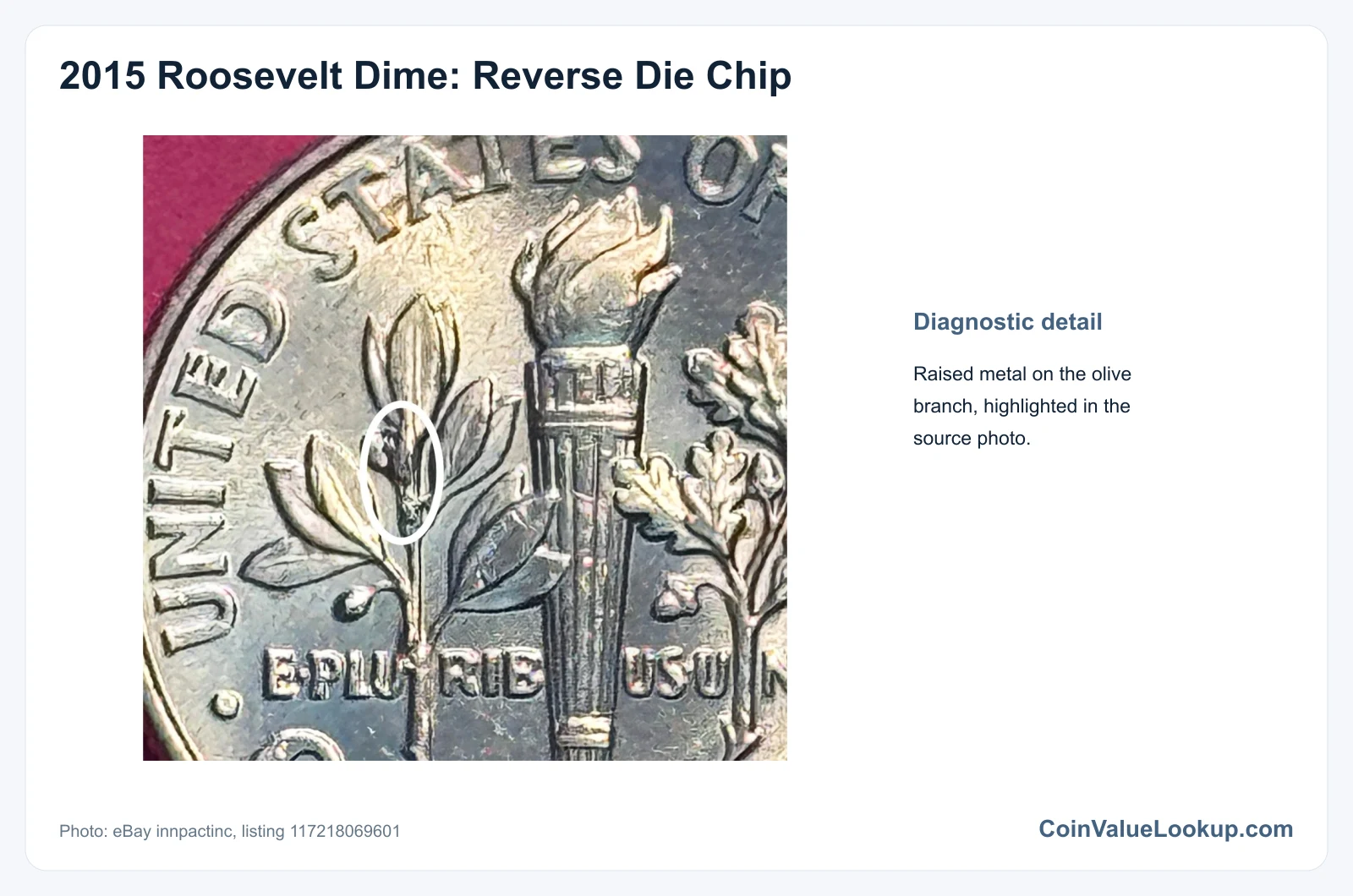
Die cracks and die chips appear as raised lines or small raised blobs on the coin's surface. They result from fractures in the steel die, and every coin struck by that cracked die will show the same raised feature in the same location.
A die crack running from the interior to the rim is common. When a large piece of the die breaks away near the rim, the result is a retained cud — a raised, featureless blob connected to the edge.
Interior chips produce smaller raised lumps within the design.
Do not confuse these with incuse scratches, corrosion buildup, or foreign material stuck to the surface. Die cracks are raised, follow consistent paths, and repeat across multiple coins from the same die.
Value depends on the size, location, and visual impact of the crack or cud. No specific price range is adopted here.
6. 2015 Roosevelt Dime — Struck-Through Error
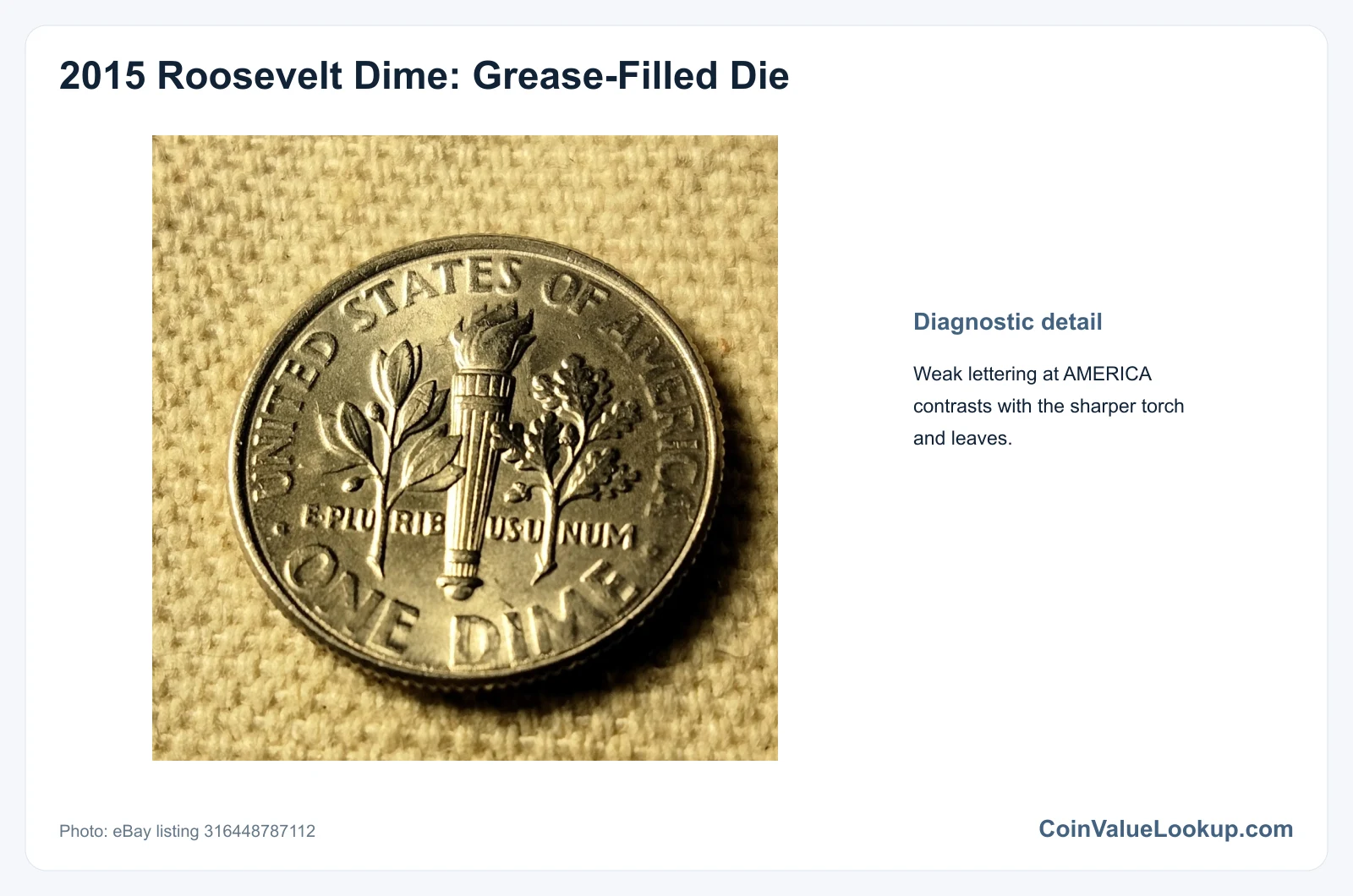
A struck-through error occurs when debris — grease, a thread, a metal fragment — sits between the die and the planchet during striking. The result is a localized depression or incomplete design area where the foreign material blocked the die's impression.
Grease-filled dies leave soft, mushy areas where detail is missing. A retained foreign object can leave an impression of its shape pressed into the coin's surface.
These are distinct categories, so note which type you think you have.
Ordinary wear, cleaning damage, and weak strikes from a tired die can look similar. The difference is that a struck-through error creates a specific, localized disruption rather than the broad, gradual loss of detail you see from circulation wear.
Value varies with the size and clarity of the obstruction impression and overall coin condition. No specific price range is adopted here.
7. 2015 Roosevelt Dime — Misaligned Die
A misaligned die shifts one side of the design relative to the planchet. Unlike an off-center strike where the whole blank is displaced, a misaligned die means one die face is offset while the other remains centered, or both shift differently.
The result is uneven rim width on one side of the coin.
Compare both sides carefully. On the affected face, the design will be slightly off-center relative to the rim, while the opposite side may look normal.
This is different from a rotational misalignment, where the designs are turned relative to each other.
Lookalikes include tilted photography, true off-center strikes, and post-mint rim damage. A genuine misaligned die shows consistent offset on one face with a normal or differently offset opposite face.
Value depends on the degree of misalignment and the coin's overall condition. No specific price range is adopted here.
8. 2015 Roosevelt Dime — Improper Annealing
Improper annealing refers to an error in the heat-treatment process that prepares planchets before striking. On a 2015 dime, this can show up as unusual surface discoloration or an atypical texture that differs from a normally prepared coin.
The surface may appear darker, streaky, or have an uneven finish that does not match standard luster. Compare the suspect coin's surface and edge to a normal 2015 dime side by side.
The appearance is a screening clue, not definitive proof of the cause — professional evaluation helps confirm.
Environmental toning, corrosion, and heat applied after minting can all mimic an annealing error. Post-mint damage tends to be uneven and concentrated in spots, while an annealing issue typically affects the surface more uniformly.
Value depends on how dramatic the visual effect is and the coin's overall preservation. No specific price range is adopted here.