1850 Liberty Seated Dime Coin Value: How Much Is It Worth?
The 1850 Liberty Seated Dime spans a wide value range depending on mint and condition. Philadelphia issues start around $29 at G4 and climb to roughly $864 at MS63 per USA Coin Book estimates.
New Orleans coins carry a steeper premium, from about $54 at G4 up to $5,626 at MS63. Proof strikes are a different category entirely, with a PR63 guide estimate near $25,000.
Fast Way to Identify Your 1850 Liberty Seated Dime
Want a quick read on what you have? Upload clear photos of the front and back of your 1850 dime and our identifier will give you a preliminary take on the mint, version and general condition.
Two sharp, well-lit images are all it takes to get started.
1850 Liberty Seated Dime Value
Upload both sides of your 1850 Liberty Seated Dime.
Front Obverse
Upload photo
Back Reverse
Upload photo
Which 1850 Liberty Seated Dime Versions Are Worth Money?
- Philadelphia (no mintmark) business strikes range from about $29 at G4 to $864 at MS63 per guide estimates, making condition the key factor.
- New Orleans (O mintmark) issues carry a significant premium, with guide values from roughly $54 at G4 to $5,626 at MS63.
- Proof 1850 dimes are rare early Philadelphia strikes; a PR63 carries a guide estimate around $25,000.
- A documented rotated-die variety exists for the 1850-O and may add value depending on the degree of rotation and overall condition.
- Original surfaces and correct identification of the mint and design branch matter far more than a polished appearance.
Step 1: Identify Your 1850 Liberty Seated Dime Mint Mark and Version
First, confirm you are looking at a Liberty Seated Dime and not the smaller half dime. The obverse shows a seated Liberty figure surrounded by stars, and the reverse reads ONE DIME inside a small wreath.
The design includes drapery at Liberty's elbow, which is correct for the 1850 date.
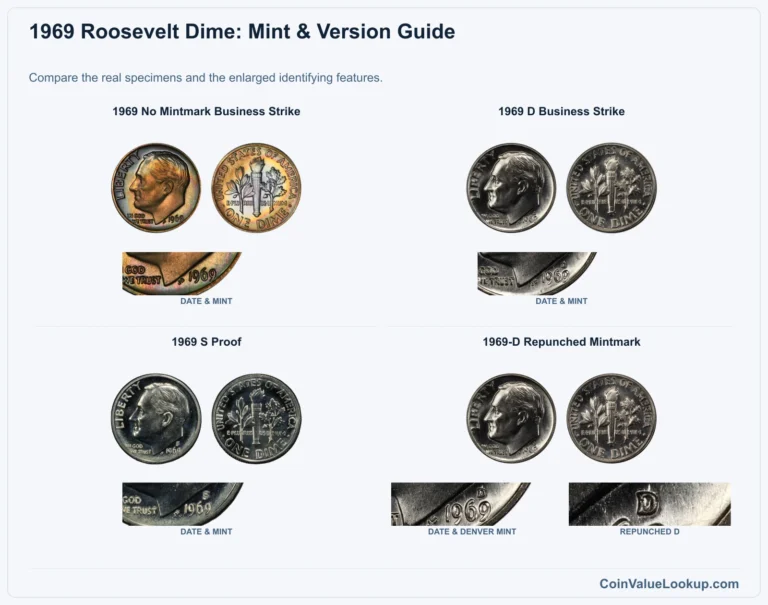
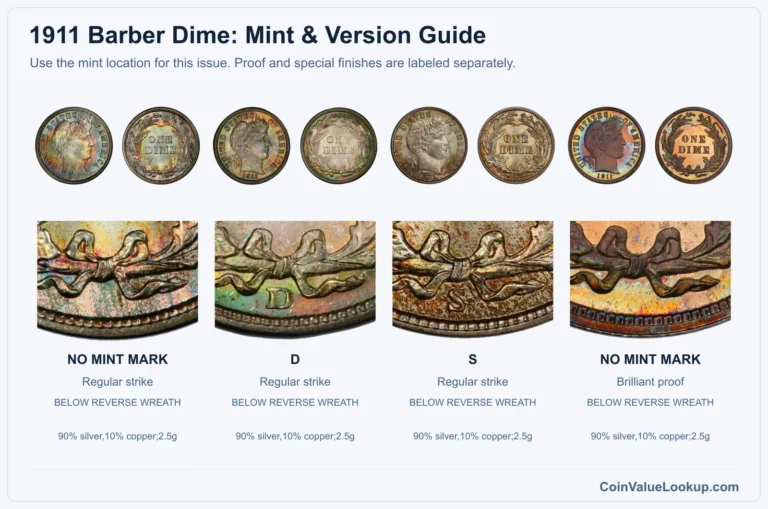
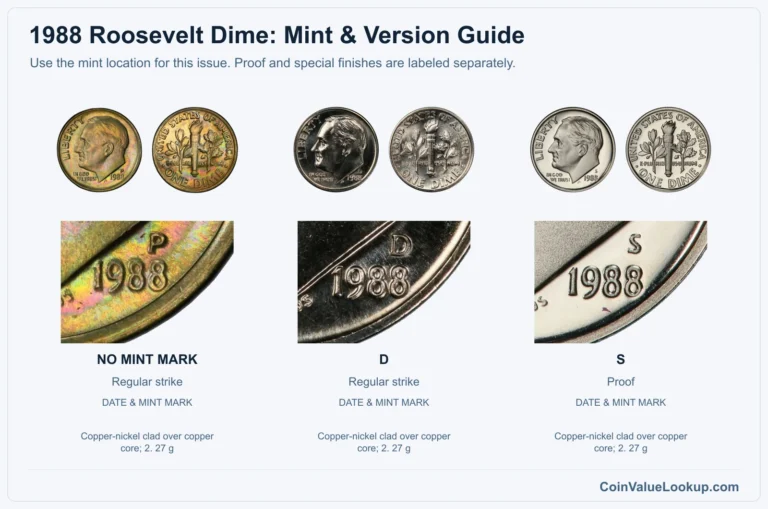
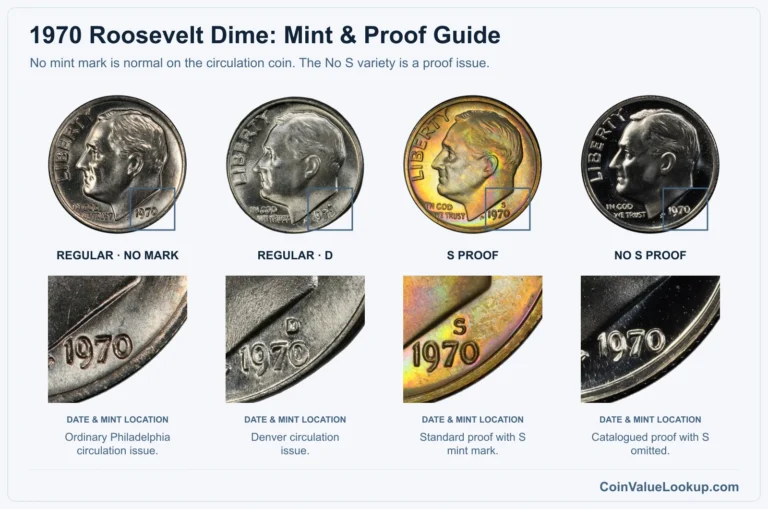
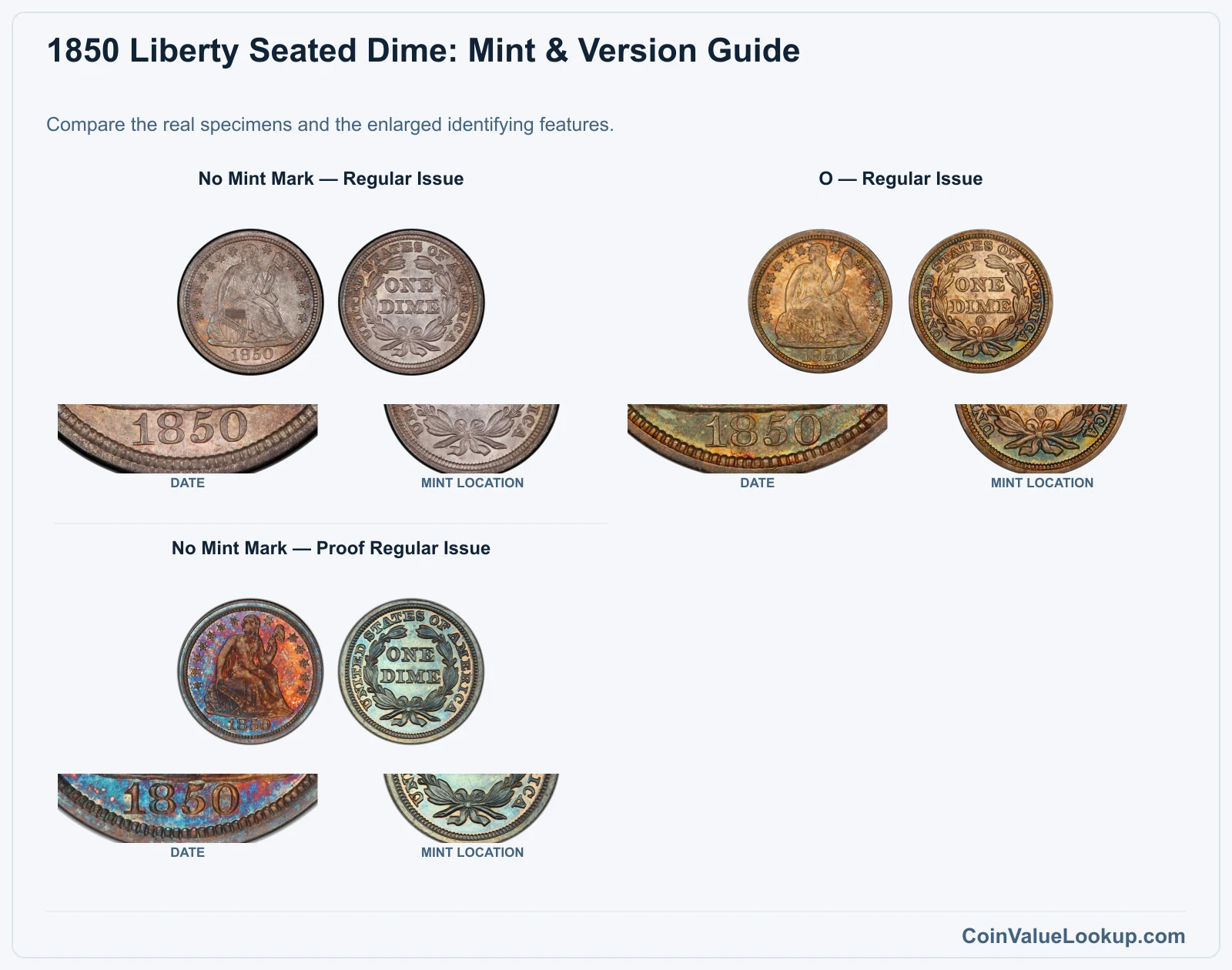
Next, flip the coin over and look below the wreath on the reverse. A small "O" mintmark means New Orleans.
No letter at all means Philadelphia. That single detail is the biggest driver of value for this date.
The coin is 90% silver and 10% copper, weighs nominally 2.67 grams, measures 17.9 mm across, and has a reeded edge. If it feels too light or the edge is smooth, you may have a different denomination or a problem coin.
One thing worth knowing: some 1850 dimes show weak stars on the obverse. This is a die-preparation issue, not an error that commands a premium by itself.
Weak stars alone do not make the coin more valuable.
Step 2: Check Your 1850 Liberty Seated Dime Grade
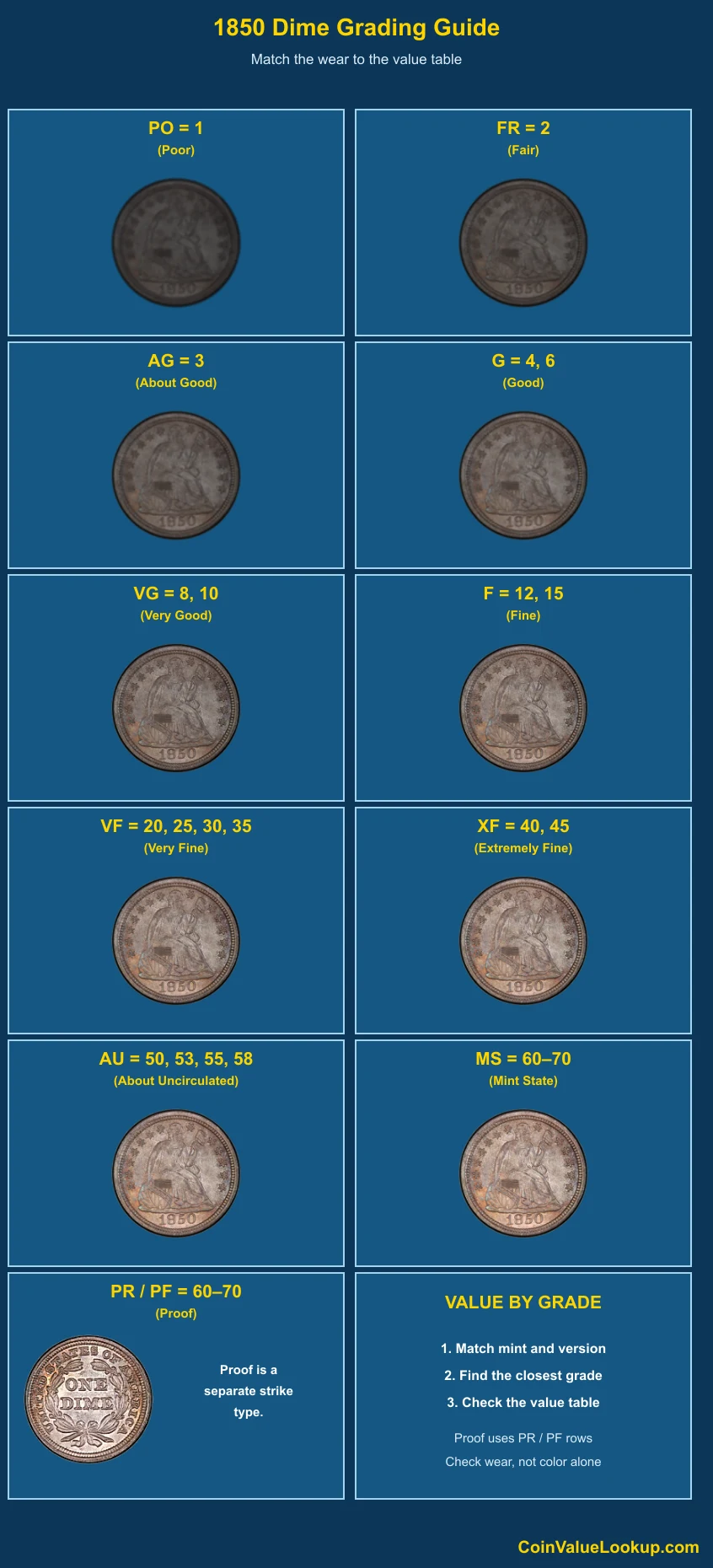
Look at the high points first. On the obverse, check Liberty's head, the shield on her lap, her gown folds, and her feet.
On the reverse, examine the wreath details near the base. These are the areas where wear shows up earliest.
Separating actual circulation wear from original strike weakness takes practice. A softly struck coin can look worn even if it never left a bank vault.
Compare your coin side by side with the grading image to see where genuine friction differs from a weak impression at the mint.
Luster matters. A coin with original mint luster in the protected areas grades higher than a dull, cleaned example at the same level of detail.
Polished or "shiny" coins are not the same as well-preserved ones, and a polished circulated coin is definitely not a Proof.
Coin Value Lookup is a handy starting point if you want to look up other dates and denominations in this series or compare across different coin types.
Step 3: Check 1850 Liberty Seated Dime Value by Mint and Version
1850 Liberty Seated Dime — No Mint Mark — Regular Issue
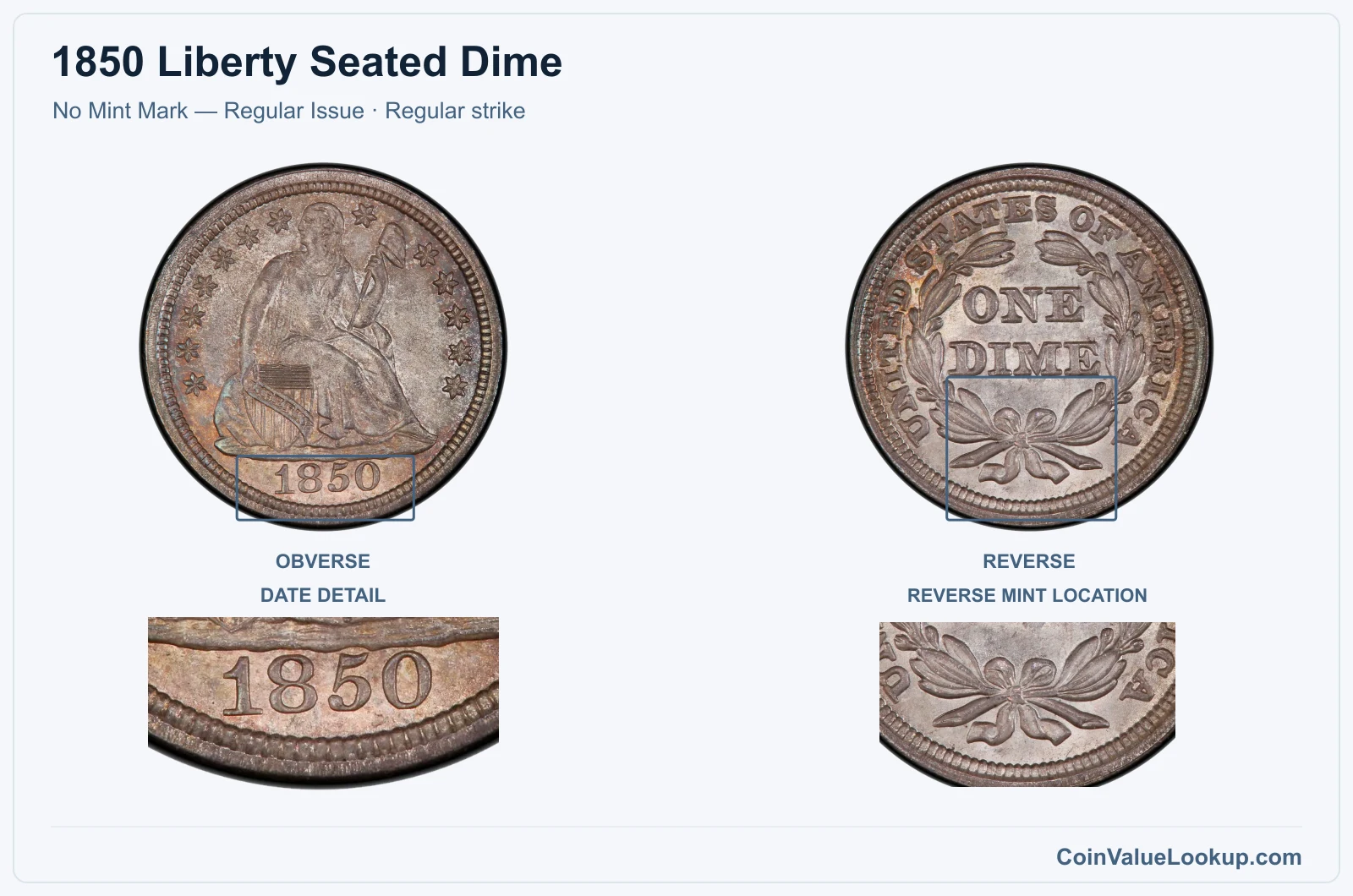
The Philadelphia 1850 dime carries no mintmark. Look at the reverse below the wreath: if the field is clean with no letter, you have the Philadelphia issue.
This is the more available of the two mints for the date.
USA Coin Book guide estimates place this coin at about $29 in G4 (a heavily worn but readable example) and around $864 in MS63 (a lightly marked coin with good luster). Some examples show weak obverse stars due to die preparation at the mint.
That softness is normal for the issue and does not add an error premium on its own.
Range Grade
Price Auction Records Appraisal PO PO 1
—
Coin Identifier FR FR 2
—
Coin Identifier AG AG 3
—
Coin Identifier G G 4
—
Coin Identifier
G 6
—
Coin Identifier VG VG 8
—
Coin Identifier
VG 10
—
Coin Identifier F F 12
—
Coin Identifier
F 15
—
Coin Identifier VF VF 20
—
Coin Identifier
VF 25
—
Coin Identifier
VF 30
—
Coin Identifier
VF 35
—
Coin Identifier XF XF 40
Coin Identifier
XF 45
Coin Identifier AU AU 50
Coin Identifier
AU 53
Coin Identifier
AU 55
Coin Identifier
AU 58
Coin Identifier MS MS 60
Coin Identifier
MS 61
Coin Identifier
MS 62
Coin Identifier
MS 63
Coin Identifier
MS 64
Coin Identifier
MS 65
Coin Identifier
MS 66
Coin Identifier
MS 67
—
—
—
MS 68
—
—
—
MS 69
—
—
—
MS 70
—
—
—
1850 Liberty Seated Dime — O — Regular Issue
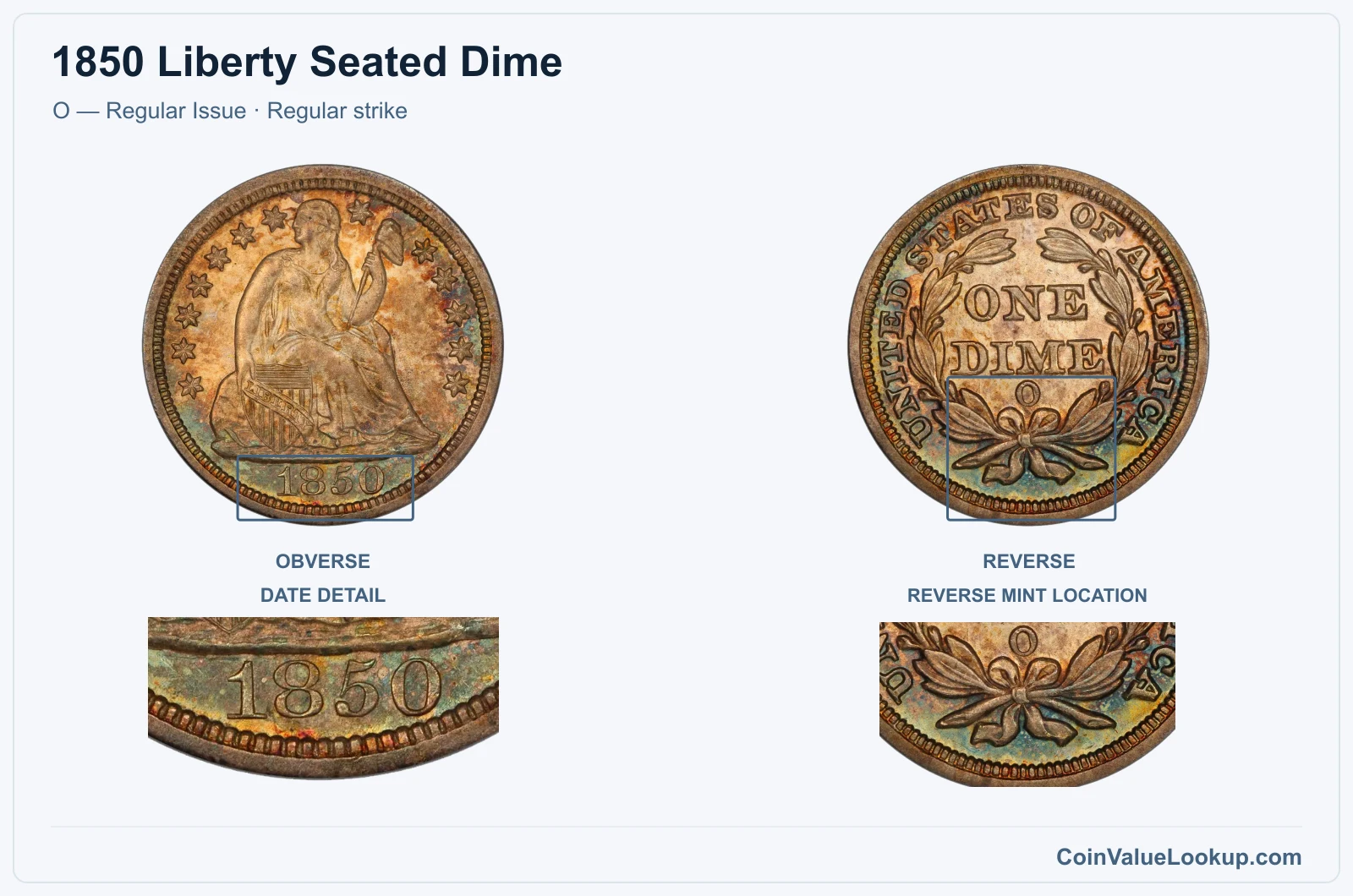
The New Orleans version carries a small "O" mintmark on the reverse, positioned below the wreath. This is the pricier mint for 1850 dimes across every grade level.
USA Coin Book estimates run from about $54 at G4 to roughly $5,626 at MS63. That high-end jump reflects genuine scarcity in uncirculated condition.
New Orleans coins of this era often come with softer strikes and weaker stars, again a product of die preparation rather than a collectible error. When evaluating an 1850-O, pay close attention to whether the mintmark is clearly visible, since a worn or filled "O" can sometimes be mistaken for a Philadelphia coin.
Range Grade
Price Auction Records Appraisal PO PO 1
—
Coin Identifier FR FR 2
—
Coin Identifier AG AG 3
—
Coin Identifier G G 4
—
Coin Identifier
G 6
—
Coin Identifier VG VG 8
—
Coin Identifier
VG 10
—
Coin Identifier F F 12
—
Coin Identifier
F 15
Coin Identifier VF VF 20
Coin Identifier
VF 25
Coin Identifier
VF 30
Coin Identifier
VF 35
Coin Identifier XF XF 40
Coin Identifier
XF 45
Coin Identifier AU AU 50
Coin Identifier
AU 53
Coin Identifier
AU 55
Coin Identifier
AU 58
Coin Identifier MS MS 60
—
Coin Identifier
MS 61
Coin Identifier
MS 62
Coin Identifier
MS 63
Coin Identifier
MS 64
—
Coin Identifier
MS 65
Coin Identifier
MS 66
Coin Identifier
MS 67
Coin Identifier
MS 68
—
—
—
MS 69
—
—
—
MS 70
—
—
—
1850 Liberty Seated Dime — No Mint Mark — Proof Regular Issue
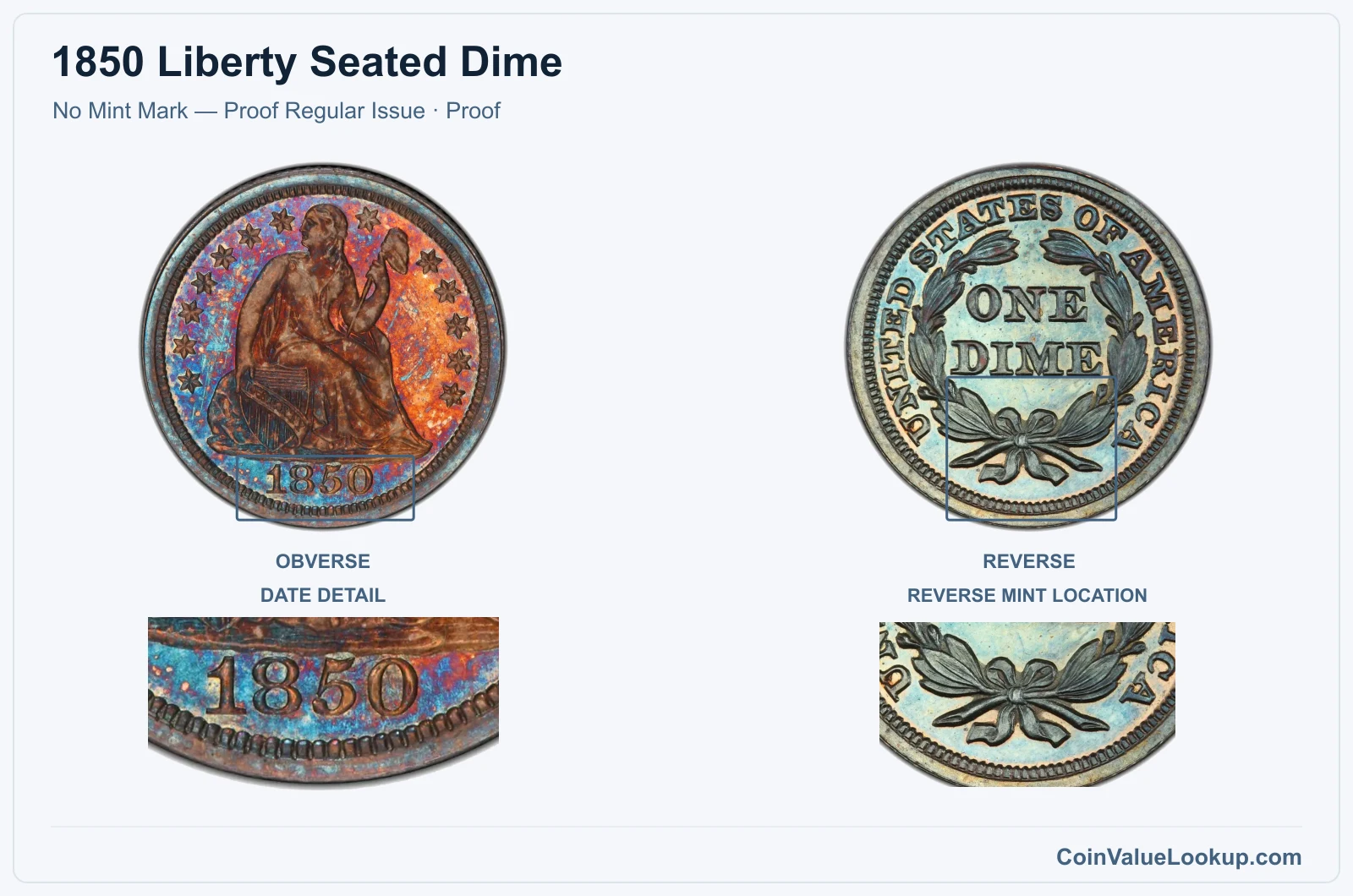
Proof 1850 dimes were struck at Philadelphia with specially prepared dies on polished planchets. These are not ordinary annual collector products.
Early-date Proofs like this are genuinely rare, and survivors are few.
The hallmark of a real Proof is deeply mirrored fields, sharp design details, and squared-off rims. A PCGS-sourced guide estimate places a PR63 example around $25,000.
Do not confuse a polished or lightly circulated coin for a Proof. Cleaning a business strike can mimic reflective fields, but the strike characteristics, rim profile, and surface quality under magnification will differ.
Cameo contrast, where frosted devices stand against mirror fields, is a surface characteristic rather than a separate mint or version. Any Proof attribution for this date should come from a professional grading service.
Range Grade
Price Auction Records Appraisal PR PR 1
—
Coin Identifier
PR 2
—
Coin Identifier
PR 3
—
Coin Identifier
PR 4
—
Coin Identifier
PR 6
—
Coin Identifier
PR 8
—
Coin Identifier
PR 10
—
Coin Identifier
PR 12
—
Coin Identifier
PR 15
—
Coin Identifier
PR 20
—
Coin Identifier
PR 25
—
Coin Identifier
PR 30
—
Coin Identifier
PR 35
—
Coin Identifier
PR 40
—
Coin Identifier
PR 45
—
Coin Identifier
PR 50
—
Coin Identifier
PR 53
—
Coin Identifier
PR 55
—
Coin Identifier
PR 58
—
Coin Identifier
PR 60
—
Coin Identifier
PR 61
—
Coin Identifier
PR 62
—
Coin Identifier
PR 63
—
Coin Identifier
PR 64
Coin Identifier
PR 65
—
Coin Identifier
PR 66
Coin Identifier
PR 67
—
—
—
PR 68
—
—
—
PR 69
—
—
—
PR 70
—
—
—
1850 Liberty Seated Dime Error List
1. 1850 Liberty Seated Dime — Rotated Dies
A rotated-die error occurs when the obverse and reverse dies are misaligned in their normal orientation. On a correctly struck U.S. coin, if you hold the obverse upright and flip the coin top to bottom, the reverse should also appear upright.
If the reverse is tilted at an angle, you may have a die rotation.
This variety is documented for the 1850-O dime specifically. The degree of rotation matters: a few degrees is minor, while a significant turn is more notable.
Value depends on the visibility of the rotation and the coin's overall condition, so no single price applies.
Be careful with lookalikes. A photograph taken at an angle, or simply holding the coin sideways, can create the illusion of rotation.
Always test with the coin in hand using the flip method described above.