1867 Liberty Seated Dime Coin Value: How Much Is It Worth?
The 1867 Liberty Seated Dime spans a wide value range depending on mint, grade and finish. A USA Coin Book retail guide estimate places the San Francisco issue around $158 in G4, while that same mint climbs to roughly $5,223 in MS63.
The Philadelphia business strike is a genuine low-mintage rarity with guide values starting at about $1,067 in G4. Philadelphia Proofs occupy their own price chart entirely.
Sorting out which version you hold is the first step to understanding what your coin might be worth.
Fast Way to Identify Your 1867 Liberty Seated Dime
The fastest way to figure out what you have is to upload clear photos of both the front and back of your coin. Our identifier can help with a preliminary read on the mint, date and general type.
It works from your images alone, so good lighting and a steady hand go a long way. Just snap both sides and let the tool do its thing.
1867 Liberty Seated Dime Value
Upload both sides of your 1867 Liberty Seated Dime.
Front Obverse
Upload photo
Back Reverse
Upload photo
Which 1867 Liberty Seated Dime Versions Are Worth Money?
- The Philadelphia business strike is a low-mintage rarity with a USA Coin Book guide value of about $1,067 even in G4, rising to around $3,432 at MS63.
- The San Francisco regular issue ranges from roughly $158 at G4 to about $5,223 at MS63 per the same guide, making high-grade survivors especially desirable.
- Philadelphia Proofs carry a guide value near $725 at PR63 and require confirmed mirror fields and deliberate die preparation — not just a shiny surface.
Step 1: Identify Your 1867 Liberty Seated Dime Mint Mark and Version
Start by confirming the obverse shows a seated Liberty figure with the legend around the rim, and the reverse reads ONE DIME inside a wreath. If your coin is smaller and says HALF DIME, set it aside; that is a different denomination.
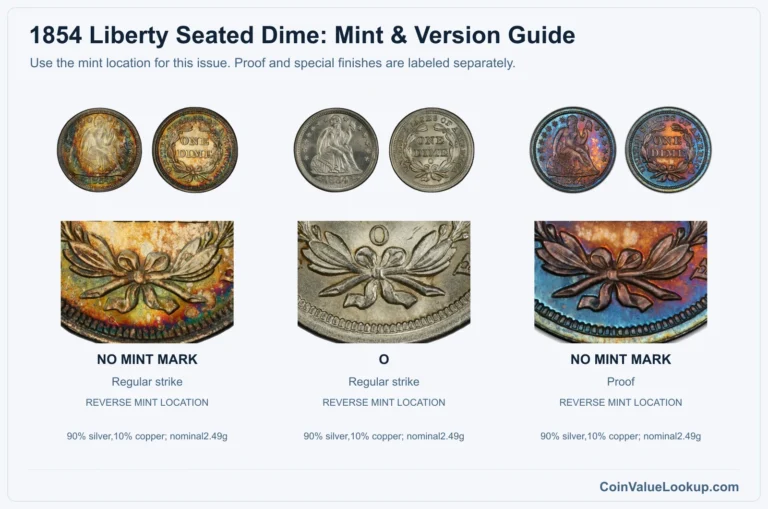
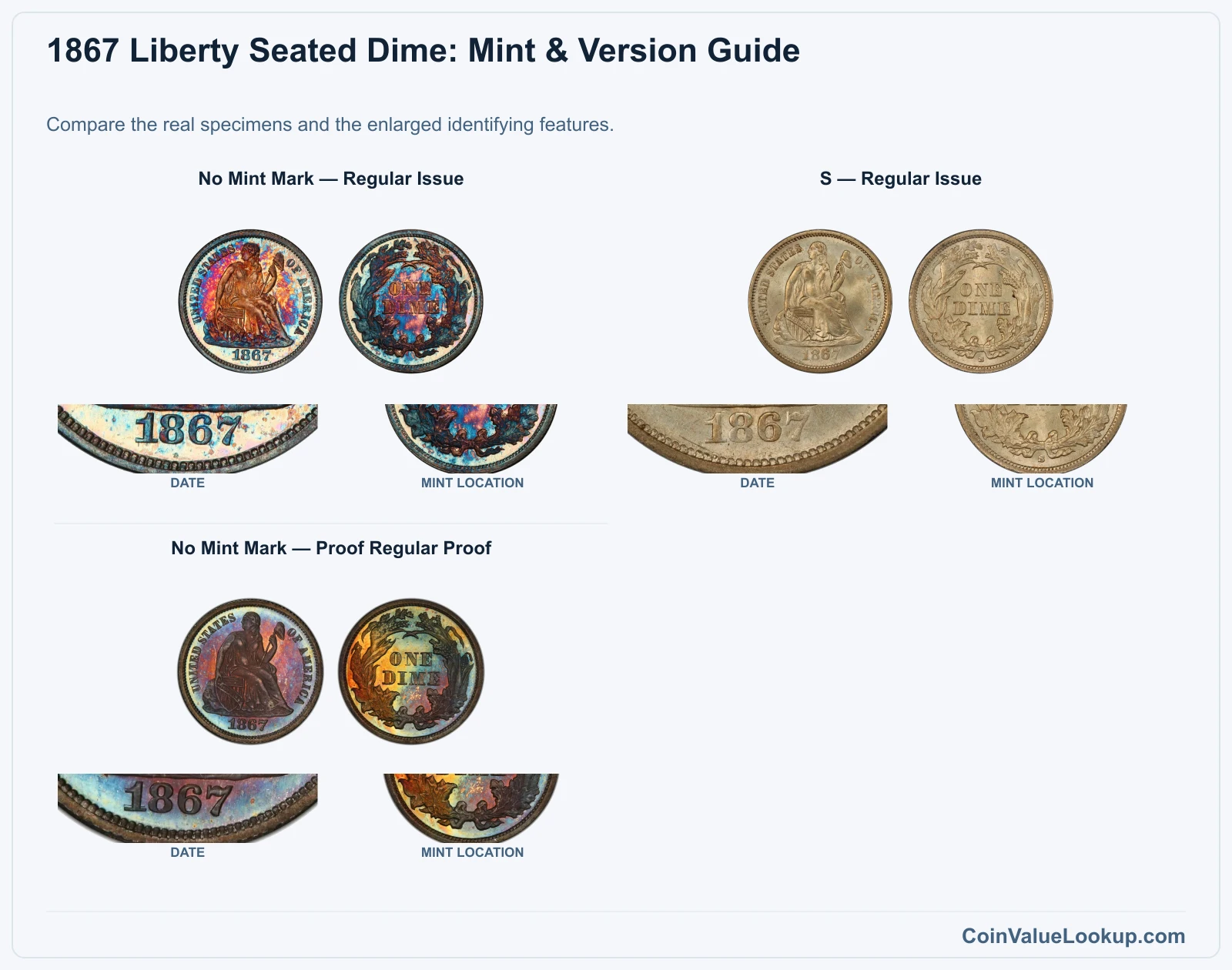
Flip the coin over and look below the wreath for a mintmark. Philadelphia coins carry no mintmark at all.
An "S" below the wreath means San Francisco. No other mintmark applies to the 1867 dime.
All regular 1867 dimes are struck in 90% silver and 10% copper, measure 17.9mm across, weigh a nominal 2.49 grams and have a reeded edge. If the weight or diameter is way off, you may have a counterfeit or a different denomination.
The Philadelphia business strike had a very small mintage, making it considerably scarcer than the San Francisco issue in any grade. Philadelphia Proofs were produced separately with a distinct mirror-field finish.
Each of these three versions — Philadelphia business strike, San Francisco business strike and Philadelphia Proof — follows its own value track, so correct identification matters.
Step 2: Check Your 1867 Liberty Seated Dime Grade
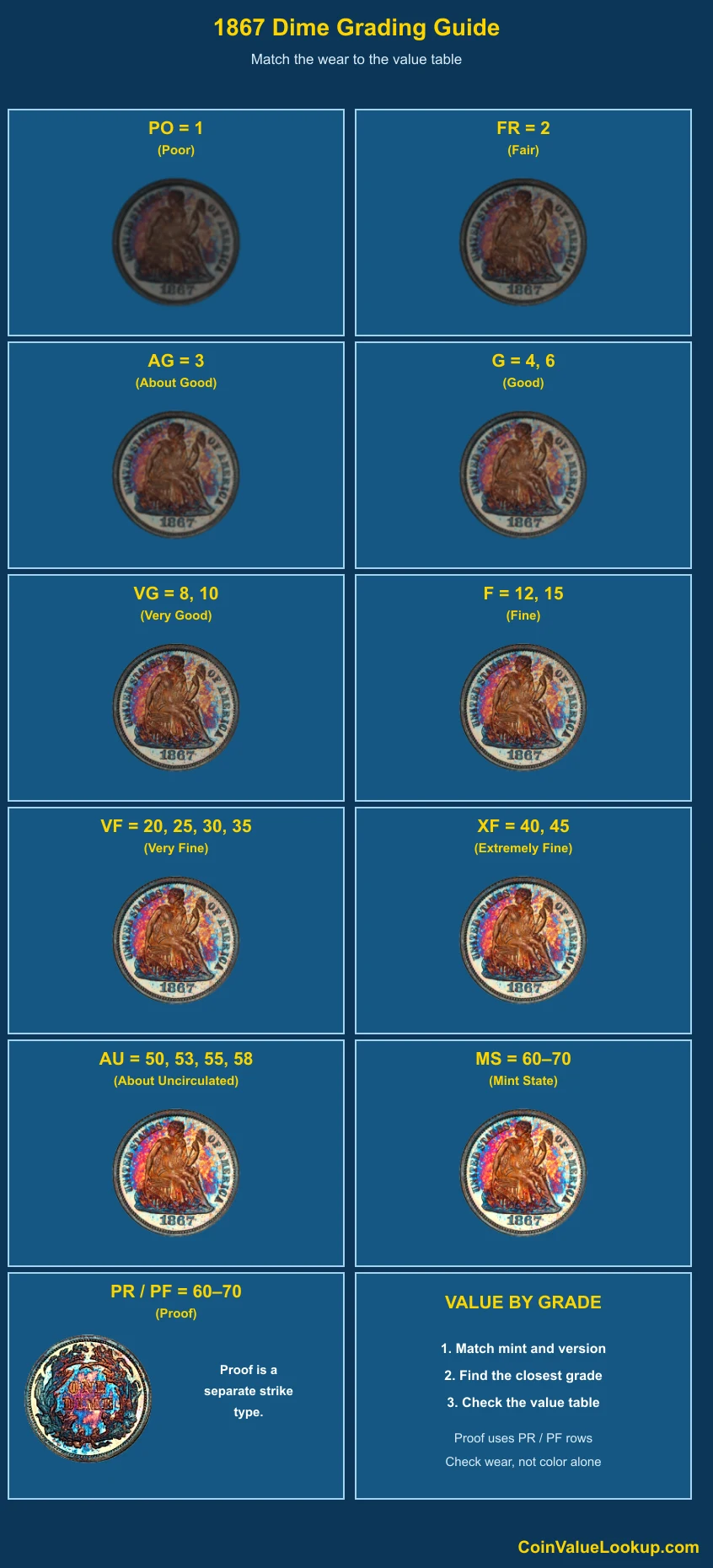
On any 1867 Seated dime, wear shows up first on Liberty's head, across her breast and knee, on the shield lines and on the highest wreath leaves on the reverse. Compare both sides of your coin to the reference image.
A coin grading around Good (G4) will have a visible outline of Liberty but most interior detail is gone. The date and legend should still be readable.
At Mint State (MS63), you should see full or nearly full original luster with only minor contact marks or blemishes. Strike quality matters here: some coins left the press with soft details on the head or shield that look like wear but are not.
Weak strikes and worn dies can fool you. A coin with mushy details but full cartwheel luster was probably struck that way, not circulated.
Compare the high points against the protected areas to judge actual friction.
Coin Value Lookup is a handy starting point if you want to look up guides for other dates and denominations in this series. It can save you time when you are working through a group of old silver coins.
Step 3: Check 1867 Liberty Seated Dime Value by Mint and Version
1867 Liberty Seated Dime — No Mint Mark — Regular Issue
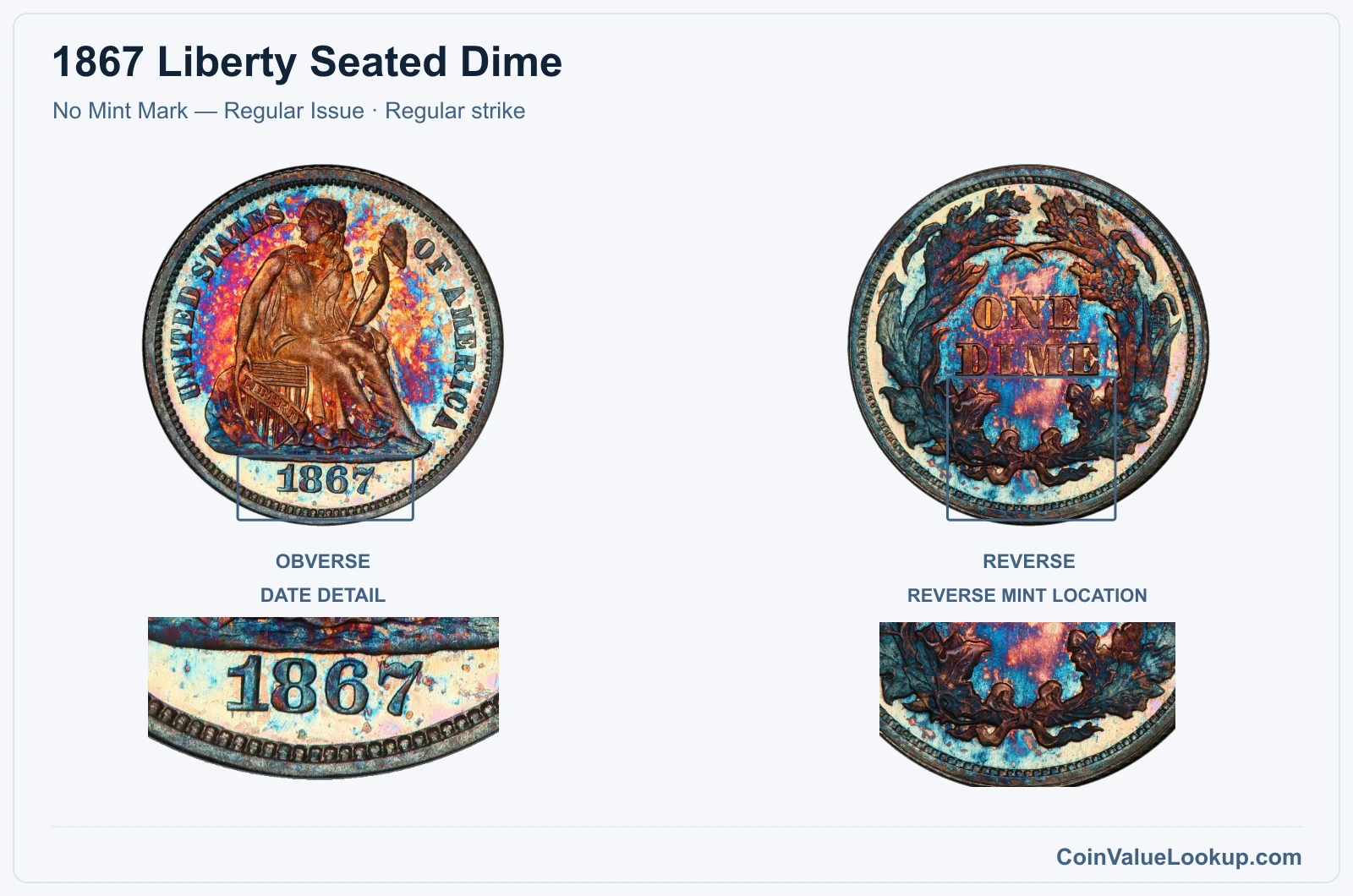
The 1867 Philadelphia dime has no mintmark. Look at the reverse below the wreath bow: clean space, no letter.
This is a genuinely scarce coin. The mintage was small enough that even well-worn survivors command strong prices.
USA Coin Book lists a retail guide estimate of about $1,067 in G4 and roughly $3,432 at MS63. Those are guide figures, not guaranteed sale prices, but they reflect how thin the supply is at every grade level.
The design is the Legend Obverse paired with the agricultural wreath reverse. If you have one with original surfaces and a clear date, you are holding a coin most Seated dime collectors actively hunt for.
Range Grade
Price Auction Records Appraisal PO PO 1
—
Coin Identifier FR FR 2
Coin Identifier AG AG 3
—
Coin Identifier G G 4
—
Coin Identifier
G 6
Coin Identifier VG VG 8
—
Coin Identifier
VG 10
—
Coin Identifier F F 12
Coin Identifier
F 15
Coin Identifier VF VF 20
—
Coin Identifier
VF 25
Coin Identifier
VF 30
—
Coin Identifier
VF 35
Coin Identifier XF XF 40
—
Coin Identifier
XF 45
—
Coin Identifier AU AU 50
—
Coin Identifier
AU 53
Coin Identifier
AU 55
Coin Identifier
AU 58
—
Coin Identifier MS MS 60
—
Coin Identifier
MS 61
—
Coin Identifier
MS 62
Coin Identifier
MS 63
Coin Identifier
MS 64
Coin Identifier
MS 65
Coin Identifier
MS 66
Coin Identifier
MS 67
Coin Identifier
MS 68
Coin Identifier
MS 69
—
—
—
MS 70
—
—
—
1867 Liberty Seated Dime — S — Regular Issue
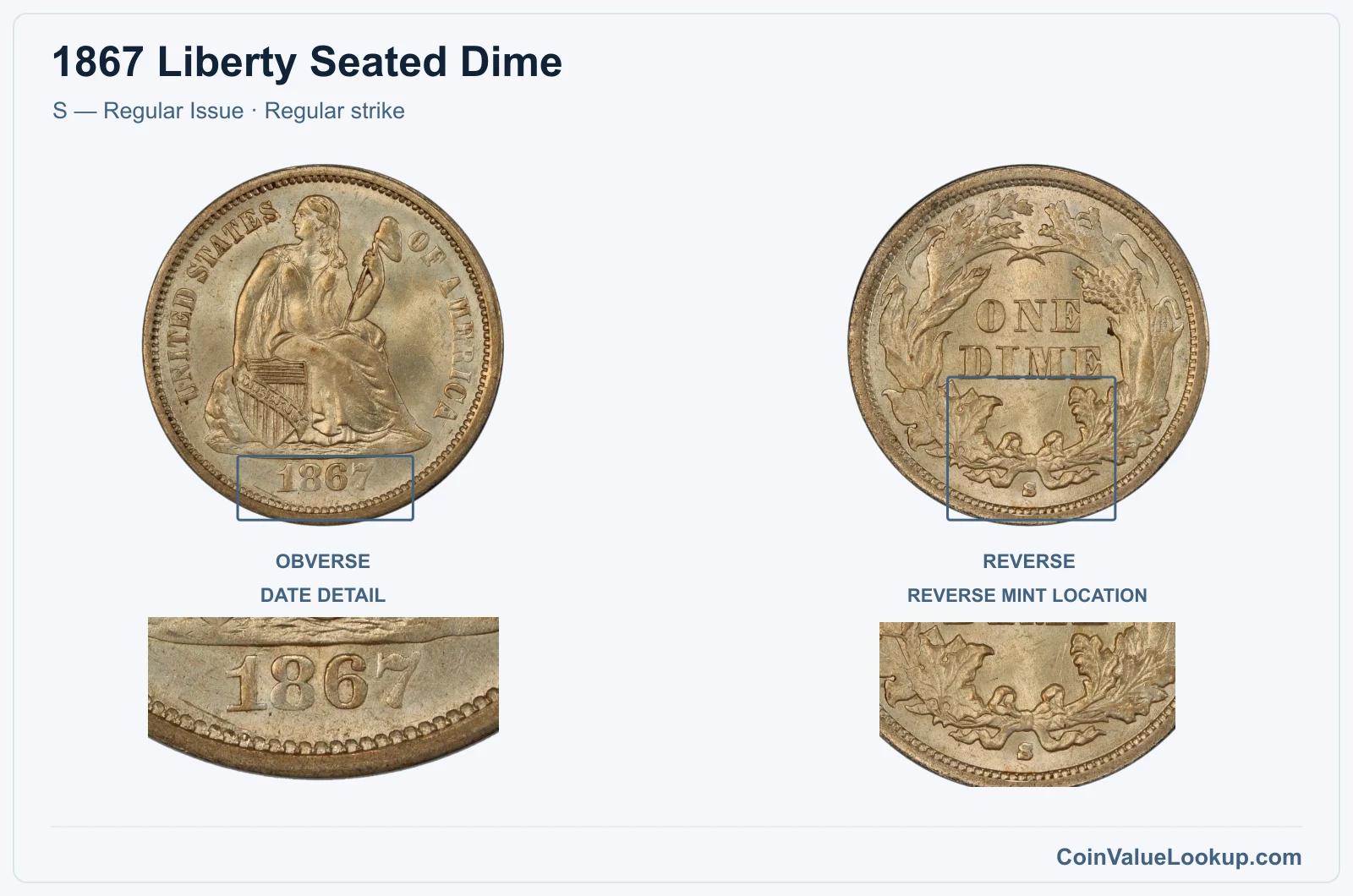
San Francisco struck 1867 dimes carry a small "S" mintmark on the reverse, positioned below the wreath. This issue is far more available than its Philadelphia counterpart, especially in circulated grades.
The USA Coin Book retail guide places a G4 example around $158, which makes it accessible compared to the no-mintmark version. At MS63, though, the guide jumps to approximately $5,223.
That steep climb tells you survivors in high grades are genuinely scarce. The coin shares the same Legend Obverse and agricultural wreath reverse as the Philadelphia issue.
If the mintmark is clear and the surfaces are honest, you have a solid piece of Civil War-era silver.
Range Grade
Price Auction Records Appraisal PO PO 1
—
Coin Identifier FR FR 2
—
Coin Identifier AG AG 3
Coin Identifier G G 4
—
Coin Identifier
G 6
Coin Identifier VG VG 8
Coin Identifier
VG 10
Coin Identifier F F 12
Coin Identifier
F 15
Coin Identifier VF VF 20
Coin Identifier
VF 25
Coin Identifier
VF 30
Coin Identifier
VF 35
Coin Identifier XF XF 40
Coin Identifier
XF 45
Coin Identifier AU AU 50
Coin Identifier
AU 53
Coin Identifier
AU 55
Coin Identifier
AU 58
Coin Identifier MS MS 60
—
Coin Identifier
MS 61
Coin Identifier
MS 62
Coin Identifier
MS 63
Coin Identifier
MS 64
Coin Identifier
MS 65
Coin Identifier
MS 66
Coin Identifier
MS 67
—
—
—
MS 68
—
—
—
MS 69
—
—
—
MS 70
—
—
—
1867 Liberty Seated Dime — No Mint Mark — Proof Regular Proof
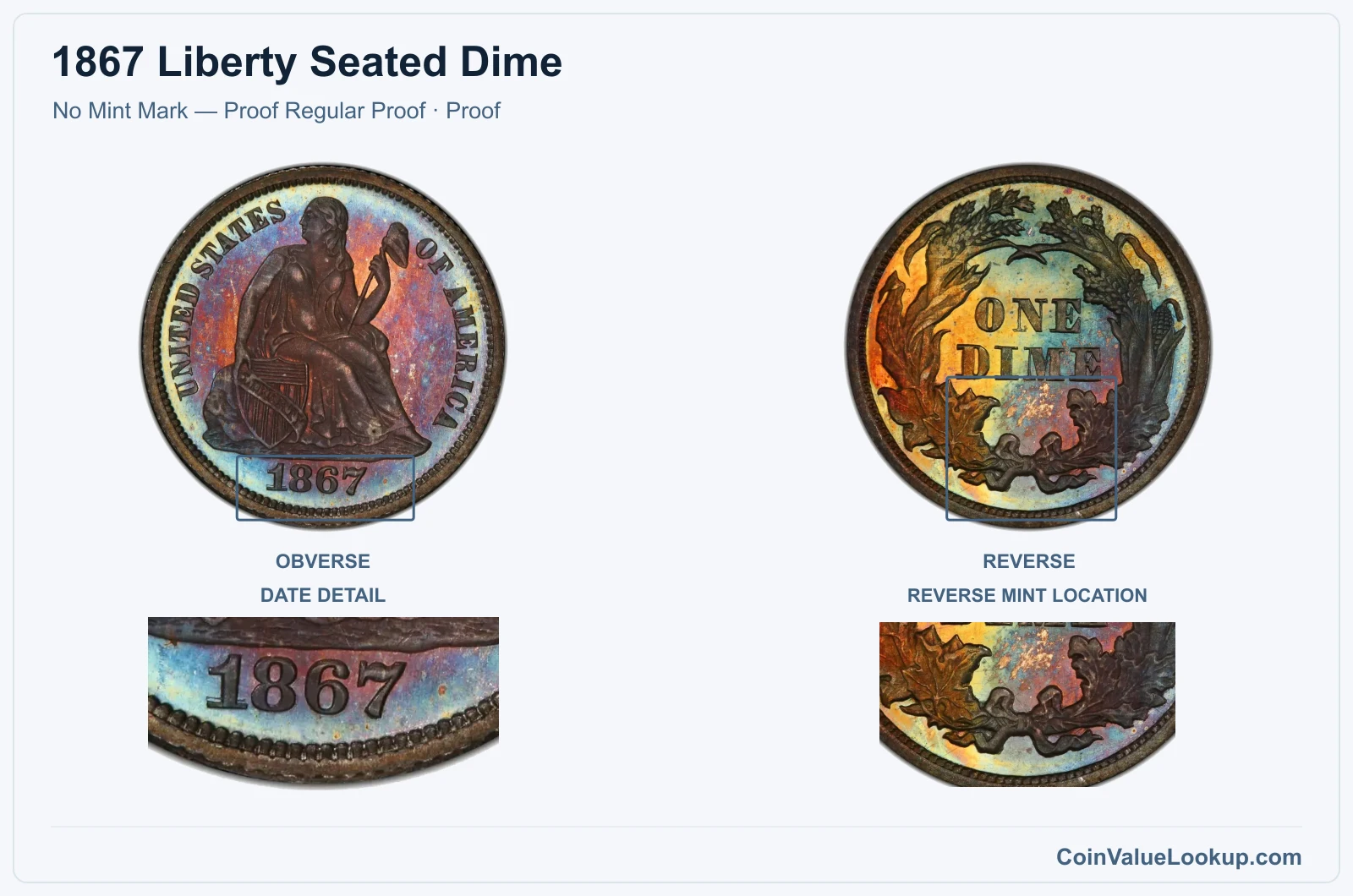
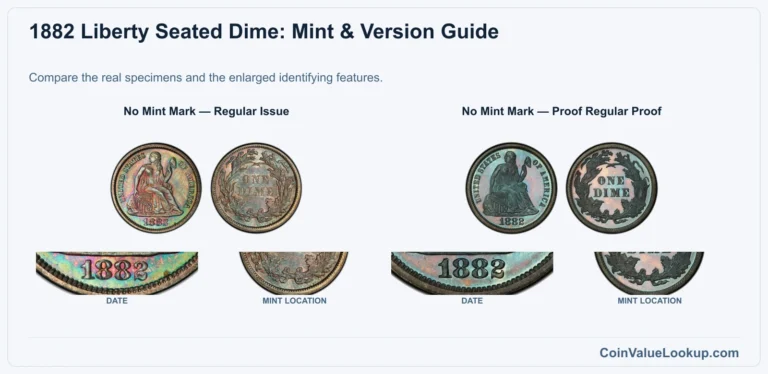
Philadelphia Proofs of 1867 were struck from specially prepared dies on polished planchets, producing deep mirror fields on both sides. They carry no mintmark, just like the business strike, so the finish itself is the distinguishing feature.
Look for glassy, reflective surfaces across the flat areas of the coin. Hairlines from old cleaning or mishandling are common and will affect the grade.
A coin that merely looks shiny or has been polished is not a Proof; genuine Proofs show a specific relationship between the mirrored field and the design relief that buffing cannot replicate.
USA Coin Book lists a guide estimate of about $725 at PR63. Proof and business-strike grading scales are completely separate, so do not compare a PR63 value to an MS63 value as though they are interchangeable.
Range Grade
Price Auction Records Appraisal PR PR 1
—
Coin Identifier
PR 2
—
Coin Identifier
PR 3
—
Coin Identifier
PR 4
—
Coin Identifier
PR 6
—
Coin Identifier
PR 8
—
Coin Identifier
PR 10
—
Coin Identifier
PR 12
—
Coin Identifier
PR 15
—
Coin Identifier
PR 20
—
Coin Identifier
PR 25
—
Coin Identifier
PR 30
—
Coin Identifier
PR 35
—
Coin Identifier
PR 40
—
Coin Identifier
PR 45
—
Coin Identifier
PR 50
—
Coin Identifier
PR 53
—
Coin Identifier
PR 55
Coin Identifier
PR 58
—
Coin Identifier
PR 60
Coin Identifier
PR 61
Coin Identifier
PR 62
Coin Identifier
PR 63
Coin Identifier
PR 64
Coin Identifier
PR 65
Coin Identifier
PR 66
Coin Identifier
PR 67
Coin Identifier
PR 68
—
—
—
PR 69
—
—
—
PR 70
—
—
—
1867 Liberty Seated Dime Error List
1. 1867 Liberty Seated Dime — Repunched Date
A repunched date on the 1867 dime shows remnants of an earlier position of one or more date numerals alongside the final placement. You are looking for ghost images, partial extra serifs or thickened strokes near the digits of the date.
The key is that the doubling is confined to the date area and results from the date punch being impressed into the die more than once at slightly different positions.
This is different from mechanical doubling, which tends to produce flat, shelf-like distortion across multiple design elements, not just the date. A damaged or corroded date can also mimic a repunched appearance, so check whether the extra impressions are raised and consistent with a die-made feature rather than post-strike damage.
No specific price data is available for this variety. Value depends on the visibility of the repunching, the overall condition of the coin and the particular date digits affected.
2. 1867 Liberty Seated Dime — Clashed Dies
Clashed dies occur when the obverse and reverse dies strike each other without a planchet between them. The result is a faint transfer of design elements from one side onto the opposite die, which then shows up on subsequently struck coins as ghostly traces of the wrong design.
On an 1867 Philadelphia dime, look for portions of Liberty or the wreath appearing where they do not belong — faint outlines in the fields that align with the expected position of the opposing die's features. These impressions are typically subtle and require good lighting and magnification.
Do not confuse die clash marks with random scratches, raised lines from a damaged die or a brockage, which involves a previously struck coin acting as a die. Clash marks follow a predictable pattern tied to the opposing design.
No adopted price data exists for this variety. The premium, if any, depends on how visible the clash is and the coin's overall condition.