1840 Liberty Seated Dime Coin Value: How Much Is It Worth?
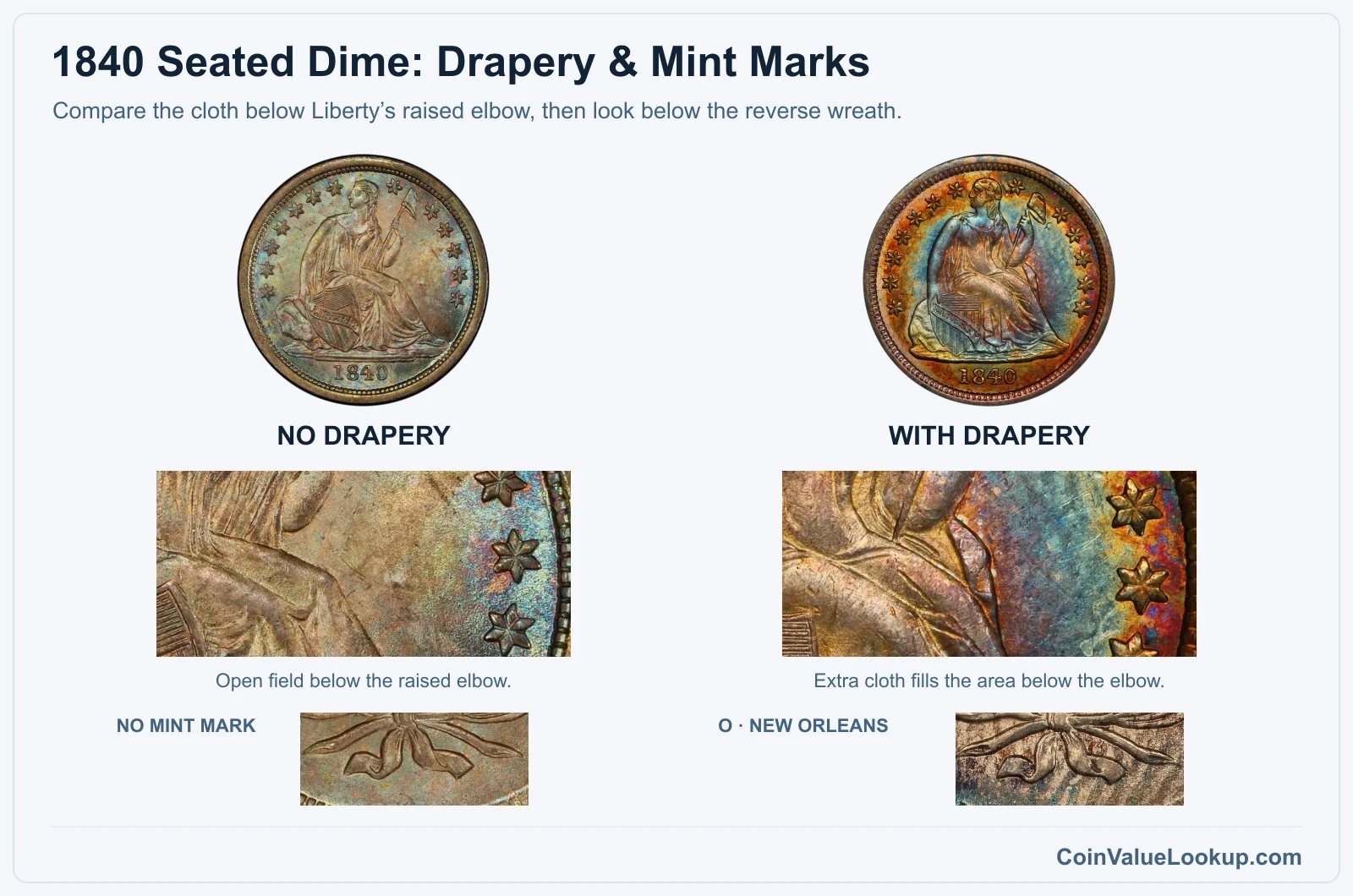
The 1840 Liberty Seated Dime is a transitional year where Philadelphia switched from the No Drapery to the With Drapery design mid-production, while New Orleans struck only the No Drapery type. Retail guide estimates range from about $29 at G4 to around $18,158 at MS63 depending on the specific mint and design branch.
Rare Proofs command their own separate pricing.
Fast Way to Identify Your 1840 Liberty Seated Dime
Snap clear photos of both the front and back of your coin and upload them to our identifier for a preliminary look at what you have. This helps narrow down which 1840 dime variety you hold, whether it carries a mintmark, and which design hub was used.
Exact grading, authentication, and final value still require professional evaluation.
1840 Liberty Seated Dime Value
Upload both sides of your 1840 Liberty Seated Dime.
Front Obverse
Upload photo
Back Reverse
Upload photo
Which 1840 Liberty Seated Dime Versions Are Worth Money?
- Philadelphia No Drapery and With Drapery are separate collectible types split by whether fabric hangs from Liberty's elbow, and each carries different guide values.
- The New Orleans (O mintmark) No Drapery version lists around $18,158 at MS63 in one guide, reflecting genuine scarcity in high grades.
- Philadelphia With Drapery dimes start higher in low grades (about $127 at G4) than the No Drapery Philadelphia issue (about $29 at G4), making the design branch worth checking even on worn coins.
- Proof No Drapery dimes from Philadelphia are genuinely rare early issues, not routine collector products, with a guide estimate near $60,000 at PR64.
- Die cracks and chin-whisker die lines are documented on 1840 dimes and can add collector interest depending on visibility and condition.
Step 1: Identify Your 1840 Liberty Seated Dime Mint Mark and Version
Start by confirming you have a seated Liberty obverse paired with a ONE DIME reverse inside a small wreath. Half dimes are smaller and say HALF DIME, so set those aside.
Flip the coin over and look below the wreath for a mintmark. A small "O" means New Orleans.
No letter means Philadelphia.
Now the critical step: look at Liberty's left elbow on the obverse. On No Drapery coins the arm is bare from elbow to hip.
On With Drapery coins, a fold of fabric hangs from the elbow downward. This single detail splits Philadelphia production into two distinct collectible types.
New Orleans only made the No Drapery version in 1840, so if you see an O mintmark with drapery, something is off. All 1840 dimes are struck in 90% silver and 10% copper, weigh about 2.67 grams, measure 17.9 mm across, and have a reeded edge.
Those specs help separate a genuine piece from a counterfeit or a different denomination.
Step 2: Check Your 1840 Liberty Seated Dime Grade
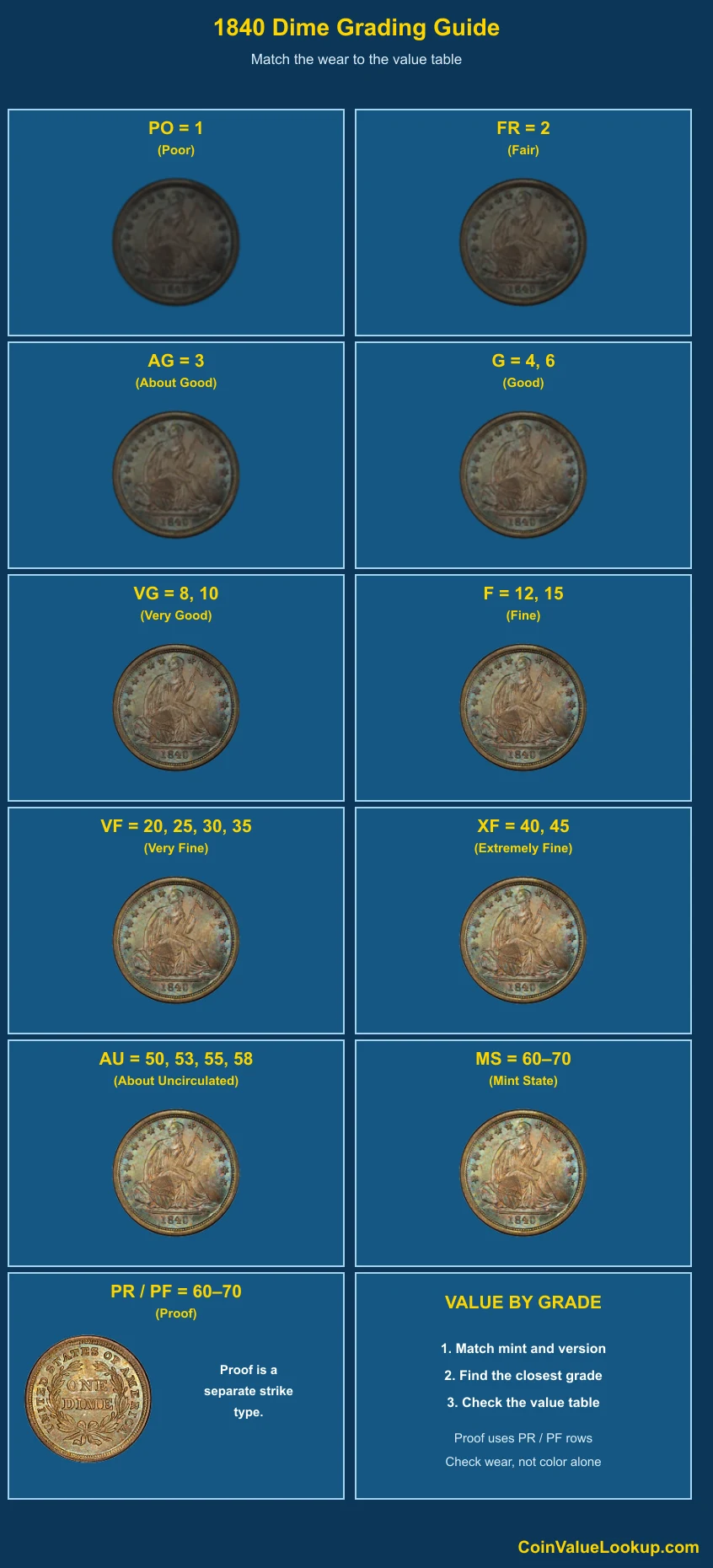
Use the grading comparison image matched to your specific subtype, because No Drapery and With Drapery coins wear differently in key spots. On any 1840 dime, check Liberty's head, the shield on her arm, the gown folds across her lap, and her feet.
These are the first areas to lose detail as a coin circulates.
Don't confuse a weakly struck coin with a heavily worn one. Some 1840 dimes left the press with soft details due to tired dies, especially around the stars or wreath tips.
Look at the overall luster and surface quality together to separate strike weakness from actual wear.
A polished circulated coin is not a Proof, no matter how shiny someone made it. Proof 1840 dimes have deeply mirrored fields from specially prepared dies, and hairlines from mishandling are a different concern than circulation friction.
Step 3: Check 1840 Liberty Seated Dime Value by Mint and Version
1840 Liberty Seated Dime — No Mint Mark — No Drapery
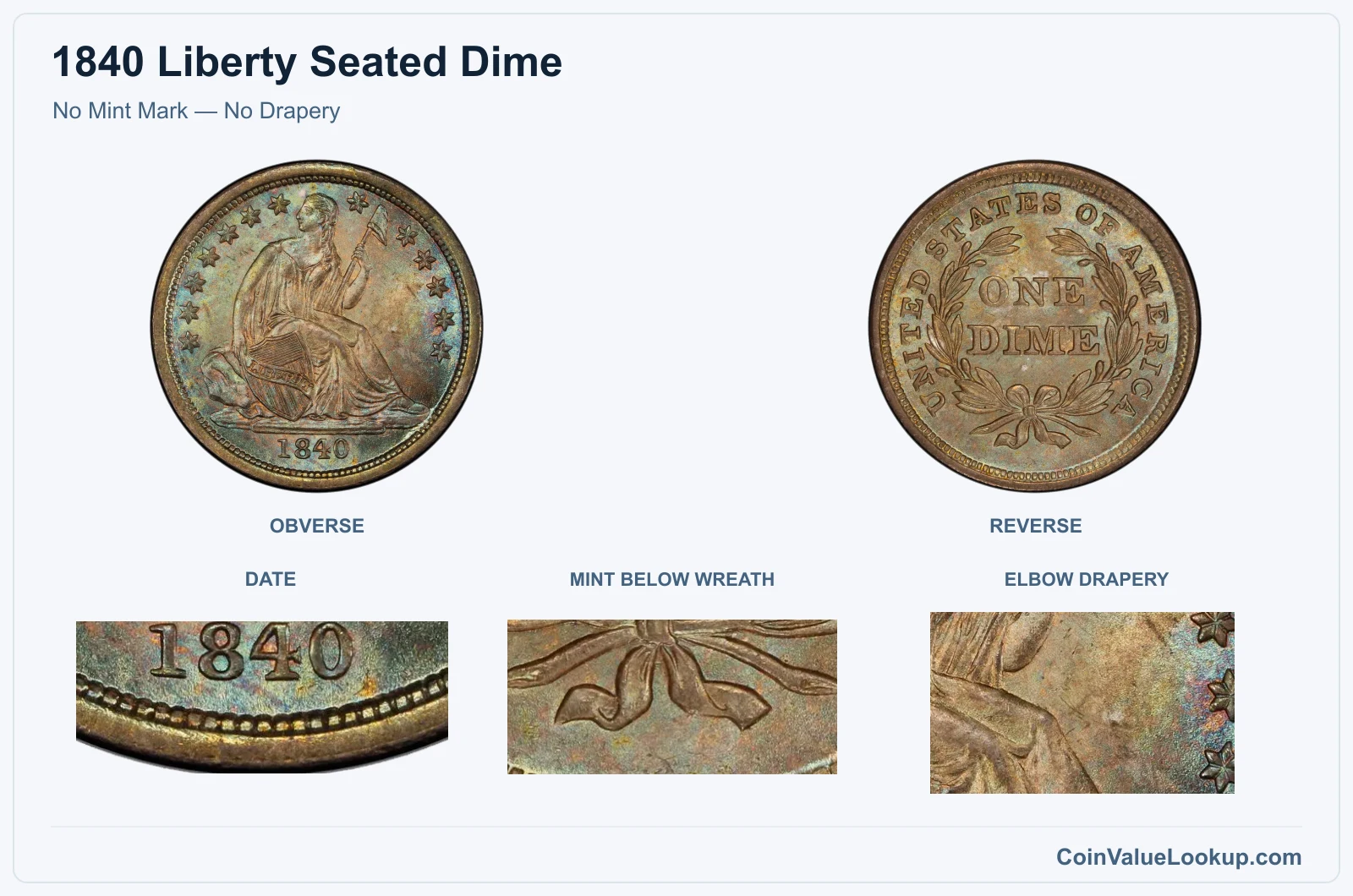
This is the Philadelphia issue without drapery below Liberty's elbow, paired with the small wreath reverse. No mintmark appears anywhere on the coin.
It is the most affordable entry point for the date, with guide estimates around $29 at G4 and about $1,067 at MS63 per USA Coin Book.
Confirm the bare elbow area carefully. Some coins show die clashing or wear that can mimic faint fabric lines, so compare against a known example.
The reverse carries the legend UNITED STATES OF AMERICA around a tight wreath enclosing ONE DIME. Condition and original surfaces matter far more than a quick polish for determining real value.
Range Grade
Price Auction Records Appraisal PO PO 1
—
Coin Identifier FR FR 2
—
Coin Identifier AG AG 3
—
Coin Identifier G G 4
—
Coin Identifier
G 6
Coin Identifier VG VG 8
Coin Identifier
VG 10
—
Coin Identifier F F 12
—
Coin Identifier
F 15
—
Coin Identifier VF VF 20
Coin Identifier
VF 25
Coin Identifier
VF 30
—
Coin Identifier
VF 35
—
Coin Identifier XF XF 40
Coin Identifier
XF 45
Coin Identifier AU AU 50
Coin Identifier
AU 53
Coin Identifier
AU 55
Coin Identifier
AU 58
Coin Identifier MS MS 60
—
Coin Identifier
MS 61
Coin Identifier
MS 62
Coin Identifier
MS 63
Coin Identifier
MS 64
Coin Identifier
MS 65
Coin Identifier
MS 66
Coin Identifier
MS 67
Coin Identifier
MS 68
Coin Identifier
MS 69
—
—
—
MS 70
—
—
—
1840 Liberty Seated Dime — O — No Drapery
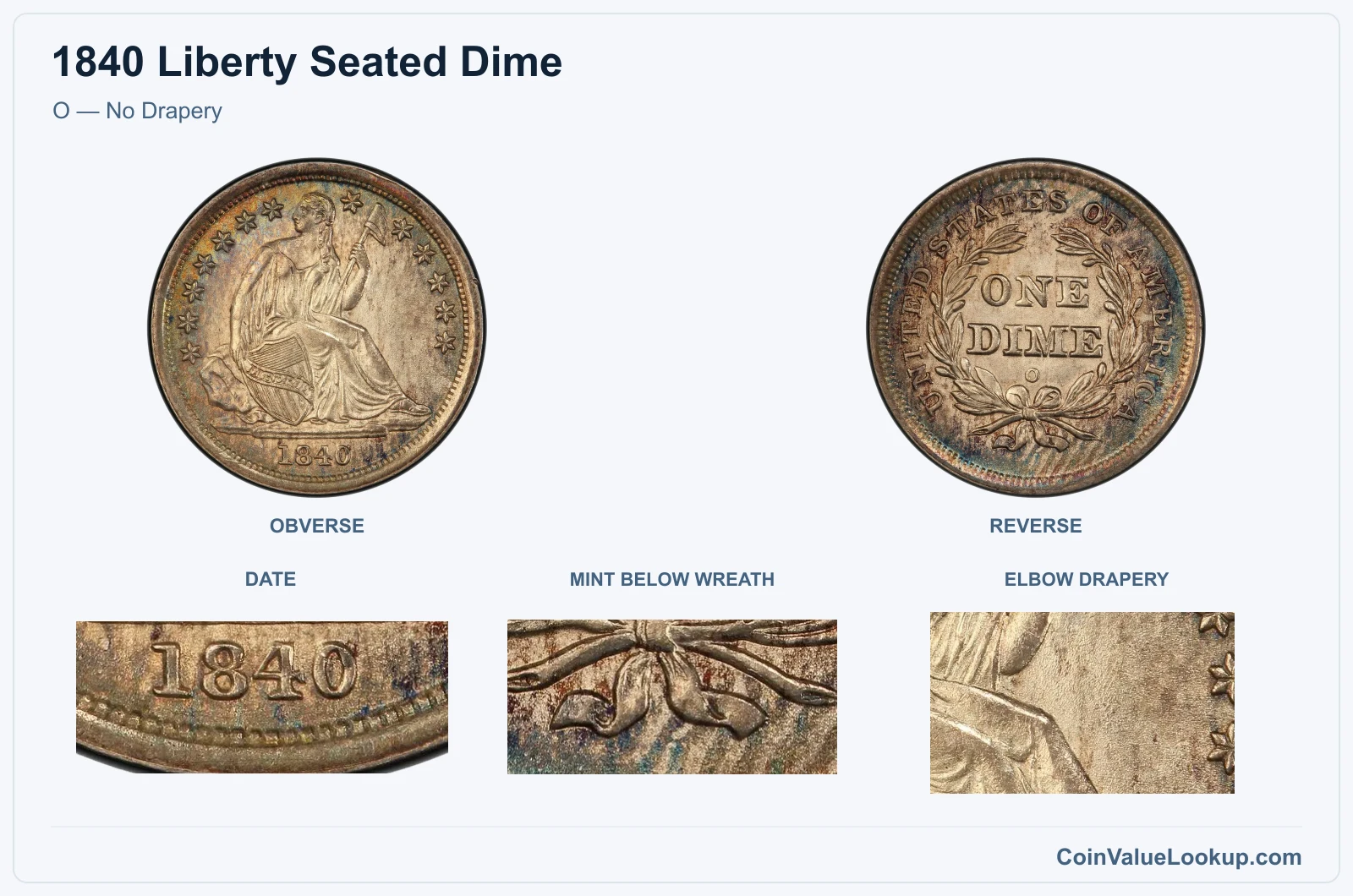
Look for the small "O" mintmark below the wreath on the reverse. New Orleans struck only the No Drapery design in 1840, so every genuine O-mint example has a bare elbow on Liberty.
Guide estimates from USA Coin Book place this version at roughly $77 in G4 and around $18,158 at MS63. That jump tells you something: survivors in mint condition are scarce.
Most known pieces saw heavy circulation in the Gulf states.
Coin Value Lookup can help you find guides for other Liberty Seated dates and mints as you build out your collection research. The alloy is 90% silver and 10% copper at a nominal weight of 2.67 grams, same as the Philadelphia strikes.
Range Grade
Price Auction Records Appraisal PO PO 1
—
Coin Identifier FR FR 2
—
Coin Identifier AG AG 3
—
Coin Identifier G G 4
—
Coin Identifier
G 6
—
Coin Identifier VG VG 8
—
Coin Identifier
VG 10
Coin Identifier F F 12
Coin Identifier
F 15
Coin Identifier VF VF 20
Coin Identifier
VF 25
Coin Identifier
VF 30
Coin Identifier
VF 35
Coin Identifier XF XF 40
Coin Identifier
XF 45
Coin Identifier AU AU 50
Coin Identifier
AU 53
Coin Identifier
AU 55
Coin Identifier
AU 58
Coin Identifier MS MS 60
Coin Identifier
MS 61
Coin Identifier
MS 62
Coin Identifier
MS 63
Coin Identifier
MS 64
Coin Identifier
MS 65
Coin Identifier
MS 66
—
—
—
MS 67
—
—
—
MS 68
—
—
—
MS 69
—
—
—
MS 70
—
—
—
1840 Liberty Seated Dime — No Mint Mark — With Drapery
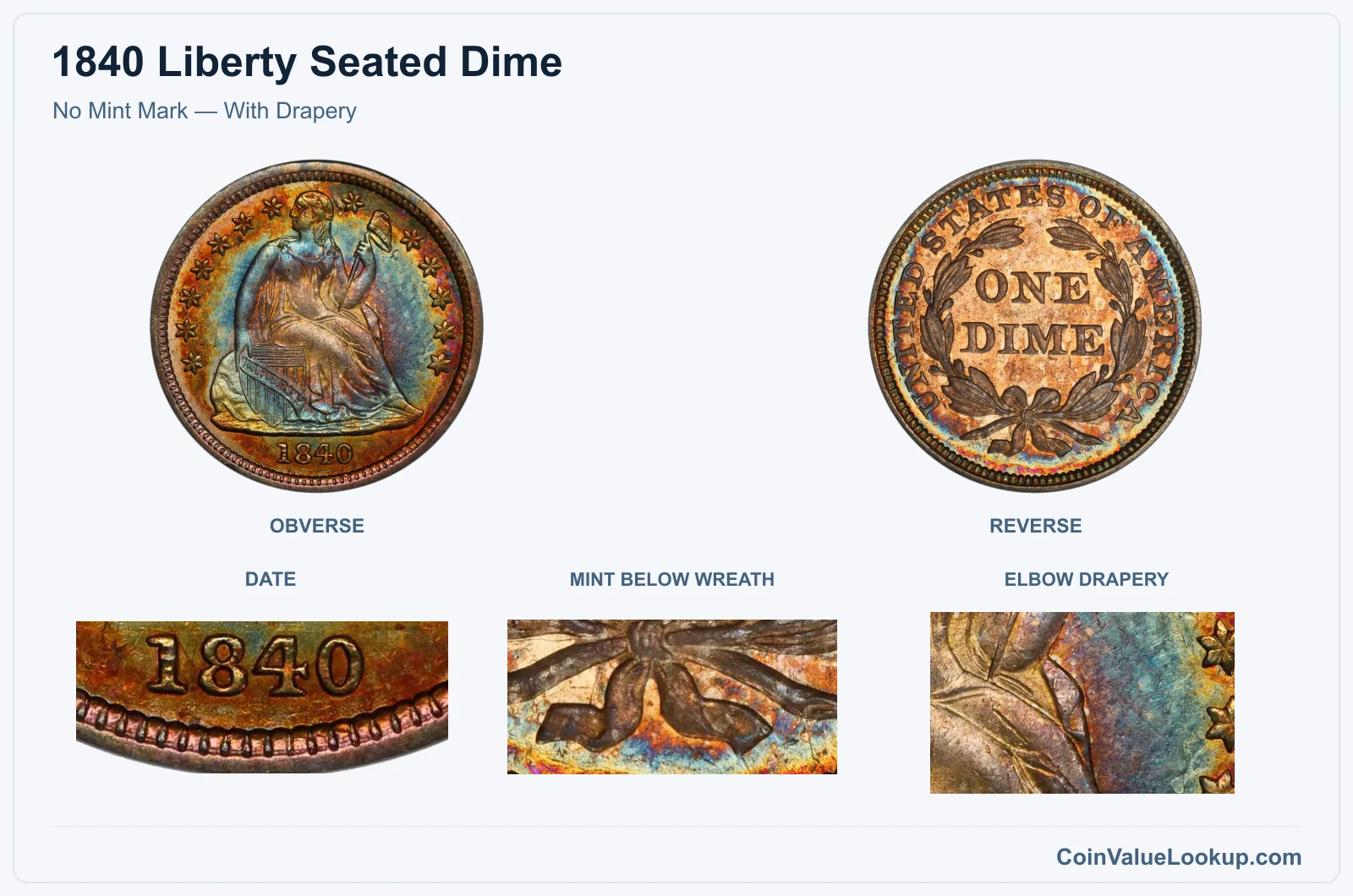
Mid-year, Philadelphia introduced a new obverse hub adding a fold of drapery hanging from Liberty's left elbow. This came alongside a revised reverse wreath hub.
Both changes are visible without magnification on a decent example.
The With Drapery Philadelphia dime starts noticeably higher in low grades, around $127 at G4 versus $29 for the No Drapery version, per USA Coin Book. At MS63 the guide lists about $14,885.
No mintmark appears on this coin. Make sure you are comparing the correct design branch when using any price chart, because lumping the two Philadelphia hubs together will mislead you.
Range Grade
Price Auction Records Appraisal PO PO 1
—
Coin Identifier FR FR 2
—
Coin Identifier AG AG 3
—
Coin Identifier G G 4
Coin Identifier
G 6
—
Coin Identifier VG VG 8
—
Coin Identifier
VG 10
Coin Identifier F F 12
Coin Identifier
F 15
Coin Identifier VF VF 20
Coin Identifier
VF 25
Coin Identifier
VF 30
Coin Identifier
VF 35
Coin Identifier XF XF 40
Coin Identifier
XF 45
Coin Identifier AU AU 50
Coin Identifier
AU 53
Coin Identifier
AU 55
Coin Identifier
AU 58
Coin Identifier MS MS 60
—
Coin Identifier
MS 61
—
Coin Identifier
MS 62
Coin Identifier
MS 63
Coin Identifier
MS 64
Coin Identifier
MS 65
—
Coin Identifier
MS 66
—
—
—
MS 67
—
—
—
MS 68
—
—
—
MS 69
—
—
—
MS 70
—
—
—
1840 Liberty Seated Dime — No Mint Mark — Proof No Drapery
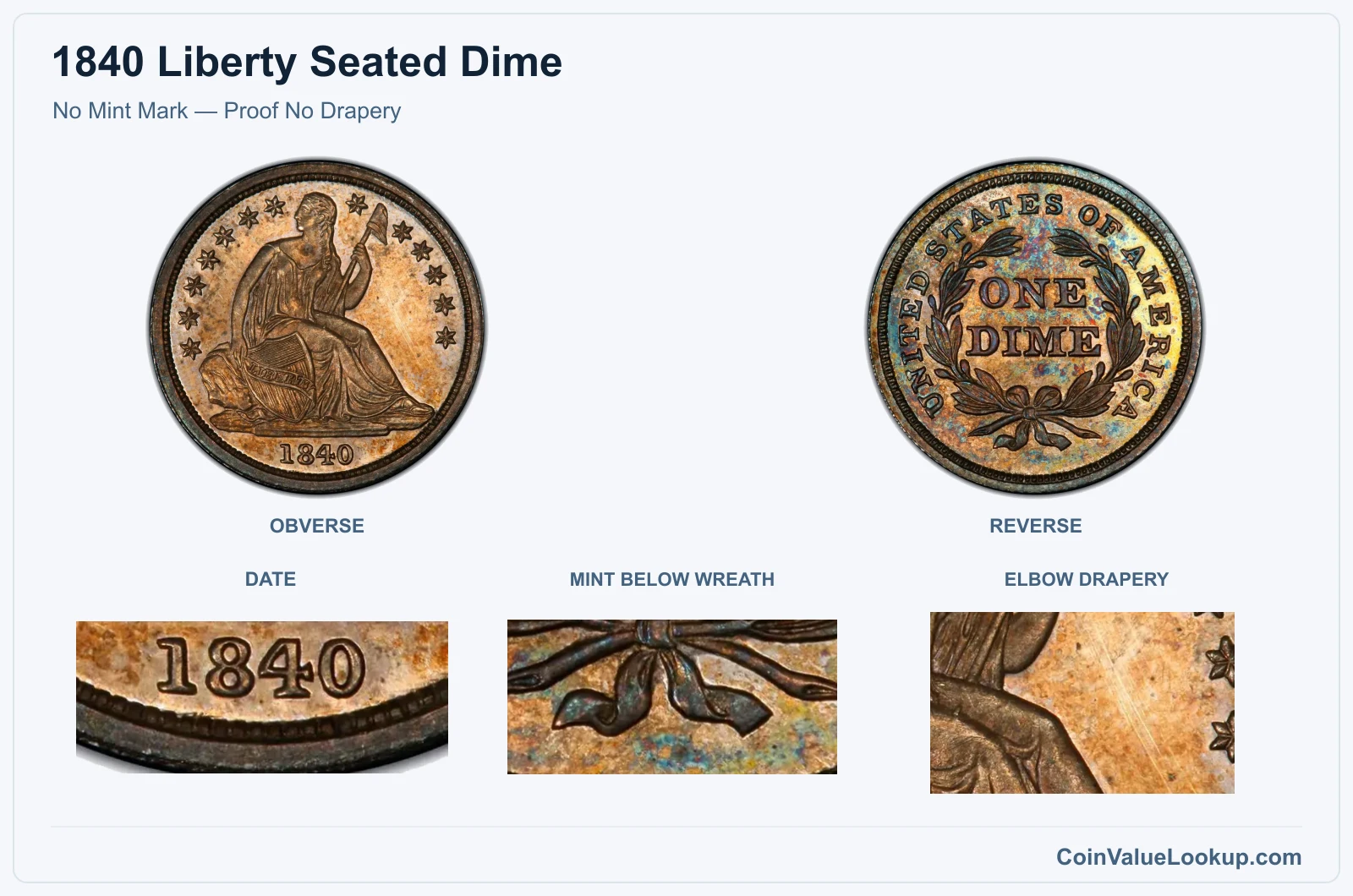
Proof 1840 dimes use the No Drapery obverse and were struck on specially prepared planchets with polished dies, producing deeply mirrored fields. These are not ordinary annual collector products.
Early Seated dime Proofs are genuinely rare, and a PCGS guide estimate places a PR64 example near $60,000.
Do not assume your shiny coin is a Proof. Polished circulation strikes and whizzed surfaces can fool the casual eye.
True Proofs show consistent mirror-like reflectivity across the fields, squared-off rims, and often sharper design elements than business strikes. Hairlines from old cleaning are a surface issue on Proofs, distinct from the wear patterns on a circulated coin.
Professional attribution through a major grading service is essential before treating any 1840 dime as a Proof.
Range Grade
Price Auction Records Appraisal PR PR 1
—
Coin Identifier
PR 2
—
Coin Identifier
PR 3
—
Coin Identifier
PR 4
—
Coin Identifier
PR 6
—
Coin Identifier
PR 8
—
Coin Identifier
PR 10
—
Coin Identifier
PR 12
—
Coin Identifier
PR 15
—
Coin Identifier
PR 20
—
Coin Identifier
PR 25
—
Coin Identifier
PR 30
—
Coin Identifier
PR 35
—
Coin Identifier
PR 40
—
Coin Identifier
PR 45
—
Coin Identifier
PR 50
—
Coin Identifier
PR 53
—
Coin Identifier
PR 55
—
Coin Identifier
PR 58
—
Coin Identifier
PR 60
—
Coin Identifier
PR 61
—
Coin Identifier
PR 62
—
Coin Identifier
PR 63
—
Coin Identifier
PR 64
Coin Identifier
PR 65
—
—
—
PR 66
—
—
—
PR 67
—
—
—
PR 68
—
—
—
PR 69
—
—
—
PR 70
—
—
—
1840 Liberty Seated Dime Error List
1. 1840 Liberty Seated Dime — Die Crack / Die Chip
Die cracks show up as thin raised lines on the coin's surface, following the path of a fracture in the steel die. A die chip is a small raised blob where a piece of the die broke away.
Both are legitimate mint-produced errors on 1840 dimes, documented in specialist references.
To spot them, look for raised ridges connecting design elements or running from the rim inward. A cud is a specific type where the crack reaches the rim and a chunk of the die collapses, leaving a raised blank area.
Each one looks different.
Don't confuse these with incuse scratches, corrosion lines, or gunk stuck to the surface. Die cracks are always raised because they result from material filling a gap in the die.
Value depends on the crack's size, location, visibility, and the coin's overall condition. No single price range covers all examples.
2. 1840 Liberty Seated Dime — Chin Whiskers Die Lines
Some 1840 No Drapery obverse dies developed raised lines near Liberty's chin, earning the nickname "chin whiskers." These are die gouge lines, fine raised marks produced by damage to the die surface itself. They appear in the same spot on every coin struck from that particular die.
Check the chin area under magnification against a normal No Drapery example. The whisker lines are raised and consistent, not random.
An incuse scratch from post-mint damage cuts into the surface and feels recessed. Added material like glue residue sits on top and can be scraped off.
A die crack nearby is a separate phenomenon, usually longer and thinner.
Value depends on how prominent the lines are, the coin's grade, and collector demand for the specific die. No fixed price premium applies across the board.