1987 Roosevelt Dime Coin Value: How Much Is It Worth?
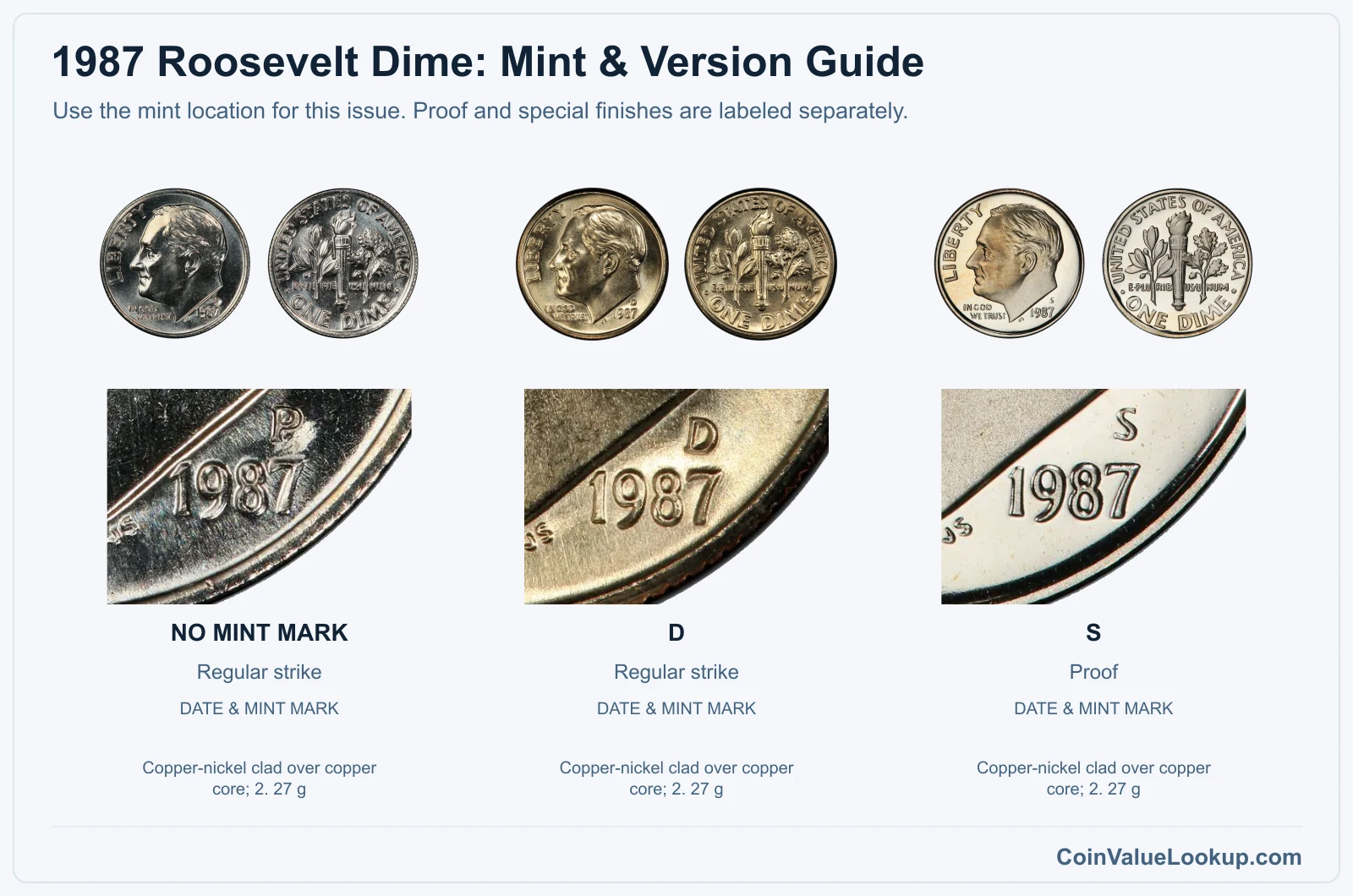
Most 1987 Roosevelt dimes are worth face value in circulation. For uncirculated examples, a USA Coin Book guide estimate places both the Philadelphia and Denver business strikes at about $2.79 in MS 65.
The 1987-S proof starts around $3.62 at PR 65. Real premiums come from specific mint-mark varieties in high grades and from authenticated striking errors, so identifying what you actually have is the first step.
Fast Way to Identify Your 1987 Roosevelt Dime
Snap a clear photo of both sides of your 1987 dime and upload them here. Our identifier can give you a preliminary read on mint mark, general condition, and version, which helps you figure out next steps.
Good lighting and a steady hand make a big difference — blurry images are the enemy of useful answers.
1987 Roosevelt Dime Value
Upload both sides of your 1987 Roosevelt Dime.
Front Obverse
Upload photo
Back Reverse
Upload photo
Which 1987 Roosevelt Dime Versions Are Worth Money?
- Well-preserved 1987-P or 1987-D business strikes with fully separated torch bands can carry a premium over ordinary uncirculated examples.
- 1987-S proofs in high grades with strong cameo contrast are worth comparing to ordinary proof pricing.
- A Struck Through Detached Reeding error on a 1987-P dime has been documented on a certified coin — match the diagnostic carefully before assuming a premium.
- An Off-Center Strike on a 1987-D dime has appeared in a dealer auction catalog — value depends on the percentage off-center, date visibility, and authentication.
Step 1: Identify Your 1987 Roosevelt Dime Mint Mark and Version
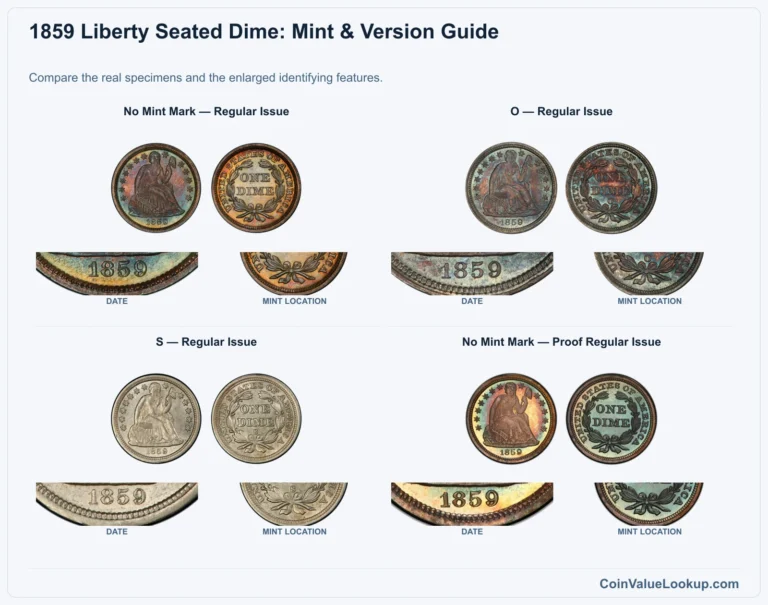
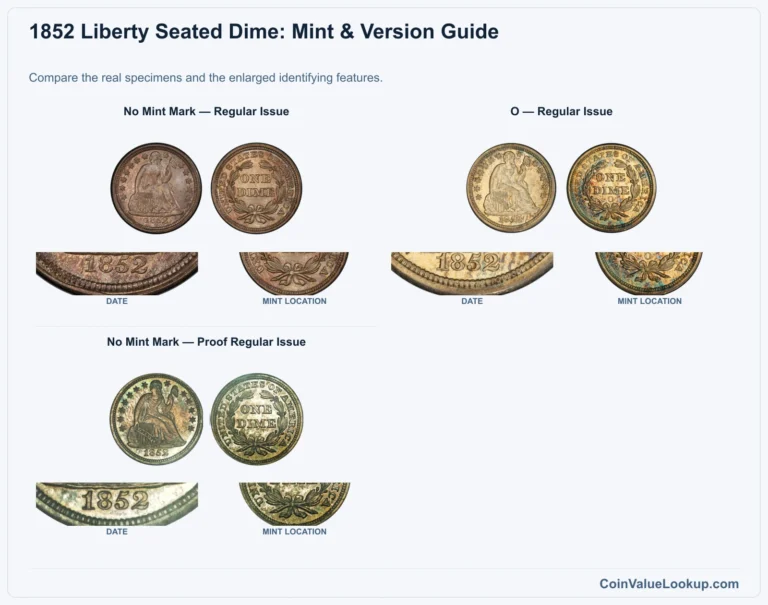
Start with the basics: confirm you see "1987" on the obverse, Roosevelt's portrait facing left, and the torch-and-branches reverse. The coin should be copper-nickel clad, weighing about 2.27 grams with a diameter near 17.9 mm.
There is no silver version for this year.
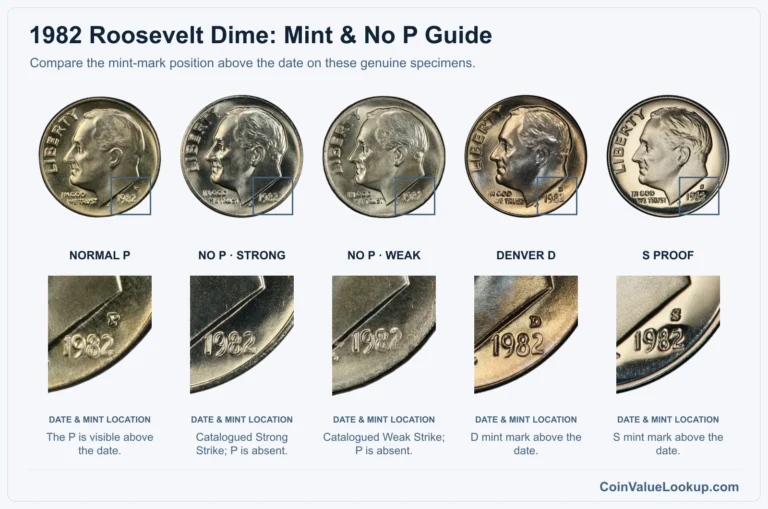
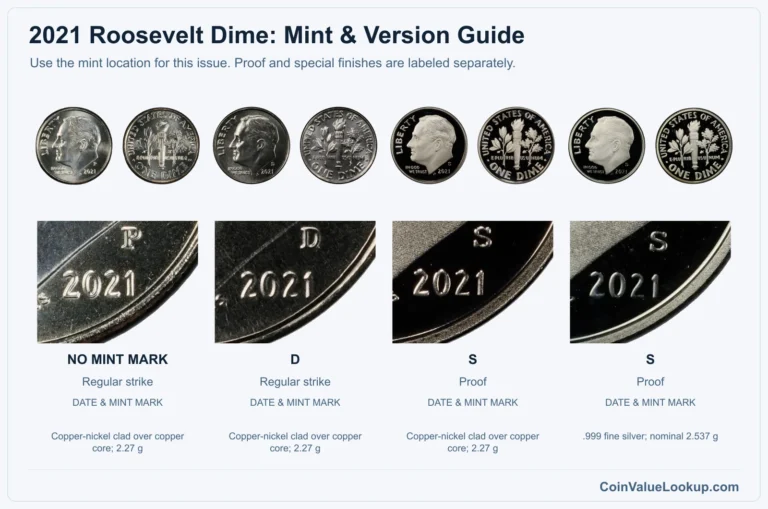
The mint mark sits on the obverse near the date. A "P" means Philadelphia, a "D" means Denver, and an "S" indicates a San Francisco proof.
If you see no mint mark at all, look again — from 1980 onward, Philadelphia dimes carry the P.
You may encounter online claims about doubled die varieties for 1987 dimes. Be cautious: unsupported generic doubled-die attributions for this date have not been adopted here.
Any doubled-die coin needs careful comparison to a known normal specimen and, ideally, third-party certification before you assign it extra value.
Step 2: Check Your 1987 Roosevelt Dime Grade
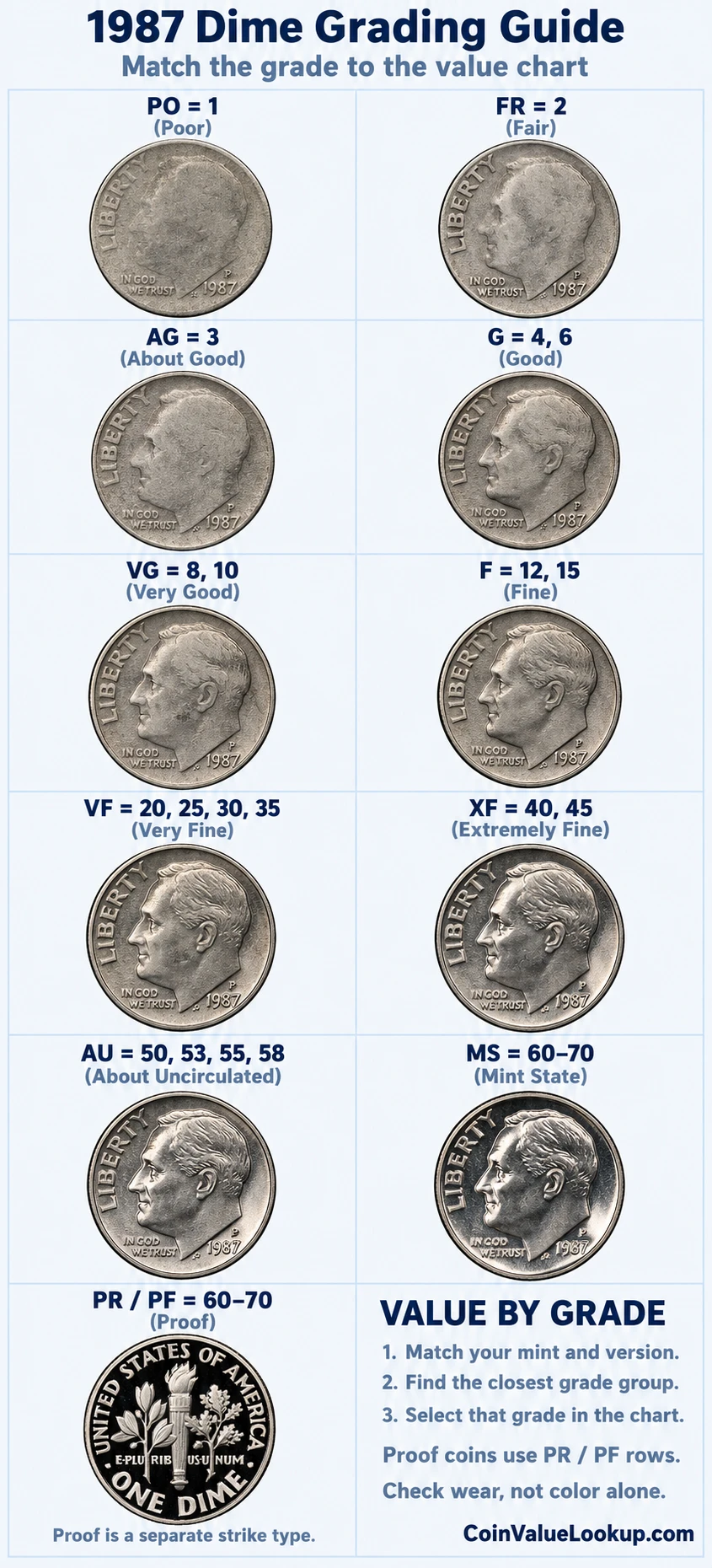
Focus on four spots when judging wear: Roosevelt's cheekbone and jawline, the hair detail above the ear, the torch flame, and the olive and oak leaves on the reverse. Even slight friction on the cheek flattens those high points first.
Original mint luster matters a lot. A coin can look shiny from cleaning, but that actually hurts the grade — and the value.
Compare your dime to the reference image to see how much surface detail remains.
For proofs, the mirror fields and frosted devices are a product of the manufacturing process, not a higher grade tier. Cameo contrast is a separate designation.
Full Bands — where both horizontal torch bands show complete separation — is a strike quality designation, not an error.
Coin Value Lookup is a handy starting point when you want to look up guides for other dates and denominations in the Roosevelt series or beyond.
Step 3: Check 1987 Roosevelt Dime Value by Mint and Version
1987 Roosevelt Dime — P Business Strike
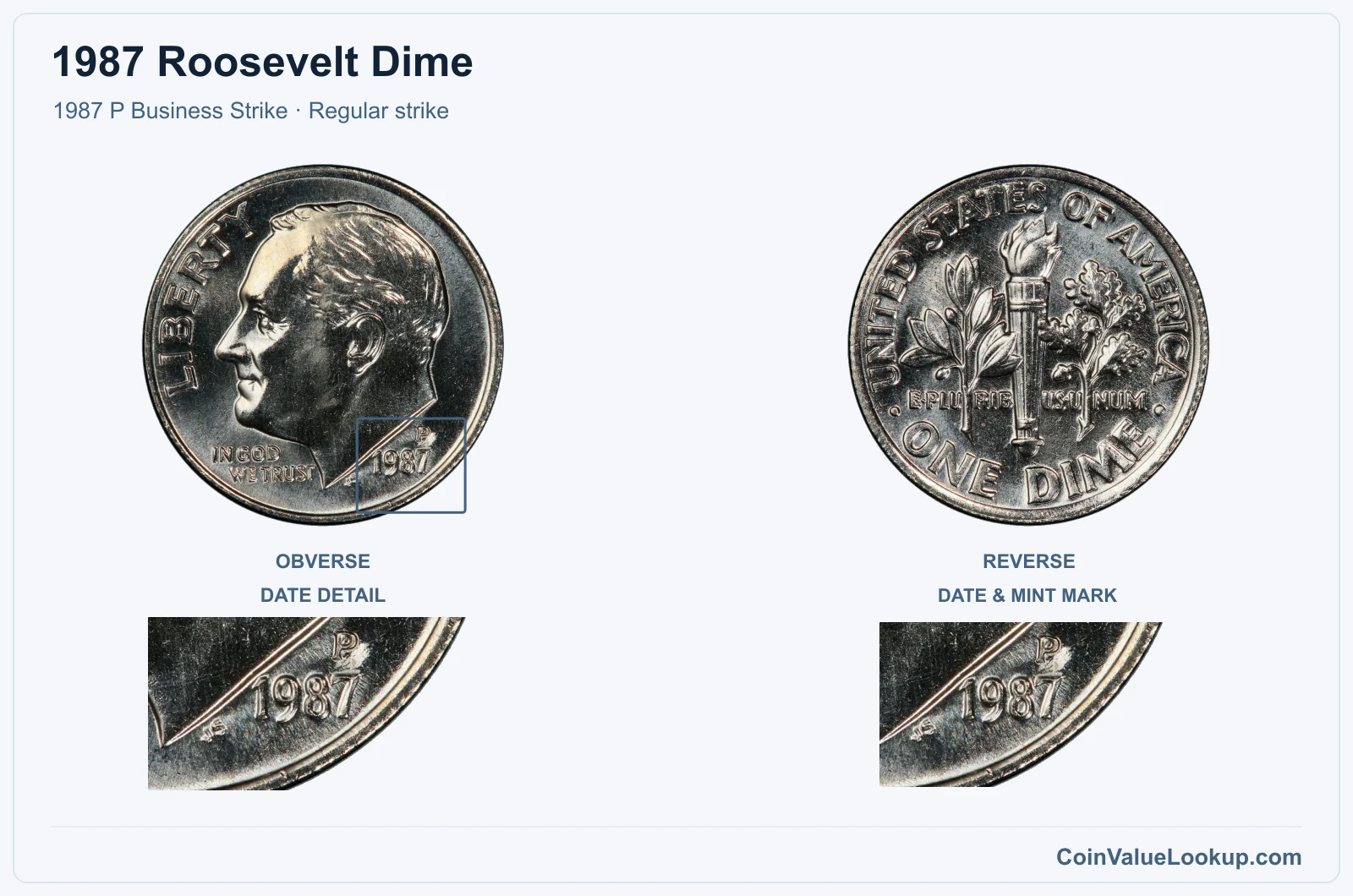
The 1987-P is the Philadelphia business strike, carrying a small "P" mint mark near the date. It's copper-nickel clad over a copper core, weighing 2.27 grams.
In circulated condition, expect face value.
The USA Coin Book guide places an MS 65 example at roughly $2.79. Coins with Full Bands — both horizontal torch bands fully separated — can command more attention from collectors, since that feature reflects a strong strike rather than an error.
Look for sharp, uninterrupted lines across the torch.
Range Grade
Price Auction Records Appraisal PO PO 1
—
Coin Identifier FR FR 2
—
Coin Identifier AG AG 3
—
Coin Identifier G G 4
—
Coin Identifier
G 6
—
Coin Identifier VG VG 8
—
Coin Identifier
VG 10
—
Coin Identifier F F 12
—
Coin Identifier
F 15
—
Coin Identifier VF VF 20
—
Coin Identifier
VF 25
—
Coin Identifier
VF 30
—
Coin Identifier
VF 35
—
Coin Identifier XF XF 40
—
Coin Identifier
XF 45
—
Coin Identifier AU AU 50
—
Coin Identifier
AU 53
—
Coin Identifier
AU 55
—
Coin Identifier
AU 58
—
Coin Identifier MS MS 60
—
Coin Identifier
MS 61
—
Coin Identifier
MS 62
—
Coin Identifier
MS 63
—
Coin Identifier
MS 64
—
Coin Identifier
MS 65
Coin Identifier
MS 66
Coin Identifier
MS 67
Coin Identifier
MS 68
Coin Identifier
MS 69
—
—
—
MS 70
—
—
—
1987 Roosevelt Dime — D Business Strike
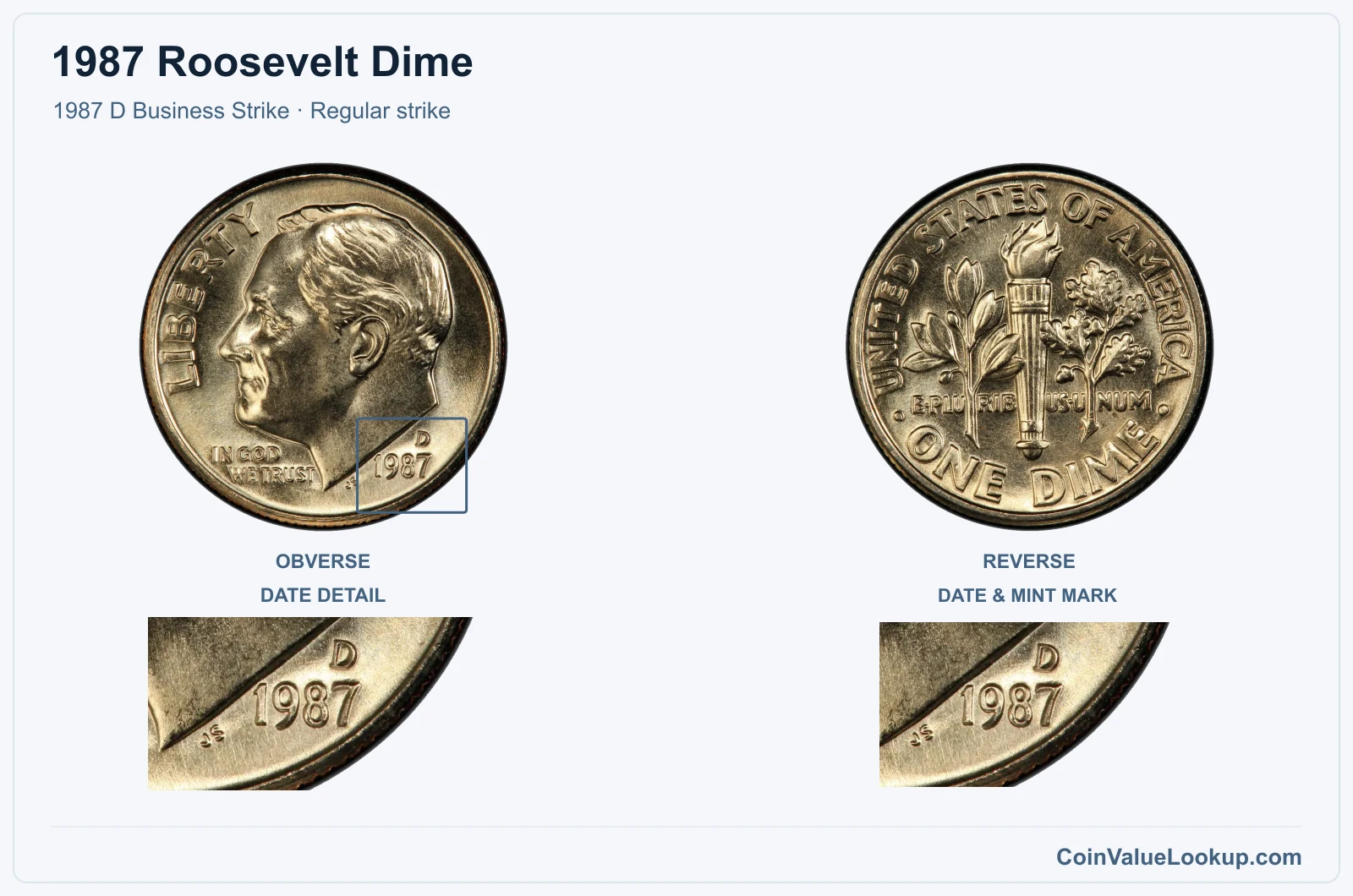
Denver's 1987-D dime mirrors the Philadelphia version in design and composition. The "D" mint mark sits on the obverse near the date.
Same weight, same clad makeup.
A USA Coin Book guide estimate puts the MS 65 value at about $2.79, identical to the P. In worn grades, it's a ten-cent coin.
As with Philadelphia strikes, Full Bands separation on the torch adds collector interest in higher grades. The 1987-D is also the date associated with a documented off-center strike error, covered separately below.
Range Grade
Price Auction Records Appraisal PO PO 1
—
Coin Identifier FR FR 2
—
Coin Identifier AG AG 3
—
Coin Identifier G G 4
—
Coin Identifier
G 6
—
Coin Identifier VG VG 8
—
Coin Identifier
VG 10
—
Coin Identifier F F 12
—
Coin Identifier
F 15
—
Coin Identifier VF VF 20
—
Coin Identifier
VF 25
—
Coin Identifier
VF 30
—
Coin Identifier
VF 35
—
Coin Identifier XF XF 40
—
Coin Identifier
XF 45
—
Coin Identifier AU AU 50
—
Coin Identifier
AU 53
—
Coin Identifier
AU 55
—
Coin Identifier
AU 58
—
Coin Identifier MS MS 60
—
Coin Identifier
MS 61
—
Coin Identifier
MS 62
—
Coin Identifier
MS 63
—
Coin Identifier
MS 64
—
Coin Identifier
MS 65
—
Coin Identifier
MS 66
Coin Identifier
MS 67
Coin Identifier
MS 68
Coin Identifier
MS 69
—
—
—
MS 70
—
—
—
1987 Roosevelt Dime — S Proof
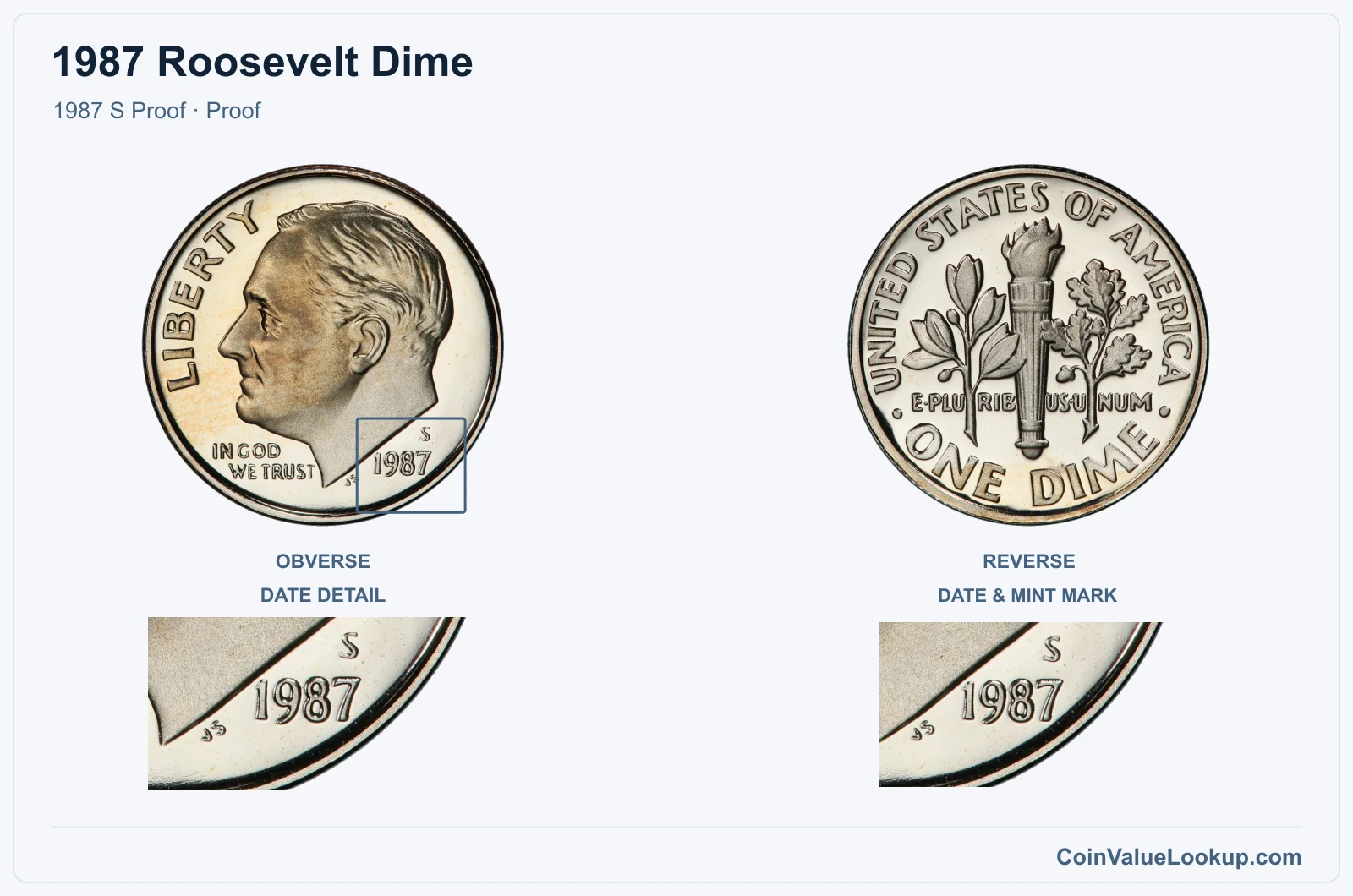
San Francisco produced the 1987-S proof exclusively for collectors, struck on polished planchets with specially prepared dies. You'll find the "S" mint mark on the obverse.
The composition remains copper-nickel clad — no silver proofs were made this year.
USA Coin Book guides an ordinary PR 65 at about $3.62. Cameo and deep cameo contrast designations are separate from the numerical grade and can influence value at higher proof levels.
These typically came in official mint proof sets, so finding one loose in circulation would be unusual. Inspect the mirror fields for hazing or fingerprints, which pull the grade down fast.
Range Grade
Price Auction Records Appraisal PR PR 1
—
Coin Identifier
PR 2
—
Coin Identifier
PR 3
—
Coin Identifier
PR 4
—
Coin Identifier
PR 6
—
Coin Identifier
PR 8
—
Coin Identifier
PR 10
—
Coin Identifier
PR 12
—
Coin Identifier
PR 15
—
Coin Identifier
PR 20
—
Coin Identifier
PR 25
—
Coin Identifier
PR 30
—
Coin Identifier
PR 35
—
Coin Identifier
PR 40
—
Coin Identifier
PR 45
—
Coin Identifier
PR 50
—
Coin Identifier
PR 53
—
Coin Identifier
PR 55
—
Coin Identifier
PR 58
—
Coin Identifier
PR 60
—
Coin Identifier
PR 61
—
Coin Identifier
PR 62
—
Coin Identifier
PR 63
—
Coin Identifier
PR 64
—
Coin Identifier
PR 65
—
Coin Identifier
PR 66
—
Coin Identifier
PR 67
Coin Identifier
PR 68
Coin Identifier
PR 69
Coin Identifier
PR 70
Coin Identifier
1987 Roosevelt Dime Error List
1. 1987 Roosevelt Dime — Struck Through Detached Reeding
A Struck Through Detached Reeding happens when a loose fragment of edge reeding material gets between the die and the planchet during striking. The result is a recessed pattern of parallel ridges impressed into the coin's surface, mimicking the edge reeding texture but appearing on a flat face of the coin.
This error has been documented on a 1987-P business strike that was certified by PCGS as MS 67. Look for a clearly defined, repeating reed pattern pressed into the surface — not raised scratches or contact marks from other coins banging around in a bag.
Post-mint bagmarks can leave linear impressions, but they won't show the uniform spacing and depth of a genuine struck-through event. No supported price range is available; value depends on the coin's authenticated identity, its condition, and the severity of the error.
2. 1987 Roosevelt Dime — Off-Center Strike
An off-center strike occurs when the planchet isn't properly seated between the dies. A 1987-D dime struck approximately 45% off-center toward the 11:30 position has been documented in a dealer auction catalog, described as BU condition with the date still visible and a blank crescent on the opposite side.
That listing carried a minimum opening bid of $26, but a minimum bid is not a realized sale price, so treat it only as a reference point. Date visibility is critical for value — a 45% off-center dime that lost its date is worth far less.
Don't confuse this with a misaligned die strike, where the full planchet is struck but the design is shifted, or with post-mint cutting damage. Genuine off-center coins show a smooth, unstruck crescent with the original planchet edge.
Individual assessment based on authentication, condition, and percentage of offset determines value.
3. 1987 Roosevelt Dime — Die Crack / Die Chip
Die cracks and die chips have been reported for 1987 dimes. A die crack shows up as a raised line on the coin's surface, tracing a fracture in the steel die.
A die chip appears as a small raised blob where a piece of the die face broke away. If the crack extends from the design to the rim, it may form a "cud" — a raised, featureless lump at the edge.
Check under magnification. Genuine die cracks are raised because metal fills the crack in the die during striking.
Incuse scratches, corrosion pits, or foreign material stuck to the surface can mimic these features but will be recessed or sit on top. The condition of the coin, visibility of the crack, and its specific location all factor into value — no supported numerical price range is available for this date.
4. 1987 Roosevelt Dime — Clipped Planchet
Clipped planchet errors on 1987 dimes occur when the blank is punched from strip metal that overlaps a previously punched hole or the strip's edge. The result is a missing curved section of the coin.
Straight clips and ragged clips also exist but are less common.
A key diagnostic is the Blakesley effect: weakness in the design directly opposite the clip, caused by reduced metal flow during striking. The edge at the clip will show the raw planchet metal, not a filed or cut surface.
Post-mint damage like filing, deliberate cutting, or corrosion eating away the rim can look similar, but those won't produce the opposite-side weakness. No numerical price range is adopted for this date; value depends on the clip size, type, coin condition, and authentication.
5. 1987 Roosevelt Dime — Wrong Planchet / Off-Metal Strike
A wrong planchet error means the dime dies struck a blank intended for a different denomination or even a different country's coin. These are rare and dramatic — the coin's weight, diameter, edge, and design completeness will all differ from a normal 1987 dime's 2.27 grams and 17.9 mm specifications.
If you suspect one, weigh it carefully and measure the diameter. Compare the edge type.
A genuine wrong-planchet strike will show incomplete design coverage if the blank was smaller, or an oversized blank if it was larger. Don't confuse this with plating loss, acid damage, environmental corrosion, or deliberate alteration — all of which can change a coin's appearance and apparent weight.
Third-party certification is strongly recommended. No supported price range is available; each example is assessed individually based on authenticated identity and condition.
6. 1987 Roosevelt Dime — Doubled Die Obverse
Doubled die obverse varieties have been listed as a reported category for 1987 dimes. A genuine doubled die shows consistent separation or notching on obverse lettering or design elements, visible under magnification across multiple examples from the same die.
The key distinction is between a true doubled die and machine doubling. Machine doubling produces a flat, shelf-like distortion on one side of the lettering — it's common and adds almost nothing.
A real doubled die shows rounded, equally defined secondary images. Compare your coin's obverse lettering to a known normal 1987 dime under the same lighting.
No specific supported price is available for this date; value depends on the variety's documentation, visibility, and the coin's overall condition.
7. 1987 Roosevelt Dime — Doubled Die Reverse
Doubled die reverse errors have also been listed as a reported category for the 1987 dime. The same principles apply as with the obverse: look for consistent doubling on reverse legends like "UNITED STATES OF AMERICA" or on design elements like the torch and branches.
Compare suspect areas against a normal coin under matched lighting and magnification. True hub doubling will show separation with rounded secondary contours, not the flat mechanical shelving typical of machine doubling.
Reflections from proof surfaces or worn die contours can also trick you into seeing doubling that isn't there. No numerical price range is adopted; the specific variety's documentation, the strength of the doubling, and overall coin condition all factor into any premium.
Authentication by a recognized grading service is the safest path for a serious attribution.