1987 Washington Quarter Coin Value: How Much Is It Worth?
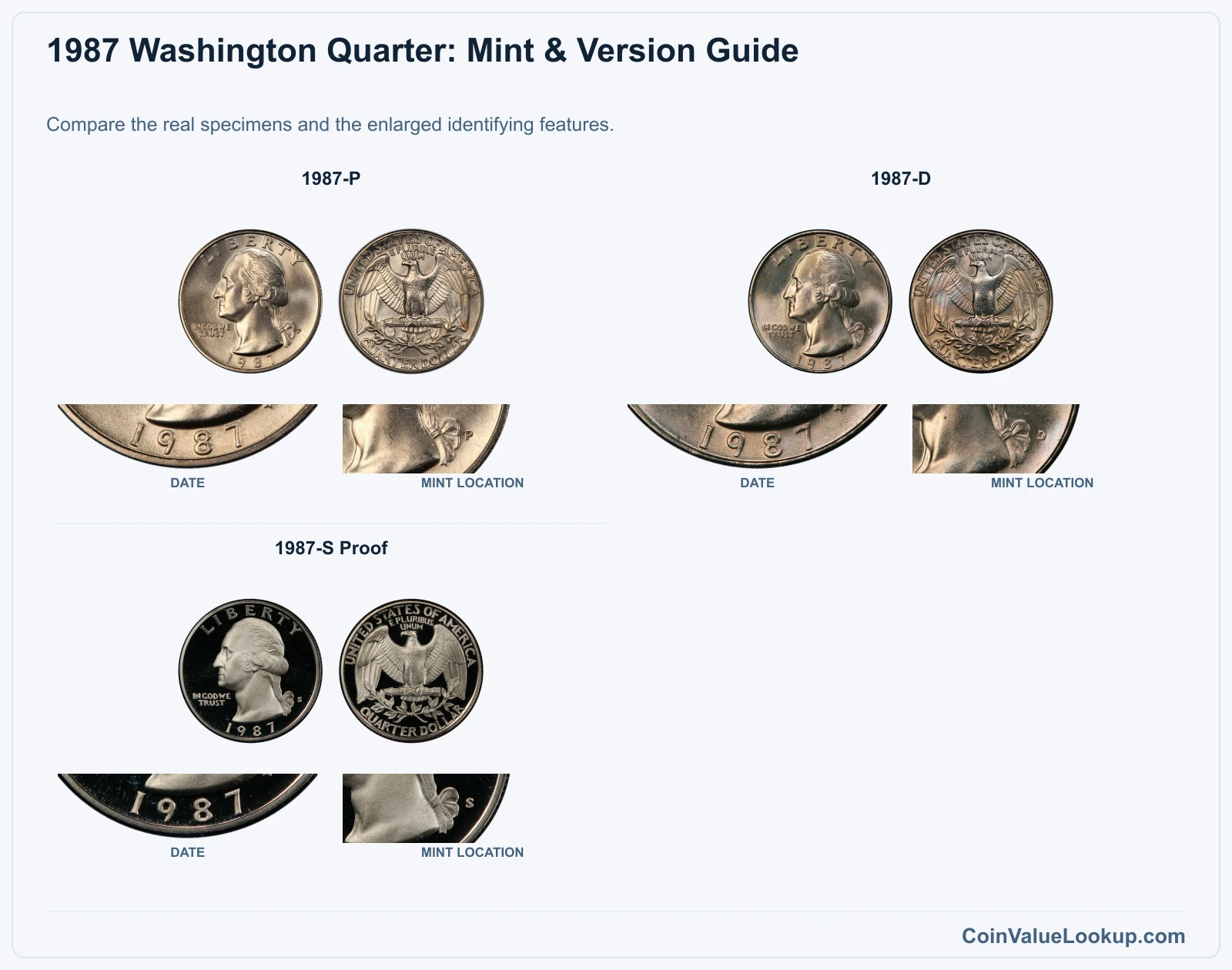
Most 1987 Washington quarters are worth face value — 25 cents — if they show any wear at all. The real upside comes from uncirculated examples and certain mint errors.
A guide estimate for a 1987-P in MS65 condition reaches about $11, while the 1987-S clad proof sits around $4.96 in PR65. Three mint versions exist for 1987: the Philadelphia (P), Denver (D), and San Francisco (S) proof, all struck in copper-nickel clad.
Fast Way to Identify Your 1987 Washington Quarter
Want a quick read on your 1987 quarter? Upload clear photos of the front and back of your coin using the identifier on this page.
It can help with preliminary identification of your coin's mint version and general characteristics. Good lighting and a steady shot make a big difference, so skip the blurry phone pics if you can.
1987 Washington Quarter Value
Upload both sides of your 1987 Washington Quarter.
Front Obverse
Upload photo
Back Reverse
Upload photo
Which 1987 Washington Quarter Versions Are Worth Money?
- The 1987-P in MS65 carries a guide estimate around $11, making well-preserved uncirculated examples worth checking your pocket change for.
- Broadstrike errors on 1987-P quarters have sold at auction — one MS63 example brought $20 at Heritage in August 2009.
- Off-center strikes are documented for 1987-P, with visible blank crescents that distinguish them from post-mint damage.
- The 1987-S clad proof in PR65 has a guide estimate of about $4.96, and higher-contrast examples may command more attention from collectors.
- Doubled die reverse, wrong planchet, and mated pair errors have been reported for 1987 quarters and can carry premiums depending on condition and visibility.
Step 1: Identify Your 1987 Washington Quarter Mint Mark and Version
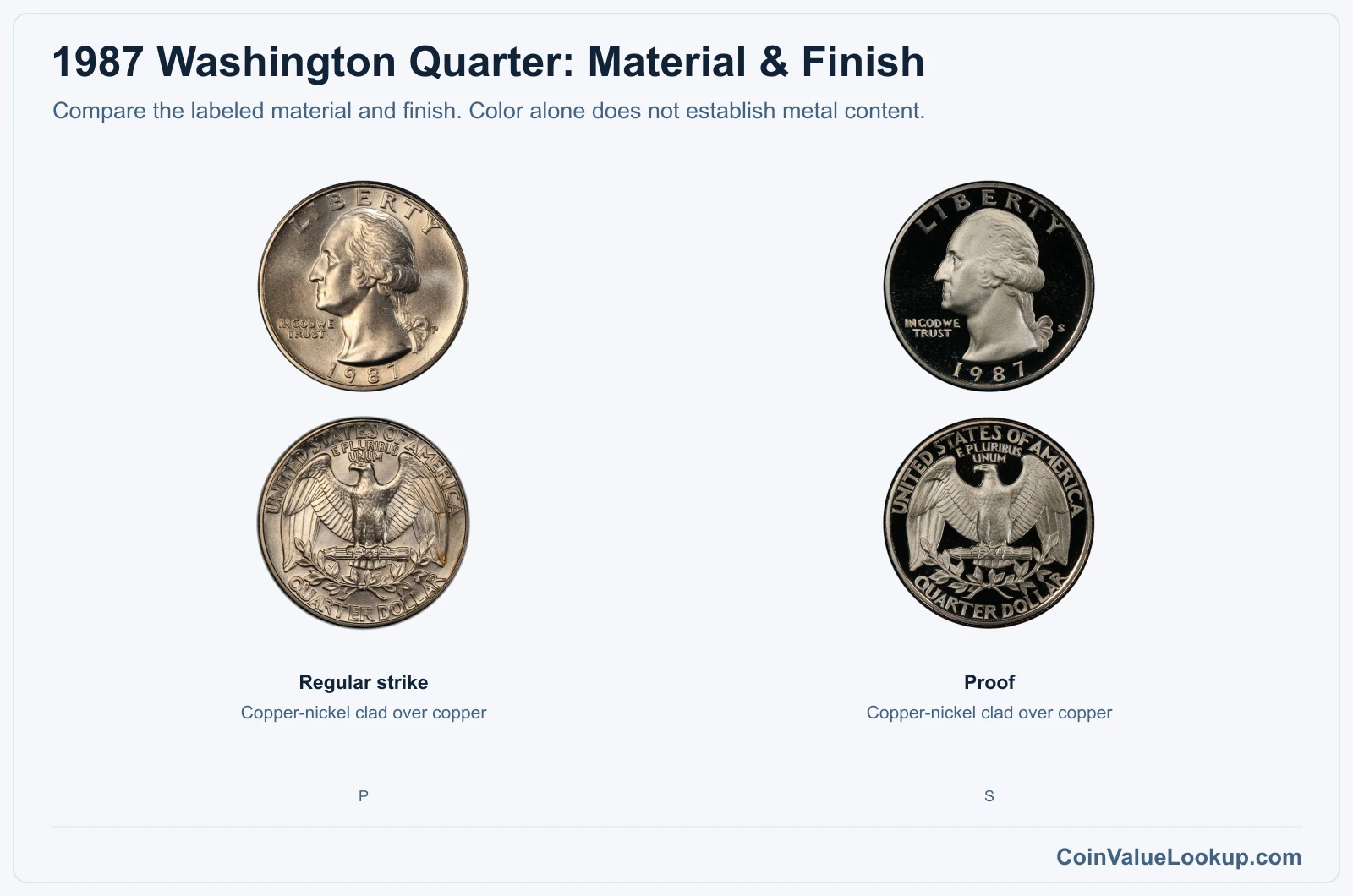
The 1987 Washington quarter comes in three versions, and the mintmark tells you which one you have. Look just to the right of the ribbon in Washington's hair, near the date.
A "P" means Philadelphia, a "D" means Denver, and an "S" means San Francisco proof. There is no blank-mintmark Philadelphia variety for 1987 — all Philadelphia quarters carry the P.
All three versions are copper-nickel clad over copper, with an overall composition of 91.67% copper and 8.33% nickel. Normal weight is about 5.67 grams, and diameter runs approximately 24.3 mm.
None of the regular 1987 quarters contain silver, so don't let anyone tell you otherwise.
The obverse shows George Washington's profile facing left, with the date below. The reverse displays an eagle with spread wings, clutching arrows and olive branches.
Both business strikes and the proof share this same design.
Step 2: Check Your 1987 Washington Quarter Grade
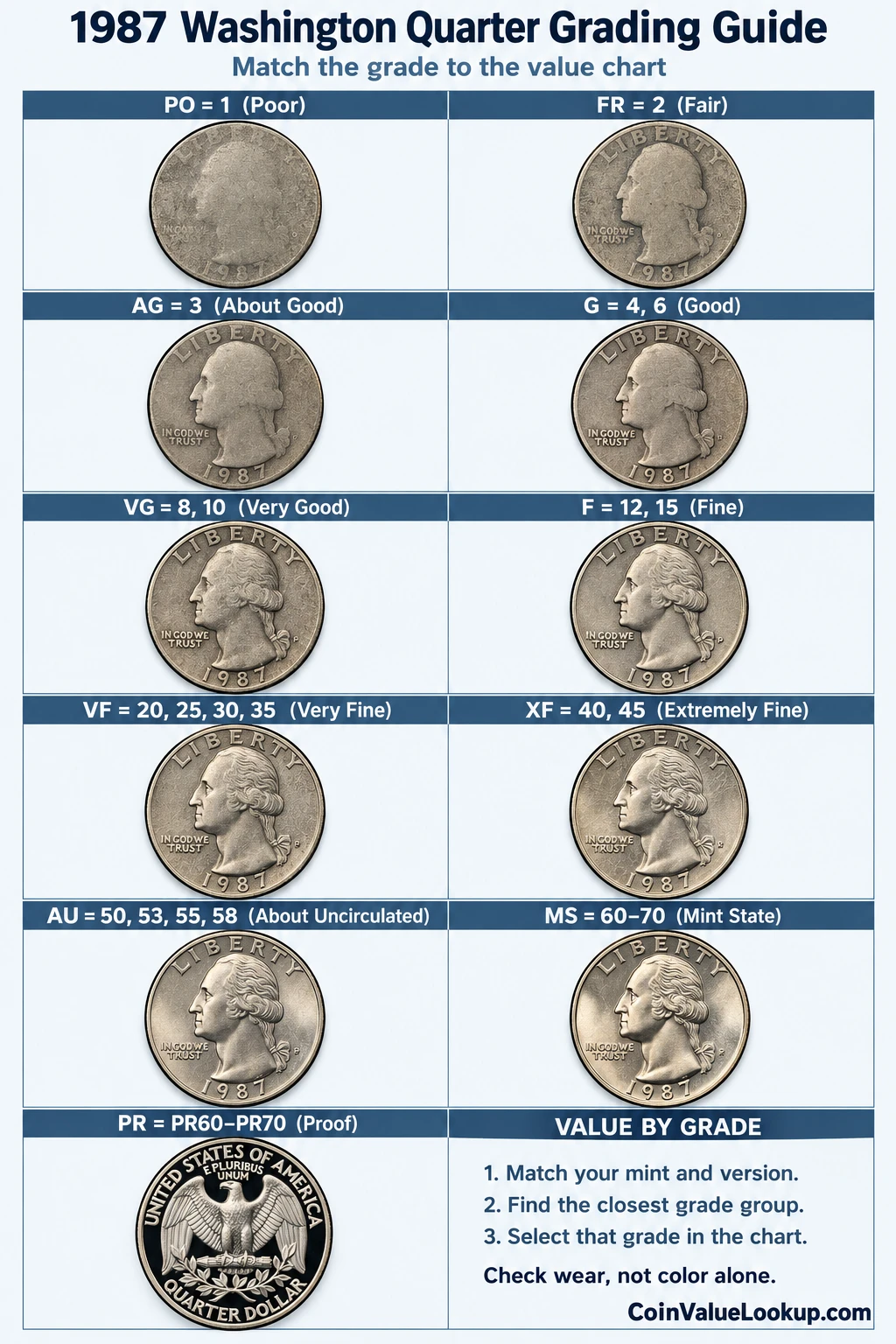
Check the hair detail above Washington's ear first. On a well-circulated coin, those strands flatten into a smooth patch.
The cheekbone and jawline are next — rub shows up there quickly as a dull, featureless area.
Flip the coin over and look at the eagle's breast feathers. They wear down in step with the obverse, so a flat eagle chest usually means a flat Washington portrait too.
Compare your coin to the reference image on this page.
Luster matters more than shine. A cleaned coin can look bright but still show hairlines under magnification.
Those hairlines and scattered contact marks both drag down the grade.
For proof coins, remember that "proof" describes how the coin was made, not a grade above Mint State. A deep cameo (DCAM) designation refers to the contrast between frosted raised devices and mirror fields — it has nothing to do with silver content.
Step 3: Check 1987 Washington Quarter Value by Mint and Version
1987 Washington Quarter — P
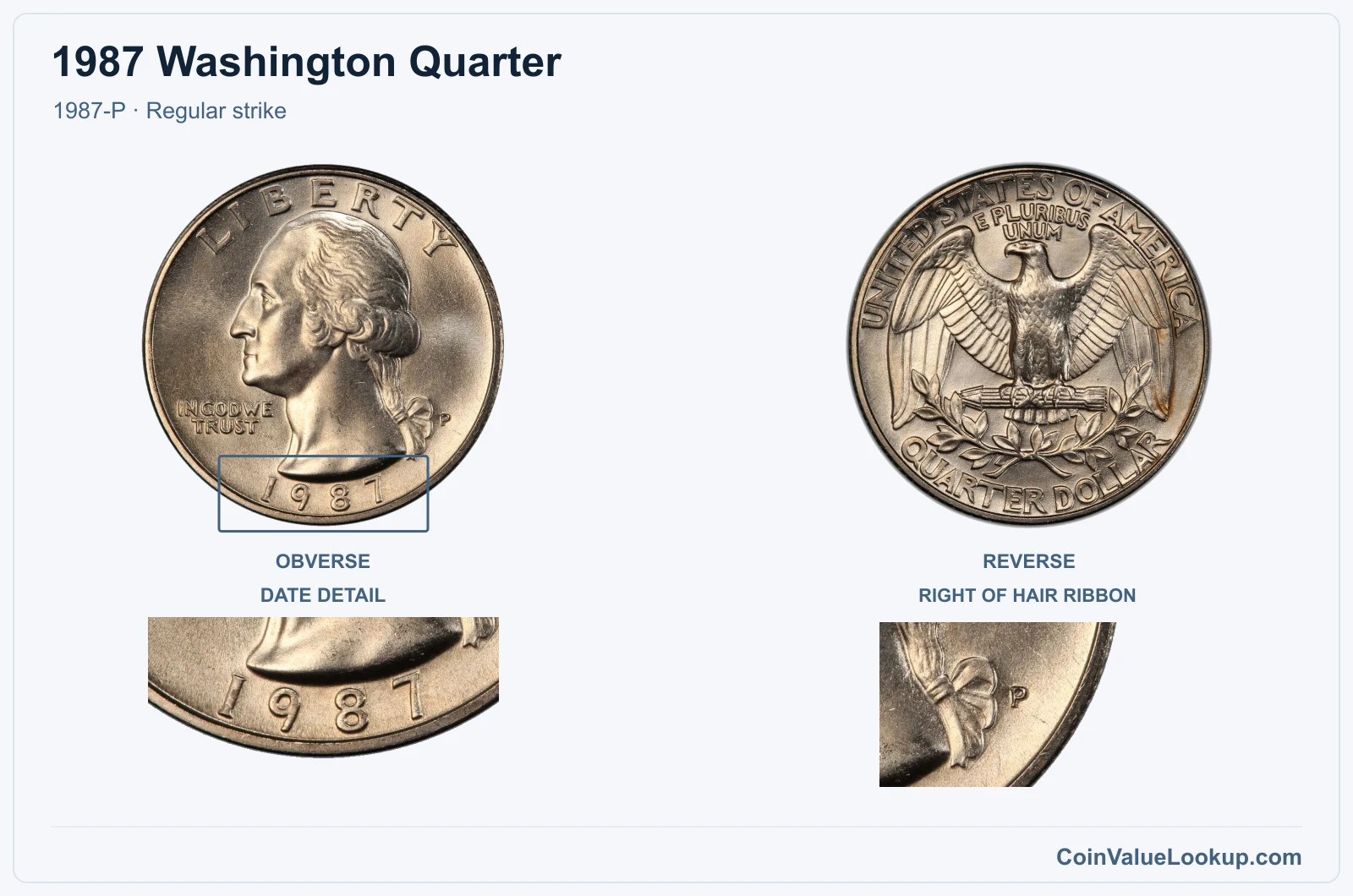
The 1987-P was struck at the Philadelphia Mint for general circulation. You will find a small "P" mintmark on the obverse near Washington's hair ribbon.
It is copper-nickel clad — no silver here.
In typical circulated condition, this coin spends at face value. A USA Coin Book guide estimate puts an MS65 example at about $11, which means you need a coin with strong luster, minimal contact marks, and full hair detail above the ear.
Finding one in that condition from pocket change is a long shot, but roll hunting turns them up occasionally.
Coin Value Lookup is a good starting point if you want to look up guide values for other dates and denominations in the Washington quarter series.
| Range | Grade | Price | Auction Records | Appraisal |
|---|---|---|---|---|
| PO | PO 1 | — | Coin Identifier | |
| FR | FR 2 | — | Coin Identifier | |
| AG | AG 3 | — | Coin Identifier | |
| G | G 4 | — | Coin Identifier | |
| G 6 | — | Coin Identifier | ||
| VG | VG 8 | — | Coin Identifier | |
| VG 10 | — | Coin Identifier | ||
| F | F 12 | — | Coin Identifier | |
| F 15 | — | Coin Identifier | ||
| VF | VF 20 | — | Coin Identifier | |
| VF 25 | — | Coin Identifier | ||
| VF 30 | — | Coin Identifier | ||
| VF 35 | — | Coin Identifier | ||
| XF | XF 40 | — | Coin Identifier | |
| XF 45 | — | Coin Identifier | ||
| AU | AU 50 | — | Coin Identifier | |
| AU 53 | — | Coin Identifier | ||
| AU 55 | — | Coin Identifier | ||
| AU 58 | — | Coin Identifier | ||
| MS | MS 60 | — | Coin Identifier | |
| MS 61 | — | Coin Identifier | ||
| MS 62 | — | Coin Identifier | ||
| MS 63 | Coin Identifier | |||
| MS 64 | — | Coin Identifier | ||
| MS 65 | Coin Identifier | |||
| MS 66 | Coin Identifier | |||
| MS 67 | Coin Identifier | |||
| MS 68 | — | — | — | |
| MS 69 | — | — | — | |
| MS 70 | — | — | — |
1987 Washington Quarter — D
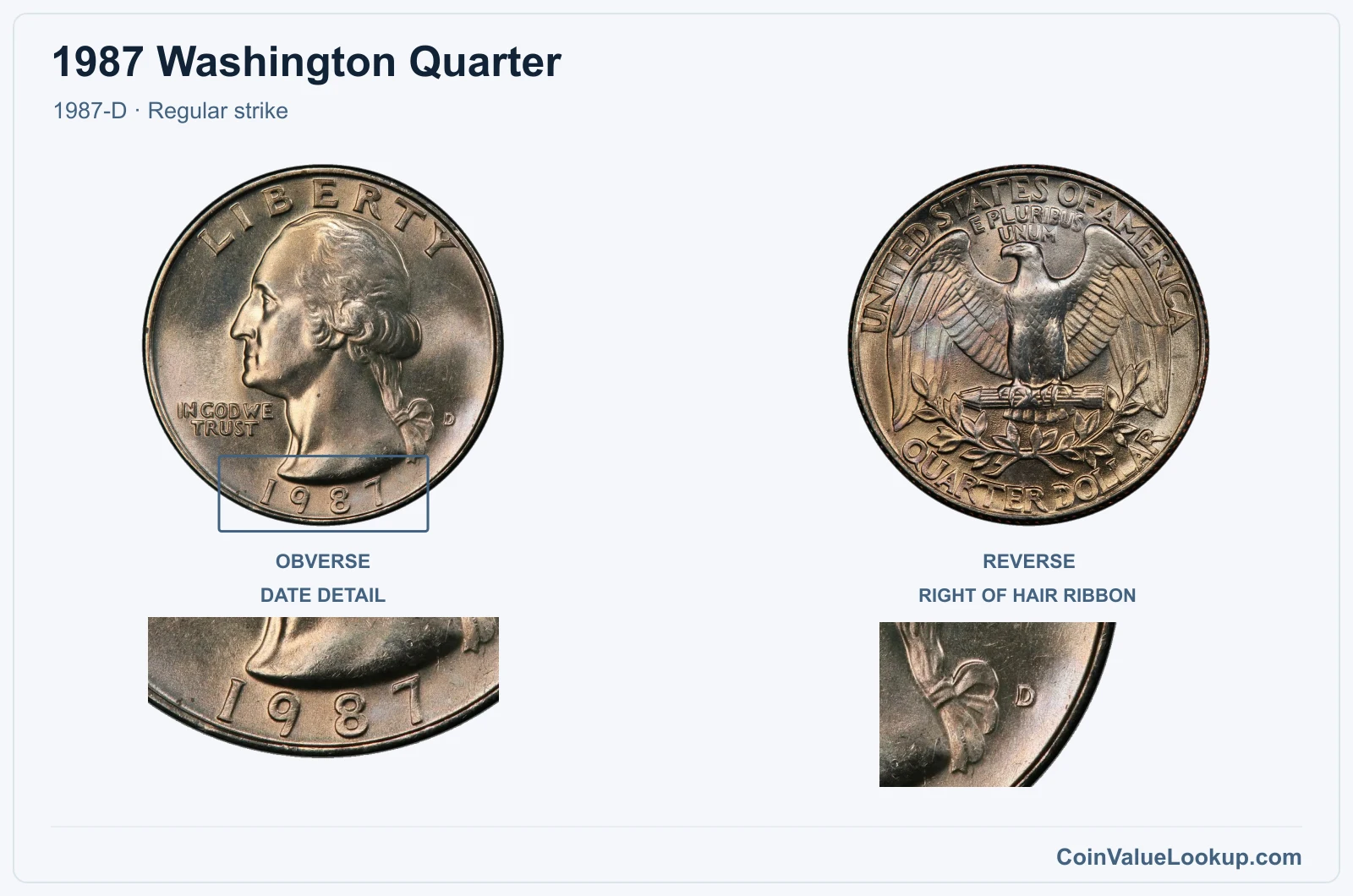
The 1987-D quarter was produced at the Denver Mint. Look for the "D" mintmark in the same spot near the hair ribbon on the obverse.
Like its Philadelphia sibling, this is a copper-nickel clad business strike weighing about 5.67 grams. A circulated piece is worth 25 cents.
The USA Coin Book guide estimate for MS65 is roughly $7.29, a bit less than the P-mint version at the same grade. To hit that MS65 threshold, your coin needs essentially untouched surfaces with only very minor bag marks.
| Range | Grade | Price | Auction Records | Appraisal |
|---|---|---|---|---|
| PO | PO 1 | — | Coin Identifier | |
| FR | FR 2 | — | Coin Identifier | |
| AG | AG 3 | — | Coin Identifier | |
| G | G 4 | — | Coin Identifier | |
| G 6 | — | Coin Identifier | ||
| VG | VG 8 | — | Coin Identifier | |
| VG 10 | — | Coin Identifier | ||
| F | F 12 | — | Coin Identifier | |
| F 15 | — | Coin Identifier | ||
| VF | VF 20 | — | Coin Identifier | |
| VF 25 | — | Coin Identifier | ||
| VF 30 | — | Coin Identifier | ||
| VF 35 | — | Coin Identifier | ||
| XF | XF 40 | — | Coin Identifier | |
| XF 45 | — | Coin Identifier | ||
| AU | AU 50 | — | Coin Identifier | |
| AU 53 | — | Coin Identifier | ||
| AU 55 | — | Coin Identifier | ||
| AU 58 | — | Coin Identifier | ||
| MS | MS 60 | — | Coin Identifier | |
| MS 61 | — | Coin Identifier | ||
| MS 62 | — | Coin Identifier | ||
| MS 63 | — | Coin Identifier | ||
| MS 64 | — | Coin Identifier | ||
| MS 65 | Coin Identifier | |||
| MS 66 | Coin Identifier | |||
| MS 67 | Coin Identifier | |||
| MS 68 | — | — | — | |
| MS 69 | — | — | — | |
| MS 70 | — | — | — |
1987 Washington Quarter — S Proof
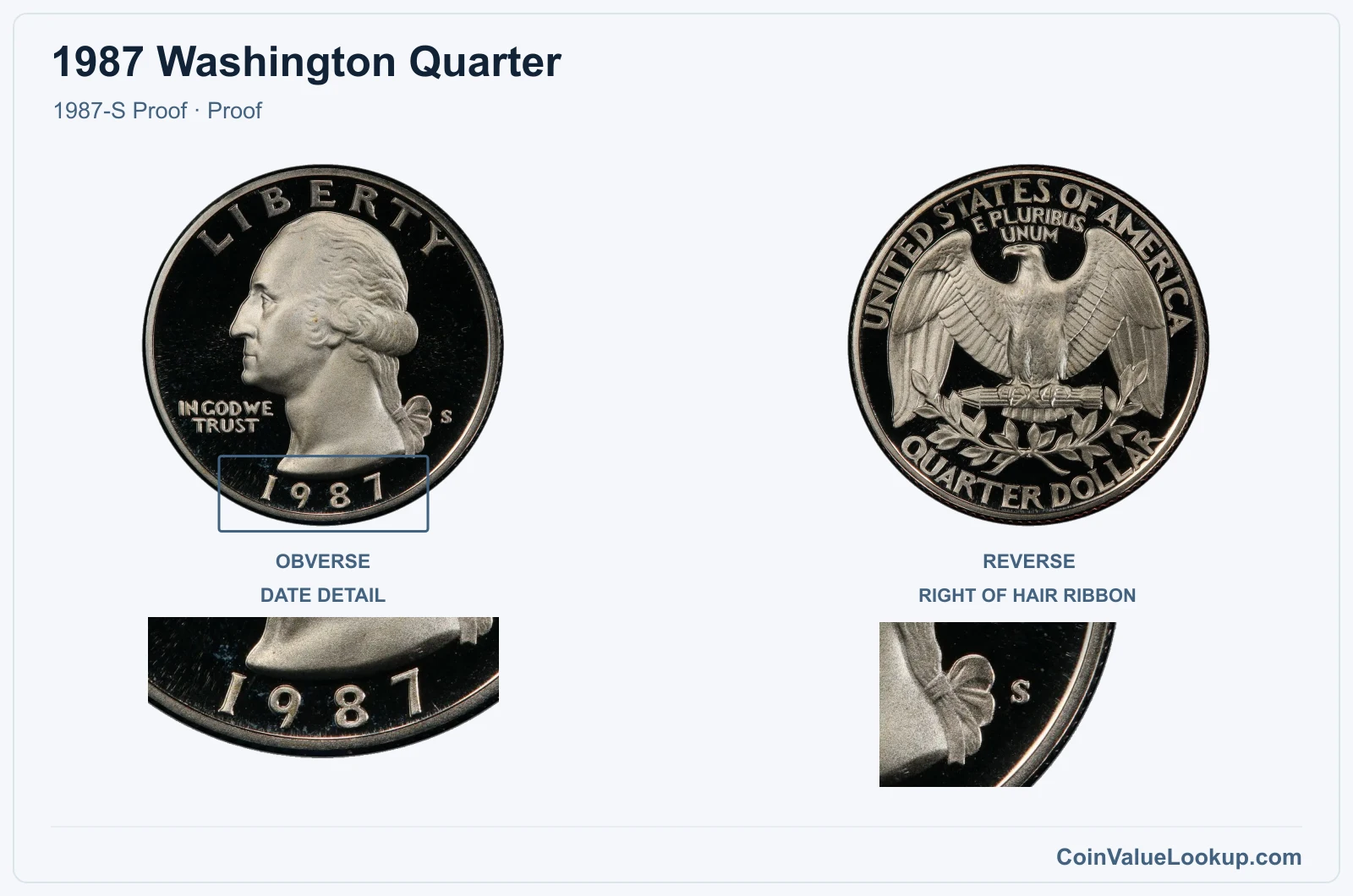
The 1987-S proof quarter was made at the San Francisco Mint exclusively for collectors, sold in proof sets. It carries an "S" mintmark and has the distinctive sharp strike and mirror-like fields that proof production creates.
This is a clad proof — copper-nickel clad over copper, same alloy as the circulation strikes. It is not silver.
The USA Coin Book guide estimate is about $4.96 in PR65. That is a generic PR65 figure and does not reflect a deep cameo (DCAM) designation, which commands different pricing.
Because these were handled with care from the start, many survive in high grades, which keeps values modest.
| Range | Grade | Price | Auction Records | Appraisal |
|---|---|---|---|---|
| PR | PR 1 | — | Coin Identifier | |
| PR 2 | — | Coin Identifier | ||
| PR 3 | — | Coin Identifier | ||
| PR 4 | — | Coin Identifier | ||
| PR 6 | — | Coin Identifier | ||
| PR 8 | — | Coin Identifier | ||
| PR 10 | — | Coin Identifier | ||
| PR 12 | — | Coin Identifier | ||
| PR 15 | — | Coin Identifier | ||
| PR 20 | — | Coin Identifier | ||
| PR 25 | — | Coin Identifier | ||
| PR 30 | — | Coin Identifier | ||
| PR 35 | — | Coin Identifier | ||
| PR 40 | — | Coin Identifier | ||
| PR 45 | — | Coin Identifier | ||
| PR 50 | — | Coin Identifier | ||
| PR 53 | — | Coin Identifier | ||
| PR 55 | — | Coin Identifier | ||
| PR 58 | — | Coin Identifier | ||
| PR 60 | — | Coin Identifier | ||
| PR 61 | — | Coin Identifier | ||
| PR 62 | — | Coin Identifier | ||
| PR 63 | — | Coin Identifier | ||
| PR 64 | — | Coin Identifier | ||
| PR 65 | — | Coin Identifier | ||
| PR 66 | — | Coin Identifier | ||
| PR 67 | Coin Identifier | |||
| PR 68 | Coin Identifier | |||
| PR 69 | Coin Identifier | |||
| PR 70 | Coin Identifier |
1987 Washington Quarter Error List
1. 1987 Washington Quarter — Broadstrike
A broadstrike happens when the collar die — the ring that normally restrains the coin's edge during striking — fails to contain the planchet. The result is a quarter with a full design that spreads slightly beyond normal diameter, giving the rim a flattened or missing appearance.
One documented 1987-P broadstrike graded NGC MS63 sold for $20 at a Heritage auction in August 2009. To identify a genuine broadstrike, examine the edge: it should lack the normal reeded pattern and the coin outline will look expanded but still round, with complete design elements.
Post-mint alterations like filing, hammering, or chemical treatment can mimic this look. A legitimate broadstrike retains original strike surfaces and correct design details for the date.
2. 1987 Washington Quarter — Off-Center Strike
An off-center strike occurs when the planchet is not properly seated between the dies, so part of the design is missing and a blank crescent appears on one side of the coin. A documented 1987-P example was struck approximately 15% off center toward the 4 o'clock position.
That specific coin was graded ANACS AU58 Details due to scratches, which are post-mint damage separate from the manufacturing error itself. It sold in a Heritage auction in January 2022 as part of a two-coin lot alongside a 1990-D partial-collar quarter for $65 total, so no individual price can be assigned from that sale.
When checking your coin, look for a smooth blank crescent, a visible date, and original strike surfaces on both sides. Filing, cutting, or hammering after minting can create a similar appearance but will show tool marks rather than a clean unstruck area.
3. 1987 Washington Quarter — Doubled Die Reverse
Doubled die reverse (DDR) errors have been reported for the 1987 quarter. This type of error results from a misalignment during the die-making process, producing doubled or slightly shifted design elements on the reverse.
To check, compare your coin's reverse lettering and design contours against a normal 1987 quarter under magnification. Genuine doubling should appear consistent and raised, affecting specific design elements in a repeatable way.
Machine doubling — a much more common occurrence — tends to show flat, shelf-like distortion rather than the crisp secondary image of a true doubled die. Random nicks, reflections, or wear patterns can also mimic doubling to the untrained eye.
Value for a DDR depends on the specific die variety, how visible the doubling is, and the coin's condition. No specific price data is available for this category.
4. 1987 Washington Quarter — Bonded / Mated Pair
A mated pair error — sometimes called a bonded coin — occurs when two coins become fused together during the striking process inside the press. The contact areas between the two pieces will match, showing corresponding design impressions where they met under pressure.
Mated pair errors have been reported for the 1987 quarter. If you think you have one, look at how the two pieces relate to each other: genuine examples show struck impressions that correspond between the coins and evidence of simultaneous striking.
Coins that have been glued, welded, or mechanically pressed together after leaving the mint will usually show adhesive residue, irregular bonding patterns, or damage inconsistent with a mint-produced error. Value depends on condition and the nature of the pairing, but no specific price data is available for this variety.
5. 1987 Washington Quarter — Wrong Planchet / Off-Metal Strike
A wrong planchet error means the 1987 quarter dies struck a blank intended for a different denomination or even a different coin series. The result is a coin that carries the full Washington quarter design but looks or feels wrong — different weight, different diameter, possibly an incomplete impression if the blank was smaller than normal.
This error category has been reported for the 1987 quarter. To evaluate a suspect coin, weigh it carefully and measure the diameter, then compare against the normal specifications of 5.67 grams and approximately 24.3 mm.
Also examine the edge — reeding may be absent or different. Be cautious: plating, acid-thinned coins, corrosion, and deliberate alteration can all change a coin's appearance and weight enough to fool someone into thinking they have a wrong planchet strike.
Value depends on the specific off-metal combination and the coin's condition, but no price data is available for this category.