1977 Washington Quarter Coin Value: How Much Is It Worth?
Most 1977 Washington quarters are worth face value — 25 cents — in circulated condition. That is the practical starting point for ordinary worn examples.
Uncirculated coins in strong condition carry a modest premium, with selected guide estimates for MS65 reaching around $7.29. Proof, variety and authenticated error pieces follow their own pricing path entirely.
Fast Way to Identify Your 1977 Washington Quarter
Upload clear photos of the front and back of your 1977 quarter, and our identifier can provide a preliminary read on which version you have. This is not authentication or exact grading — just a quick first step.
Good lighting and a sharp image of the mintmark area help the most.
1977 Washington Quarter Value
Upload both sides of your 1977 Washington Quarter.
Front Obverse
Upload photo
Back Reverse
Upload photo
Which 1977 Washington Quarter Versions Are Worth Money?
- The 1977-D struck on a 40% silver planchet is a confirmed wrong-metal error; one sold for $4,935 at Heritage Auctions in 2016.
- Uncirculated Philadelphia and Denver quarters in MS65 or higher condition carry guide estimates above face value.
- The 1977-S proof in top condition with strong contrast commands collector interest beyond its modest guide baseline.
- Authenticated striking errors such as off-center strikes, broadstrikes and missing clad layers each carry their own premium depending on severity and grade.
Step 1: Identify Your 1977 Washington Quarter Mint Mark and Version
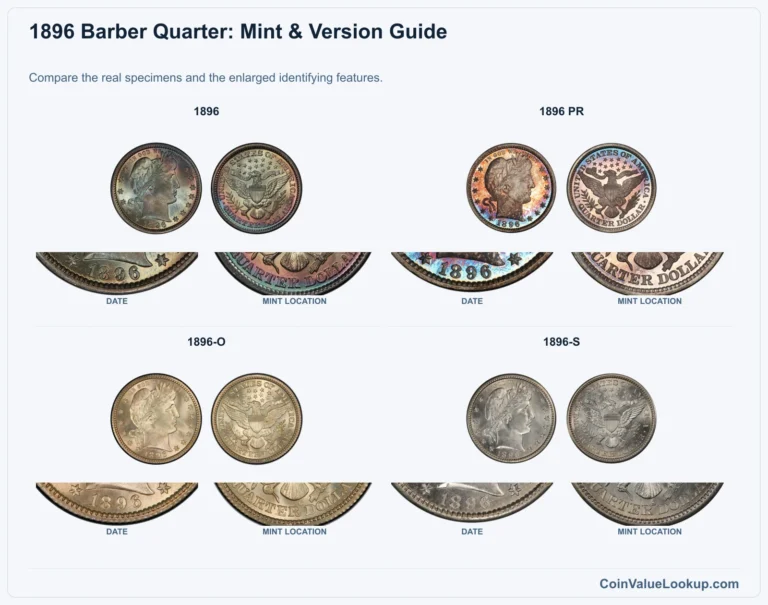
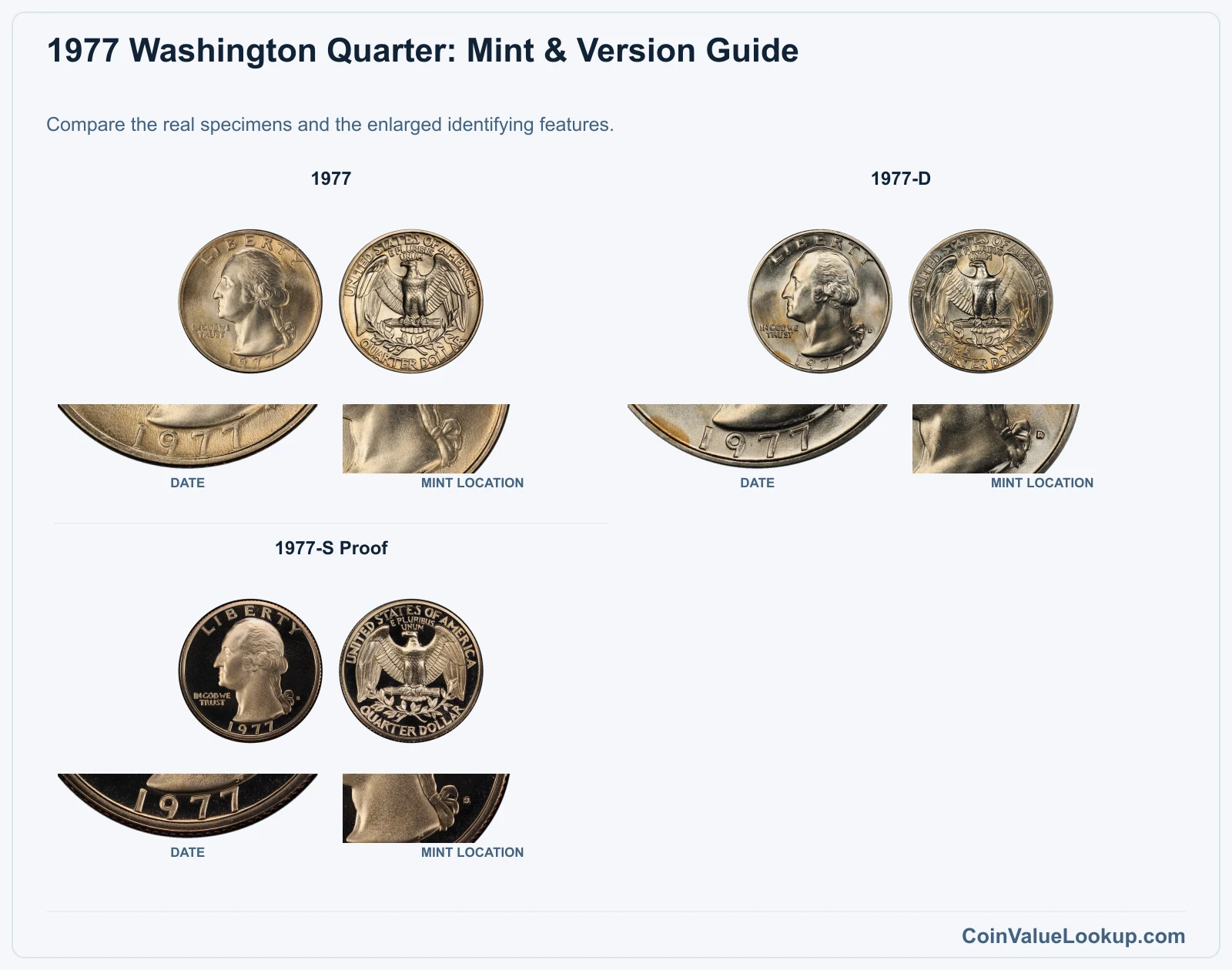
The 1977 quarter brought back the familiar eagle reverse after the Bicentennial design used in 1975–1976. Three versions exist: Philadelphia (no mintmark), Denver (D), and San Francisco proof (S).
Look near the date on the obverse for the mintmark.
All regular 1977 quarters are copper-nickel clad, weighing about 5.67 grams and measuring 24.3 mm across. The S mintmark means San Francisco proof — it does not mean silver.
A rare 40% silver planchet error exists for the Denver mint, but that is an authenticated error, not a standard issue.
To check the edge, look for the copper-red band sandwiched between nickel-colored layers. That copper stripe is normal for clad quarters.
Do not try to authenticate alloy composition by color alone — professional verification is needed for suspected wrong-metal errors.
Step 2: Check Your 1977 Washington Quarter Grade
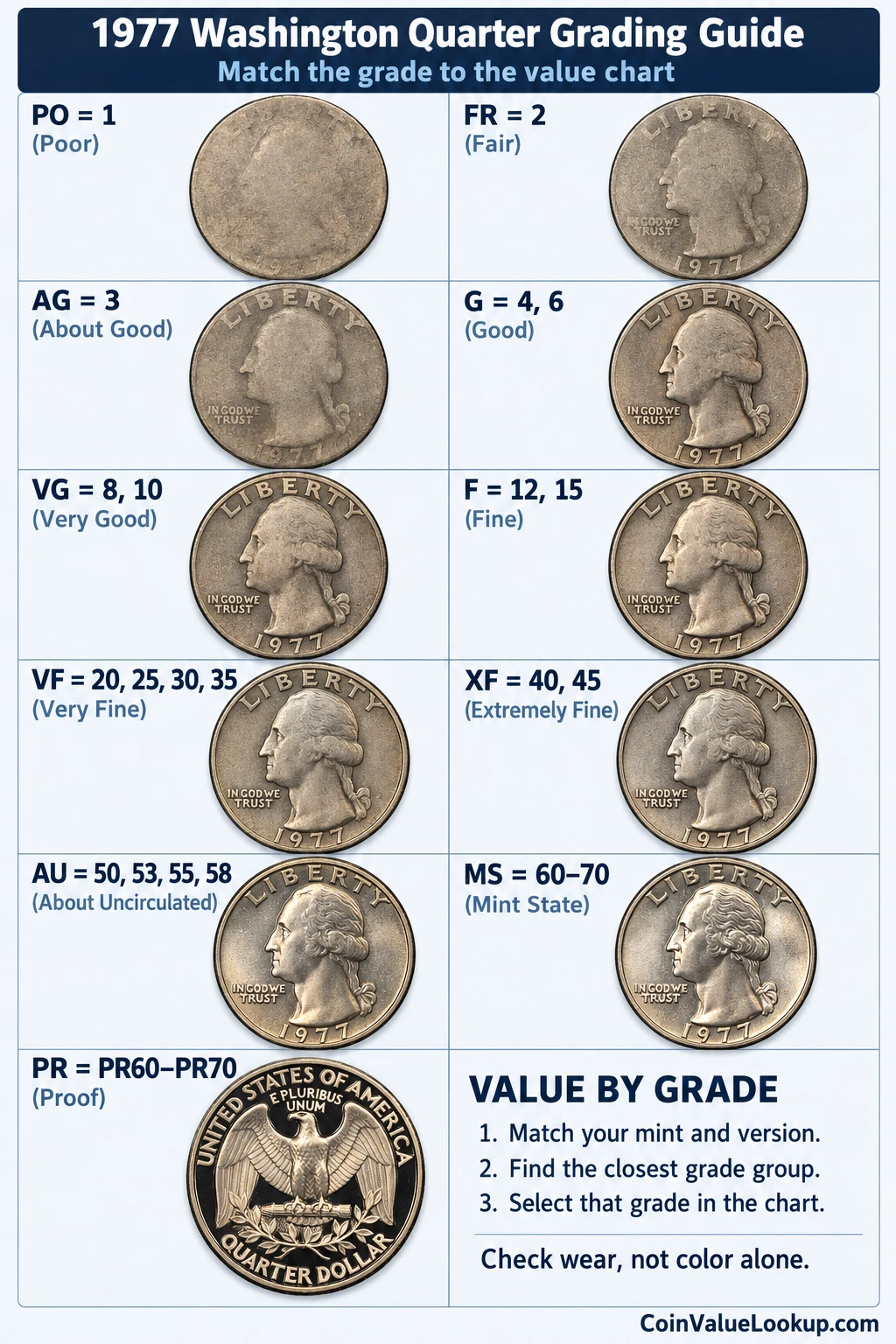
Start with Washington's hair detail above the ear, then check the cheek and jawline. On the reverse, examine the eagle's breast feathers.
These are the first areas to lose detail from circulation wear, and you want to distinguish a weakly struck coin from a genuinely worn one.
Original mint luster matters. A coin can look complete in design detail but show dull, washed-out surfaces from cleaning or heavy bag contact.
Hairlines from cleaning and deep contact marks both lower the grade. Use the comparison image to match your coin's wear pattern against known grade benchmarks.
For proofs, the mirror finish and sharp rims are expected from the manufacturing process, not signs of a higher numerical grade. Cameo contrast — frosted devices against mirror fields — is a separate designation within proof, not a different metal or grade level.
Step 3: Check 1977 Washington Quarter Value by Mint and Version
1977 Washington Quarter
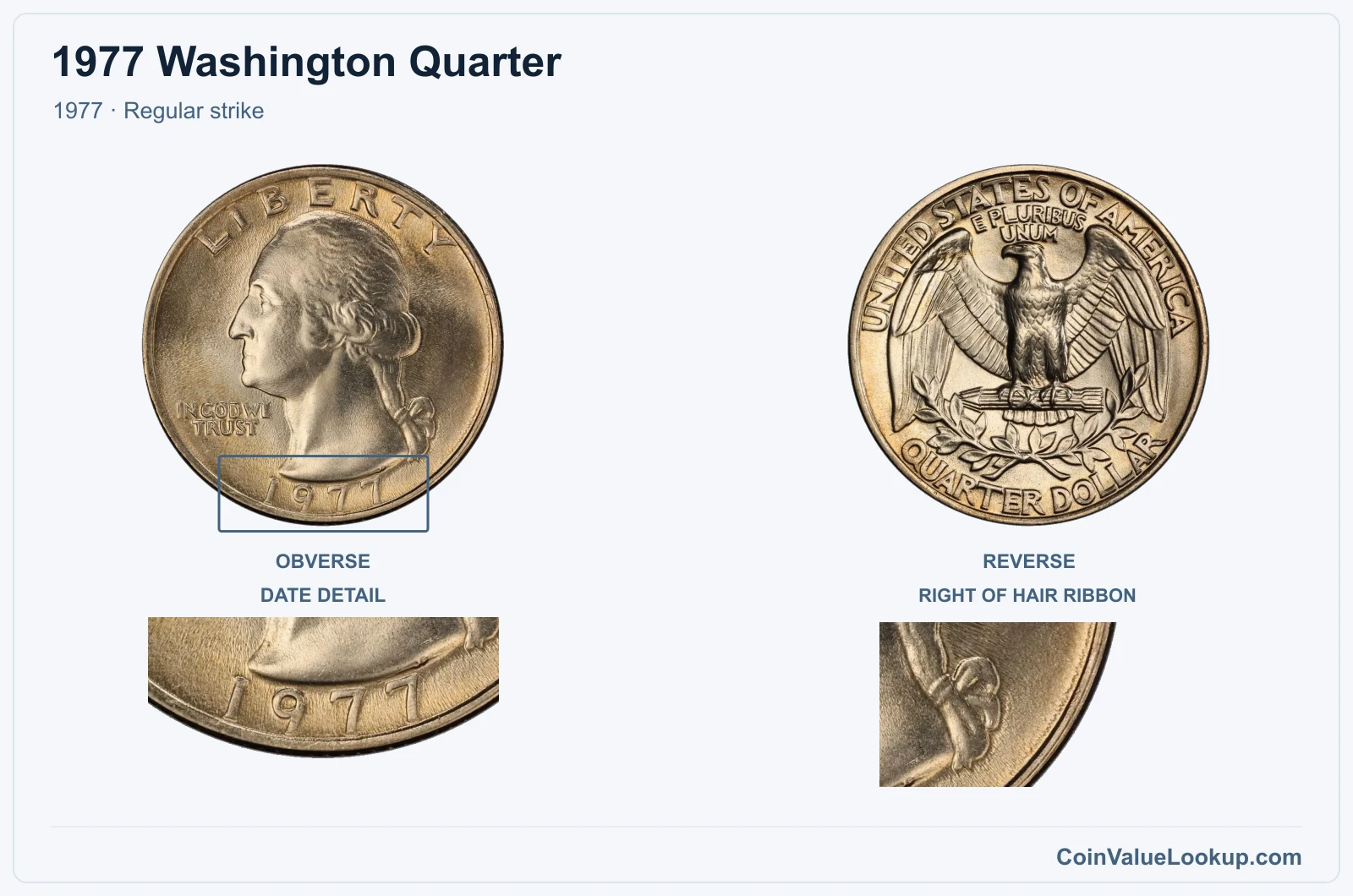
The 1977 Philadelphia quarter has no mintmark — just a blank space near the date. This is a copper-nickel clad business strike, the standard circulation issue.
Hundreds of millions were produced, so circulated examples are worth face value.
In uncirculated condition, these pick up a small premium. A USA Coin Book guide estimate places MS65 examples around $7.29.
That figure is a retail guide snapshot, not a guaranteed offer. Finding one with clean surfaces and full luster in the wild is the real challenge.
| Range | Grade | Price | Auction Records | Appraisal |
|---|---|---|---|---|
| PO | PO 1 | — | Coin Identifier | |
| FR | FR 2 | — | Coin Identifier | |
| AG | AG 3 | — | Coin Identifier | |
| G | G 4 | — | Coin Identifier | |
| G 6 | — | Coin Identifier | ||
| VG | VG 8 | — | Coin Identifier | |
| VG 10 | — | Coin Identifier | ||
| F | F 12 | — | Coin Identifier | |
| F 15 | — | Coin Identifier | ||
| VF | VF 20 | — | Coin Identifier | |
| VF 25 | — | Coin Identifier | ||
| VF 30 | — | Coin Identifier | ||
| VF 35 | — | Coin Identifier | ||
| XF | XF 40 | — | Coin Identifier | |
| XF 45 | — | Coin Identifier | ||
| AU | AU 50 | — | Coin Identifier | |
| AU 53 | — | Coin Identifier | ||
| AU 55 | — | Coin Identifier | ||
| AU 58 | — | Coin Identifier | ||
| MS | MS 60 | — | Coin Identifier | |
| MS 61 | — | Coin Identifier | ||
| MS 62 | — | Coin Identifier | ||
| MS 63 | — | Coin Identifier | ||
| MS 64 | Coin Identifier | |||
| MS 65 | Coin Identifier | |||
| MS 66 | Coin Identifier | |||
| MS 67 | Coin Identifier | |||
| MS 68 | Coin Identifier | |||
| MS 69 | — | — | — | |
| MS 70 | — | — | — |
1977 Washington Quarter — D
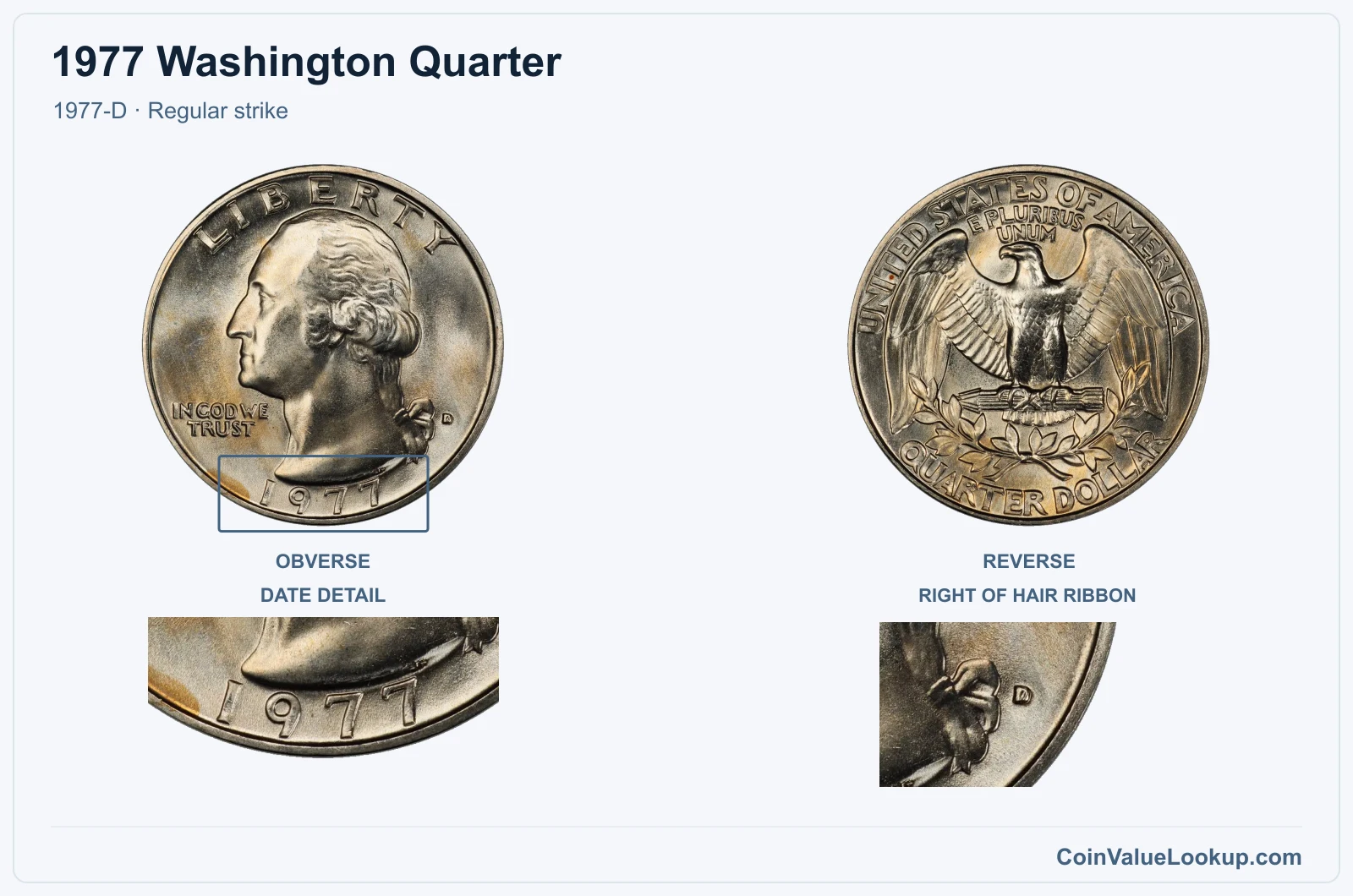
The 1977-D carries a small D mintmark near the date, identifying the Denver Mint. Same clad composition, same design, same practical value in circulated grades: 25 cents.
At MS65, the USA Coin Book guide estimate also sits at $7.29. Where the Denver issue gets genuinely interesting is in the error department — a confirmed 40% silver planchet strike exists exclusively from this mint, making it worth inspecting any 1977-D quarter's edge closely.
Coin Value Lookup is a useful starting point if you want to compare this quarter against other Washington quarter years or denominations. You can look up guides for the specific coin you are holding.
| Range | Grade | Price | Auction Records | Appraisal |
|---|---|---|---|---|
| PO | PO 1 | — | Coin Identifier | |
| FR | FR 2 | — | Coin Identifier | |
| AG | AG 3 | — | Coin Identifier | |
| G | G 4 | — | Coin Identifier | |
| G 6 | — | Coin Identifier | ||
| VG | VG 8 | — | Coin Identifier | |
| VG 10 | — | Coin Identifier | ||
| F | F 12 | — | Coin Identifier | |
| F 15 | — | Coin Identifier | ||
| VF | VF 20 | — | Coin Identifier | |
| VF 25 | — | Coin Identifier | ||
| VF 30 | — | Coin Identifier | ||
| VF 35 | — | Coin Identifier | ||
| XF | XF 40 | — | Coin Identifier | |
| XF 45 | — | Coin Identifier | ||
| AU | AU 50 | — | Coin Identifier | |
| AU 53 | — | Coin Identifier | ||
| AU 55 | — | Coin Identifier | ||
| AU 58 | — | Coin Identifier | ||
| MS | MS 60 | — | Coin Identifier | |
| MS 61 | — | Coin Identifier | ||
| MS 62 | — | Coin Identifier | ||
| MS 63 | — | Coin Identifier | ||
| MS 64 | — | Coin Identifier | ||
| MS 65 | Coin Identifier | |||
| MS 66 | Coin Identifier | |||
| MS 67 | Coin Identifier | |||
| MS 68 | — | Coin Identifier | ||
| MS 69 | — | — | — | |
| MS 70 | — | — | — |
1977 Washington Quarter — S Proof
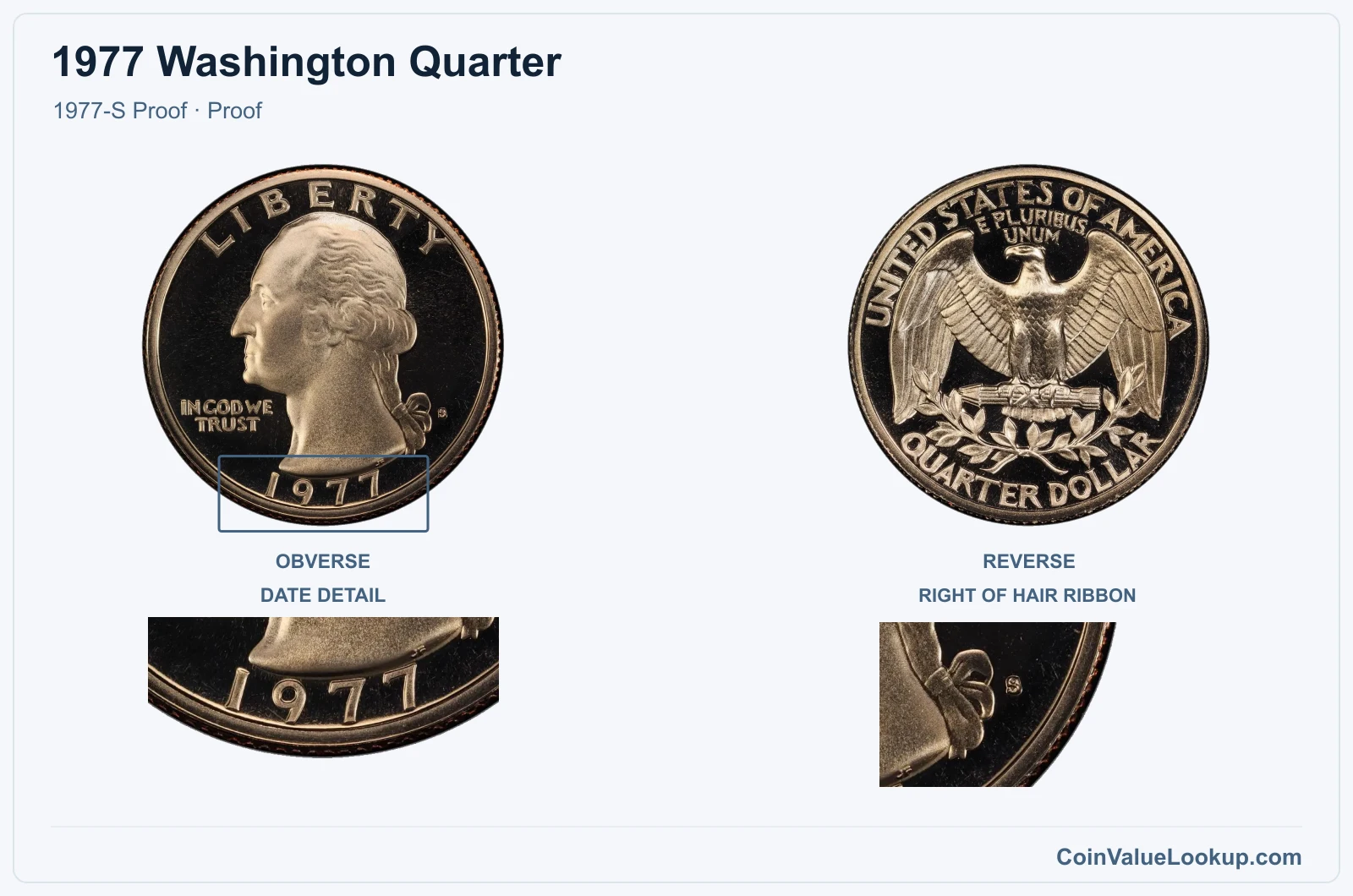
The 1977-S proof was struck at the San Francisco Mint and sold in proof sets, not released into circulation. It carries an S mintmark near the date.
Despite common belief, the S does not indicate silver — this is standard copper-nickel clad.
A USA Coin Book guide estimate places PR65 examples at about $6.25. Cameo and deep cameo contrast designations describe the frosted-versus-mirror appearance and are noted separately from the numerical proof grade.
The generic PR65 guide figure cited here is not specific to cameo or deep cameo versions, which may trade differently.
| Range | Grade | Price | Auction Records | Appraisal |
|---|---|---|---|---|
| PR | PR 1 | — | Coin Identifier | |
| PR 2 | — | Coin Identifier | ||
| PR 3 | — | Coin Identifier | ||
| PR 4 | — | Coin Identifier | ||
| PR 6 | — | Coin Identifier | ||
| PR 8 | — | Coin Identifier | ||
| PR 10 | — | Coin Identifier | ||
| PR 12 | — | Coin Identifier | ||
| PR 15 | — | Coin Identifier | ||
| PR 20 | — | Coin Identifier | ||
| PR 25 | — | Coin Identifier | ||
| PR 30 | — | Coin Identifier | ||
| PR 35 | — | Coin Identifier | ||
| PR 40 | — | Coin Identifier | ||
| PR 45 | — | Coin Identifier | ||
| PR 50 | — | Coin Identifier | ||
| PR 53 | — | Coin Identifier | ||
| PR 55 | — | Coin Identifier | ||
| PR 58 | — | Coin Identifier | ||
| PR 60 | — | Coin Identifier | ||
| PR 61 | — | Coin Identifier | ||
| PR 62 | — | Coin Identifier | ||
| PR 63 | — | Coin Identifier | ||
| PR 64 | — | Coin Identifier | ||
| PR 65 | — | Coin Identifier | ||
| PR 66 | — | Coin Identifier | ||
| PR 67 | Coin Identifier | |||
| PR 68 | Coin Identifier | |||
| PR 69 | Coin Identifier | |||
| PR 70 | Coin Identifier |
1977 Washington Quarter Error List
1. 1977 Washington Quarter — Struck on a 40% Silver Planchet
This is the headline error for 1977 quarters. A 1977-D quarter was struck on a 40% silver clad planchet — a blank intended for a different denomination or series that somehow reached the Denver striking press.
The coin weighs approximately 5.7 grams and the edge lacks the normal copper-red band visible on standard clad quarters.
One example graded NGC XF Details (Improperly Cleaned) sold for $4,935 at Heritage Auctions in January 2016. That price reflects a single authenticated specimen in a specific condition, not a guaranteed figure for every claim.
How the blank reached Denver has not been established.
Beware lookalikes. Post-mint plating, chemical treatment and filed edges can all mimic an unusual edge appearance.
Professional authentication of the alloy is required — unusual color or a missing copper stripe alone does not confirm a wrong-planchet error.
2. 1977 Washington Quarter — Misaligned Obverse Die
A misaligned die error on the 1977-D quarter shifts the obverse design relative to the planchet. In the documented example, the obverse is displaced downward roughly 5%, leaving only half the date visible.
The reverse may appear normally centered because only one die was out of position.
One example graded NGC MS63 sold for $25 at Heritage Auctions in March 2000. Value depends on the degree of shift and overall condition.
Do not confuse this with an off-center strike, which displaces the entire design footprint on both sides and typically leaves an unstruck crescent. Rim damage and photographic cropping can also mimic a shifted design.
Check both faces carefully to see whether the misalignment is one-sided or affects both.
3. 1977 Washington Quarter — Off-Center Strike
An off-center strike happens when the planchet is not properly seated between the dies at the moment of striking. The result is a displaced design with an unstruck crescent of blank metal along part of the rim.
Both sides show the shift, unlike a one-sided die misalignment.
For a 1977 quarter off-center error, the date should remain at least partially visible — coins without a readable date are much harder to attribute and less desirable. The percentage of off-center displacement and the coin's overall condition both affect value, but no specific price range is adopted here.
Watch out for clipped edges, post-mint flattening and one-sided die misalignment, all of which can resemble an off-center strike at first glance. Genuine off-center coins show design displacement on both faces and an uninterrupted blank area.
4. 1977 Washington Quarter — Broadstrike
A broadstrike occurs when the collar die — the ring that normally contains the planchet during striking — fails to engage. Without that confinement, metal spreads outward, producing a coin that is wider than normal with a distorted or absent rim.
The design is still centered, which separates this from an off-center error.
On a 1977 quarter broadstrike, look for an expanded diameter, a weak or missing rim and full design coverage that simply spills past the normal boundary. The edge profile will lack the reeded texture of a properly struck quarter.
No specific price is adopted for this error. Condition, the degree of spread and visual appeal all factor into value.
A coin that was simply flattened after leaving the mint — by a train, a hammer, or sheer boredom — will not show the uniform metal flow of a genuine broadstrike.
5. 1977 Washington Quarter — Doubled Die Obverse
A doubled die obverse on a 1977 quarter results from a misaligned hub impression during die manufacturing. The reported examples for this year are described as minor.
Look for consistent separation or notching on obverse lettering or design elements — the doubling should repeat identically on every coin struck by that die.
Compare your coin's letters under magnification against a known normal example in matching light. True hub doubling shows a raised, shelf-like secondary image.
Machine doubling, by contrast, tends to produce a flat shelf with reduced detail rather than a raised secondary impression.
No specific price is adopted for this variety. Value depends on the strength of the doubling, the coin's grade and how visible the effect is to the unaided eye.
6. 1977 Washington Quarter — Missing Clad Layer
A missing clad layer error means one of the outer nickel-alloy layers was not bonded to the copper core before the blank was struck. On a 1977 quarter with a missing obverse clad layer, the face of Washington appears on exposed copper, giving that side a distinctly different color and texture.
Check the edge of the coin — you should see an asymmetric layering where one clad layer is absent. The coin's weight will also be noticeably below the normal 5.67 grams because an entire layer of metal is missing.
No specific price is adopted. Condition and the completeness of the missing layer affect value.
Beware coins that appear copper-colored due to environmental toning, acid exposure, plating removal or deliberate surface alteration. These post-mint changes do not produce the weight difference a genuine missing clad layer creates.
7. 1977 Washington Quarter — Clipped Planchet
A clipped planchet error occurs when the blank is punched incorrectly from the metal strip, capturing an area that overlaps a previous punch or the strip's edge. The result is a curved, straight or irregular missing section on the finished coin.
On a 1977 quarter, look for a smooth, unstruck curved edge and a zone of design weakness opposite the clip — metal flow during striking tends to thin out on the far side. That weakness pattern is a useful authenticity marker.
No specific price is adopted. Value depends on the size and shape of the clip, overall condition, and whether the date remains visible.
Filed notches, deliberate edge cuts and corrosion can all produce missing-edge appearances, but these lack the corresponding opposite-side weakness and the smooth, factory-edge texture of a genuine clip.
8. 1977 Washington Quarter — Die Crack / Die Chip
Die cracks and die chips are raised features caused by a damaged or deteriorating die. A crack appears as a thin raised line running across the coin's surface, while a chip shows up as a small raised blob where a piece of the die face broke away.
When a crack reaches the rim and a chunk of the die breaks off entirely, the result is called a cud — a raised, featureless lump at the edge.
On a 1977 quarter, examine both faces under magnification. The key word is raised — these features sit above the normal surface because they correspond to recesses in the broken die.
No specific price is adopted. Value depends on size, location and visibility.
Scratches, corrosion lines and foreign material stuck to the surface are incuse or sit on top in a different way, and they will not show the uniform raised profile of a genuine die crack or chip.