1974 Washington Quarter Coin Value: How Much Is It Worth?
Most 1974 Washington quarters are worth face value — 25 cents — if they show any wear at all. Coins preserved in uncirculated condition tell a different story: a USA Coin Book guide estimate for a select MS65 example reaches $8.64.
Proof, variety and error pieces each need their own identification and grade before any value discussion applies.
Fast Way to Identify Your 1974 Washington Quarter
Snap a clear photo of both sides of your 1974 quarter and upload them here for a preliminary identification. We can help you figure out which mint struck it, whether it might be a proof, and if any obvious error characteristics are visible.
Good lighting and a steady hand go a long way.
1974 Washington Quarter Value
Upload both sides of your 1974 Washington Quarter.
Front Obverse
Upload photo
Back Reverse
Upload photo
Which 1974 Washington Quarter Versions Are Worth Money?
- Uncirculated 1974-D quarters in MS65 condition carry a USA Coin Book guide estimate of $8.64, the highest among the three regular issues for this grade.
- The 1974-S Proof in PR65 carries a guide estimate of about $6.25, but cameo and deep-cameo contrast designations can affect value separately.
- A 1974-D die cap with reverse brockage sold for $1,265 in MS66 at a Heritage auction in April 2006.
- A 1974-D quarter struck on a cent planchet brought $1,175 in MS64 Red at Heritage in September 2012.
- Several error categories — off-center strikes, broadstrikes, clipped planchets and missing clad layers — are reported for 1974 quarters; value depends on condition and visibility of the error.
Step 1: Identify Your 1974 Washington Quarter Mint Mark and Version
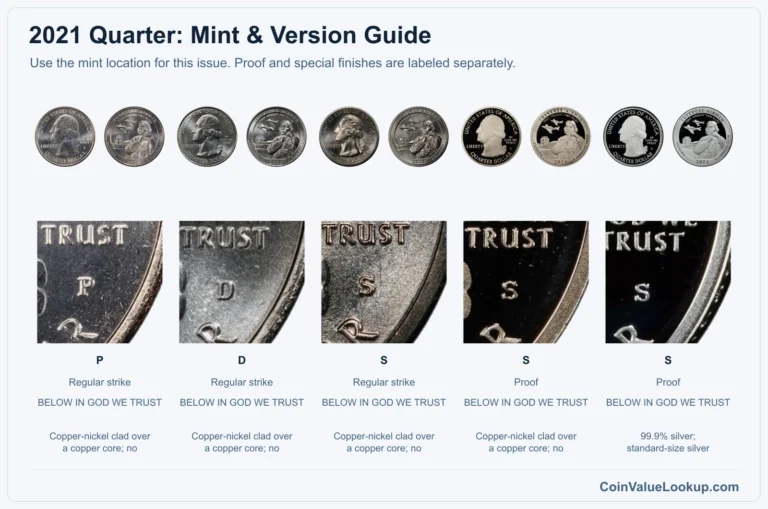
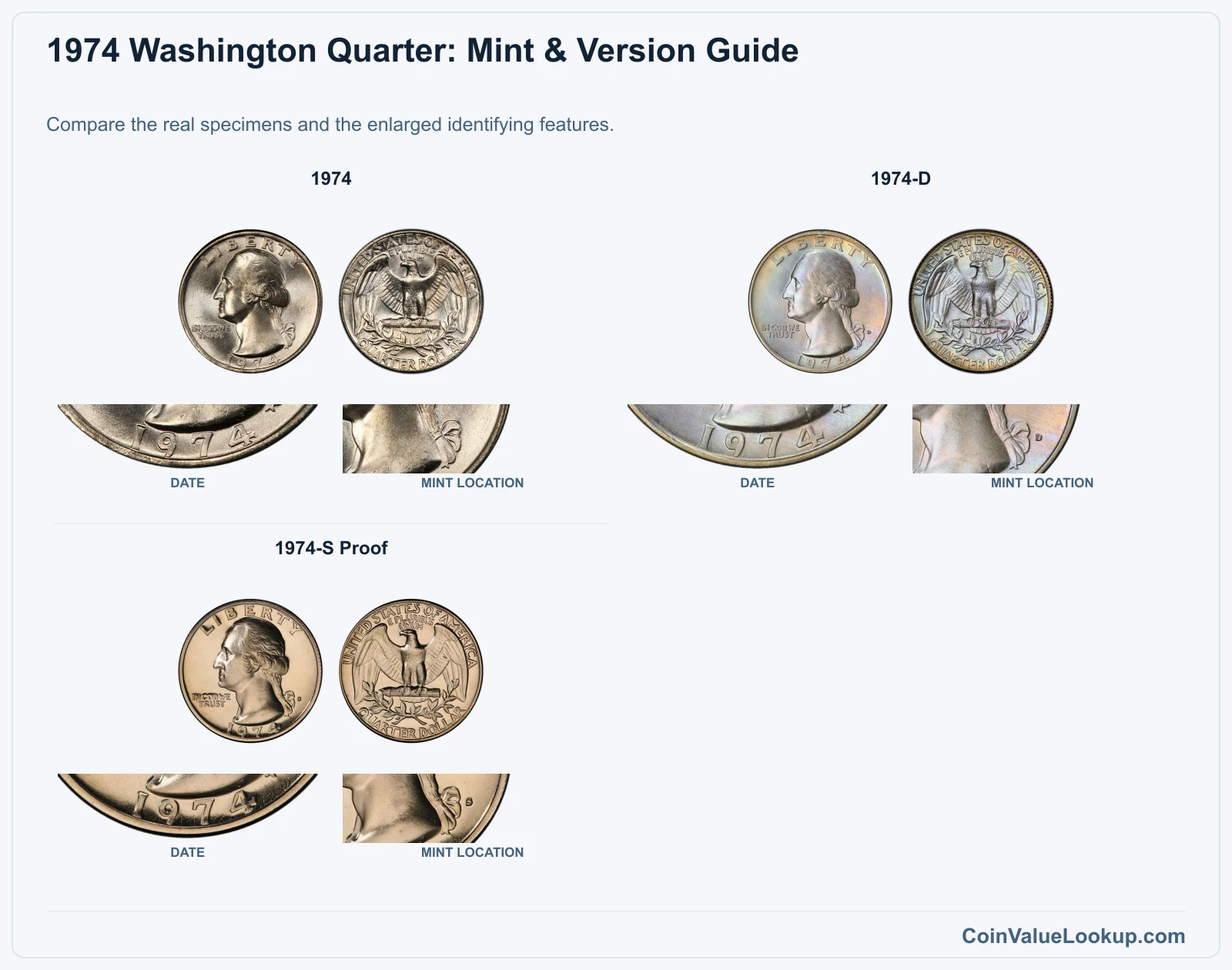
Three versions of the 1974 Washington quarter exist. Philadelphia coins carry no mintmark.
Denver coins show a small "D" near the date on the obverse. San Francisco coins bear an "S" mintmark and were struck as proofs only.
All three are copper-nickel clad, weighing about 5.67 grams at 24.3 mm diameter. The S mintmark does not mean silver for this year.
You can check the edge for the copper-colored stripe typical of clad construction, but do not try to authenticate the alloy by color alone.
Prioritize identifying the mintmark first. Then look at overall condition and check for anything unusual — off-center designs, cupping, missing metal, raised lines, or wrong-looking planchets.
These are the features that separate a spender from something a collector wants.
Step 2: Check Your 1974 Washington Quarter Grade
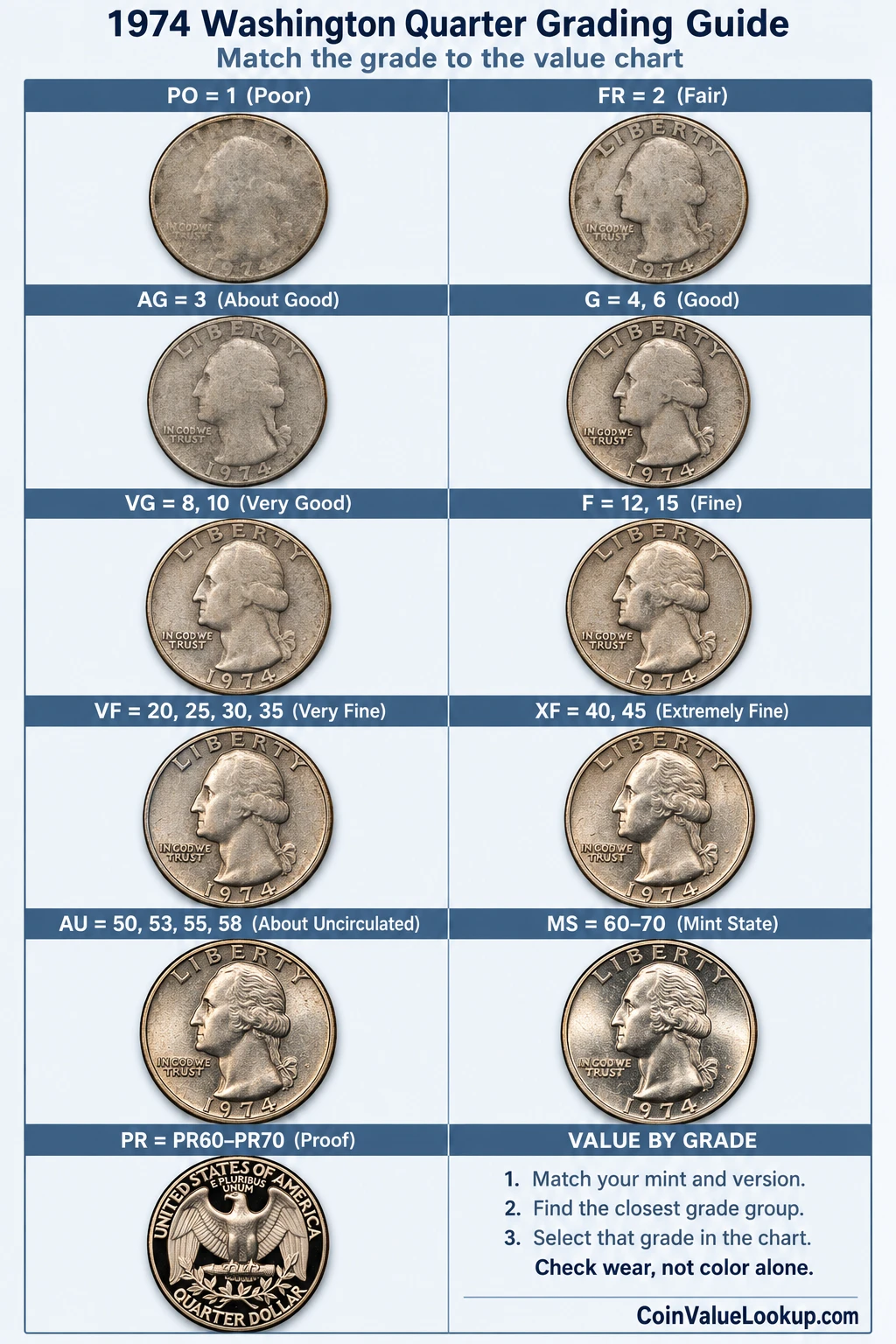
Focus on the hair detail above Washington's ear, the cheek and the jawline on the obverse. On the reverse, the eagle's breast feathers lose definition first.
A coin with full, sharp hair strands and complete breast feathers is a candidate for a high mint-state grade.
Separate a weak strike from actual wear. A weakly struck coin may lack detail but still show unbroken original luster.
A worn coin will have flattened high points and interrupted luster.
Look for contact marks — tiny nicks from other coins banging around in bags. These pull down the grade even on an otherwise lustrous coin.
Cleaning hairlines under magnification also matter; a cleaned coin grades lower than an original one.
For proofs, the mirror fields and frosted devices are a manufacturing finish, not a higher grade than mint state. Compare your coin to the reference image to see where your example falls on the condition spectrum.
Step 3: Check 1974 Washington Quarter Value by Mint and Version
1974 Washington Quarter
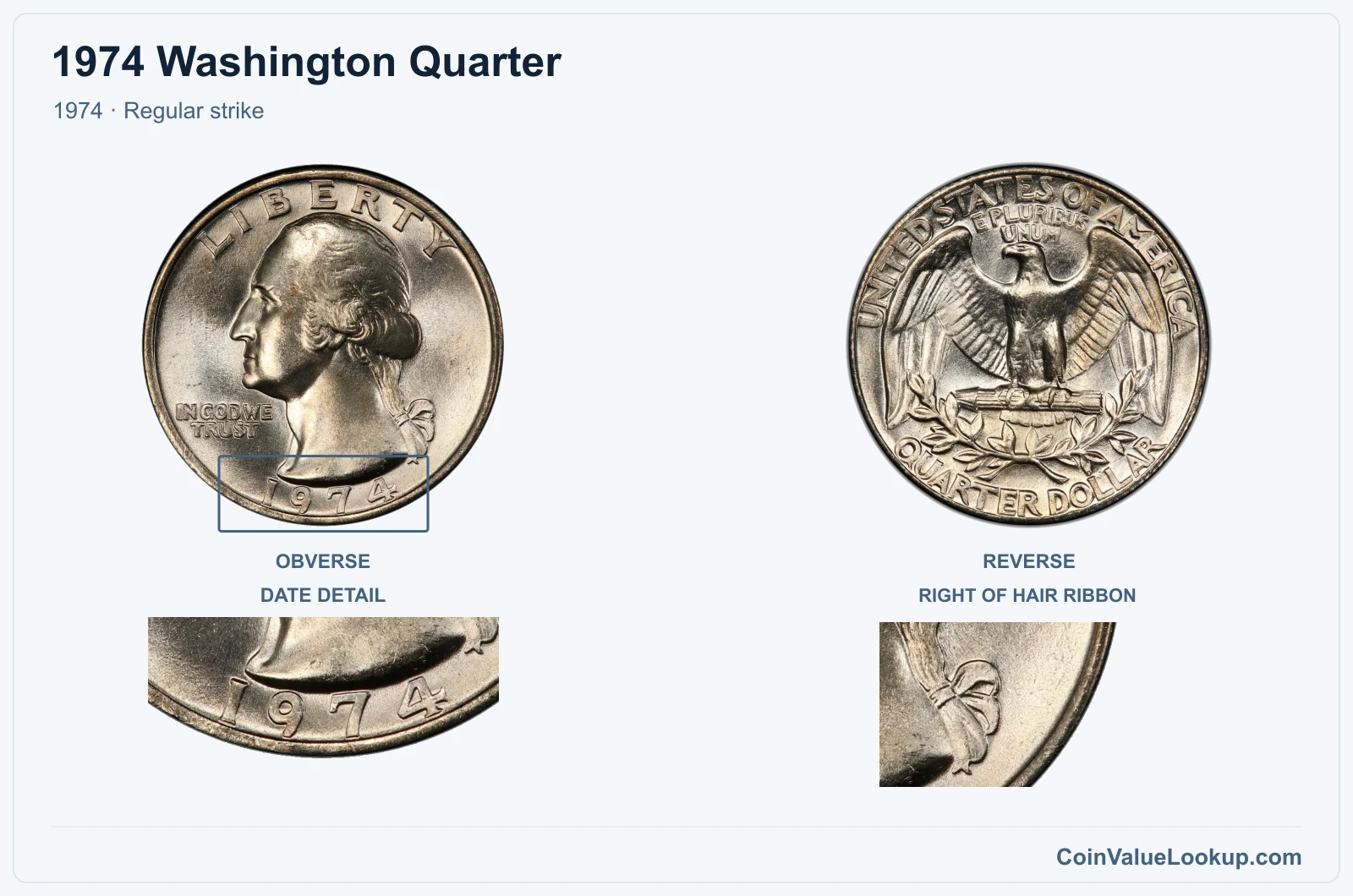
The 1974 Philadelphia quarter has no mintmark — just a blank space near the date on the obverse. It is a standard copper-nickel clad business strike with the familiar Washington obverse and eagle reverse.
In circulated grades, these are worth face value. A USA Coin Book guide estimate places an MS65 example at about $7.29.
That is a retail guide figure, not an offer, and your coin needs to actually grade MS65 to approach it. Most pocket change examples will not.
| Range | Grade | Price | Auction Records | Appraisal |
|---|---|---|---|---|
| PO | PO 1 | — | Coin Identifier | |
| FR | FR 2 | — | Coin Identifier | |
| AG | AG 3 | — | Coin Identifier | |
| G | G 4 | — | Coin Identifier | |
| G 6 | — | Coin Identifier | ||
| VG | VG 8 | — | Coin Identifier | |
| VG 10 | — | Coin Identifier | ||
| F | F 12 | — | Coin Identifier | |
| F 15 | — | Coin Identifier | ||
| VF | VF 20 | — | Coin Identifier | |
| VF 25 | — | Coin Identifier | ||
| VF 30 | — | Coin Identifier | ||
| VF 35 | — | Coin Identifier | ||
| XF | XF 40 | — | Coin Identifier | |
| XF 45 | — | Coin Identifier | ||
| AU | AU 50 | — | Coin Identifier | |
| AU 53 | — | Coin Identifier | ||
| AU 55 | — | Coin Identifier | ||
| AU 58 | — | Coin Identifier | ||
| MS | MS 60 | — | Coin Identifier | |
| MS 61 | — | Coin Identifier | ||
| MS 62 | — | Coin Identifier | ||
| MS 63 | — | Coin Identifier | ||
| MS 64 | Coin Identifier | |||
| MS 65 | Coin Identifier | |||
| MS 66 | Coin Identifier | |||
| MS 67 | Coin Identifier | |||
| MS 68 | — | — | — | |
| MS 69 | — | — | — | |
| MS 70 | — | — | — |
1974 Washington Quarter — D
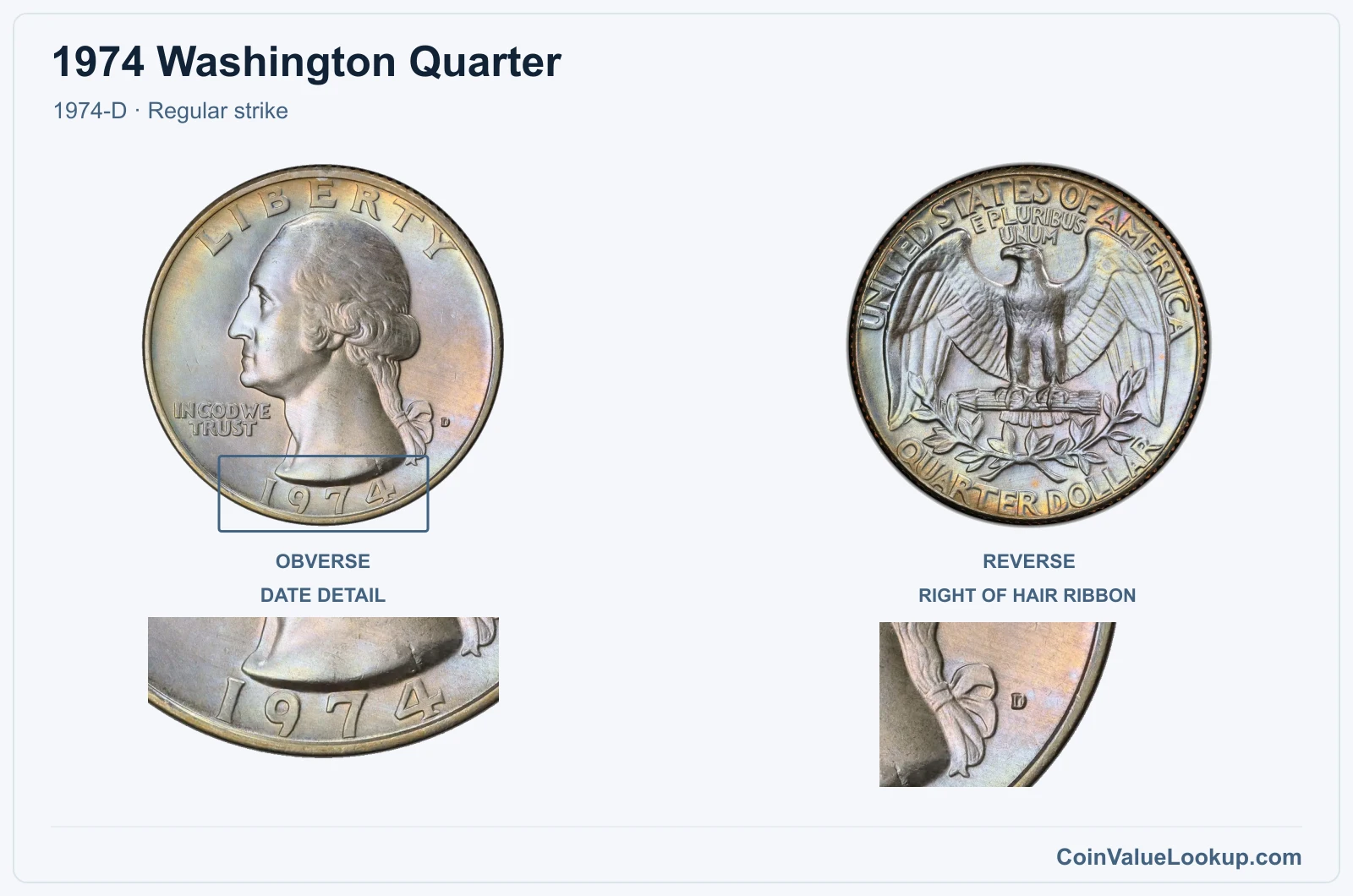
Look for the small "D" mintmark near the date. The 1974-D is another copper-nickel clad business strike from Denver, identical in design and composition to its Philadelphia sibling.
A USA Coin Book guide estimate for MS65 is $8.64, slightly above the Philadelphia issue at the same grade. Circulated pieces remain at face value.
Denver-minted 1974 quarters are also the source of the most dramatic known errors for this date, including a die cap brockage and a wrong-planchet strike, so the "D" is worth confirming if your coin looks unusual in any way.
| Range | Grade | Price | Auction Records | Appraisal |
|---|---|---|---|---|
| PO | PO 1 | — | Coin Identifier | |
| FR | FR 2 | — | Coin Identifier | |
| AG | AG 3 | — | Coin Identifier | |
| G | G 4 | — | Coin Identifier | |
| G 6 | — | Coin Identifier | ||
| VG | VG 8 | — | Coin Identifier | |
| VG 10 | — | Coin Identifier | ||
| F | F 12 | — | Coin Identifier | |
| F 15 | — | Coin Identifier | ||
| VF | VF 20 | — | Coin Identifier | |
| VF 25 | — | Coin Identifier | ||
| VF 30 | — | Coin Identifier | ||
| VF 35 | — | Coin Identifier | ||
| XF | XF 40 | — | Coin Identifier | |
| XF 45 | — | Coin Identifier | ||
| AU | AU 50 | — | Coin Identifier | |
| AU 53 | — | Coin Identifier | ||
| AU 55 | — | Coin Identifier | ||
| AU 58 | — | Coin Identifier | ||
| MS | MS 60 | — | Coin Identifier | |
| MS 61 | — | Coin Identifier | ||
| MS 62 | — | Coin Identifier | ||
| MS 63 | — | Coin Identifier | ||
| MS 64 | Coin Identifier | |||
| MS 65 | Coin Identifier | |||
| MS 66 | Coin Identifier | |||
| MS 67 | Coin Identifier | |||
| MS 68 | — | — | — | |
| MS 69 | — | — | — | |
| MS 70 | — | — | — |
1974 Washington Quarter — S Proof
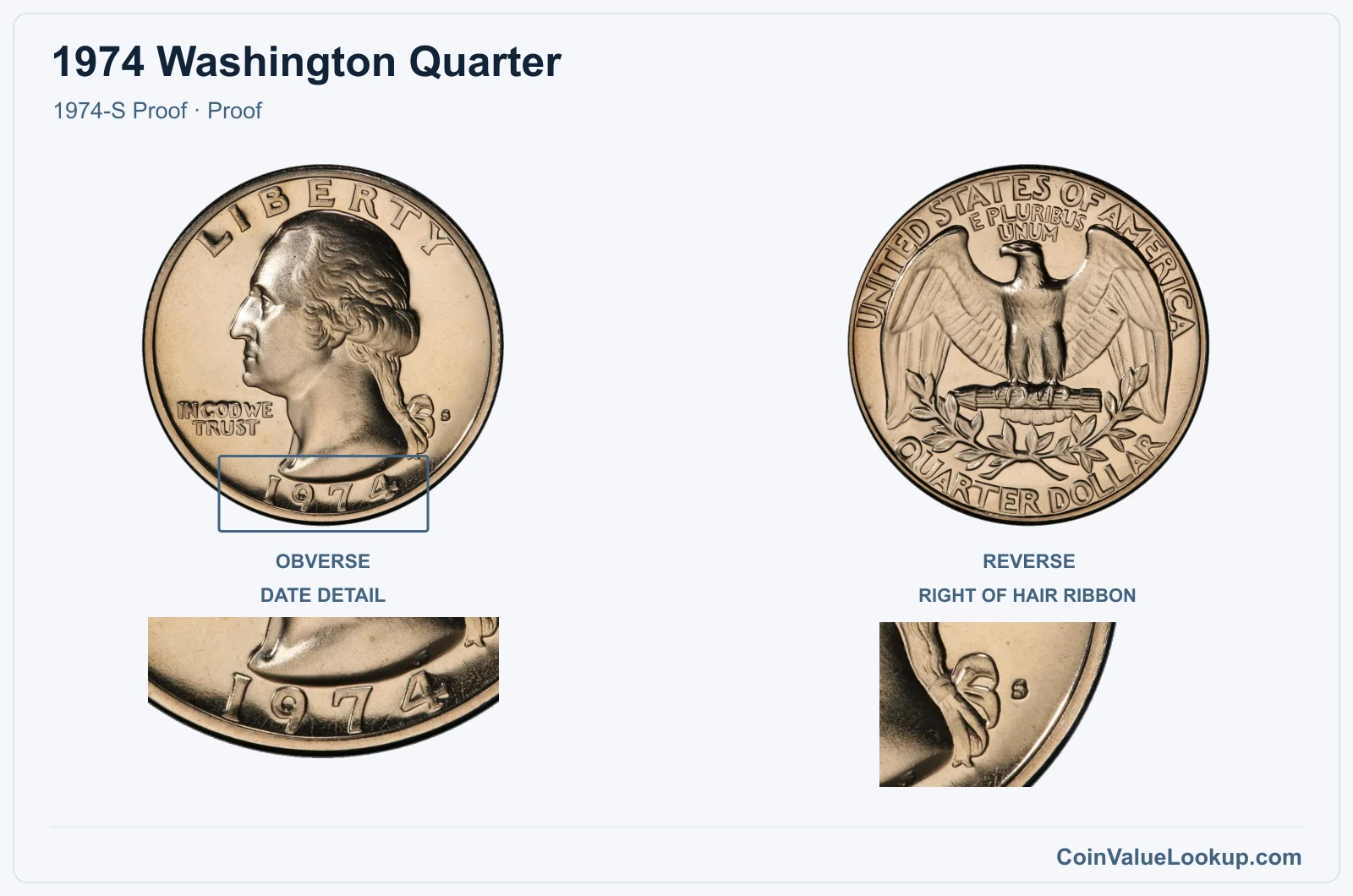
The 1974-S Proof carries an "S" mintmark and was produced at San Francisco exclusively as a proof. These were sold in government proof sets, not released into circulation.
The copper-nickel clad composition is the same as the business strikes. An "S" on a 1974 quarter does not indicate silver.
A USA Coin Book guide estimate places a PR65 example at roughly $6.25. That generic proof figure does not specifically account for cameo or deep-cameo contrast designations, which are separate market categories.
Coin Value Lookup is a useful starting point if you want to compare this proof with other Washington quarter dates and mints across different years.
| Range | Grade | Price | Auction Records | Appraisal |
|---|---|---|---|---|
| PR | PR 1 | — | Coin Identifier | |
| PR 2 | — | Coin Identifier | ||
| PR 3 | — | Coin Identifier | ||
| PR 4 | — | Coin Identifier | ||
| PR 6 | — | Coin Identifier | ||
| PR 8 | — | Coin Identifier | ||
| PR 10 | — | Coin Identifier | ||
| PR 12 | — | Coin Identifier | ||
| PR 15 | — | Coin Identifier | ||
| PR 20 | — | Coin Identifier | ||
| PR 25 | — | Coin Identifier | ||
| PR 30 | — | Coin Identifier | ||
| PR 35 | — | Coin Identifier | ||
| PR 40 | — | Coin Identifier | ||
| PR 45 | — | Coin Identifier | ||
| PR 50 | — | Coin Identifier | ||
| PR 53 | — | Coin Identifier | ||
| PR 55 | — | Coin Identifier | ||
| PR 58 | — | Coin Identifier | ||
| PR 60 | — | Coin Identifier | ||
| PR 61 | — | Coin Identifier | ||
| PR 62 | — | Coin Identifier | ||
| PR 63 | — | Coin Identifier | ||
| PR 64 | — | Coin Identifier | ||
| PR 65 | — | Coin Identifier | ||
| PR 66 | — | Coin Identifier | ||
| PR 67 | Coin Identifier | |||
| PR 68 | — | Coin Identifier | ||
| PR 69 | Coin Identifier | |||
| PR 70 | — | — | — |
1974 Washington Quarter Error List
1. 1974 Washington Quarter — Die Cap with Reverse Brockage
A die cap forms when a struck coin sticks to the upper die and then strikes subsequent blanks, gradually cupping into a bottle-cap shape. The reverse of the capped coin eventually shows a greatly expanded, incuse mirror-image of the obverse — that is the brockage.
This error is confirmed on the 1974-D quarter. Look for shallow cupping of the coin and a spread-out, reversed obverse image on what should be the normal reverse.
The cap and brockage are one continuous manufacturing sequence, not ordinary doubled lettering.
Do not confuse this with coins pressed together after leaving the mint, post-strike cupping or machine doubling. A genuine die cap has a distinctive form and attributed brockage detail.
One PCGS MS66 example sold for $1,265 at a Heritage auction in April 2006.
2. 1974 Washington Quarter — Struck on a Cent Planchet
A 1974-D quarter struck on a cent planchet occurs when a smaller copper-alloy cent blank feeds into the quarter press by mistake. The result is a coin roughly the size of a cent carrying Washington quarter designs, with incomplete peripheral detail because the blank is too small to receive the full impression.
You should see the date, the "D" mintmark and quarter design elements on a visibly undersized, copper-colored planchet. Compare it side by side with a normal clad quarter — the difference in diameter and edge composition is obvious.
Post-mint cutting, hammering or plating can mimic this error superficially. True struck surfaces and correct-year attribution are essential.
One NGC MS64 Red specimen brought $1,175 at a Heritage auction in September 2012.
3. 1974 Washington Quarter — Double / Multiple Strike
A double or multiple strike happens when a coin is struck more than once, with the second impression displaced or rotated from the first. On a 1974-D quarter, this has been reported in combination with die cap and brockage characteristics.
Look for two separate, overlapping design impressions. The second strike will usually be shifted or turned, producing a ghosted duplicate image that is physically offset from the primary design.
This is different from a doubled die, where the doubling originates in the die itself and appears identically on every coin struck by that die.
It also differs from impressions added after minting by non-mint equipment. Condition, degree of displacement and visual impact all affect value; individual assessment is necessary.
4. 1974 Washington Quarter — Off-Center Strike
An off-center strike occurs when the planchet is not properly centered between the dies during striking. The result is a crescent-shaped blank area on one side of the coin, with the design shifted toward the opposite edge.
On a 1974 quarter, look for a displaced Washington portrait and an unstruck arc of flat metal. Coins that still show a readable date are more desirable than those where the date has moved off the flan entirely.
Do not confuse this with a clipped planchet, a one-sided die misalignment or post-mint flattening. The design shift is uniform and the blank crescent has no struck detail at all.
Value depends on the percentage off center, date visibility and overall condition.
5. 1974 Washington Quarter — Clipped Planchet
A clipped planchet error results when the blank is punched incorrectly from the metal strip, leaving a missing curved, straight or ragged section. On a 1974 quarter, you may notice weakness in the design opposite the clip — this is called the Blakesley effect and helps confirm a genuine clip.
Examine the edge texture carefully. A true clip will show metal flow consistent with the striking process, not the sharp or rough edges left by cutting, filing or corrosion after minting.
The size and location of the clip, along with the coin's overall condition, determine its collectible value. Each piece needs individual evaluation.
6. 1974 Washington Quarter — Broadstrike
A broadstrike happens when a coin is struck without the retaining collar that normally confines the planchet and forms the reeded edge. The metal spreads outward beyond normal diameter, and the edge will appear smooth or irregular rather than reeded.
On a 1974 quarter, look for an oversized coin with the full design present but slightly spread. The rim may be weak or absent, and the overall diameter will exceed the standard 24.3 mm.
This is different from an off-center strike, where the design itself is shifted. It also differs from a coin flattened by post-mint damage, which would show disturbed surface detail rather than a cleanly struck but expanded design.
Value depends on how dramatic the spread is and the coin's preservation.
7. 1974 Washington Quarter — Missing Clad Layer
A missing clad layer error means one of the outer copper-nickel layers was absent from the planchet before striking. The exposed side may show the copper core, giving the coin an unusual brownish or reddish appearance on one face.
Compare the affected side, the edge cross-section and the coin's weight against a normal clad quarter. A missing layer will produce a noticeably lighter coin and an asymmetric edge stripe.
This is not the same as toning, environmental damage, plating or chemical removal of the surface metal after minting. Genuine examples show normal strike detail on the exposed core.
Condition and the extent of the missing layer influence collectible value, and each coin requires individual assessment.
8. 1974 Washington Quarter — Die Crack / Die Chip
Die cracks appear as raised lines on the coin's surface, created when the steel die develops fractures from repeated use. Die chips are small raised blobs from pieces of the die breaking away.
A cud is a larger raised area connected to the rim, formed when a significant chunk of the die edge breaks off.
On a 1974 quarter, look for raised lines or lumps that follow no part of the normal design. They will be raised because the crack or chip is recessed in the die.
Interior chips and rim-connected cuds are considered different collectible categories.
Do not confuse these with incuse scratches, corrosion deposits or foreign material stuck to the surface — those are recessed or sit on top of the coin rather than being struck into it. Value depends on size, location and condition.
9. 1974 Washington Quarter — Indented Strike
An indented strike occurs when a second blank or foreign object overlaps the planchet during striking, leaving a bounded depressed area on the finished coin. The depressed zone will lack normal design detail because the overlapping piece absorbed the die's impression in that area.
On a 1974-D quarter, this error has been reported alongside double-strike and off-center characteristics. Look for a clearly defined sunken region with a distinct boundary, and examine how it relates to the normal design elements around it.
A post-mint dent lacks the sharp boundary and struck-surface characteristics of a true indent. A brockage, by contrast, shows an actual mirrored design within the depressed area.
Condition, size of the indent and the complexity of any combined errors all affect value.