1981 Washington Quarter Coin Value: How Much Is It Worth?
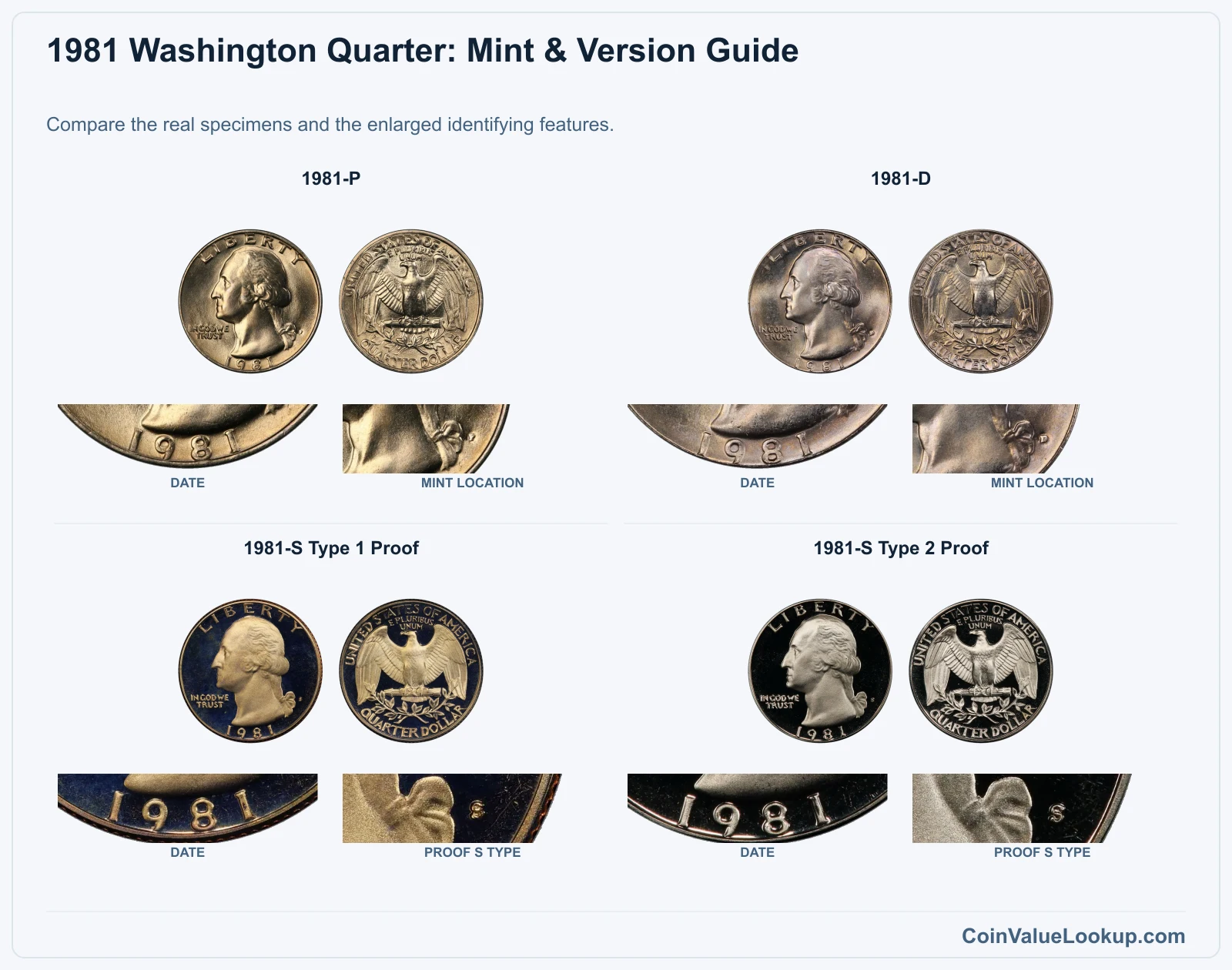
Most 1981 Washington quarters you pull from a jar are worth face value — 25 cents. That is perfectly normal for a high-mintage copper-nickel clad coin in circulated condition.
In gem uncirculated condition around MS65, a USA Coin Book guide estimate puts the value near $7.29 for the Philadelphia or Denver issues. Proof, variety and error coins each need their own identification and grading before any value discussion applies.
Fast Way to Identify Your 1981 Washington Quarter
The quickest way to start figuring out what you have is to upload clear photos of both the front and back of your 1981 quarter. Our identifier can give you a preliminary read on the mint, version and general category.
It is not a substitute for professional authentication, but it helps you decide whether to dig deeper or toss the coin back in the jar.
1981 Washington Quarter Value
Upload both sides of your 1981 Washington Quarter.
Front Obverse
Upload photo
Back Reverse
Upload photo
Which 1981 Washington Quarter Versions Are Worth Money?
- 1981-S Type 2 Proof quarters carry a PR65 guide estimate of $7.29 — correctly identifying the bulbous-serif mintmark is essential before claiming this version.
- 1981-P and 1981-D quarters in true gem MS65 or higher condition are worth checking; the guide lists $7.29 at MS65, well above face value.
- 1981-S Type 1 Proof quarters have a PR65 guide estimate around $4.96; confirming the earlier Clear S punch separates them from the pricier Type 2.
- Authenticated mint errors such as a strike on a dime planchet or a flipover double strike with indent have sold individually for hundreds to thousands of dollars at major auctions.
Step 1: Identify Your 1981 Washington Quarter Mint Mark and Version
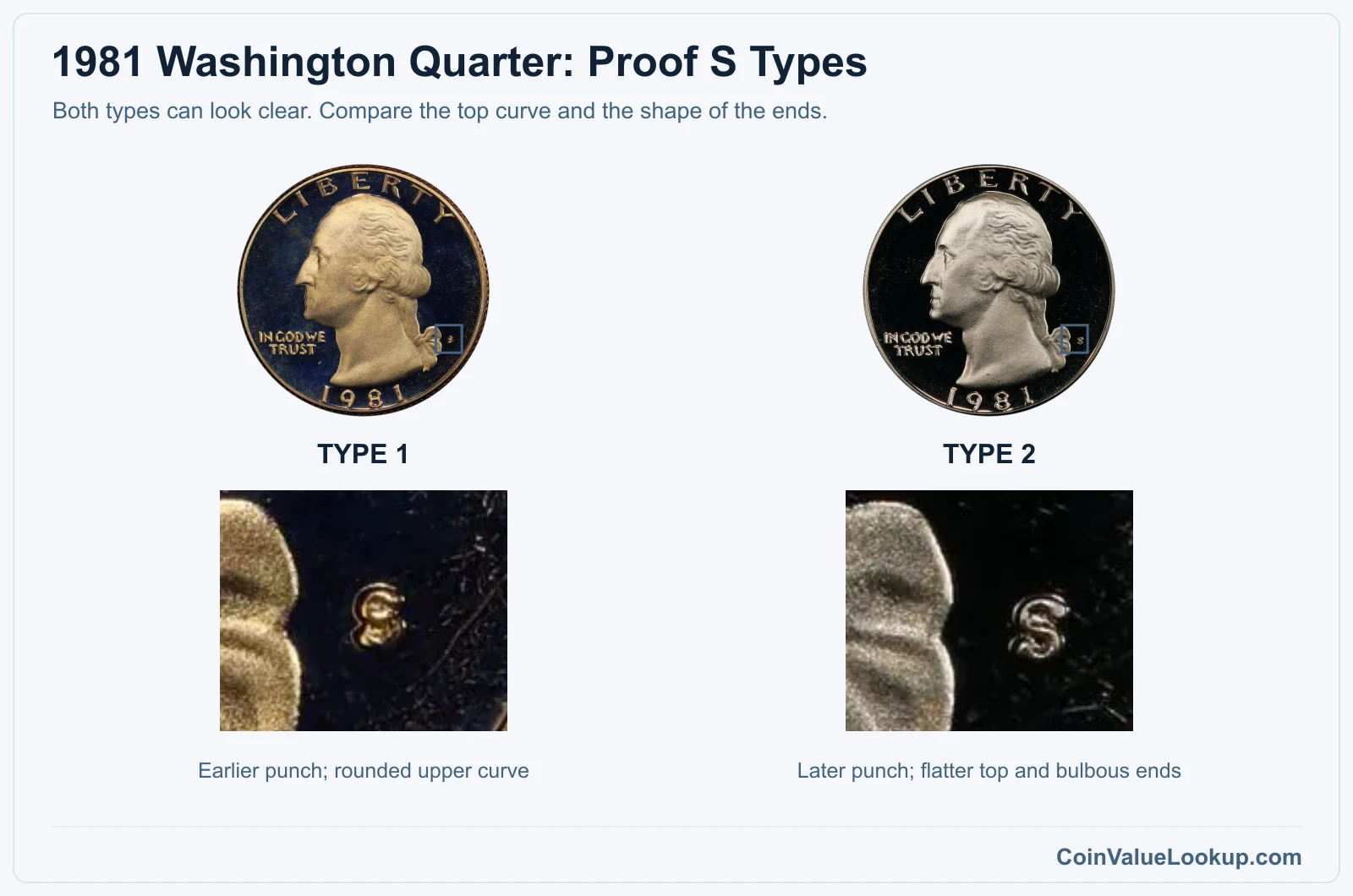
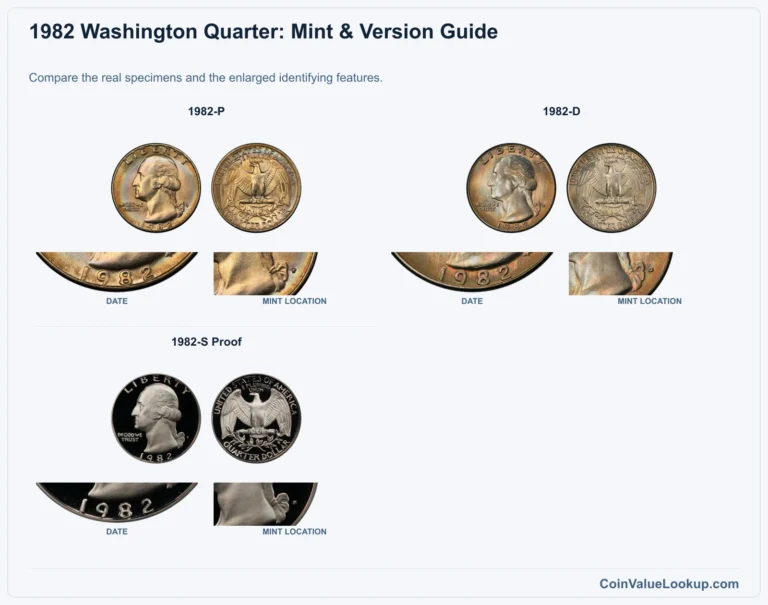
Look at the obverse near the date for a small mintmark letter. A "P" means Philadelphia, a "D" means Denver, and an "S" means San Francisco proof.
If you cannot see any mark or it is obscured, do not automatically assume Philadelphia — you need a clearer look or better magnification.
All 1981 quarters are copper-nickel clad over a copper core, with an overall composition of 91.67% copper and 8.33% nickel. They weigh about 5.67 grams and measure 24.3 mm across.
An "S" mintmark does not mean silver. Check the edge for the telltale copper stripe and weigh the coin if you are suspicious, but do not try to authenticate alloy by color alone.
The big variety story for 1981 is the Type 1 versus Type 2 mintmark punch on S-mint proofs. Type 1 uses the earlier "Clear S" punch that carried over from the 1979 Type 2.
Type 2 has noticeably more bulbous serifs on the S. You really need a close-up of the mintmark and a side-by-side comparison with a confirmed Type 1 to tell them apart — seller labels are not enough.
Step 2: Check Your 1981 Washington Quarter Grade
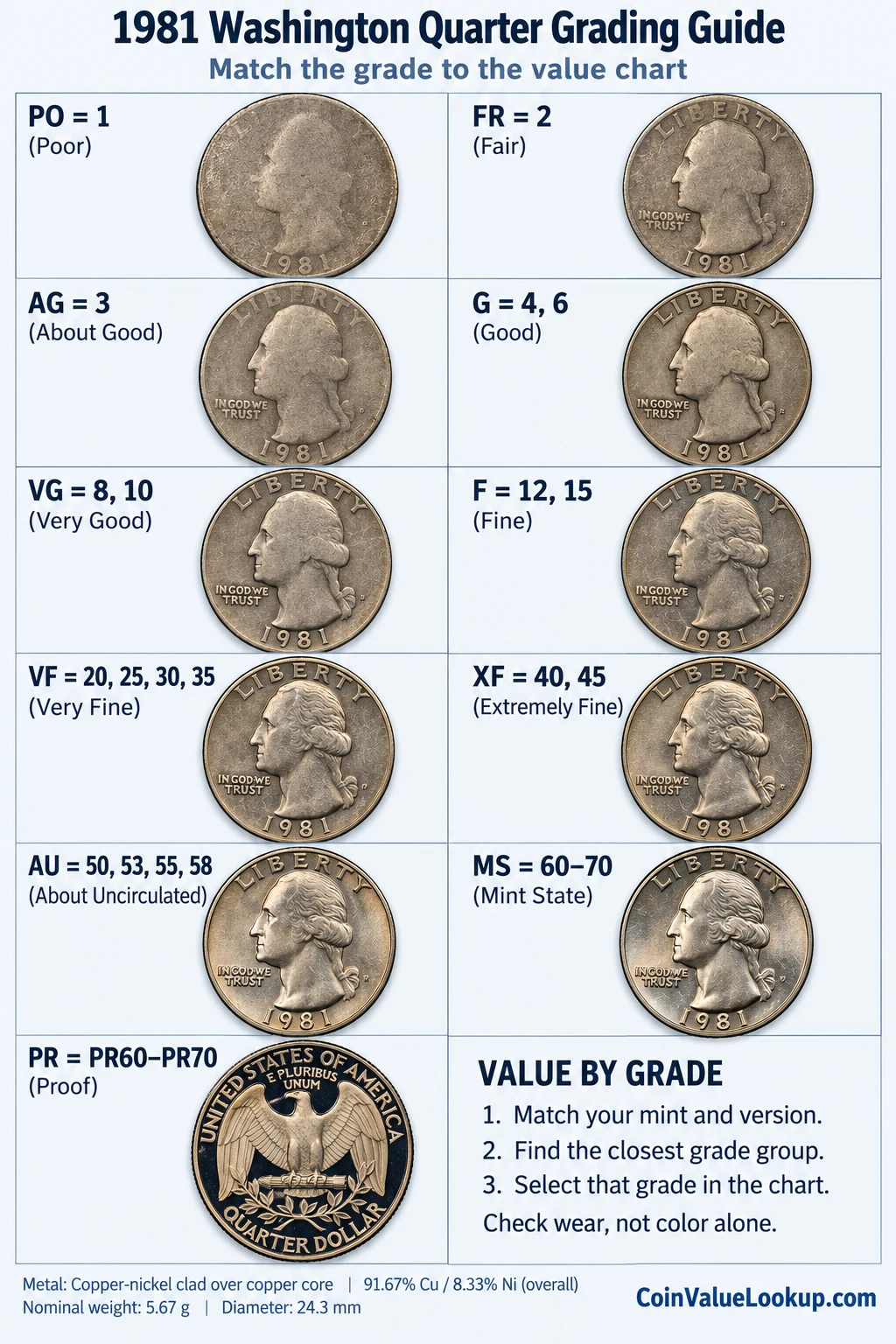
Start by checking the hair detail above Washington's ear, then move to his cheek and jawline. On the reverse, look at the eagle's breast feathers.
Friction shows up first in these high-relief areas, so any smoothness there means the coin has seen some wear.
Separate a weak strike from actual wear. A weakly struck coin may look flat in certain spots but still have its original luster intact.
A worn coin loses luster in the friction zones.
Inspect for contact marks, bag abrasions and cleaning hairlines under good light. These all drag down the grade even if the coin was never spent.
Use the comparison image to match your coin's condition against known grade benchmarks.
On proofs, contrast between mirrored fields and frosted devices (cameo or deep cameo) is a desirable visual quality, but it is a contrast designation, not a different grade tier or metal. The numerical proof grade still depends on surface preservation.
Step 3: Check 1981 Washington Quarter Value by Mint and Version
1981 Washington Quarter — P
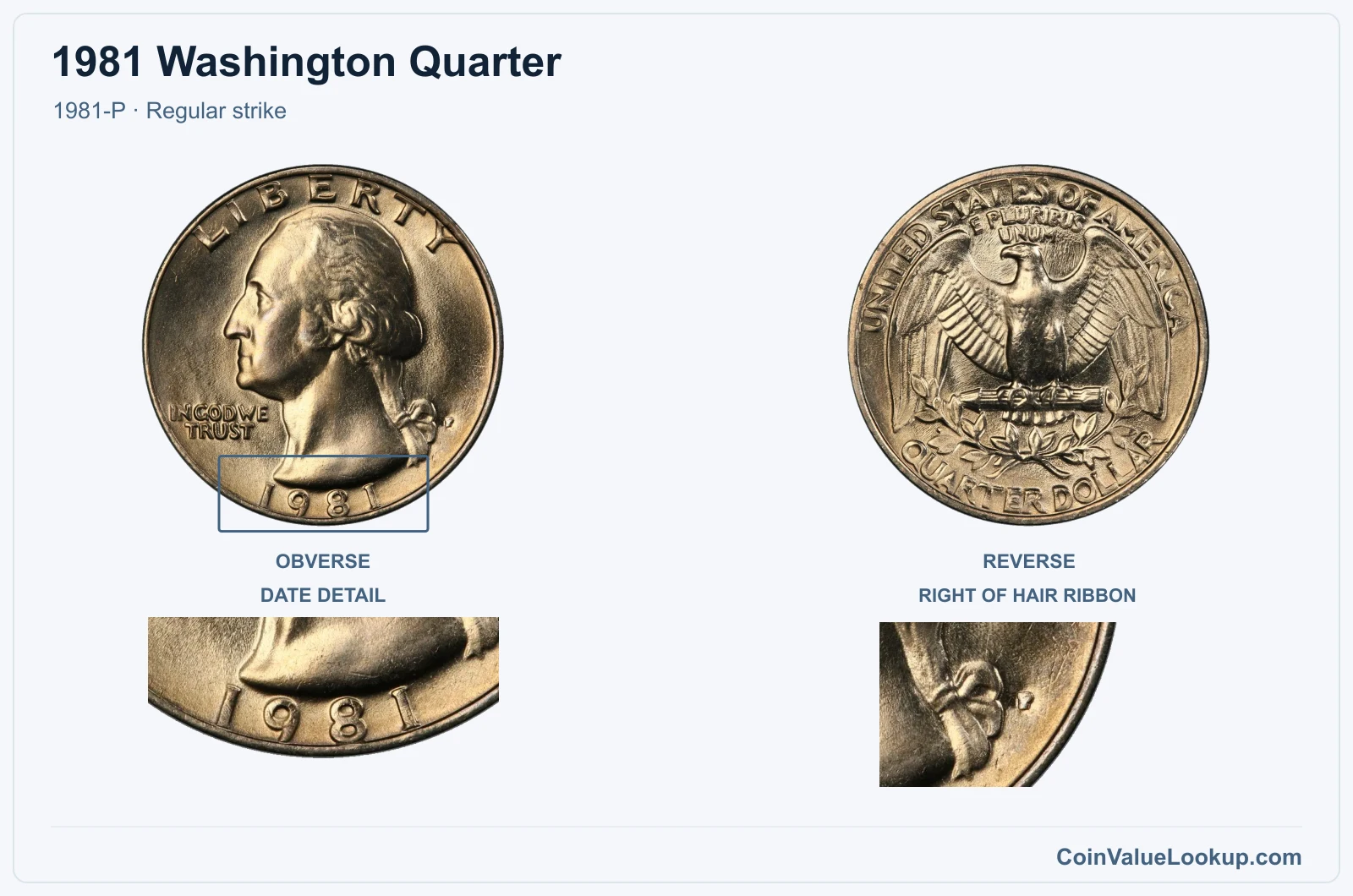
The 1981-P quarter is a business-strike copper-nickel clad coin from Philadelphia. It carries a "P" mintmark on the obverse near the date.
Huge quantities were produced, so circulated examples are worth face value.
In uncirculated condition, a USA Coin Book guide estimate places the MS65 value at about $7.29. That means you need a coin with full original luster, minimal contact marks and no signs of cleaning to reach that neighborhood.
Anything below gem condition is a quarter, plain and simple.
| Range | Grade | Price | Auction Records | Appraisal |
|---|---|---|---|---|
| PO | PO 1 | — | Coin Identifier | |
| FR | FR 2 | — | Coin Identifier | |
| AG | AG 3 | — | Coin Identifier | |
| G | G 4 | — | Coin Identifier | |
| G 6 | — | Coin Identifier | ||
| VG | VG 8 | — | Coin Identifier | |
| VG 10 | — | Coin Identifier | ||
| F | F 12 | — | Coin Identifier | |
| F 15 | — | Coin Identifier | ||
| VF | VF 20 | — | Coin Identifier | |
| VF 25 | — | Coin Identifier | ||
| VF 30 | — | Coin Identifier | ||
| VF 35 | — | Coin Identifier | ||
| XF | XF 40 | — | Coin Identifier | |
| XF 45 | — | Coin Identifier | ||
| AU | AU 50 | — | Coin Identifier | |
| AU 53 | — | Coin Identifier | ||
| AU 55 | — | Coin Identifier | ||
| AU 58 | — | Coin Identifier | ||
| MS | MS 60 | — | Coin Identifier | |
| MS 61 | — | Coin Identifier | ||
| MS 62 | — | Coin Identifier | ||
| MS 63 | — | Coin Identifier | ||
| MS 64 | Coin Identifier | |||
| MS 65 | Coin Identifier | |||
| MS 66 | Coin Identifier | |||
| MS 67 | Coin Identifier | |||
| MS 68 | — | — | — | |
| MS 69 | — | — | — | |
| MS 70 | — | — | — |
1981 Washington Quarter — D
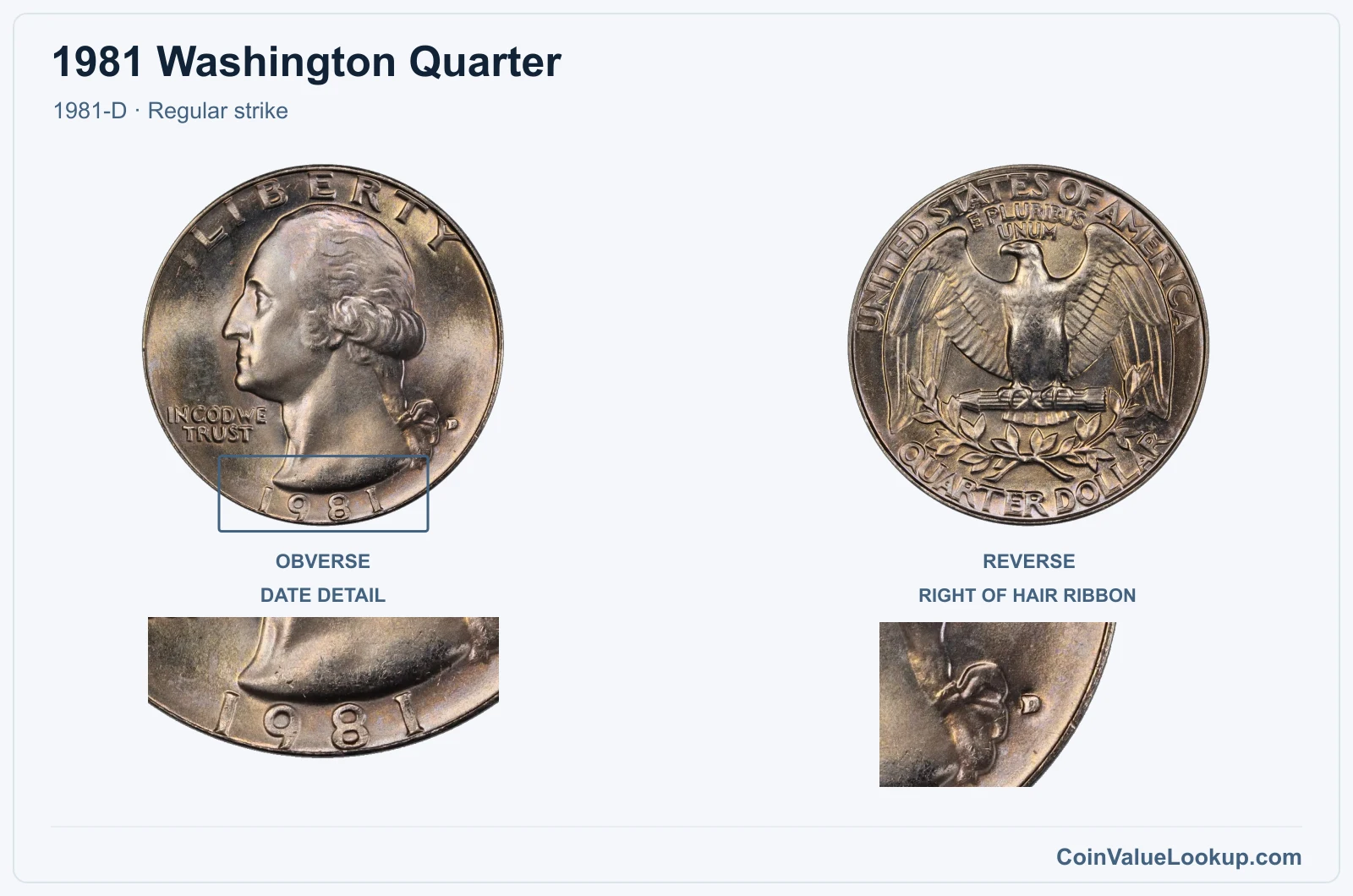
The 1981-D quarter was struck at the Denver Mint and bears a "D" mintmark near the date. Like its Philadelphia sibling, it is copper-nickel clad over a copper core, weighing around 5.67 grams.
Circulated pieces are worth 25 cents. The USA Coin Book guide estimate at MS65 is $7.29.
Finding one in true gem condition from pocket change is uncommon but not impossible — look for unbroken luster and clean fields with no heavy bag marks.
Coin Value Lookup is a good starting point if you want to compare your 1981-D against other dates and mints in the Washington quarter series. You can look up guides for different years without hunting through multiple sites.
| Range | Grade | Price | Auction Records | Appraisal |
|---|---|---|---|---|
| PO | PO 1 | — | Coin Identifier | |
| FR | FR 2 | — | Coin Identifier | |
| AG | AG 3 | — | Coin Identifier | |
| G | G 4 | — | Coin Identifier | |
| G 6 | — | Coin Identifier | ||
| VG | VG 8 | — | Coin Identifier | |
| VG 10 | — | Coin Identifier | ||
| F | F 12 | — | Coin Identifier | |
| F 15 | — | Coin Identifier | ||
| VF | VF 20 | — | Coin Identifier | |
| VF 25 | — | Coin Identifier | ||
| VF 30 | — | Coin Identifier | ||
| VF 35 | — | Coin Identifier | ||
| XF | XF 40 | — | Coin Identifier | |
| XF 45 | — | Coin Identifier | ||
| AU | AU 50 | — | Coin Identifier | |
| AU 53 | — | Coin Identifier | ||
| AU 55 | — | Coin Identifier | ||
| AU 58 | — | Coin Identifier | ||
| MS | MS 60 | — | Coin Identifier | |
| MS 61 | — | Coin Identifier | ||
| MS 62 | — | Coin Identifier | ||
| MS 63 | — | Coin Identifier | ||
| MS 64 | Coin Identifier | |||
| MS 65 | Coin Identifier | |||
| MS 66 | Coin Identifier | |||
| MS 67 | Coin Identifier | |||
| MS 68 | — | — | — | |
| MS 69 | — | — | — | |
| MS 70 | — | — | — |
1981 Washington Quarter — S Type 1 Proof
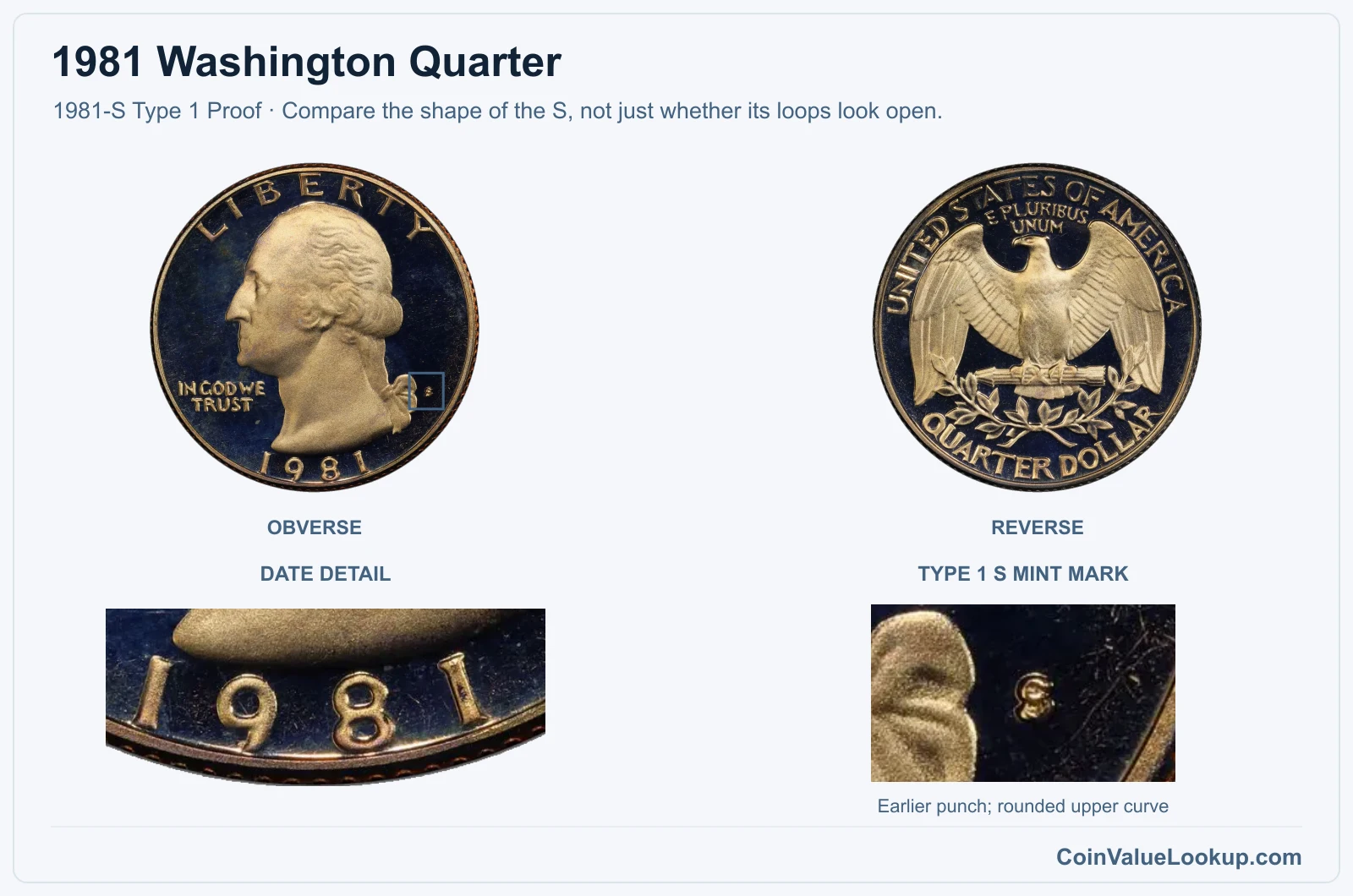
The 1981-S Type 1 Proof quarter was struck at San Francisco for collector sets. It uses the earlier Clear S mintmark punch — the same punch that debuted as the 1979 Type 2.
The serifs on this "S" are thinner and more uniform compared to the later Type 2.
Do not assume every clear-looking S is a Type 2. You need a close-up of the actual mintmark and a direct comparison with a confirmed Type 1 of the same year.
A USA Coin Book guide estimate places a generic PR65 at about $4.96, though that figure does not specifically account for cameo or deep cameo contrast designations.
Proof finish means specially prepared dies and planchets — it is a manufacturing method, not a grade above Mint State. The numerical grade still depends on surface quality.
| Range | Grade | Price | Auction Records | Appraisal |
|---|---|---|---|---|
| PR | PR 1 | — | Coin Identifier | |
| PR 2 | — | Coin Identifier | ||
| PR 3 | — | Coin Identifier | ||
| PR 4 | — | Coin Identifier | ||
| PR 6 | — | Coin Identifier | ||
| PR 8 | — | Coin Identifier | ||
| PR 10 | — | Coin Identifier | ||
| PR 12 | — | Coin Identifier | ||
| PR 15 | — | Coin Identifier | ||
| PR 20 | — | Coin Identifier | ||
| PR 25 | — | Coin Identifier | ||
| PR 30 | — | Coin Identifier | ||
| PR 35 | — | Coin Identifier | ||
| PR 40 | — | Coin Identifier | ||
| PR 45 | — | Coin Identifier | ||
| PR 50 | — | Coin Identifier | ||
| PR 53 | — | Coin Identifier | ||
| PR 55 | — | Coin Identifier | ||
| PR 58 | — | Coin Identifier | ||
| PR 60 | — | Coin Identifier | ||
| PR 61 | — | Coin Identifier | ||
| PR 62 | — | Coin Identifier | ||
| PR 63 | — | Coin Identifier | ||
| PR 64 | — | Coin Identifier | ||
| PR 65 | — | Coin Identifier | ||
| PR 66 | — | Coin Identifier | ||
| PR 67 | — | Coin Identifier | ||
| PR 68 | Coin Identifier | |||
| PR 69 | Coin Identifier | |||
| PR 70 | Coin Identifier |
1981 Washington Quarter — S Type 2 Proof
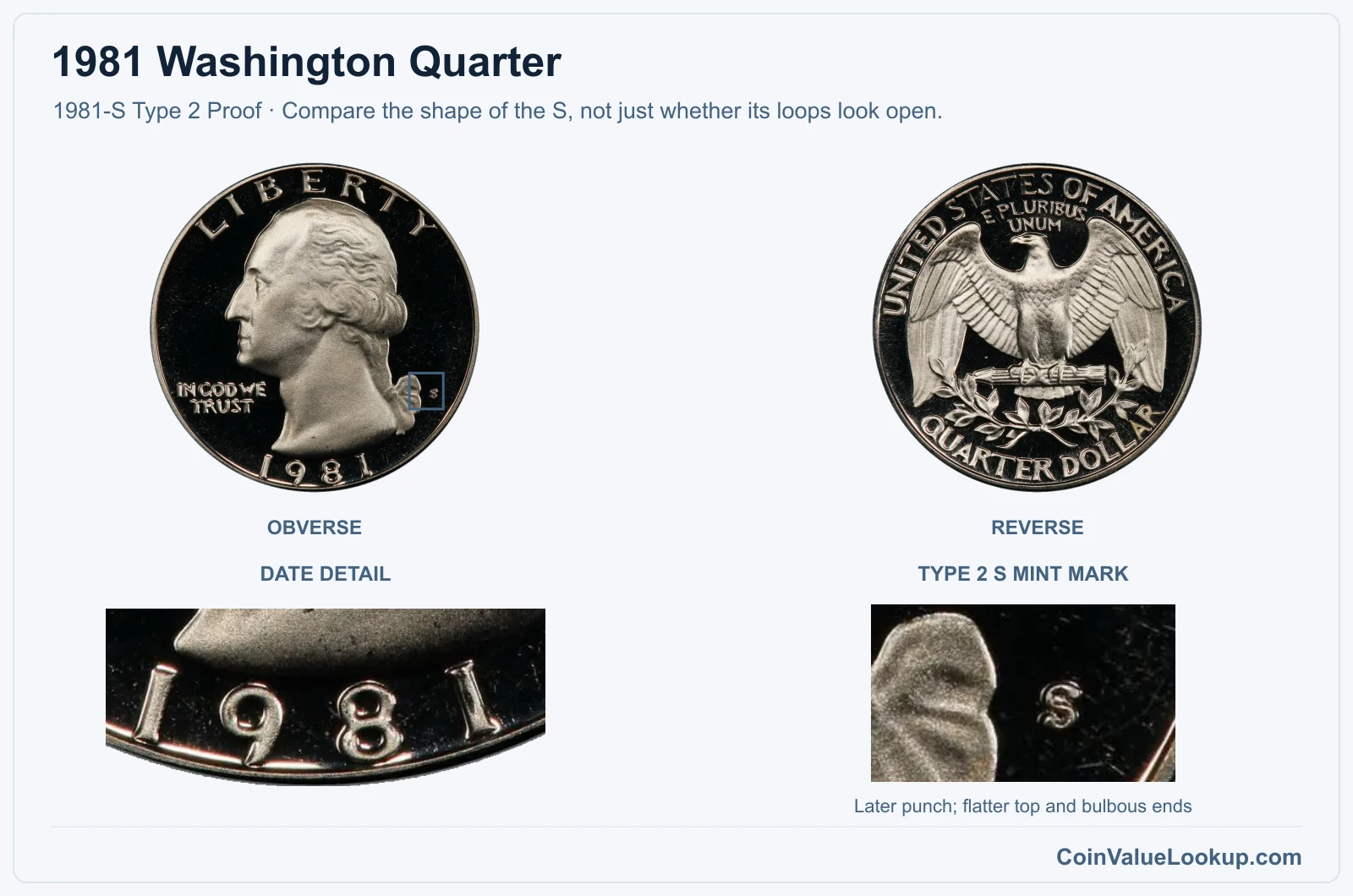
The 1981-S Type 2 Proof is the version collectors pay closer attention to. Its mintmark has distinctly bulbous serifs on the S, giving it a rounder, heavier appearance than the Type 1's thinner letterforms.
You genuinely need magnification and a side-by-side reference to confirm this — do not trust a flip label alone.
The USA Coin Book guide estimate at PR65 is $7.29. That figure is a generic proof grade estimate and does not specifically represent cameo or deep cameo examples.
Exact production totals for the Type 2 punch are not established, which adds to collector interest.
Condition still matters. Surface hairlines, haze and fingerprints reduce the grade regardless of which punch was used.
Confirm the mintmark first, then worry about the grade.
| Range | Grade | Price | Auction Records | Appraisal |
|---|---|---|---|---|
| PR | PR 1 | — | Coin Identifier | |
| PR 2 | — | Coin Identifier | ||
| PR 3 | — | Coin Identifier | ||
| PR 4 | — | Coin Identifier | ||
| PR 6 | — | Coin Identifier | ||
| PR 8 | — | Coin Identifier | ||
| PR 10 | — | Coin Identifier | ||
| PR 12 | — | Coin Identifier | ||
| PR 15 | — | Coin Identifier | ||
| PR 20 | — | Coin Identifier | ||
| PR 25 | — | Coin Identifier | ||
| PR 30 | — | Coin Identifier | ||
| PR 35 | — | Coin Identifier | ||
| PR 40 | — | Coin Identifier | ||
| PR 45 | — | Coin Identifier | ||
| PR 50 | — | Coin Identifier | ||
| PR 53 | — | Coin Identifier | ||
| PR 55 | — | Coin Identifier | ||
| PR 58 | — | Coin Identifier | ||
| PR 60 | — | Coin Identifier | ||
| PR 61 | — | Coin Identifier | ||
| PR 62 | — | Coin Identifier | ||
| PR 63 | — | Coin Identifier | ||
| PR 64 | — | Coin Identifier | ||
| PR 65 | — | Coin Identifier | ||
| PR 66 | — | Coin Identifier | ||
| PR 67 | Coin Identifier | |||
| PR 68 | Coin Identifier | |||
| PR 69 | Coin Identifier | |||
| PR 70 | Coin Identifier |
1981 Washington Quarter Error List
1. 1981 Washington Quarter — Struck on a Dime Planchet
A 1981 quarter struck on a dime-sized planchet is a dramatic wrong-planchet error. The smaller blank means the design is incomplete — typically LIBERTY, the denomination and the mintmark are missing because the planchet did not cover the full die area.
The date is present, which confirms the 1981 attribution, but the absent mintmark cannot be used to identify the issuing mint.
A PCGS MS62 example sold for $747.50 at a Heritage auction in August 2006. That price belongs to that specific certified coin.
Watch out for post-mint damage that mimics this error: coins that have been cut down, hammered, plated or chemically altered. A genuine wrong-planchet strike will show true struck surfaces consistent with a smaller blank entering the press, not tool marks or filed edges.
2. 1981 Washington Quarter — Flipover Double Strike with Indent
This is a complex multi-strike error documented on a 1981-D quarter. The coin was struck once, then flipped over and struck again with another blank intervening between the coin and the reverse die, leaving an indent.
Both strike orientations and the date plus D mintmark remnants should be visible.
A PCGS MS64 example brought $7,200 at a Heritage auction in August 2020. That result reflects this specific elaborate combination — do not treat it as a baseline for simpler strike errors.
Lookalikes include ordinary doubled images, flattened letters from mechanical doubling and post-mint sandwich damage where coins are pressed together outside the mint. A certified complex error of this type requires the actual matching diagnostics, not just a vaguely off-looking coin.
3. 1981 Washington Quarter — Doubled Die Obverse
Doubled die obverse varieties have been reported for the 1981 quarter. On a genuine doubled die, you will see consistent separation or notching on obverse design elements — letters, the date, or profile details — that repeats in a uniform direction across the affected area.
Compare suspect areas against a normal 1981 quarter under the same lighting. What you are looking for is a true second image, not a flat shelf along one side of the letters.
Machine doubling is the most common lookalike. It produces a flat, shelf-like distortion without the rounded secondary image of a hub-doubled die.
Reflections and worn-die contours can also fool you. Value depends on condition, the visibility of the doubling and which specific die is involved.
4. 1981 Washington Quarter — Off-Center Strike
Off-center strikes occur when the planchet is not properly seated in the collar before the dies close. The result is a displaced design with an unstruck crescent of blank metal on one side.
The key detail collectors want is a visible date — without it, the coin cannot be attributed to 1981 and loses most of its appeal. A small percentage off-center with a clear date is more desirable than a dramatic shift that obliterates identifying features.
Do not confuse an off-center strike with a clipped planchet, one-sided die misalignment or post-mint flattening. A genuine off-center coin has a complete design that is simply shifted, not cut or crushed.
Value depends on condition, the degree of misalignment and whether the date is readable.
5. 1981 Washington Quarter — Doubled Die Reverse
Doubled die reverse varieties have also been reported for the 1981 quarter. The diagnostic approach is the same as the obverse: compare reverse legends and design contours — especially around E PLURIBUS UNUM, UNITED STATES OF AMERICA, or the eagle's details — against a normal coin.
Look for consistent doubled impressions rather than flat shelf-like distortions. Machine doubling, reflections off proof surfaces and random contact damage can all mimic a doubled die to the untrained eye.
Value varies with the strength of the doubling, the specific die involved and the coin's overall condition. No single guide price applies across all doubled die reverses, so individual assessment by a grading service is the practical route for anything you think is genuine.
6. 1981 Washington Quarter — Missing Clad Layer
A missing clad layer error means one of the outer nickel-alloy layers was not bonded to the copper core before the planchet was struck. The affected side may show the reddish-brown copper core instead of the usual silvery surface, and the coin's weight will be noticeably below the normal 5.67 grams.
Check the edge carefully — on a normal clad quarter you see a copper stripe sandwiched between two silvery layers. A missing-clad coin will show an abnormal edge profile on the affected side.
The most common lookalikes are toning, environmental damage, corrosion and coins that have had their surface metal removed after leaving the mint by chemicals or abrasion. Value depends on condition and the extent of the missing layer, and individual assessment is recommended.