1995 Washington Quarter Coin Value: How Much Is It Worth?
Most 1995 Washington quarters you pull from a jar are worth face value — 25 cents. In higher uncirculated grades, a guide estimate for an MS65 example reaches about $16 to $18 depending on the mint.
The 1995-S silver proof carries a separate PR65 guide estimate around $21. Where this date gets genuinely interesting is the recognized doubled die obverse on the clad proof, which has sold in the hundreds at auction.
Fast Way to Identify Your 1995 Washington Quarter
The quickest way to figure out what you have is to snap clear photos of the front and back of your coin and upload them to our identifier. It can give you a preliminary identification of the mint, version and metal type based on what it sees.
This is not a substitute for professional authentication or grading, but it gets you pointed in the right direction fast.
1995 Washington Quarter Value
Upload both sides of your 1995 Washington Quarter.
Front Obverse
Upload photo
Back Reverse
Upload photo
Which 1995 Washington Quarter Versions Are Worth Money?
- The 1995-S clad proof doubled die obverse is the standout variety — a PR69 example sold for $920 at Heritage in July 2010.
- A 1995-D double strike with 60% off-center second strike brought $312 in NGC MS64 at Heritage in July 2022.
- The 1995-S silver proof in PR65 carries a guide estimate around $21, higher than the clad proof at that grade.
- High-grade 1995-P and 1995-D business strikes in MS65 have guide estimates of $18 and $16 respectively — well above face value.
- A 1995-D missing obverse clad layer error sold for $89 in NGC MS63 at Heritage in June 2023.
Step 1: Identify Your 1995 Washington Quarter Mint Mark and Version
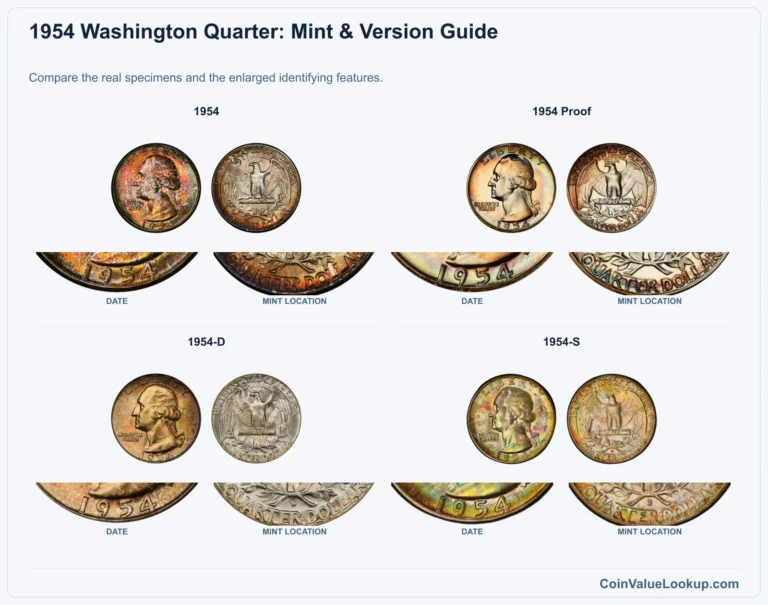
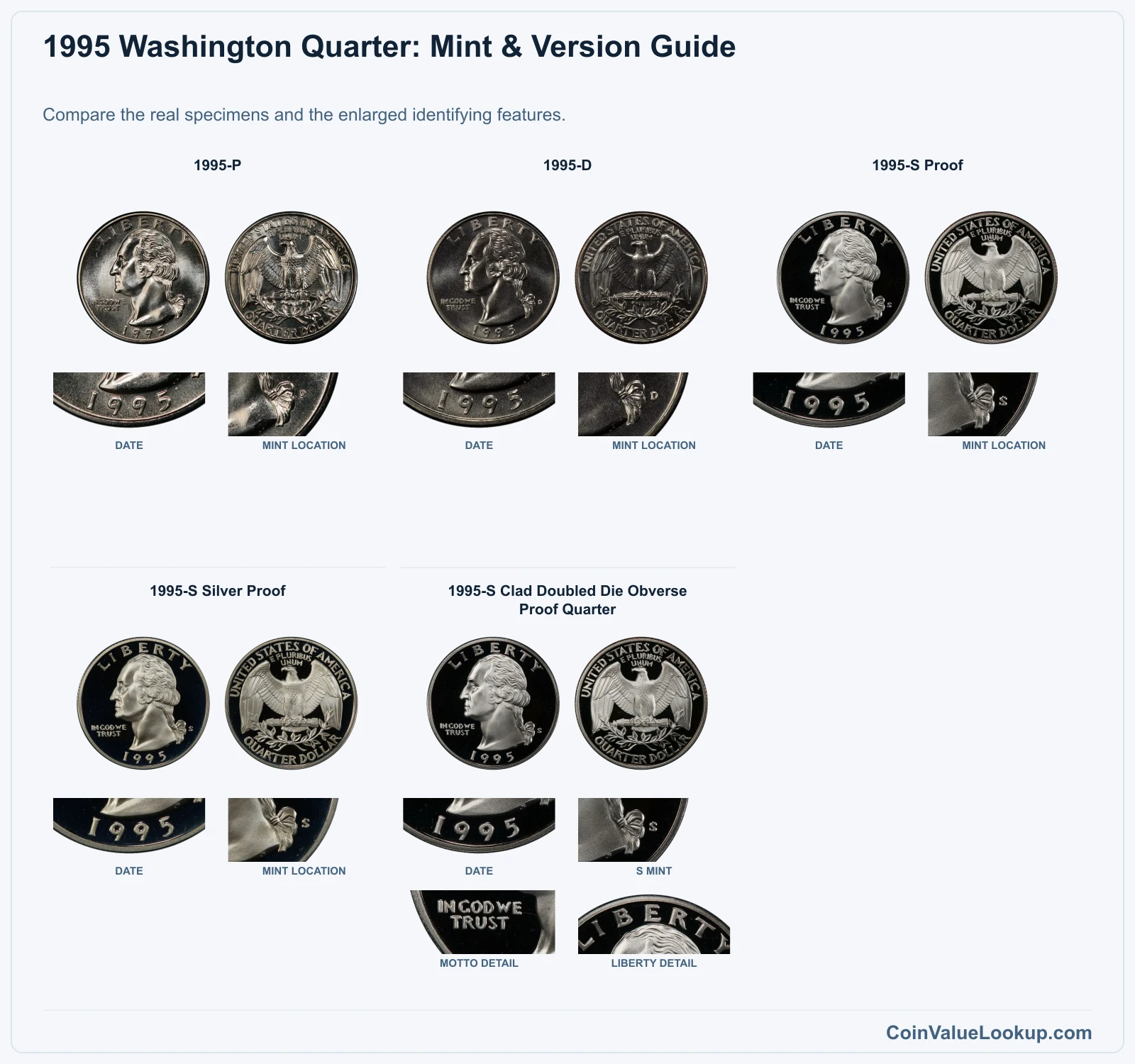
Three mints struck 1995 quarters. Philadelphia coins carry a P mintmark to the right of the ribbon bow on the obverse, Denver coins show a D in the same spot, and San Francisco proofs bear an S there.
No blank-mintmark variety exists for this date.
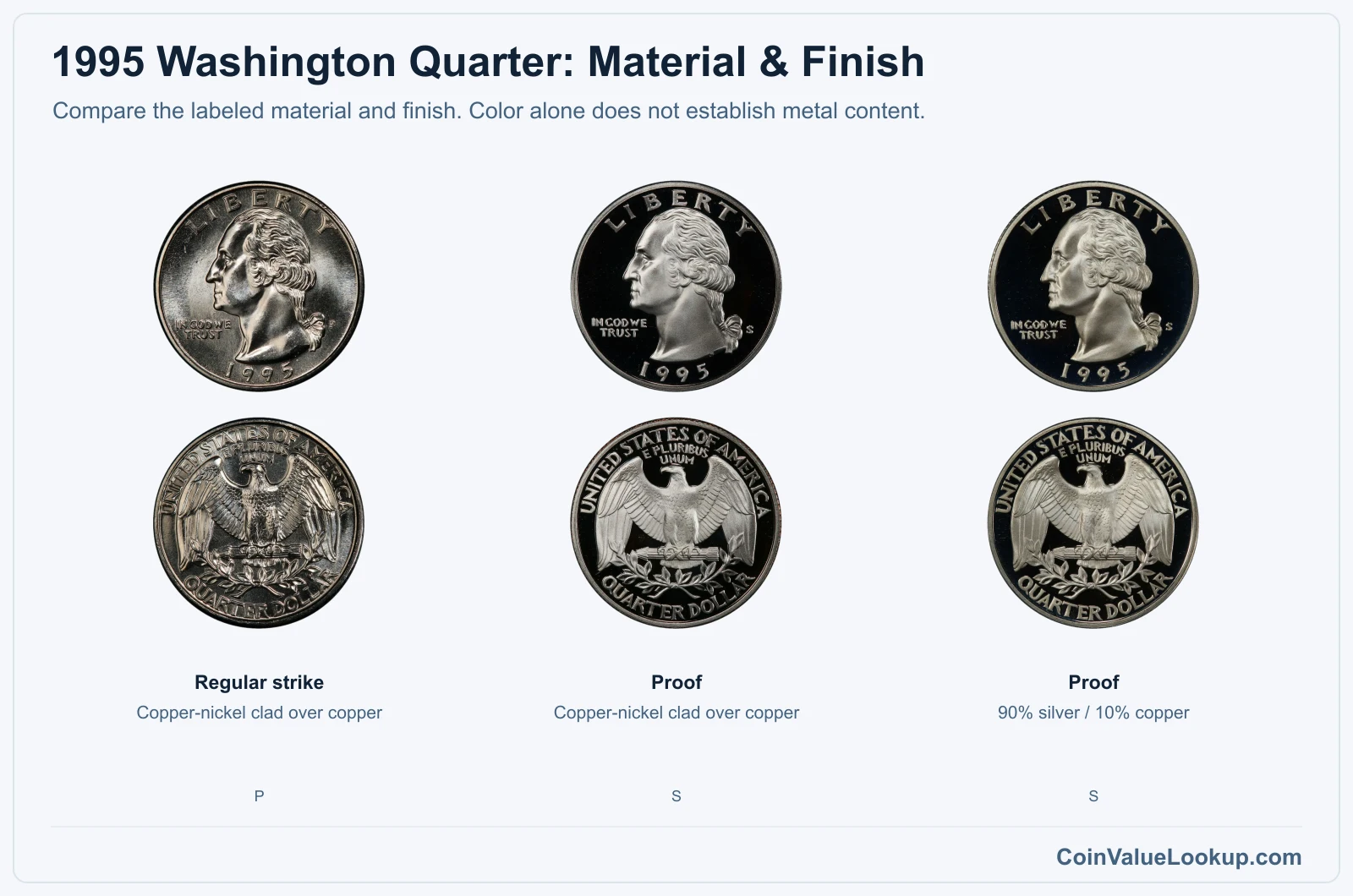
All P and D business strikes are copper-nickel clad, weighing about 5.67 grams with a diameter near 24.3 mm. San Francisco produced two different proof versions in 1995: a clad proof made of the same copper-nickel composition, and a 90% silver proof weighing approximately 6.25 grams.
Both carry the S mintmark, so you cannot separate them by mintmark alone.
To tell the two S proofs apart, check the edge. A clad proof shows a visible copper-colored stripe along the edge, while the silver proof does not.
Weight is another reliable method — silver is noticeably heavier. Original government packaging also helps, since silver proofs shipped in distinct sets.
The recognized doubled die obverse variety exists only on the clad S proof, not the silver version, so getting the metal right matters.
Step 2: Check Your 1995 Washington Quarter Grade
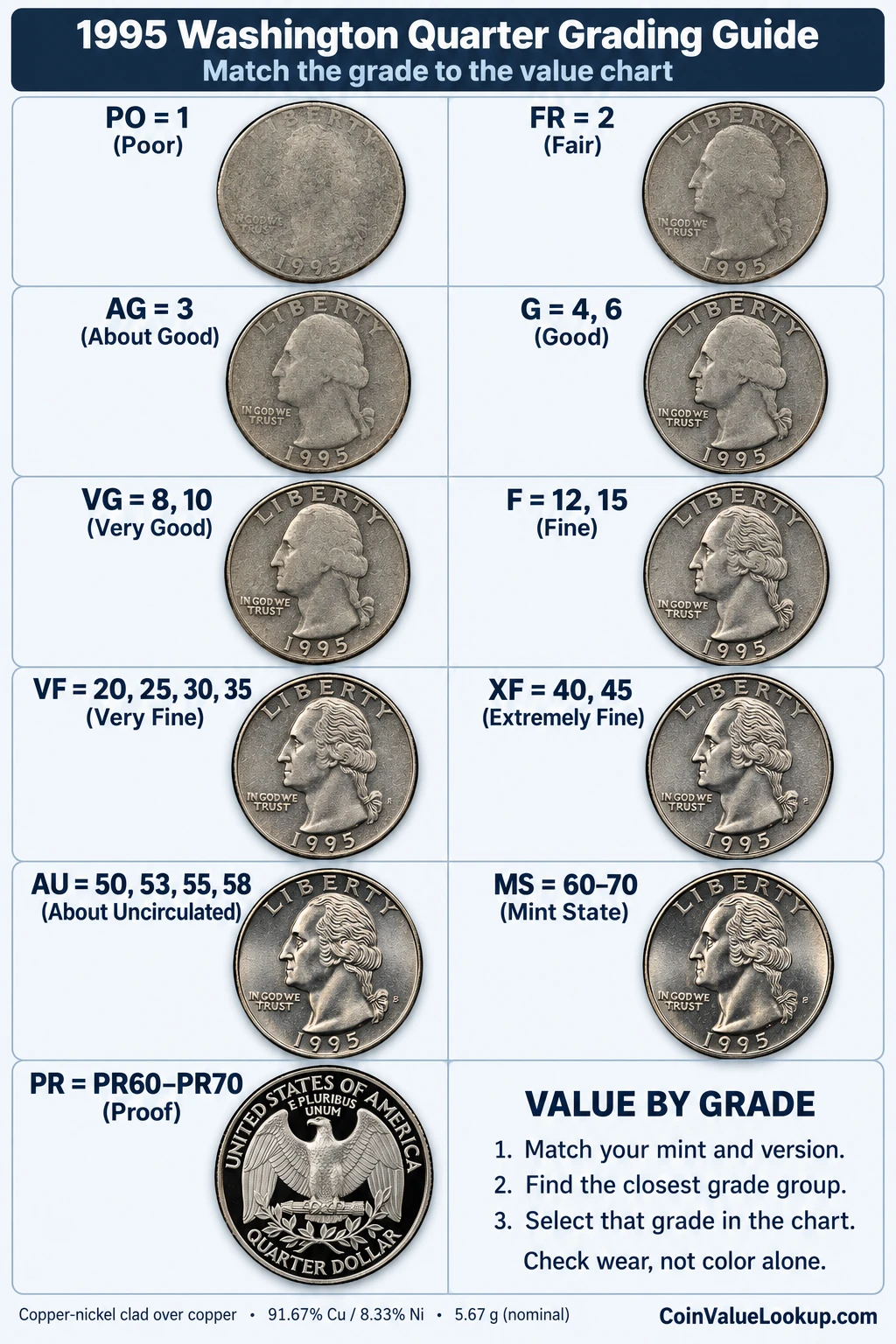
Start by checking the hair detail above Washington's ear. On a well-worn coin, this area goes flat first, followed by the cheek and jawline.
Flip the coin over and look at the eagle's breast feathers — wear shows up there next.
Compare your coin against the reference image. A coin with full original luster and no rub on those high points is in the Mint State range.
Contact marks, bag scuffs and hairlines from cleaning all drag down the grade even if the coin was never circulated.
For proofs, remember that "proof" describes how the coin was made — mirrored fields, sharp strikes — not a grade above Mint State. Deep Cameo (DCAM) refers to strong contrast between frosted devices and mirror fields.
A proof with hairlines or haze grades lower than a clean one regardless of its contrast.
Step 3: Check 1995 Washington Quarter Value by Mint and Version
1995 Washington Quarter — P
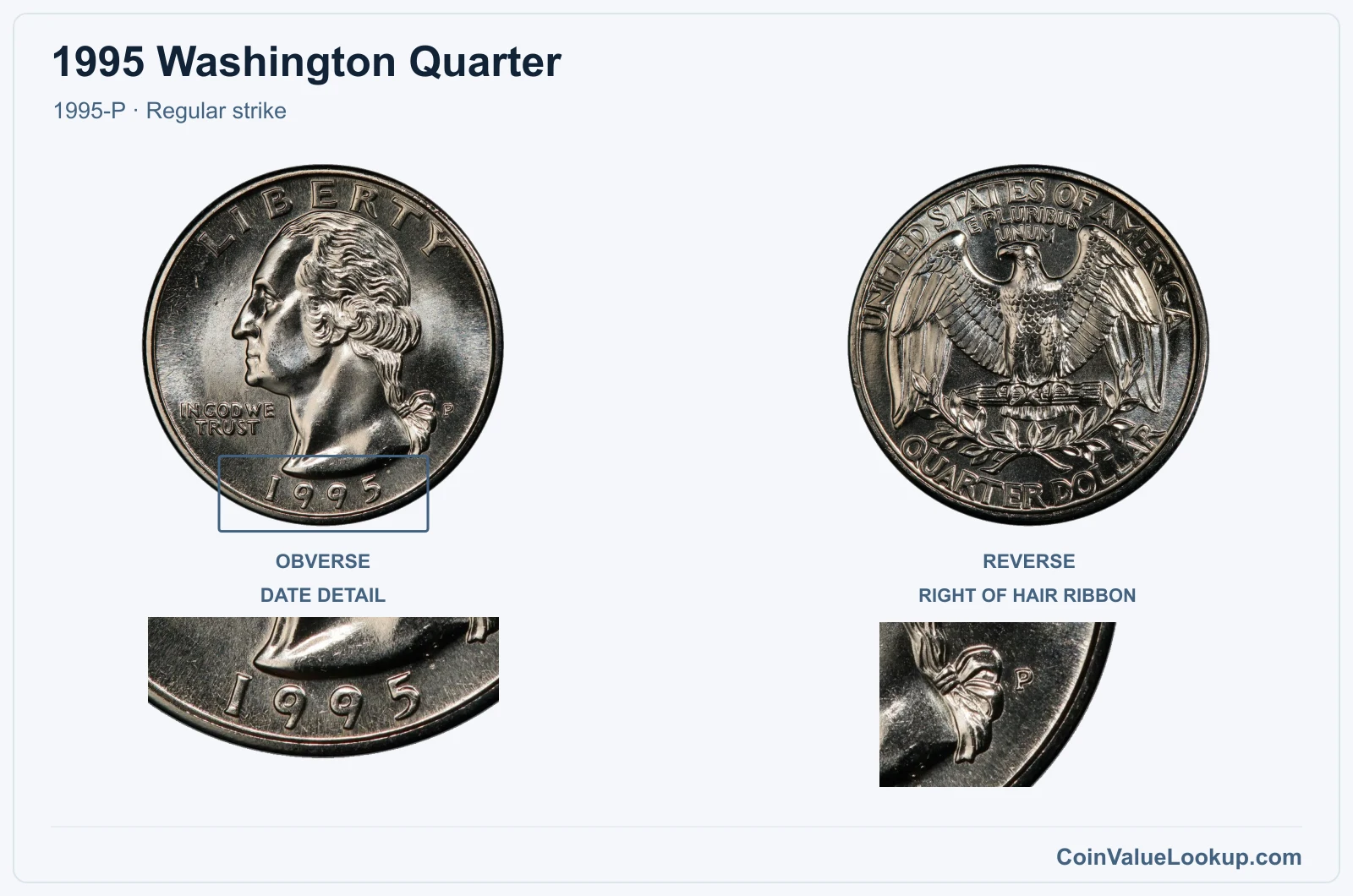
The 1995-P is a Philadelphia business strike on a copper-nickel clad planchet weighing about 5.67 grams. Look for the P mintmark to the right of the ribbon bow on the obverse.
Hundreds of millions were struck, so circulated examples are worth 25 cents. In higher uncirculated condition the coin starts to carry a small premium.
A USA Coin Book guide estimate places the MS65 value at about $18. That is not a guaranteed sale price, but it gives you a ballpark for a well-preserved example with good luster and minimal marks.
| Range | Grade | Price | Auction Records | Appraisal |
|---|---|---|---|---|
| PO | PO 1 | — | Coin Identifier | |
| FR | FR 2 | — | Coin Identifier | |
| AG | AG 3 | — | Coin Identifier | |
| G | G 4 | — | Coin Identifier | |
| G 6 | — | Coin Identifier | ||
| VG | VG 8 | — | Coin Identifier | |
| VG 10 | — | Coin Identifier | ||
| F | F 12 | — | Coin Identifier | |
| F 15 | — | Coin Identifier | ||
| VF | VF 20 | — | Coin Identifier | |
| VF 25 | — | Coin Identifier | ||
| VF 30 | — | Coin Identifier | ||
| VF 35 | — | Coin Identifier | ||
| XF | XF 40 | — | Coin Identifier | |
| XF 45 | — | Coin Identifier | ||
| AU | AU 50 | — | Coin Identifier | |
| AU 53 | — | Coin Identifier | ||
| AU 55 | — | Coin Identifier | ||
| AU 58 | — | Coin Identifier | ||
| MS | MS 60 | — | Coin Identifier | |
| MS 61 | — | Coin Identifier | ||
| MS 62 | Coin Identifier | |||
| MS 63 | — | Coin Identifier | ||
| MS 64 | Coin Identifier | |||
| MS 65 | — | Coin Identifier | ||
| MS 66 | Coin Identifier | |||
| MS 67 | Coin Identifier | |||
| MS 68 | Coin Identifier | |||
| MS 69 | — | — | — | |
| MS 70 | — | — | — |
1995 Washington Quarter — D
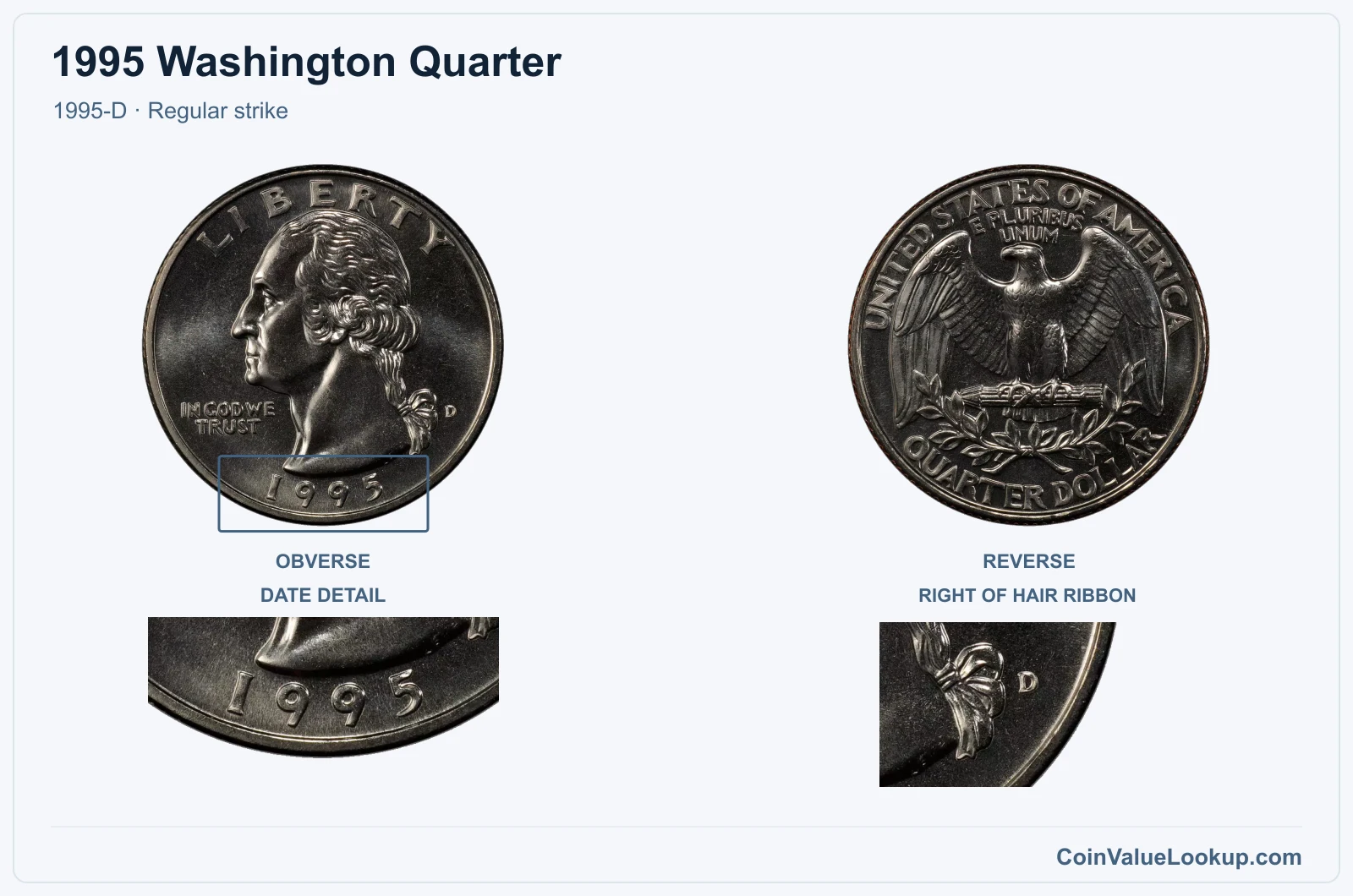
Denver's 1995-D quarter shares the same copper-nickel clad composition and 5.67-gram weight as the Philadelphia issue. The D mintmark sits in the usual spot to the right of the ribbon.
Worn pieces spend at face value. A USA Coin Book guide estimate for MS65 is around $16.
Several error types have been confirmed on this mint — double strikes, missing clad layers and broadstrikes — so if your 1995-D looks odd, it is worth a closer look rather than an immediate shrug.
| Range | Grade | Price | Auction Records | Appraisal |
|---|---|---|---|---|
| PO | PO 1 | — | Coin Identifier | |
| FR | FR 2 | — | Coin Identifier | |
| AG | AG 3 | — | Coin Identifier | |
| G | G 4 | — | Coin Identifier | |
| G 6 | — | Coin Identifier | ||
| VG | VG 8 | — | Coin Identifier | |
| VG 10 | — | Coin Identifier | ||
| F | F 12 | — | Coin Identifier | |
| F 15 | — | Coin Identifier | ||
| VF | VF 20 | — | Coin Identifier | |
| VF 25 | — | Coin Identifier | ||
| VF 30 | — | Coin Identifier | ||
| VF 35 | — | Coin Identifier | ||
| XF | XF 40 | — | Coin Identifier | |
| XF 45 | — | Coin Identifier | ||
| AU | AU 50 | — | Coin Identifier | |
| AU 53 | — | Coin Identifier | ||
| AU 55 | — | Coin Identifier | ||
| AU 58 | — | Coin Identifier | ||
| MS | MS 60 | — | Coin Identifier | |
| MS 61 | — | Coin Identifier | ||
| MS 62 | — | Coin Identifier | ||
| MS 63 | Coin Identifier | |||
| MS 64 | Coin Identifier | |||
| MS 65 | Coin Identifier | |||
| MS 66 | Coin Identifier | |||
| MS 67 | Coin Identifier | |||
| MS 68 | — | Coin Identifier | ||
| MS 69 | — | — | — | |
| MS 70 | — | — | — |
1995 Washington Quarter — S Proof
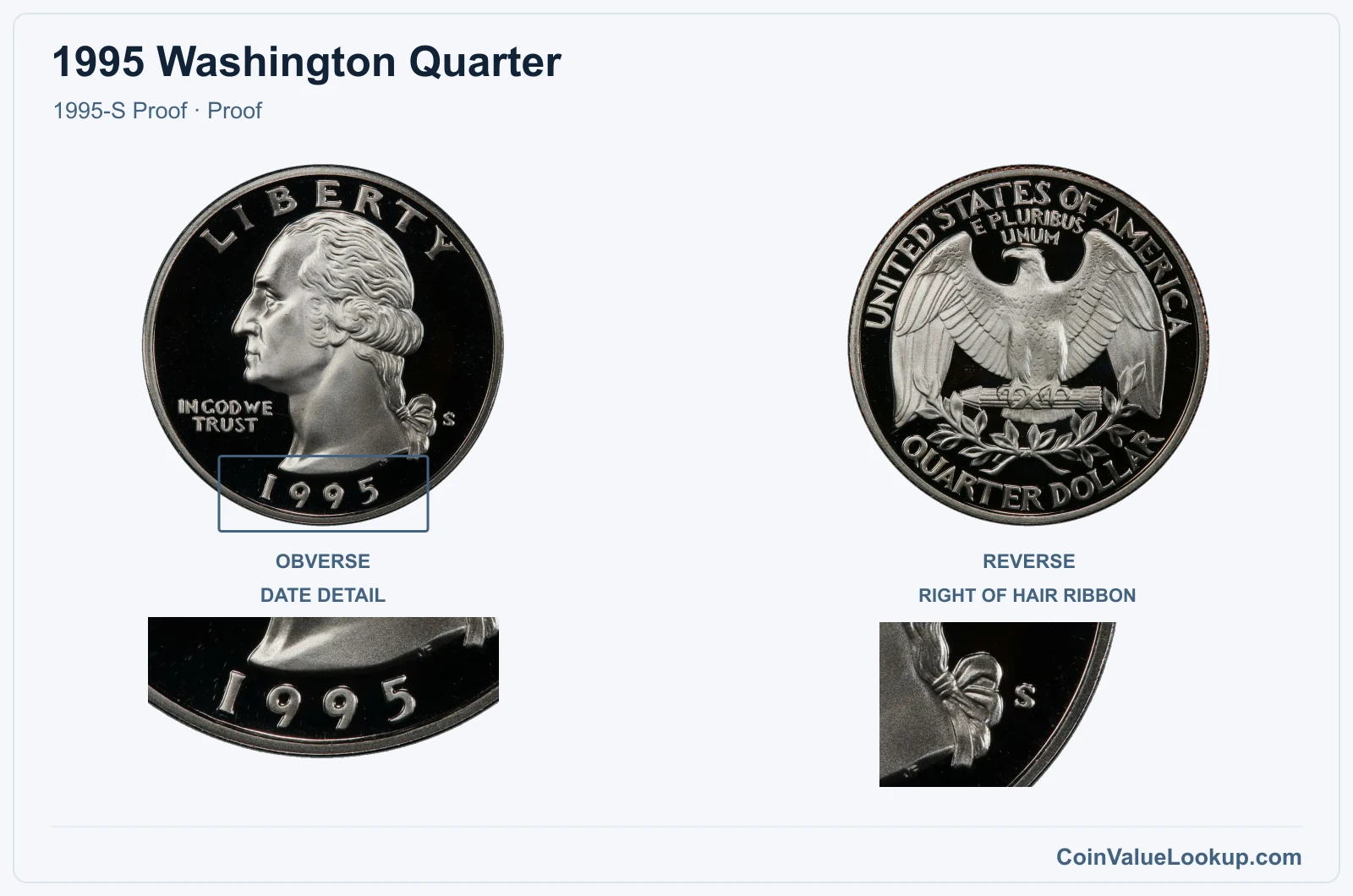
The 1995-S clad proof was struck at San Francisco on the same copper-nickel clad planchet used for circulation quarters. It has mirror fields and sharply struck devices typical of the proof process.
The S mintmark appears on the obverse. A USA Coin Book guide estimate for a standard PR65 is about $10.
That guide figure reflects a basic proof grade, not a Deep Cameo designation. This is also the host coin for the recognized doubled die obverse variety, covered separately.
Check the edge for the telltale copper stripe to confirm you have the clad version rather than the silver proof.
| Range | Grade | Price | Auction Records | Appraisal |
|---|---|---|---|---|
| PR | PR 1 | — | Coin Identifier | |
| PR 2 | — | Coin Identifier | ||
| PR 3 | — | Coin Identifier | ||
| PR 4 | — | Coin Identifier | ||
| PR 6 | — | Coin Identifier | ||
| PR 8 | — | Coin Identifier | ||
| PR 10 | — | Coin Identifier | ||
| PR 12 | — | Coin Identifier | ||
| PR 15 | — | Coin Identifier | ||
| PR 20 | — | Coin Identifier | ||
| PR 25 | — | Coin Identifier | ||
| PR 30 | — | Coin Identifier | ||
| PR 35 | — | Coin Identifier | ||
| PR 40 | — | Coin Identifier | ||
| PR 45 | — | Coin Identifier | ||
| PR 50 | — | Coin Identifier | ||
| PR 53 | — | Coin Identifier | ||
| PR 55 | — | Coin Identifier | ||
| PR 58 | — | Coin Identifier | ||
| PR 60 | — | Coin Identifier | ||
| PR 61 | — | Coin Identifier | ||
| PR 62 | — | Coin Identifier | ||
| PR 63 | — | Coin Identifier | ||
| PR 64 | — | Coin Identifier | ||
| PR 65 | — | Coin Identifier | ||
| PR 66 | — | Coin Identifier | ||
| PR 67 | — | Coin Identifier | ||
| PR 68 | Coin Identifier | |||
| PR 69 | Coin Identifier | |||
| PR 70 | Coin Identifier |
1995 Washington Quarter — S Silver Proof
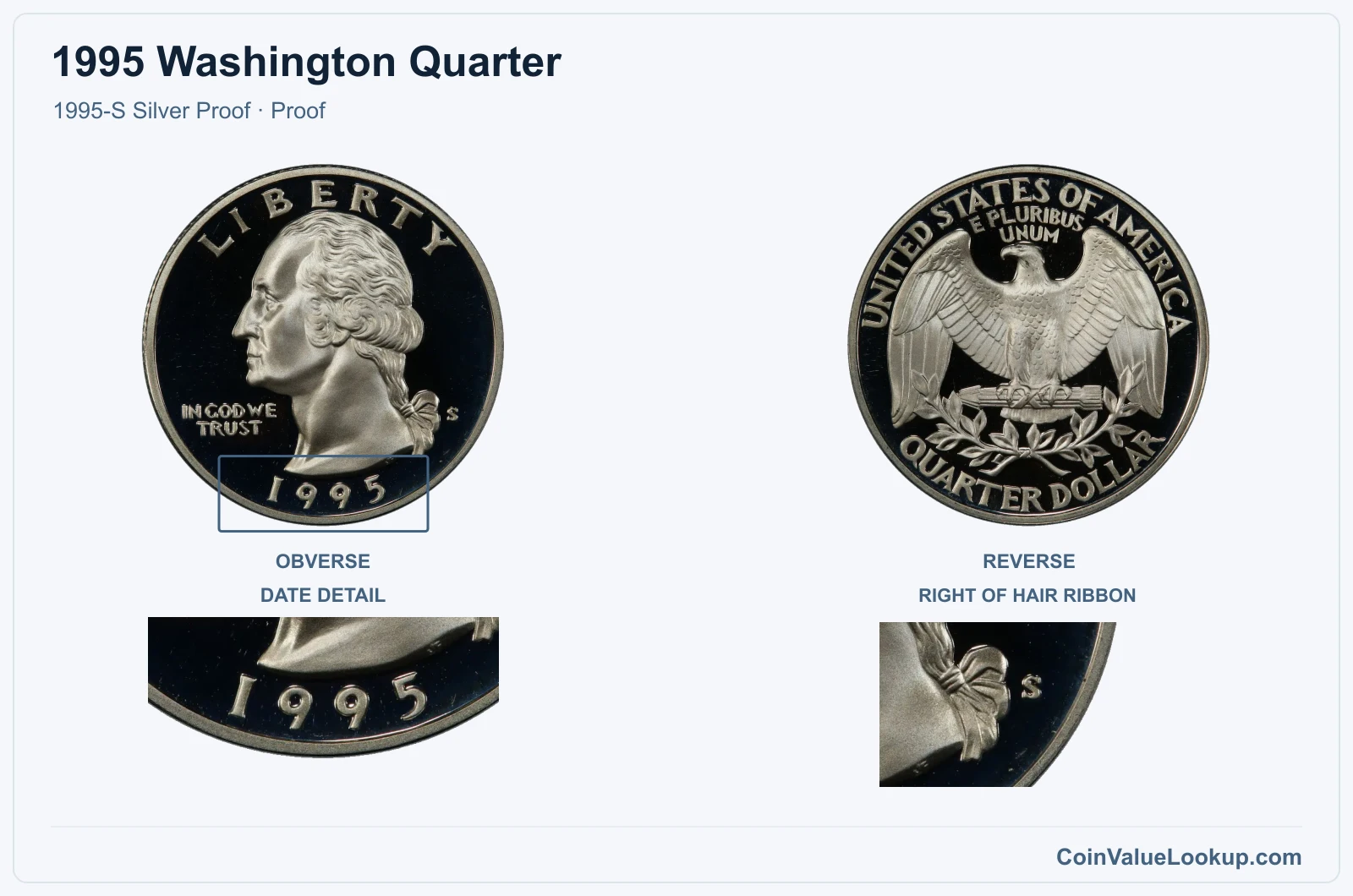
The 1995-S silver proof is struck on a 90% silver, 10% copper planchet weighing approximately 6.25 grams. It looks similar to the clad proof but lacks the copper edge stripe and feels heavier in hand.
A USA Coin Book guide estimate for PR65 is about $21, making it the highest-valued standard version at that grade level. Because silver content ties its floor value to the metal market, these estimates shift over time.
Coin Value Lookup is a handy starting point if you want to check guide values for other denominations or years alongside your 1995 silver proof. It brings together coin guides in one place so you can compare quickly.
| Range | Grade | Price | Auction Records | Appraisal |
|---|---|---|---|---|
| PR | PR 1 | — | Coin Identifier | |
| PR 2 | — | Coin Identifier | ||
| PR 3 | — | Coin Identifier | ||
| PR 4 | — | Coin Identifier | ||
| PR 6 | — | Coin Identifier | ||
| PR 8 | — | Coin Identifier | ||
| PR 10 | — | Coin Identifier | ||
| PR 12 | — | Coin Identifier | ||
| PR 15 | — | Coin Identifier | ||
| PR 20 | — | Coin Identifier | ||
| PR 25 | — | Coin Identifier | ||
| PR 30 | — | Coin Identifier | ||
| PR 35 | — | Coin Identifier | ||
| PR 40 | — | Coin Identifier | ||
| PR 45 | — | Coin Identifier | ||
| PR 50 | — | Coin Identifier | ||
| PR 53 | — | Coin Identifier | ||
| PR 55 | — | Coin Identifier | ||
| PR 58 | — | Coin Identifier | ||
| PR 60 | — | Coin Identifier | ||
| PR 61 | — | Coin Identifier | ||
| PR 62 | — | Coin Identifier | ||
| PR 63 | — | Coin Identifier | ||
| PR 64 | — | Coin Identifier | ||
| PR 65 | — | Coin Identifier | ||
| PR 66 | — | Coin Identifier | ||
| PR 67 | Coin Identifier | |||
| PR 68 | Coin Identifier | |||
| PR 69 | Coin Identifier | |||
| PR 70 | Coin Identifier |
1995 Washington Quarter — S Clad Doubled Die Obverse Proof Quarter
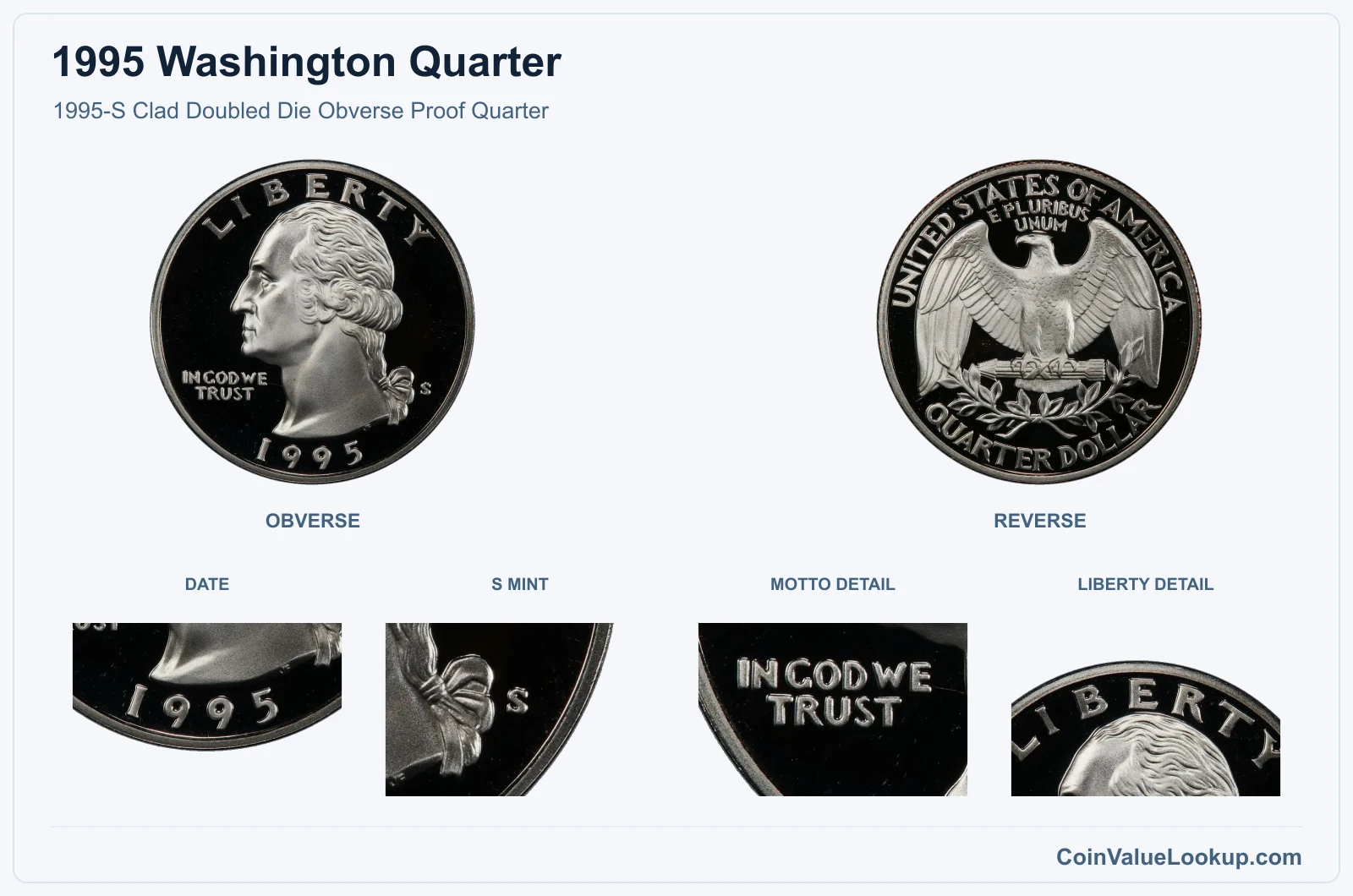
This is the prize of the 1995 quarter family. The doubled die obverse exists only on clad S proofs — not silver proofs, not business strikes.
Look at the motto IN GOD WE TRUST: genuine examples show split and spread letter serifs, particularly visible on the serifs of the I, N, G and T. Lighter doubling also appears on the date numerals, LIBERTY, the ribbon end and the S mintmark itself.
A PCGS-graded PR69 example sold for $920 at Heritage Auctions in July 2010. That is a single recorded sale at a high proof grade, not a blanket market price for every specimen.
Flat shelf-like distortion on letters or camera-angle reflections are common lookalikes that do not qualify. If you think you have one, third-party certification from a major grading service is the way to confirm it.
Range Grade
Price Auction Records Appraisal PR PR 1
—
Coin Identifier
PR 2
—
Coin Identifier
PR 3
—
Coin Identifier
PR 4
—
Coin Identifier
PR 6
—
Coin Identifier
PR 8
—
Coin Identifier
PR 10
—
Coin Identifier
PR 12
—
Coin Identifier
PR 15
—
Coin Identifier
PR 20
—
Coin Identifier
PR 25
—
Coin Identifier
PR 30
—
Coin Identifier
PR 35
—
Coin Identifier
PR 40
—
Coin Identifier
PR 45
—
Coin Identifier
PR 50
—
Coin Identifier
PR 53
—
Coin Identifier
PR 55
—
Coin Identifier
PR 58
—
Coin Identifier
PR 60
—
Coin Identifier
PR 61
—
Coin Identifier
PR 62
—
Coin Identifier
PR 63
—
Coin Identifier
PR 64
—
Coin Identifier
PR 65
—
Coin Identifier
PR 66
—
Coin Identifier
PR 67
—
Coin Identifier
PR 68
Coin Identifier
PR 69
Coin Identifier
PR 70
—
Coin Identifier
1995 Washington Quarter Error List
1. 1995 Washington Quarter — Doubled Die Obverse on Clad S Proof
The doubled die obverse on the 1995-S clad proof quarter is a die variety, meaning the doubling originated in the die manufacturing process rather than from two separate strikes of the coin. The clearest diagnostic is the motto IN GOD WE TRUST — genuine examples show split and spread serifs across the letters.
Lighter doubling is also reported on the date, LIBERTY, the ribbon end and the S mintmark.
A PCGS-graded PR69 sold for $920 at Heritage Auctions in July 2010. Not every S proof has this variety.
Machine doubling produces flat, shelf-like displacement without the raised split-serif character, and camera reflections can mimic doubling in photos. If you suspect you have one, compare your coin carefully against attributed examples and consider professional authentication.
2. 1995 Washington Quarter — Double Strike with Off-Center Second Strike
A confirmed 1995-D quarter struck twice, with the second impression landing about 60% off center, sold for $312 in NGC MS64 at Heritage Auctions in July 2022. On the coin, you can see two complete design positions — the first centered strike and the second dramatically shifted.
The date and D mintmark remain readable alongside a full outline of both impressions.
This kind of error happens when the coin fails to eject properly and gets hit again by the dies in a different position. Post-mint damage from hammering, cutting or filing can superficially resemble a double strike, but it will not show two cleanly defined struck surfaces with proper metal flow.
Authentic struck detail on both impressions is the giveaway.
3. 1995 Washington Quarter — Missing Obverse Clad Layer
When one of the outer clad layers fails to bond before striking, the exposed copper core gives the coin a distinctive reddish-brown appearance on that side. A 1995-D quarter missing its obverse clad layer weighed only 4.7 grams — noticeably lighter than the normal 5.67 grams — and sold for $89 in NGC MS63 at Heritage Auctions in June 2023.
The reverse on such a coin typically looks normal. Check the edge: on a genuine missing-layer error, one side of the sandwich is simply absent.
Coins that have been chemically stripped, corroded or stained can turn coppery too, but they will still weigh close to normal and lack the clean edge profile of an authentic planchet error. Weight is your first and best screening tool.
4. 1995 Washington Quarter — Broadstrike
A broadstrike occurs when the retaining collar fails to confine the planchet during striking, allowing the metal to spread outward. The result is a coin with an expanded outline, a flattened or absent rim and an edge that looks abnormal compared to a regular quarter.
A 1995-D broadstrike graded PCGS MS62 sold for $63 at Heritage Auctions in March 2023.
Despite the spread, the full design is usually retained — it is simply larger and flatter at the edges than normal. Edge damage from being dropped or run over can distort a rim too, but it will not produce the uniform expansion and intact design detail that a true broadstrike shows.
Look for even spread all around rather than localized dents.
5. 1995 Washington Quarter — Wrong Planchet / Off-Metal Strike
A wrong planchet error means the quarter dies struck a blank intended for a different denomination or even a different country's coin. The resulting piece will show the Washington quarter design but on a blank that differs in weight, diameter, edge or metal from a standard quarter planchet.
If you suspect you have one, compare your coin's weight and size against the normal 5.67-gram, 24.3-mm specifications. The design may be incomplete if the blank was smaller, or the color and edge may look distinctly different.
Plating, corrosion and acid thinning can make a normal quarter look off-metal, so careful measurement matters. Value depends on the specific planchet involved, the completeness of the design and the coin's condition — no single price applies to all wrong planchet errors.
6. 1995 Washington Quarter — Brockage
A brockage happens when a previously struck coin sticks to a die and impresses its design into the next blank that enters the press. The result is one normal side and one side bearing an incuse, mirror-image version of a design transferred through that stuck coin.
On a 1995-P quarter brockage, you would see the normal obverse or reverse on one face and a sunken, reversed duplicate on the other.
Die clashes can leave faint outlines of the opposite design on a coin, but a true brockage produces a fully incuse, clearly mirrored impression — much deeper and more complete. Coins pressed together after leaving the mint lack proper strike characteristics.
Value depends on the clarity of the brockage, how much of the design transferred and overall condition.
7. 1995 Washington Quarter — Partial Collar Strike
A partial collar strike happens when the planchet is not fully seated in the collar die, so part of the coin is restrained normally while the rest expands freely. The telltale sign is a stepped or shelf-like edge on one portion of the coin, with a normal reeded edge on the other portion.
Flip the coin on its edge and compare sections — the difference is usually visible without magnification.
This is distinct from a full broadstrike, where no collar restraint exists at all. It also differs from post-mint edge damage, which tends to be irregular and localized rather than producing a clean step.
Value for a 1995 quarter partial collar depends on how dramatic the misalignment is and the coin's overall condition.