1986 Washington Quarter Coin Value: How Much Is It Worth?
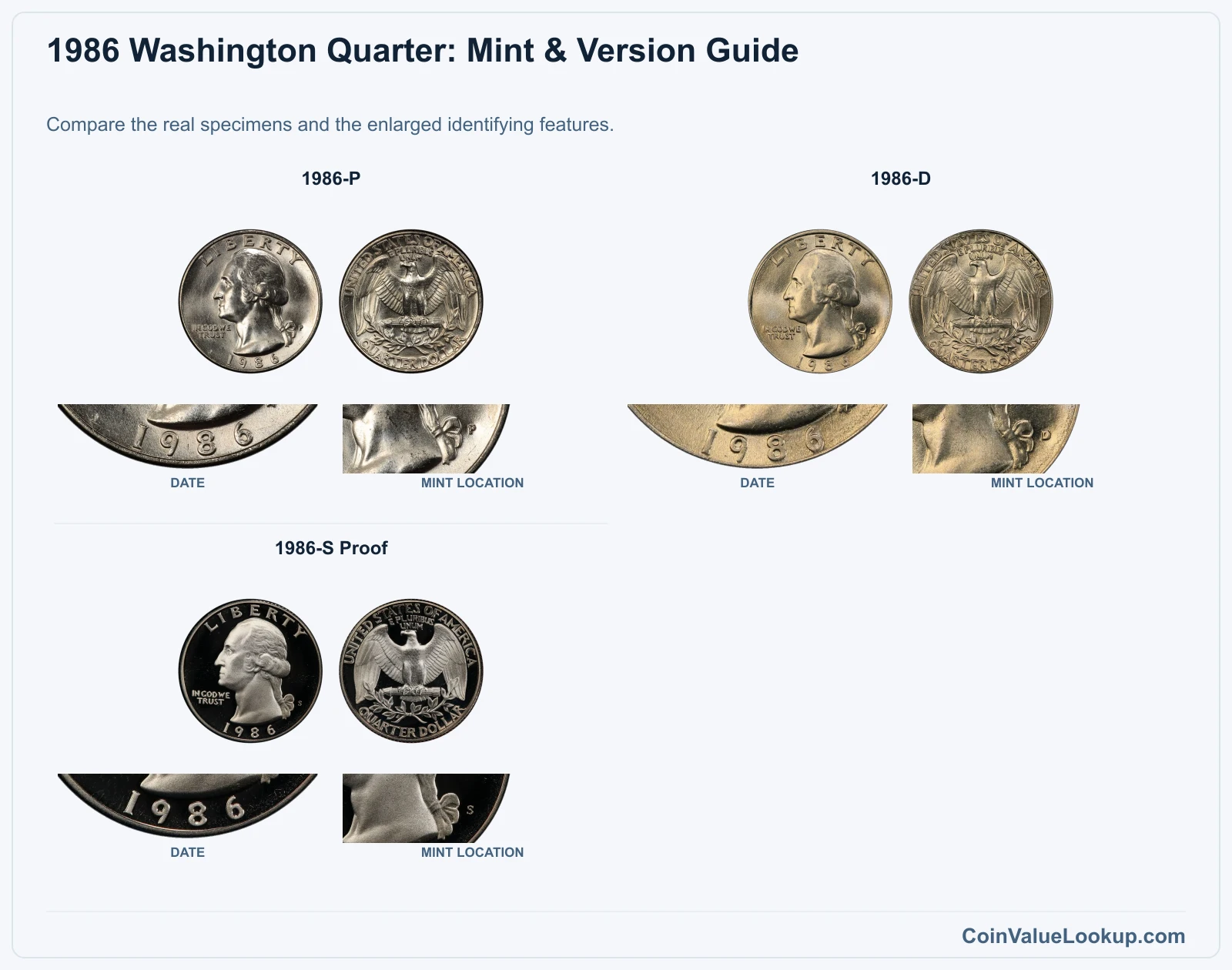
Most 1986 Washington quarters are worth face value — 25 cents — if they show any meaningful wear. The premium kicks in with well-preserved examples.
A USA Coin Book guide estimate places the 1986-P at about $15 in MS65 and the 1986-D at roughly $22 in the same grade. The 1986-S clad proof sits around $4.96 at PR65.
Authenticated striking errors carry their own separate premiums. Condition matters far more than age alone, so do not assume every 1986 quarter hiding in a junk drawer is a windfall.
Fast Way to Identify Your 1986 Washington Quarter
Want a quick read on what you have? Upload clear photos of both the front and back of your 1986 quarter for a preliminary identification.
Good lighting and sharp focus help distinguish mintmarks, surface quality, and any potential striking anomalies. This is not a substitute for professional authentication, but it is a solid starting point.
1986 Washington Quarter Value
Upload both sides of your 1986 Washington Quarter.
Front Obverse
Upload photo
Back Reverse
Upload photo
Which 1986 Washington Quarter Versions Are Worth Money?
- The 1986-D quarter carries the highest regular-issue guide estimate at about $22 in MS65, so check your Denver-mint coins for strong original luster and minimal contact marks.
- The 1986-P in MS65 is estimated around $15 — still a decent return on a coin you might pull from a roll.
- Authenticated error coins such as a quarter struck on a nickel planchet, an off-center strike, or a broadstruck double strike have sold individually at auction for roughly $129 to $195.
- Condition and correct attribution are the keys — polished or damaged coins do not qualify as valuable varieties no matter what the date says.
Step 1: Identify Your 1986 Washington Quarter Mint Mark and Version
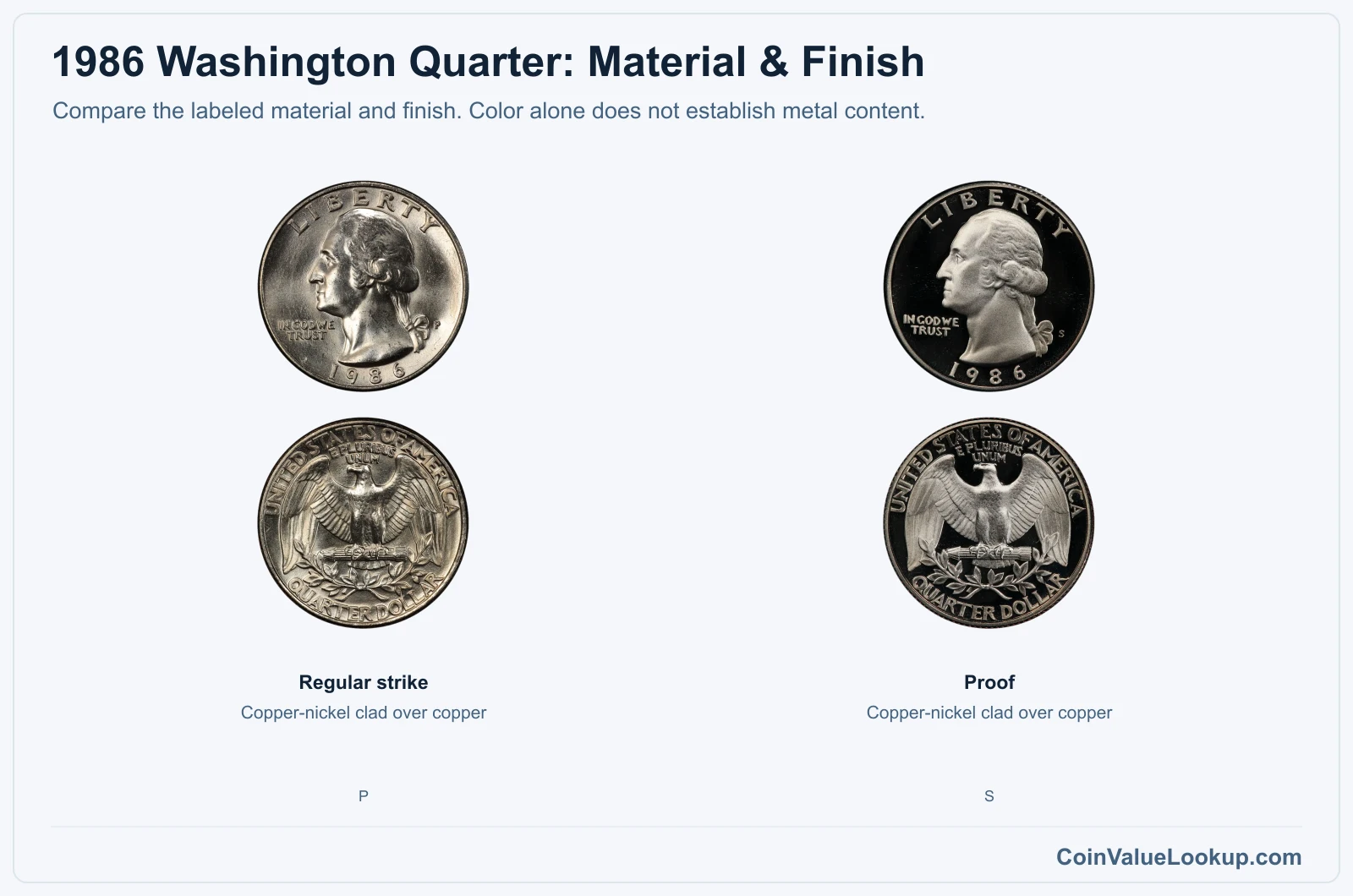
Three branches exist for the 1986 Washington quarter: the 1986-P from Philadelphia, the 1986-D from Denver, and the 1986-S clad proof from San Francisco. Look near the date on the obverse to find the mintmark — P, D, or S.
There is no blank-mintmark Philadelphia variety for this date, so every regular-issue coin carries a letter.
All three are struck on copper-nickel clad planchets with an overall composition of 91.67% copper and 8.33% nickel, weighing a nominal 5.67 grams. The standard diameter is about 24.3 mm.
None of these contain silver.
The obverse shows Washington's bust, and the reverse features the heraldic eagle with arrows and olive branches — the classic design used throughout most of the series. If your coin looks silver-toned or unusually light, that alone does not make it silver; clad coins can tone in odd ways.
Focus on the mintmark and the condition rather than color.
Step 2: Check Your 1986 Washington Quarter Grade
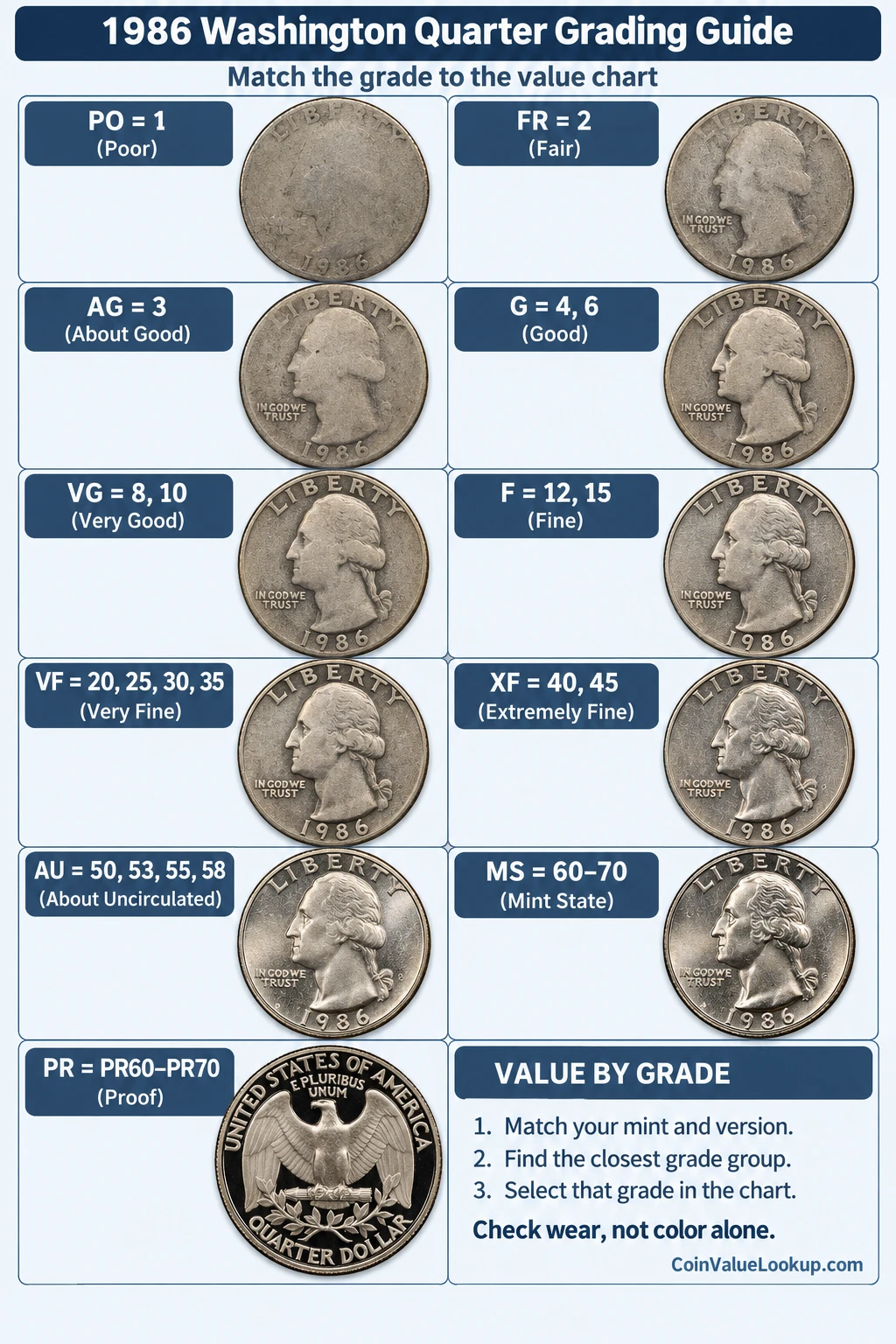
Check the hair detail above Washington's ear first. On a well-worn coin this area flattens into a smooth blob; on a higher-grade piece you can still trace individual strands.
The cheekbone and jawline are the next wear checkpoints — rub shows up there before almost anywhere else on the obverse.
Flip the coin over and look at the eagle's breast feathers. Loss of detail there confirms the grade range you saw on the front.
Compare your coin's luster to the reference image: original mint luster has a cartwheel effect under a light, while a cleaned coin just looks shiny without that directional glow.
Hairlines from cleaning and scattered contact marks (bag marks from the mint) both lower the grade. A proof coin can look spectacular and still be downgraded for hairlines.
Remember that DCAM (Deep Cameo) describes the contrast between frosted devices and mirrored fields — it is a designation about appearance, not a claim about silver content.
Step 3: Check 1986 Washington Quarter Value by Mint and Version
1986 Washington Quarter — P
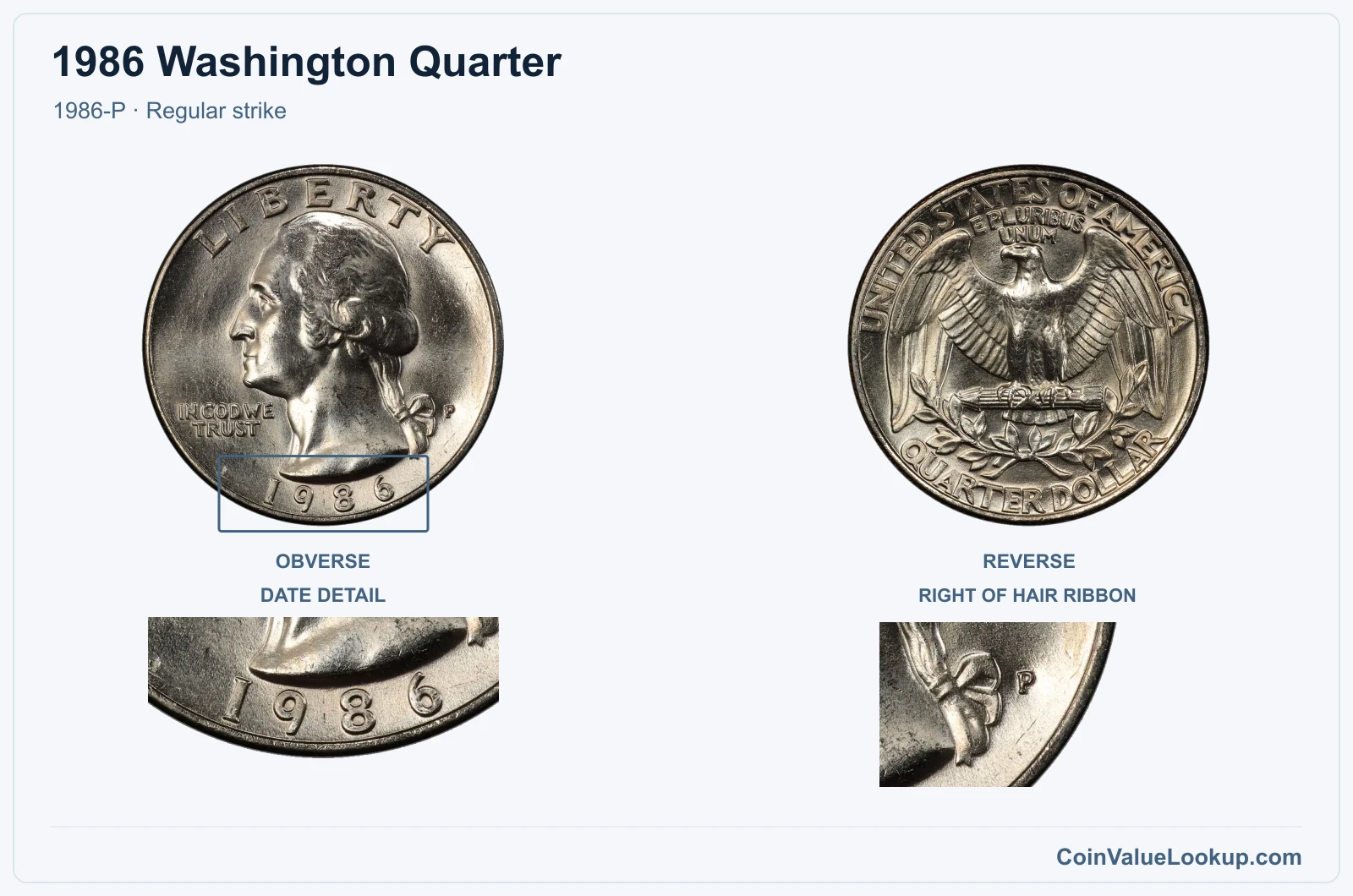
The 1986-P Washington quarter was struck at Philadelphia for general circulation. It is copper-nickel clad over copper, weighs about 5.67 grams, and carries a small P mintmark to the right of Washington's ponytail near the date.
A USA Coin Book guide estimate puts this coin at roughly $15 in MS65.
In circulated grades it is a 25-cent coin, plain and simple. The value jumps only when you find one with clean surfaces, full luster, and minimal bag marks — the kind of coin that looks like it went straight from the mint into a tube and stayed there.
Do not mistake a polished coin for an uncirculated one; luster and shine are not the same thing.
| Range | Grade | Price | Auction Records | Appraisal |
|---|---|---|---|---|
| PO | PO 1 | — | Coin Identifier | |
| FR | FR 2 | — | Coin Identifier | |
| AG | AG 3 | — | Coin Identifier | |
| G | G 4 | — | Coin Identifier | |
| G 6 | — | Coin Identifier | ||
| VG | VG 8 | — | Coin Identifier | |
| VG 10 | — | Coin Identifier | ||
| F | F 12 | — | Coin Identifier | |
| F 15 | — | Coin Identifier | ||
| VF | VF 20 | — | Coin Identifier | |
| VF 25 | — | Coin Identifier | ||
| VF 30 | — | Coin Identifier | ||
| VF 35 | — | Coin Identifier | ||
| XF | XF 40 | — | Coin Identifier | |
| XF 45 | — | Coin Identifier | ||
| AU | AU 50 | — | Coin Identifier | |
| AU 53 | — | Coin Identifier | ||
| AU 55 | — | Coin Identifier | ||
| AU 58 | — | Coin Identifier | ||
| MS | MS 60 | — | Coin Identifier | |
| MS 61 | — | Coin Identifier | ||
| MS 62 | — | Coin Identifier | ||
| MS 63 | Coin Identifier | |||
| MS 64 | Coin Identifier | |||
| MS 65 | Coin Identifier | |||
| MS 66 | Coin Identifier | |||
| MS 67 | Coin Identifier | |||
| MS 68 | — | — | — | |
| MS 69 | — | — | — | |
| MS 70 | — | — | — |
1986 Washington Quarter — D
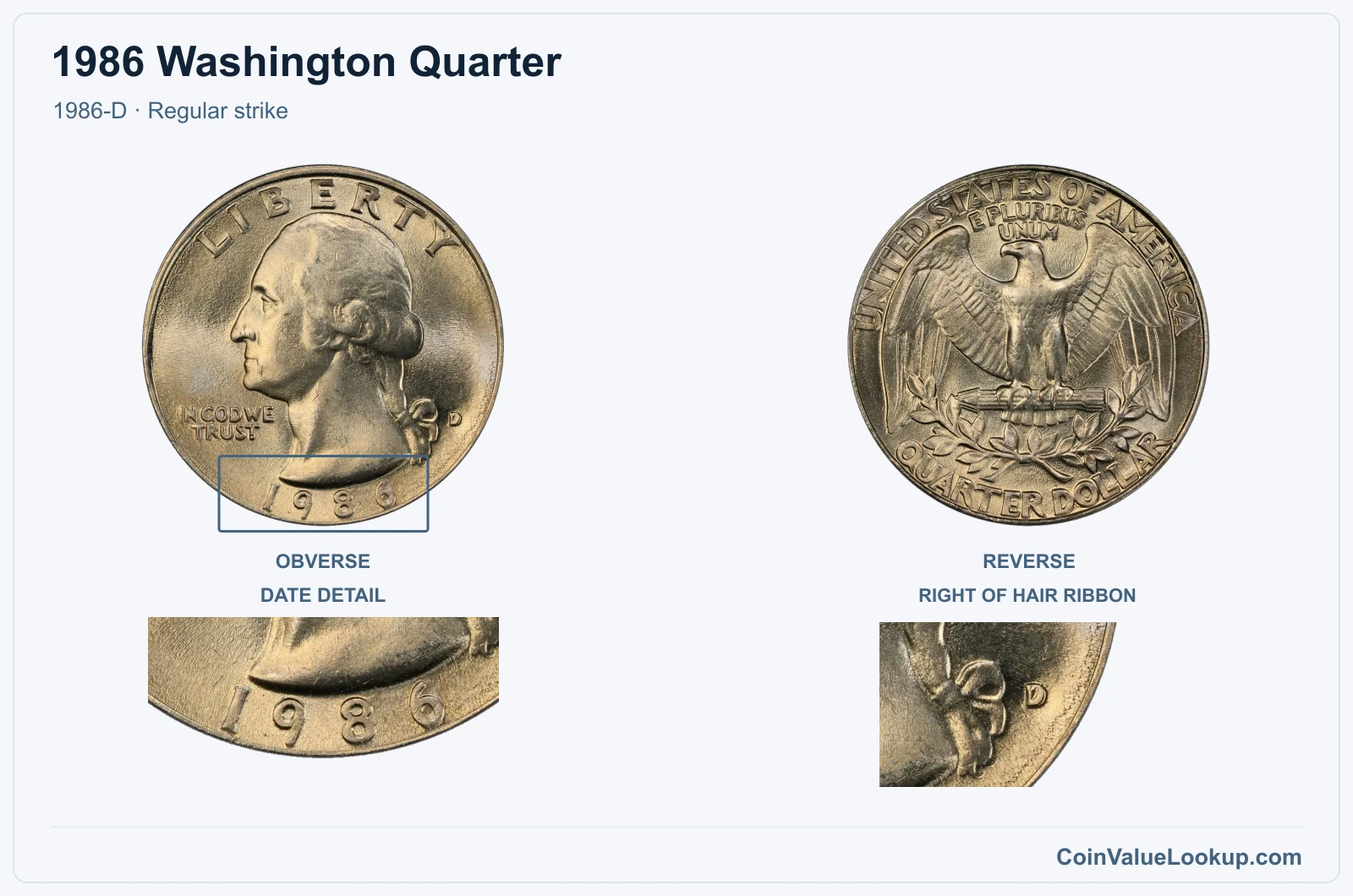
The 1986-D was produced at Denver and shares the same copper-nickel clad composition and 5.67-gram weight as its Philadelphia sibling. Look for the D mintmark near the date.
A USA Coin Book guide estimate puts the 1986-D at about $22 in MS65, the highest among the three regular 1986 quarter issues at that grade level.
Why a few dollars more than the P? Market dynamics for this particular date and mint at that grade.
In worn condition, it is still worth a quarter. Hunt through uncirculated rolls if you want a realistic shot at a higher-grade example — circulated pocket change almost never grades MS65.
Coin Value Lookup is a handy starting point if you want to look up values for other dates and denominations in the Washington quarter series or beyond.
| Range | Grade | Price | Auction Records | Appraisal |
|---|---|---|---|---|
| PO | PO 1 | — | Coin Identifier | |
| FR | FR 2 | — | Coin Identifier | |
| AG | AG 3 | — | Coin Identifier | |
| G | G 4 | — | Coin Identifier | |
| G 6 | — | Coin Identifier | ||
| VG | VG 8 | — | Coin Identifier | |
| VG 10 | — | Coin Identifier | ||
| F | F 12 | — | Coin Identifier | |
| F 15 | — | Coin Identifier | ||
| VF | VF 20 | — | Coin Identifier | |
| VF 25 | — | Coin Identifier | ||
| VF 30 | — | Coin Identifier | ||
| VF 35 | — | Coin Identifier | ||
| XF | XF 40 | — | Coin Identifier | |
| XF 45 | — | Coin Identifier | ||
| AU | AU 50 | — | Coin Identifier | |
| AU 53 | — | Coin Identifier | ||
| AU 55 | — | Coin Identifier | ||
| AU 58 | — | Coin Identifier | ||
| MS | MS 60 | — | Coin Identifier | |
| MS 61 | — | Coin Identifier | ||
| MS 62 | — | Coin Identifier | ||
| MS 63 | — | Coin Identifier | ||
| MS 64 | Coin Identifier | |||
| MS 65 | Coin Identifier | |||
| MS 66 | Coin Identifier | |||
| MS 67 | Coin Identifier | |||
| MS 68 | — | — | — | |
| MS 69 | — | — | — | |
| MS 70 | — | — | — |
1986 Washington Quarter — S Proof
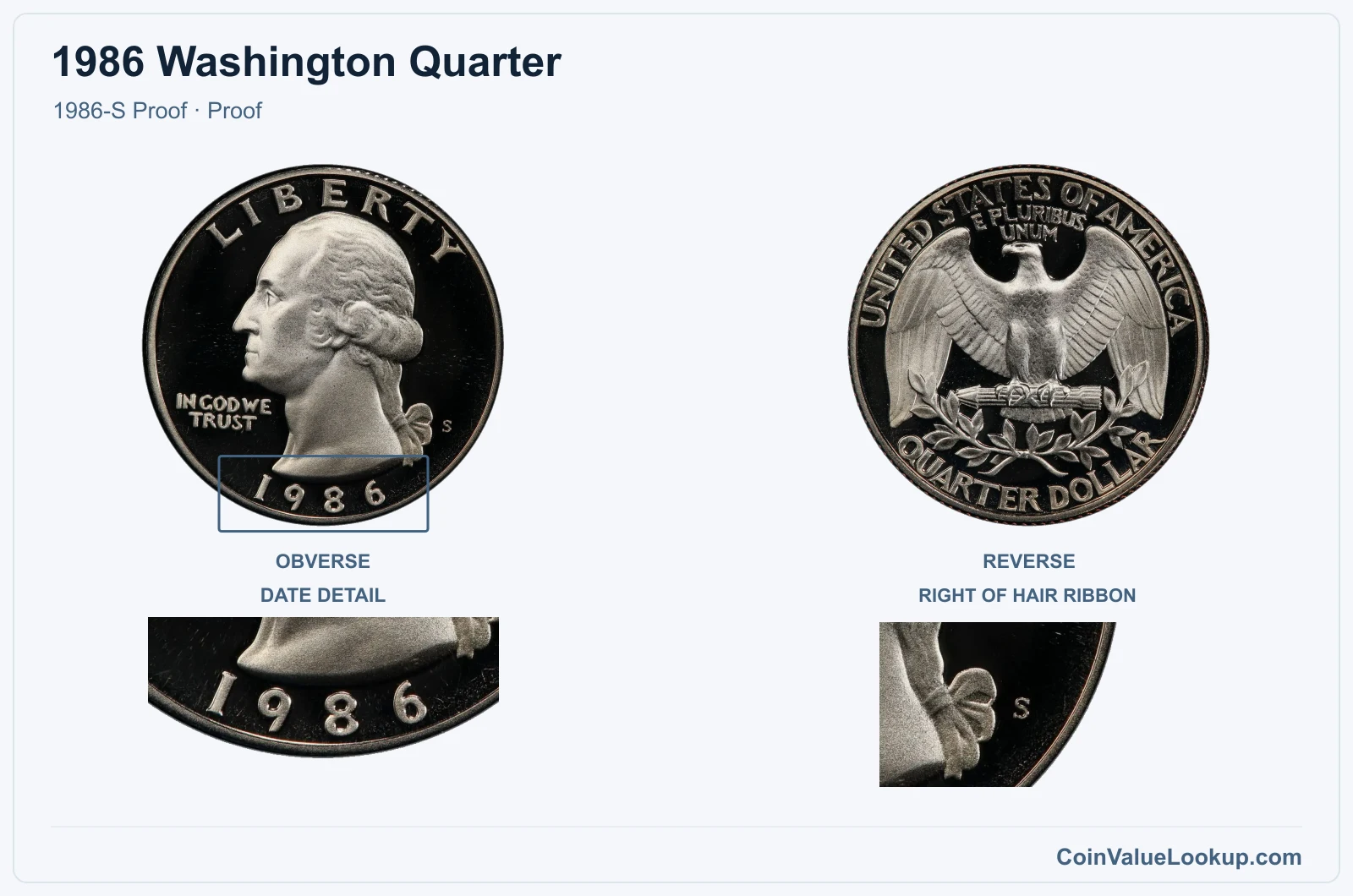
The 1986-S proof was struck at San Francisco exclusively for collectors, sold in proof sets. It is copper-nickel clad — not silver — with the same overall alloy as the business strikes.
The S mintmark sits near the date. A USA Coin Book guide estimate places this coin at about $4.96 in PR65.
Proof is a manufacturing method, not a grade above Mint State. These coins were struck with specially polished dies on polished planchets, producing mirror-like fields.
Some display Deep Cameo contrast between frosted devices and reflective fields, but a generic PR65 guide figure does not automatically apply to a DCAM example — those carry separate market pricing. Hairlines from mishandling are the most common grade limiter for proofs.
| Range | Grade | Price | Auction Records | Appraisal |
|---|---|---|---|---|
| PR | PR 1 | — | Coin Identifier | |
| PR 2 | — | Coin Identifier | ||
| PR 3 | — | Coin Identifier | ||
| PR 4 | — | Coin Identifier | ||
| PR 6 | — | Coin Identifier | ||
| PR 8 | — | Coin Identifier | ||
| PR 10 | — | Coin Identifier | ||
| PR 12 | — | Coin Identifier | ||
| PR 15 | — | Coin Identifier | ||
| PR 20 | — | Coin Identifier | ||
| PR 25 | — | Coin Identifier | ||
| PR 30 | — | Coin Identifier | ||
| PR 35 | — | Coin Identifier | ||
| PR 40 | — | Coin Identifier | ||
| PR 45 | — | Coin Identifier | ||
| PR 50 | — | Coin Identifier | ||
| PR 53 | — | Coin Identifier | ||
| PR 55 | — | Coin Identifier | ||
| PR 58 | — | Coin Identifier | ||
| PR 60 | — | Coin Identifier | ||
| PR 61 | — | Coin Identifier | ||
| PR 62 | — | Coin Identifier | ||
| PR 63 | — | Coin Identifier | ||
| PR 64 | — | Coin Identifier | ||
| PR 65 | — | Coin Identifier | ||
| PR 66 | — | Coin Identifier | ||
| PR 67 | Coin Identifier | |||
| PR 68 | Coin Identifier | |||
| PR 69 | Coin Identifier | |||
| PR 70 | Coin Identifier |
1986 Washington Quarter Error List
1. 1986 Washington Quarter — Struck on a Nickel Planchet
A 1986-P Washington quarter struck on a five-cent nickel planchet is a legitimate and scarce mint error. The nickel blank is smaller, so the finished coin shows quarter designs — Washington's portrait, the eagle — but with incomplete peripheral lettering and a visibly reduced diameter compared to a normal quarter.
One example graded ANACS MS61 sold at Heritage Auctions in March 2006 for $195.50. That is a single recorded sale, not a guaranteed market price; condition and third-party attribution matter.
How to spot a fake: post-mint filing, grinding, or chemical treatment can make a normal quarter look undersized or oddly colored. An authentic wrong-planchet strike retains original die-struck surfaces across both faces with no tool marks on the rim.
Look for the P mintmark and date to confirm the attribution. This is a US coin error — do not confuse it with 1986 Canadian quarter planchet errors, which involve a different design entirely.
2. 1986 Washington Quarter — Off-Center Strike
An off-center strike occurs when the planchet is not seated properly in the collar, so part of the design is displaced and a blank crescent appears along one edge. A 1986-P quarter struck roughly 30% off center, graded NGC MS65, sold at Heritage Auctions in October 2022 for $139.
The coin must still show enough of the date and mintmark for attribution — that is what makes it collectible rather than just odd-looking. The displacement itself does not remove metal from the coin; you are looking at the same planchet, just improperly struck.
Watch out for post-mint damage that mimics this error. A coin that has been cut, filed, or hammered after leaving the mint will show tool marks, disturbed metal flow, or an unnatural edge.
Authentic off-center strikes have smooth, original surfaces on the struck portion and a clean unstruck crescent.
3. 1986 Washington Quarter — Broadstruck and Double Struck
This combined error is exactly what it sounds like: a 1986-P quarter that escaped the collar (broadstrike) and then received a second impression from the dies (double strike). The result is a wider-than-normal coin with overlapping or shadowed design elements from two separate strikes.
An ANACS MS64 example sold at Heritage Auctions in October 2014 for $129.25. Again, one auction result for one specific coin.
Look for the expanded diameter from the missing collar plus clearly repeated design features — doubled lettering or a ghost image of Washington's profile offset from the primary strike. The two effects together are the key: a simple broadstrike will not show doubled devices, and a simple double strike within the collar will not show the expanded form.
Fakes created by post-mint hammering or alteration lack the clean die-struck detail on both impressions.
4. 1986 Washington Quarter — Repunched Mintmark
A repunched mintmark on the 1986-D quarter means the D mintmark was punched into the working die more than once, leaving traces of a secondary position visible under magnification. You are looking for a faint ghost or partial outline of the D slightly offset from the primary punch.
Compare your coin's mintmark to a known normal example at the same magnification. Machine doubling — a flat, shelf-like distortion — can mimic an RPM at first glance but lacks the rounded, raised quality of a genuine secondary punch.
Die chips and corrosion around the mintmark area can also create confusing shapes.
No specific price is adopted for this variety because value depends on the visibility of the repunching, the coin's overall condition, and the particular die marriage involved. Professional attribution helps establish what you actually have.
5. 1986 Washington Quarter — Clipped Planchet
A clipped planchet error on a 1986 quarter means the blank was incompletely punched from the metal strip before striking, leaving a missing curved, straight, or ragged section along the edge. The clip area typically shows weakness in the design directly opposite it — this is called the Blakesley effect, and its presence helps confirm authenticity.
Examine the edge texture carefully. An authentic clip has smooth, natural metal flow where the strip was improperly cut, consistent with the rest of the planchet's edge.
A post-mint filed notch or deliberate cut will show scratches, tool marks, or an abrupt transition that does not match the surrounding surface.
No specific price is adopted for this error. The value depends on the clip's size, shape, the coin's preservation, and whether it retains enough design for date and mint attribution.
Larger, more dramatic clips on well-preserved coins tend to attract stronger collector interest.