1964 Washington Quarter Coin Value: How Much Is It Worth?
The 1964 Washington quarter is the last regular-issue 90% silver quarter, and millions were struck at both Philadelphia and Denver. Circulated examples carry guide estimates around $16.43, while a selected MS65 business strike lists near $27 according to USA Coin Book.
The real action sits with scarce varieties, special finishes and documented mint errors.
Fast Way to Identify Your 1964 Washington Quarter
Snap a clear photo of both sides of your 1964 quarter and upload them here. Our identifier can provide a preliminary look at your coin's mint, variety branch and general condition.
It is a starting point, not a certified authentication or exact grade, but it helps you figure out what you are holding before you dig deeper.
1964 Washington Quarter Value
Upload both sides of your 1964 Washington Quarter.
Front Obverse
Upload photo
Back Reverse
Upload photo
Which 1964 Washington Quarter Versions Are Worth Money?
- The 1964-D Type C reverse quarter uses a sharper wreath-leaf design; a single MS66+ example sold for $8,400 at Stack's Bowers in June 2023.
- The 1964 Type B reverse quarter features separated ES in STATES on a business strike; an MS66 sold for $494 at Heritage in February 2017.
- A 1964 SMS special strike graded SP67 sold for $24,000 at Heritage in August 2025, but attribution requires professional certification, not visual guessing.
- Wrong-planchet errors carry strong premiums: a 1964 quarter struck on a silver dime planchet sold for $1,092.50 at Heritage in 2006.
- Repunched mintmark and doubled die reverse varieties on 1964-D quarters have documented sales ranging from roughly $16 to $349 depending on grade and attribution.
Step 1: Identify Your 1964 Washington Quarter Mint Mark and Version
The 1964 quarter is 90% silver and 10% copper, with a nominal weight of 6.25 grams and a diameter of approximately 24.3 mm. A genuine silver edge looks uniformly gray; a clad coin shows a visible copper core stripe.
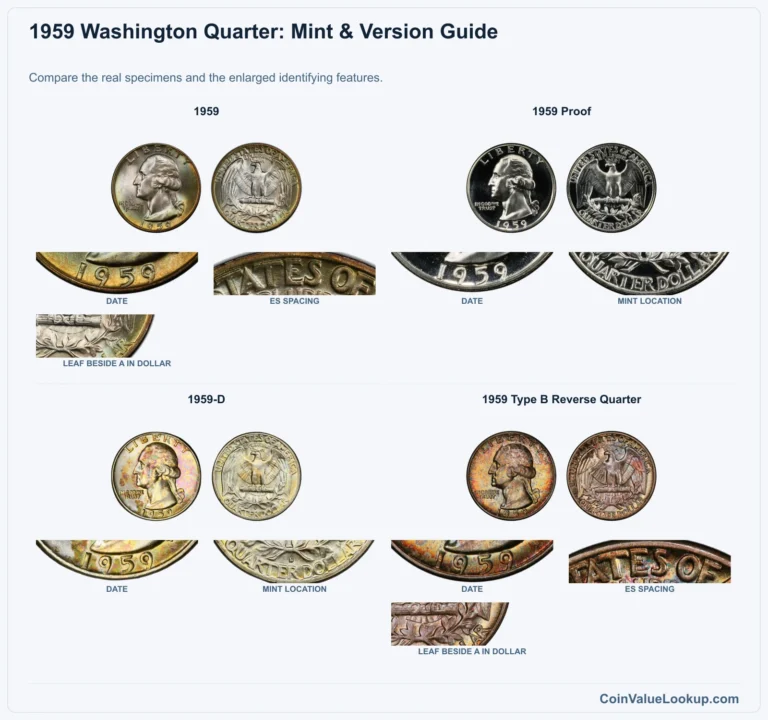
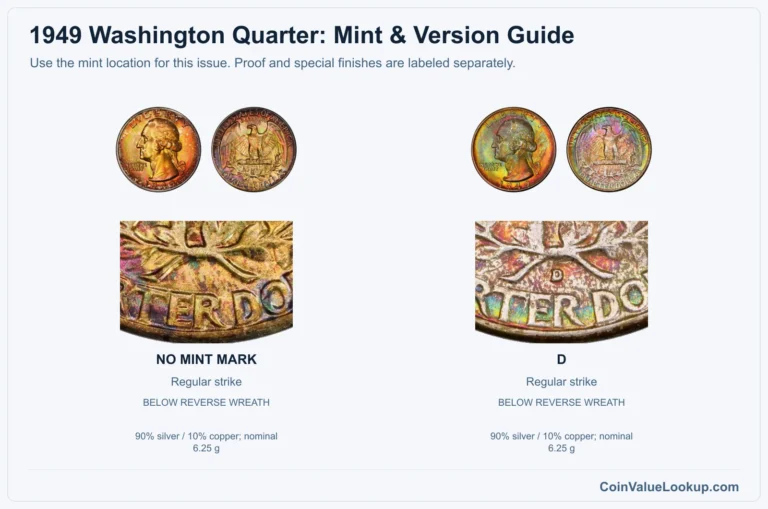
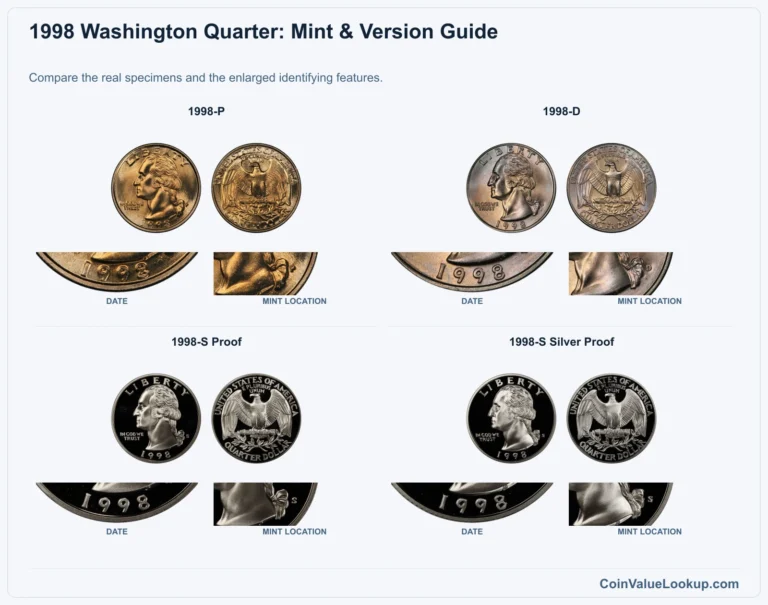
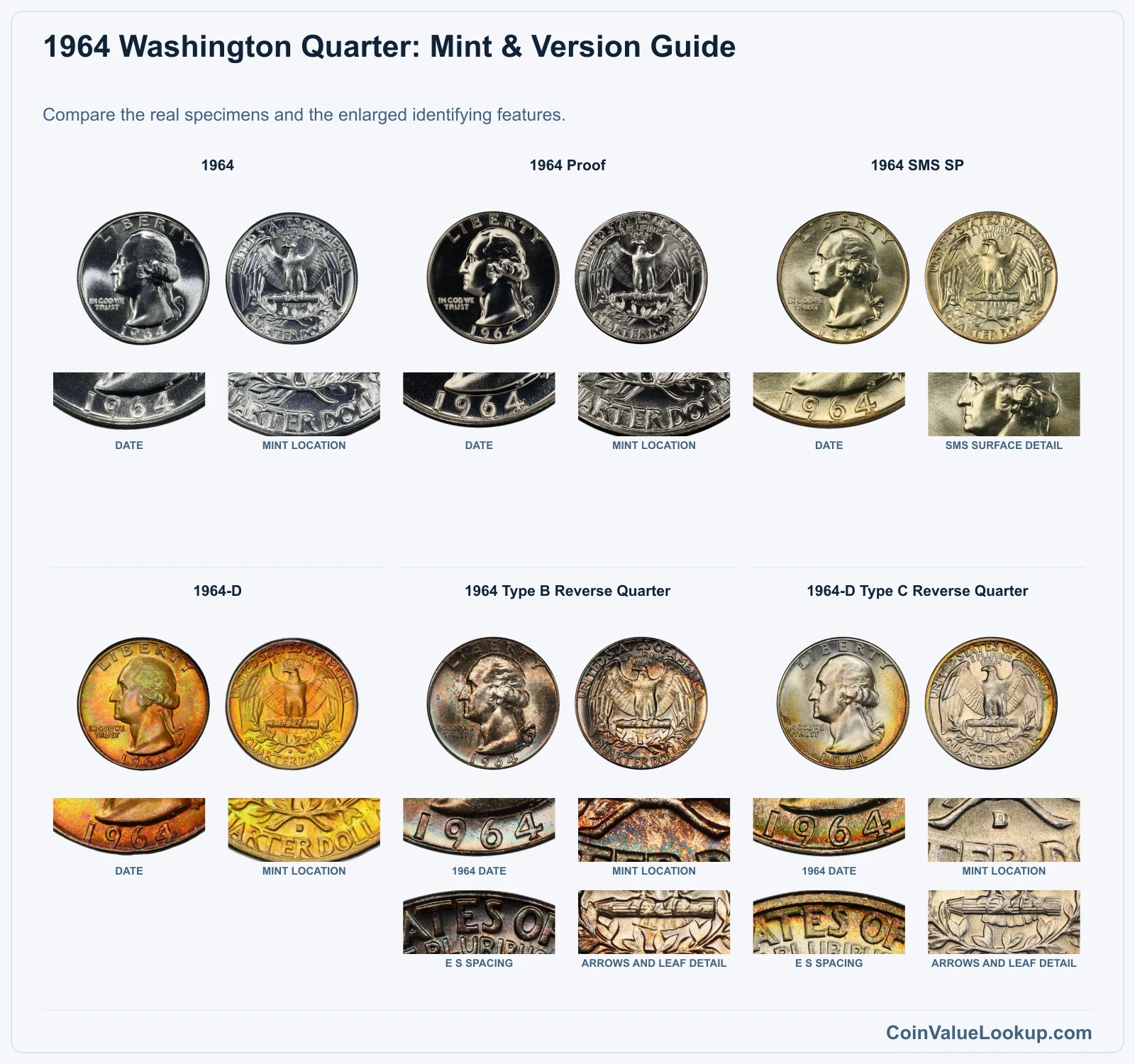
Philadelphia strikes carry no mintmark. The D mintmark for Denver sits below the wreath bow on the reverse.
For 1963 and 1964, that is the only spot to check.
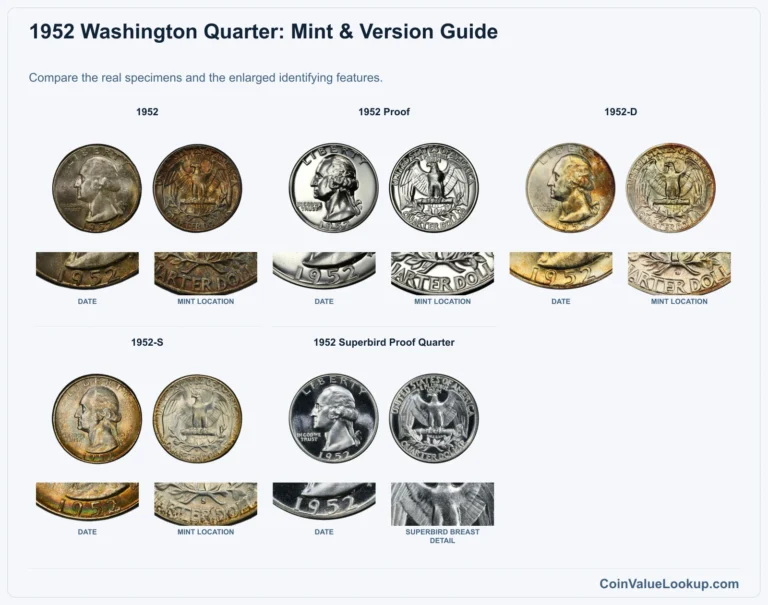
Six distinct branches exist: Philadelphia business strike, Philadelphia proof, Philadelphia SMS special strike, Denver business strike, Philadelphia Type B reverse, and Denver Type C reverse. A satin look alone does not prove SMS.
Proofs are a manufacturing finish with mirrored fields and are separate from SMS coins, which require professional attribution.
Type B reverses are identified by the separated E and S in STATES on the reverse. Type C reverses on 1964-D coins show sharper, more detailed wreath leaves compared with a standard Denver reverse.
Both require careful comparison under magnification.
Step 2: Check Your 1964 Washington Quarter Grade
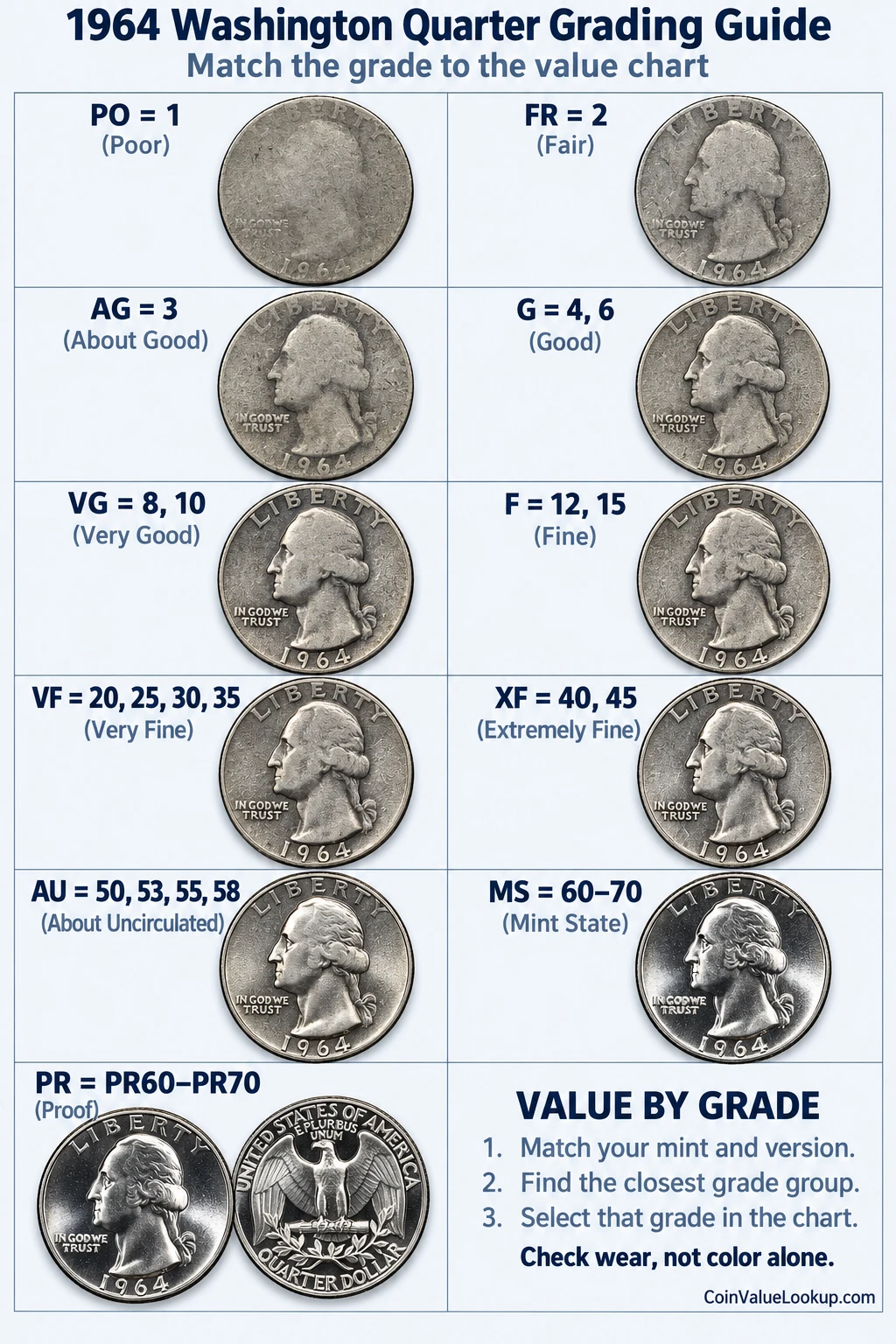
Start at the hair above Washington's ear. On a lightly circulated coin, the waves flatten first in this zone.
Then check the cheekbone and jawline, which lose definition quickly with wear.
Flip to the reverse. The eagle's breast feathers are the high point and will show smoothing before the wing tips or tail.
Luster is your friend. A coin with full original mint luster across both sides is a different animal from one with dull, washed-out fields.
Compare your coin against the reference image to spot where luster breaks match known grade thresholds.
Surface hairlines, contact marks and rim dings all drag a grade down. On proofs and SMS coins, evaluate contrast and reflectivity separately.
A polished coin cannot become a proof or SMS coin; polishing destroys original surfaces and is considered damage.
Step 3: Check 1964 Washington Quarter Value by Mint and Version
1964 Washington Quarter
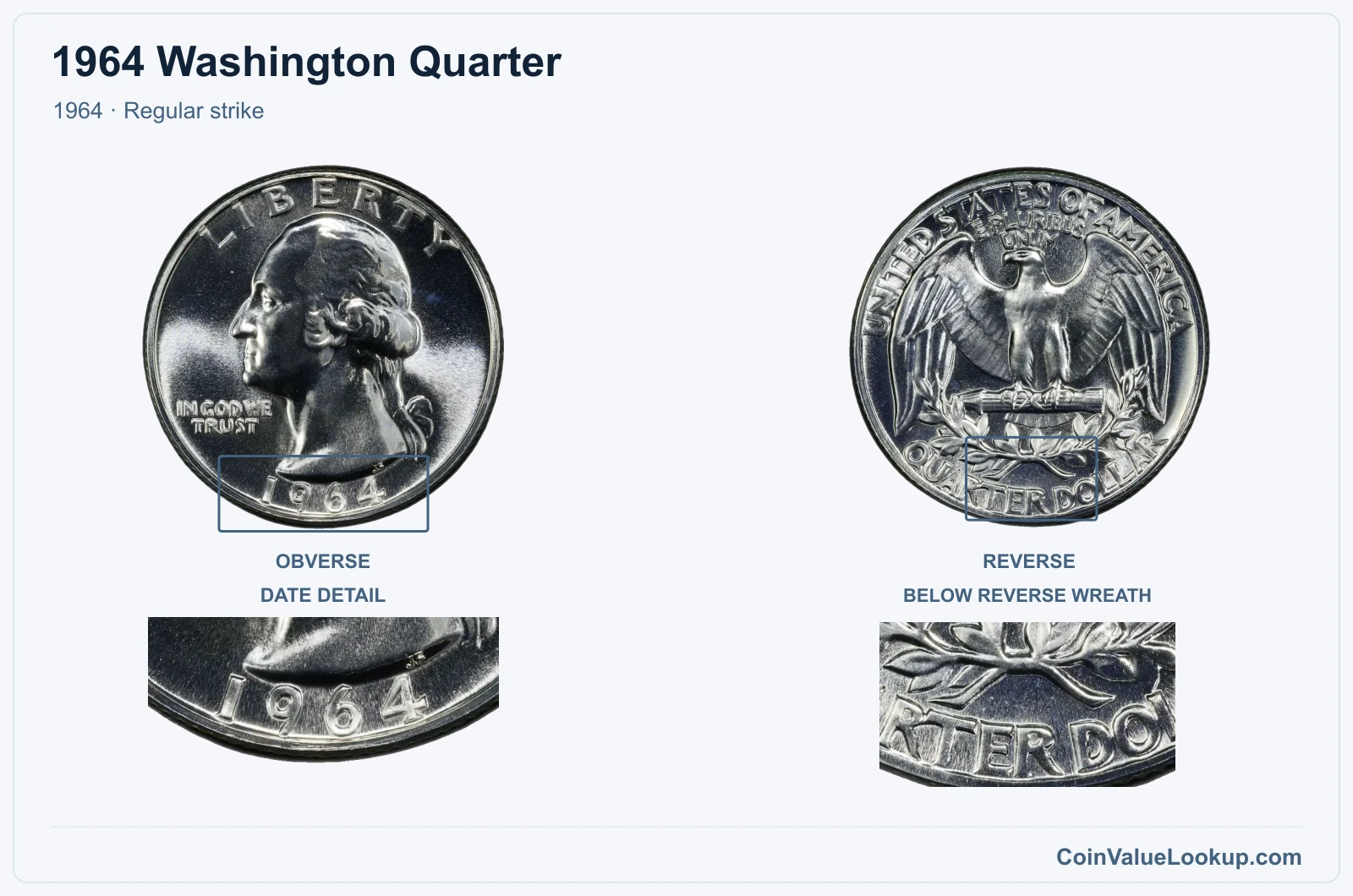
The 1964 Philadelphia business strike is the baseline coin most people find. No mintmark appears anywhere on the coin.
It weighs about 6.25 grams in 90% silver.
USA Coin Book guide estimates place a G4 example around $16.43, an MS60 near $20 and an MS65 at about $27. Those figures fluctuate with silver prices, so a worn pocket coin's floor is largely set by its melt value.
High-grade uncirculated pieces with clean surfaces and strong luster command a modest premium over silver content.
| Range | Grade | Price | Auction Records | Appraisal |
|---|---|---|---|---|
| PO | PO 1 | — | Coin Identifier | |
| FR | FR 2 | — | Coin Identifier | |
| AG | AG 3 | — | Coin Identifier | |
| G | G 4 | — | Coin Identifier | |
| G 6 | — | Coin Identifier | ||
| VG | VG 8 | — | Coin Identifier | |
| VG 10 | — | Coin Identifier | ||
| F | F 12 | — | Coin Identifier | |
| F 15 | — | Coin Identifier | ||
| VF | VF 20 | — | Coin Identifier | |
| VF 25 | — | Coin Identifier | ||
| VF 30 | — | Coin Identifier | ||
| VF 35 | — | Coin Identifier | ||
| XF | XF 40 | — | Coin Identifier | |
| XF 45 | Coin Identifier | |||
| AU | AU 50 | — | Coin Identifier | |
| AU 53 | — | Coin Identifier | ||
| AU 55 | — | Coin Identifier | ||
| AU 58 | — | Coin Identifier | ||
| MS | MS 60 | — | Coin Identifier | |
| MS 61 | — | Coin Identifier | ||
| MS 62 | — | Coin Identifier | ||
| MS 63 | Coin Identifier | |||
| MS 64 | Coin Identifier | |||
| MS 65 | Coin Identifier | |||
| MS 66 | Coin Identifier | |||
| MS 67 | Coin Identifier | |||
| MS 68 | Coin Identifier | |||
| MS 69 | — | — | — | |
| MS 70 | — | — | — |
1964 Washington Quarter — Proof
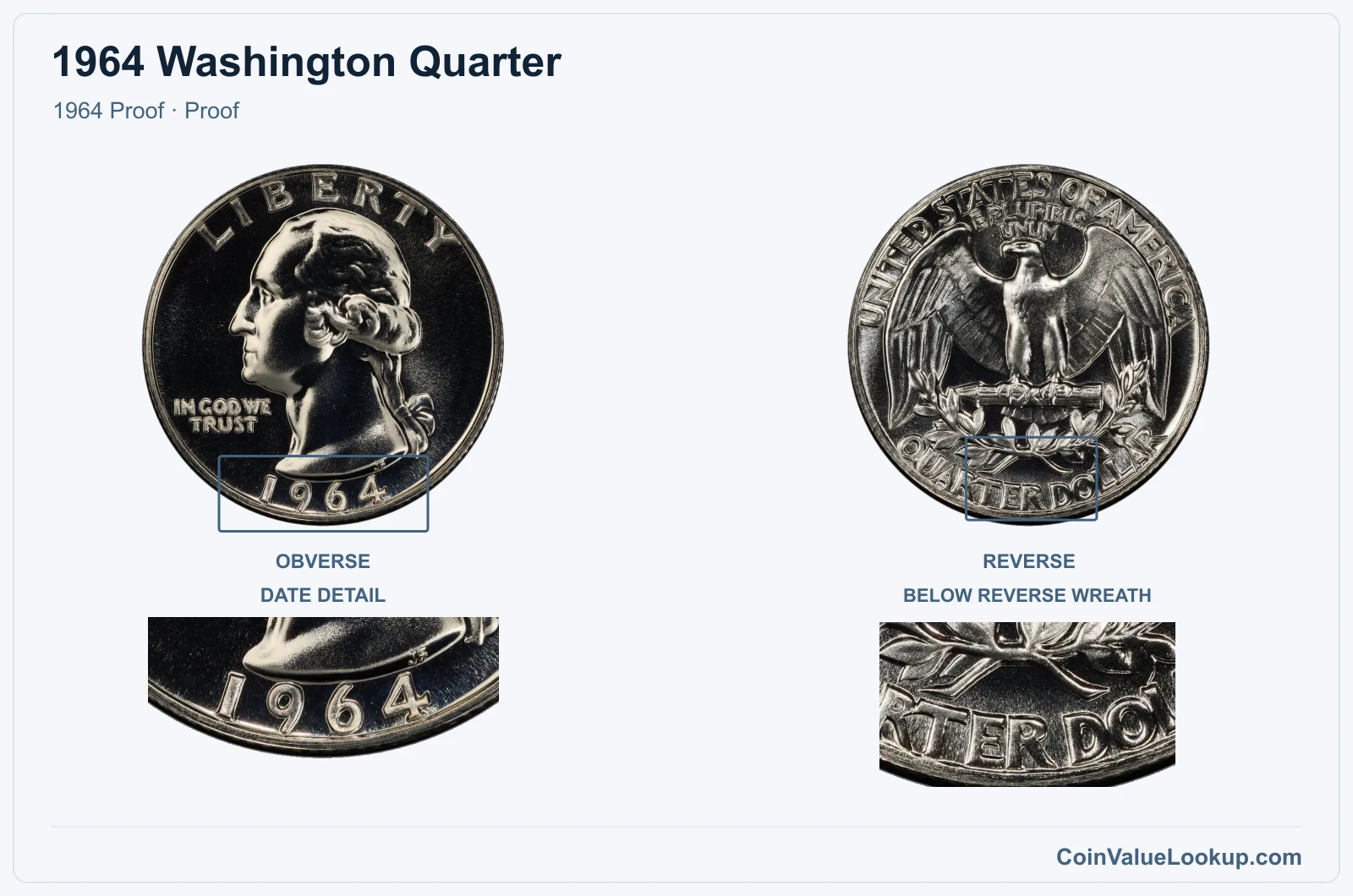
Philadelphia also struck proof quarters in 1964 for collectors, using specially prepared dies and planchets. These have mirrored fields and sharp, squared rims.
They came in proof sets, not circulation.
A PR65 example carries a USA Coin Book guide estimate of about $23. Proofs are graded on a separate scale from business strikes, looking at hairlines, haze and contrast rather than wear.
A proof is a finish, not a grade above Mint State, so a PR65 and an MS65 describe two different manufacturing processes.
| Range | Grade | Price | Auction Records | Appraisal |
|---|---|---|---|---|
| PR | PR 1 | — | Coin Identifier | |
| PR 2 | — | Coin Identifier | ||
| PR 3 | — | Coin Identifier | ||
| PR 4 | — | Coin Identifier | ||
| PR 6 | — | Coin Identifier | ||
| PR 8 | — | Coin Identifier | ||
| PR 10 | — | Coin Identifier | ||
| PR 12 | — | Coin Identifier | ||
| PR 15 | — | Coin Identifier | ||
| PR 20 | — | Coin Identifier | ||
| PR 25 | — | Coin Identifier | ||
| PR 30 | — | Coin Identifier | ||
| PR 35 | — | Coin Identifier | ||
| PR 40 | — | Coin Identifier | ||
| PR 45 | — | Coin Identifier | ||
| PR 50 | — | Coin Identifier | ||
| PR 53 | — | Coin Identifier | ||
| PR 55 | — | Coin Identifier | ||
| PR 58 | — | Coin Identifier | ||
| PR 60 | — | Coin Identifier | ||
| PR 61 | — | Coin Identifier | ||
| PR 62 | — | Coin Identifier | ||
| PR 63 | — | Coin Identifier | ||
| PR 64 | Coin Identifier | |||
| PR 65 | Coin Identifier | |||
| PR 66 | Coin Identifier | |||
| PR 67 | Coin Identifier | |||
| PR 68 | Coin Identifier | |||
| PR 69 | Coin Identifier | |||
| PR 70 | Coin Identifier |
1964 Washington Quarter — SMS SP
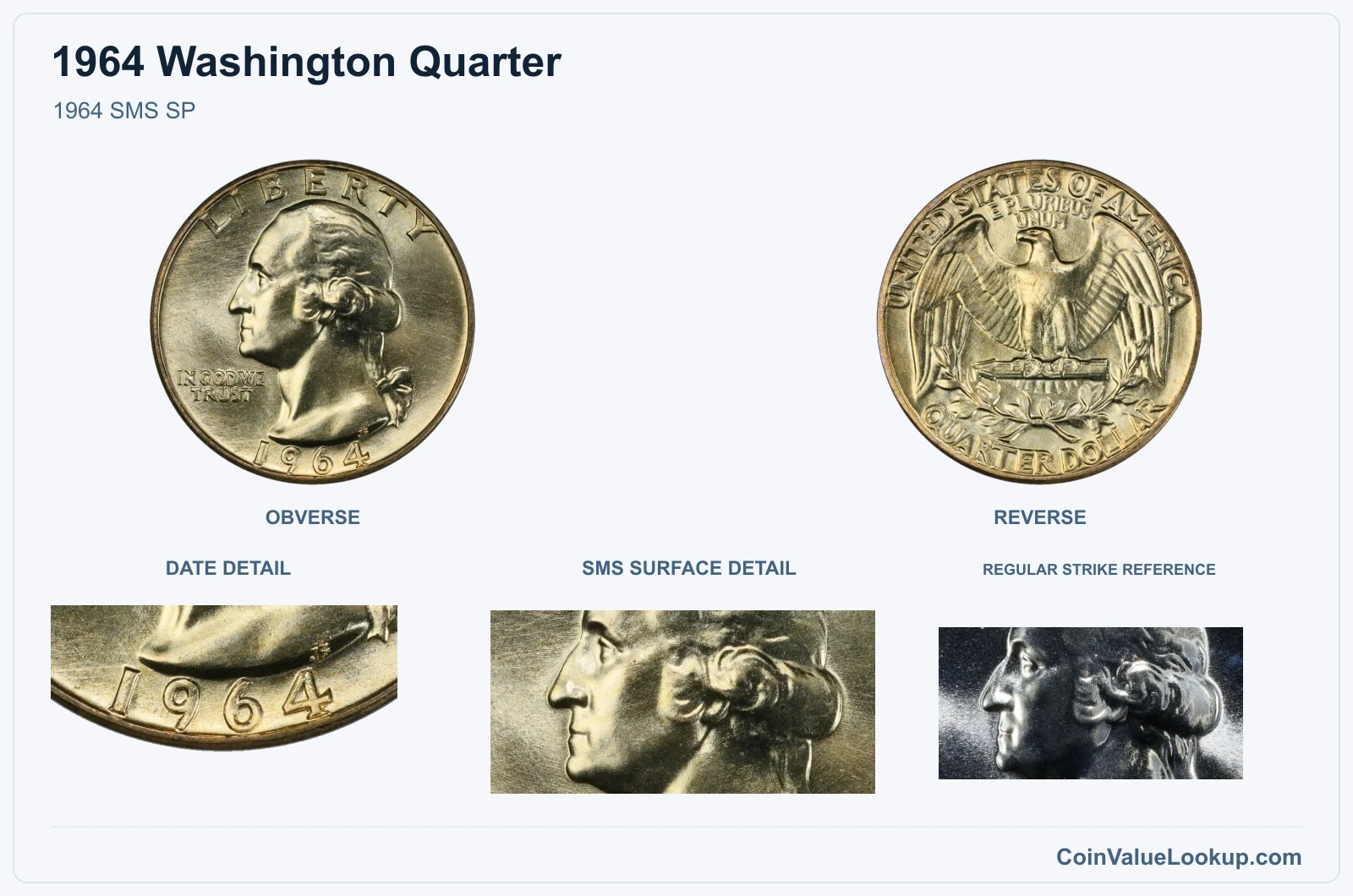
The 1964 SMS special strike is exceptionally scarce and still debated among specialists. These coins show smooth satin fields, sharp square edges and strong design detail, but a satin appearance alone does not establish SMS status.
Professional attribution from a major grading service is required.
Exact origin and quantity remain uncertain. A PCGS SP67 example sold for $24,000 at Heritage in August 2025.
That is one authenticated special strike, not a price that applies to ordinary 1964 quarters that happen to look nice. If your coin seems unusually sharp and satiny, professional submission is the only path to confirmation.
Do not assume you have found one in a roll.
| Range | Grade | Price | Auction Records | Appraisal |
|---|---|---|---|---|
| SP | SP 1 | — | Coin Identifier | |
| SP 2 | — | Coin Identifier | ||
| SP 3 | — | Coin Identifier | ||
| SP 4 | — | Coin Identifier | ||
| SP 6 | — | Coin Identifier | ||
| SP 8 | — | Coin Identifier | ||
| SP 10 | — | Coin Identifier | ||
| SP 12 | — | Coin Identifier | ||
| SP 15 | — | Coin Identifier | ||
| SP 20 | — | Coin Identifier | ||
| SP 25 | — | Coin Identifier | ||
| SP 30 | — | Coin Identifier | ||
| SP 35 | — | Coin Identifier | ||
| SP 40 | — | Coin Identifier | ||
| SP 45 | — | Coin Identifier | ||
| SP 50 | — | Coin Identifier | ||
| SP 53 | — | Coin Identifier | ||
| SP 55 | — | Coin Identifier | ||
| SP 58 | — | Coin Identifier | ||
| SP 60 | — | Coin Identifier | ||
| SP 61 | — | Coin Identifier | ||
| SP 62 | — | Coin Identifier | ||
| SP 63 | — | Coin Identifier | ||
| SP 64 | Coin Identifier | |||
| SP 65 | — | Coin Identifier | ||
| SP 66 | Coin Identifier | |||
| SP 67 | Coin Identifier | |||
| SP 68 | — | Coin Identifier | ||
| SP 69 | — | — | — | |
| SP 70 | — | — | — |
1964 Washington Quarter — D
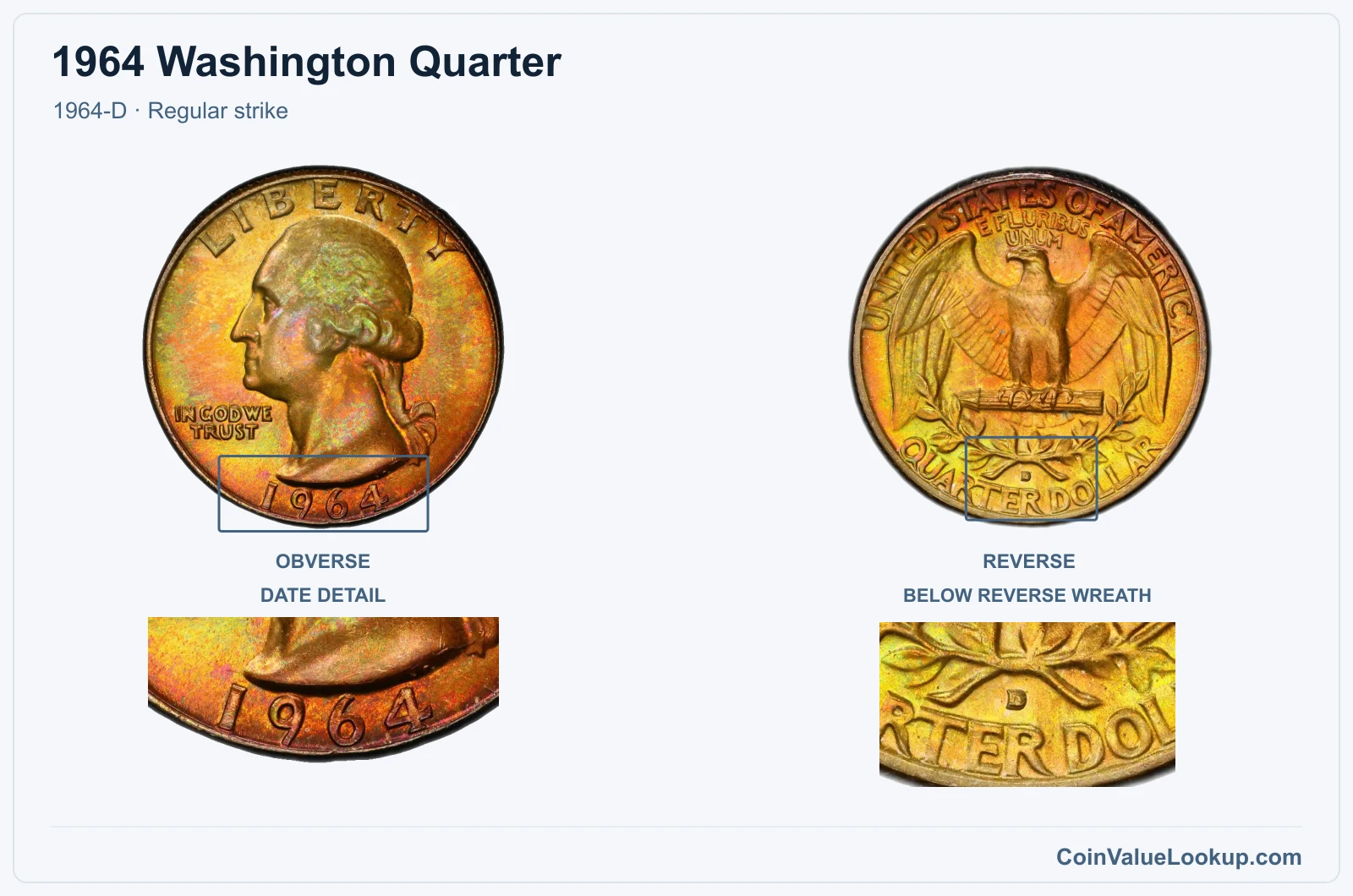
The 1964-D carries a D mintmark below the wreath bow on the reverse. Denver struck enormous quantities, so these are common in every circulated grade.
Guide estimates match the Philadelphia issue: about $16.43 at G4, $20 at MS60 and $27 at MS65 per USA Coin Book. As with all 1964 quarters, silver content sets a practical floor.
Gem uncirculated examples with original luster and minimal bag marks bring the strongest returns, but the premium over melt is modest for a normal strike.
| Range | Grade | Price | Auction Records | Appraisal |
|---|---|---|---|---|
| PO | PO 1 | — | Coin Identifier | |
| FR | FR 2 | — | Coin Identifier | |
| AG | AG 3 | — | Coin Identifier | |
| G | G 4 | — | Coin Identifier | |
| G 6 | — | Coin Identifier | ||
| VG | VG 8 | — | Coin Identifier | |
| VG 10 | — | Coin Identifier | ||
| F | F 12 | — | Coin Identifier | |
| F 15 | — | Coin Identifier | ||
| VF | VF 20 | — | Coin Identifier | |
| VF 25 | — | Coin Identifier | ||
| VF 30 | — | Coin Identifier | ||
| VF 35 | — | Coin Identifier | ||
| XF | XF 40 | — | Coin Identifier | |
| XF 45 | — | Coin Identifier | ||
| AU | AU 50 | Coin Identifier | ||
| AU 53 | — | Coin Identifier | ||
| AU 55 | Coin Identifier | |||
| AU 58 | Coin Identifier | |||
| MS | MS 60 | — | Coin Identifier | |
| MS 61 | — | Coin Identifier | ||
| MS 62 | Coin Identifier | |||
| MS 63 | Coin Identifier | |||
| MS 64 | Coin Identifier | |||
| MS 65 | Coin Identifier | |||
| MS 66 | Coin Identifier | |||
| MS 67 | Coin Identifier | |||
| MS 68 | Coin Identifier | |||
| MS 69 | — | — | — | |
| MS 70 | — | — | — |
1964 Washington Quarter — Type B Reverse Quarter
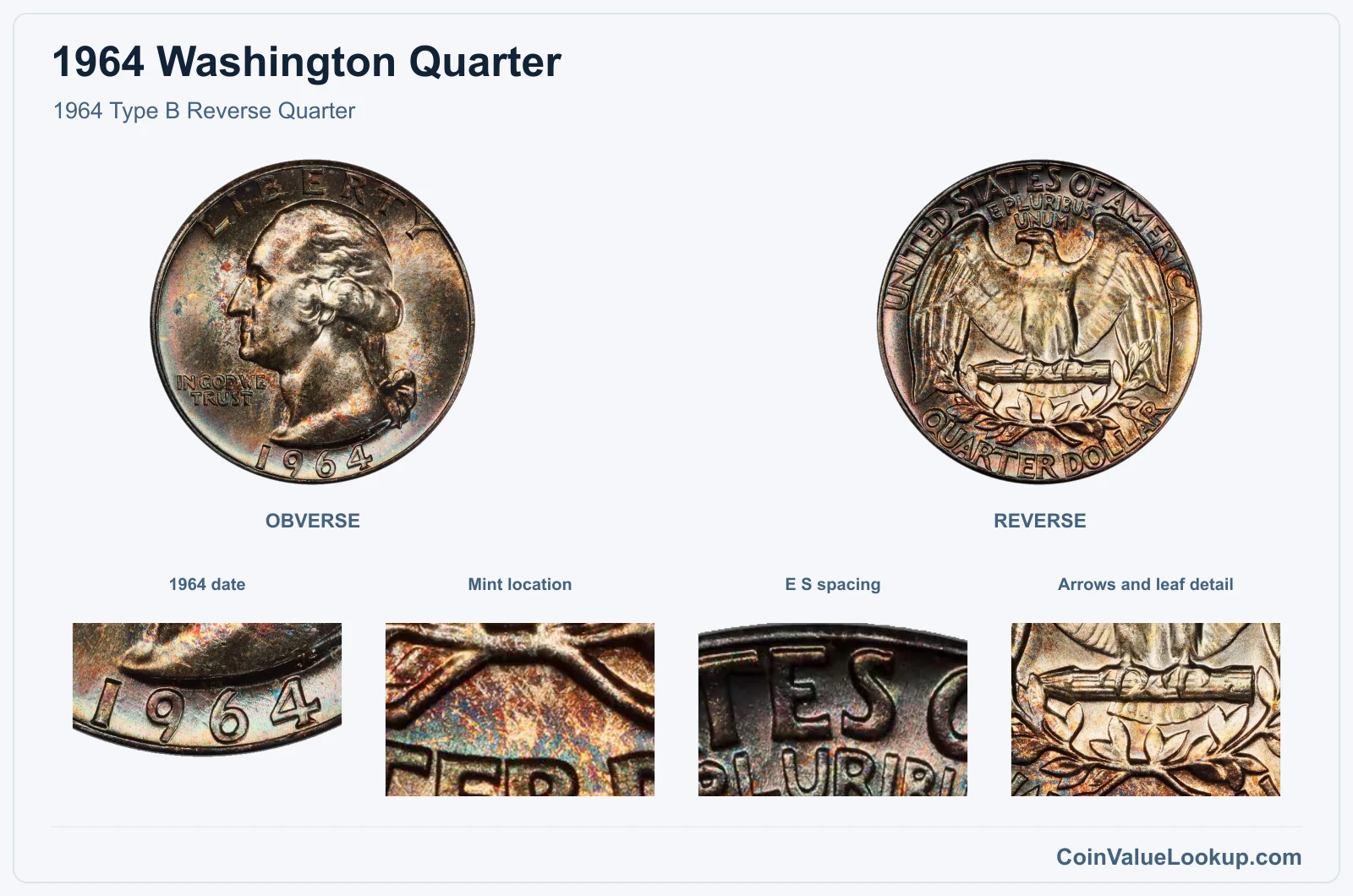
The 1964 Type B reverse is a Philadelphia business strike that used a proof-style reverse die. The key diagnostic is the spacing between the E and S in STATES on the reverse.
On a normal business strike, those letters nearly touch. On a Type B, they are clearly separated.
Coin Value Lookup is a good starting point if you want to compare your quarter's reverse lettering against reference examples for other dates and types.
Standard proofs already use this reverse style, so they are not Type B varieties. An MS66 Type B sold for $494 at Heritage in February 2017.
That is a single historical auction result, not a broad market range, but it shows that correctly attributed examples carry a solid premium over ordinary 1964 quarters.
Range Grade
Price Auction Records Appraisal PO PO 1
—
Coin Identifier FR FR 2
—
Coin Identifier AG AG 3
—
Coin Identifier G G 4
—
Coin Identifier
G 6
—
Coin Identifier VG VG 8
—
Coin Identifier
VG 10
—
Coin Identifier F F 12
—
Coin Identifier
F 15
—
Coin Identifier VF VF 20
—
Coin Identifier
VF 25
—
Coin Identifier
VF 30
—
Coin Identifier
VF 35
—
Coin Identifier XF XF 40
—
Coin Identifier
XF 45
—
Coin Identifier AU AU 50
—
Coin Identifier
AU 53
—
Coin Identifier
AU 55
—
Coin Identifier
AU 58
—
Coin Identifier MS MS 60
—
Coin Identifier
MS 61
—
Coin Identifier
MS 62
—
Coin Identifier
MS 63
—
Coin Identifier
MS 64
—
Coin Identifier
MS 65
Coin Identifier
MS 66
Coin Identifier
MS 67
—
—
—
MS 68
—
—
—
MS 69
—
—
—
MS 70
—
—
—
1964 Washington Quarter — D Type C Reverse Quarter
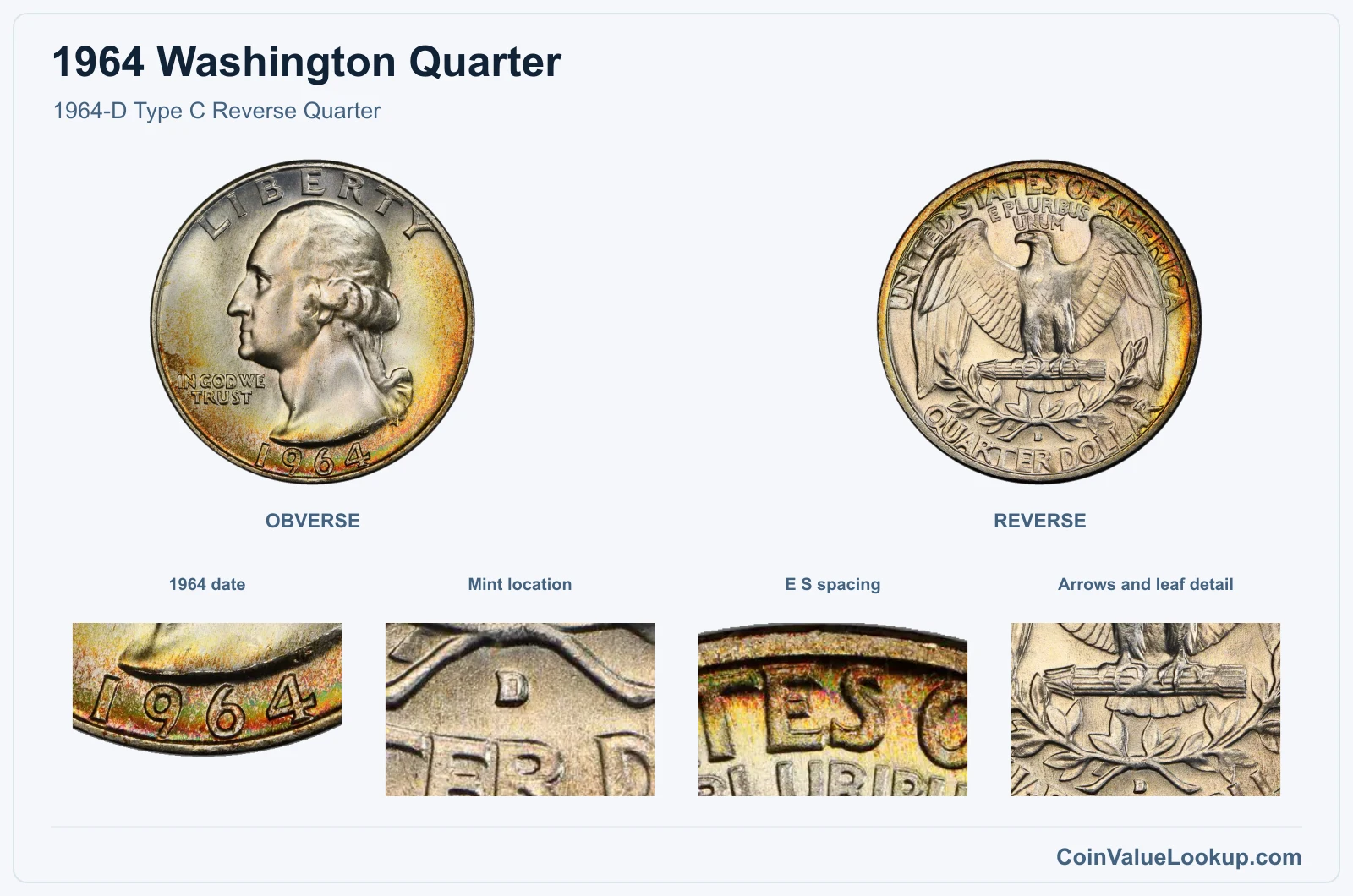
The 1964-D Type C reverse shows sharper, more detailed wreath leaves that resemble the reverse style introduced on later quarters. It is still a 90% silver coin despite the updated reverse design.
Denver is the only mint documented for this variety.
Compare the wreath leaf detail carefully under magnification against a standard 1964-D reverse. Certified attribution is important because subtle die differences can fool the naked eye.
A single MS66+ example sold for $8,400 at Stack's Bowers in June 2023. That result reflects the rarity and collector interest in this crossover variety, but it is one sale, not a standing offer.
Range Grade
Price Auction Records Appraisal PO PO 1
—
Coin Identifier FR FR 2
—
Coin Identifier AG AG 3
—
Coin Identifier G G 4
—
Coin Identifier
G 6
—
Coin Identifier VG VG 8
—
Coin Identifier
VG 10
—
Coin Identifier F F 12
—
Coin Identifier
F 15
—
Coin Identifier VF VF 20
—
Coin Identifier
VF 25
—
Coin Identifier
VF 30
—
Coin Identifier
VF 35
—
Coin Identifier XF XF 40
—
Coin Identifier
XF 45
—
Coin Identifier AU AU 50
—
Coin Identifier
AU 53
Coin Identifier
AU 55
—
Coin Identifier
AU 58
Coin Identifier MS MS 60
—
Coin Identifier
MS 61
—
Coin Identifier
MS 62
Coin Identifier
MS 63
Coin Identifier
MS 64
Coin Identifier
MS 65
Coin Identifier
MS 66
Coin Identifier
MS 67
—
—
—
MS 68
—
—
—
MS 69
—
—
—
MS 70
—
—
—
1964 Washington Quarter Error List
1. 1964 Washington Quarter — Broadstrike
A broadstrike happens when the collar fails to contain the planchet during striking. The coin spreads wider than normal, and the rim is flat or absent while the central design stays intact.
On a 1964 Philadelphia quarter, this produces a noticeably oversized coin with mushy edges.
One documented example, graded NGC Uncirculated Details with a reverse wheelmark (post-strike damage, not part of the error), sold for $204 at Heritage in June 2025. A separate MS65 PCGS uncentered broadstrike is documented without an individual sale price.
Watch for fakes. Post-mint hammering or squeezing in a vise can flatten rims, but the struck surfaces and metal flow will look different from a genuine broadstrike.
Color or odd shape alone are not enough to confirm this error.
2. 1964 Washington Quarter — Underweight Planchet (4.8 g)
An underweight planchet error means the blank fed into the press weighed less than the standard 6.25 grams. A documented 1964 Philadelphia example weighed just 4.8 grams yet still received a full strike.
No individual sale price was published for this piece.
To screen for this error, you need an accurate scale and careful inspection of diameter, thickness and edge. A coin that weighs light because someone filed it down, chemically stripped silver or clipped it after striking is not the same thing.
Genuine underweight planchets retain normal strike characteristics across whatever surface area they have. The deficit comes from the blank itself, not from post-mint removal of metal.
3. 1964 Washington Quarter — Split Planchet
A split planchet occurs when the metal separates along an internal plane during or before striking. A documented 1964 Philadelphia example weighs only 3.0 grams, roughly half the normal weight, with an exposed laminar layer visible on the split face.
The split follows the planchet's internal structure rather than cutting through the design at an angle. This distinguishes it from a coin that was sawed, ground or glued together after leaving the mint.
No individual sale price was published for the documented piece. If you find a quarter that seems impossibly thin on one side with a rough exposed interior, weigh it and compare.
Post-mint cracks and scrapes do not produce the same even laminar separation.
4. 1964 Washington Quarter — Partial Collar Strike
A partial collar strike creates a stepped or "railroad" rim on one portion of the coin where the collar only partially restrained the planchet. The documented 1964 Philadelphia example was struck on a Type One blank, and you can see a raised shelf along part of the edge while the opposite side looks normal.
This error is different from a broadstrike, where the collar is entirely absent. It is also different from post-mint rim damage caused by squeezing or dropping.
The step on a genuine partial collar is uniform and shows struck metal flow.
No individual sale price was published for this specimen. Look for the distinct thickness change at the rim line and confirm the coin has not simply been pressed against a hard surface.
5. 1964 Washington Quarter — 40% Off-Center Strike
A 40% off-center strike means the planchet was badly misaligned under the dies, leaving roughly 40% of the design missing. The result is an unstruck crescent of blank metal on one side with the visible design shifted dramatically toward the opposite edge.
The documented 1964 Philadelphia example is graded MS64 by PCGS. No individual sale price was published.
Off-center quarters with a visible date tend to be more desirable than those where the date falls in the blank area.
Do not confuse a damaged rim or a coin that was bent and flattened with a genuine off-center strike. The blank crescent should show original planchet surface, not tool marks or corrosion.
6. 1964 Washington Quarter — Struck on 10C Thickness Stock (5.2 g)
This error involves a 1964 Philadelphia quarter struck on rolling stock intended for dimes. The blank is quarter-diameter but only dime-thickness, resulting in a coin weighing about 5.2 grams with a weakly filled edge.
It is not the same as a quarter struck on a dime planchet, which would be smaller in diameter. Here the diameter is correct but the metal is too thin.
The edge and rim will look incomplete because there was not enough metal to fill the collar.
No individual sale price was published for the documented specimen. Confirm by measuring thickness and weight rather than relying on color or visual impression.
Certified attribution is the safest route for wrong-stock errors.
7. 1964 Washington Quarter — Struck on a 90% Silver Dime Planchet
A 1964 quarter struck on a 90% silver dime planchet is a wrong-planchet error. The much smaller dime blank means peripheral legends like LIBERTY and the denomination are completely off the flan, while the date typically remains visible.
The documented coin weighs about 2.5 grams with no mintmark.
One NGC MS64 example sold for $1,092.50 at Heritage in April 2006. Wrong-planchet errors are popular with collectors because they are visually dramatic and easy to understand.
A clipped quarter or a quarter that has been cut down is not the same thing. Check that the edge is uniformly struck and the weight matches a dime planchet, not a shaved-down quarter.
8. 1964 Washington Quarter — Tapered Planchet
A tapered planchet is a rolling-mill error where the blank varies in thickness from one edge to the other. On the documented 1964 Philadelphia specimen, this produces weaker design detail on the thin side and stronger detail on the thick side.
The coin weighs 5.3 grams, lighter than the standard 6.25 grams.
An NGC MS65 example sold for $192 at Heritage in December 2020. That is a single result, not a market range.
Do not confuse a bent coin with a tapered planchet. A bent coin was struck normally and then deformed.
A tapered planchet was already uneven before it entered the press, so the thickness gradient follows the design's strike pressure pattern.
9. 1964 Washington Quarter — Defective Planchet
A defective planchet carries a flaw in the metal that existed before the coin was struck. The defect interrupts normal metal flow during striking, so the area around it may show incomplete or distorted design elements.
The rest of the coin strikes up normally.
A documented 1964 Philadelphia MS65 NGC example sold for $89 at Heritage in December 2025. That gives a ballpark but is one coin.
Post-mint scratches, corrosion pits and environmental discoloration are not planchet defects. The key distinction is that a genuine defect is embedded in the struck surface and interacts with the die's impression.
Damage applied after striking sits on top of the design instead of being part of it.
10. 1964 Washington Quarter — Struck on a 5C Planchet
A 1964 quarter struck on a five-cent (nickel) planchet is another wrong-planchet error. The smaller nickel blank leaves peripheral legends incomplete while stretching the surviving design outward.
The documented specimen weighs 5.0 grams and was graded MS65 by NGC.
No individual sale price was published. Wrong-planchet errors on silver-era quarters are scarce and tend to attract collector attention because of the obvious visual mismatch.
Do not assume a yellowish quarter is on a nickel planchet. Confirm by measured weight, diameter and edge character.
A shaved, plated or environmentally toned quarter is not the same thing. Certified attribution protects both buyer and seller.
11. 1964 Washington Quarter — Multiple Strikes
A multiple-strike error on a 1964 Philadelphia quarter shows two distinct impressions on the same coin. In one documented example, the first strike occurred inside the collar and the second struck after the coin shifted outside collar restraint, producing broadstrike expansion.
Another documented specimen shows a first partial-collar strike with a knife rim and a second impression displaced roughly 90% toward 7 o'clock.
These are compound errors, not two separate collectible categories on one coin. No individual sale prices were published for either documented example.
A single off-center strike cannot reproduce the overlapping geometry of two distinct axes. Look for doubled legends, a second partial design impression and the expanded edge.
Post-mint squeezing or vise damage does not replicate genuine struck metal flow.
12. 1964 Washington Quarter — Straight-End Clip
A straight-end clip on a 1964-D quarter means the blank was cut with a straight missing segment from the strip rather than the usual curved clip from an overlapping punch. The documented example shows an 18% clip graded MS63 by PCGS.
Look for the Blakesley effect, a weak area on the rim directly opposite the clip, caused by reduced striking pressure where metal is missing. A genuine clip has a struck edge along the straight boundary.
A saw cut or filing done after striking leaves rough tool marks and no Blakesley effect.
No individual sale price was published. Weigh the coin and photograph both sides to document the missing segment before seeking professional attribution.
13. 1964 Washington Quarter — Deep Reverse Struck-Through
A deep reverse struck-through on a 1964-D quarter shows an incuse depression on the reverse where foreign material sat between the die and the planchet during striking. The design is missing or distorted in the affected area, and the surrounding metal may show flow lines where it was pushed aside.
The documented specimen is graded MS64 by NGC. No individual sale price was published.
A drilled hole, deep gouge or corrosion pit looks different because it cuts through the coin's surface after striking. A genuine struck-through retains original mint luster inside the depression and shows no sharp tool edges.
The shape of the obstruction is sometimes visible as a raised outline within the void.
14. 1964 Washington Quarter — Rotated Dies (150°)
A rotated die error means the obverse and reverse are misaligned from their normal orientation. On the documented 1964-D quarter, the rotation measures approximately 150 degrees.
Hold the obverse upright and flip along the vertical axis; the reverse will appear nearly upside down compared to a normal coin.
The documented specimen is graded MS64 by PCGS. No individual sale price was published.
Be careful testing this. Flipping a coin along the wrong axis or using a loose holder can simulate a rotation that does not exist.
Use a fixed reference point and photograph both sides in the same orientation. Dramatic rotations like 150 degrees are hard to fake convincingly.
15. 1964 Washington Quarter — 90% Brockage with Large Broadstrike
This compound error on a 1964 Philadelphia quarter combines a 90% brockage with a large broadstrike. One face shows an incuse, mirror-image impression of a previously struck coin that was still sitting in the press.
The broadstrike expansion stretches the peripheral legends outward because the collar was not in place.
The documented specimen carries a Type B reverse and was graded PCGS MS63. It sold for $329 at Heritage in April 2013.
A brockage impression is distinctly incuse and reversed. Flat environmental damage, corrosion or intentional tooling will not reproduce the precise mirrored geometry and struck metal flow of a genuine brockage.
The broadstrike component adds further visual drama and complexity.
16. 1964 Washington Quarter — Repunched D Mintmark
The 1964-D repunched mintmark shows a secondary D offset from the primary D below the wreath bow. On one documented variety, the secondary punch sits north of the primary; on another, it sits east.
Both display a raised, rounded outline repeating the letter's shape.
A PCGS AU58 example of the first variety sold for $348.74 at GreatCollections, with archive results in the range of roughly $154 to $349 across grades 58 to 63. A PCGS AU53 example of the second variety sold for $27 in August 2018.
Do not confuse a die gouge, flat shelf or contact mark with a repunched mintmark. The doubled letter must repeat the D's exact curve and proportions.
17. 1964 Washington Quarter — Doubled Die Reverse
The 1964-D doubled die reverse shows split or spread doubling on STATES OF AMERICA, E PLURIBUS UNUM, QUARTER DOLLAR and the lower wreath leaves. The doubling is part of the raised design and repeats consistently across multiple letters and elements.
An NGC MS65 example sold for $174.38 at GreatCollections, with archive results from about $16 to $174 depending on grade. Stronger doubling in higher grades commands the premium end of that range.
Machine doubling is the common lookalike. It produces a flat, shelf-like distortion in one direction and lacks the raised, consistent spread of a true doubled die.
Examine under magnification and compare both types before drawing a conclusion.
18. 1964 Washington Quarter — Retained / Pre-Cud Die Break
A retained pre-cud is a die break where the broken piece has not yet fallen away. On a 1964-D quarter, this appears as raised retained metal near the rim, still attached to the surrounding design.
Cuds-on-Coins catalogs this as a documented variety with reference images.
No sale price was published for this piece. Die breaks in general attract a niche collector base, and retained cuds are considered more interesting than simple rim cuds because the break is still evolving.
A fully detached cud leaves a blank, featureless blob at the rim. A post-mint bump or ding does not show the struck metal flow pattern that characterizes a genuine die break.
Compare carefully under magnification.
19. 1964 Washington Quarter — Doubled Die Obverse
A doubled die obverse on a 1964 quarter shows consistent separation or notching on obverse letters or design elements. The doubling is struck into the coin by the die itself, so it repeats in the same position on every coin struck by that die.
Compare your coin's obverse lettering with a known normal example under the same lighting. Genuine die doubling produces raised, split features that follow the design contours.
Machine doubling, reflections and worn die contours can all mimic doubling to the untrained eye but behave differently under magnification.
No numerical price range is available. Value depends on condition, the specific doubled die attribution and how visible the doubling is.
Professional grading service attribution is the standard route for confirming this variety.