1989 Washington Quarter Coin Value: How Much Is It Worth?
Most 1989 Washington quarters are worth face value — 25 cents — if they show any real circulation wear. The coins that matter are the ones still in original, uncirculated condition with minimal bag marks.
A USA Coin Book guide estimate puts a nice MS65 Philadelphia strike around $15, while the S-mint clad proof sits near $4.96 in PR65. Philadelphia coins are notorious for picking up scuffs, so truly clean examples deserve a closer look.
Fast Way to Identify Your 1989 Washington Quarter
Want a quick read on your 1989 quarter? Upload clear photos of both the front and back of the coin.
The identifier can help with preliminary identification of your mint version and condition based on those images. It is not a substitute for professional grading or authentication, but it gives you a solid starting point.
1989 Washington Quarter Value
Upload both sides of your 1989 Washington Quarter.
Front Obverse
Upload photo
Back Reverse
Upload photo
Which 1989 Washington Quarter Versions Are Worth Money?
- 1989-P quarters in true MS65 or better condition, where scuffs are minimal and luster is intact — a USA Coin Book guide estimate is about $15 at MS65.
- 1989-P off-center strikes: a Heritage auction sold a 20% off-center example graded NGC MS66 for $329 in February 2016.
- 1989-P broadstrike with partial brockage: a certified ANACS MS63 example brought $69 at Heritage in September 2004.
- 1989-D quarters with a repunched mintmark, reported for this date and worth investigating under magnification.
- 1989 doubled die obverse or doubled die reverse varieties, which have been reported for this date and can carry premiums depending on condition and visibility.
Step 1: Identify Your 1989 Washington Quarter Mint Mark and Version
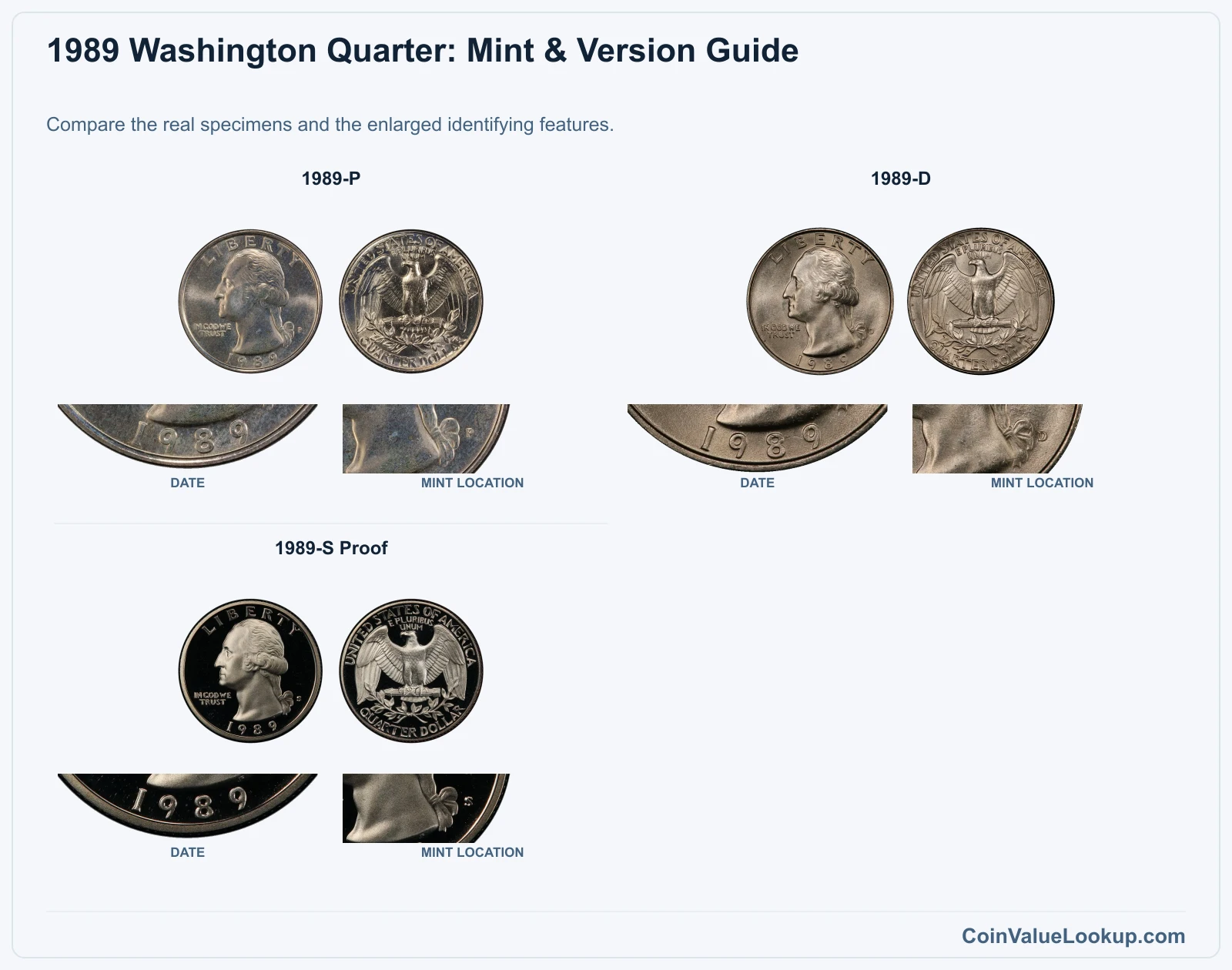
Three versions exist for 1989. Flip the coin to the obverse and look near the date, just behind Washington's ponytail.
A "P" means Philadelphia, a "D" means Denver, and an "S" means San Francisco proof. There is no blank-mintmark Philadelphia variety for this year, so every business strike will carry a P or D.
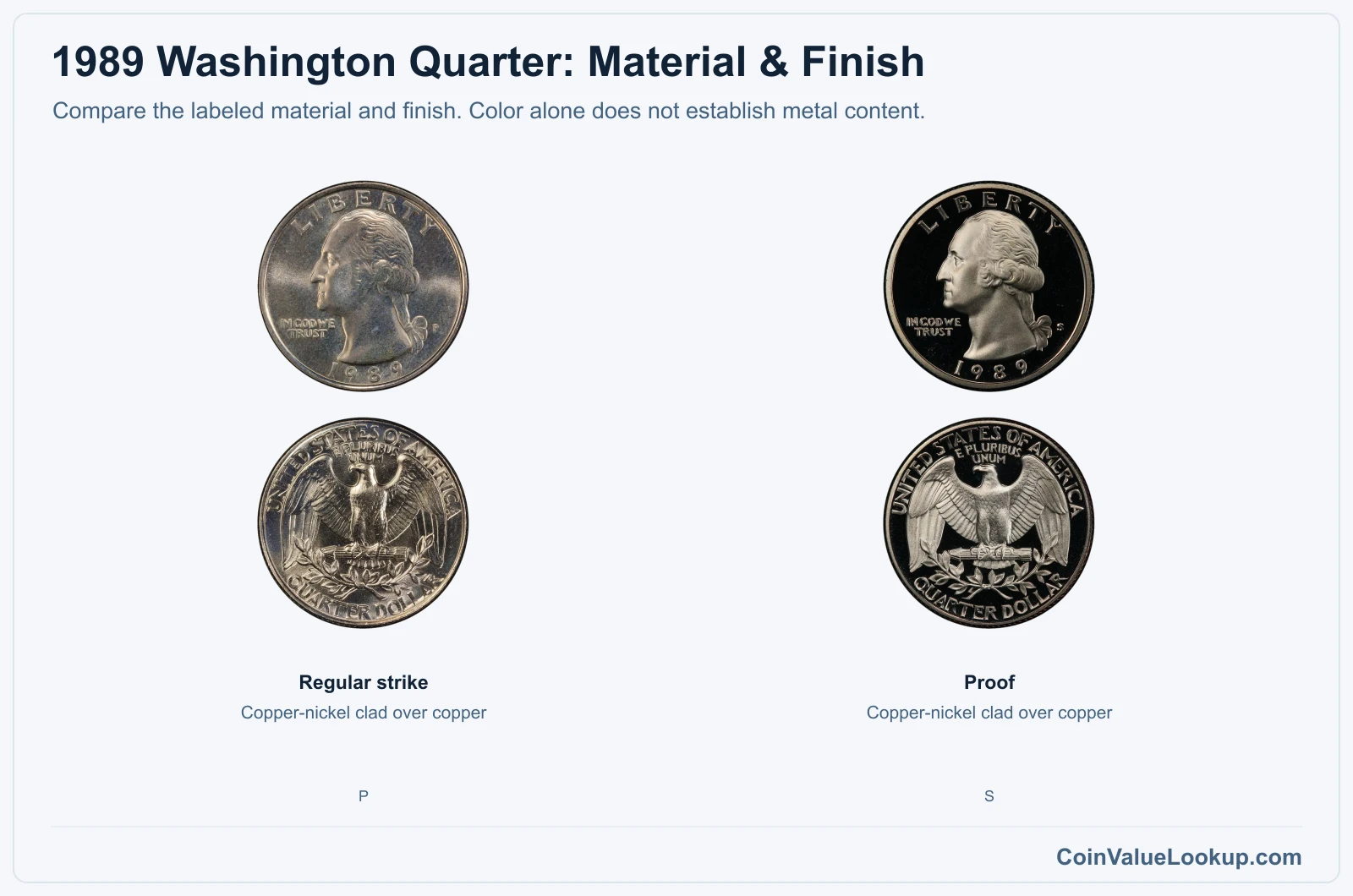
All three are copper-nickel clad, not silver. The standard specs are about 24.3 mm diameter and a nominal weight of 5.67 grams.
If you see a copper-colored edge stripe, that is normal for clad quarters. The obverse shows Washington's profile; the reverse features an eagle clutching arrows and olive branches.
Separating a proof from a business strike is straightforward. Proofs have mirror-like fields and sharp, squared-off rims — they were sold in sealed sets, not released into circulation.
DCAM (deep cameo) describes a contrast between frosted devices and reflective fields; it is a surface characteristic, not a different metal.
Step 2: Check Your 1989 Washington Quarter Grade
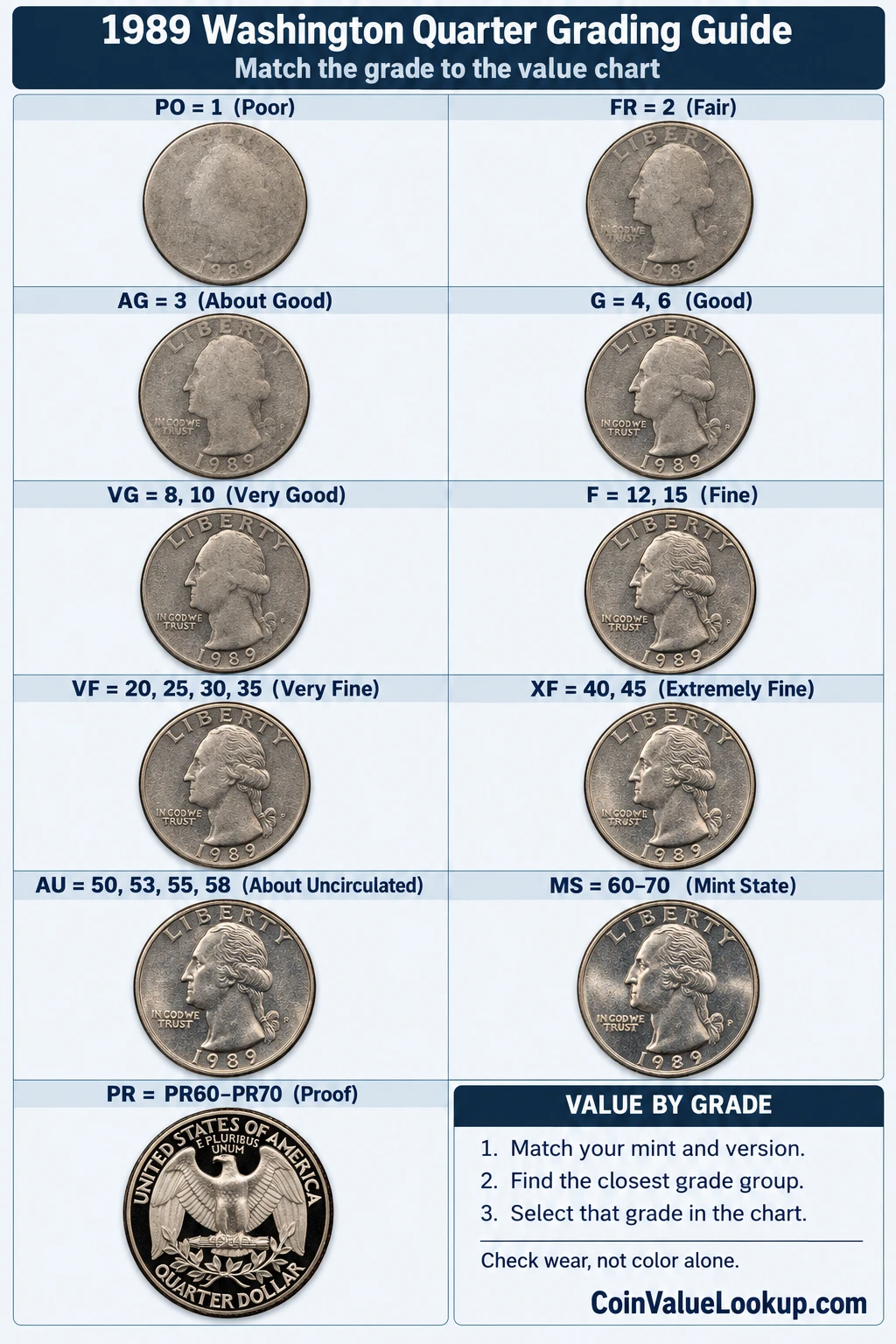
Check the hair detail above Washington's ear first — that is where rub shows up earliest. The cheekbone and jawline lose definition next.
On the reverse, the eagle's breast feathers flatten with wear before other details.
Compare your coin to the reference image at matching angles. You are looking for original mint luster, not just shininess.
A cleaned coin can look bright but will show fine hairlines under magnification that knock its grade and desirability.
Contact marks matter a lot on these. Bag-mark-free surfaces in the fields around Washington's portrait separate an MS65 from a lower-grade uncirculated coin.
For proofs, any haze or hairlines from mishandling reduce the grade quickly.
Step 3: Check 1989 Washington Quarter Value by Mint and Version
1989 Washington Quarter — P
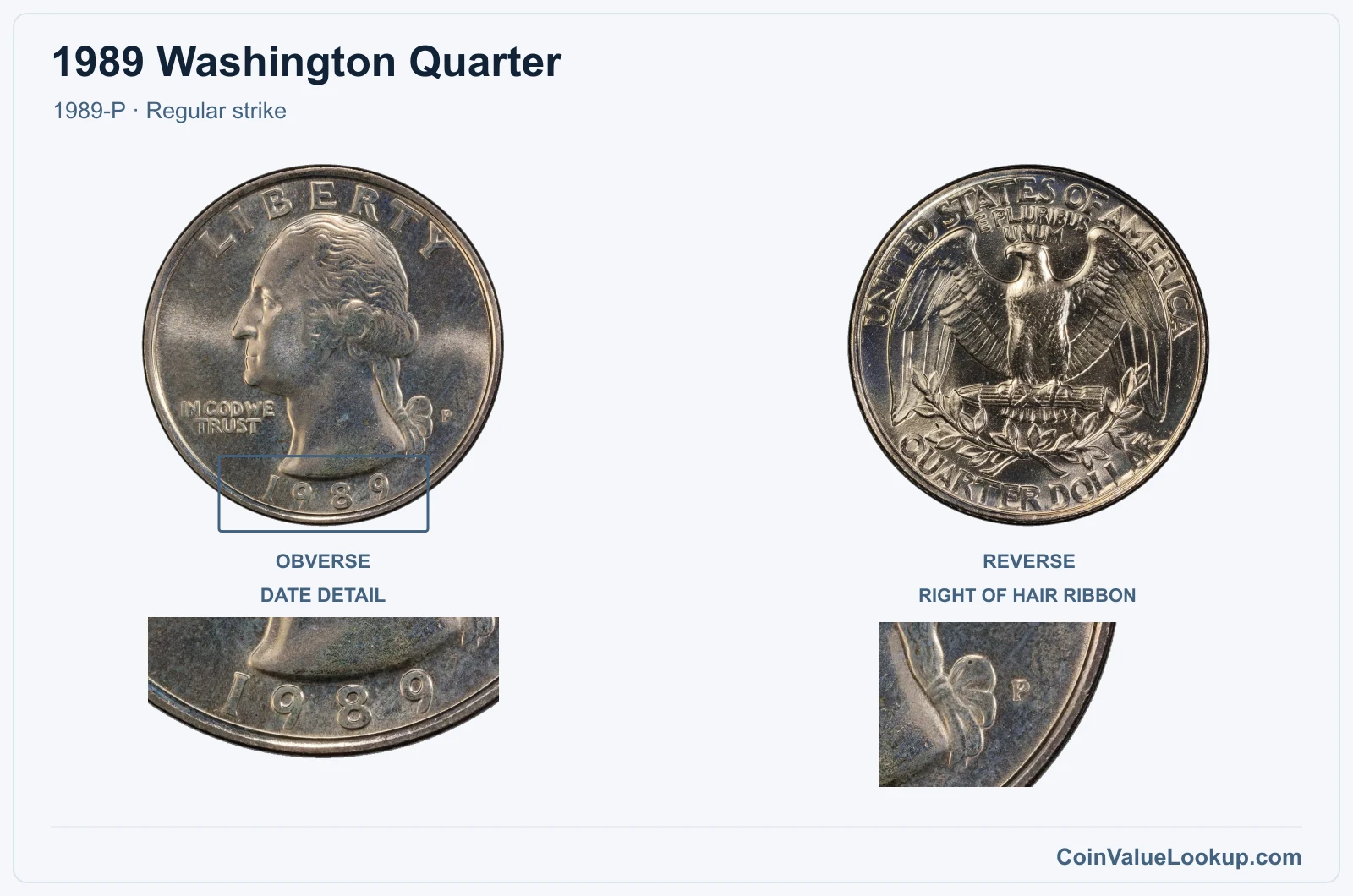
The 1989-P is the Philadelphia business strike, identifiable by the small "P" mintmark near the date. These were produced in large numbers and most went straight into commerce, where they picked up the usual dings.
Philadelphia coins from this year are especially prone to contact marks, which is why truly clean examples stand out.
A USA Coin Book guide estimate places an MS65 around $15. That sounds modest, but finding one that actually grades MS65 — with full original luster and minimal field marks — is harder than it sounds.
Worn examples are worth face value.
| Range | Grade | Price | Auction Records | Appraisal |
|---|---|---|---|---|
| PO | PO 1 | — | Coin Identifier | |
| FR | FR 2 | — | Coin Identifier | |
| AG | AG 3 | — | Coin Identifier | |
| G | G 4 | — | Coin Identifier | |
| G 6 | — | Coin Identifier | ||
| VG | VG 8 | — | Coin Identifier | |
| VG 10 | — | Coin Identifier | ||
| F | F 12 | — | Coin Identifier | |
| F 15 | — | Coin Identifier | ||
| VF | VF 20 | — | Coin Identifier | |
| VF 25 | — | Coin Identifier | ||
| VF 30 | — | Coin Identifier | ||
| VF 35 | — | Coin Identifier | ||
| XF | XF 40 | — | Coin Identifier | |
| XF 45 | — | Coin Identifier | ||
| AU | AU 50 | — | Coin Identifier | |
| AU 53 | — | Coin Identifier | ||
| AU 55 | — | Coin Identifier | ||
| AU 58 | — | Coin Identifier | ||
| MS | MS 60 | — | Coin Identifier | |
| MS 61 | — | Coin Identifier | ||
| MS 62 | — | Coin Identifier | ||
| MS 63 | — | Coin Identifier | ||
| MS 64 | — | Coin Identifier | ||
| MS 65 | Coin Identifier | |||
| MS 66 | Coin Identifier | |||
| MS 67 | Coin Identifier | |||
| MS 68 | — | — | — | |
| MS 69 | — | — | — | |
| MS 70 | — | — | — |
1989 Washington Quarter — D
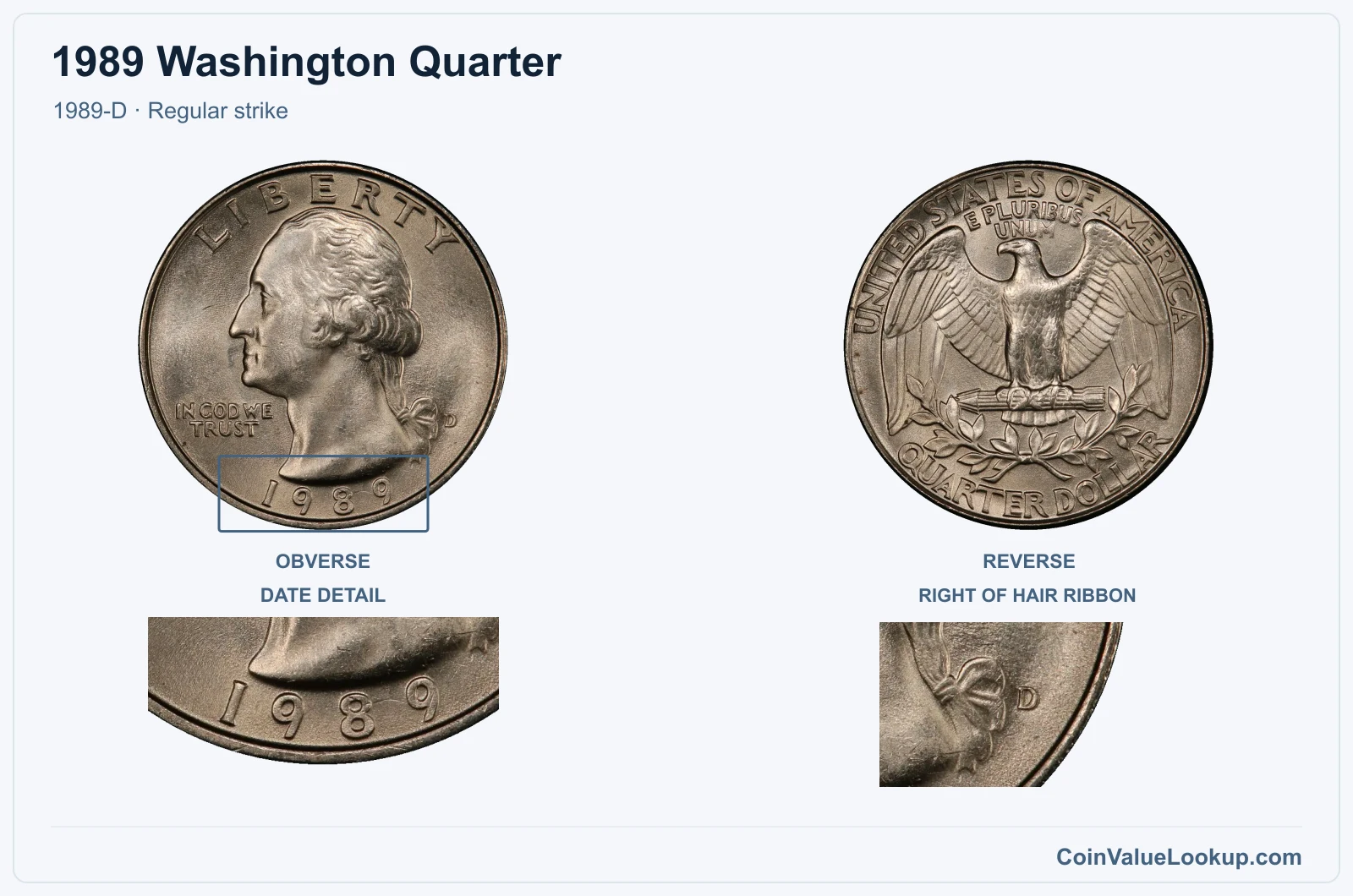
The 1989-D carries a "D" mintmark and was struck at the Denver facility. Same copper-nickel clad composition and Washington/eagle design as the P-mint coin.
A USA Coin Book guide estimate for MS65 is about $8.64, which is lower than the Philadelphia version at the same grade. Denver coins from this year tend to be a bit easier to find in clean condition, which keeps the premium modest.
Circulated pieces are still just quarters.
Coin Value Lookup is a handy place to look up guides for other dates and denominations if you are working through a jar of change or a starter collection.
| Range | Grade | Price | Auction Records | Appraisal |
|---|---|---|---|---|
| PO | PO 1 | — | Coin Identifier | |
| FR | FR 2 | — | Coin Identifier | |
| AG | AG 3 | — | Coin Identifier | |
| G | G 4 | — | Coin Identifier | |
| G 6 | — | Coin Identifier | ||
| VG | VG 8 | — | Coin Identifier | |
| VG 10 | — | Coin Identifier | ||
| F | F 12 | — | Coin Identifier | |
| F 15 | — | Coin Identifier | ||
| VF | VF 20 | — | Coin Identifier | |
| VF 25 | — | Coin Identifier | ||
| VF 30 | — | Coin Identifier | ||
| VF 35 | — | Coin Identifier | ||
| XF | XF 40 | — | Coin Identifier | |
| XF 45 | — | Coin Identifier | ||
| AU | AU 50 | — | Coin Identifier | |
| AU 53 | — | Coin Identifier | ||
| AU 55 | — | Coin Identifier | ||
| AU 58 | — | Coin Identifier | ||
| MS | MS 60 | — | Coin Identifier | |
| MS 61 | — | Coin Identifier | ||
| MS 62 | — | Coin Identifier | ||
| MS 63 | — | Coin Identifier | ||
| MS 64 | Coin Identifier | |||
| MS 65 | Coin Identifier | |||
| MS 66 | Coin Identifier | |||
| MS 67 | Coin Identifier | |||
| MS 68 | — | — | — | |
| MS 69 | — | — | — | |
| MS 70 | — | — | — |
1989 Washington Quarter — S Proof
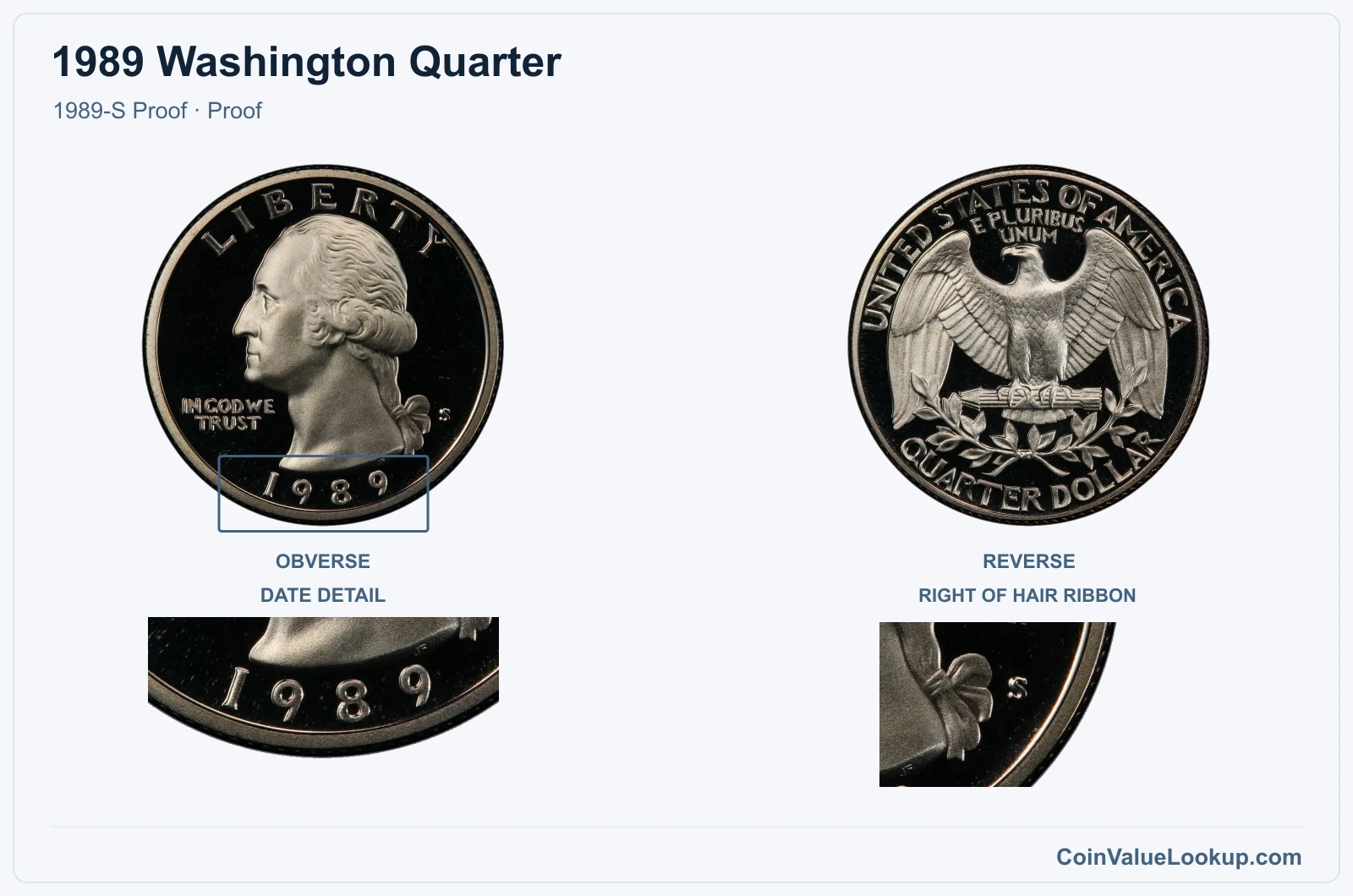
The 1989-S proof was struck at San Francisco exclusively for collector sets. Look for the "S" mintmark near the date, mirror-finish fields, and crisp squared rims.
These were not released into circulation.
A USA Coin Book guide estimate for PR65 is about $4.96. This is the standard clad proof — copper-nickel clad, same as the business strikes.
DCAM (deep cameo) is a separate contrast designation, not a different alloy, and this guide figure does not represent a DCAM coin. There is no silver proof in this series for 1989.
If someone offers you a "silver proof" 1989-S quarter, that is a red flag.
| Range | Grade | Price | Auction Records | Appraisal |
|---|---|---|---|---|
| PR | PR 1 | — | Coin Identifier | |
| PR 2 | — | Coin Identifier | ||
| PR 3 | — | Coin Identifier | ||
| PR 4 | — | Coin Identifier | ||
| PR 6 | — | Coin Identifier | ||
| PR 8 | — | Coin Identifier | ||
| PR 10 | — | Coin Identifier | ||
| PR 12 | — | Coin Identifier | ||
| PR 15 | — | Coin Identifier | ||
| PR 20 | — | Coin Identifier | ||
| PR 25 | — | Coin Identifier | ||
| PR 30 | — | Coin Identifier | ||
| PR 35 | — | Coin Identifier | ||
| PR 40 | — | Coin Identifier | ||
| PR 45 | — | Coin Identifier | ||
| PR 50 | — | Coin Identifier | ||
| PR 53 | — | Coin Identifier | ||
| PR 55 | — | Coin Identifier | ||
| PR 58 | — | Coin Identifier | ||
| PR 60 | — | Coin Identifier | ||
| PR 61 | — | Coin Identifier | ||
| PR 62 | — | Coin Identifier | ||
| PR 63 | — | Coin Identifier | ||
| PR 64 | — | Coin Identifier | ||
| PR 65 | — | Coin Identifier | ||
| PR 66 | — | Coin Identifier | ||
| PR 67 | — | Coin Identifier | ||
| PR 68 | Coin Identifier | |||
| PR 69 | Coin Identifier | |||
| PR 70 | Coin Identifier |
1989 Washington Quarter Error List
1. 1989 Washington Quarter — Off-Center Strike
An off-center strike happens when the planchet is not seated properly in the collar during striking, so part of the design shifts toward one side and a blank crescent appears on the opposite edge. Both sides show the displacement.
For the 1989-P, a 20% off-center example graded NGC MS66 sold for $329 at Heritage Auctions in February 2016. That price reflected both the degree of offset and the high grade.
The date and mintmark need to be visible for the coin to be properly attributed, which is a major factor in value.
Do not confuse post-mint damage — filing, hammering or cutting the edge — with a genuine off-center strike. A real one shows original strike surfaces and consistent displacement on both sides.
2. 1989 Washington Quarter — Broadstrike with Partial Brockage
A broadstrike with partial brockage occurs when the coin strikes without the collar in place (broadstrike) and simultaneously receives an impression from a previously struck coin still stuck in the press. The result is an expanded outline plus an incuse, mirror-image design element transferred onto the surface.
On the reported 1989-P example, about 30% of the obverse near the one-o'clock position shows an incuse reversed eagle — the head, neck, and wings are pressed inward. An ANACS MS63 example of this error sold for $69 at Heritage in September 2004.
Random dents or die clashes look nothing like a true brockage under magnification. The transferred design must be reversed and match an actual coin design.
Certification helps confirm authenticity on these.
3. 1989 Washington Quarter — Struck-Through Error
A struck-through error on a 1989 quarter shows a localized depression or incomplete design where foreign material — grease, metal fragments, cloth — sat between the die and planchet during striking. For the 1989-P, a filled-die variety has been reported where grease or debris filled the mintmark area, creating the appearance of a missing "P."
These are not the same as general weak strikes or worn coins. A genuine struck-through area typically has smooth, undisturbed metal in the affected zone rather than the rough texture you would see from post-mint scratches or cleaning.
Condition, the size of the affected area, and visibility all influence what a particular example might be worth. Professional attribution is the safest path for confirmation.
4. 1989 Washington Quarter — Missing Clad Layer
A missing clad layer error means one of the outer copper-nickel layers was absent from the planchet before striking. The affected side exposes the copper core, giving it a distinctly different color — usually a warm brown or reddish tone on one face, while the other face looks normal.
This has been reported for 1989 quarters. To check, compare the edge of your coin with a normal quarter.
A genuine missing-clad coin will show an uneven layer structure and weigh noticeably less than the standard 5.67 grams.
Do not confuse this with environmental toning, corrosion, or a coin that someone plated or stripped after minting. Post-mint surface removal usually leaves an uneven, rough texture that a missing-clad error does not share.
Value depends on condition and how clearly the error presents.
5. 1989 Washington Quarter — Doubled Die Obverse
A doubled die obverse on a 1989 quarter would show consistent doubling in the lettering, date, or design elements on the front of the coin. This is a die-manufacturing variety — the doubling is identical on every coin struck from that particular die.
Under magnification, look for separation or notching on obverse letters rather than a flat, shelf-like displacement. Compare against a normal 1989 quarter under the same lighting to be sure.
Machine doubling is the most common lookalike. It produces flat, shelf-like distortion and carries almost no premium.
True hub doubling shows distinct, raised secondary images. Value depends on condition and how strong the doubling is; professional attribution is recommended before assuming a premium.
6. 1989 Washington Quarter — Repunched Mintmark
A repunched mintmark has been reported on the 1989-D quarter. This variety shows remnants of an earlier mintmark position underneath or beside the final "D" — essentially, the punch was applied more than once in slightly different positions.
You will need at least 5x to 10x magnification to spot this. Look carefully at the edges of the D mintmark for traces of a secondary impression.
Compare to a normal 1989-D at the same magnification so you know what the baseline looks like.
Die chips, corrosion around the mintmark, or machine doubling can mimic a repunched mintmark to the untrained eye. A genuine RPM shows a distinct, separate outline from a second punch, not just a fuzzy edge.
Condition and clarity of the repunching affect value.
7. 1989 Washington Quarter — Doubled Die Reverse
A doubled die reverse has been reported for the 1989 quarter. This would appear as consistent doubling in the reverse legends, eagle design, or other elements — the same doubling present on every coin from that die.
To check, compare the reverse lettering and design contours of your coin against a known normal example under the same lighting and magnification. True hub doubling creates raised, separated secondary images rather than the flat displacement typical of machine doubling.
Reflections, random nicks, and machine doubling are the usual false positives. Machine doubling is especially common on high-mintage dates like 1989.
Value depends on condition and the strength of the doubling, so professional attribution is a good idea before drawing conclusions.
8. 1989 Washington Quarter — Clipped Planchet
A clipped planchet error on a 1989 quarter means a portion of the blank was missing before the coin was struck. The reported type is a small, curved clip — a crescent-shaped absence along the rim where the blank overlapped a previously punched hole in the strip.
Look for a smooth, curved missing section with original edge texture. The area directly opposite the clip often shows slight design weakness, called the Blaine-Maris effect, which helps confirm authenticity.
A filed notch, deliberate edge cut, or corrosion-eaten rim will usually show rough, uneven surfaces that differ from the smooth contour of a genuine clip. Weigh the coin — a clipped quarter should be slightly under 5.67 grams.
Value depends on the clip size, coin condition, and overall eye appeal.
9. 1989 Washington Quarter — Die Crack / Die Chip
Die cracks and die chips have been reported on 1989 quarters. A die crack shows up as a thin raised line on the coin's surface, tracing a fracture in the die.
A die chip appears as a small raised blob where a piece of the die broke away. If a crack reaches the rim and produces a raised lump of metal, that is called a cud.
These are easy to spot once you know what you are looking at — raised, not incuse. Scratches go into the surface; die cracks sit above it.
Minor die cracks are common on high-production dates and typically carry small premiums at best.
Value depends on the size, location, and visual impact of the crack or chip. Larger cuds connected to the rim tend to be more collectible than tiny interior cracks.
Condition and the coin's overall grade also matter.