1965 Washington Quarter Coin Value: How Much Is It Worth?
Most 1965 Washington quarters you will find in pocket change are worth face value — 25 cents. This was the first year the U.S. Mint struck quarters on copper-nickel clad planchets instead of 90% silver.
In higher uncirculated condition, a USA Coin Book guide estimate places an MS65 business strike around $11. The real excitement comes from errors and the Special Mint Set finish, which can push values considerably higher.
Fast Way to Identify Your 1965 Washington Quarter
Snap a clear photo of both sides of your 1965 quarter and upload them here for a preliminary identification. The images help distinguish a standard business strike from an SMS coin, and they can flag visible characteristics consistent with known error types.
This is not a substitute for professional authentication, but it is a solid first step.
1965 Washington Quarter Value
Upload both sides of your 1965 Washington Quarter.
Front Obverse
Upload photo
Back Reverse
Upload photo
Which 1965 Washington Quarter Versions Are Worth Money?
- A 1965 quarter struck on a leftover 90% silver planchet is a rare transitional error — one PCGS XF45 example sold for $9,300 at Heritage Auctions in July 2022.
- The 1965 SMS Special Strike quarter commands a premium over business strikes; value depends on authenticated finish, condition and any errors present.
- Wrong-planchet errors such as strikes on dime or five-cent blanks have sold at Heritage for several hundred dollars each in certified grades.
- A 25% off-center strike on a 1965 clad quarter brought $180 in NGC MS65 at a December 2025 Heritage auction.
- An SMS coin struck 10% off center and out of collar realized $312 in PCGS SP63 at Heritage in April 2020.
Step 1: Identify Your 1965 Washington Quarter Mint Mark and Version
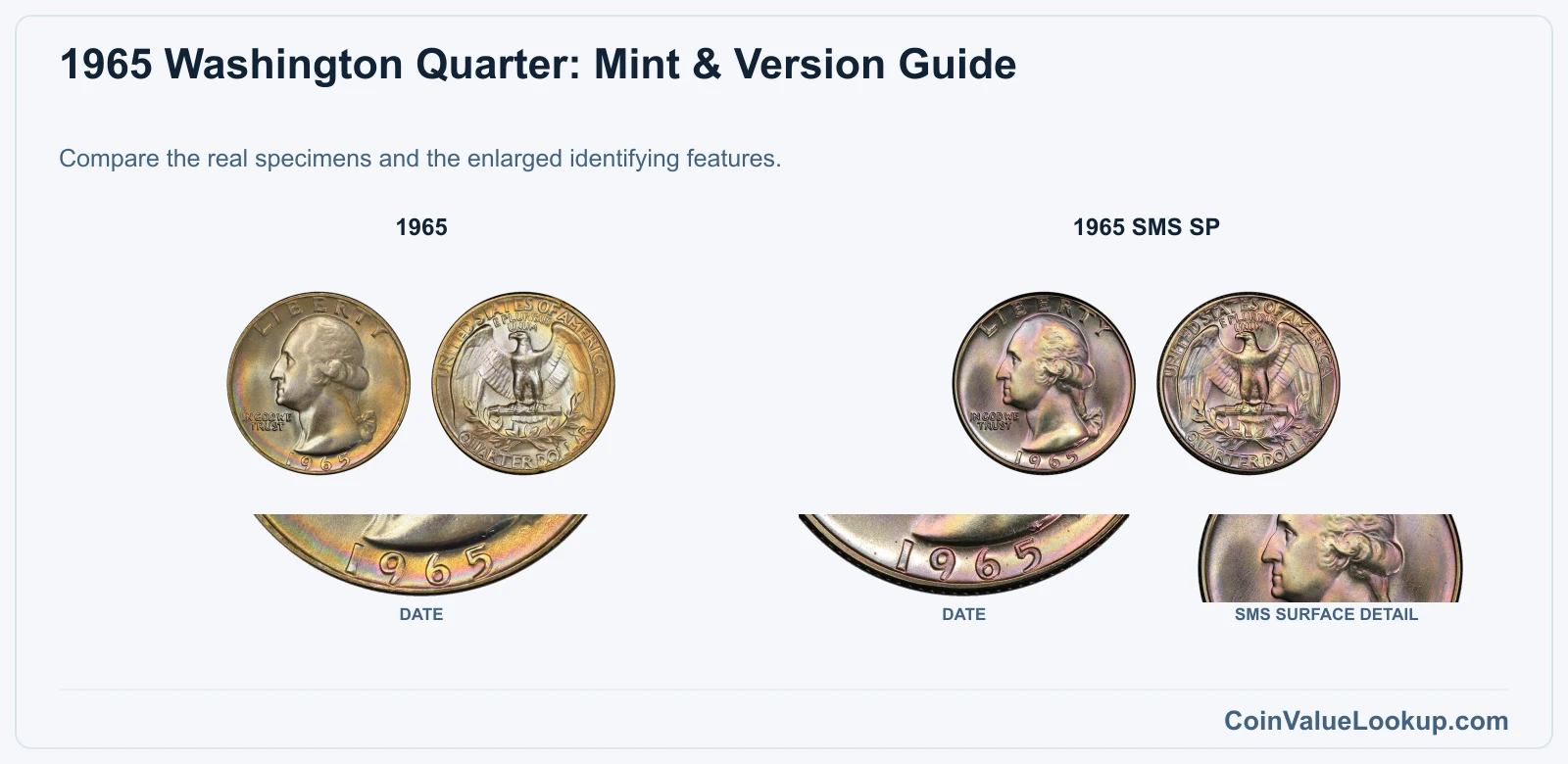
The 1965 quarter has no mintmark, and that is completely normal. From 1965 through 1967, the Mint suppressed all mintmark usage, so a blank space below the wreath on the reverse does not indicate Philadelphia or any other specific facility.
Do not treat the missing letter as an error.
The coin is struck on a copper-nickel clad planchet with an overall composition of 91.67% copper and 8.33% nickel, weighing about 5.67 grams with a diameter of roughly 24.3 mm. If you look at the edge, you should see a visible copper core sandwiched between silvery outer layers.
That copper stripe is the quickest way to confirm a normal clad coin versus something unusual.
There are two legitimate finish categories for 1965 quarters: regular business strikes and Special Mint Set coins. No standard proof quarter exists for this year.
The 90% silver wrong-planchet quarter is a rare transitional error, not a version you can simply pick up at a coin shop. Authentication by a grading service is essential for any silver-planchet claim — color alone is not proof of alloy.
Step 2: Check Your 1965 Washington Quarter Grade
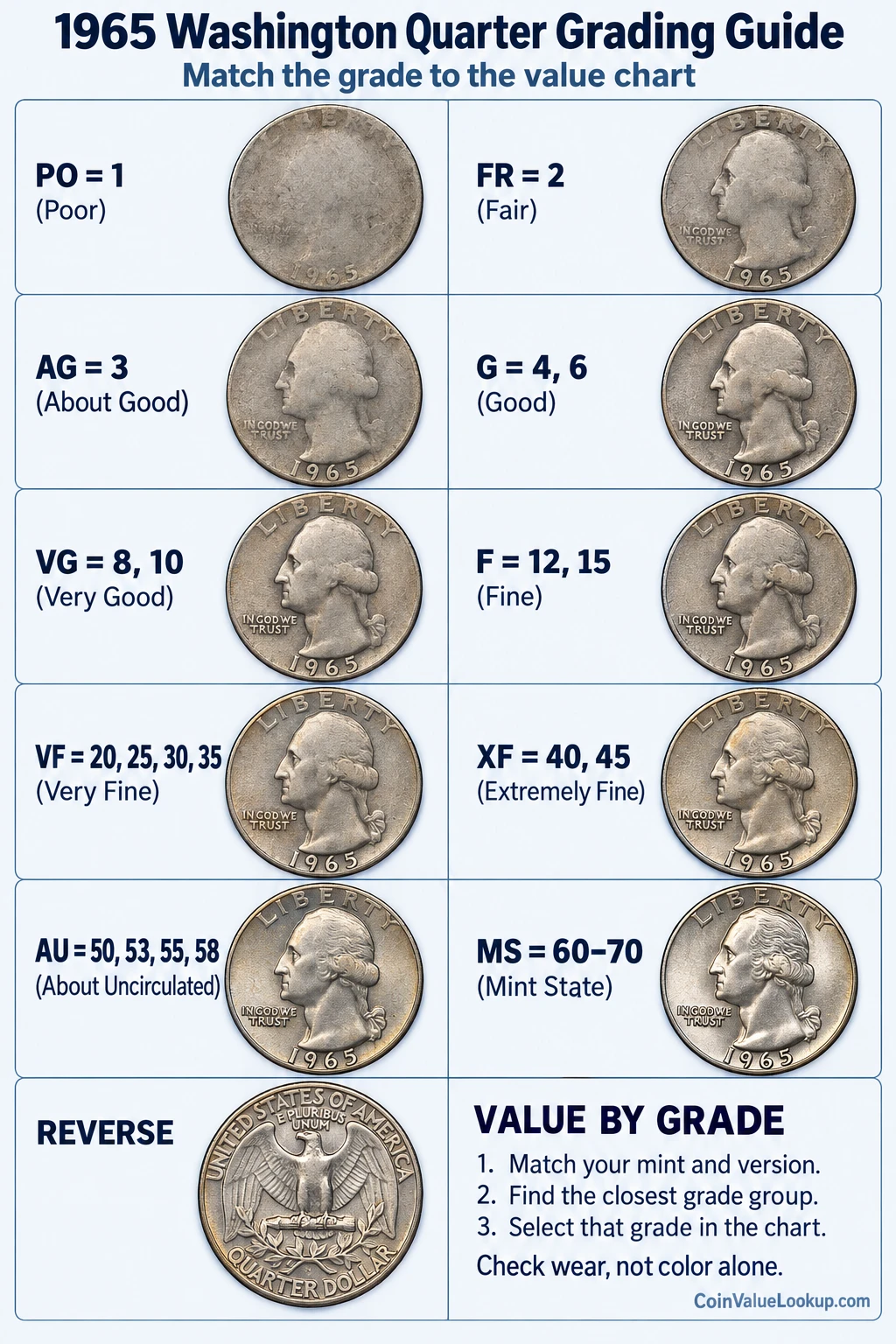
Start by checking Washington's hair detail just above the ear. On a well-worn coin, this area goes flat first, followed by the cheekbone and jawline.
Flip it over and examine the eagle's breast feathers — they lose definition quickly with circulation.
Luster matters as much as detail. A coin can show full hair lines but have dull, lifeless surfaces from cleaning or environmental damage, and that kills collector appeal.
Compare your coin's surface to the grading comparison image to gauge where it falls.
Hairlines from wiping, contact marks from other coins, and rim dings all drag down the grade. Be honest with yourself: a polished coin is not an SMS coin, and rubbing a quarter with a cloth does not upgrade it.
SMS and special-strike coins should be evaluated for their distinctive satin or reflective finish, which is a product of manufacture, not post-mint treatment.
Step 3: Check 1965 Washington Quarter Value by Mint and Version
1965 Washington Quarter
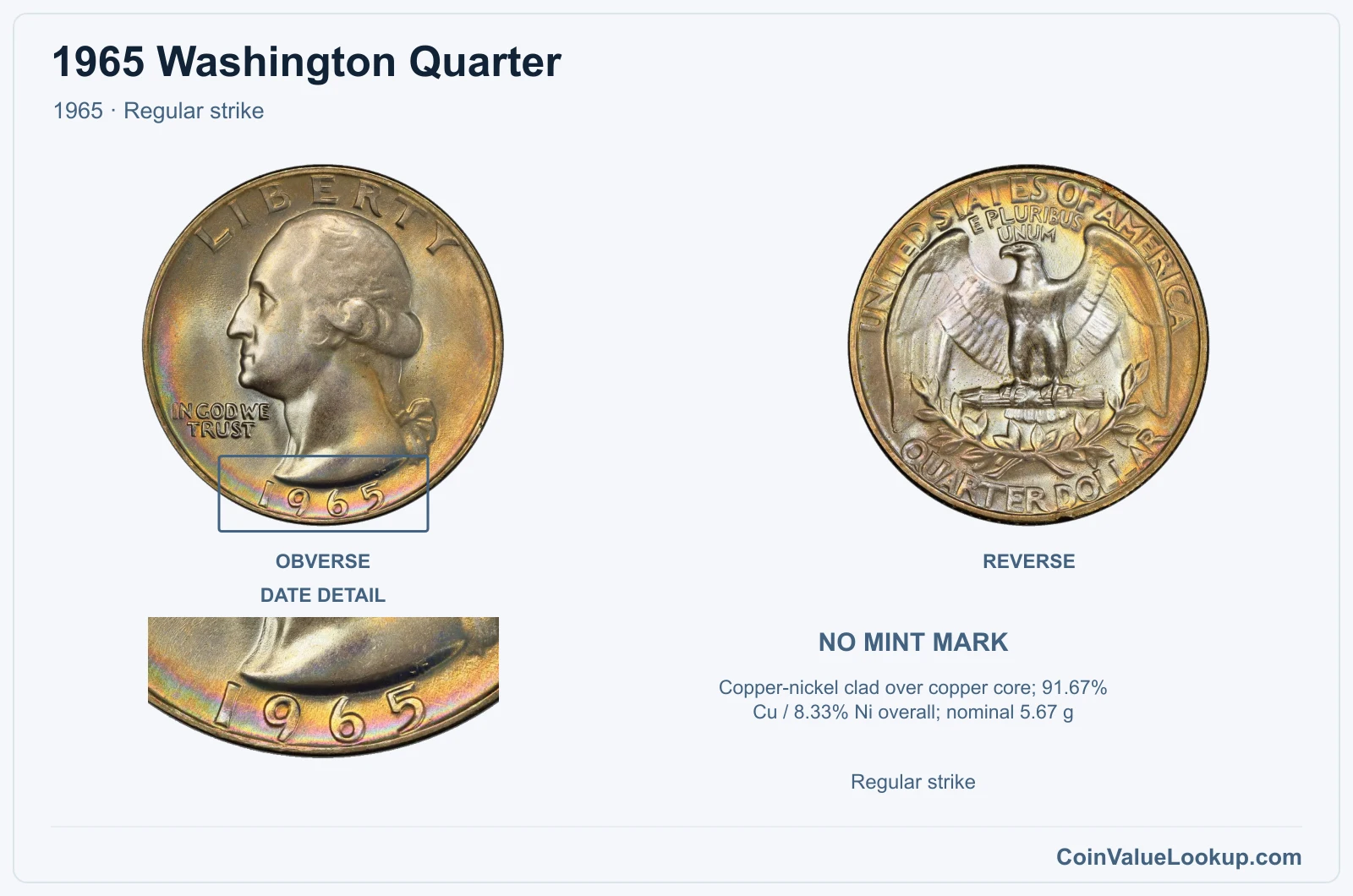
The 1965 business-strike quarter is the workhorse of this year's production — billions were made. It carries the standard Washington obverse and eagle-with-arrows-and-olive-branches reverse.
No mintmark appears below the wreath, and that blank space is shared by every 1965 quarter regardless of which facility struck it.
In circulated grades these trade at face value. A USA Coin Book guide estimate puts an MS65 example at about $11.
To reach that level, a coin needs full original luster, no distracting contact marks, and sharp design details. Most survivors you pull from rolls will grade lower.
Coin Value Lookup is a handy starting point if you want to look up guide values for other years or denominations in the Washington quarter series.
| Range | Grade | Price | Auction Records | Appraisal |
|---|---|---|---|---|
| PO | PO 1 | — | Coin Identifier | |
| FR | FR 2 | — | Coin Identifier | |
| AG | AG 3 | — | Coin Identifier | |
| G | G 4 | — | Coin Identifier | |
| G 6 | — | Coin Identifier | ||
| VG | VG 8 | — | Coin Identifier | |
| VG 10 | — | Coin Identifier | ||
| F | F 12 | — | Coin Identifier | |
| F 15 | — | Coin Identifier | ||
| VF | VF 20 | — | Coin Identifier | |
| VF 25 | — | Coin Identifier | ||
| VF 30 | — | Coin Identifier | ||
| VF 35 | — | Coin Identifier | ||
| XF | XF 40 | — | Coin Identifier | |
| XF 45 | — | Coin Identifier | ||
| AU | AU 50 | — | Coin Identifier | |
| AU 53 | — | Coin Identifier | ||
| AU 55 | — | Coin Identifier | ||
| AU 58 | — | Coin Identifier | ||
| MS | MS 60 | — | Coin Identifier | |
| MS 61 | — | Coin Identifier | ||
| MS 62 | — | Coin Identifier | ||
| MS 63 | Coin Identifier | |||
| MS 64 | — | Coin Identifier | ||
| MS 65 | Coin Identifier | |||
| MS 66 | Coin Identifier | |||
| MS 67 | Coin Identifier | |||
| MS 68 | Coin Identifier | |||
| MS 69 | — | — | — | |
| MS 70 | — | — | — |
1965 Washington Quarter — SMS SP
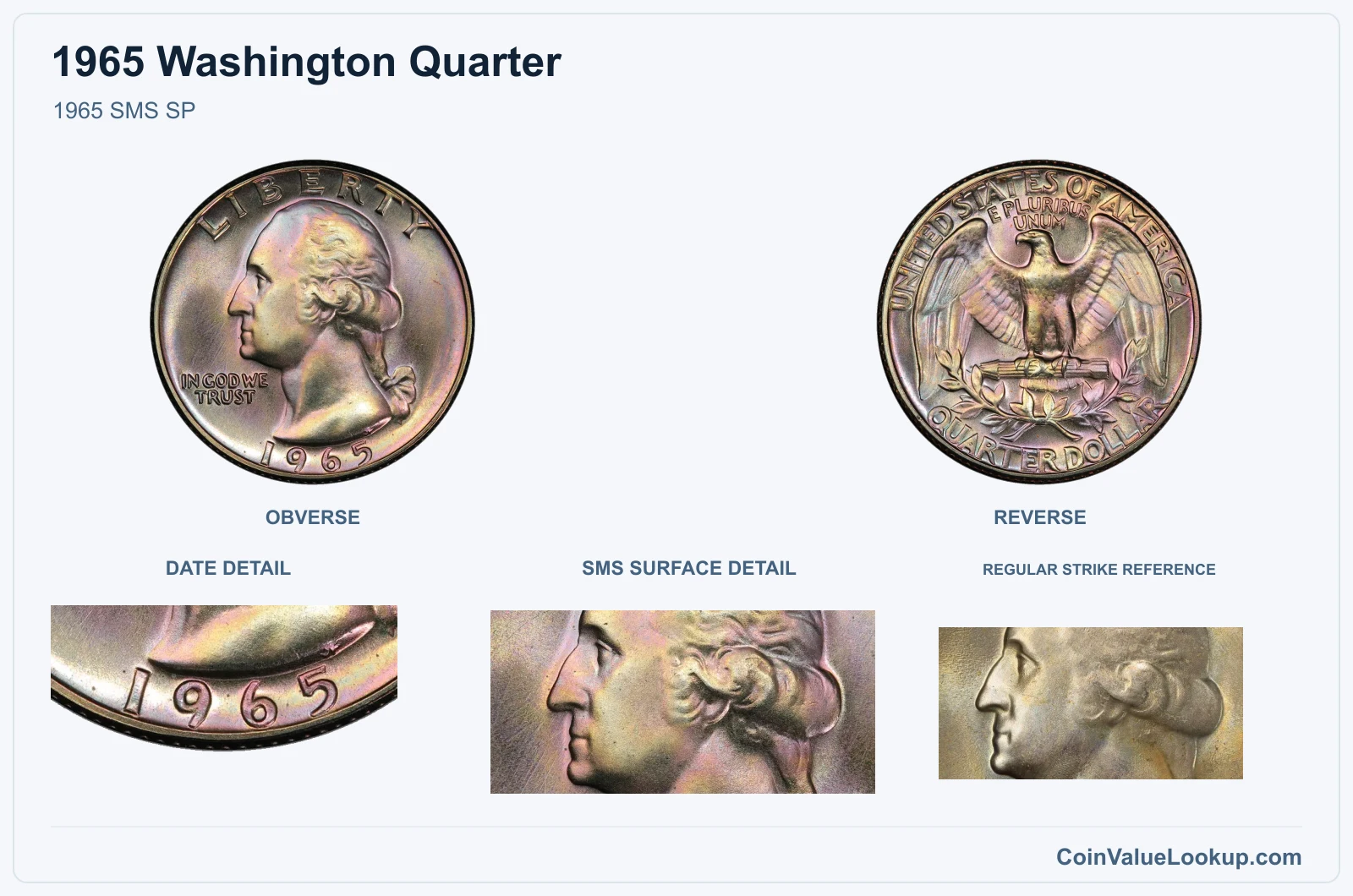
The 1965 SMS (Special Mint Set) quarter was sold in sealed government sets as a replacement for the proof sets suspended that year. These coins have a distinctive finish — often a satin or lightly reflective surface that differs clearly from ordinary business strikes under good lighting.
Authentication matters here, because a polished circulation coin can fool beginners.
No supported numeric price range is adopted for the SMS issue. Value depends heavily on the authenticated finish, the specific grade assigned by a service like PCGS or NGC, and whether any error is present.
A raw coin claimed as SMS without third-party attribution carries much less market confidence. If your coin has unusually sharp rims and a finish that looks "too nice" for a regular strike, professional grading is the logical next step.
| Range | Grade | Price | Auction Records | Appraisal |
|---|---|---|---|---|
| SP | SP 1 | — | Coin Identifier | |
| SP 2 | — | Coin Identifier | ||
| SP 3 | — | Coin Identifier | ||
| SP 4 | — | Coin Identifier | ||
| SP 6 | — | Coin Identifier | ||
| SP 8 | — | Coin Identifier | ||
| SP 10 | — | Coin Identifier | ||
| SP 12 | — | Coin Identifier | ||
| SP 15 | — | Coin Identifier | ||
| SP 20 | — | Coin Identifier | ||
| SP 25 | — | Coin Identifier | ||
| SP 30 | — | Coin Identifier | ||
| SP 35 | — | Coin Identifier | ||
| SP 40 | — | Coin Identifier | ||
| SP 45 | — | Coin Identifier | ||
| SP 50 | — | Coin Identifier | ||
| SP 53 | — | Coin Identifier | ||
| SP 55 | — | Coin Identifier | ||
| SP 58 | — | Coin Identifier | ||
| SP 60 | — | Coin Identifier | ||
| SP 61 | — | Coin Identifier | ||
| SP 62 | — | Coin Identifier | ||
| SP 63 | — | Coin Identifier | ||
| SP 64 | — | Coin Identifier | ||
| SP 65 | Coin Identifier | |||
| SP 66 | Coin Identifier | |||
| SP 67 | Coin Identifier | |||
| SP 68 | Coin Identifier | |||
| SP 69 | — | — | — | |
| SP 70 | — | — | — |
1965 Washington Quarter Error List
1. 1965 Washington Quarter — Struck on a 90% Silver Planchet
This is the headline error for 1965 quarters: a coin struck on a leftover 90% silver planchet from 1964 production. The older silver blank weighs about 6.25 grams versus the standard 5.67 grams for clad, so a precise scale is your first diagnostic tool.
Look at the edge. A genuine silver-planchet quarter has a uniform silver-colored edge with no copper core visible.
But a plated clad coin can hide its copper layer too, so edge color alone is not enough. Third-party certification with alloy testing is non-negotiable for this claim.
A PCGS XF45 example sold for $9,300 at Heritage Auctions in July 2022. Post-mint filing, corrosion, hammering or plating can all produce a similar look.
If you think you have one, send it to a grading service before celebrating.
2. 1965 Washington Quarter — Off-Center SMS Strike
An off-center SMS strike combines two collecting categories into one coin. The documented example was struck about 10% off center and outside the collar, producing an expanded irregular outline while retaining most of the peripheral lettering and the special-strike finish.
A PCGS SP63 specimen sold for $312 at Heritage Auctions in April 2020. The key is confirming both the SMS identity and the genuine off-center displacement.
Post-mint damage like filing or hammering can create odd shapes, but it will not reproduce the smooth blank crescent and uninterrupted metal flow of a real off-center strike. Look for consistent luster across the struck area and a clean unstruck margin.
3. 1965 Washington Quarter — 25% Off-Center Strike
A 25% off-center strike means the planchet was misaligned enough that a full quarter of the design is missing, replaced by a smooth blank crescent. The struck portion should show intact clad edge and unbroken luster where the dies actually contacted the metal.
Measure the displacement from the center of the design to confirm the percentage. A coin that was bent, squeezed in a vise, or hit on the rim is not an off-center strike.
Heritage Auctions lot 53075 records an NGC MS65 example at $180 in December 2025. These are collectible but not ultra-rare, so condition and visual appeal drive the premium.
4. 1965 Washington Quarter — Struck on a Clad Dime Planchet
When a clad dime blank wandered into the quarter press, the result was a dramatically undersized coin weighing only about 2.2 grams. The quarter dies are much larger than the dime planchet, so parts of LIBERTY, the date and the denomination get cut off at the edges.
Confirm this by checking diameter and weight — the coin should be dime-sized, not quarter-sized. A clipped quarter is still quarter-diameter with a bite missing; a wrong-planchet strike is uniformly small all the way around.
Heritage Auctions lot 5335 records an NGC AU58 example that sold for $431.25 in April 2006. Do not confuse this with post-mint grinding or cutting.
5. 1965 Washington Quarter — Struck on a Five-Cent Planchet
Similar concept, different blank: a five-cent (nickel) planchet weighing about 5.0 grams ended up under the quarter dies. The nickel blank is smaller in diameter than a quarter, so the full design gets compressed and peripheral legends are distorted or missing entirely.
Because both the nickel and the clad quarter have a silvery appearance, color alone proves nothing. You need precise weight and diameter measurements.
Heritage Auctions lot 5336 records an NGC MS62 example that sold for $373.75 in April 2006. Post-mint filing or hammering can shrink a coin's apparent size, but it will also destroy the strike detail and luster that authenticate a genuine wrong-planchet coin.
6. 1965 Washington Quarter — Reverse Clad Layer Missing
On this error, one of the nickel outer layers is missing from the planchet before striking, exposing the copper core on the reverse. The obverse retains its normal silver-toned clad surface, so you get a coin that looks completely different on each side.
Heritage Auctions lot 93168 records an NGC MS63 example weighing 4.7 grams — noticeably lighter than the standard 5.67 grams because a full clad layer is absent. Toning or harsh cleaning can turn a normal reverse coppery, so weight is a critical diagnostic.
The edge should also show an asymmetric clad layer if you look carefully. Professional grading confirms the manufacturing origin versus surface alteration.
7. 1965 Washington Quarter — Broadstrike on Type-One Blank
A broadstrike happens when the collar die fails to contain the planchet during striking. The metal expands outward freely, producing a coin that is wider than normal with a smooth, featureless edge instead of the usual reeded rim.
The central design stays mostly intact.
Distinguish this from a coin that was flattened on railroad tracks or hammered after leaving the Mint. Genuine broadstrikes show natural metal flow and uninterrupted luster extending to the expanded edge.
Heritage Auctions lot 50165 lists an MS61 PCGS example of a 1965 broadstrike on a Type-One blank, though no realized price is adopted here. Condition, eye appeal and the degree of expansion all affect collector interest.
8. 1965 Washington Quarter — Doubled Die Obverse
Doubled die obverse varieties exist for the 1965 quarter. On a genuine doubled die, you will see consistent separation or notching on obverse design elements — letters, the date, or portions of Washington's profile — that repeats in the same direction across the affected area.
Do not confuse this with machine doubling, which produces flat, shelf-like distortion and carries little to no premium. Compare your coin's lettering to a known normal example under the same lighting.
No specific price range is adopted for 1965 doubled die obverse quarters because value depends on the particular die, the visibility of the doubling and the coin's overall condition. Certification by a grading service helps confirm attribution.
9. 1965 Washington Quarter — Doubled Die Reverse
Doubled die reverse varieties have also been reported for the 1965 quarter. Look at the reverse legends and the design contours — arrows, olive branches, lettering — for consistent doubling that appears in the same orientation across multiple elements.
Machine doubling and reflections from die polish can both mimic a true doubled die. The difference is that a genuine doubled die shows rounded, raised secondary images rather than flat displaced metal.
No supported price range is adopted for this category. Value hinges on which specific die pair is involved, how dramatic the doubling looks, and the grade of the coin.
10. 1965 Washington Quarter — Clipped Planchet
Clipped planchet errors occur when the blanking press overlaps a previously punched area of the metal strip, leaving a curved bite out of the coin. Straight clips and ragged clips also exist but are less common.
A genuine clip often shows a weakness in the design directly opposite the missing area, called the Blaine effect.
Do not mistake a filed edge, a cut notch or heavy corrosion for a clipping error. The key diagnostic is smooth, original metal flow at the clip boundary and corresponding weakness on the opposite side.
No specific price range is adopted for 1965 clipped quarters. The size of the clip, its visual impact and the coin's grade all influence what a collector will pay.
11. 1965 Washington Quarter — Struck-Through Error
A struck-through error occurs when foreign material — grease, a wire fragment, a cloth fiber, or another obstruction — gets trapped between the die and the planchet during striking. The result is a localized depression or incomplete design area on the finished coin.
Grease-filled die errors tend to produce soft, filled-in letters or features, while a retained foreign object leaves a sharper, more defined impression. Do not confuse normal wear, scratches from circulation, or cleaning damage with a genuine struck-through.
No price range is adopted for 1965 struck-through quarters because value varies widely based on what caused the obstruction, how dramatic it looks and the coin's condition.
12. 1965 Washington Quarter — Die Crack / Die Chip
Die cracks appear as thin raised lines on the coin's surface, created when the steel die itself develops a fracture from repeated use. A die chip is a small raised blob where a piece of the die broke away.
When a crack reaches the rim and a chunk of the die collapses, it produces a raised irregular lump called a cud.
These are all raised features because they correspond to missing metal in the die. Incuse scratches, surface corrosion or stuck debris look similar at first glance but are recessed or sitting on top of the surface rather than raised from it.
No specific price is adopted for 1965 die crack or chip varieties. Dramatic cuds with significant rim involvement tend to attract the most collector interest.