1954 Washington Quarter Coin Value: How Much Is It Worth?
A 1954 Washington Quarter is a 90% silver coin worth at least around $16.43 in well-worn condition, based on USA Coin Book guide estimates. Mint State examples can reach roughly $37 to $39 depending on the mint, and authenticated error coins have sold individually for much more.
Values are in USD and depend on condition, mint, and the coin's silver content.
Fast Way to Identify Your 1954 Washington Quarter
The quickest way to start figuring out what you have is to upload clear photos of both the front and back of your coin. Our identifier can give you a preliminary read on which version you're holding — Philadelphia, Denver, or San Francisco — based on design details and mintmark position.
It won't authenticate or certify, but it's a solid first step.
1954 Washington Quarter Value
Upload both sides of your 1954 Washington Quarter.
Front Obverse
Upload photo
Back Reverse
Upload photo
Which 1954 Washington Quarter Versions Are Worth Money?
- Philadelphia, Denver, and San Francisco business strikes plus the Philadelphia proof — each version has distinct value at higher grades.
- Original high-grade surfaces matter more than shine; a coin with full luster and minimal contact marks will outperform a cleaned example every time.
- Authenticated wrong-planchet errors, such as a quarter struck on a dime or nickel blank, have individually sold for hundreds to over a thousand dollars at auction.
- The 1954-S is a regular San Francisco issue, not an error — but in top condition it can still hold solid value around $37 at MS65 per the USA Coin Book guide.
Step 1: Identify Your 1954 Washington Quarter Mint Mark and Version
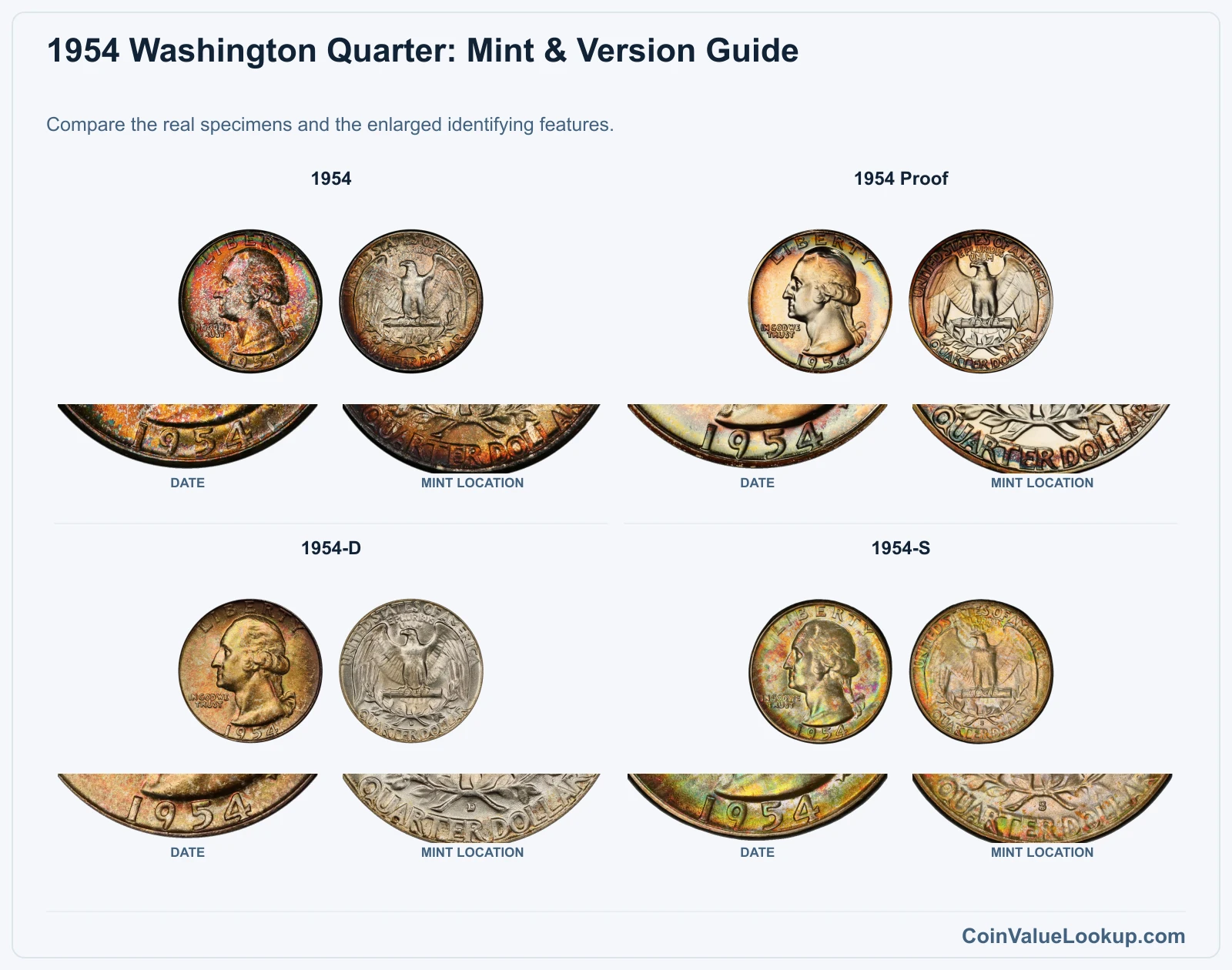
Flip your coin over. The date is on the front (obverse) beneath Washington's bust.
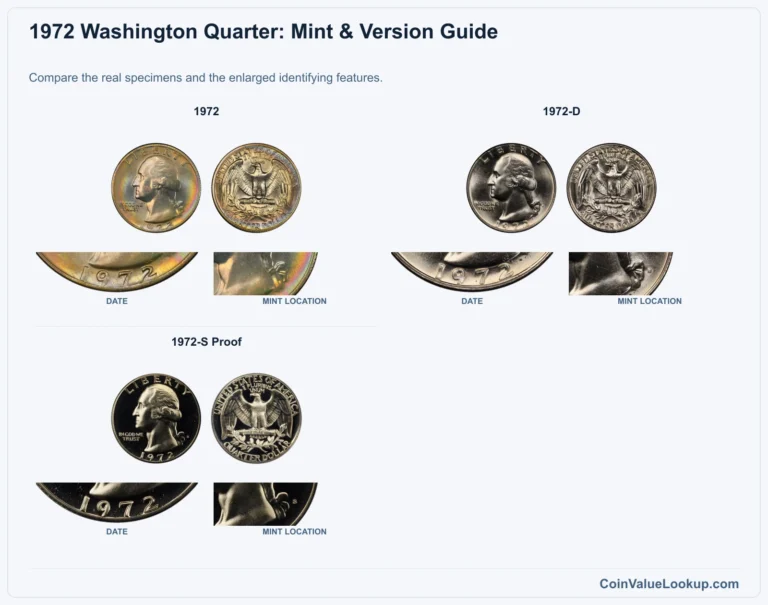
The mintmark — D or S — sits on the reverse, just below the wreath where it ties together. If there's nothing there, you have a Philadelphia strike; blank mintmark space is completely normal for this date.
All 1954 quarters share the same alloy: 90% silver and 10% copper, weighing about 6.25 grams and measuring roughly 24.3 mm across. That applies to business strikes and proofs alike.
The Philadelphia proof has mirrored fields and sharply defined detail that looks different from a business strike's frosty luster. Don't confuse a well-preserved uncirculated coin for a proof — proofs were deliberately manufactured with a mirror finish, not simply coins that avoided pocket change.
Three mints produced business strikes (Philadelphia, Denver, San Francisco) and Philadelphia also made proofs.
Step 2: Check Your 1954 Washington Quarter Grade
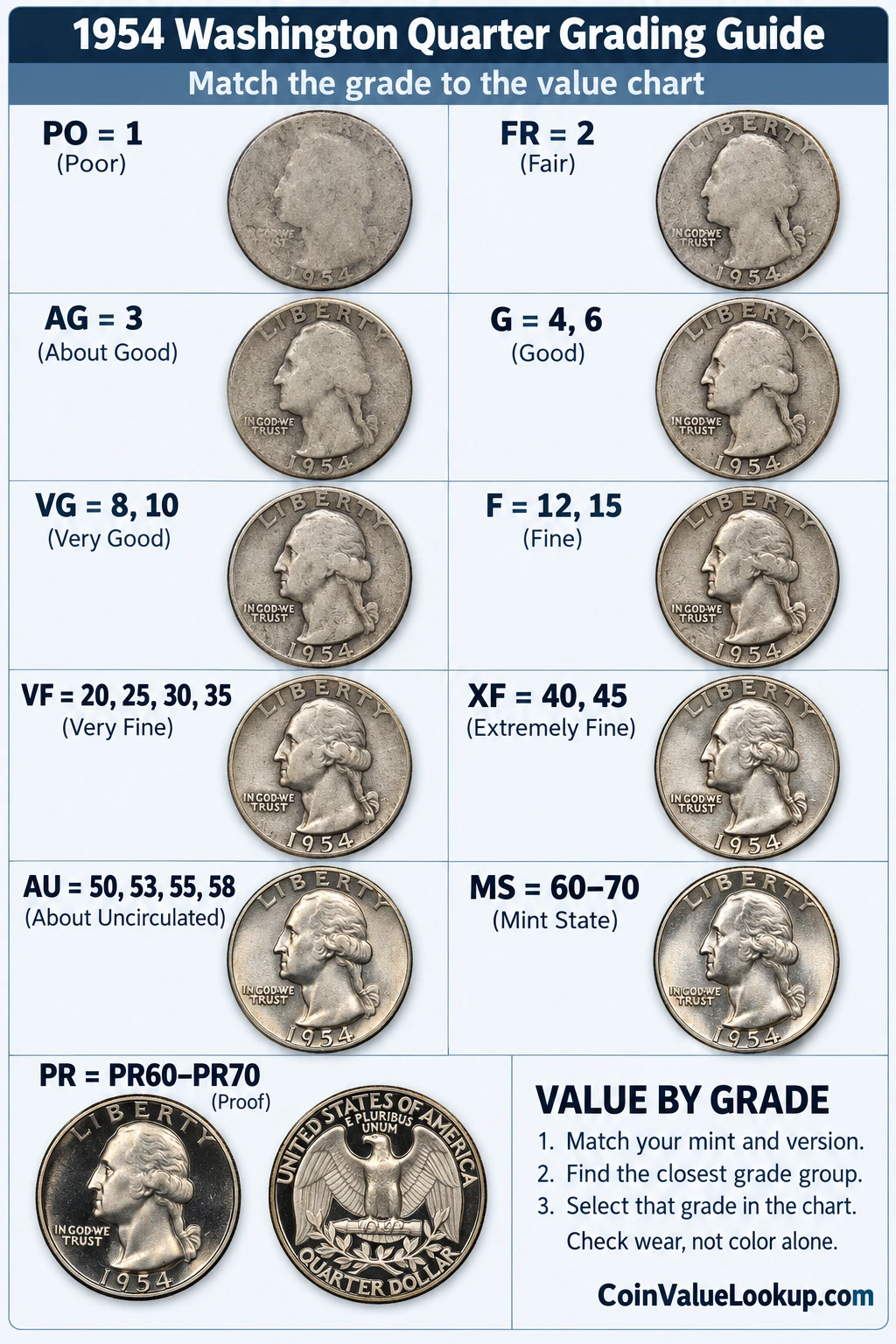
Start on the obverse. Washington's cheek, the line of his jaw, and the hair directly over his ear are the first places to lose detail.
Even light friction will dull the luster there before anywhere else on the coin.
On the reverse, examine the eagle's breast feathers and the tops of the wings. Flat spots in those areas usually confirm the wear you saw on the front.
Don't confuse a weak strike for wear. A weakly struck coin may lack fine detail but will still have unbroken luster across the surface.
Compare your coin with the reference image to see how original mint frost looks versus genuine friction.
Contact marks — little dings and nicks from other coins — are a big deal on Philadelphia issues especially. Bag marks from mint storage can drag down the grade of a coin that otherwise saw zero circulation.
Also check for cleaning hairlines under angled light; they show as fine parallel scratches that shouldn't be there.
Proof coins get their own scale. Proof contrast is a manufacturing designation, not a grade higher than Mint State.
A proof can still be low-grade if it's been mishandled.
Step 3: Check 1954 Washington Quarter Value by Mint and Version
1954 Washington Quarter
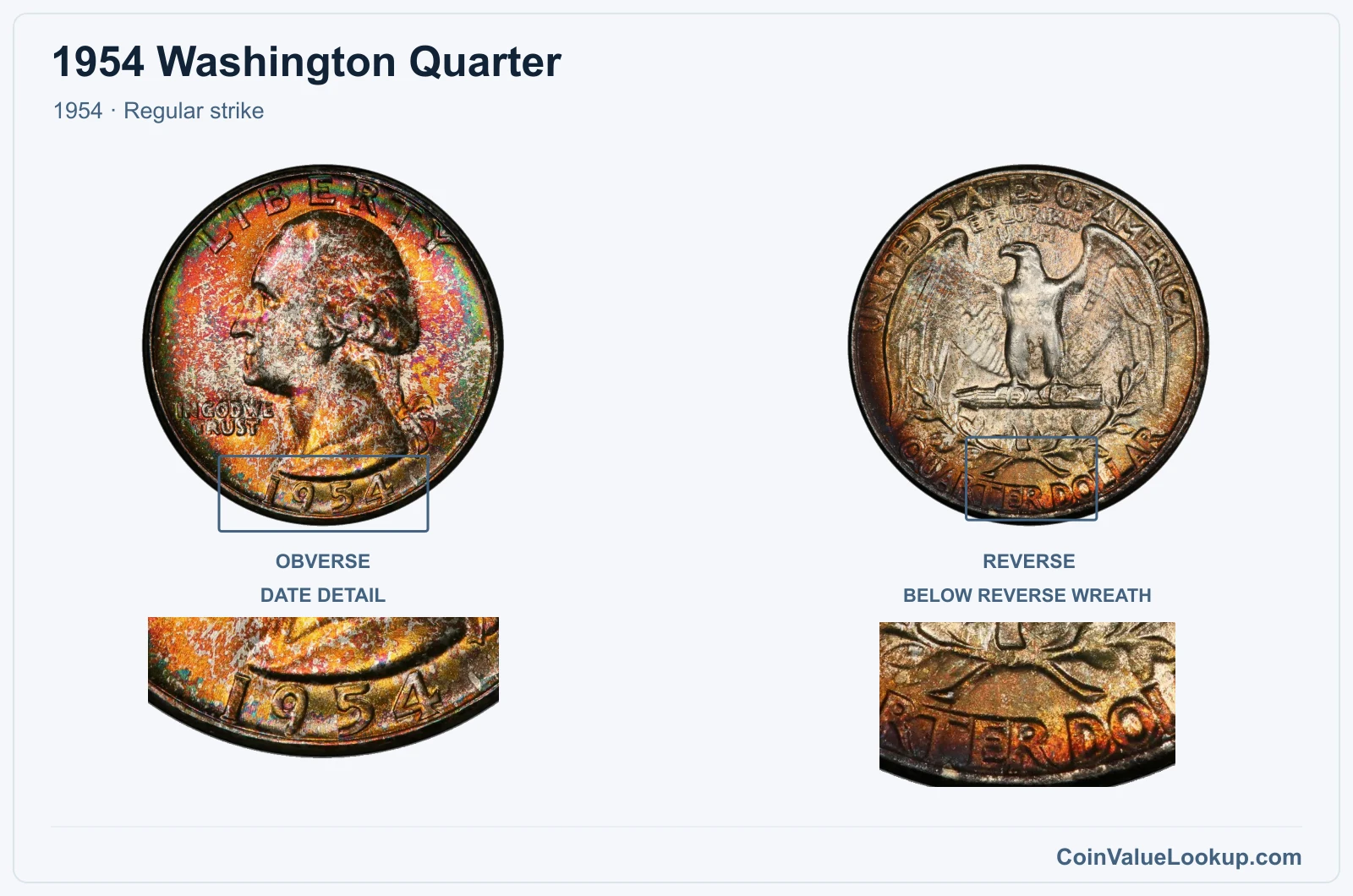
The 1954 Philadelphia quarter has no mintmark — that blank space below the reverse wreath is factory standard. In heavily worn condition around Good-4, the USA Coin Book guide estimates about $16.43, which essentially tracks its silver melt value.
An MS60 uncirculated example runs around $20, while a well-preserved MS65 coin is listed at approximately $39.
Philadelphia quarters from this year are often limited by contact marks rather than strike quality. Coins that survived without heavy bag marks are the ones that grade well.
Look for original frosty luster without cleaning hairlines.
| Range | Grade | Price | Auction Records | Appraisal |
|---|---|---|---|---|
| PO | PO 1 | — | Coin Identifier | |
| FR | FR 2 | — | Coin Identifier | |
| AG | AG 3 | — | Coin Identifier | |
| G | G 4 | — | Coin Identifier | |
| G 6 | — | Coin Identifier | ||
| VG | VG 8 | — | Coin Identifier | |
| VG 10 | — | Coin Identifier | ||
| F | F 12 | — | Coin Identifier | |
| F 15 | — | Coin Identifier | ||
| VF | VF 20 | — | Coin Identifier | |
| VF 25 | — | Coin Identifier | ||
| VF 30 | — | Coin Identifier | ||
| VF 35 | — | Coin Identifier | ||
| XF | XF 40 | — | Coin Identifier | |
| XF 45 | — | Coin Identifier | ||
| AU | AU 50 | — | Coin Identifier | |
| AU 53 | — | Coin Identifier | ||
| AU 55 | — | Coin Identifier | ||
| AU 58 | — | Coin Identifier | ||
| MS | MS 60 | — | Coin Identifier | |
| MS 61 | — | Coin Identifier | ||
| MS 62 | — | Coin Identifier | ||
| MS 63 | Coin Identifier | |||
| MS 64 | Coin Identifier | |||
| MS 65 | Coin Identifier | |||
| MS 66 | Coin Identifier | |||
| MS 67 | Coin Identifier | |||
| MS 68 | Coin Identifier | |||
| MS 69 | — | — | — | |
| MS 70 | — | — | — |
1954 Washington Quarter — Proof
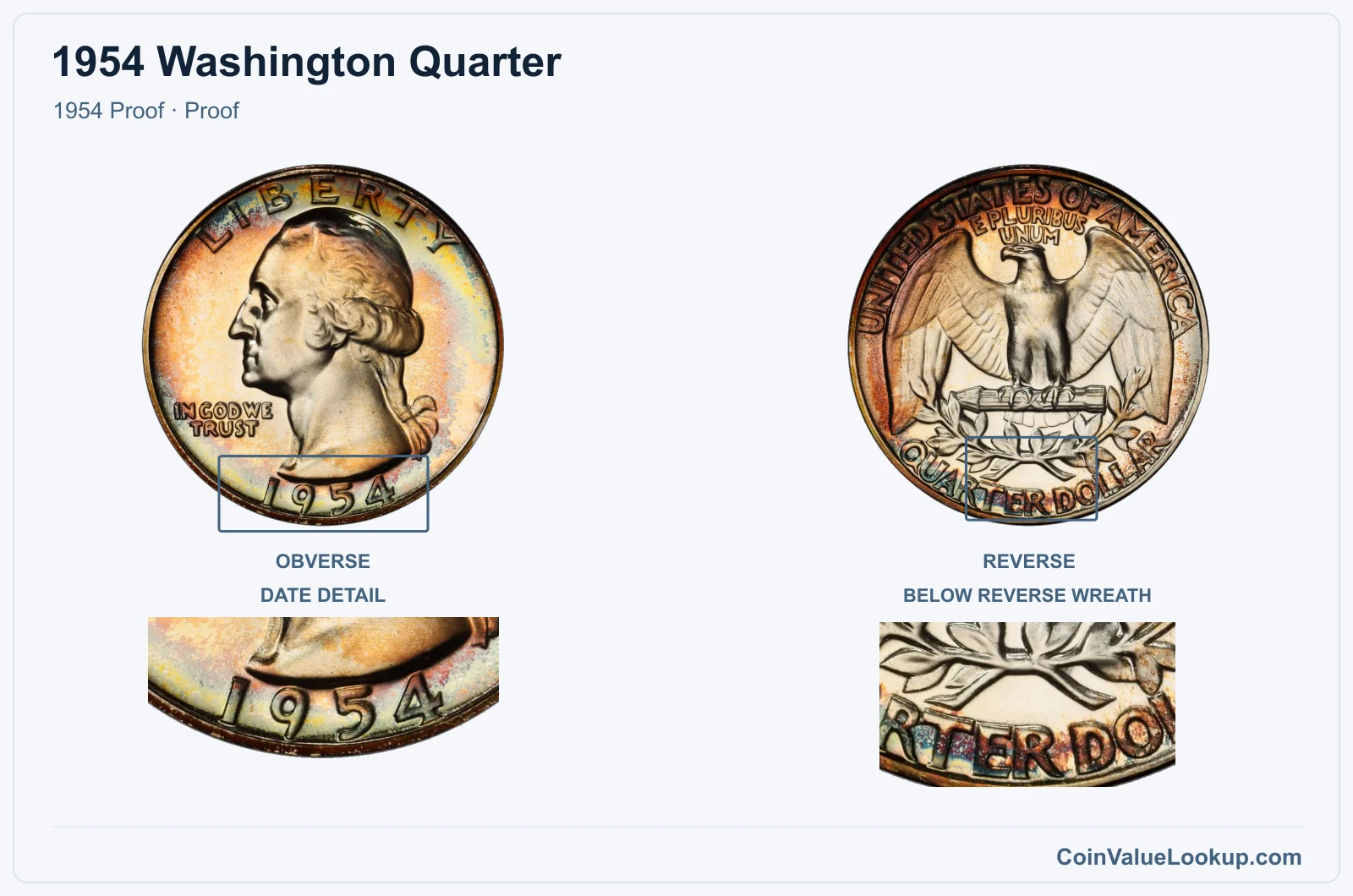
The 1954 Proof was struck only at Philadelphia and carries no mintmark, same as the business strike. The difference is immediately visible: proof coins have deeply mirrored fields and crisp, sculpted details that regular strikes simply don't match.
At PR65, the USA Coin Book guide places this coin at about $39. That's a solid baseline, though the market for proofs is sensitive to surface quality.
Hairlines from mishandling or improper storage can knock the grade down quickly.
Coin Value Lookup is a good place to look up guides for other dates and denominations in the Washington Quarter series if you're building a set or just curious about what else is out there.
| Range | Grade | Price | Auction Records | Appraisal |
|---|---|---|---|---|
| PR | PR 1 | — | Coin Identifier | |
| PR 2 | — | Coin Identifier | ||
| PR 3 | — | Coin Identifier | ||
| PR 4 | — | Coin Identifier | ||
| PR 6 | — | Coin Identifier | ||
| PR 8 | — | Coin Identifier | ||
| PR 10 | — | Coin Identifier | ||
| PR 12 | — | Coin Identifier | ||
| PR 15 | — | Coin Identifier | ||
| PR 20 | — | Coin Identifier | ||
| PR 25 | — | Coin Identifier | ||
| PR 30 | — | Coin Identifier | ||
| PR 35 | — | Coin Identifier | ||
| PR 40 | — | Coin Identifier | ||
| PR 45 | — | Coin Identifier | ||
| PR 50 | — | Coin Identifier | ||
| PR 53 | — | Coin Identifier | ||
| PR 55 | — | Coin Identifier | ||
| PR 58 | — | Coin Identifier | ||
| PR 60 | — | Coin Identifier | ||
| PR 61 | — | Coin Identifier | ||
| PR 62 | — | Coin Identifier | ||
| PR 63 | Coin Identifier | |||
| PR 64 | Coin Identifier | |||
| PR 65 | Coin Identifier | |||
| PR 66 | Coin Identifier | |||
| PR 67 | Coin Identifier | |||
| PR 68 | Coin Identifier | |||
| PR 69 | Coin Identifier | |||
| PR 70 | — | — | — |
1954 Washington Quarter — D
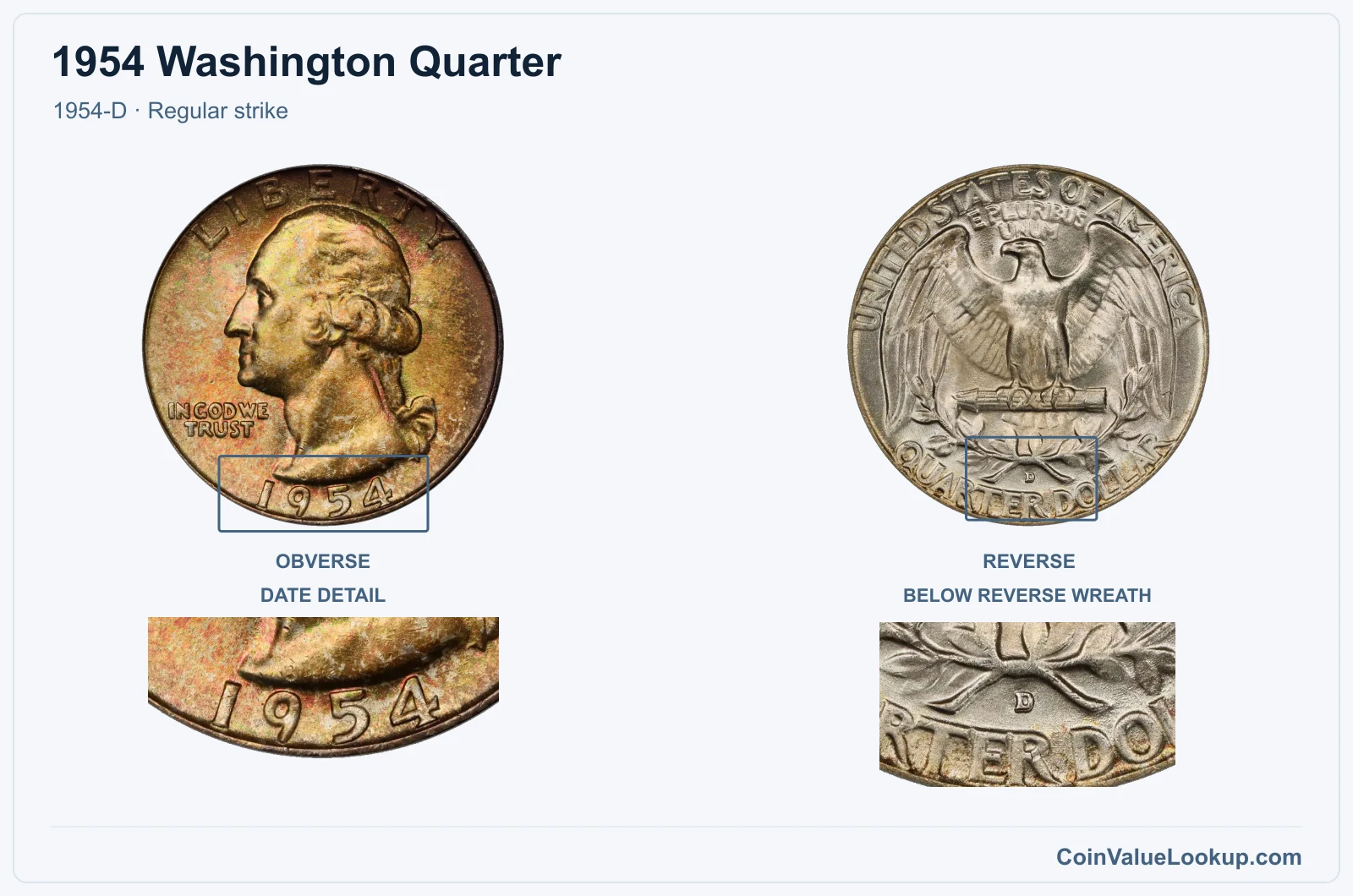
Look for the small "D" mintmark below the wreath on the reverse — that confirms Denver. In circulated Good-4 condition, the USA Coin Book guide puts it at about $16.43.
At MS60, roughly $20. A clean MS65 example is estimated around $39.
Like the Philadelphia issue, the Denver strike shares the standard 90% silver composition at 6.25 grams. Grading comes down to luster quality and freedom from marks, so check the cheek and eagle breast carefully before assuming you have a gem.
| Range | Grade | Price | Auction Records | Appraisal |
|---|---|---|---|---|
| PO | PO 1 | — | Coin Identifier | |
| FR | FR 2 | — | Coin Identifier | |
| AG | AG 3 | — | Coin Identifier | |
| G | G 4 | — | Coin Identifier | |
| G 6 | — | Coin Identifier | ||
| VG | VG 8 | — | Coin Identifier | |
| VG 10 | — | Coin Identifier | ||
| F | F 12 | — | Coin Identifier | |
| F 15 | — | Coin Identifier | ||
| VF | VF 20 | — | Coin Identifier | |
| VF 25 | — | Coin Identifier | ||
| VF 30 | — | Coin Identifier | ||
| VF 35 | — | Coin Identifier | ||
| XF | XF 40 | — | Coin Identifier | |
| XF 45 | — | Coin Identifier | ||
| AU | AU 50 | — | Coin Identifier | |
| AU 53 | — | Coin Identifier | ||
| AU 55 | — | Coin Identifier | ||
| AU 58 | — | Coin Identifier | ||
| MS | MS 60 | — | Coin Identifier | |
| MS 61 | — | Coin Identifier | ||
| MS 62 | — | Coin Identifier | ||
| MS 63 | — | Coin Identifier | ||
| MS 64 | Coin Identifier | |||
| MS 65 | Coin Identifier | |||
| MS 66 | Coin Identifier | |||
| MS 67 | Coin Identifier | |||
| MS 68 | — | — | — | |
| MS 69 | — | — | — | |
| MS 70 | — | — | — |
1954 Washington Quarter — S
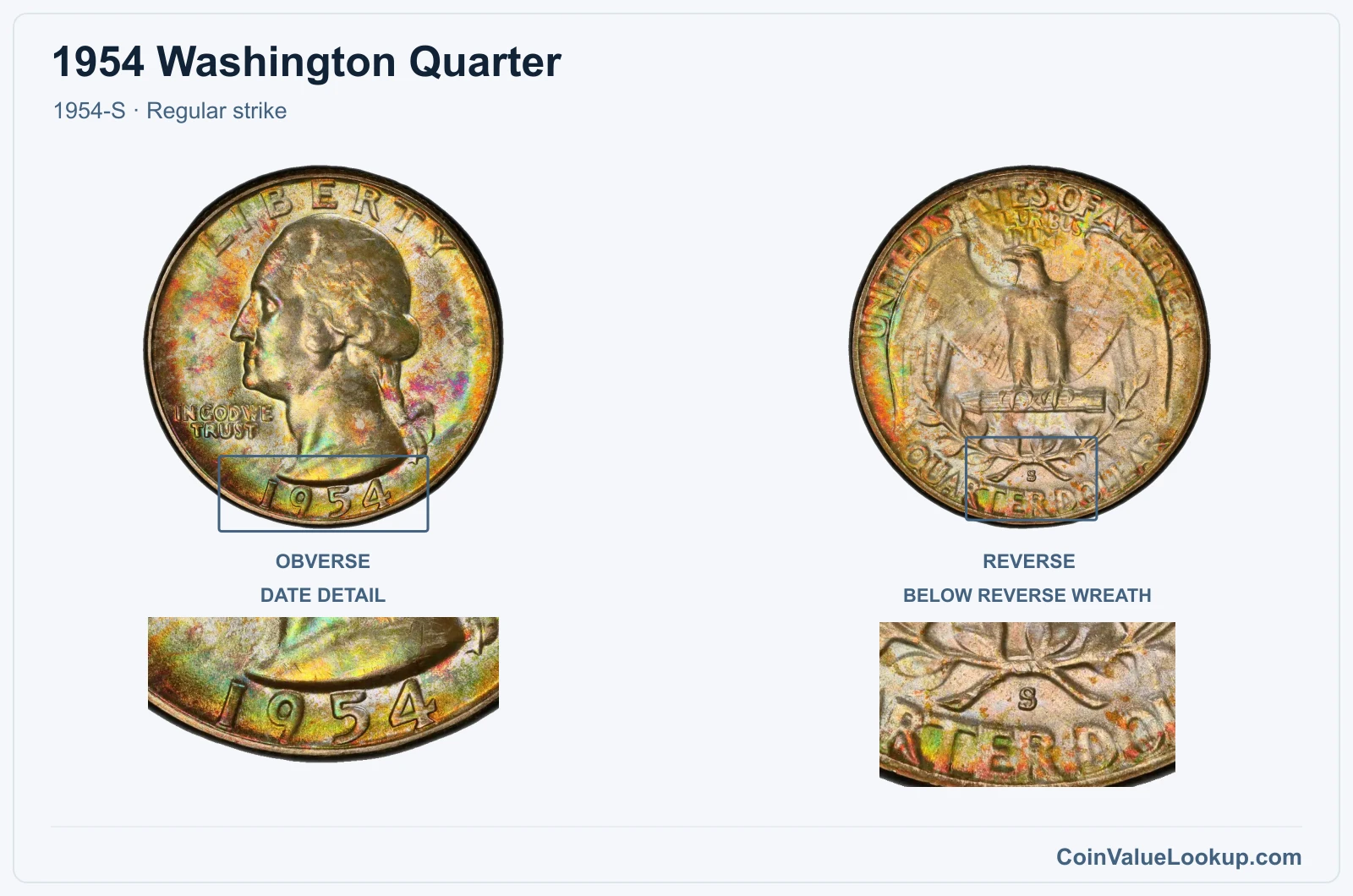
The 1954-S carries a small "S" mintmark below the reverse wreath and was produced at San Francisco. This is a standard business strike — not a proof and not an error.
Some newer collectors mistake the S mint for something exotic, but it's a regular-production coin.
USA Coin Book guide estimates place it at about $16.43 in Good-4, $20 at MS60, and around $37 at MS65 — a touch below the Philadelphia and Denver issues at the top grade. The same silver alloy and weight apply.
Focus on original surfaces when evaluating.
| Range | Grade | Price | Auction Records | Appraisal |
|---|---|---|---|---|
| PO | PO 1 | — | Coin Identifier | |
| FR | FR 2 | — | Coin Identifier | |
| AG | AG 3 | — | Coin Identifier | |
| G | G 4 | — | Coin Identifier | |
| G 6 | — | Coin Identifier | ||
| VG | VG 8 | — | Coin Identifier | |
| VG 10 | — | Coin Identifier | ||
| F | F 12 | — | Coin Identifier | |
| F 15 | — | Coin Identifier | ||
| VF | VF 20 | — | Coin Identifier | |
| VF 25 | — | Coin Identifier | ||
| VF 30 | — | Coin Identifier | ||
| VF 35 | — | Coin Identifier | ||
| XF | XF 40 | — | Coin Identifier | |
| XF 45 | — | Coin Identifier | ||
| AU | AU 50 | — | Coin Identifier | |
| AU 53 | — | Coin Identifier | ||
| AU 55 | — | Coin Identifier | ||
| AU 58 | — | Coin Identifier | ||
| MS | MS 60 | — | Coin Identifier | |
| MS 61 | — | Coin Identifier | ||
| MS 62 | — | Coin Identifier | ||
| MS 63 | Coin Identifier | |||
| MS 64 | Coin Identifier | |||
| MS 65 | Coin Identifier | |||
| MS 66 | Coin Identifier | |||
| MS 67 | Coin Identifier | |||
| MS 68 | Coin Identifier | |||
| MS 69 | — | — | — | |
| MS 70 | — | — | — |
1954 Washington Quarter Error List
1. 1954 Washington Quarter — Struck on a Silver Dime Planchet
A 1954 Philadelphia quarter struck on a silver dime planchet is a dramatic wrong-planchet error. The smaller dime blank physically cannot fill the quarter dies, so the finished coin is missing its outer design ring entirely.
You'll see a noticeably undersized coin with genuine struck edges and partial quarter design — Washington's portrait may be intact, but the peripheral legends and rim will be incomplete or absent.
Weight and diameter are the first checks: a normal quarter is about 6.25 grams and 24.3 mm, while a dime planchet is significantly smaller and lighter. The silver color alone won't distinguish it since both coins are 90% silver.
Look for intact strike-made surfaces — post-mint grinding or cutting will leave different edge characteristics.
A PCGS MS64 example sold for $990 at Heritage Auctions in September 2024. That's a single recorded sale, not a market range.
Third-party authentication is essential for a coin like this.
2. 1954 Washington Quarter — Struck on a Nickel Planchet
This error involved a 1954 Philadelphia quarter die striking a five-cent nickel planchet instead of the correct silver blank. The result is a quarter-design coin on a noticeably wrong-sized, wrong-metal disc.
The peripheral detail is constrained because the nickel blank is smaller than a quarter planchet, so legends and rim detail will be incomplete.
Don't assume nickel composition just because the coin looks dull or grayish — you need to compare the blank's size and weight against both a normal quarter and a normal nickel. Genuine struck surfaces should be present without evidence of post-mint alteration like hammering, cutting, or added metal.
A PCGS MS64 specimen brought $1,440 at Heritage Auctions in September 2024. That's one authenticated sale at one grade.
Professional certification is critical for any wrong-planchet claim, since convincing fakes exist.
3. 1954 Washington Quarter — Obverse Struck Through a String
On this 1954-S quarter, a thin string or fiber got caught between the obverse die and the planchet during striking. The result is a recessed, gently curved interruption across part of the obverse surface.
The key diagnostic is that the depression retains original struck texture inside it — the metal was blocked from fully rising into the die, not gouged out afterward.
A scratch or post-strike gouge will have sharper, more angular edges and may cut across devices in a way that doesn't follow the struck surface. A struck-through impression is softer-edged and sits within the plane of the original strike.
Heritage Auctions archive lot 91871 identifies a PCGS MS66 example of this 1954-S struck-through-string error. No individual price is separated from that archive lot, so there isn't a standalone figure to cite.
Authentication by a major grading service is the only reliable way to confirm a struck-through error.
4. 1954 Washington Quarter — Obverse Die Crack on Head
Die cracks happen when the steel die fractures from repeated use. On this 1954 Philadelphia quarter, the crack runs into Washington's head on the obverse, leaving a thin raised line of metal where the broken die allowed extra material to squeeze up during striking.
The critical distinction: a die crack is raised above the coin's surface, while a scratch or contact mark is incused — pressed into the surface. If you tilt the coin under a light and the line catches a shadow above the field, that's consistent with a die crack.
A scratch will appear as a groove.
An NGC MS65 example with this obverse die crack sold for $52 at Heritage Auctions in July 2022. That's a modest premium over a normal MS65, but it confirms collector interest exists.
Die cracks are relatively common across the series, so the specific location and visual appeal drive desirability.