1932 Washington Quarter Coin Value: How Much Is It Worth?
The 1932 Washington quarter is the first year of issue for one of America's most recognizable coin designs, and it was struck in 90% silver. Circulated examples from Philadelphia start around $17 in lower grades, while select uncirculated pieces from the Denver mint can reach guide estimates near $12,168 at MS65.
The Denver and San Francisco issues are widely recognized key dates, valuable even with heavy wear.
Fast Way to Identify Your 1932 Washington Quarter
Snap a clear photo of both the front and back of your 1932 quarter and upload them to our identifier. It will give you a preliminary identification of your coin's mint, version and general condition.
This is a quick first step before any professional evaluation, though it does not replace certified authentication or exact grading.
1932 Washington Quarter Value
Upload both sides of your 1932 Washington Quarter.
Front Obverse
Upload photo
Back Reverse
Upload photo
Which 1932 Washington Quarter Versions Are Worth Money?
- The 1932-D quarter is the scarcest regular issue of the year, with guide estimates from about $121 in G4 to roughly $12,168 at MS65, making it worth authenticating in any condition.
- The 1932-S quarter is another key date, estimated from around $111 in G4 up to about $3,094 at MS65, and genuine examples with original surfaces command strong collector interest.
- A recognized doubled die obverse variety exists for the 1932 Philadelphia quarter; one PCGS MS63 example sold for $305.50 at Heritage Auctions in March 2017.
- A 1932-D repunched mintmark variety has been reported, and confirmed examples may carry a premium depending on visibility and condition.
Step 1: Identify Your 1932 Washington Quarter Mint Mark and Version
Start on the obverse. You are looking at a left-facing portrait of George Washington with the date 1932 below.
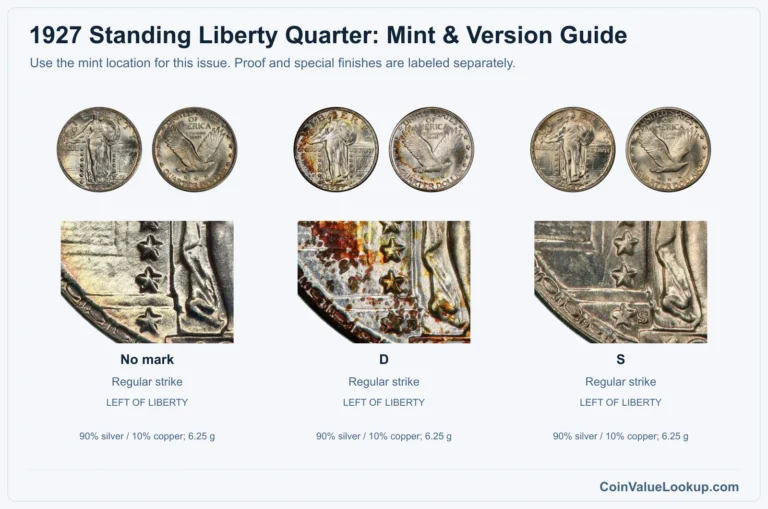
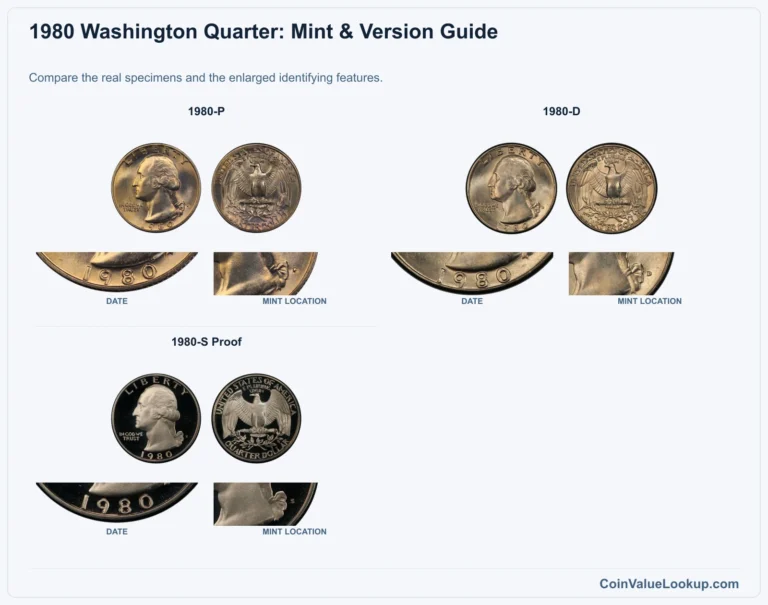
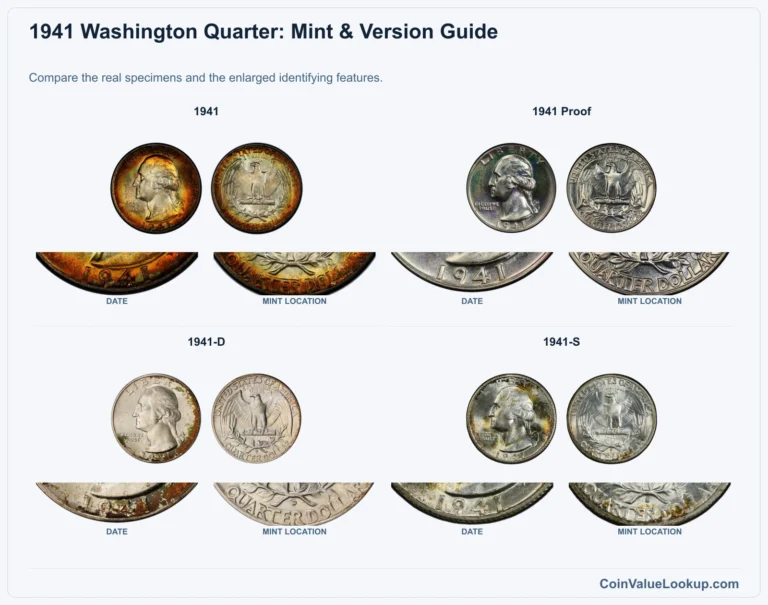
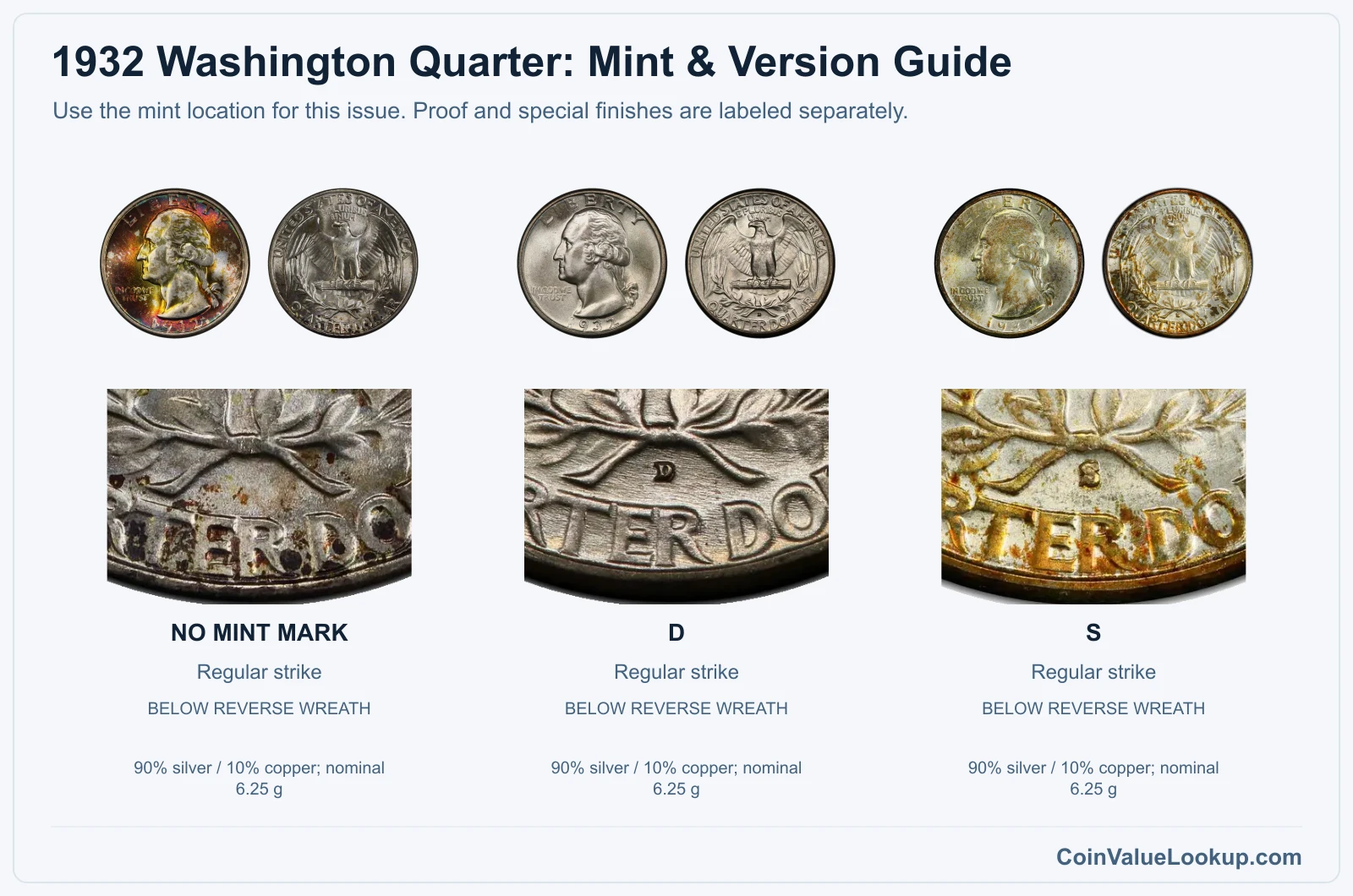
Flip the coin over and look just below the wreath tied at the bottom: that is where a small D or S mintmark would appear.
If that space is blank, you have a Philadelphia issue. A D means Denver; an S means San Francisco.
Both branch-mint versions are key dates in this series.
The coin should weigh about 6.25 grams and measure roughly 24.3 mm across. The edge is reeded, with no copper stripe visible, because these are 90% silver with 10% copper.
If you see a copper-clad sandwich line on the edge, your coin is not a genuine 1932 issue.
One important caution: added mintmarks are a known problem with this date. Because the D and S versions carry significant premiums, unscrupulous individuals have tooled fake mintmarks onto Philadelphia coins.
Any 1932-D or 1932-S you acquire should be authenticated by a reputable third-party grading service.
Step 2: Check Your 1932 Washington Quarter Grade
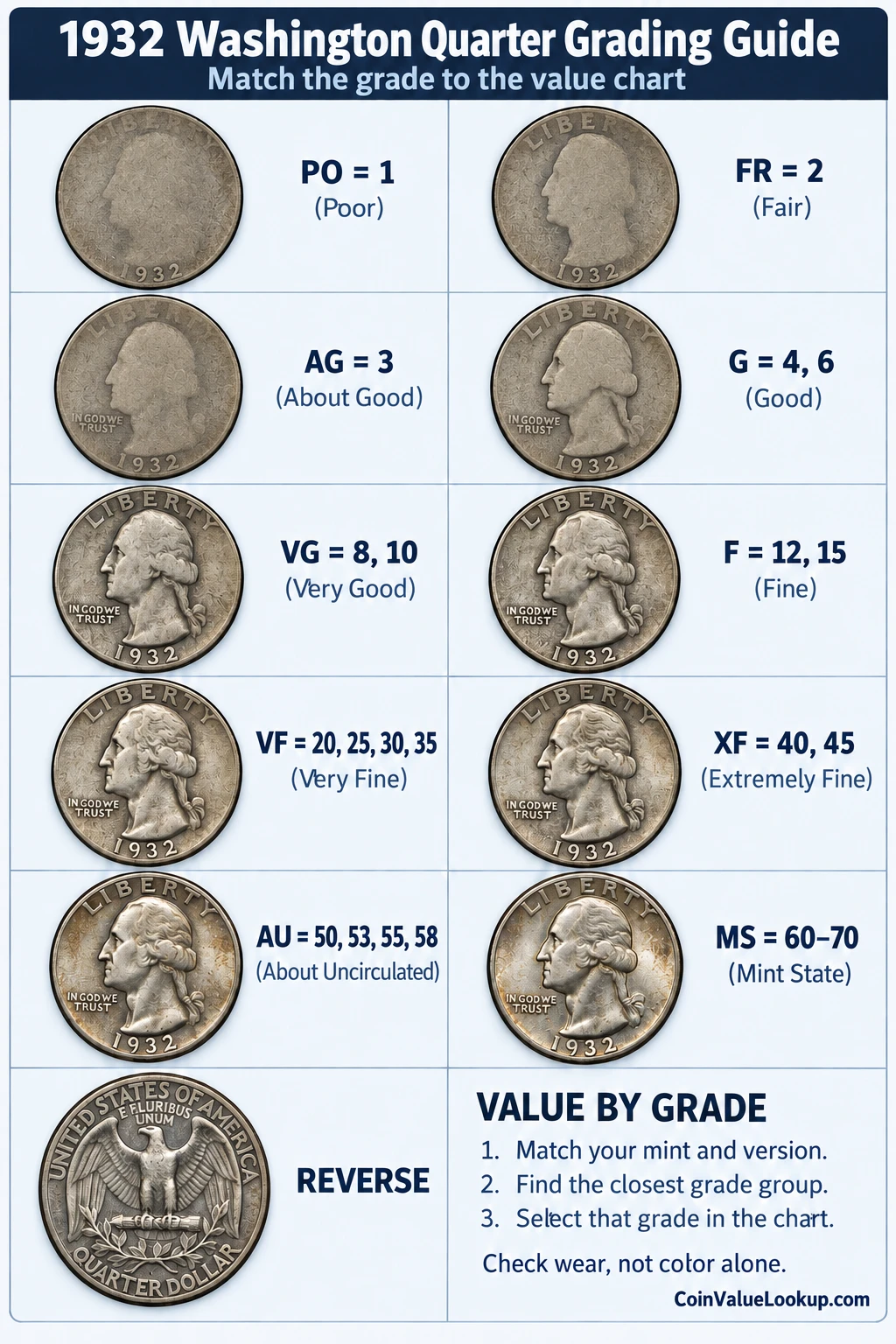
Focus on the hair detail above Washington's ear first. On a well-preserved coin, individual strands are sharp and unbroken.
As a coin circulates, this area flattens and the hair merges into a smooth mass. The cheek and jawline lose definition next.
Flip to the reverse and examine the eagle's breast feathers and wing tips. These are high points that wear early.
A coin with full breast detail and sharp wing feathers is in a different league from one with a blobby eagle.
Weak strikes exist on this date, so do not confuse soft detail from an incomplete strike with actual wear. The difference: a weakly struck coin still has undisturbed luster in the soft areas, while a worn coin shows friction and interrupted surfaces.
Use the comparison image to match your coin's detail level. Look for hairlines from old cleanings, rim nicks, and unnatural brightness.
A coin that gleams but has tiny parallel scratches was probably cleaned, and that matters for value. Shine alone does not indicate a high grade.
Step 3: Check 1932 Washington Quarter Value by Mint and Version
1932 Washington Quarter
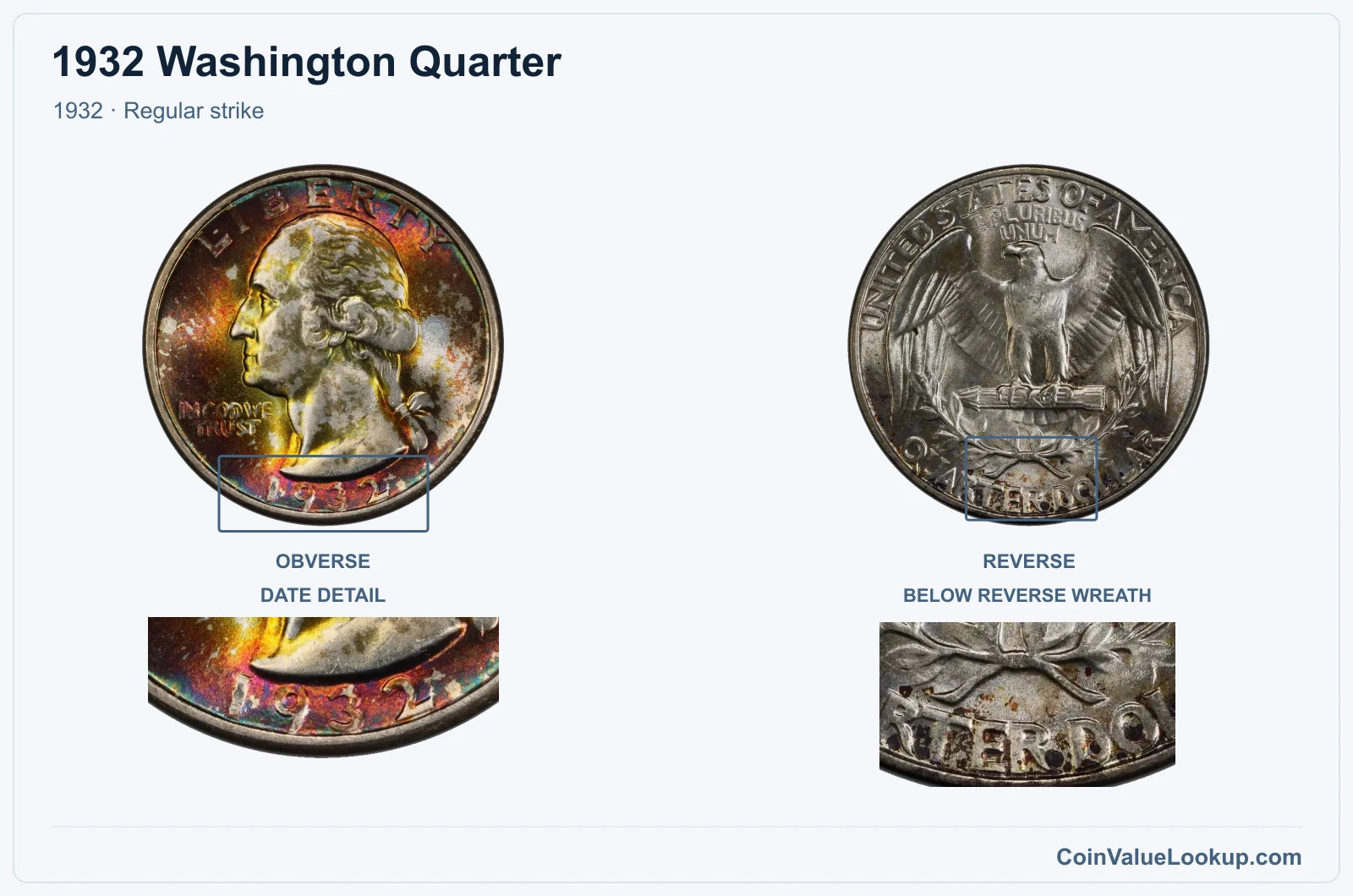
The 1932 Philadelphia quarter has no mintmark beneath the reverse wreath. As the first year of the Washington design by John Flanagan, it launched with a left-facing portrait on the obverse and an eagle clutching arrows and olive branches on the reverse.
Philadelphia produced the largest share of 1932 quarters. USA Coin Book guide estimates place a well-worn G4 example around $17, an MS60 near $39, and an MS65 around $353.
These are retail guide figures, not guaranteed sale prices, and silver content provides a floor.
Coin Value Lookup is a handy starting point if you want to look up other dates and denominations in the Washington quarter series or compare values across years.
| Range | Grade | Price | Auction Records | Appraisal |
|---|---|---|---|---|
| PO | PO 1 | — | Coin Identifier | |
| FR | FR 2 | — | Coin Identifier | |
| AG | AG 3 | — | Coin Identifier | |
| G | G 4 | — | Coin Identifier | |
| G 6 | — | Coin Identifier | ||
| VG | VG 8 | — | Coin Identifier | |
| VG 10 | — | Coin Identifier | ||
| F | F 12 | — | Coin Identifier | |
| F 15 | — | Coin Identifier | ||
| VF | VF 20 | Coin Identifier | ||
| VF 25 | — | Coin Identifier | ||
| VF 30 | — | Coin Identifier | ||
| VF 35 | — | Coin Identifier | ||
| XF | XF 40 | Coin Identifier | ||
| XF 45 | Coin Identifier | |||
| AU | AU 50 | Coin Identifier | ||
| AU 53 | Coin Identifier | |||
| AU 55 | Coin Identifier | |||
| AU 58 | Coin Identifier | |||
| MS | MS 60 | Coin Identifier | ||
| MS 61 | Coin Identifier | |||
| MS 62 | Coin Identifier | |||
| MS 63 | Coin Identifier | |||
| MS 64 | Coin Identifier | |||
| MS 65 | Coin Identifier | |||
| MS 66 | Coin Identifier | |||
| MS 67 | Coin Identifier | |||
| MS 68 | — | — | — | |
| MS 69 | — | — | — | |
| MS 70 | — | — | — |
1932 Washington Quarter — D
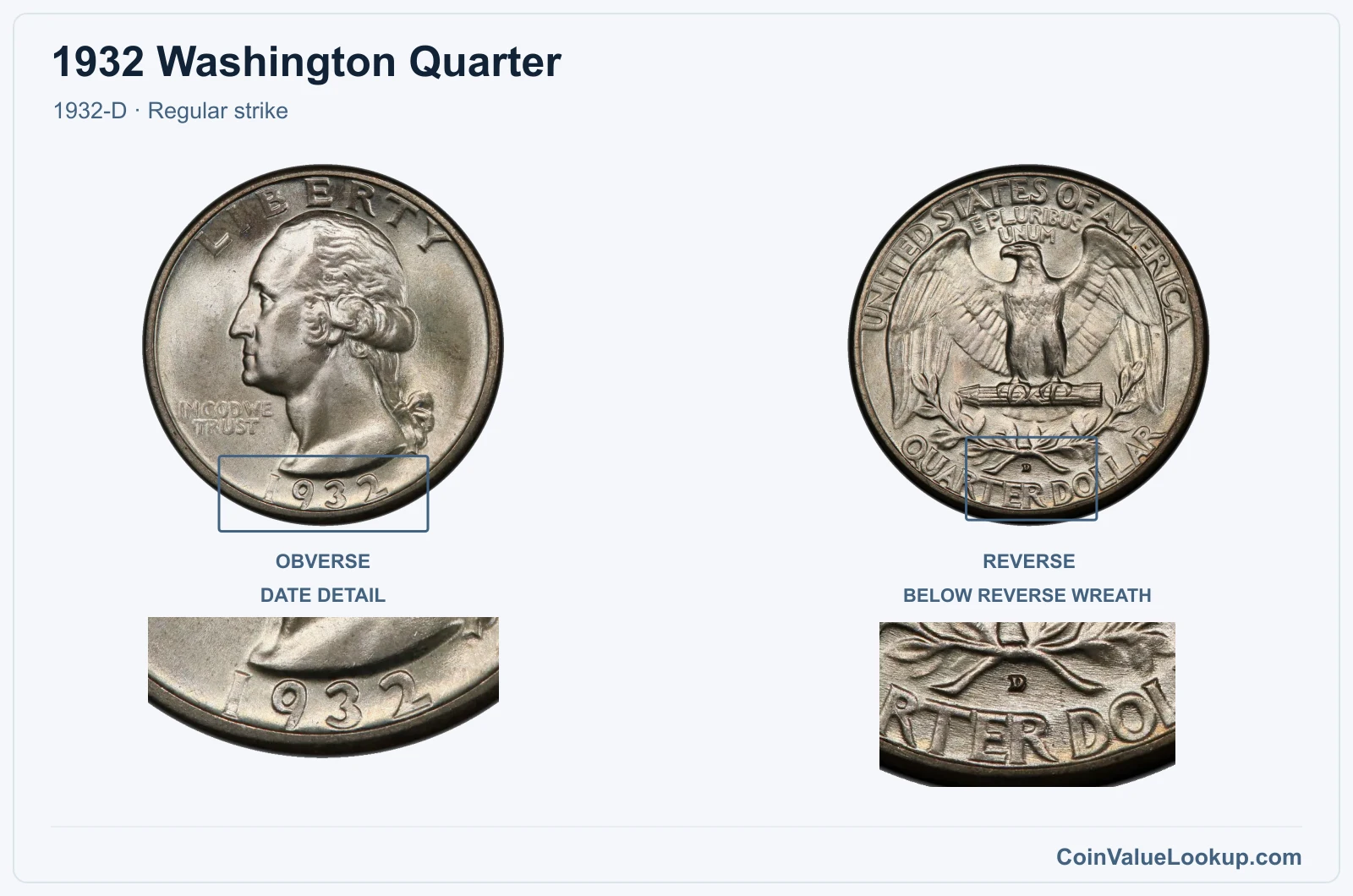
The 1932-D carries a small D mintmark below the wreath on the reverse and is the key date of the entire Washington quarter series. Denver's production was limited, which is why even a heavily circulated example commands attention.
USA Coin Book guide estimates put a G4 around $121, an MS60 near $1,252, and an MS65 at roughly $12,168. Those numbers reflect just how thin the supply gets in higher grades.
Because of the premium, added or altered mintmarks are a real risk. Any 1932-D should be authenticated by a third-party grading service before you pay key-date money for it.
Original, undisturbed surfaces matter enormously here. A lightly worn coin with honest toning can be more desirable than a cleaned example that superficially looks shinier.
| Range | Grade | Price | Auction Records | Appraisal |
|---|---|---|---|---|
| PO | PO 1 | Coin Identifier | ||
| FR | FR 2 | Coin Identifier | ||
| AG | AG 3 | Coin Identifier | ||
| G | G 4 | Coin Identifier | ||
| G 6 | Coin Identifier | |||
| VG | VG 8 | Coin Identifier | ||
| VG 10 | Coin Identifier | |||
| F | F 12 | Coin Identifier | ||
| F 15 | Coin Identifier | |||
| VF | VF 20 | Coin Identifier | ||
| VF 25 | Coin Identifier | |||
| VF 30 | Coin Identifier | |||
| VF 35 | Coin Identifier | |||
| XF | XF 40 | Coin Identifier | ||
| XF 45 | Coin Identifier | |||
| AU | AU 50 | Coin Identifier | ||
| AU 53 | Coin Identifier | |||
| AU 55 | Coin Identifier | |||
| AU 58 | Coin Identifier | |||
| MS | MS 60 | Coin Identifier | ||
| MS 61 | Coin Identifier | |||
| MS 62 | Coin Identifier | |||
| MS 63 | Coin Identifier | |||
| MS 64 | Coin Identifier | |||
| MS 65 | Coin Identifier | |||
| MS 66 | Coin Identifier | |||
| MS 67 | — | — | — | |
| MS 68 | — | — | — | |
| MS 69 | — | — | — | |
| MS 70 | — | — | — |
1932 Washington Quarter — S
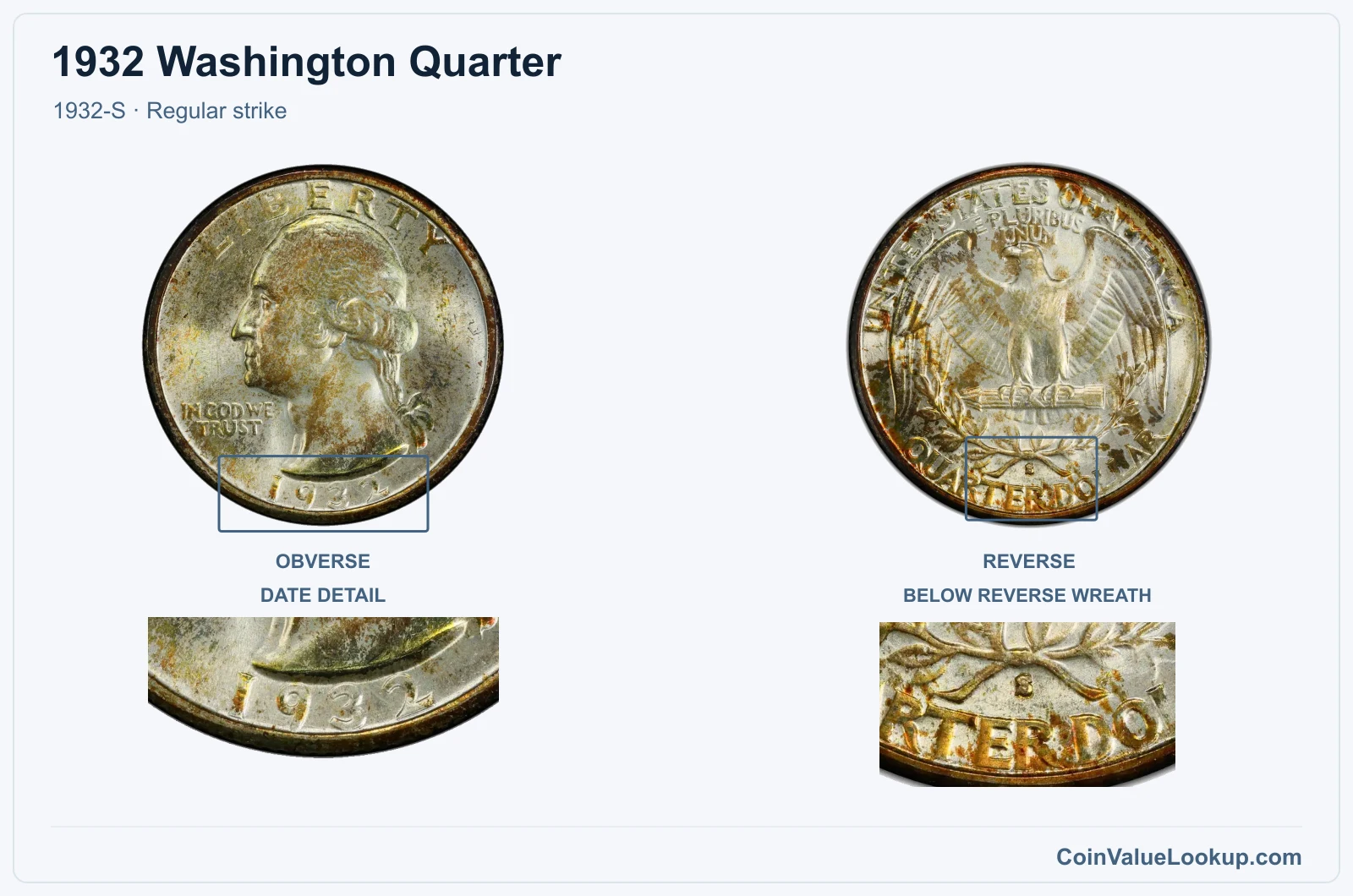
The 1932-S features a small S mintmark under the reverse wreath and sits right alongside its Denver sibling as a recognized key date. San Francisco's mintage was low enough that these trade at a substantial premium in every grade.
USA Coin Book guide estimates range from about $111 at G4, through $536 at MS60, up to around $3,094 at MS65. Like the Denver issue, fake mintmarks have been added to Philadelphia coins to simulate a 1932-S, so third-party authentication is strongly recommended.
Even in well-circulated condition, a genuine 1932-S with a clear date and legible mintmark is a coin worth holding onto. Check the mintmark carefully under magnification and compare its shape and position to a known authentic example.
| Range | Grade | Price | Auction Records | Appraisal |
|---|---|---|---|---|
| PO | PO 1 | — | Coin Identifier | |
| FR | FR 2 | Coin Identifier | ||
| AG | AG 3 | Coin Identifier | ||
| G | G 4 | Coin Identifier | ||
| G 6 | Coin Identifier | |||
| VG | VG 8 | Coin Identifier | ||
| VG 10 | Coin Identifier | |||
| F | F 12 | Coin Identifier | ||
| F 15 | Coin Identifier | |||
| VF | VF 20 | Coin Identifier | ||
| VF 25 | Coin Identifier | |||
| VF 30 | Coin Identifier | |||
| VF 35 | Coin Identifier | |||
| XF | XF 40 | Coin Identifier | ||
| XF 45 | Coin Identifier | |||
| AU | AU 50 | Coin Identifier | ||
| AU 53 | Coin Identifier | |||
| AU 55 | Coin Identifier | |||
| AU 58 | Coin Identifier | |||
| MS | MS 60 | Coin Identifier | ||
| MS 61 | Coin Identifier | |||
| MS 62 | Coin Identifier | |||
| MS 63 | Coin Identifier | |||
| MS 64 | Coin Identifier | |||
| MS 65 | Coin Identifier | |||
| MS 66 | Coin Identifier | |||
| MS 67 | — | — | — | |
| MS 68 | — | — | — | |
| MS 69 | — | — | — | |
| MS 70 | — | — | — |
1932 Washington Quarter Error List
1. 1932 Washington Quarter — Doubled Die Obverse
A doubled die obverse variety has been identified on the 1932 Philadelphia quarter. Under 5 to 10 times magnification, look for separated or thickened relief in the obverse lettering.
The doubling is die-made, meaning it repeats in a consistent pattern across every coin struck from that die.
Compare your coin's lettering carefully to an attributed specimen. Not every thick or fuzzy letter qualifies.
Machine doubling, which is a flat, shelf-like displacement, looks different: it produces a smeared secondary image rather than a distinctly separated one. Ordinary wear and scratches can also mimic doubling at a glance.
One PCGS MS63 example of this variety sold for $305.50 at Heritage Auctions in March 2017. That is a single historical sale, not a current market range.
Condition and strength of the doubling both affect what a buyer will pay.
2. 1932 Washington Quarter — Obverse Lamination
A lamination error has been documented on a 1932-S Washington quarter. This occurs when a flaw in the silver-alloy planchet causes a thin layer of metal to peel or separate from the surface.
On the documented example, the lamination appeared on the obverse.
If you spot what looks like a peeling flap or a missing patch of metal, resist the urge to pull any loose material away. Leaving it intact preserves the error's character.
Compare the undisturbed struck detail around the affected area to the rest of the coin: a genuine lamination will have normal design features adjacent to the flaw.
Post-mint damage such as cuts, filing, applied metal or corrosion can mimic a lamination. No specific price range is adopted for this error.
Value depends on authentication, the severity and visual impact of the flaw, and overall coin condition. The documented piece was graded AU58 by NGC.
3. 1932 Washington Quarter — Repunched Mintmark
A repunched mintmark variety has been reported on the 1932-D quarter. This happens when the mintmark punch was applied more than once in slightly different positions, leaving traces of the earlier impression visible alongside the final D.
Under magnification, inspect the D mintmark for any remnant of a second impression, offset shadow or notch that does not match the primary punch position. Compare it side by side with a normal 1932-D mintmark at the same magnification to see whether the extra detail is consistent with a repunch.
Do not confuse this with machine doubling, which creates flat shelf-like displacement, or with a die chip or corrosion that merely distorts the mintmark outline. No specific price range is adopted; value depends on the visibility of the repunch, the coin's overall condition, and third-party attribution.
4. 1932 Washington Quarter — Broadstrike
A broadstrike error has been reported on the 1932 Washington quarter. A broadstrike occurs when the coin is struck without the retaining collar that normally confines the planchet, allowing metal to spread outward beyond the standard diameter.
The result is a coin that looks wider than normal, with a complete design but no reeded edge or a distorted edge profile. The design may appear slightly spread compared to a standard piece.
Do not confuse a broadstrike with an off-center strike, which shifts the design away from center and leaves an unstruck crescent, or with a coin that was flattened or squeezed after leaving the mint. A genuine broadstrike retains the full design in correct proportion, just spread outward.
No specific price range is adopted for this error; value depends on the coin's condition, the degree of spread, and authentication.
5. 1932 Washington Quarter — Off-Center Strike
An off-center strike error has been reported on the 1932 quarter. This happens when the planchet is not properly seated between the dies, so the design is displaced to one side and a blank crescent of unstruck metal appears on the opposite edge.
The most collectible off-center errors retain a visible date, because without it the coin is much harder to attribute. Look at the overall shape: a genuine off-center coin still has a round planchet, but the design is shifted.
Do not confuse this with a clipped planchet, which removes a section of the blank before striking, or with one-sided die misalignment that distorts the design without leaving an unstruck crescent. Post-mint flattening can also mislead.
No numerical price range is adopted for this error. Value depends on the percentage of off-center displacement, whether the date is readable, and the coin's overall condition.
6. 1932 Washington Quarter — Die Crack / Die Chip
Die crack and die chip errors have been reported on 1932 quarters, sometimes described as cud errors when the break reaches the rim. These appear as raised lines or small raised blobs on the coin's surface, created by cracks in the steel die transferring their shape onto struck coins.
An interior die crack shows up as a thin raised line crossing the design. A cud is a larger, raised, featureless area connected to the rim where a piece of the die actually broke away.
These are distinct from each other in both appearance and collector interest.
Do not confuse raised die cracks with incuse scratches, which are pressed into the surface. Corrosion deposits or foreign material stuck to the coin can also mimic a raised feature.
No specific price range is adopted. Value depends on the size, location and visual impact of the break, plus the coin's condition.
7. 1932 Washington Quarter — Die Cap / Capped-Die Strike
A die cap error has been reported on the 1932 quarter. This dramatic error occurs when a struck coin sticks to the upper die and is carried upward, where it acts as a cap over the die face.
Subsequent blanks are then struck through this trapped coin, creating progressively distorted impressions.
The capped coin itself becomes cupped, with one side showing a normal strike and the other side displaying a mirror-image brockage that deepens with each successive hit. Coins struck through the cap show a weakened or distorted design on the affected side.
A bent coin, vise damage or a simple weak strike can look unusual, but none of these produce the characteristic cupping and brockage pattern of a genuine die cap. No numerical price range is adopted.
Value depends on the stage of the cap, overall condition, and professional authentication confirming the error is genuine.