1982 Roosevelt Dime Coin Value: How Much Is It Worth?
Ordinary circulated 1982 Roosevelt dimes are worth face value — ten cents. In higher uncirculated grades, a USA Coin Book guide estimate places the 1982-P at about $9.37 in MS 65 and the 1982-D at roughly $3.08 in MS 65.
The 1982-S proof starts around $3.08 at PR 65. The real action with this date is the well-known No P mintmark error, which comes in both strong and weak strike classes and requires authentication before any premium applies.
Fast Way to Identify Your 1982 Roosevelt Dime
Upload clear photos of your dime's front and back for a preliminary identification. The tool can help you sort out whether you have a P, D, S proof, or a potential No P variety.
Make sure to capture the area near the date where the mintmark sits — that spot matters most for 1982 dimes.
1982 Roosevelt Dime Value
Upload both sides of your 1982 Roosevelt Dime.
Front Obverse
Upload photo
Back Reverse
Upload photo
Which 1982 Roosevelt Dime Versions Are Worth Money?
- 1982-P business strikes preserved in MS 65 or higher with clear, separated torch bands.
- 1982-S proofs with strong contrast between frosted devices and mirrored fields.
- Authenticated 1982 No P Strong Strike — nearly full detail, confirmed missing mintmark.
- Authenticated 1982 No P Weak Strike — flattened outer details, weak 2 near rim, confirmed missing mintmark.
- 1982-P with a verified tilted partial collar error showing a stepped, partially reeded edge.
Step 1: Identify Your 1982 Roosevelt Dime Mint Mark and Version
Start by confirming the date reads 1982 and the coin shows Roosevelt's portrait on the obverse with a torch flanked by branches on the reverse. The composition is copper-nickel clad over a copper core, weighing about 2.27 grams and measuring roughly 17.9 mm across.
There is no silver in these.
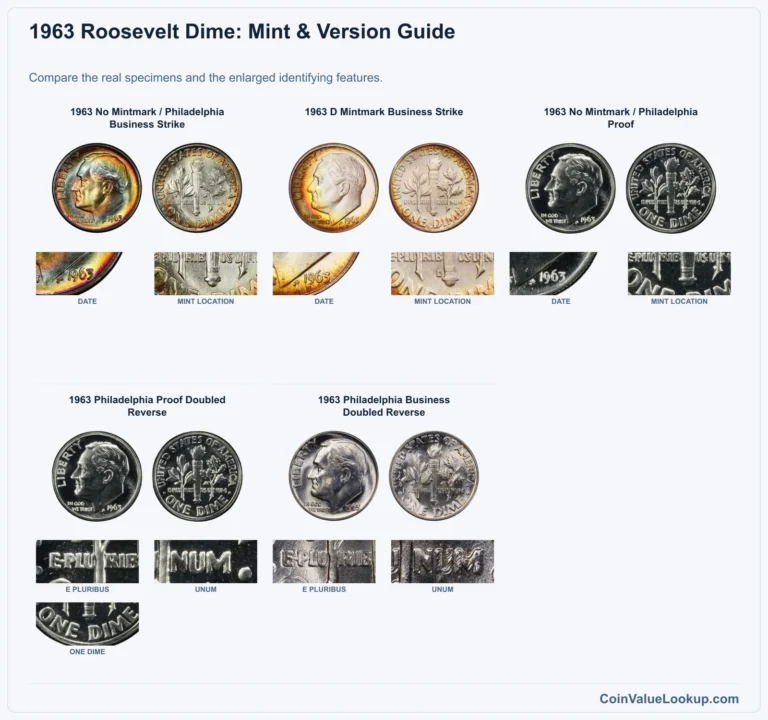
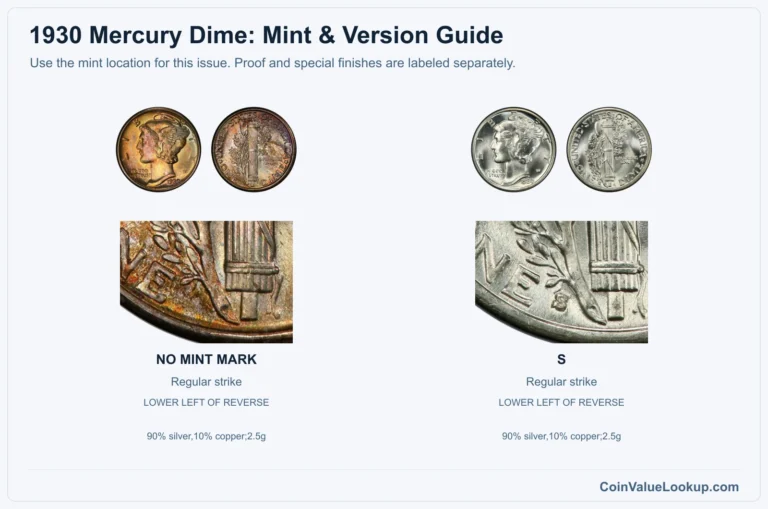
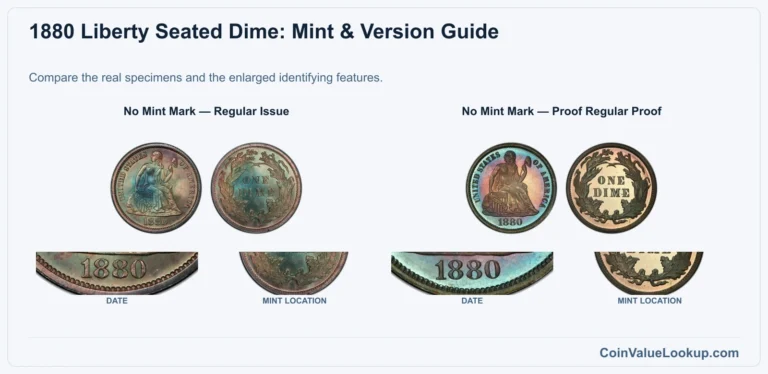
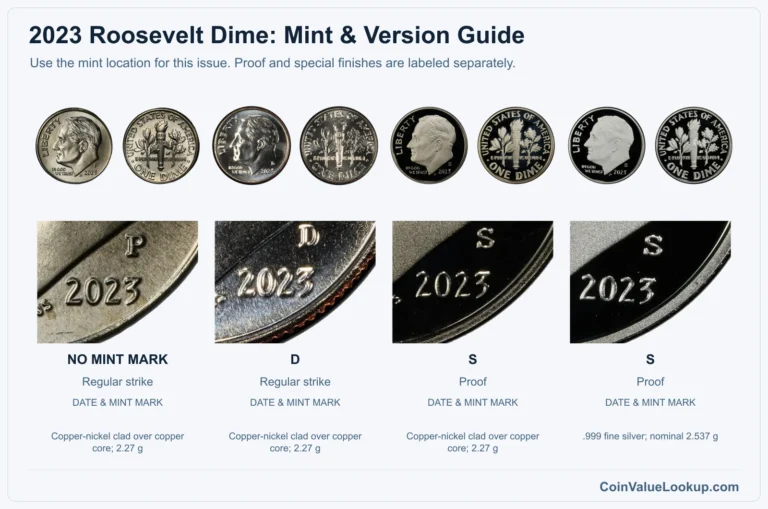
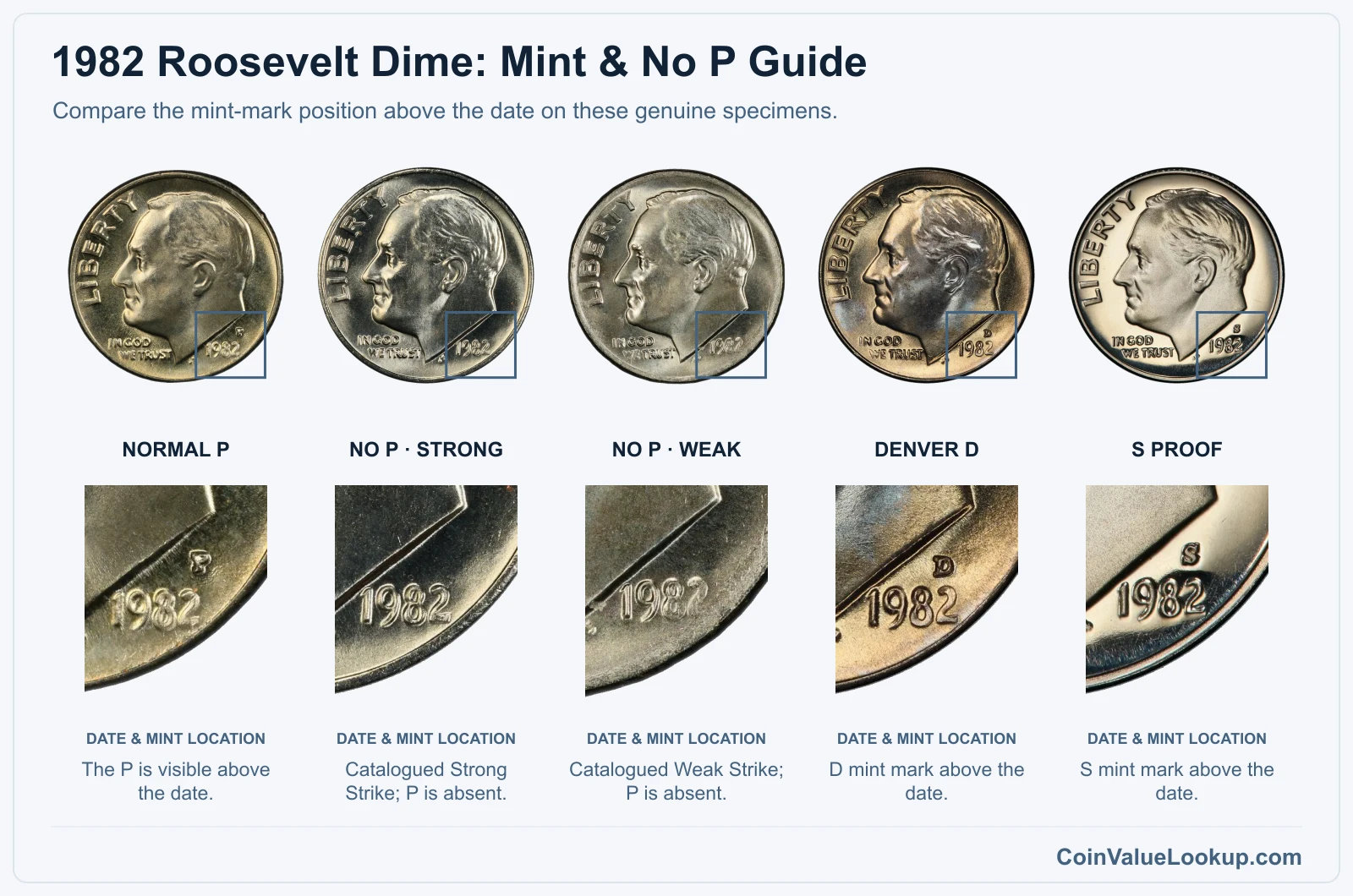
Now check the mintmark location, which sits on the obverse near the date. A "P" means Philadelphia, a "D" means Denver, and an "S" means San Francisco proof.
If you see no mintmark at all, pay close attention — prior to 1980, Philadelphia dimes carried no mintmark normally, but by 1982 every Philadelphia strike was supposed to have a "P." A blank spot where the P should be could indicate the scarce No P error.
The No P variety splits into two classes: strong strike and weak strike. On a weak strike example, look for flattened outer details and a noticeably weak "2" in the date sitting closer to the rim.
The strong strike version appears nearly fully struck with sharp detail throughout. Do not confuse normal circulation wear with the weak strike class — they look different under magnification, and certified attribution from a grading service is the safest way to confirm which you have.
Step 2: Check Your 1982 Roosevelt Dime Grade
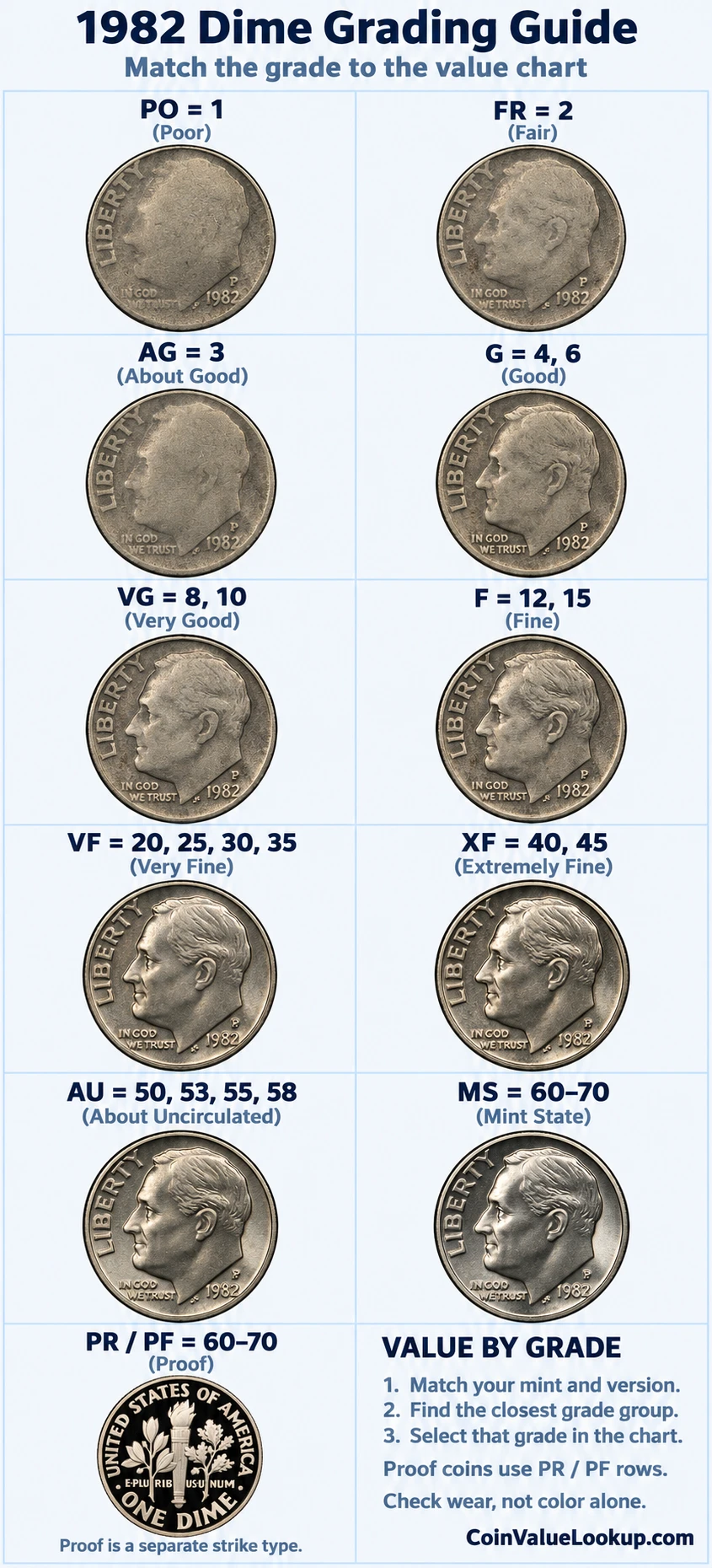
Check the high points first: Roosevelt's cheekbone and jawline on the obverse, and the hair detail above the ear. On the reverse, examine the torch lines and leaf details for flatness.
These spots show wear earliest.
Original luster matters a lot. A coin that still has its full mint shine across the fields grades considerably higher than one that has been wiped or cleaned, even if the detail looks sharp.
Scratches and cleaning always hurt the grade.
Use the comparison image to match your coin's wear pattern against known grade examples. Full Bands — where both horizontal torch band pairs are clearly separated — is a strike designation recognized by PCGS, not an error or a grade bump by itself.
Proof finish and cameo contrast are manufacturing characteristics, separate from the numerical grade.
Step 3: Check 1982 Roosevelt Dime Value by Mint and Version
1982 Roosevelt Dime — P Business Strike
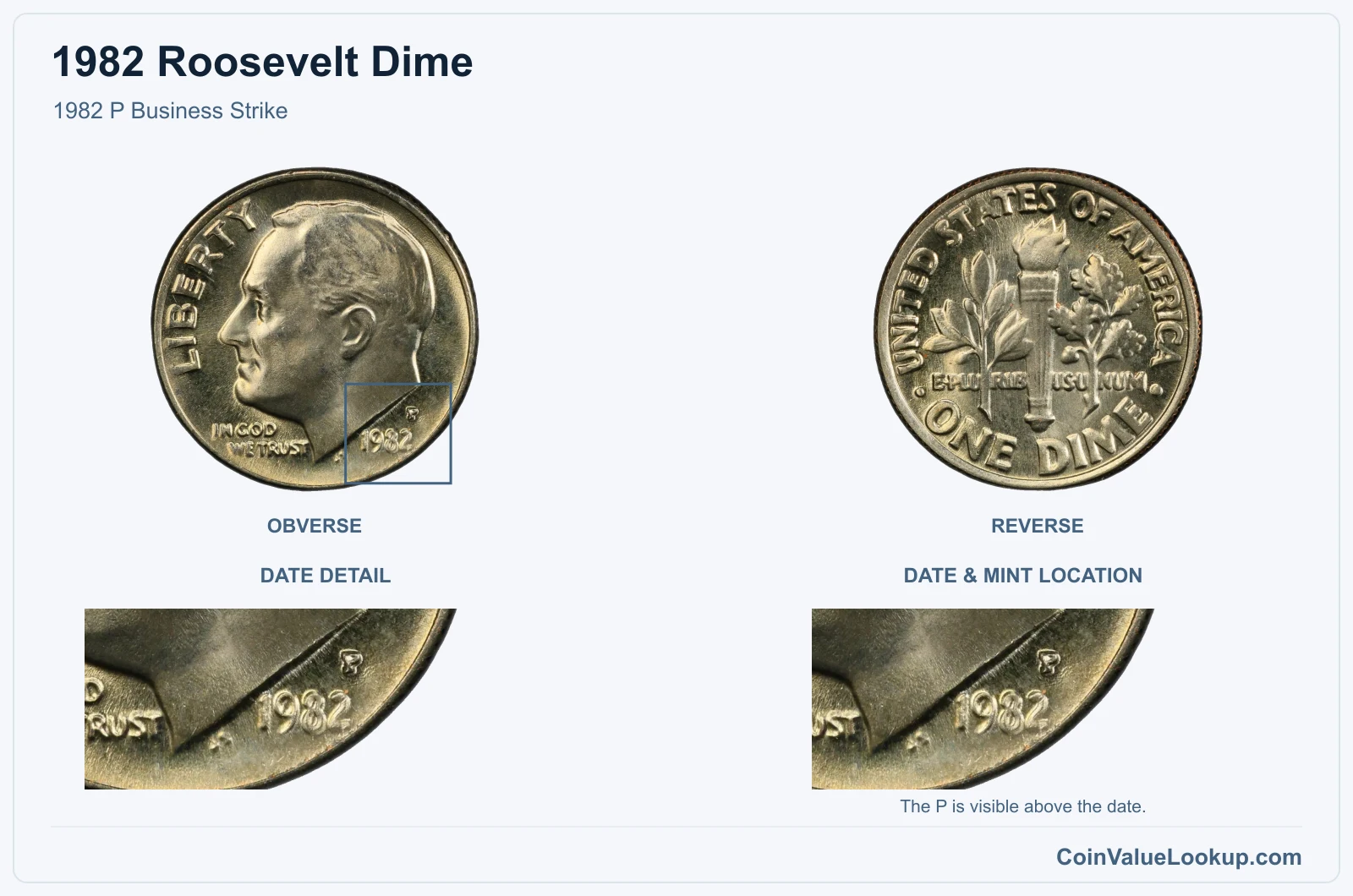
The 1982-P is the standard Philadelphia business strike, copper-nickel clad over a copper core at 2.27 grams. Look for the small "P" mintmark on the obverse near the date.
A USA Coin Book guide estimate places this coin at about $9.37 in MS 65.
In circulated condition, these are worth face value. The premium kicks in only when you have a well-preserved uncirculated example with original luster and, ideally, fully separated horizontal torch bands on the reverse.
That Full Bands designation, recognized by PCGS, indicates a strong strike and adds collector appeal.
Range Grade
Price Auction Records Appraisal PO PO 1
—
Coin Identifier FR FR 2
—
Coin Identifier AG AG 3
—
Coin Identifier G G 4
—
Coin Identifier
G 6
—
Coin Identifier VG VG 8
—
Coin Identifier
VG 10
—
Coin Identifier F F 12
—
Coin Identifier
F 15
—
Coin Identifier VF VF 20
—
Coin Identifier
VF 25
—
Coin Identifier
VF 30
—
Coin Identifier
VF 35
—
Coin Identifier XF XF 40
—
Coin Identifier
XF 45
—
Coin Identifier AU AU 50
—
Coin Identifier
AU 53
—
Coin Identifier
AU 55
—
Coin Identifier
AU 58
Coin Identifier MS MS 60
—
Coin Identifier
MS 61
—
Coin Identifier
MS 62
—
Coin Identifier
MS 63
—
Coin Identifier
MS 64
Coin Identifier
MS 65
Coin Identifier
MS 66
Coin Identifier
MS 67
Coin Identifier
MS 68
—
—
—
MS 69
—
—
—
MS 70
—
—
—
1982 Roosevelt Dime — No P Strong Strike
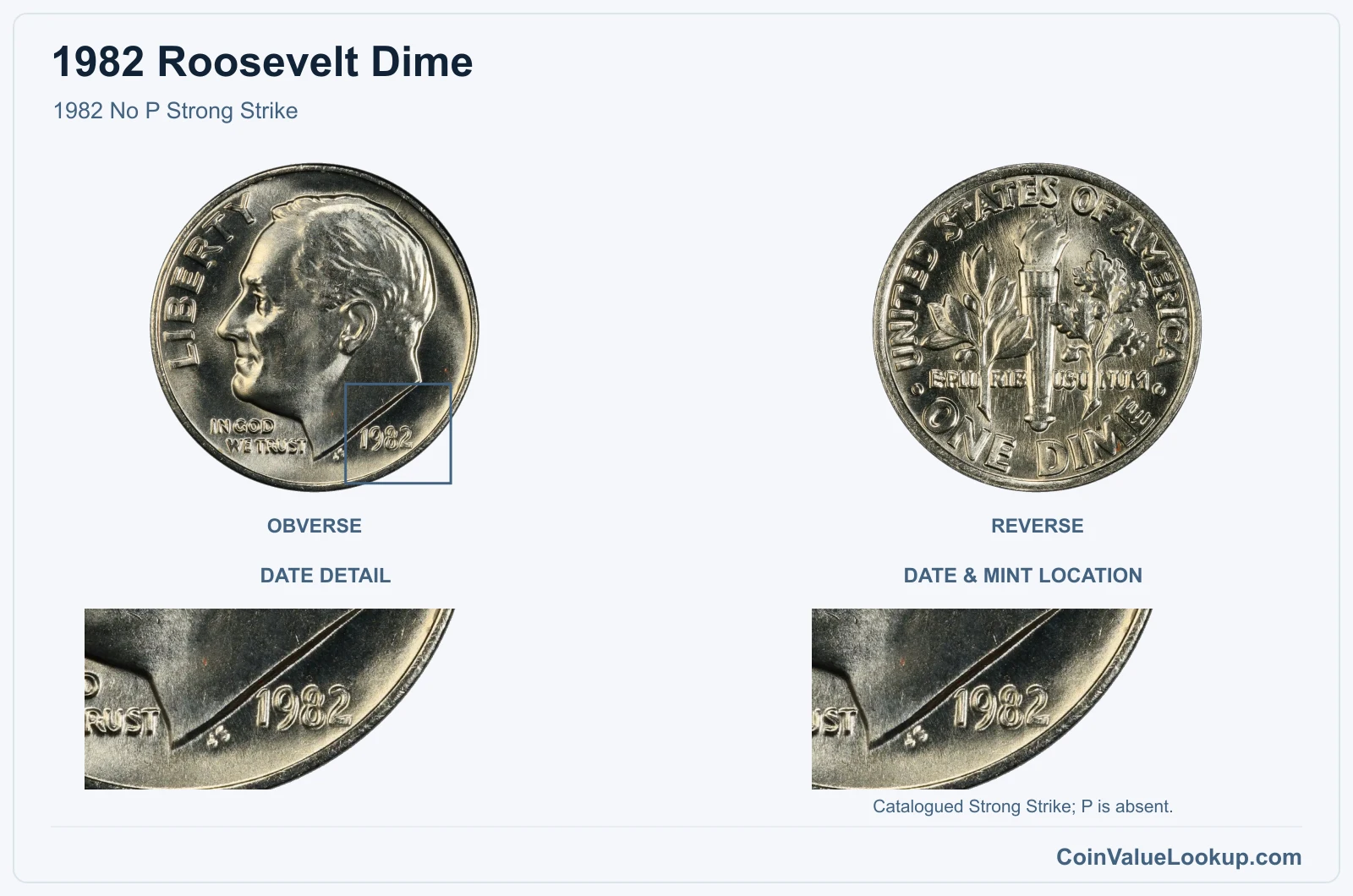
This is the strong strike class of the famous 1982 No P Roosevelt dime. The mintmark area on the obverse is blank — no "P" where one should be — and the rest of the coin shows nearly full, sharp detail throughout.
It is a business strike, not a proof, struck at Philadelphia from a die that simply lacked the mintmark.
Distinguishing it from the weak strike class matters. On a strong strike example, the outer design elements remain crisp and the "2" in the date sits at its normal position relative to the rim.
Authentication by a recognized grading service is the practical way to confirm you have a genuine No P and to establish which strike class applies. Value depends on the authenticated identity, condition, and the specific characteristics of the error on your coin — there is no single fixed guide price for this variety.
Coin Value Lookup is a good starting point if you want to look up other Roosevelt dime dates and compare what different years and mintmarks typically bring.
Range Grade
Price Auction Records Appraisal PO PO 1
—
Coin Identifier FR FR 2
—
Coin Identifier AG AG 3
—
Coin Identifier G G 4
—
Coin Identifier
G 6
—
Coin Identifier VG VG 8
—
Coin Identifier
VG 10
—
Coin Identifier F F 12
—
Coin Identifier
F 15
—
Coin Identifier VF VF 20
—
Coin Identifier
VF 25
—
Coin Identifier
VF 30
—
Coin Identifier
VF 35
—
Coin Identifier XF XF 40
—
Coin Identifier
XF 45
—
Coin Identifier AU AU 50
—
Coin Identifier
AU 53
—
Coin Identifier
AU 55
—
Coin Identifier
AU 58
Coin Identifier MS MS 60
—
Coin Identifier
MS 61
—
Coin Identifier
MS 62
Coin Identifier
MS 63
Coin Identifier
MS 64
Coin Identifier
MS 65
Coin Identifier
MS 66
Coin Identifier
MS 67
Coin Identifier
MS 68
Coin Identifier
MS 69
—
—
—
MS 70
—
—
—
1982 Roosevelt Dime — No P Weak Strike
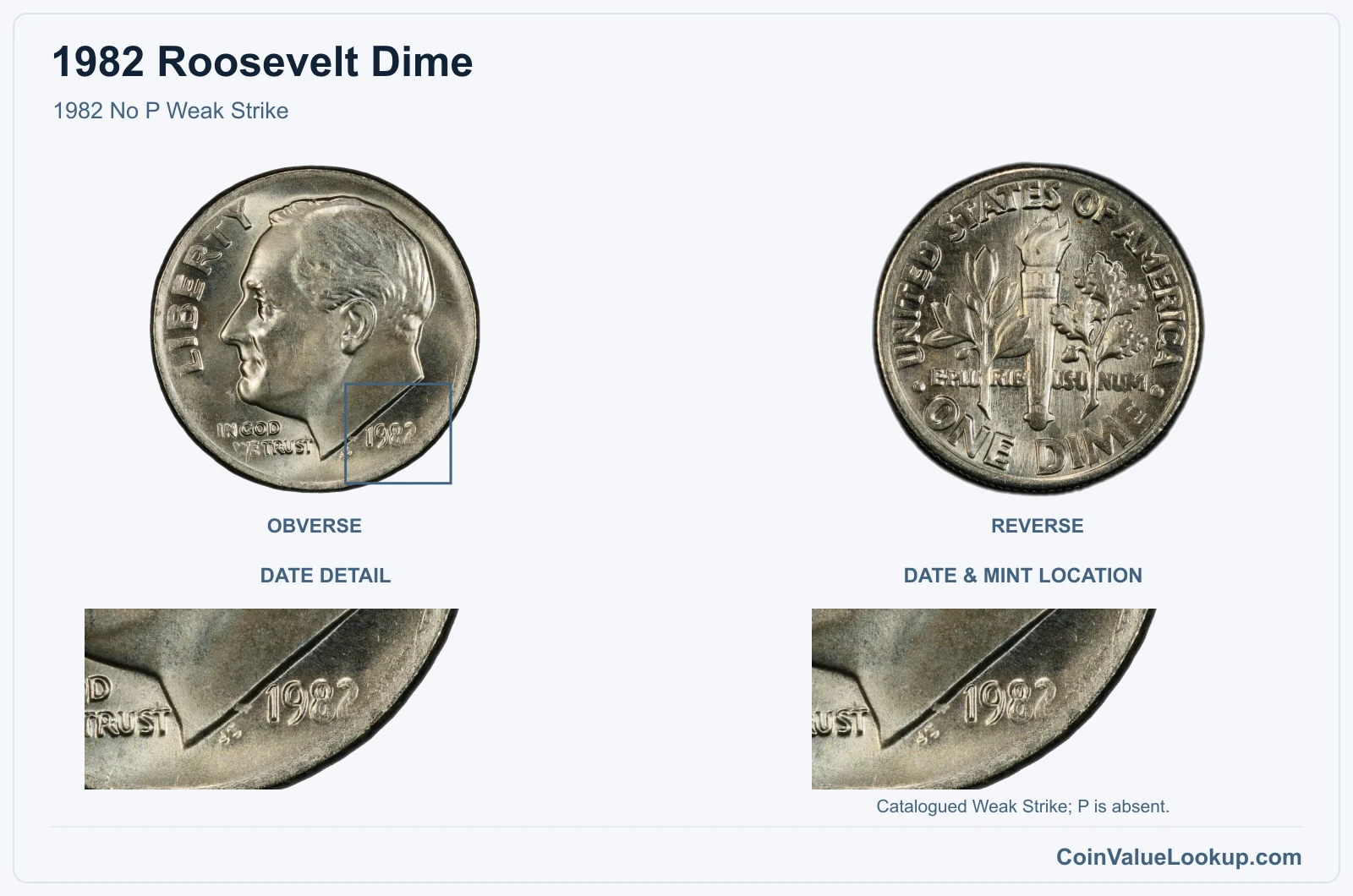
The weak strike class of the 1982 No P dime shares the same missing mintmark but shows distinct softness in the outer details. The "2" in the date appears weaker and sits closer to the rim than on a normal or strong strike coin.
Peripheral design elements look flattened, almost mushy.
Do not confuse this with ordinary circulation wear. A worn coin loses detail from contact over time; a weak strike coin left the press that way.
The difference is visible under magnification, and certified attribution removes the guesswork. This is still a business strike from Philadelphia, copper-nickel clad, 2.27 grams — just struck from a die that was both missing its mintmark and producing softer impressions.
Value hinges on authenticated identity, overall condition, and how the error presents on the individual piece.
Range Grade
Price Auction Records Appraisal PO PO 1
—
Coin Identifier FR FR 2
—
Coin Identifier AG AG 3
—
Coin Identifier G G 4
—
Coin Identifier
G 6
—
Coin Identifier VG VG 8
—
Coin Identifier
VG 10
—
Coin Identifier F F 12
—
Coin Identifier
F 15
—
Coin Identifier VF VF 20
—
Coin Identifier
VF 25
—
Coin Identifier
VF 30
—
Coin Identifier
VF 35
—
Coin Identifier XF XF 40
—
Coin Identifier
XF 45
—
Coin Identifier AU AU 50
—
Coin Identifier
AU 53
—
Coin Identifier
AU 55
—
Coin Identifier
AU 58
—
Coin Identifier MS MS 60
—
Coin Identifier
MS 61
—
Coin Identifier
MS 62
—
Coin Identifier
MS 63
—
Coin Identifier
MS 64
Coin Identifier
MS 65
—
Coin Identifier
MS 66
Coin Identifier
MS 67
—
Coin Identifier
MS 68
—
—
—
MS 69
—
—
—
MS 70
—
—
—
1982 Roosevelt Dime — D Business Strike
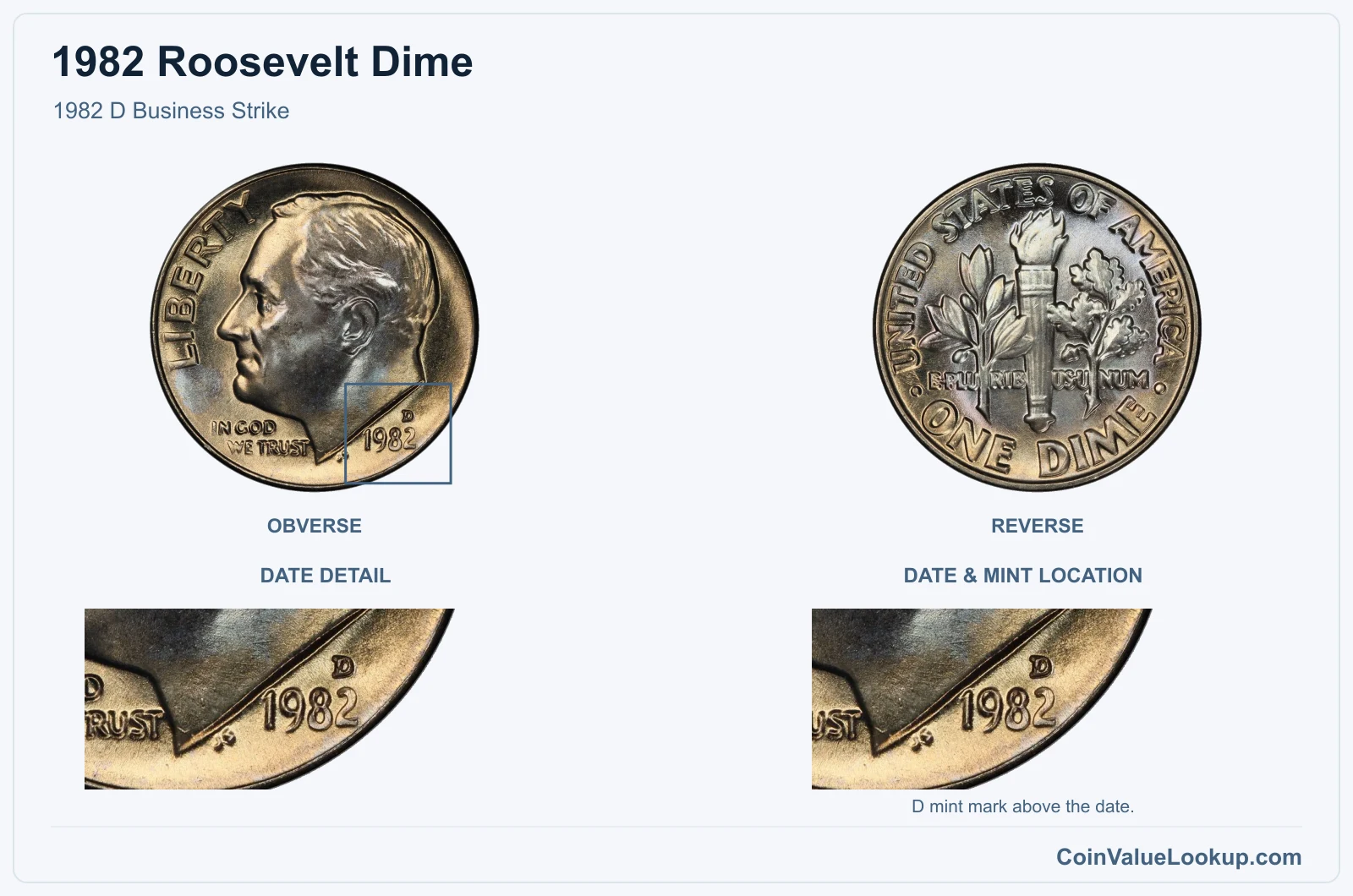
The 1982-D comes from Denver and carries a "D" mintmark near the date. Same copper-nickel clad composition, same 2.27 grams.
A USA Coin Book guide estimate puts this at about $3.08 in MS 65, which is lower than the Philadelphia issue at the same grade.
Circulated examples are face value coins. For any meaningful premium, you need an uncirculated piece with original surfaces and minimal marks.
Coins with fully separated torch bands on the reverse are preferred by collectors who focus on strike quality.
Range Grade
Price Auction Records Appraisal PO PO 1
—
Coin Identifier FR FR 2
—
Coin Identifier AG AG 3
—
Coin Identifier G G 4
—
Coin Identifier
G 6
—
Coin Identifier VG VG 8
—
Coin Identifier
VG 10
—
Coin Identifier F F 12
—
Coin Identifier
F 15
—
Coin Identifier VF VF 20
—
Coin Identifier
VF 25
—
Coin Identifier
VF 30
—
Coin Identifier
VF 35
—
Coin Identifier XF XF 40
—
Coin Identifier
XF 45
—
Coin Identifier AU AU 50
—
Coin Identifier
AU 53
—
Coin Identifier
AU 55
—
Coin Identifier
AU 58
—
Coin Identifier MS MS 60
—
Coin Identifier
MS 61
—
Coin Identifier
MS 62
—
Coin Identifier
MS 63
—
Coin Identifier
MS 64
Coin Identifier
MS 65
—
Coin Identifier
MS 66
Coin Identifier
MS 67
Coin Identifier
MS 68
—
—
—
MS 69
—
—
—
MS 70
—
—
—
1982 Roosevelt Dime — S Proof
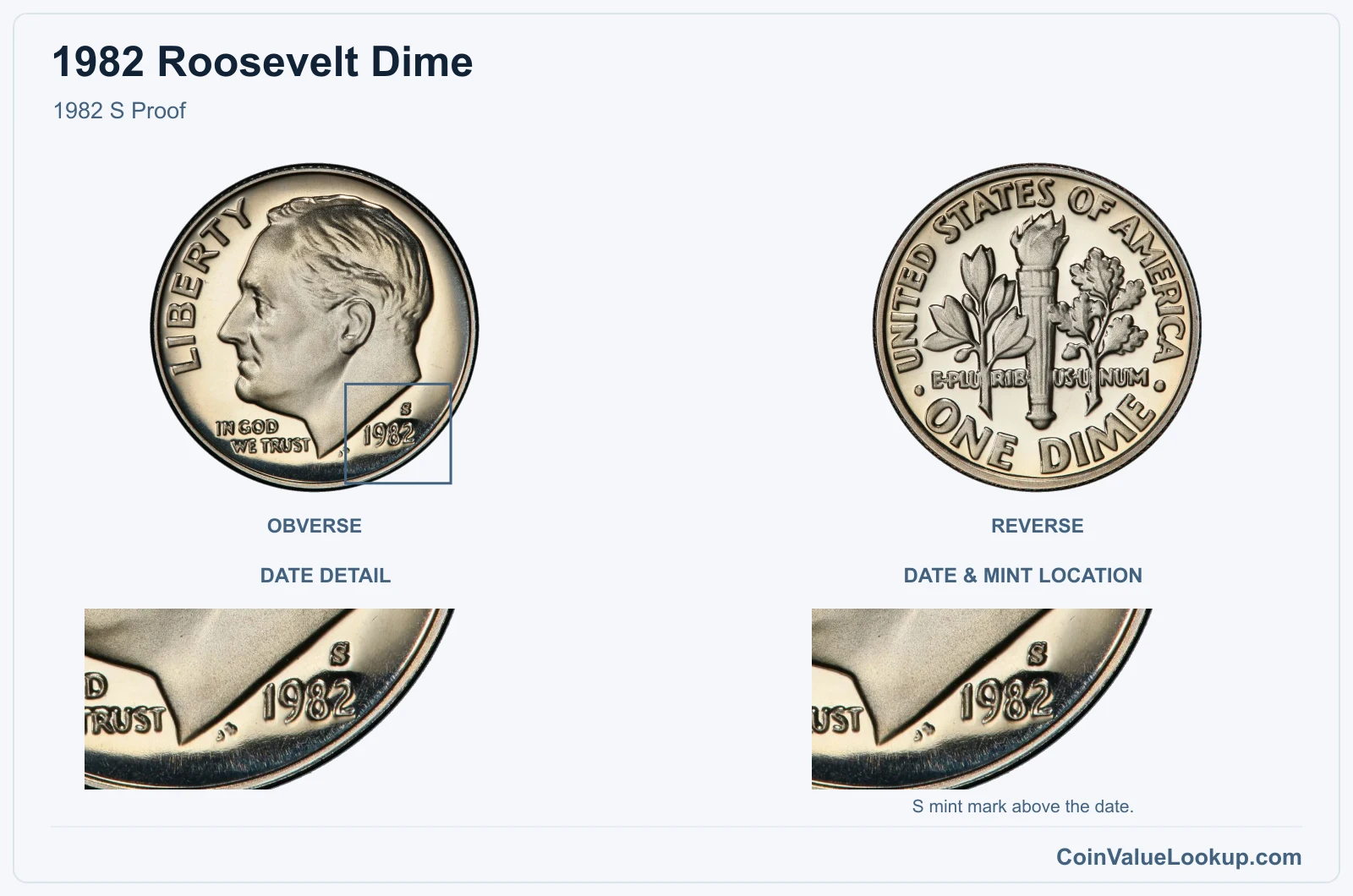
The 1982-S proof was struck at San Francisco with an "S" mintmark and sold in proof sets, not released into circulation. It is copper-nickel clad over a copper core, same as the business strikes.
A USA Coin Book guide estimate places it at about $3.08 in PR 65.
Proof is a manufacturing method — polished dies, specially prepared planchets, multiple strikes — not a grade above Mint State. Coins with strong contrast between frosted raised devices and deeply mirrored fields are more visually appealing.
The numerical grade still depends on surface preservation, absence of haze, and whether the coin avoided contact marks in or out of its original holder.
Range Grade
Price Auction Records Appraisal PR PR 1
—
Coin Identifier
PR 2
—
Coin Identifier
PR 3
—
Coin Identifier
PR 4
—
Coin Identifier
PR 6
—
Coin Identifier
PR 8
—
Coin Identifier
PR 10
—
Coin Identifier
PR 12
—
Coin Identifier
PR 15
—
Coin Identifier
PR 20
—
Coin Identifier
PR 25
—
Coin Identifier
PR 30
—
Coin Identifier
PR 35
—
Coin Identifier
PR 40
—
Coin Identifier
PR 45
—
Coin Identifier
PR 50
—
Coin Identifier
PR 53
—
Coin Identifier
PR 55
—
Coin Identifier
PR 58
—
Coin Identifier
PR 60
—
Coin Identifier
PR 61
—
Coin Identifier
PR 62
—
Coin Identifier
PR 63
—
Coin Identifier
PR 64
—
Coin Identifier
PR 65
—
Coin Identifier
PR 66
—
Coin Identifier
PR 67
Coin Identifier
PR 68
Coin Identifier
PR 69
Coin Identifier
PR 70
Coin Identifier
1982 Roosevelt Dime Error List
1. 1982 Roosevelt Dime — Missing P Mintmark
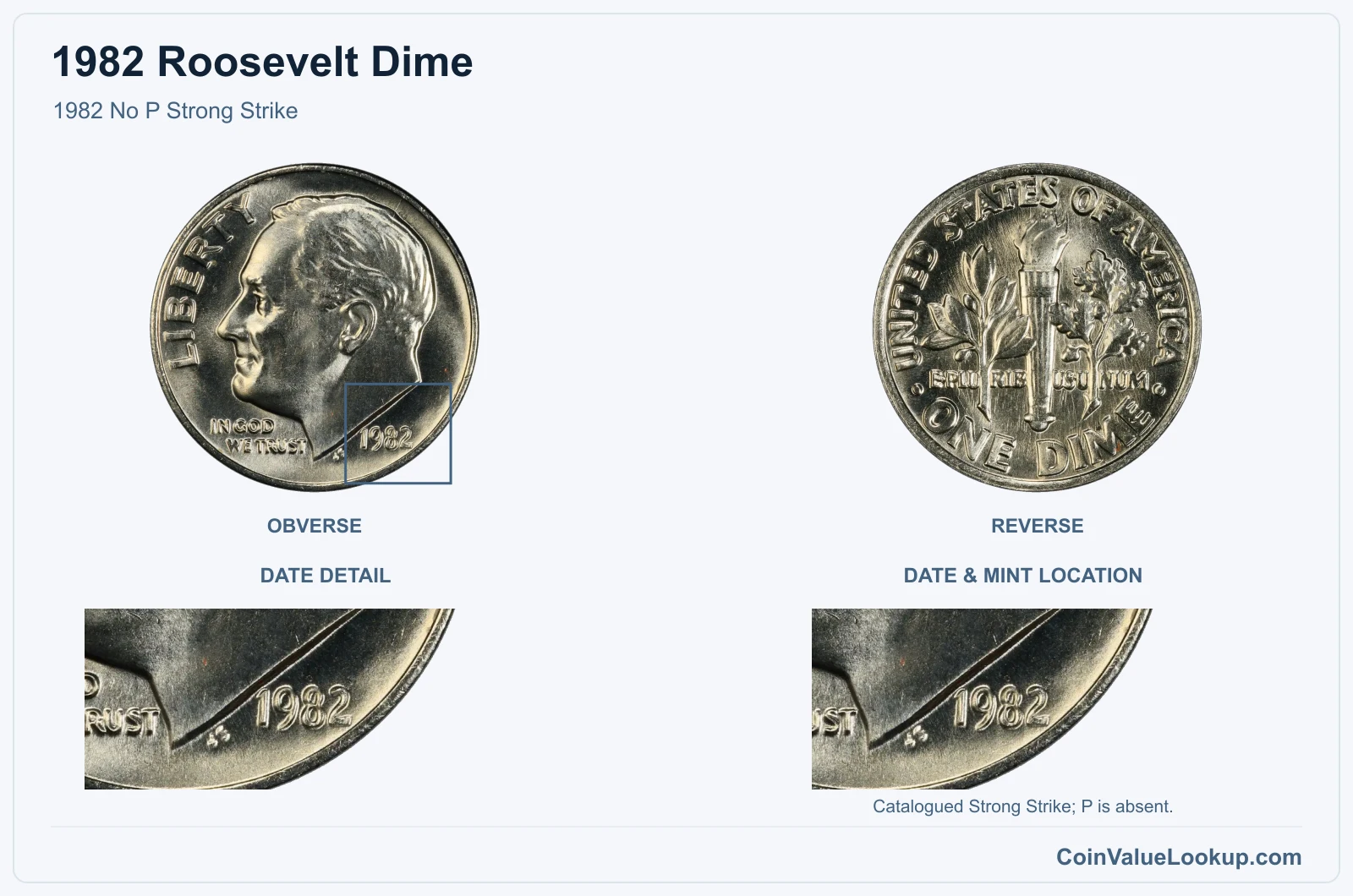
The 1982 Missing P Mintmark is one of the most recognized modern U.S. coin errors. On a normal 1982 Philadelphia dime, you will see a small "P" on the obverse near the date.
On a No P example, that area is undisturbed and blank — no trace of a mintmark at all.
Before you get excited, compare closely against a normal 1982-P. A mintmark that was physically removed will leave tooling marks or a disturbed field.
A strike-through or grease-filled die can also obscure details temporarily. And pre-1980 Philadelphia dimes had no mintmark by design, so make sure you are not looking at an older coin.
PCGS recognizes both strong and weak strike classes of this error; certified attribution is the surest confirmation.
Value for a genuine example depends on the authenticated identity, condition, and strike class of the specific coin. There is no single adopted guide price that covers both classes.
2. 1982 Roosevelt Dime — Tilted Partial Collar
A tilted partial collar error occurs when the collar die — the ring that forms the coin's edge — shifts or tilts during striking. The result is a stepped edge: one section shows normal reeding while another portion is expanded and smooth.
Heritage Auctions sold a 1982-P example graded ANACS MS 64 as lot 44274.
To check for this, photograph the edge at an angle. You should see a clear transition between the reeded and smooth sections, with one side of the coin slightly wider than the other.
The rim may appear raised or irregular on the expanded side.
Do not confuse this with post-mint damage. Coins that have been rolled along a hard surface or suffered rim dings can look vaguely similar, but they lack the clean stepped transition and the smooth-to-reeded pattern that a genuine partial collar produces.
Value depends on the individual coin's condition and how dramatic the collar shift is — no fixed guide price is adopted for this variety.