1930 Mercury Dime Coin Value: How Much Is It Worth?
A 1930 Mercury dime in well-worn condition starts around $7.16 in G-4, while a pristine MS-65 example can reach $158 to $261 depending on the mint. Only Philadelphia and San Francisco struck dimes this year — there is no Denver issue.
Full Bands designation and identified error varieties each carry their own value considerations beyond the standard guide figures.
Fast Way to Identify Your 1930 Mercury Dime
Snap a clear photo of both the front and back of your 1930 dime and upload them here. Our identifier can give you a preliminary read on which mint struck your coin and its approximate condition.
It is not a substitute for professional certification, but it is a solid starting point to figure out what you are holding.
1930 Mercury Dime Value
Upload both sides of your 1930 Mercury Dime.
Front Obverse
Upload photo
Back Reverse
Upload photo
Which 1930 Mercury Dime Versions Are Worth Money?
- Only two mints produced 1930 dimes — Philadelphia and San Francisco — so check for a small S on the reverse near ONE.
- San Francisco MS-65 examples carry a higher guide value (about $261) than Philadelphia MS-65 coins (about $158), per USA Coin Book estimates.
- Full Bands designation indicates sharply struck fasces bands and can command a premium above standard mint-state prices.
- Recognized error categories for this date include off-center strikes, doubled die obverse, broadstrikes, and lamination issues — each valued individually based on condition and severity.
Step 1: Identify Your 1930 Mercury Dime Mint Mark and Version
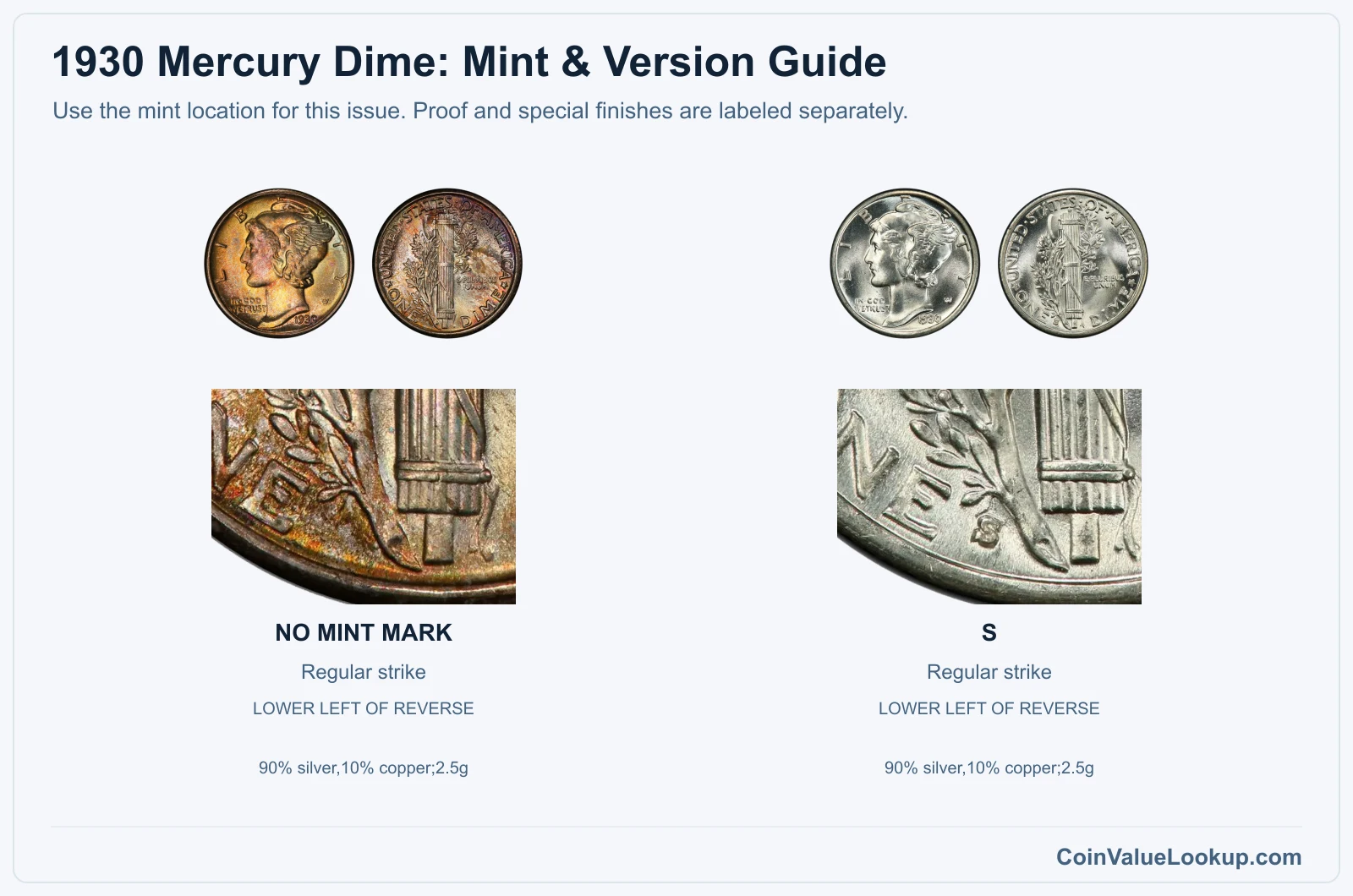
The 1930 Mercury dime was produced at only two mints: Philadelphia and San Francisco. No Denver coins exist for this date.
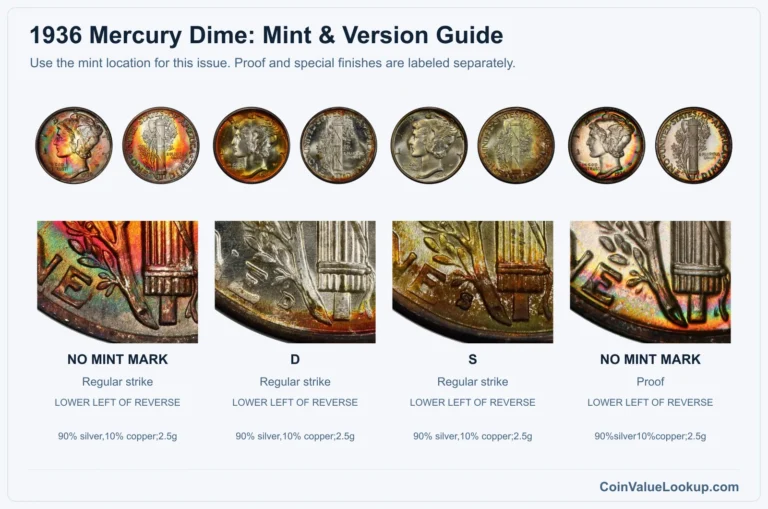
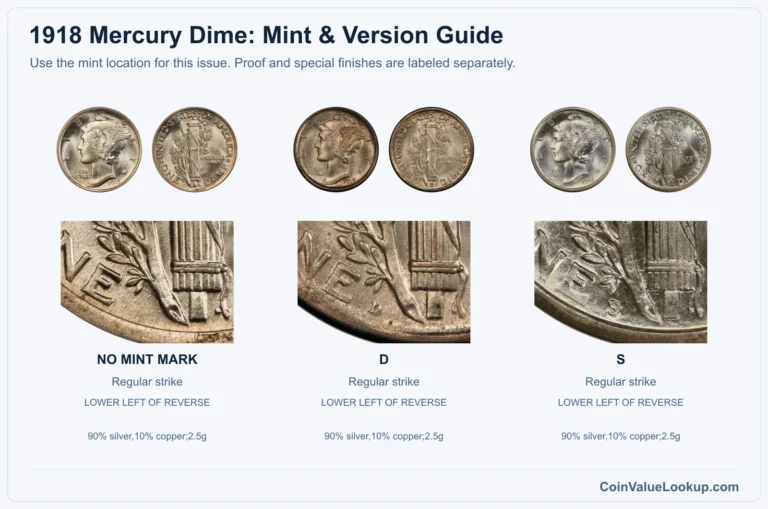
Philadelphia pieces carry no mintmark at all. San Francisco coins display a small "S" on the reverse, tucked to the lower left of the fasces near the word ONE.
Flip the coin over and look closely — on well-circulated examples the S can be faint.
Do not confuse the "AW" monogram on the obverse with a mintmark. Those are the initials of designer Adolph Weinman, not a West Point identifier.
Every 1930 Mercury dime is struck in 90% silver and 10% copper, weighs about 2.5 grams, and measures 17.9 mm with a reeded edge. That composition applies to both mints on this page.
Step 2: Check Your 1930 Mercury Dime Grade
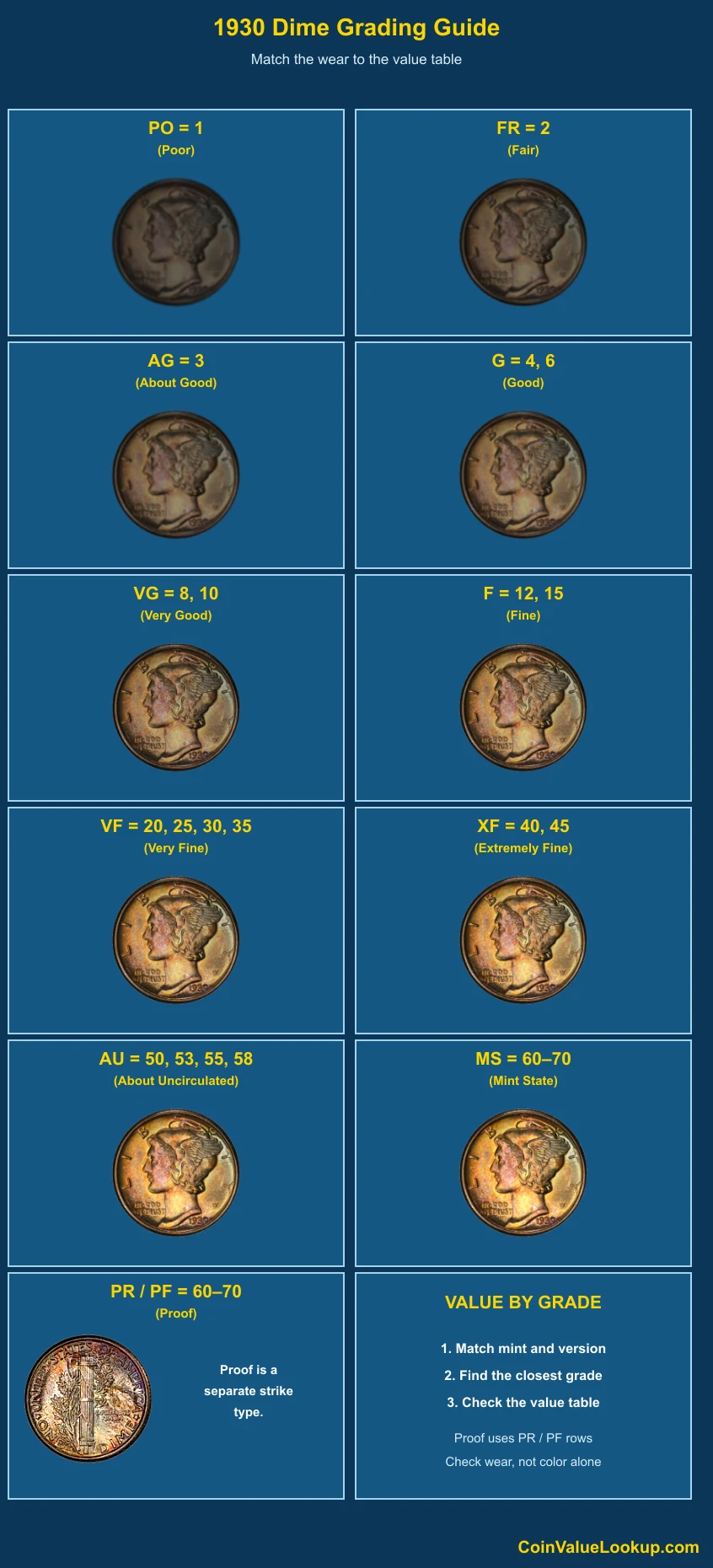
Start by looking at Liberty's hair detail directly above and in front of the ear. On a high-grade coin those strands are sharp and distinct.
As wear increases, the hair merges into a flat area and the wing on the cap loses feather separation.
Flip to the reverse and examine the fasces — the bundle of rods and bands in the center. On lightly circulated pieces the horizontal bands remain visible, while heavy wear flattens them first.
Luster matters too. Check for original mint shine versus dull, cleaned, or retoned surfaces.
Contact marks from bag storage are common on mint-state survivors and reduce eye appeal even when the coin technically grades high.
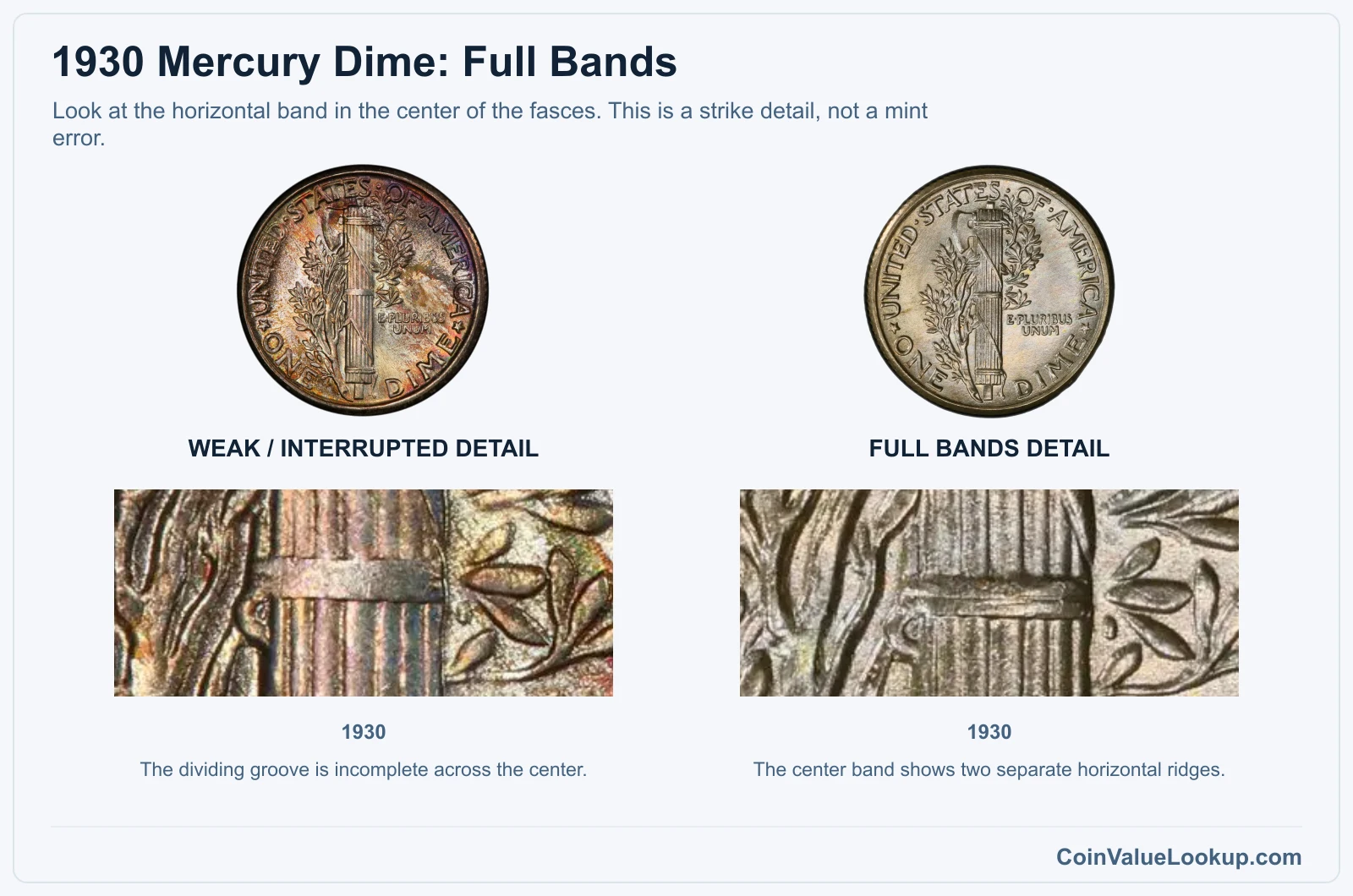
Do not assume weak peripheral legends or mushy bands automatically mean circulation wear. Branch-mint strikes — especially San Francisco — sometimes came off the press with soft detail.
Use the comparison image to gauge actual surface wear versus a strike issue. Full Bands is a separate designation that NGC evaluates by checking central and outer band separation; different grading services may apply slightly different criteria.
Step 3: Check 1930 Mercury Dime Value by Mint and Version
1930 Mercury Dime — No Mint Mark — Silver Circulation
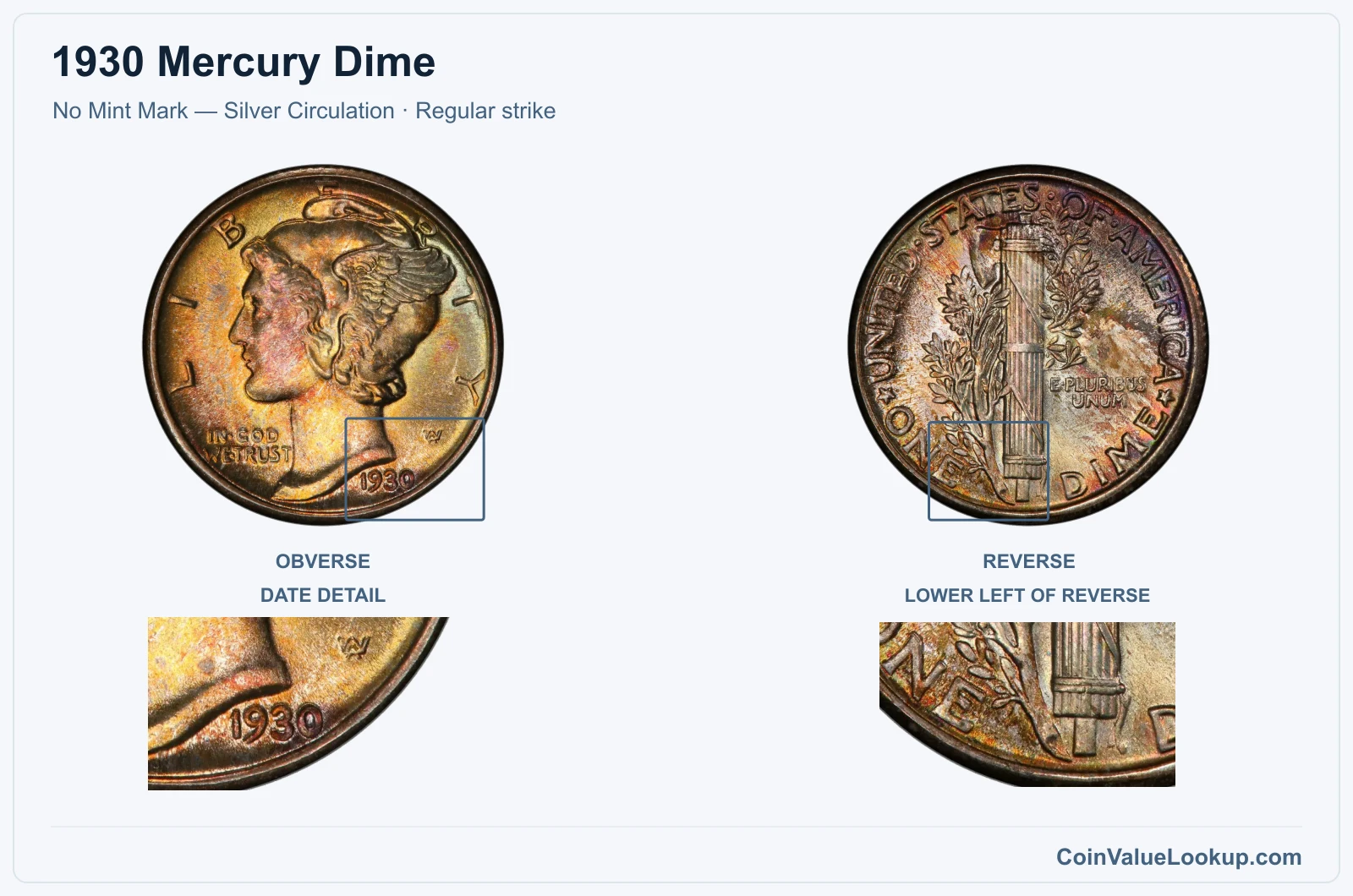
The Philadelphia 1930 Mercury dime has no mintmark anywhere on the coin. Guide estimates from USA Coin Book place a well-worn G-4 example around $7.16, climbing to roughly $158 at MS-65.
When examining yours, confirm the obverse date and check the lower-left reverse area beside ONE — a blank space there confirms Philadelphia. Original mint-state surfaces with strong luster are the main value drivers at this mint.
Full Bands examples exist but carry their own separate pricing that cannot be inferred from the regular MS-65 figure.
Coin Value Lookup is a useful starting point if you want to look up guides for other Mercury dime dates or different series in your collection.
Range Grade
Price Auction Records Appraisal PO PO 1
—
Coin Identifier FR FR 2
—
Coin Identifier AG AG 3
—
Coin Identifier G G 4
—
Coin Identifier
G 6
—
Coin Identifier VG VG 8
—
Coin Identifier
VG 10
—
Coin Identifier F F 12
—
Coin Identifier
F 15
—
Coin Identifier VF VF 20
—
Coin Identifier
VF 25
—
Coin Identifier
VF 30
—
Coin Identifier
VF 35
—
Coin Identifier XF XF 40
—
Coin Identifier
XF 45
—
Coin Identifier AU AU 50
—
Coin Identifier
AU 53
—
Coin Identifier
AU 55
—
Coin Identifier
AU 58
Coin Identifier MS MS 60
—
Coin Identifier
MS 61
—
Coin Identifier
MS 62
Coin Identifier
MS 63
Coin Identifier
MS 64
Coin Identifier
MS 65
Coin Identifier
MS 66
Coin Identifier
MS 67
Coin Identifier
MS 68
—
—
—
MS 69
—
—
—
MS 70
—
—
—
1930 Mercury Dime — S — Silver Circulation
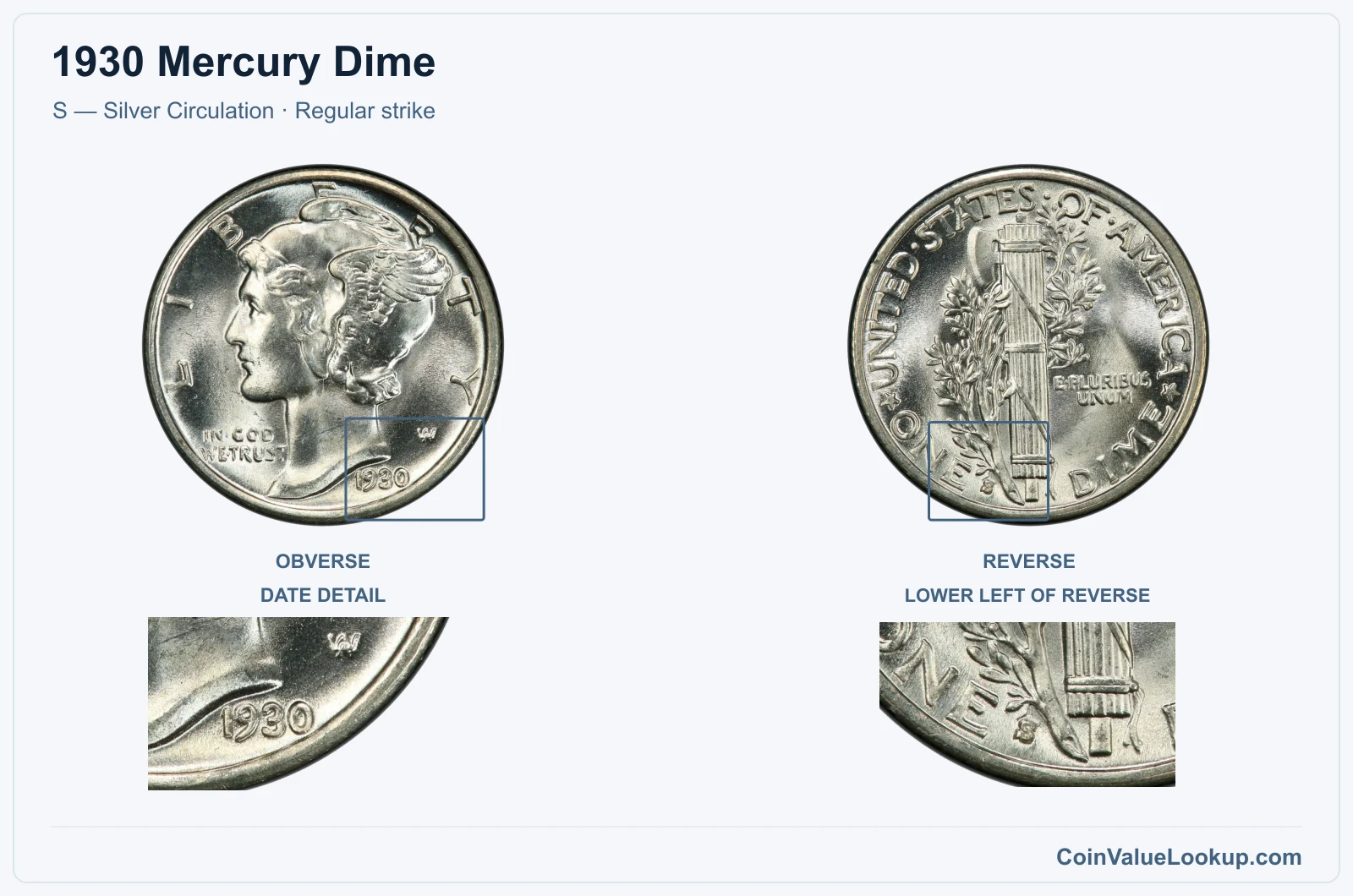
San Francisco struck 1930 dimes bearing a small "S" mintmark on the lower-left reverse near ONE. In G-4 condition a guide estimate sits around $7.16, but an MS-65 piece jumps to approximately $261 per USA Coin Book — noticeably higher than the Philadelphia counterpart at the same grade.
San Francisco issues from this era are sometimes seen with softer strikes, so do not confuse weak detail with heavy circulation. Full Bands coins exist for this mint but their pricing is separate from the standard MS-65 estimate listed here.
A sharp, fully lustrous S-mint survivor in high grade is a coin worth getting professionally graded.
Range Grade
Price Auction Records Appraisal PO PO 1
—
Coin Identifier FR FR 2
—
Coin Identifier AG AG 3
—
Coin Identifier G G 4
—
Coin Identifier
G 6
—
Coin Identifier VG VG 8
—
Coin Identifier
VG 10
—
Coin Identifier F F 12
—
Coin Identifier
F 15
—
Coin Identifier VF VF 20
—
Coin Identifier
VF 25
—
Coin Identifier
VF 30
—
Coin Identifier
VF 35
—
Coin Identifier XF XF 40
—
Coin Identifier
XF 45
—
Coin Identifier AU AU 50
—
Coin Identifier
AU 53
Coin Identifier
AU 55
Coin Identifier
AU 58
Coin Identifier MS MS 60
—
Coin Identifier
MS 61
—
Coin Identifier
MS 62
Coin Identifier
MS 63
Coin Identifier
MS 64
Coin Identifier
MS 65
Coin Identifier
MS 66
Coin Identifier
MS 67
Coin Identifier
MS 68
—
—
—
MS 69
—
—
—
MS 70
—
—
—
1930 Mercury Dime Error List
1. 1930 Mercury Dime — Off-Center Strike
An off-center strike happens when the planchet is not seated properly between the dies, producing a shifted design with an unstruck crescent of blank metal along one edge. On a 1930 Mercury dime, the key diagnostic is that displaced crescent — it should be smooth and follow the coin's curvature, not jagged or irregular.
The date needs to remain visible for the coin to be attributed and to hold meaningful collector interest. The more dramatic the percentage off-center while still showing the full date, the more desirable the piece tends to be.
Do not confuse an off-center strike with a clipped planchet, a one-sided die misalignment, or post-mint damage from being flattened. Condition, severity, and date visibility all factor into what any individual example is worth — no single guide range covers every scenario.
2. 1930 Mercury Dime — Doubled Die Obverse
A doubled die obverse on a 1930 dime shows consistent extra thickness or separation in the obverse lettering, date, or design elements. The doubling should appear the same way under different lighting angles and magnification — that consistency separates a genuine hub-doubling variety from lookalikes.
Machine doubling, which is far more common, creates a flat shelf-like appearance without the raised, notched profile of a true doubled die. Worn die contours and optical reflections on lustrous surfaces can also mimic doubling to the untrained eye.
Compare your coin's obverse details side-by-side with a known normal strike under the same lighting. Value depends on the strength and location of the doubling as well as overall coin condition, so each piece needs individual assessment.
3. 1930 Mercury Dime — Broadstrike
A broadstrike occurs when a coin is struck without the restraining collar that normally forms the reeded edge. The result is a dime that spreads outward, appearing slightly wider than normal, with the design reaching closer to a smooth or malformed rim.
On a 1930 Mercury dime, look for outward metal flow and an edge that lacks the sharp reeding you would see on a properly struck coin. The entire design should still be present and roughly centered — if large portions of the design are missing, you may be looking at an off-center strike instead.
Coins flattened after leaving the mint can mimic a broadstrike, but post-mint damage usually shows uneven distortion and tooling marks. Value for a genuine broadstrike depends on the degree of spread, surface condition, and overall eye appeal.
4. 1930 Mercury Dime — Lamination / Split Planchet
A lamination or split planchet error shows up as peeling metal, a retained flap, or a visible layer separating within the coin's alloy. On a 1930 Mercury dime, photograph both the affected face and the edge together — the edge view often reveals the depth of the split clearly.
These flaws originate from impurities or gas pockets trapped in the silver-copper alloy during preparation. The peeling section typically follows the coin's contour rather than cutting across it at random angles.
Do not confuse lamination with surface scraping, corrosion pitting, or a coin that has been deliberately cut or filed. Genuine lamination has a natural, layered look.
The value of any individual lamination error depends on how dramatic the separation is and the overall condition of the coin.