1918 Mercury Dime Coin Value: How Much Is It Worth?
The 1918 Mercury dime was struck at all three active mints — Philadelphia, Denver and San Francisco — in 90% silver. USA Coin Book guide estimates place these coins from about $7.16 in G4 to $1,001 in MS65, depending on the mint.
No proofs were made this year. Coins with original mint-state surfaces and fully separated fasces bands can command premiums above those baseline figures.
Fast Way to Identify Your 1918 Mercury Dime
Snap clear photos of the front and back of your 1918 Mercury dime and upload them here. Our identifier can give you a preliminary read on which mint struck your coin and its general condition.
Good lighting and a steady hand help — try to capture the mintmark area on the lower left reverse and the band detail on the fasces.
1918 Mercury Dime Value
Upload both sides of your 1918 Mercury Dime.
Front Obverse
Upload photo
Back Reverse
Upload photo
Which 1918 Mercury Dime Versions Are Worth Money?
- Philadelphia coins without a mintmark range from about $7.16 in G4 to $441 in MS65 per USA Coin Book — original surfaces matter.
- Denver (D) examples carry the highest guide estimate of the three mints, reaching about $1,001 in MS65.
- San Francisco (S) coins follow closely, with guide estimates up to about $933 in MS65.
- Full Bands designation can add a premium to any mint's coin, though no separate FB price is provided here.
- Check for reported error types like doubled dies, off-center strikes and repunched mintmarks, which may carry additional collector interest.
Step 1: Identify Your 1918 Mercury Dime Mint Mark and Version
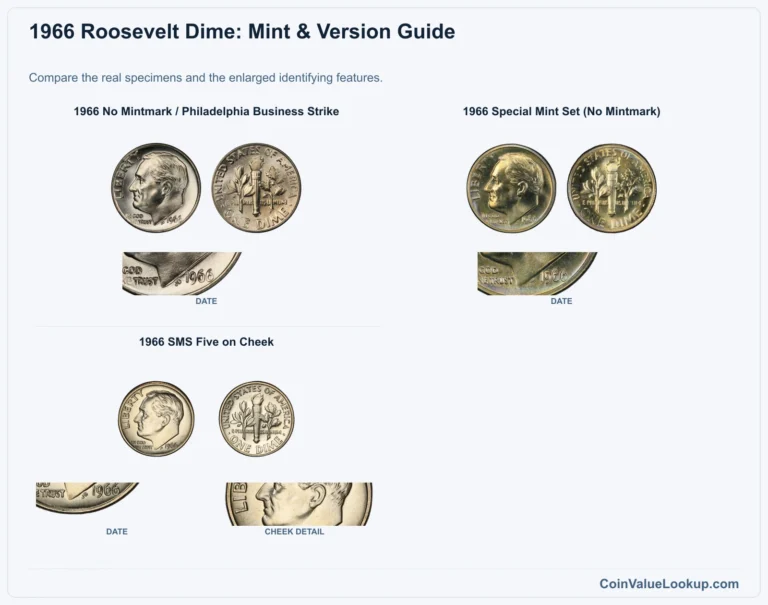
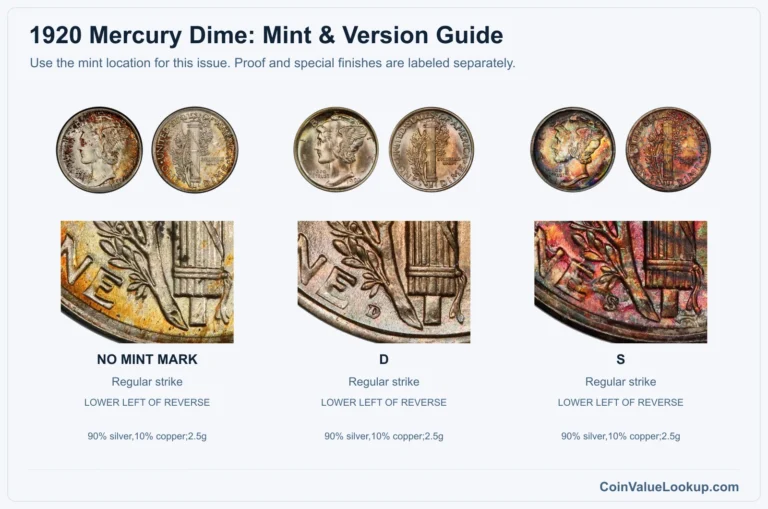
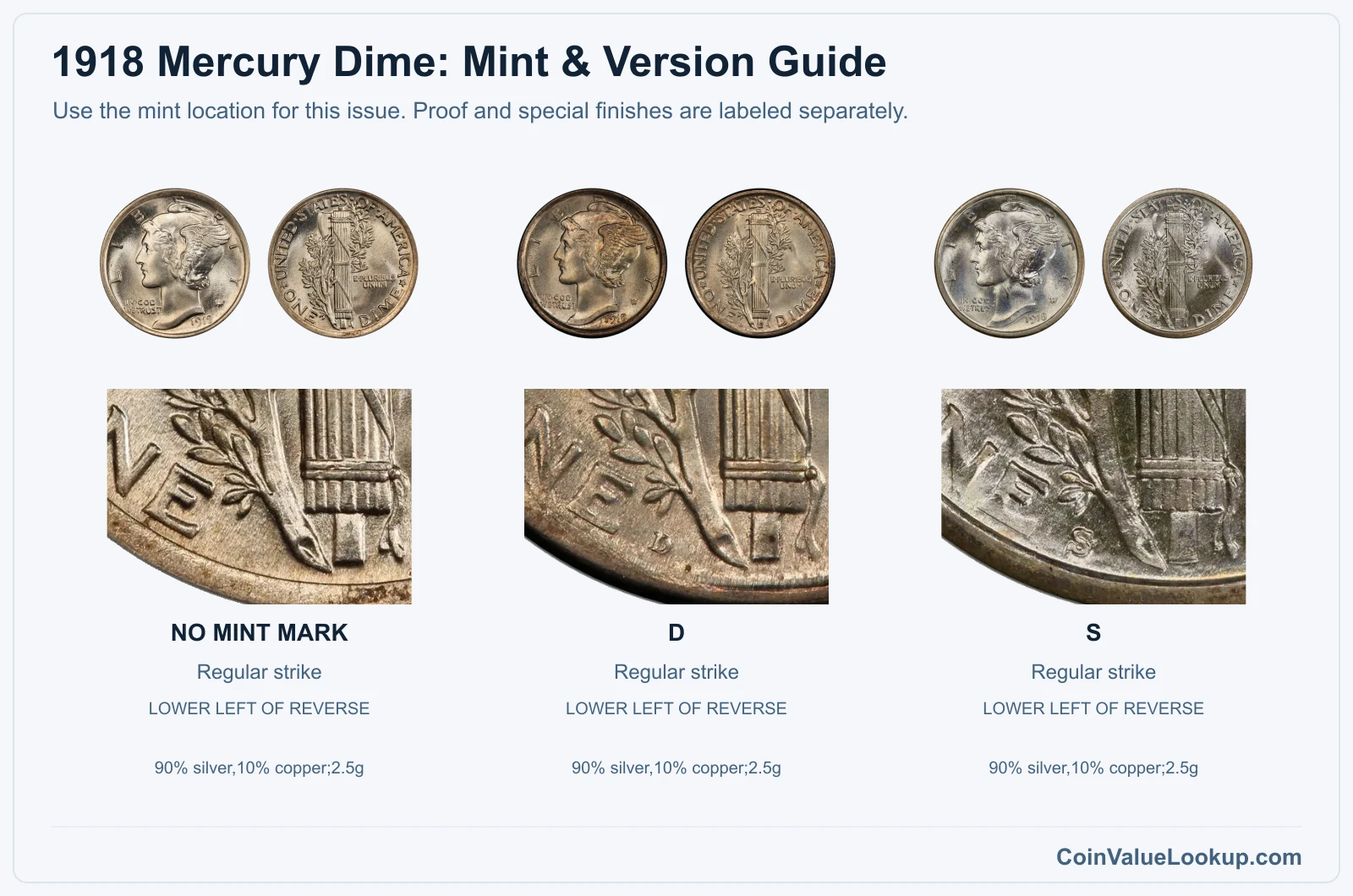
Three business-strike versions exist for 1918: Philadelphia (no mintmark), Denver (D) and San Francisco (S). The mintmark sits on the reverse, to the lower left of the word ONE, near the base of the fasces.
If you see no mintmark at all, that is Philadelphia — not a missing letter.
The small "AW" on the obverse near Liberty's neck is designer Adolph Weinman's monogram. It is not a mintmark and has nothing to do with West Point.
Every version shares the same composition: 90% silver and 10% copper, weighing about 2.5 grams on a 17.9 mm reeded-edge planchet.
One common mix-up: the 1918/7-D overdate is a Buffalo nickel variety, not a Mercury dime. If someone mentions it while discussing your dime, they are confusing two different series.
Step 2: Check Your 1918 Mercury Dime Grade
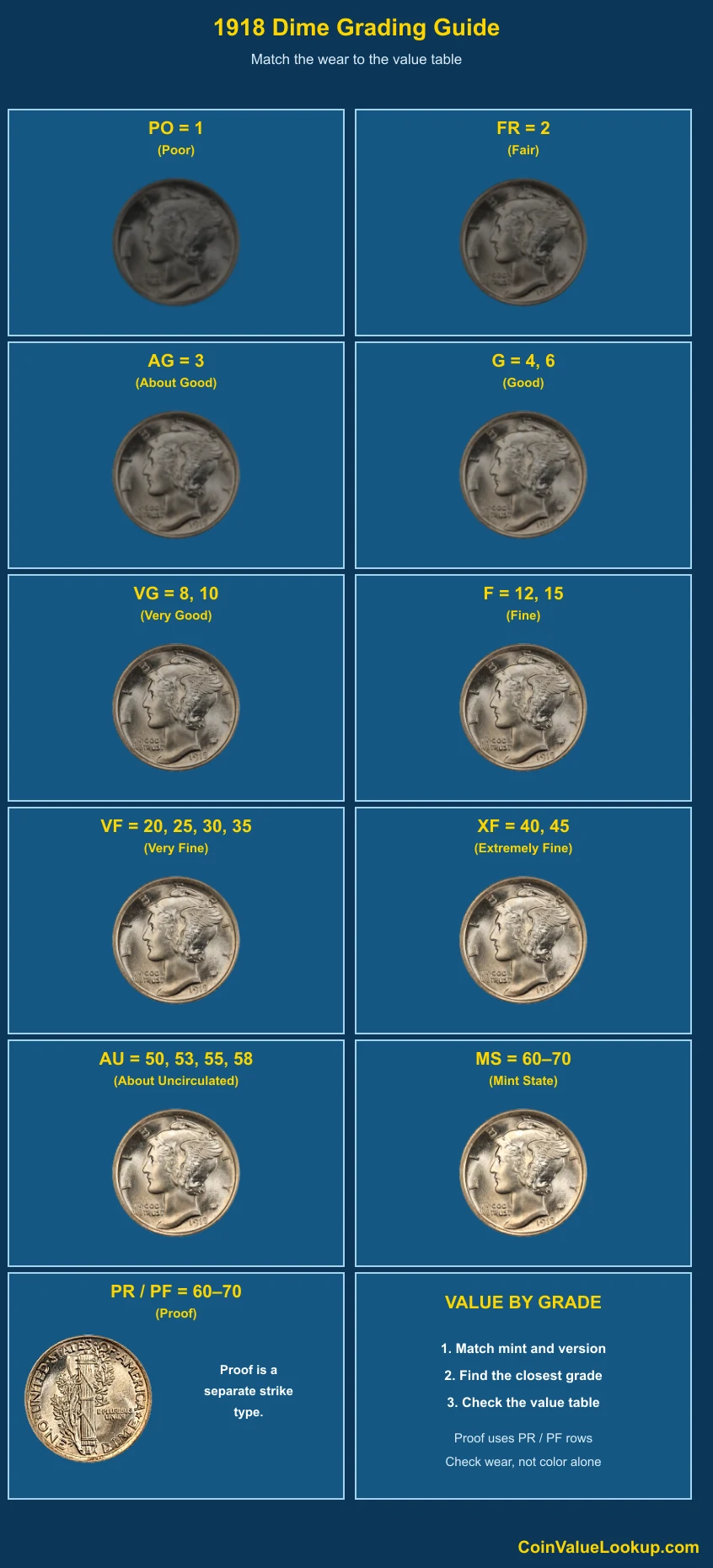
Start with Liberty's hair detail just above and in front of her ear. On a well-circulated piece those strands merge into a flat mass.
A coin in the G4 range will show a smooth profile with the major design visible but little fine hair texture remaining.
Move to the cap and wing. Higher-grade coins retain distinct feather separation in the wing and sharp lines on the cap folds.
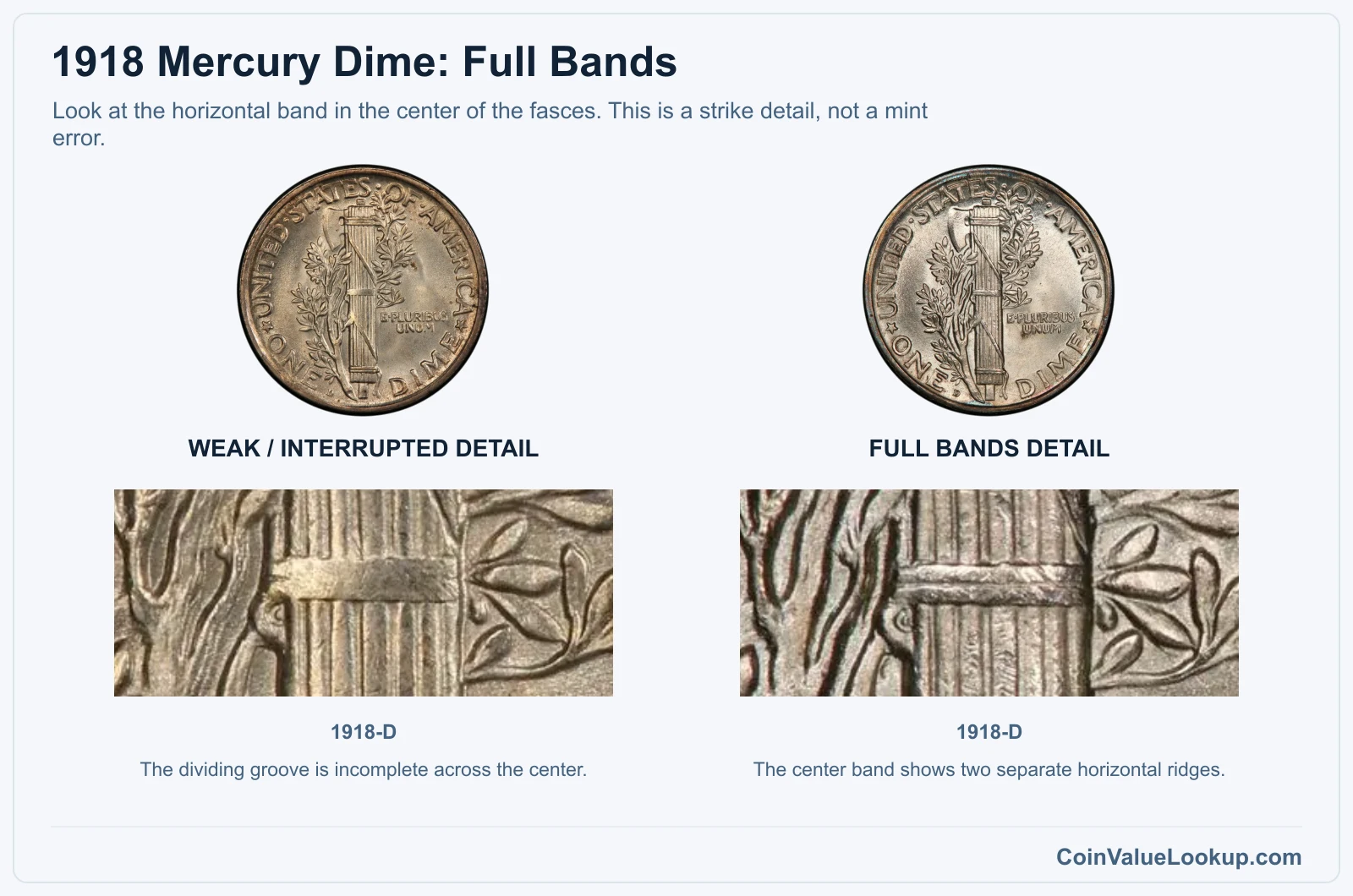
On the reverse, check the fasces bands and the horizontal crossbands — these wear quickly and are also affected by strike quality.
Weak bands or soft peripheral legends do not always mean heavy circulation. Branch-mint Mercury dimes are often softly struck from the press, so compare your coin's luster and contact marks alongside the design sharpness.
Use the comparison image to judge actual wear versus a strike issue.
Full Bands (FB) is a separate designation reflecting strong central and outer band separation on the fasces. Different grading services may apply slightly different criteria, so FB is worth checking independently of the overall grade.
Step 3: Check 1918 Mercury Dime Value by Mint and Version
1918 Mercury Dime — No Mint Mark — Silver Circulation
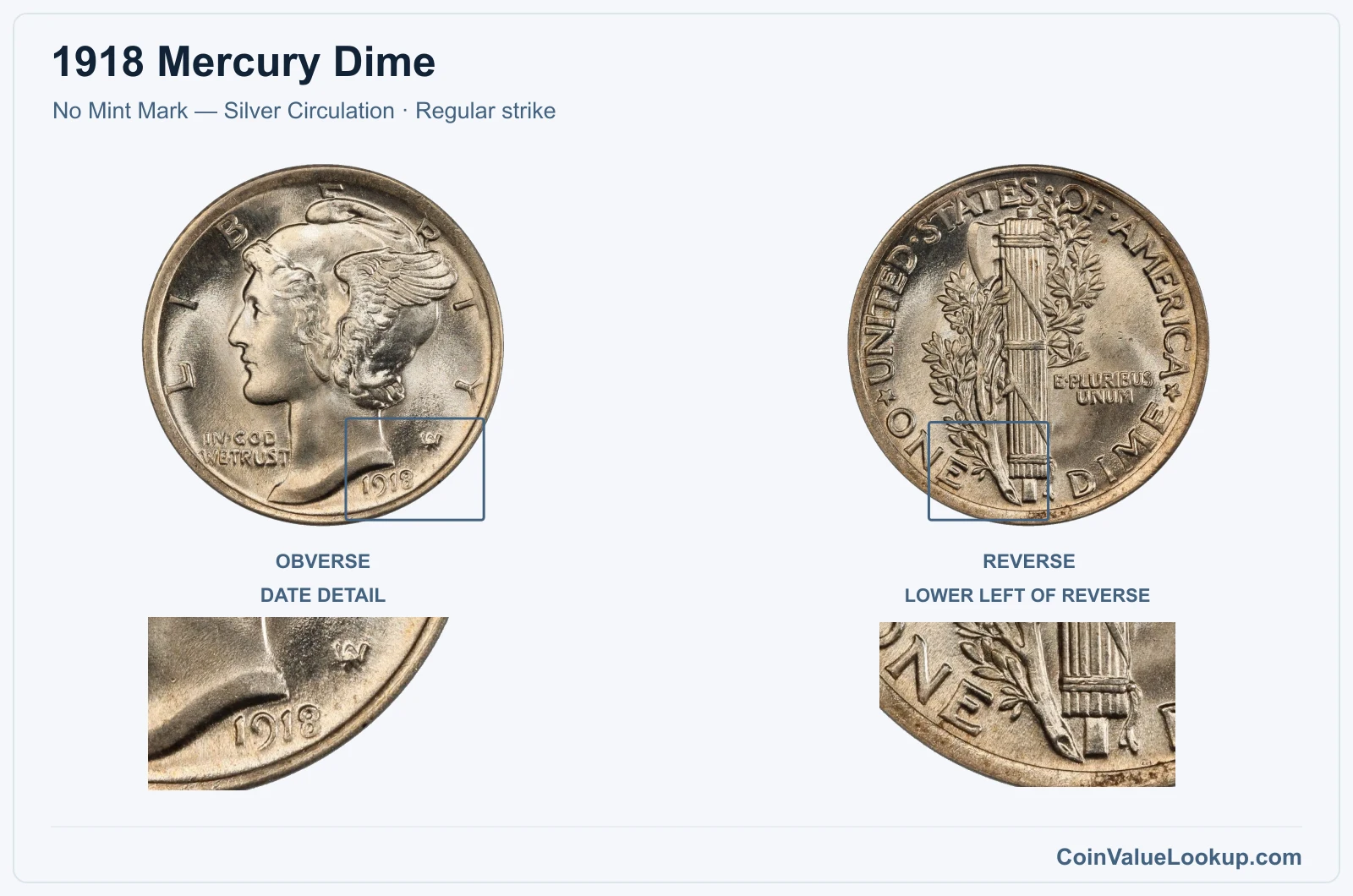
The 1918 Philadelphia dime carries no mintmark. Look at the reverse to the lower left of ONE — a blank space confirms this mint.
USA Coin Book guide estimates run from about $7.16 in G4 to $441 in MS65 for regular strikes.
Full Bands coins can trade at a premium above those figures, but no separate FB price is included here, so treat FB as an extra feature to verify rather than an assumed multiplier. Original, uncleaned surfaces with good luster are what push a Philadelphia coin toward those upper estimates.
Range Grade
Price Auction Records Appraisal PO PO 1
—
Coin Identifier FR FR 2
—
Coin Identifier AG AG 3
—
Coin Identifier G G 4
—
Coin Identifier
G 6
—
Coin Identifier VG VG 8
—
Coin Identifier
VG 10
—
Coin Identifier F F 12
—
Coin Identifier
F 15
—
Coin Identifier VF VF 20
—
Coin Identifier
VF 25
—
Coin Identifier
VF 30
—
Coin Identifier
VF 35
—
Coin Identifier XF XF 40
—
Coin Identifier
XF 45
—
Coin Identifier AU AU 50
Coin Identifier
AU 53
Coin Identifier
AU 55
Coin Identifier
AU 58
Coin Identifier MS MS 60
—
Coin Identifier
MS 61
—
Coin Identifier
MS 62
Coin Identifier
MS 63
Coin Identifier
MS 64
Coin Identifier
MS 65
Coin Identifier
MS 66
Coin Identifier
MS 67
—
—
—
MS 68
—
—
—
MS 69
—
—
—
MS 70
—
—
—
1918 Mercury Dime — D — Silver Circulation
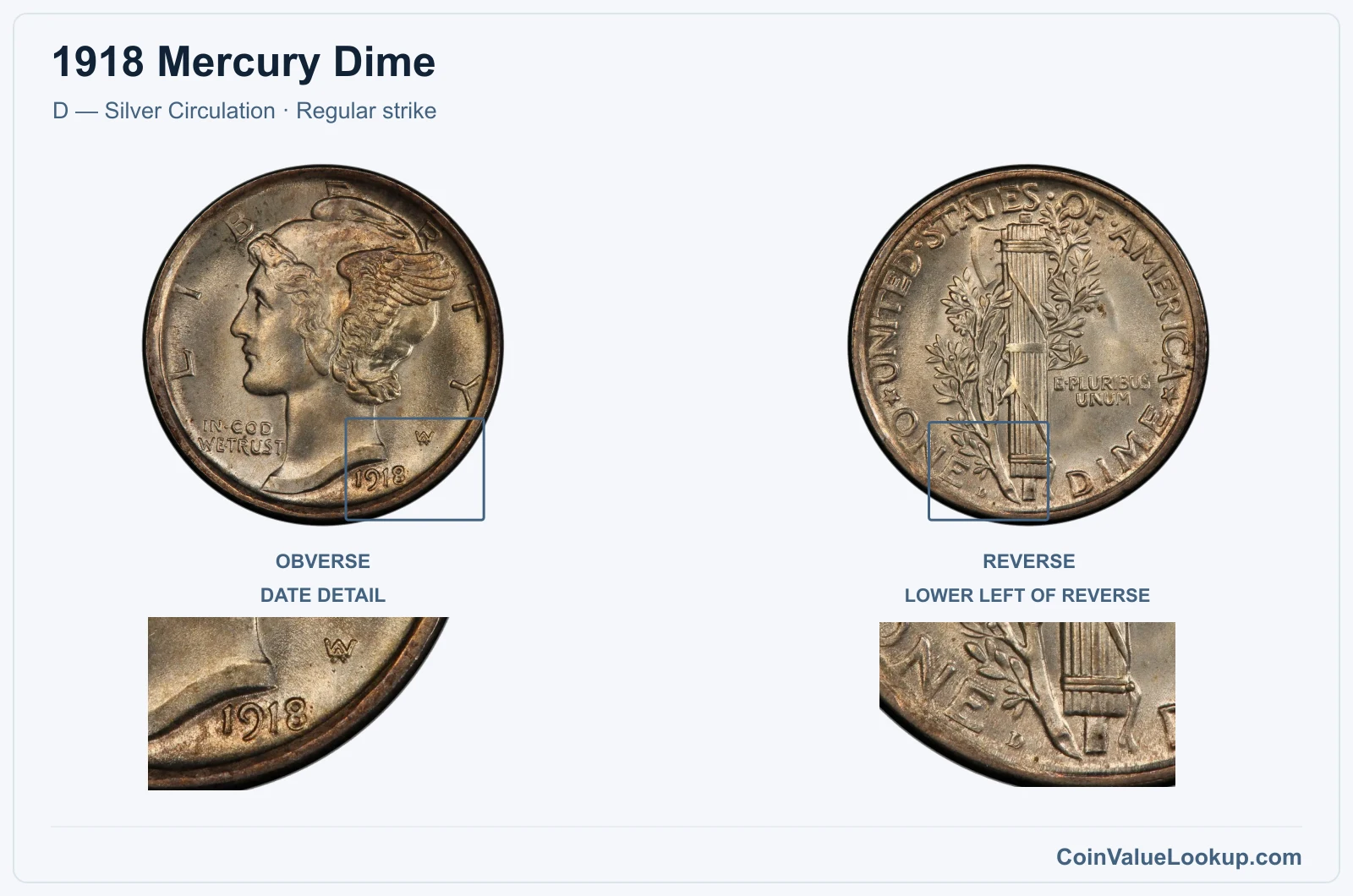
Look for a small "D" on the reverse, lower left beside the word ONE. The Denver issue carries the highest guide estimate among the three 1918 mints, with USA Coin Book listing about $7.16 in G4 and roughly $1,001 in MS65.
That upper figure assumes a coin with original surfaces, strong luster and minimal contact marks — not just any uncirculated survivor. Full Bands examples may bring more, but no separate FB value is provided.
Denver Mercury dimes of this era are sometimes softly struck, so a genuinely sharp coin with full detail stands out.
Coin Value Lookup is a good starting point if you want to compare your 1918-D against other Mercury dime years or check values across the full series.
Range Grade
Price Auction Records Appraisal PO PO 1
—
Coin Identifier FR FR 2
—
Coin Identifier AG AG 3
—
Coin Identifier G G 4
—
Coin Identifier
G 6
—
Coin Identifier VG VG 8
—
Coin Identifier
VG 10
—
Coin Identifier F F 12
—
Coin Identifier
F 15
—
Coin Identifier VF VF 20
—
Coin Identifier
VF 25
—
Coin Identifier
VF 30
—
Coin Identifier
VF 35
—
Coin Identifier XF XF 40
—
Coin Identifier
XF 45
Coin Identifier AU AU 50
—
Coin Identifier
AU 53
Coin Identifier
AU 55
Coin Identifier
AU 58
Coin Identifier MS MS 60
Coin Identifier
MS 61
Coin Identifier
MS 62
Coin Identifier
MS 63
Coin Identifier
MS 64
Coin Identifier
MS 65
Coin Identifier
MS 66
Coin Identifier
MS 67
Coin Identifier
MS 68
—
—
—
MS 69
—
—
—
MS 70
—
—
—
1918 Mercury Dime — S — Silver Circulation
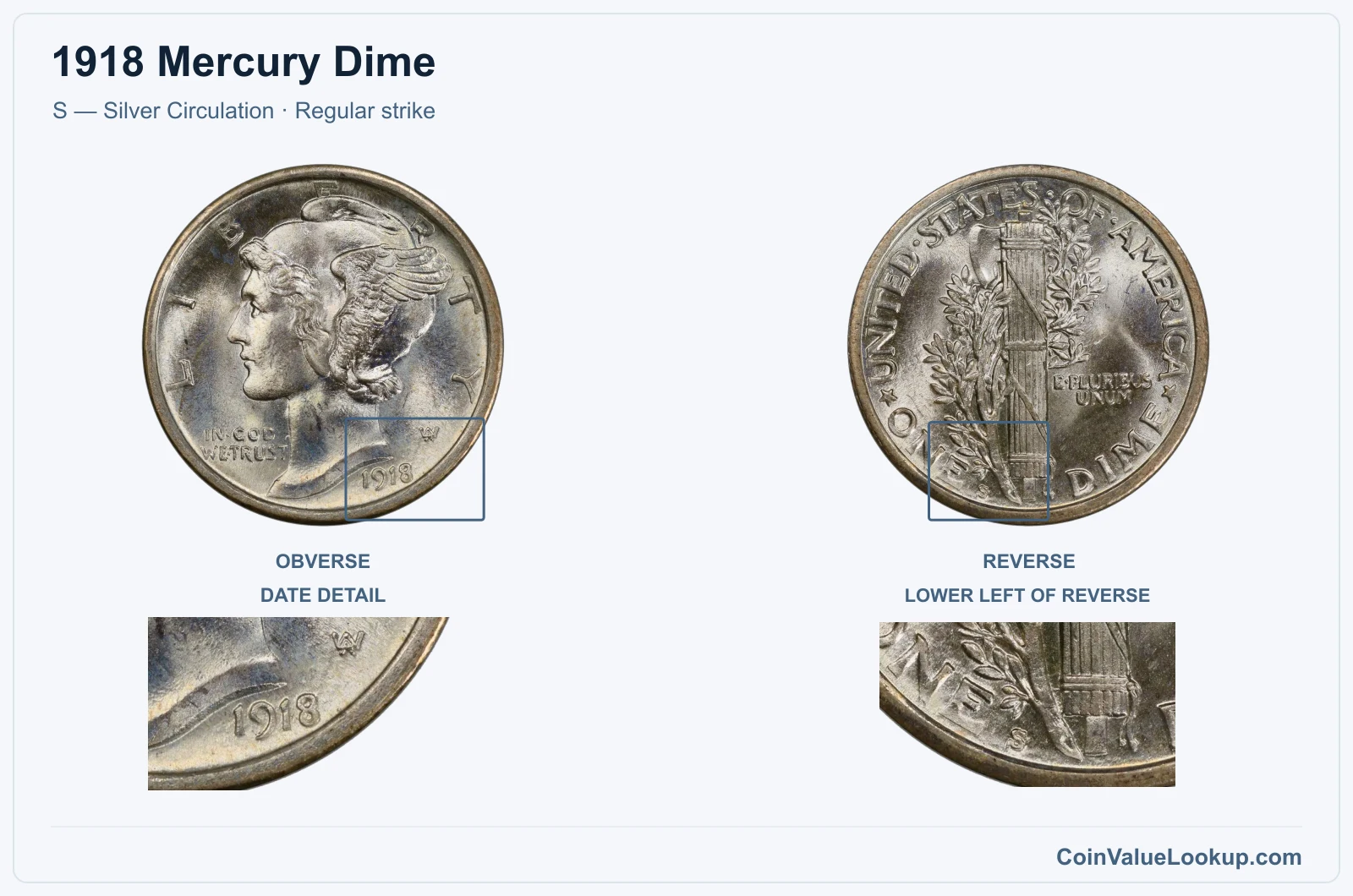
The San Francisco coin shows an "S" mintmark on the lower-left reverse near the fasces base. Guide estimates from USA Coin Book place this version at about $7.16 in G4 and around $933 in MS65.
Like its Denver sibling, the S-mint can suffer from weak strikes that disguise an otherwise high-grade coin. Pay close attention to luster and surface quality rather than relying on band sharpness alone to judge the grade.
Full Bands status is a separate evaluation; no FB-specific price is provided here, so consider it a potential bonus rather than a guaranteed premium.
Range Grade
Price Auction Records Appraisal PO PO 1
—
Coin Identifier FR FR 2
—
Coin Identifier AG AG 3
—
Coin Identifier G G 4
—
Coin Identifier
G 6
—
Coin Identifier VG VG 8
—
Coin Identifier
VG 10
—
Coin Identifier F F 12
—
Coin Identifier
F 15
—
Coin Identifier VF VF 20
—
Coin Identifier
VF 25
—
Coin Identifier
VF 30
—
Coin Identifier
VF 35
—
Coin Identifier XF XF 40
—
Coin Identifier
XF 45
—
Coin Identifier AU AU 50
Coin Identifier
AU 53
Coin Identifier
AU 55
Coin Identifier
AU 58
Coin Identifier MS MS 60
Coin Identifier
MS 61
—
Coin Identifier
MS 62
Coin Identifier
MS 63
Coin Identifier
MS 64
Coin Identifier
MS 65
Coin Identifier
MS 66
Coin Identifier
MS 67
Coin Identifier
MS 68
—
Coin Identifier
MS 69
—
—
—
MS 70
—
—
—
1918 Mercury Dime Error List
1. 1918 Mercury Dime — Doubled Die Obverse
A doubled die obverse on a 1918 Mercury dime shows consistent doubling on letters, the date or design elements on the front of the coin. Under magnification, look for separation or notching on features like LIBERTY, IN GOD WE TRUST or the date numerals.
The doubling should repeat in the same direction across multiple elements — that consistency is the key diagnostic.
Do not confuse this with machine doubling, which tends to produce flat, shelf-like distortions rather than distinct separated outlines. Reflections or uneven die wear can also mimic doubling at first glance.
No specific price is provided for this variety; value depends on the strength and visibility of the doubling as well as the coin's overall condition. A professional opinion is worth seeking if you spot clear, consistent separation.
2. 1918 Mercury Dime — Die Crack / Die Chip
Die cracks appear as thin raised lines on the coin's surface, created when the steel die itself fractured during use. On a 1918 dime, look for fine raised ridges that cut across design elements or fields — they will be raised, not incised.
A small raised blob without a connecting line is usually called a die chip rather than a crack.
Do not mistake incuse scratches, corrosion tracks or foreign material stuck to the surface for a die crack. A genuine crack is part of the struck design and will not have rough or recessed edges.
No adopted price exists for this category; the value depends on the crack's size, location and the coin's overall grade. Dramatic cracks crossing major design elements tend to draw more collector attention than hairline examples.
3. 1918 Mercury Dime — Die Break / Cud
A cud is a specific type of die break that connects to the rim. When a chunk of the die breaks away at the edge, the coin receives a raised, featureless blob where design detail should be.
The boundary between the cud and the remaining design is usually sharp and obvious.
Smaller interior die breaks that do not reach the rim are sometimes called retained breaks. Compare carefully: a rim dent or ding will be incuse (pushed in), while a cud is raised metal.
Corrosion can also create lumpy surfaces, but it lacks the clean boundary of a genuine die break. No specific price is available for 1918 dime cuds; value depends on the size and location of the break and the coin's condition.
Large, well-placed cuds tend to attract more collector interest.
4. 1918 Mercury Dime — Repunched Mintmark
A repunched mintmark occurs when the mintmark punch was applied more than once in slightly different positions, leaving traces of the earlier placement. On a 1918-D or 1918-S dime, examine the mintmark under magnification for a secondary outline, notch or partial letter offset from the primary mark.
This is different from machine doubling around the mintmark, which leaves a flat shelf rather than a distinct second impression. A die chip or corrosion near the letter can also create confusing shapes.
Compare your coin's mintmark to a known normal example at the same magnification. No price is provided for this category; the premium depends on how visible the repunching is and the coin's overall condition.
Philadelphia coins have no mintmark, so RPMs apply only to D and S issues.
5. 1918 Mercury Dime — Off-Center Strike
An off-center strike happens when the planchet is not properly seated between the dies, producing a design that is shifted to one side with an unstruck crescent of blank metal opposite it. The percentage off-center and whether the date remains visible are the two biggest factors collectors care about.
A coin struck just a few percent off-center may be hard to distinguish from normal variation. Larger shifts — 10% or more — with a full date are more collectible.
Do not confuse an off-center strike with a clipped planchet (which removes metal before striking) or post-mint flattening from damage. No specific price is adopted for this error on the 1918 dime; value varies with the degree of misalignment and the coin's condition.
6. 1918 Mercury Dime — Broadstrike
A broadstrike occurs when a coin is struck without the retaining collar that normally constrains the planchet's edge. The result is a coin that spreads outward, appearing wider than normal with a distorted or absent reeded edge.
The full design is usually present but stretched toward the periphery.
Check the edge profile — a genuine broadstrike will lack the normal reeding of a Mercury dime and will feel smooth or irregular. Do not confuse this with an off-center strike, where part of the design is missing, or with a coin that was flattened after leaving the mint.
Post-mint damage will show tool marks or uneven deformation. No adopted price exists for this error; value depends on how dramatic the spread is and the coin's overall preservation.
7. 1918 Mercury Dime — Brockage
A brockage happens when a previously struck coin sticks to a die and impresses its design into the next coin struck. The result is one normal side and one side bearing an incuse (sunken), mirror-image impression of a coin's design.
It is a dramatic and uncommon error.
Look at the affected face: the image should be reversed left-to-right and recessed into the surface, not raised. Compare it with a die clash, which can leave faint design traces from the opposite die but will not produce a full incuse mirror image.
A coin pressed against another coin after minting will lack the sharp definition of a true brockage. No price is provided for 1918 dime brockages; value depends on the completeness of the transferred image and overall condition.
8. 1918 Mercury Dime — Clipped Planchet
A clipped planchet error results when the blank is punched from strip metal that overlaps a previously punched hole or the strip's edge. The coin will be missing a curved, straight or irregular section of metal.
A curved clip is most common and leaves a smooth, concave bite.
Genuine clips often show weakness in the design opposite the missing area, because the thinner planchet could not fill the die completely there. The edge at the clip will have a different texture from a filed or cut edge.
Post-mint damage like edge nicks or deliberate filing will leave tool marks and lack that opposite-side weakness. No specific price is adopted; value depends on clip size, type and the coin's grade.
9. 1918 Mercury Dime — Lamination / Split Planchet
A lamination error appears as peeling, flaking or separating metal on the coin's surface. It happens when impurities or gas pockets within the planchet cause layers to split apart.
On a 1918 Mercury dime's silver alloy, this can show up as a raised flap, a missing patch or a visible seam along the edge.
Photograph the edge and the affected face together to document the separation. A genuine lamination will follow the contour of the coin's surface and will not show scraping tool marks.
Do not confuse it with corrosion pitting, deliberate scraping or an intentionally cut coin — those leave rougher, more random damage patterns. No price is provided for this error; value depends on the severity of the separation and overall coin condition.