1957 Roosevelt Dime Coin Value: How Much Is It Worth?
The 1957 Roosevelt dime is a 90% silver coin that still turns up in old collections and estate lots. USA Coin Book guide estimates place ordinary circulated examples around $5.81 at G4, with uncirculated MS65 pieces near $12.26.
Standard Philadelphia proofs sit around $9.87 at PR65. Silver content gives every genuine piece a metal-value floor, though that fluctuates with the market.
Certain error varieties and proof designations can push values higher, so it pays to know exactly what you have.
Fast Way to Identify Your 1957 Roosevelt Dime
The quickest way to start figuring out your 1957 dime is to snap clear photos of the front and back, then upload them for a preliminary identification. Good lighting and a steady hand help.
This won't replace professional authentication, but it can point you toward the right branch — Philadelphia business strike, Denver, or proof — so you know where to focus your research.
1957 Roosevelt Dime Value
Upload both sides of your 1957 Roosevelt Dime.
Front Obverse
Upload photo
Back Reverse
Upload photo
Which 1957 Roosevelt Dime Versions Are Worth Money?
- Philadelphia business strikes in MS65 condition guide near $12.26; coins with Full Bands designation should be compared separately within the same grade.
- Philadelphia proofs with clean, undisturbed mirror fields guide around $9.87 at PR65; cameo contrast examples require their own comparison.
- A Proof Doubled Die Obverse has been attributed by PCGS on a 1957 proof; confirm the specific diagnostic before assuming any premium.
- A clipped planchet example has appeared in dealer inventory priced at $12 in About Uncirculated condition; this is a single asking price, not a market range.
Step 1: Identify Your 1957 Roosevelt Dime Mint Mark and Version
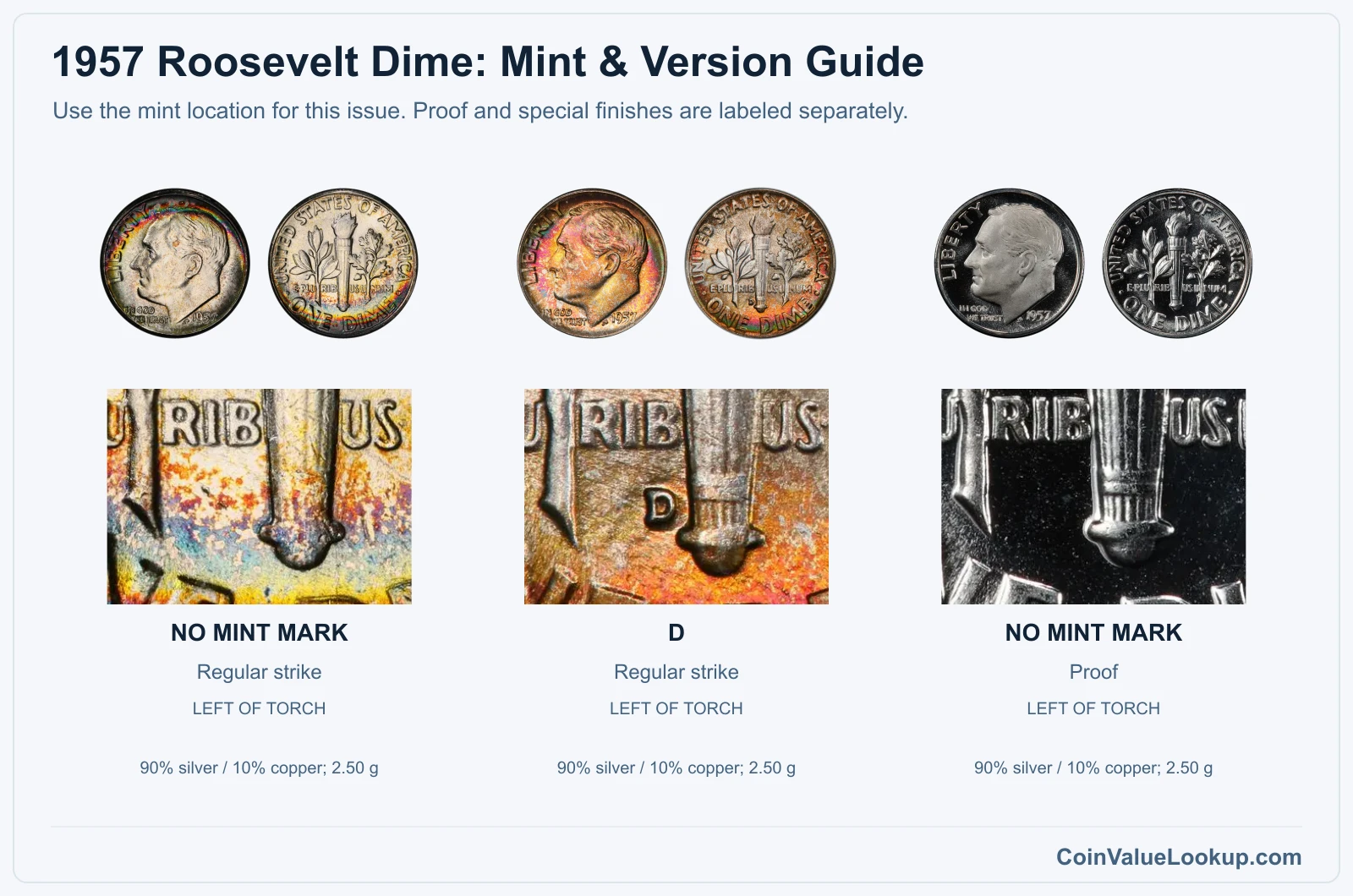
Every 1957 Roosevelt dime is struck in 90% silver and 10% copper, weighing about 2.50 grams and measuring roughly 17.9 mm across. The obverse shows Roosevelt's portrait with the date at the lower left.
Flip it over and look for the mintmark beside the torch base on the reverse.
No mintmark means Philadelphia. A small "D" means Denver.
That is the entire mintmark menu for this year.
Philadelphia also produced proof strikes in 1957, but those carry no mintmark either. Proofs have mirror-like fields and sharply defined devices — they look distinctly different from a business strike that just happens to be uncirculated.
If your coin has a satin or frosty luster rather than deep reflective fields, it is a business strike regardless of condition.
Do not assume a Philadelphia business strike is a proof doubled die just because it lacks a mintmark. The Proof DDO is a separately attributed proof variety with specific diagnostics that require magnification and comparison to a certified reference.
Step 2: Check Your 1957 Roosevelt Dime Grade
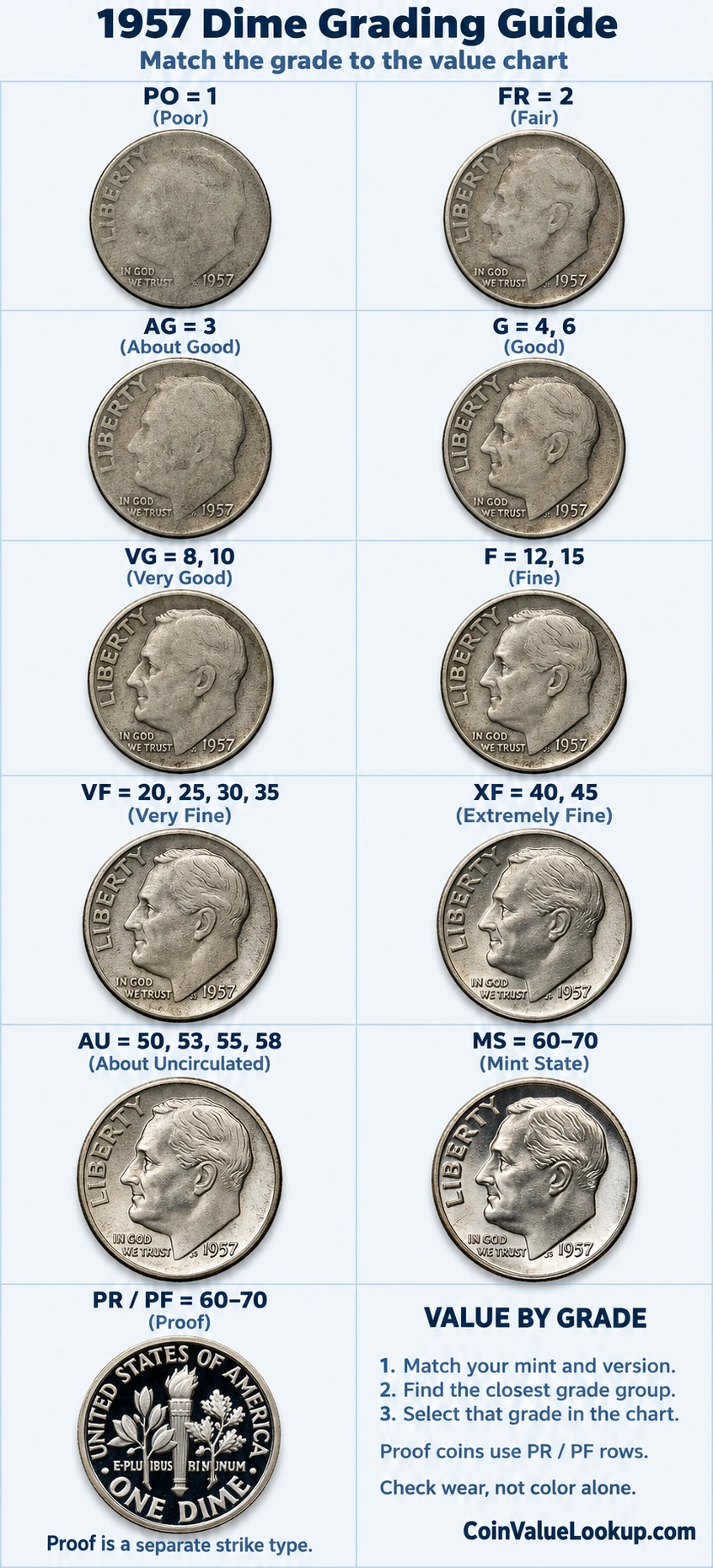
Start by checking the high points: Roosevelt's cheekbone, jawline, and the hair detail above his ear on the obverse. On the reverse, examine the torch flame and the leaf details on either side.
These areas lose definition first as a coin circulates.
Tilt the coin under a single light source. Unbroken cartwheel luster across the fields suggests minimal wear.
A coin that looks bright but shows flat spots on the cheek or hair may have been cleaned — look for fine parallel hairlines, which reduce value even on otherwise sharp coins.
Full Bands is a strike designation, not a grade. It refers to clear separation of both horizontal band pairs on the torch.
A coin can grade MS65 without Full Bands, and a Full Bands coin can still have surface marks that keep it out of higher grades. Always compare like with like: same mint, same grade, same designation.
Use the comparison image to match your coin's wear pattern against known grade benchmarks. Scratches and rim dings matter — they are not the same as honest circulation wear.
Step 3: Check 1957 Roosevelt Dime Value by Mint and Version
1957 Roosevelt Dime — No Mintmark / Philadelphia Business Strike
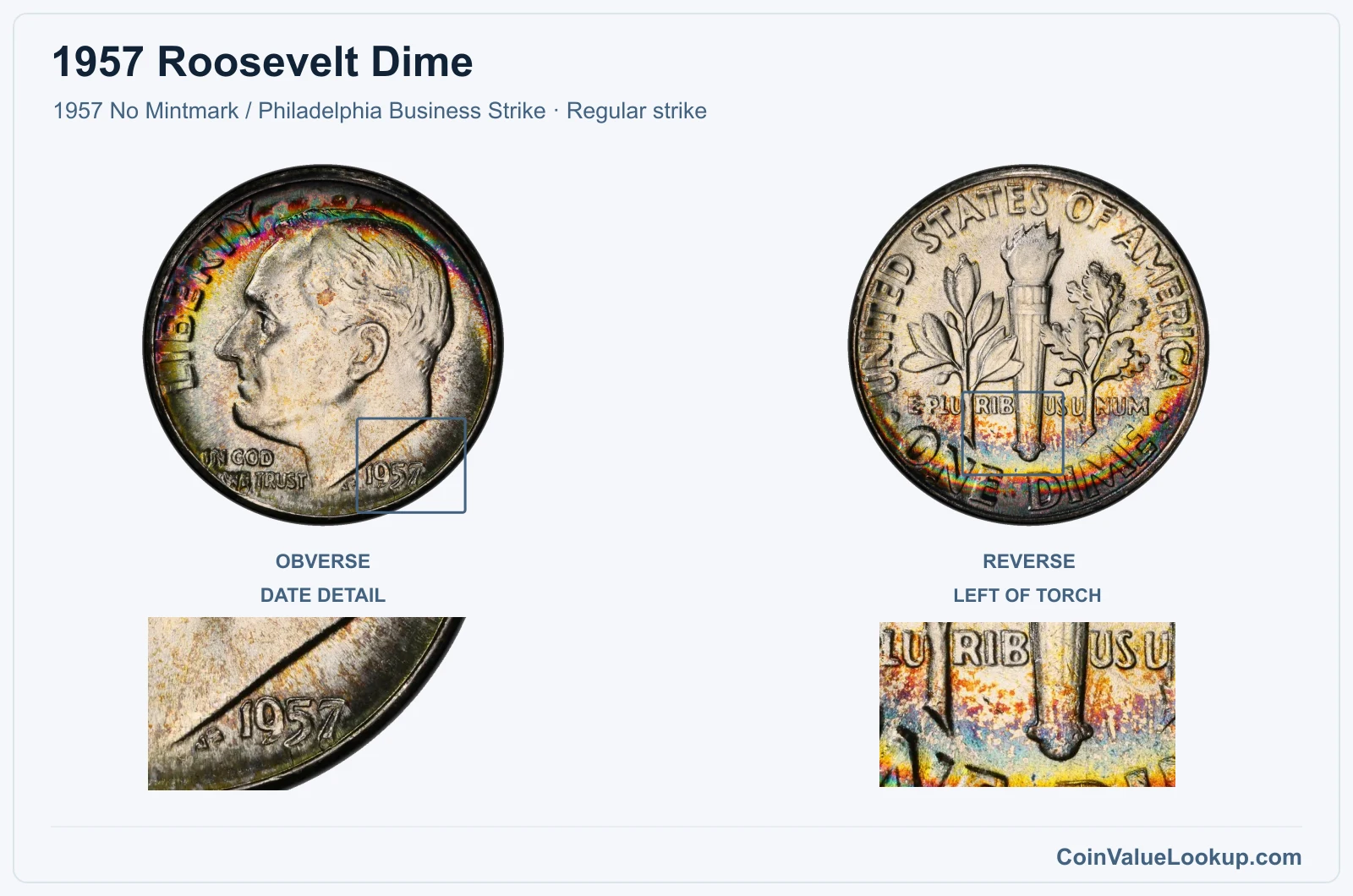
The 1957 Philadelphia business strike carries no mintmark. You will find the date on the obverse and an empty space beside the torch base on the reverse.
USA Coin Book estimates place this version at about $5.81 in G4 and $12.26 in MS65.
Original surfaces matter here. Coins that have been cleaned or dipped lose the natural silver toning and luster that graders look for.
When comparing values, match your coin to the same mint, grade, and Full Bands designation — a Full Bands MS65 is a different animal from a regular MS65.
Coin Value Lookup is a handy starting point if you are looking up guides for other Roosevelt dime years or denominations. It can help you zero in on the right series quickly.
Range Grade
Price Auction Records Appraisal PO PO 1
—
Coin Identifier FR FR 2
—
Coin Identifier AG AG 3
—
Coin Identifier G G 4
—
Coin Identifier
G 6
—
Coin Identifier VG VG 8
—
Coin Identifier
VG 10
—
Coin Identifier F F 12
—
Coin Identifier
F 15
—
Coin Identifier VF VF 20
—
Coin Identifier
VF 25
—
Coin Identifier
VF 30
—
Coin Identifier
VF 35
—
Coin Identifier XF XF 40
—
Coin Identifier
XF 45
—
Coin Identifier AU AU 50
—
Coin Identifier
AU 53
—
Coin Identifier
AU 55
—
Coin Identifier
AU 58
—
Coin Identifier MS MS 60
—
Coin Identifier
MS 61
—
Coin Identifier
MS 62
Coin Identifier
MS 63
Coin Identifier
MS 64
Coin Identifier
MS 65
Coin Identifier
MS 66
Coin Identifier
MS 67
Coin Identifier
MS 68
—
—
—
MS 69
—
—
—
MS 70
—
—
—
1957 Roosevelt Dime — D Mintmark Business Strike
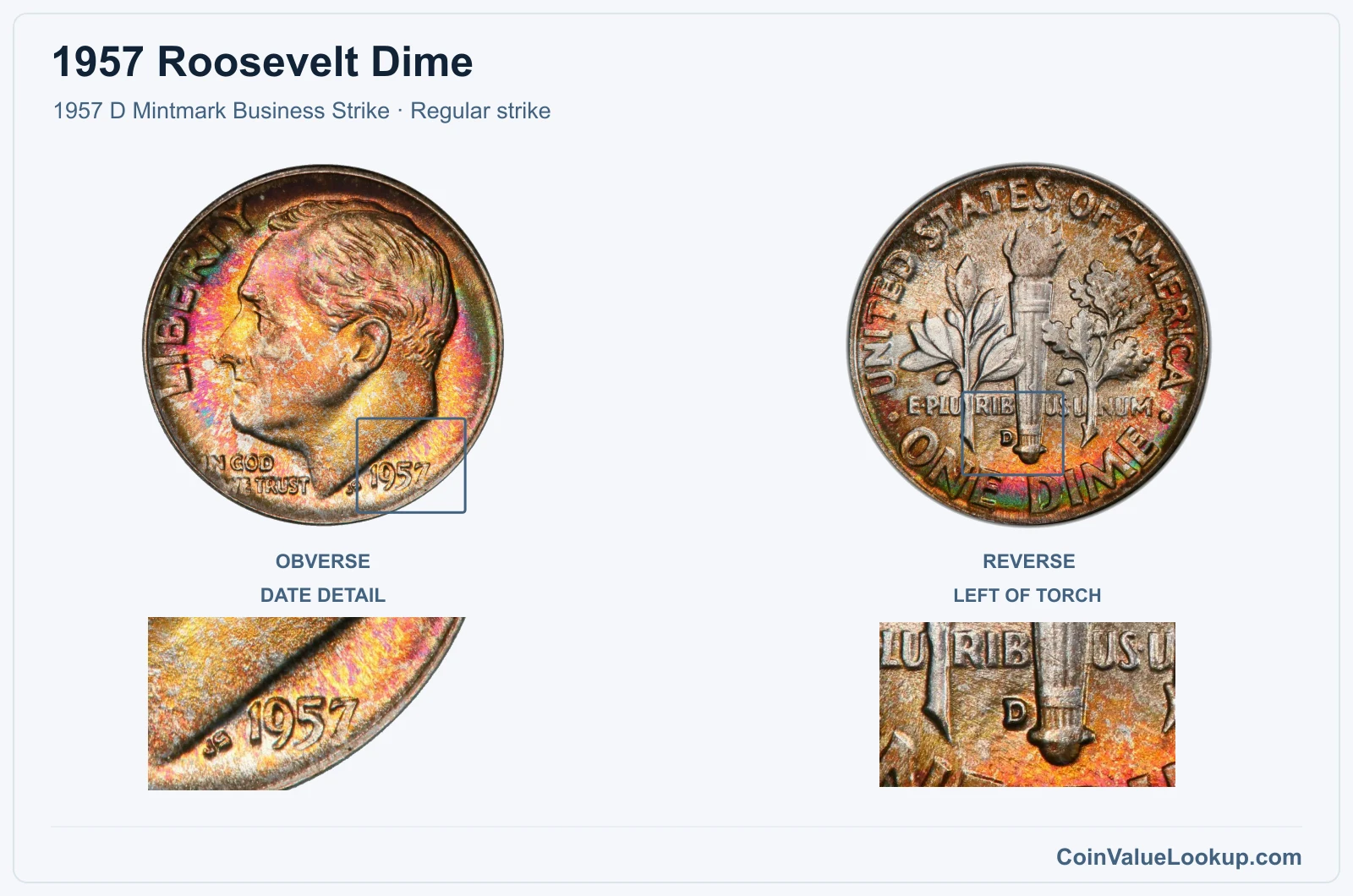
The 1957-D was struck at the Denver Mint and shows a small "D" mintmark beside the torch base on the reverse. Guide estimates from USA Coin Book are the same as the Philadelphia issue: roughly $5.81 at G4 and $12.26 at MS65.
Denver strikes from this era are common in circulated grades, so most of the premium comes from original surfaces and strong strikes. As with the Philadelphia version, Full Bands examples should be compared within their own designation rather than lumped in with regular strikes.
Look for complete band separation under magnification before assuming you have one.
Range Grade
Price Auction Records Appraisal PO PO 1
—
Coin Identifier FR FR 2
—
Coin Identifier AG AG 3
—
Coin Identifier G G 4
—
Coin Identifier
G 6
—
Coin Identifier VG VG 8
—
Coin Identifier
VG 10
—
Coin Identifier F F 12
—
Coin Identifier
F 15
—
Coin Identifier VF VF 20
—
Coin Identifier
VF 25
—
Coin Identifier
VF 30
—
Coin Identifier
VF 35
—
Coin Identifier XF XF 40
—
Coin Identifier
XF 45
—
Coin Identifier AU AU 50
—
Coin Identifier
AU 53
—
Coin Identifier
AU 55
—
Coin Identifier
AU 58
—
Coin Identifier MS MS 60
—
Coin Identifier
MS 61
—
Coin Identifier
MS 62
—
Coin Identifier
MS 63
—
Coin Identifier
MS 64
Coin Identifier
MS 65
Coin Identifier
MS 66
Coin Identifier
MS 67
Coin Identifier
MS 68
Coin Identifier
MS 69
—
—
—
MS 70
—
—
—
1957 Roosevelt Dime — No Mintmark / Philadelphia Proof
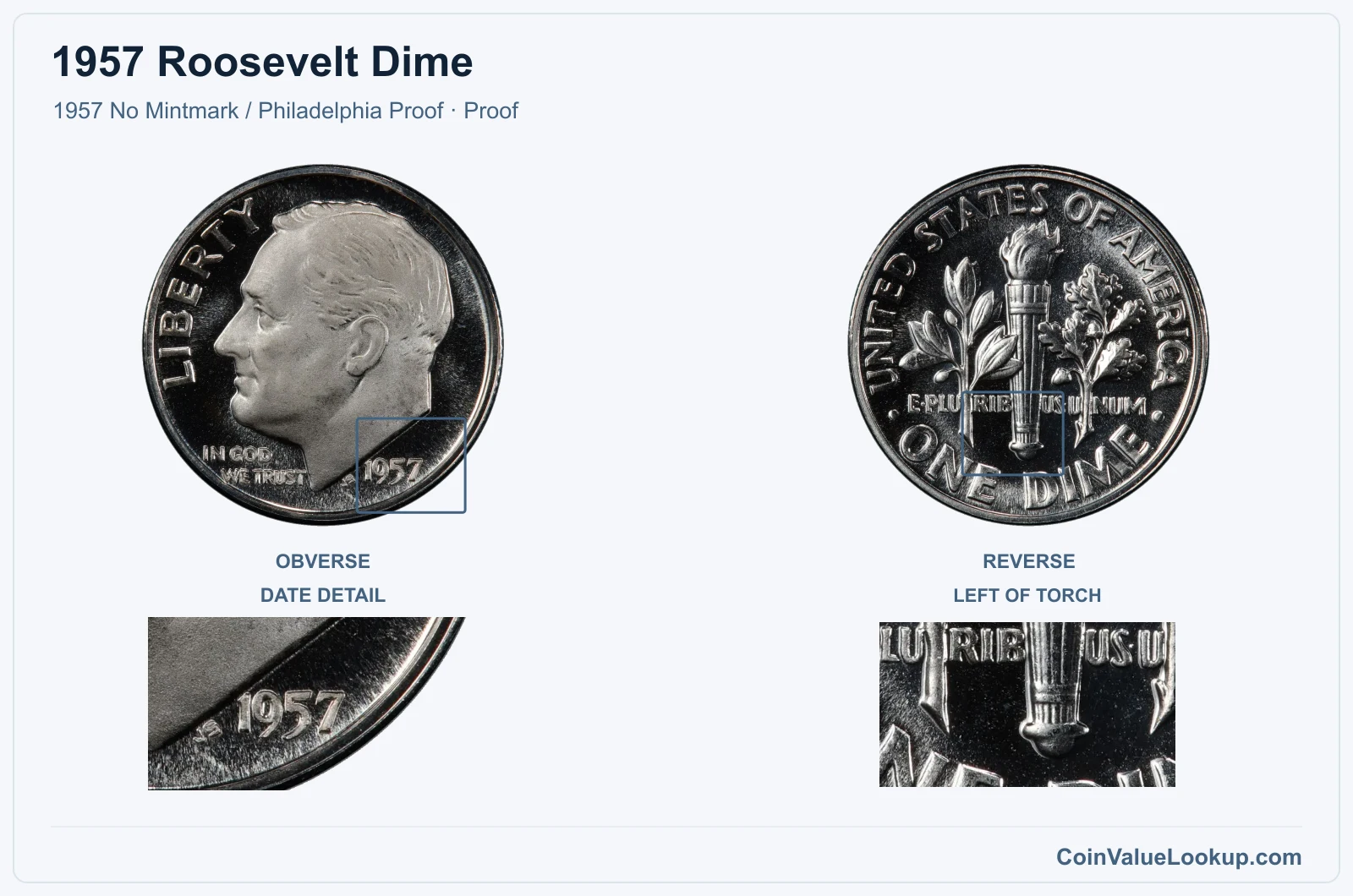
Philadelphia produced proof Roosevelt dimes in 1957 with deeply mirrored fields and razor-sharp device edges. These carry no mintmark, same as the business strikes, so you need to identify the proof finish visually.
USA Coin Book guides list PR65 at about $9.87.
Proof surfaces are fragile. Fingerprints, haze, and hairlines from improper storage all knock down the grade quickly.
If your coin has frosted devices contrasting against mirror fields, that cameo look is a separate designation and should not be compared directly with standard proofs.
The Proof DDO variety originates from this branch, but a normal proof with thick-looking letters is not automatically a doubled die. That attribution requires its own verification.
Range Grade
Price Auction Records Appraisal PR PR 1
—
Coin Identifier
PR 2
—
Coin Identifier
PR 3
—
Coin Identifier
PR 4
—
Coin Identifier
PR 6
—
Coin Identifier
PR 8
—
Coin Identifier
PR 10
—
Coin Identifier
PR 12
—
Coin Identifier
PR 15
—
Coin Identifier
PR 20
—
Coin Identifier
PR 25
—
Coin Identifier
PR 30
—
Coin Identifier
PR 35
—
Coin Identifier
PR 40
—
Coin Identifier
PR 45
—
Coin Identifier
PR 50
—
Coin Identifier
PR 53
—
Coin Identifier
PR 55
—
Coin Identifier
PR 58
—
Coin Identifier
PR 60
—
Coin Identifier
PR 61
—
Coin Identifier
PR 62
—
Coin Identifier
PR 63
—
Coin Identifier
PR 64
Coin Identifier
PR 65
Coin Identifier
PR 66
Coin Identifier
PR 67
Coin Identifier
PR 68
Coin Identifier
PR 69
Coin Identifier
PR 70
—
—
—
1957 Roosevelt Dime Error List
1. 1957 Roosevelt Dime — Proof Doubled Die Obverse
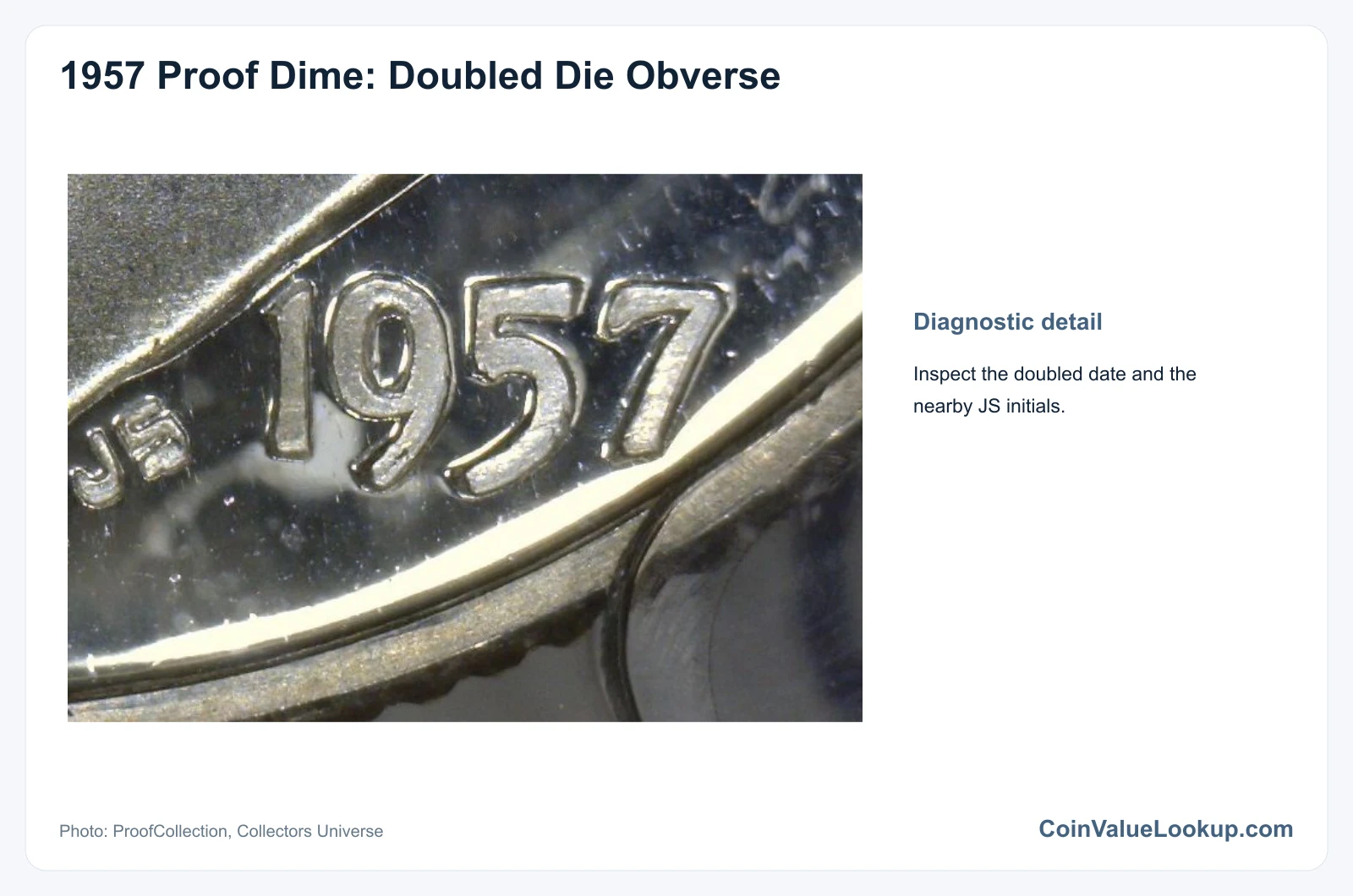
The Proof Doubled Die Obverse is a specific attributed variety on 1957 Philadelphia proof dimes. At least one specimen has been graded Proof-64 by PCGS with the DDO attribution.
This is not something you diagnose by squinting at slightly bold lettering.
To check, you need magnification and ideally a side-by-side comparison with a certified reference specimen. The doubling appears on obverse lettering and the date, but you should confirm the specific markers against the attributed example rather than guessing from photographs alone.
Look out for flat mechanical doubling, which is shelf-like and lacks the rounded secondary image of a true hub doubling. Post-mint abrasion and corrosion can also mimic doubled features under low magnification.
No supported price range is available for this variety, so value depends on the individual coin's condition, the severity of the doubling, and third-party authentication.
2. 1957 Roosevelt Dime — Clipped Planchet
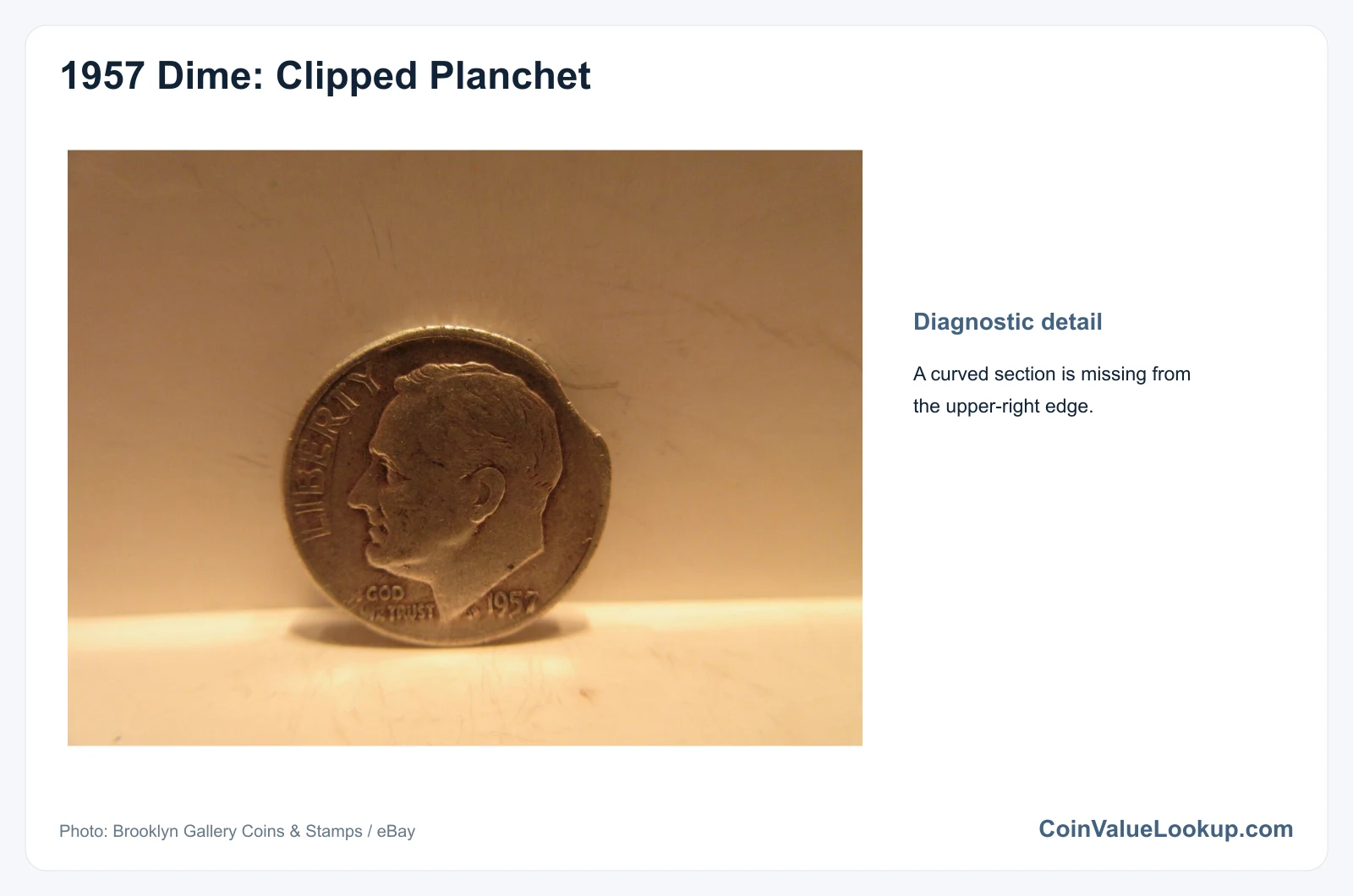
A clipped planchet 1957 dime occurs when the blank is punched from strip metal that overlaps a previously punched hole, leaving a missing crescent along the rim. One dealer-attributed example in About Uncirculated condition has been listed at $12 — that is a single asking price, not a realized auction result or a broad market value.
To identify a genuine clip, look for the missing rim segment plus a subtle flow of metal toward the gap, sometimes called the Blakesley effect on the opposite rim. The edge should show the original planchet curve, not a sharp or ragged cut.
Post-mint damage from pliers, vises, or deliberate cutting can fake the look. If the missing area has sharp tool marks or the adjacent metal shows no flow distortion, it is probably not a mint error.
Professional attribution is the safest route before assuming a premium.
3. 1957 Roosevelt Dime — Off-Center Strike
Off-center strikes happen when the planchet is not seated properly in the collar before the dies come together, producing a displaced design with an unstruck crescent on one side. The 1957 dime has been listed as a year where off-center examples exist.
The key detail collectors look for is date visibility. An off-center dime that still shows the full date is far more desirable than one where the date has shifted into the unstruck area.
The percentage of off-center displacement also matters — dramatic shifts catch more attention.
No specific price range is available for this variety, so each coin's value depends on condition, how much design is visible, and the degree of the misalignment. Do not confuse an off-center strike with a clipped planchet or one-sided die misalignment, and watch out for coins flattened after leaving the mint.
4. 1957 Roosevelt Dime — Broadstrike
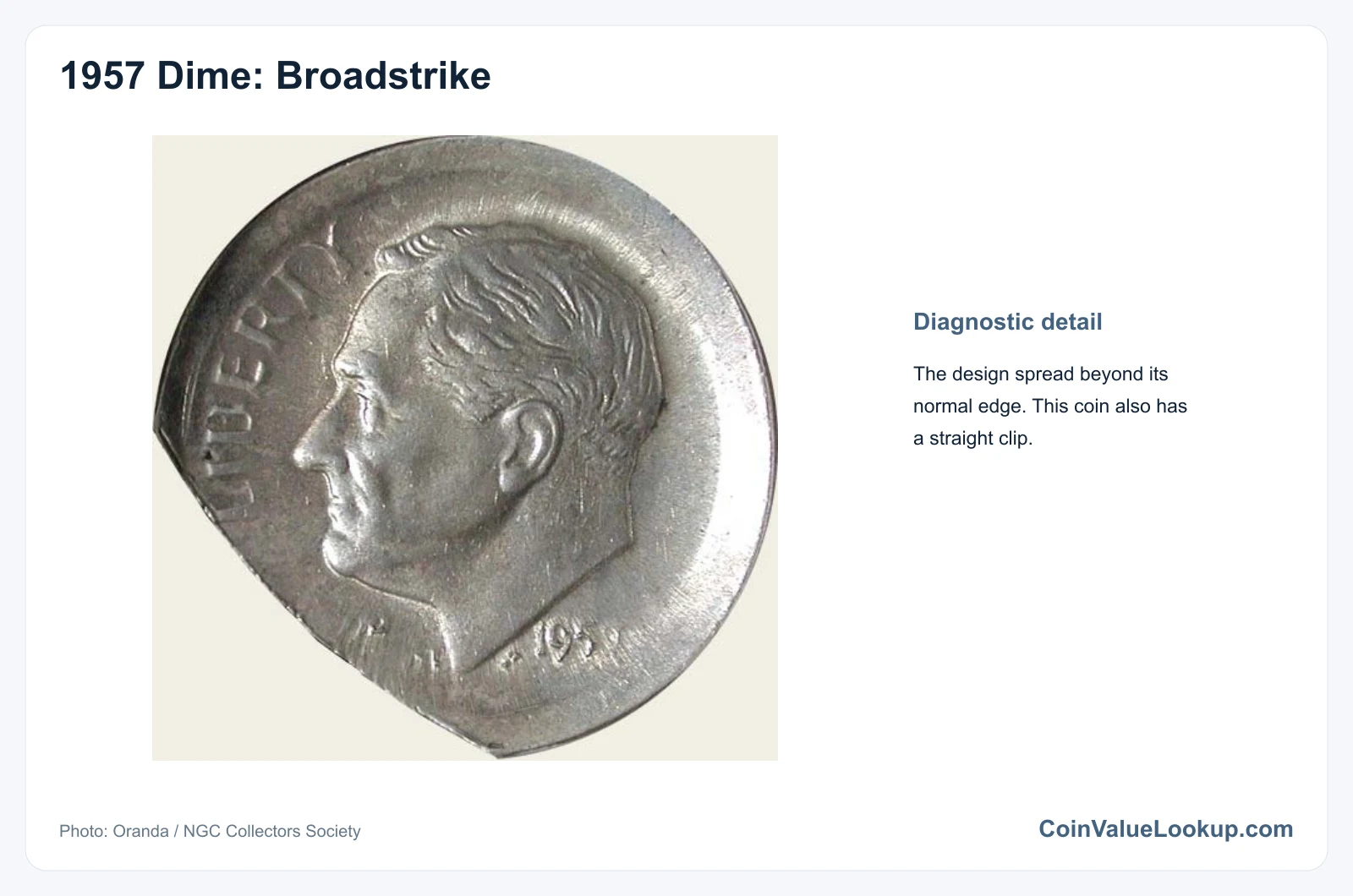
A broadstrike occurs when a coin is struck without the normal retaining collar, allowing the metal to spread outward beyond its usual diameter. On a 1957 dime, this means the design is fully centered but the rim is missing or distorted, and the coin appears wider and thinner than normal.
The edge profile is the giveaway. A genuine broadstrike has a smooth, spread edge rather than the reeded edge you expect on a dime.
The design itself remains centered, which distinguishes it from an off-center strike where the image shifts to one side.
No adopted price range exists for this error on the 1957 dime. Value depends on condition, the degree of spread, and overall eye appeal.
Coins that were flattened by machinery or other force after minting can look similar, so examine the surfaces for signs of post-strike damage.
5. 1957 Roosevelt Dime — Clashed Dies
Die clash errors appear when the obverse and reverse dies strike each other without a planchet between them, transferring faint ghost images of the opposing design onto each die face. On subsequent coins, you can see traces of the torch or branches on the obverse, or Roosevelt's profile ghosted onto the reverse fields.
These traces should line up with where the opposite design would naturally fall. Random scratches or raised lines that do not correspond to the other die's features are not clash marks.
The 1957 dime is listed as a year where die clash examples have been reported. No specific price is available, and value depends on the clarity of the transferred design, the coin's overall grade, and surface preservation.
Faint clashes on worn coins can be tough to spot. A brockage — where a struck coin acts as a die — is a different error entirely and should not be confused with a standard die clash.