1824 Capped Bust Dime Coin Value: How Much Is It Worth?
The 1824 Capped Bust Dime is an early American silver dime struck at Philadelphia, and it carries real collector demand nearly two centuries later. Guide estimates for the known branch range from about $127.00 in Good-4 condition to $7,814.00 in Mint State 63, depending on the exact variety, wear and originality of surfaces.
Those anchors reflect one published guide and are not guaranteed offers; your coin's actual worth hinges on its specific date variety, grade and whether it retains original surfaces.
Fast Way to Identify Your 1824 Capped Bust Dime
Snap clear, well-lit photos of both the front and back of your 1824 dime and upload them for a preliminary identification. This helps narrow down the design variety and gives a starting point for evaluating condition.
It will not substitute for professional grading or authentication, but it is a solid first step toward understanding what you have.
1824 Capped Bust Dime Value
Upload both sides of your 1824 Capped Bust Dime.
Front Obverse
Upload photo
Back Reverse
Upload photo
Which 1824 Capped Bust Dime Versions Are Worth Money?
- The 1824/2 overdate is the primary collectible branch for this date, with guide estimates from $127.00 in G-4 to $7,814.00 in MS-63.
- Higher-grade examples with original surfaces command the strongest premiums; cleaned or damaged coins fall well below guide figures regardless of the variety.
- Magnify the date area carefully: confirming the overdate separates a routine early dime from the specific variety collectors actively pursue.
Step 1: Identify Your 1824 Capped Bust Dime Mint Mark and Version
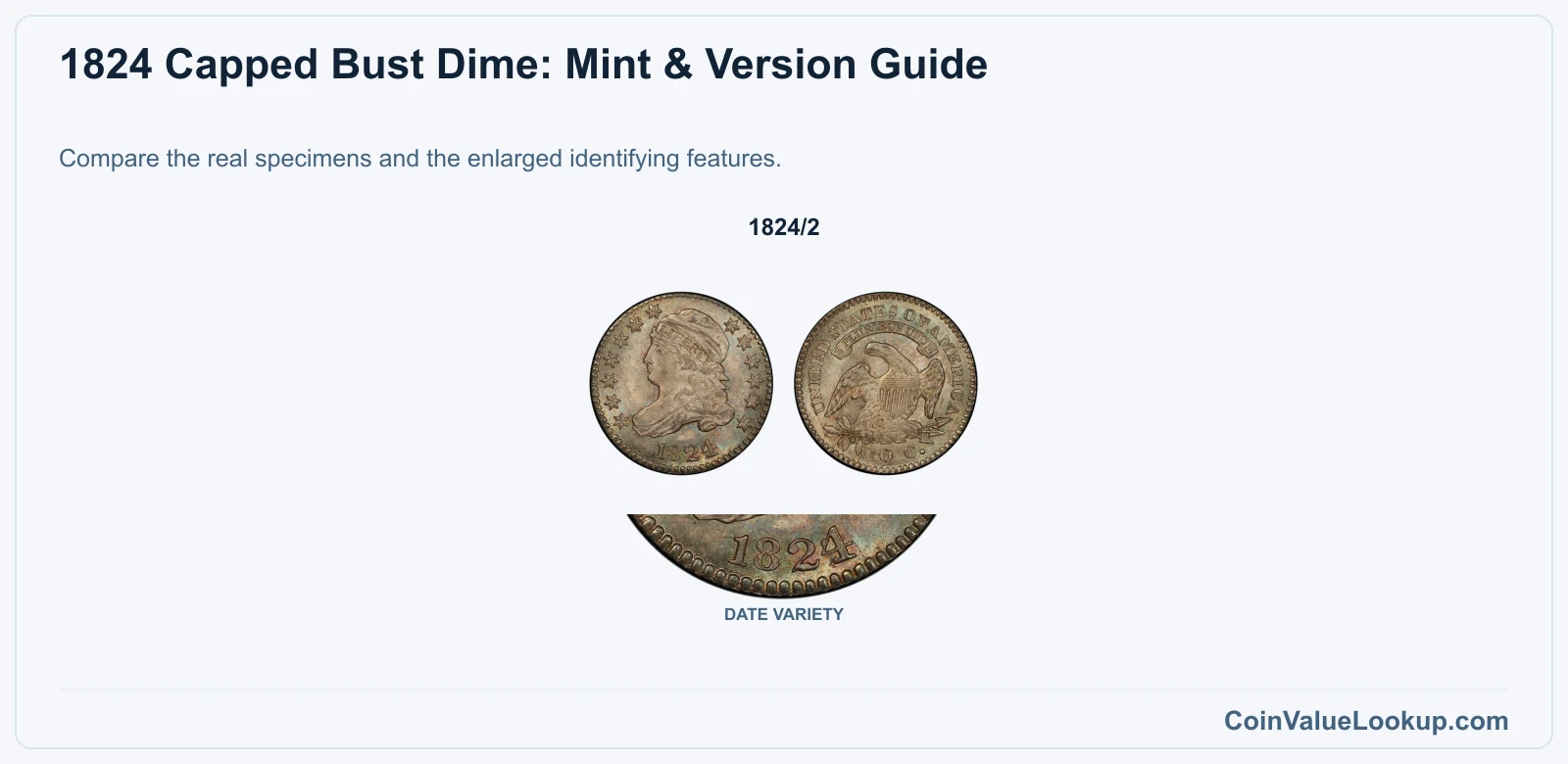
Every 1824 Capped Bust Dime was struck at Philadelphia, so there is no mintmark to hunt for. The coin is a silver-copper alloy, roughly 89.24% silver, with the wider-format Capped Bust design featuring large dentils around the rim.
The critical variety to check is the 1824/2 overdate. Grab a loupe and look closely at the final digit of the date.
On overdate specimens, faint contours of an underlying "2" are visible beneath the "4." This is not subtle damage or a trick of the light; the remnants have a consistent shape that matches the earlier numeral.
Do not confuse this denomination with the half dime, which is a smaller coin entirely. If your piece is noticeably tiny, you may be holding the wrong series.
Compare diameter and weight against known Capped Bust Dime specs before drawing any conclusions.
Step 2: Check Your 1824 Capped Bust Dime Grade
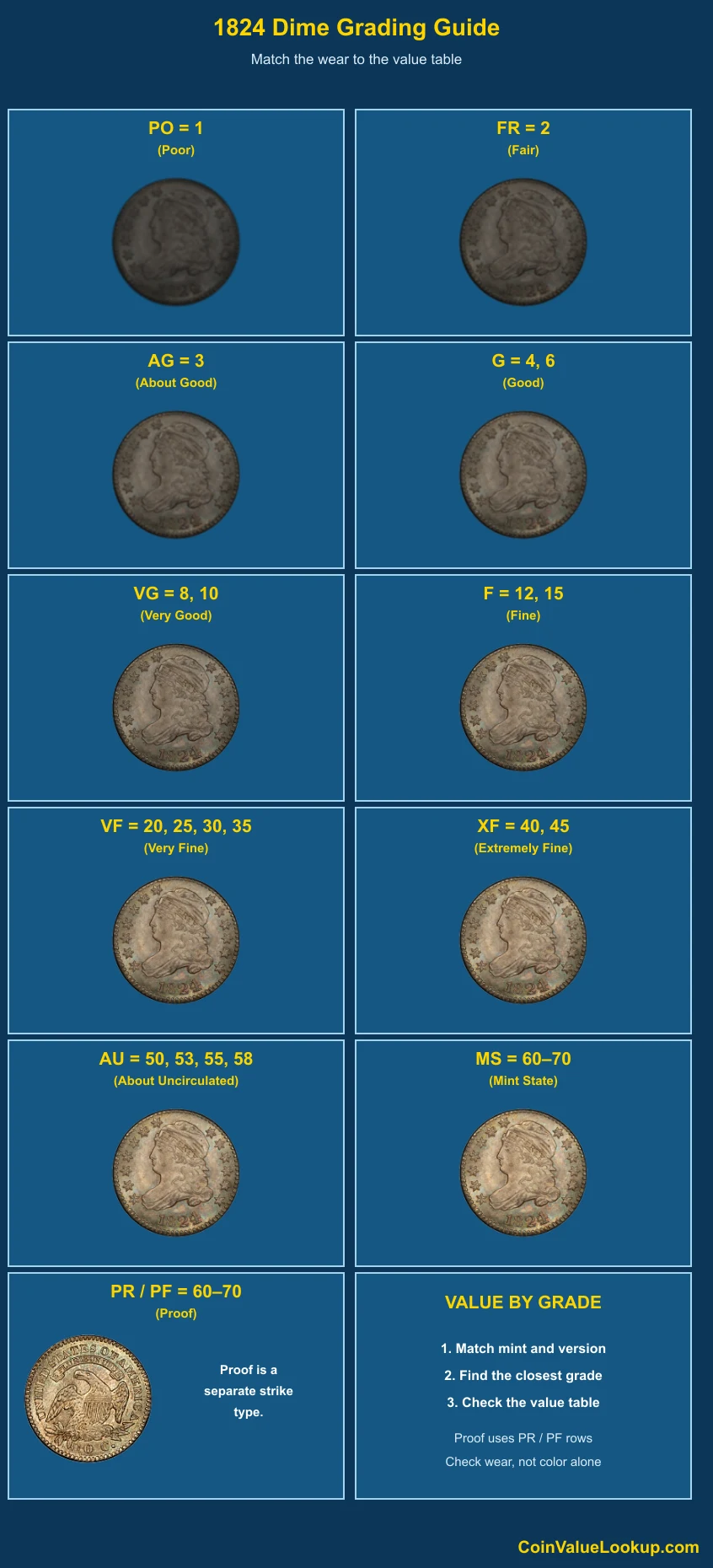
Start by examining Liberty's hair curls, the cheek and the high points of the cap and drapery on the obverse. On the reverse, the eagle's breast feathers and wing tips wear first.
These coins were made on hand-operated presses, so even a fully uncirculated example can show uneven strike or slightly weak details in spots. That is not the same as wear.
Look for unbroken luster in protected areas and check whether the high points show flattening from actual circulation contact.
Use the comparison image to match your coin's detail level against known grade benchmarks for this type. Contact marks, scratches and any evidence of cleaning or artificial brightening all reduce a coin's appeal and its comparability to published guide figures.
Original, naturally toned surfaces are what seasoned collectors prefer.
Coin Value Lookup is a good starting point if you want to look up guides for other early U.S. coin series alongside this one.
Step 3: Check 1824 Capped Bust Dime Value by Mint and Version
1824 Capped Bust Dime — /2
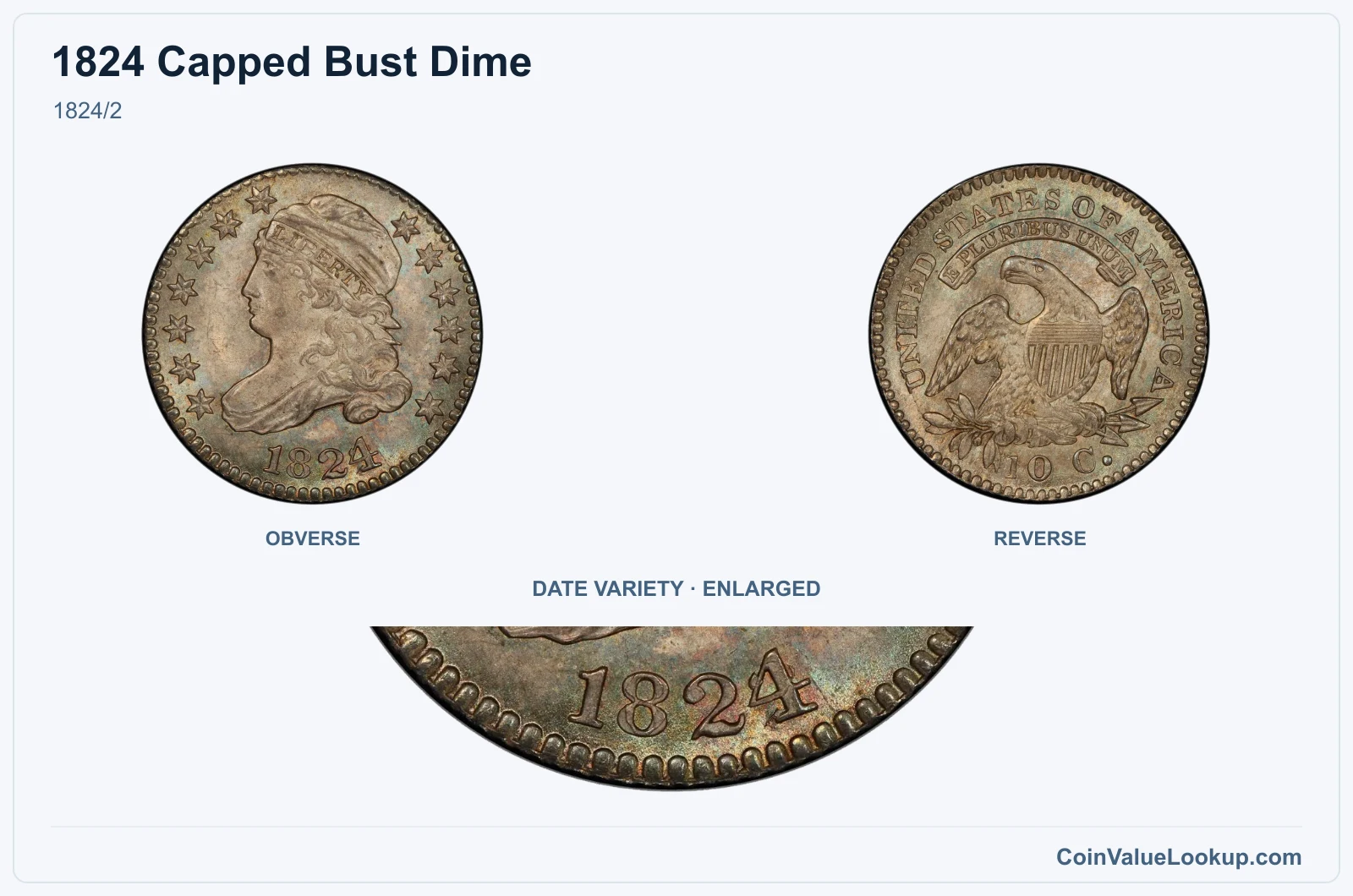
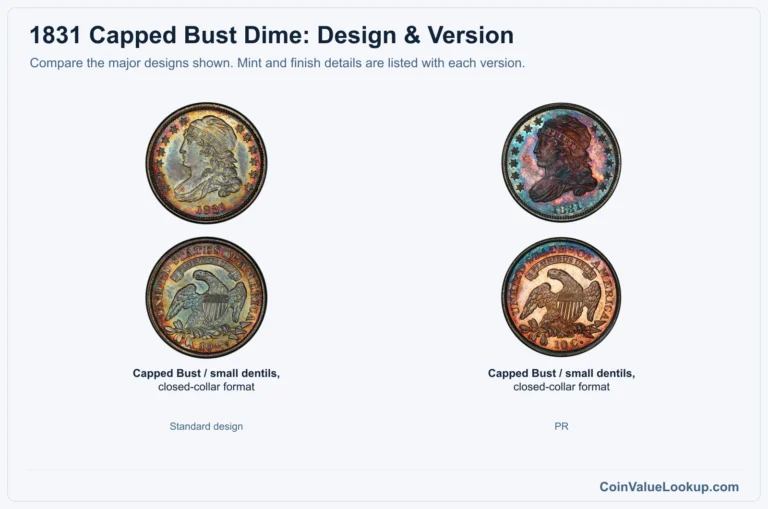
The 1824/2 is an overdate variety, meaning the die was originally engraved or hubbed with a "2" as the final digit and later corrected to a "4." Under magnification, you can see traces of the underlying "2" peeking out beneath the "4" in the date. It is a genuine die variety, not post-strike damage.
This coin was struck at Philadelphia in a silver-copper alloy of about 89.24% silver, using the wider-format Capped Bust design with large dentils. Published guide estimates place a well-worn Good-4 example around $127.00 and a choice Mint State 63 coin at roughly $7,814.00.
Those figures come from a single guide source and assume original, problem-free surfaces. Cleaning, corrosion or heavy contact marks push real-world values lower.
Always confirm the overdate detail before comparing your coin to these figures.
Range Grade
Price Auction Records Appraisal PO PO 1
—
Coin Identifier FR FR 2
—
Coin Identifier AG AG 3
Coin Identifier G G 4
Coin Identifier
G 6
Coin Identifier VG VG 8
Coin Identifier
VG 10
Coin Identifier F F 12
Coin Identifier
F 15
Coin Identifier VF VF 20
Coin Identifier
VF 25
Coin Identifier
VF 30
Coin Identifier
VF 35
Coin Identifier XF XF 40
Coin Identifier
XF 45
Coin Identifier AU AU 50
Coin Identifier
AU 53
Coin Identifier
AU 55
Coin Identifier
AU 58
Coin Identifier MS MS 60
—
Coin Identifier
MS 61
Coin Identifier
MS 62
Coin Identifier
MS 63
Coin Identifier
MS 64
Coin Identifier
MS 65
Coin Identifier
MS 66
Coin Identifier
MS 67
—
—
—
MS 68
—
—
—
MS 69
—
—
—
MS 70
—
—
—
1824 Capped Bust Dime Error List
1. 1824 Capped Bust Dime — Overdate
Some 1824 Capped Bust Dimes display an overdate, where the final "4" in the date was cut over an earlier "2" in the die. Under magnification, the curved remnants of the "2" are visible beneath the upright strokes of the "4." The surviving contours are consistent and follow the shape of the original numeral, which is your main diagnostic clue.
This is a die variety, not post-mint damage. Do not confuse it with a date digit that has been scratched, filled with debris, or shows ordinary machine doubling, which tends to produce a flat, shelf-like secondary image rather than a distinctly different numeral shape.
Not every 1824 dime is an overdate; only those struck from the specific re-engraved die carry the feature. Condition, the clarity of the underlying "2" and overall surface quality all influence what a given example is worth.
No specific numerical price range is adopted here for this feature alone, so individual assessment based on grade and eye appeal is essential.