1825 Capped Bust Dime Coin Value: How Much Is It Worth?
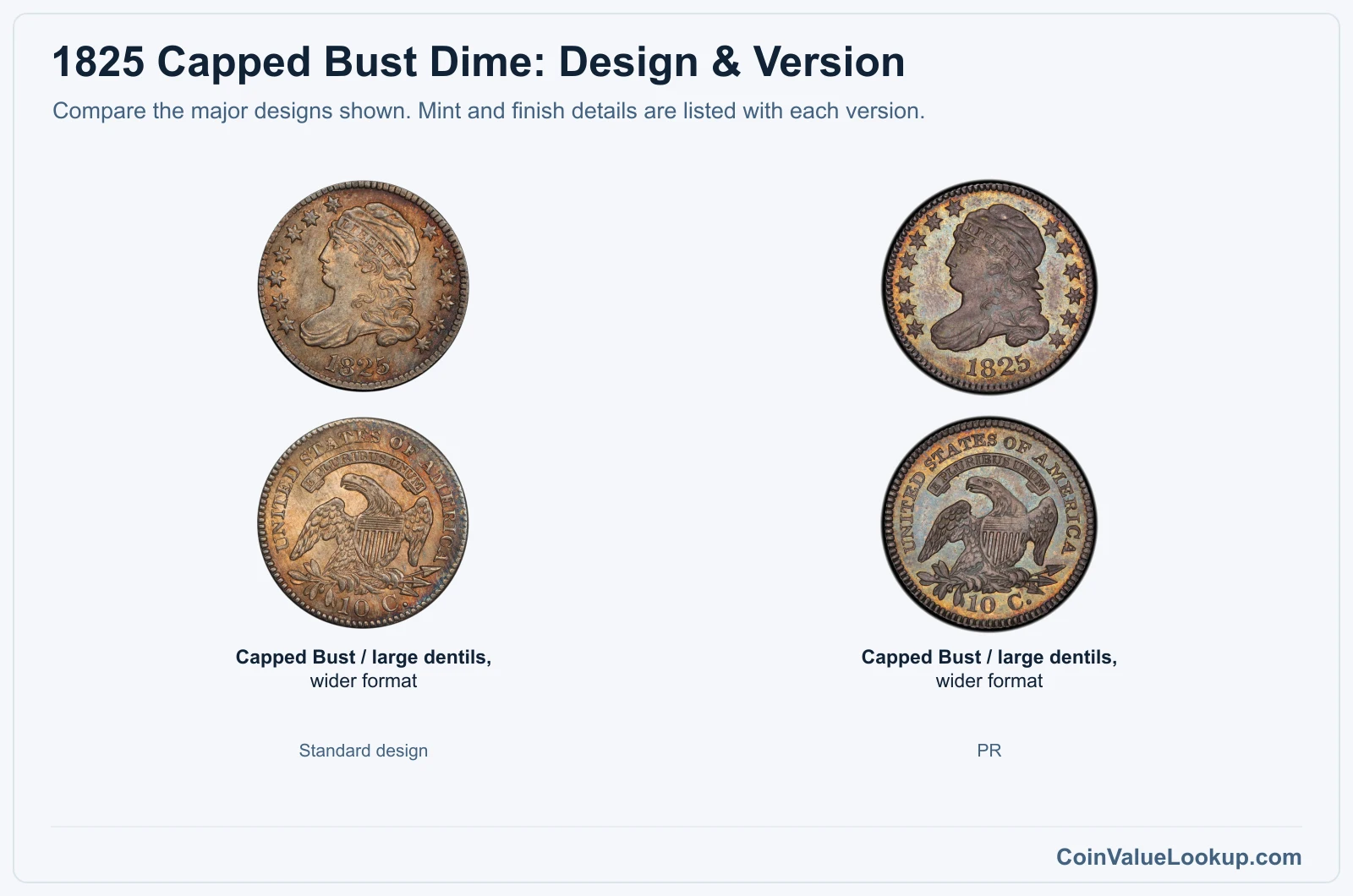
The 1825 Capped Bust Dime is an early American silver coin struck at the Philadelphia Mint, and it draws steady collector attention nearly two centuries later. Guide estimates for business strikes range from about $127.00 in Good-4 condition to around $4,674.00 in MS63, depending on the exact branch, grade and surface quality.
Those anchors are guide figures, not guaranteed offers, and your coin's actual value hinges on wear, originality and whether it qualifies as a proof.
Fast Way to Identify Your 1825 Capped Bust Dime
Snap clear photos of both the front and back of your 1825 dime and upload them here for a preliminary identification. Good lighting and a plain background help.
This step can narrow down the branch and approximate condition so you know what to research next, though it does not replace professional authentication or precise grading.
1825 Capped Bust Dime Value
Upload both sides of your 1825 Capped Bust Dime.
Front Obverse
Upload photo
Back Reverse
Upload photo
Which 1825 Capped Bust Dime Versions Are Worth Money?
- The 1825 business strike in MS63 carries a guide estimate around $4,674.00, reflecting the scarcity of surviving uncirculated examples from this era.
- The 1825 PR (proof) is extremely scarce early proof coinage; no standard guide price is adopted, so each authenticated example requires individual assessment.
- Confirm original surfaces before assuming any guide anchor applies; cleaning, scratches or corrosion significantly reduce a coin's comparability to published estimates.
Step 1: Identify Your 1825 Capped Bust Dime Mint Mark and Version
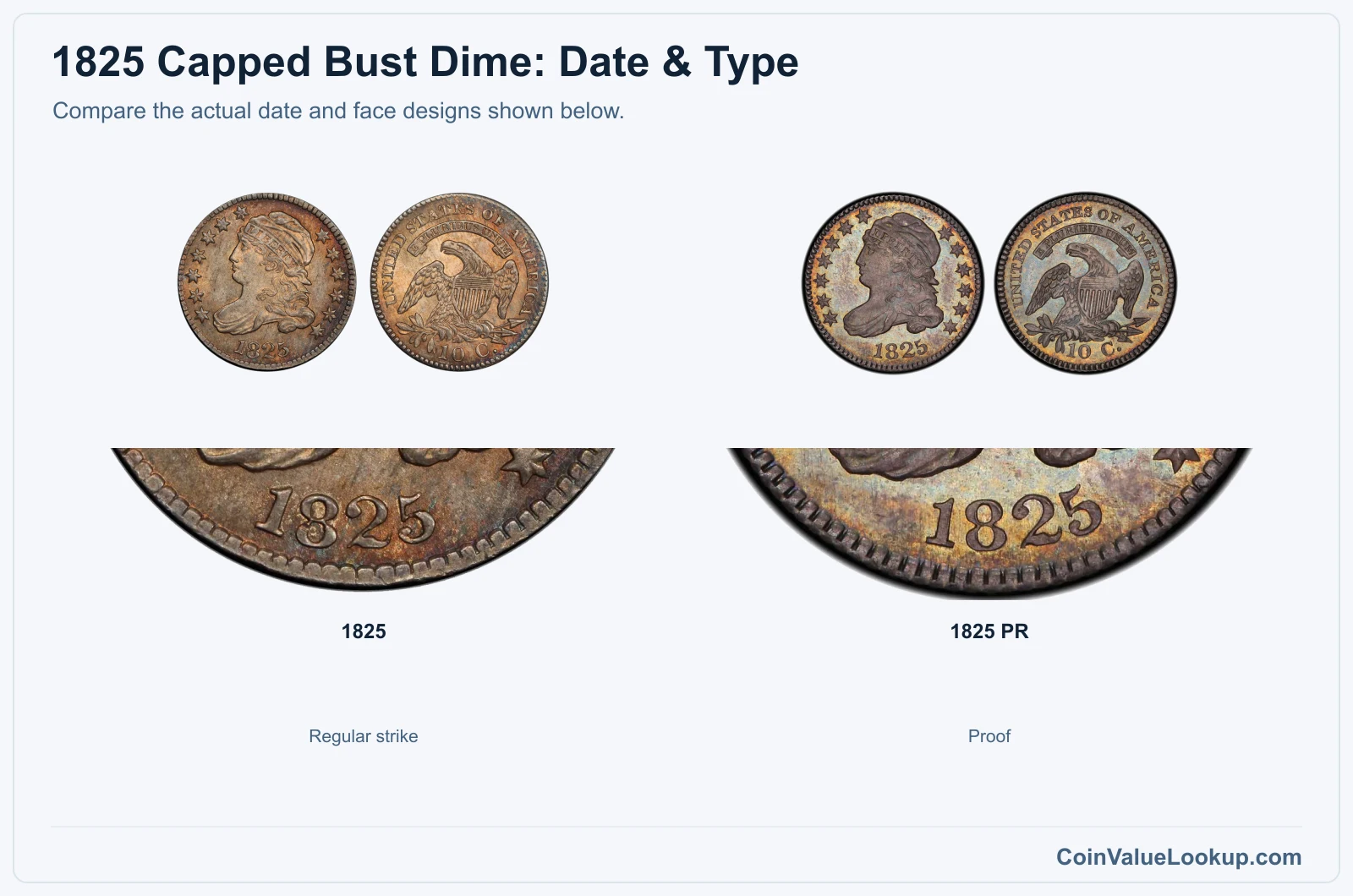
Every 1825 Capped Bust Dime was struck at Philadelphia, so there is no mintmark to look for. The coin is made from a silver-copper alloy that is approximately 89.24% silver.
The obverse shows Liberty wearing a cap, surrounded by large dentils on a wider-format planchet. The reverse features a heraldic eagle.
Do not confuse this with a half dime, which is a smaller coin entirely.
Two branches exist for this date: the regular 1825 business strike and the 1825 PR (proof). Telling them apart matters because they occupy completely different price tiers.
A proof will show deeply mirrored fields and squared, fully formed rims from a specially prepared die, not just a strong strike or a shiny surface. If a coin simply looks bright or well-struck, that alone does not make it a proof.
Only an authenticated, attributed specimen should be valued as one.
Step 2: Check Your 1825 Capped Bust Dime Grade
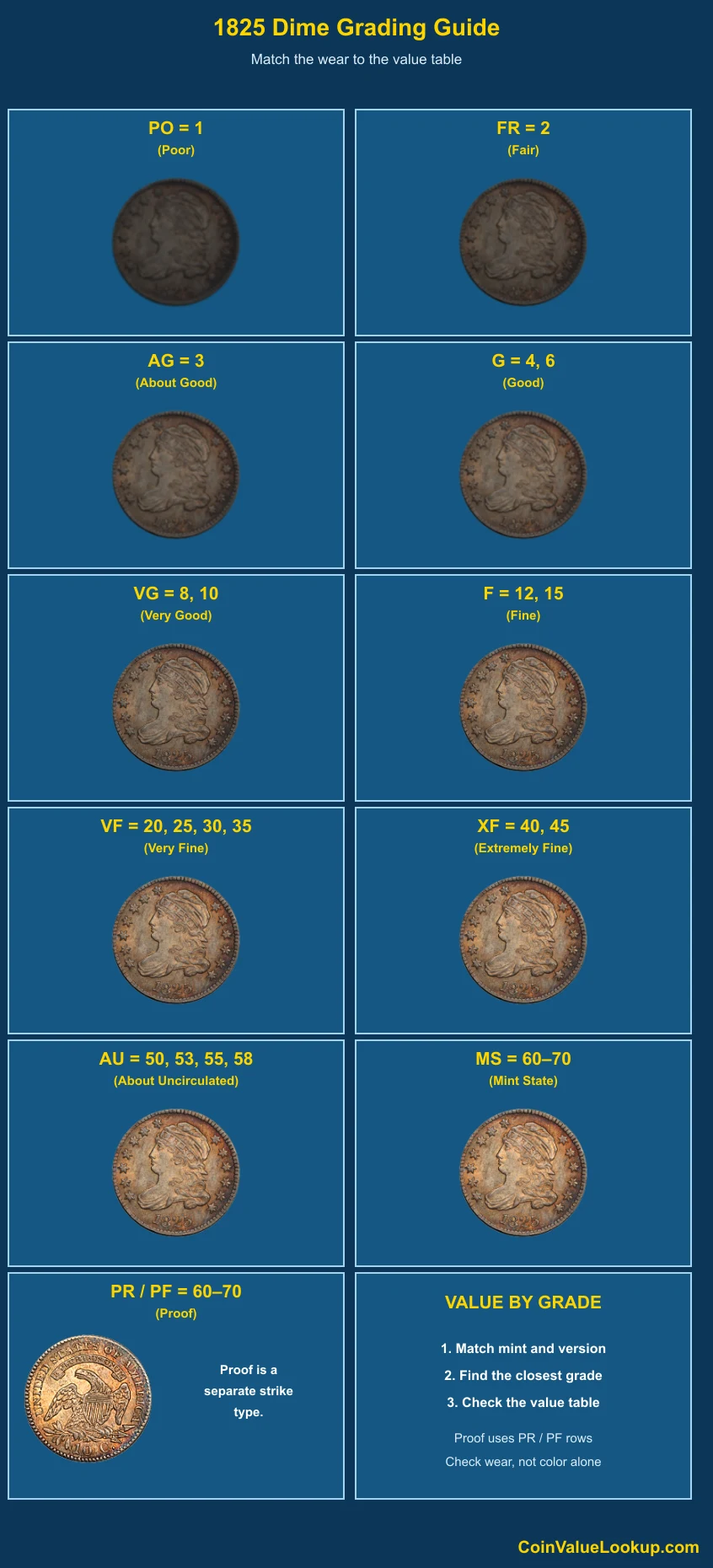
Focus on Liberty's hair curls above the forehead, her cheek and the drapery near the cap on the obverse. On the reverse, check the eagle's breast feathers and wing tips.
These are the first areas to show friction.
Early dimes were struck on hand-operated presses, so even an unworn coin can have unevenly struck details. A soft area on the highpoints is not always wear; compare it against overall luster and contact marks.
Use the comparison image alongside your coin to judge where it falls on the grading scale.
Resist the urge to clean or polish the surface. Original toning and luster, even if they look dull, preserve value.
A cleaned coin with scratches or a stripped appearance will grade lower than the same level of wear on an untouched piece.
Step 3: Check 1825 Capped Bust Dime Value by Mint and Version
1825 Capped Bust Dime
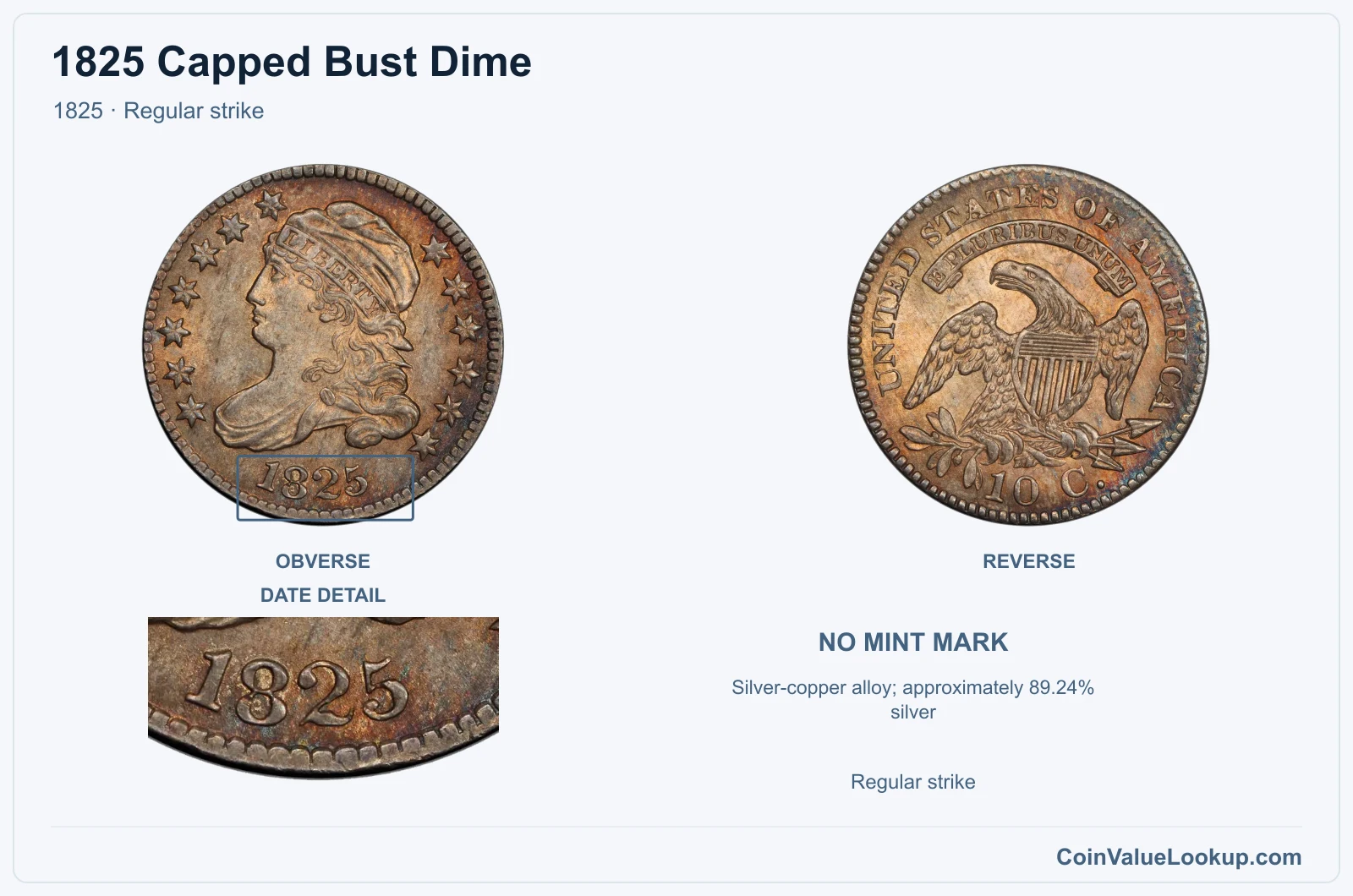
The regular 1825 business strike is the version most collectors will encounter. It was produced at Philadelphia with no mintmark.
Guide estimates place this coin at about $127.00 in Good-4 and roughly $4,674.00 in MS63. Those figures come from the USA Coin Book and represent guide anchors, not guaranteed sale prices.
Condition matters enormously across that spread. A coin with honest wear and original gray or golden toning will typically command more confidence from buyers than one that has been cleaned to look shiny.
Before comparing your coin to any price, confirm the date reads 1825 and the design matches the Capped Bust large-dentils format. Match the grade carefully using high-point wear, luster and surface quality together.
Coin Value Lookup is a good starting point when you want to look up guides for other dates and denominations in the Capped Bust series.
Range Grade
Price Auction Records Appraisal PO PO 1
Coin Identifier FR FR 2
—
Coin Identifier AG AG 3
—
Coin Identifier G G 4
Coin Identifier
G 6
Coin Identifier VG VG 8
Coin Identifier
VG 10
Coin Identifier F F 12
Coin Identifier
F 15
—
Coin Identifier VF VF 20
Coin Identifier
VF 25
Coin Identifier
VF 30
Coin Identifier
VF 35
Coin Identifier XF XF 40
Coin Identifier
XF 45
Coin Identifier AU AU 50
Coin Identifier
AU 53
Coin Identifier
AU 55
Coin Identifier
AU 58
Coin Identifier MS MS 60
—
Coin Identifier
MS 61
—
Coin Identifier
MS 62
Coin Identifier
MS 63
Coin Identifier
MS 64
Coin Identifier
MS 65
Coin Identifier
MS 66
Coin Identifier
MS 67
—
—
—
MS 68
—
—
—
MS 69
—
—
—
MS 70
—
—
—
1825 Capped Bust Dime — PR
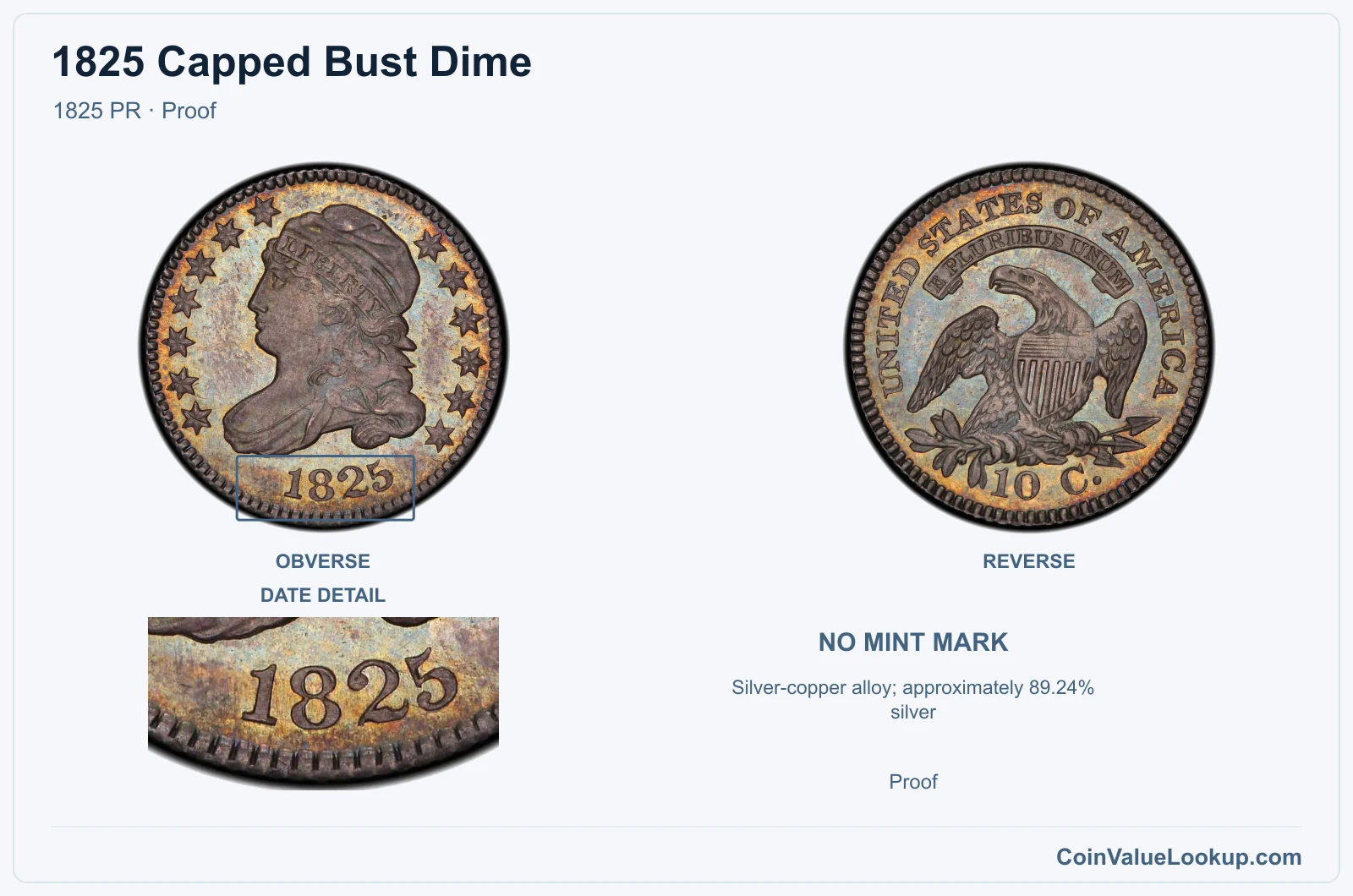
The 1825 PR is an extremely scarce early proof striking. These were made on polished planchets using specially prepared dies, producing deeply mirrored fields and sharp, squared rims.
Very few survive.
No standard numeric price range is adopted for this branch. Each authenticated proof trades as an individual event, with value shaped by its specific condition, provenance and the circumstances of the sale.
Do not attempt to price one from business-strike guides.
A common mistake is calling any well-struck or reflective 1825 dime a proof. Circulation strikes can look impressive, but proof status requires professional attribution.
If you suspect you have one, seek authentication from a major grading service rather than relying on visual comparison alone.
Range Grade
Price Auction Records Appraisal PR PR 1
—
Coin Identifier
PR 2
—
Coin Identifier
PR 3
—
Coin Identifier
PR 4
—
Coin Identifier
PR 6
—
Coin Identifier
PR 8
—
Coin Identifier
PR 10
—
Coin Identifier
PR 12
—
Coin Identifier
PR 15
—
Coin Identifier
PR 20
—
Coin Identifier
PR 25
—
Coin Identifier
PR 30
—
Coin Identifier
PR 35
—
Coin Identifier
PR 40
—
Coin Identifier
PR 45
—
Coin Identifier
PR 50
—
Coin Identifier
PR 53
—
Coin Identifier
PR 55
—
Coin Identifier
PR 58
—
Coin Identifier
PR 60
—
Coin Identifier
PR 61
—
Coin Identifier
PR 62
—
Coin Identifier
PR 63
Coin Identifier
PR 64
—
Coin Identifier
PR 65
Coin Identifier
PR 66
Coin Identifier
PR 67
Coin Identifier
PR 68
—
—
—
PR 69
—
—
—
PR 70
—
—
—