1814 Capped Bust Dime Coin Value: How Much Is It Worth?
The 1814 Capped Bust Dime is one of the earliest collectible silver dimes struck at the Philadelphia Mint. Guide estimates for this year range from about $95.00 in well-worn condition up to $11,483.00 for a specific scarce variety in uncirculated grades.
Your coin's exact value depends on which date variety it is, how much wear it shows, and whether original surfaces remain intact. These guide anchors are not guaranteed offers and do not cover every possible condition.
Fast Way to Identify Your 1814 Capped Bust Dime
Snap clear photos of both the front and back of your 1814 dime and upload them here for a preliminary identification. Good lighting at a slight angle helps show the date size and any unusual letter spacing.
This step can point you toward the right variety branch before you dig deeper into grading and value.
1814 Capped Bust Dime Value
Upload both sides of your 1814 Capped Bust Dime.
Front Obverse
Upload photo
Back Reverse
Upload photo
Which 1814 Capped Bust Dime Versions Are Worth Money?
- The 1814 STATESOF variety carries the highest guide estimates, with values from around $348 in Good-4 to $11,483 in MS63, due to its distinctive nearly-touching reverse lettering.
- The 1814 Small Date lists guide values from $116 in Good-4 up to $5,722 in MS63, making higher-grade examples well worth identifying correctly.
- The 1814 Large Date is the most accessible branch at $95 in Good-4, but uncirculated examples still reach around $5,624 in MS63.
- A late-state reverse die break over the letters CA of AMERICA has been reported; coins showing this cud feature can carry additional collector interest.
Step 1: Identify Your 1814 Capped Bust Dime Mint Mark and Version
All 1814 Capped Bust Dimes were struck in Philadelphia. There is no mintmark to look for.
The coin is a silver-copper alloy, approximately 89.24% silver, and carries the wider Capped Bust design with large dentils around the rim.
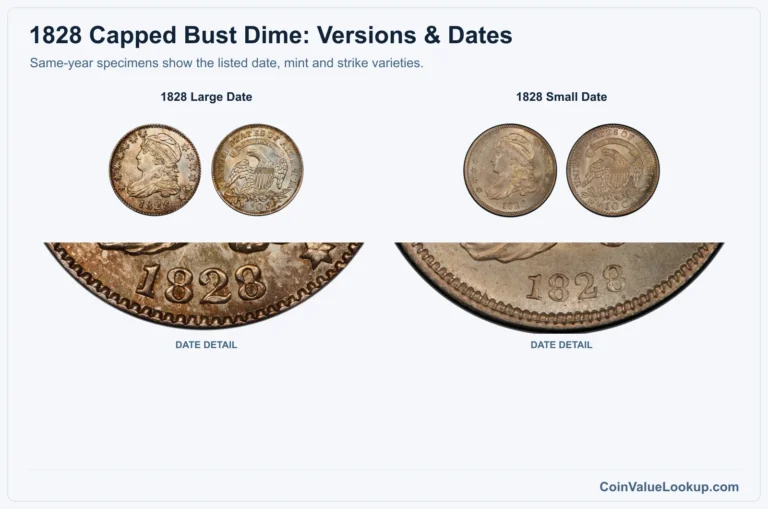
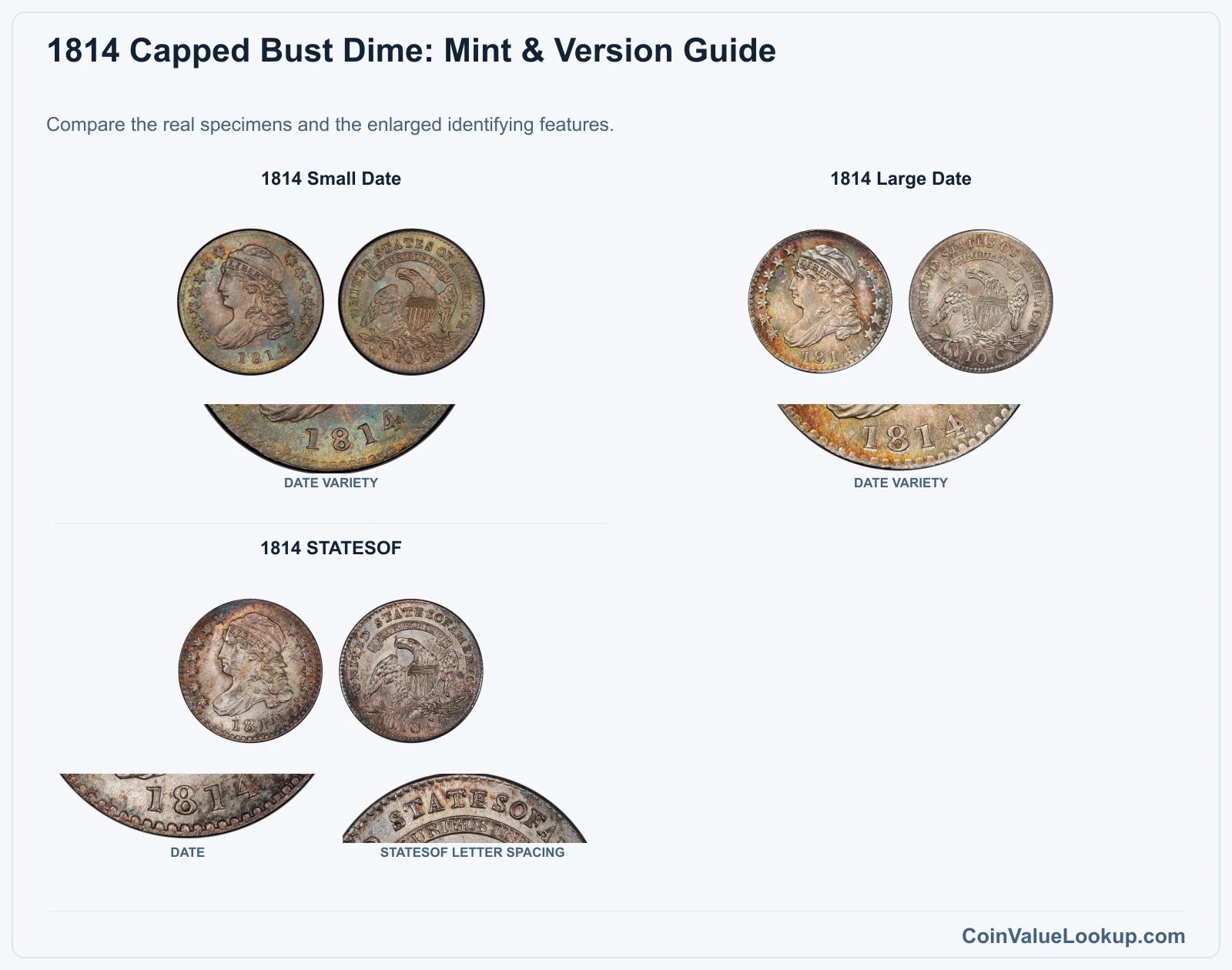
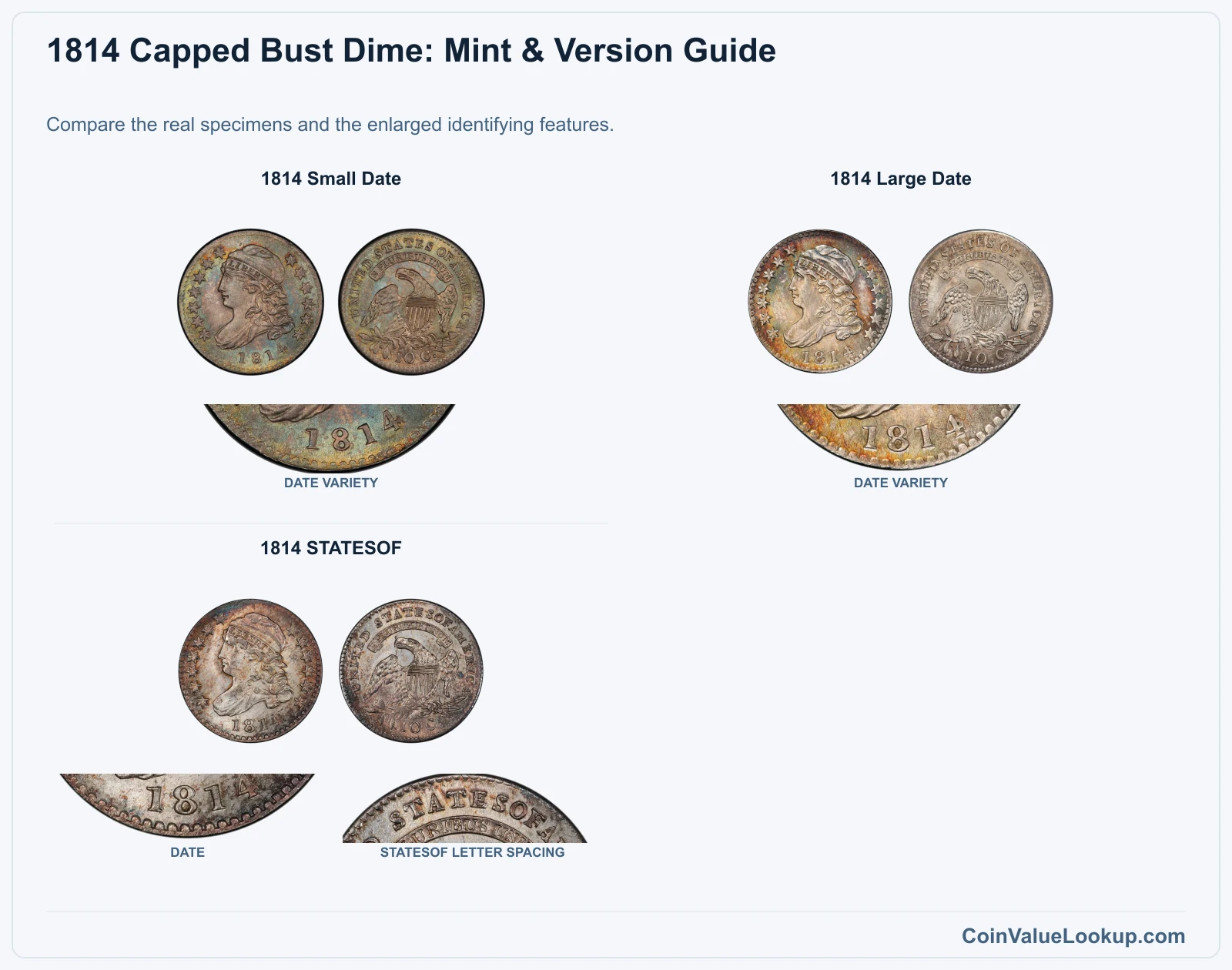
Three branches exist for this date: the Small Date, the Large Date, and the STATESOF variety. To tell the date varieties apart, you need a correctly labeled reference image showing the actual numeral sizes side by side.
Magnification alone will not settle it, because zooming in on either version makes the digits look large.
For the STATESOF variety, flip the coin over and examine the legend. On normal dies, there is a clear gap between STATES and OF.
On the STATESOF variety, those two words nearly touch. This is a die-engraving quirk, not a missing letter or a struck-through error.
Do not confuse this coin with a half dime. A half dime is a separate, smaller denomination with its own value scale entirely.
Step 2: Check Your 1814 Capped Bust Dime Grade
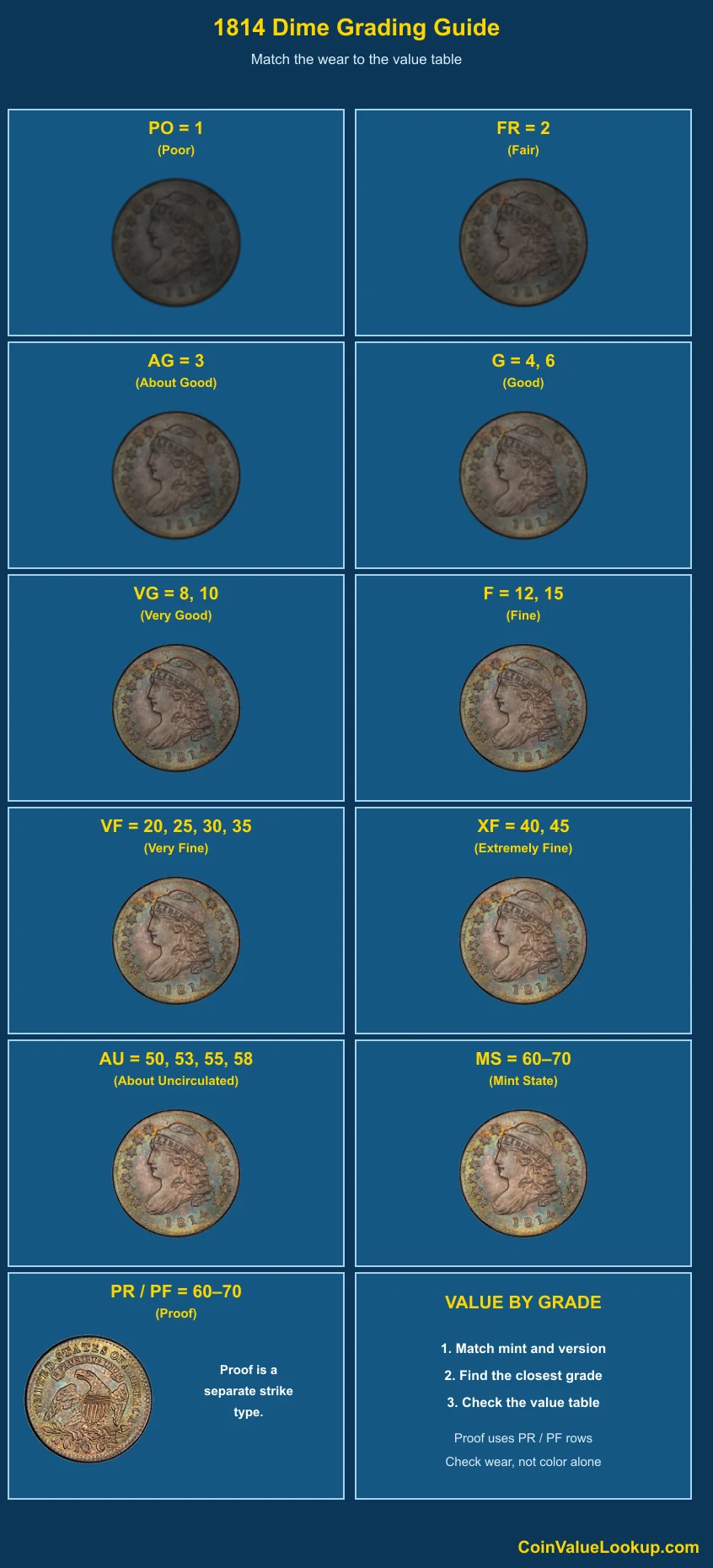
On the obverse, focus on Liberty's hair curls above the forehead and ear, the cheek, and the drapery folds near her shoulder. These are the first areas to lose detail as the coin circulates.
On the reverse, check the eagle's breast feathers and the tops of the wing tips.
These dimes were struck on hand-operated presses. That means even a brand-new coin can show uneven detail or soft spots that have nothing to do with wear.
Look at overall luster and contact marks together before deciding on a grade. If the fields still have a satiny glow and no flat spots on the high points, you are likely looking at a mint-state coin despite any minor softness.
Use the comparison image on this page to match your coin's wear pattern. Never clean or polish the surfaces.
Even a gentle wipe with a cloth can leave hairlines that permanently reduce the coin's appeal and value.
Step 3: Check 1814 Capped Bust Dime Value by Mint and Version
1814 Capped Bust Dime — Small Date
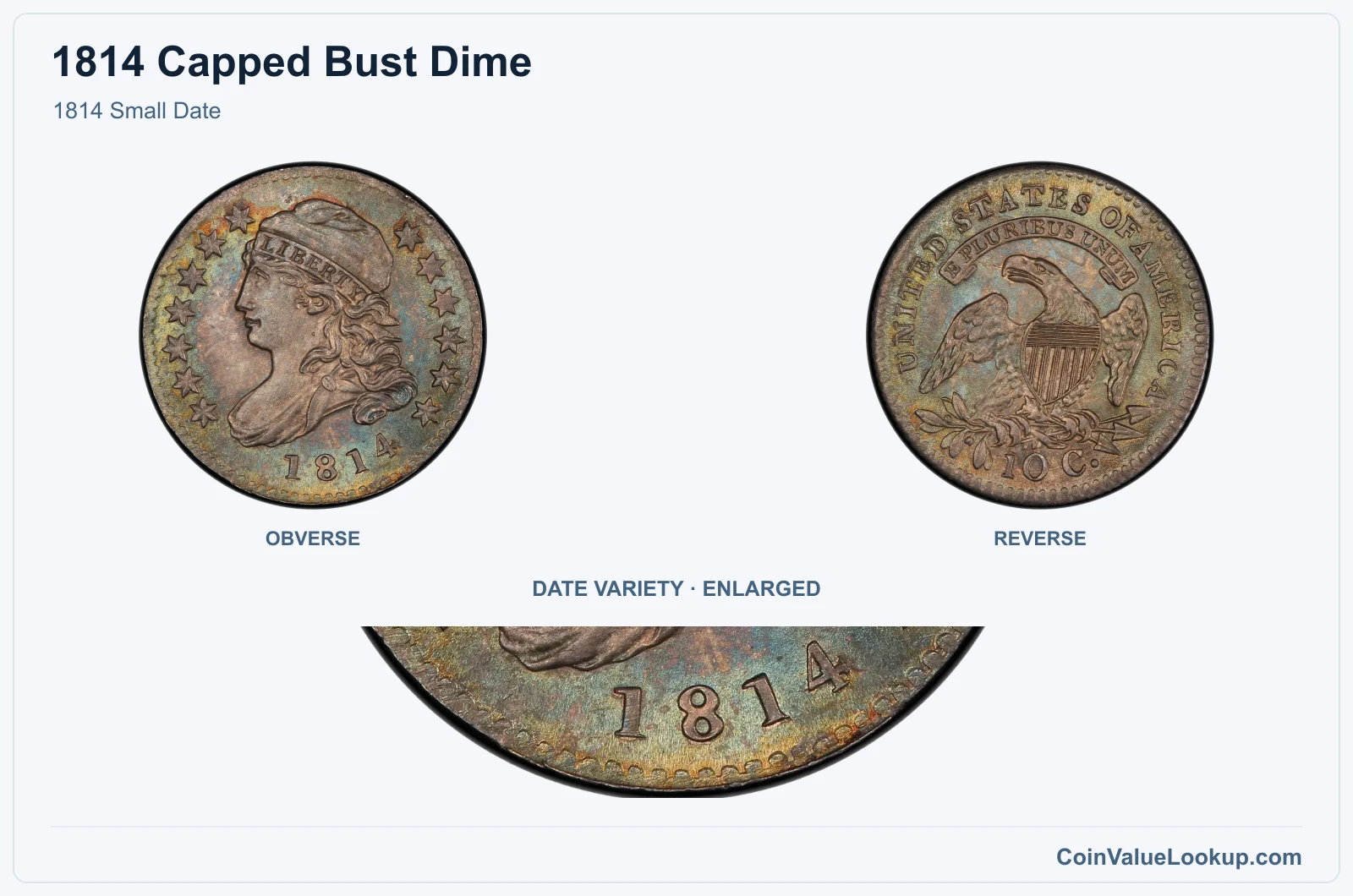
The 1814 Small Date variety was struck at Philadelphia with no mintmark. The numerals in the date are noticeably smaller than on the Large Date counterpart, but you need a labeled reference photo of both side by side to confirm it.
Do not rely on magnification alone.
Guide estimates place this variety at about $116 in Good-4 and around $5,722 in MS63, per USA Coin Book. These are guide figures, not guaranteed offers.
Original, unclean surfaces matter more than brightness. A coin that has been polished or whizzed to look shiny will grade lower than its wear alone would suggest.
Range Grade
Price Auction Records Appraisal PO PO 1
—
Coin Identifier FR FR 2
—
Coin Identifier AG AG 3
—
Coin Identifier G G 4
—
Coin Identifier
G 6
—
Coin Identifier VG VG 8
—
Coin Identifier
VG 10
—
Coin Identifier F F 12
Coin Identifier
F 15
Coin Identifier VF VF 20
—
Coin Identifier
VF 25
Coin Identifier
VF 30
Coin Identifier
VF 35
Coin Identifier XF XF 40
Coin Identifier
XF 45
Coin Identifier AU AU 50
Coin Identifier
AU 53
Coin Identifier
AU 55
Coin Identifier
AU 58
Coin Identifier MS MS 60
Coin Identifier
MS 61
Coin Identifier
MS 62
Coin Identifier
MS 63
Coin Identifier
MS 64
Coin Identifier
MS 65
Coin Identifier
MS 66
Coin Identifier
MS 67
—
—
—
MS 68
—
—
—
MS 69
—
—
—
MS 70
—
—
—
1814 Capped Bust Dime — Large Date
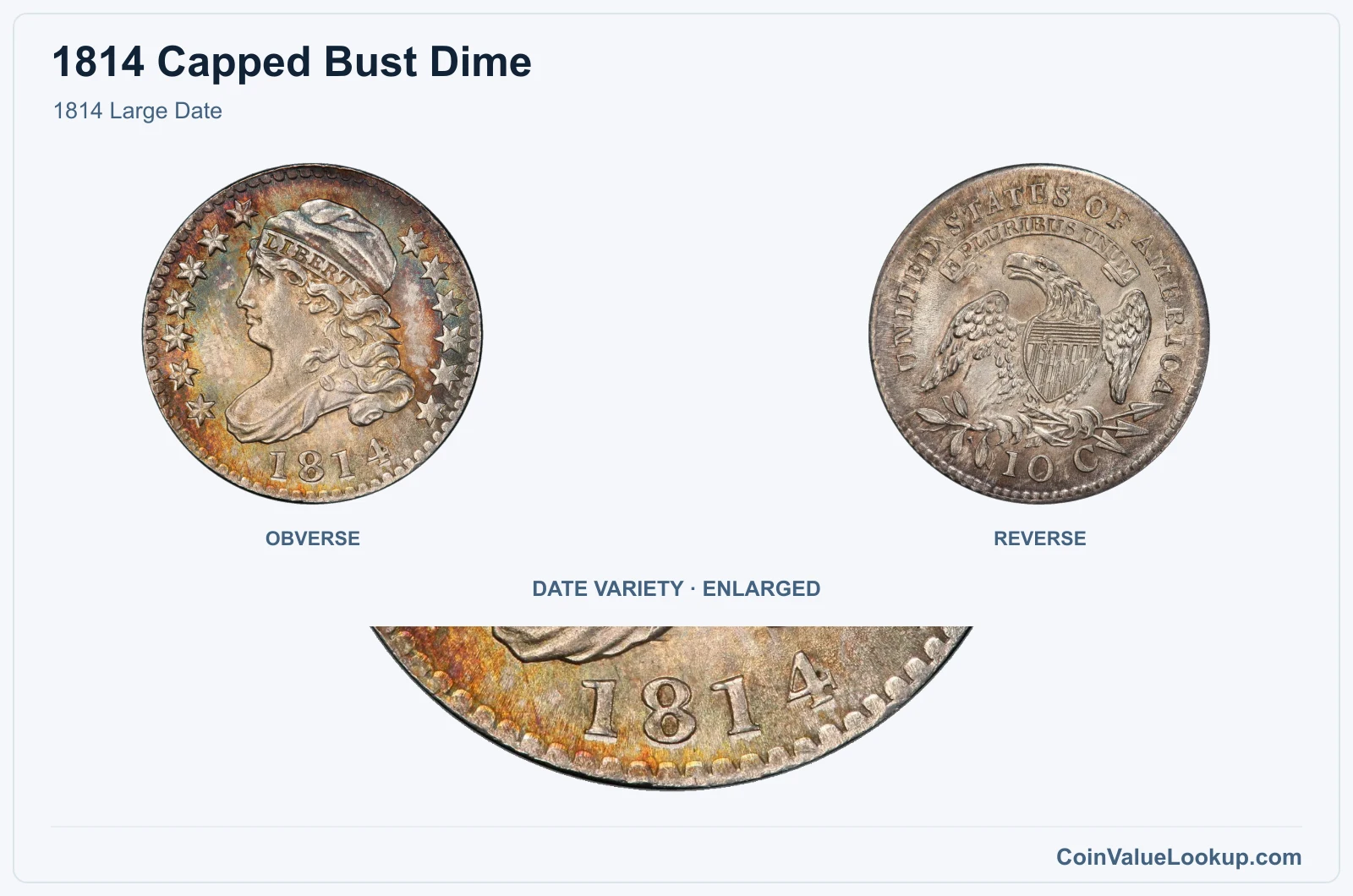
The 1814 Large Date is the Philadelphia-struck variety with visibly larger numerals in the date. Again, a side-by-side labeled comparison is the reliable way to confirm this, not just zooming in on a single coin.
Guide estimates sit at roughly $95 in Good-4 and about $5,624 in MS63. That lower entry price in worn grades makes this the most budget-friendly branch for collectors building an early dime set.
Condition still rules everything, though. A problem-free Good-4 coin with honest wear is a better buy than a cleaned example that technically shows less surface loss.
Coin Value Lookup is a useful starting point if you are working through other dates in the Capped Bust series and want quick access to value guides across different coins.
Range Grade
Price Auction Records Appraisal PO PO 1
—
Coin Identifier FR FR 2
—
Coin Identifier AG AG 3
Coin Identifier G G 4
Coin Identifier
G 6
Coin Identifier VG VG 8
Coin Identifier
VG 10
Coin Identifier F F 12
Coin Identifier
F 15
Coin Identifier VF VF 20
Coin Identifier
VF 25
Coin Identifier
VF 30
Coin Identifier
VF 35
Coin Identifier XF XF 40
Coin Identifier
XF 45
Coin Identifier AU AU 50
Coin Identifier
AU 53
Coin Identifier
AU 55
Coin Identifier
AU 58
Coin Identifier MS MS 60
Coin Identifier
MS 61
Coin Identifier
MS 62
Coin Identifier
MS 63
Coin Identifier
MS 64
Coin Identifier
MS 65
Coin Identifier
MS 66
Coin Identifier
MS 67
Coin Identifier
MS 68
—
—
—
MS 69
—
—
—
MS 70
—
—
—
1814 Capped Bust Dime — STATESOF
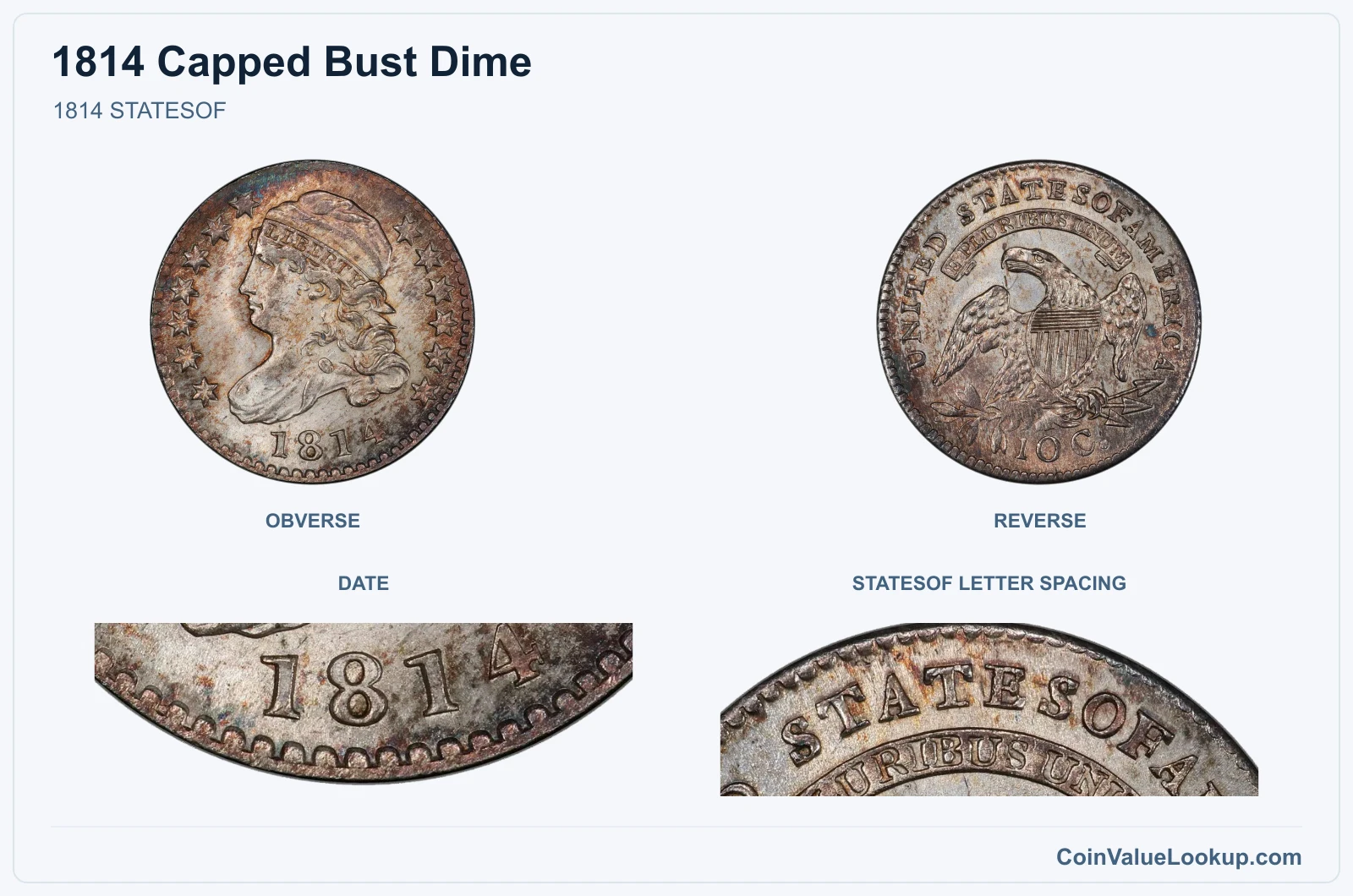
The 1814 STATESOF variety is identified on the reverse. Look at the space between the words STATES and OF in the legend above the eagle.
On this variety, the gap is so narrow the words nearly run together. This is not a missing-letter error or a die clash.
It is simply how the particular die was engraved.
This branch carries the strongest guide estimates of the three: about $348 in Good-4 and around $11,483 in MS63, according to USA Coin Book. The premium reflects genuine scarcity combined with collector demand for a visually distinct die variety.
As with all 1814 dimes, surfaces should be original. Cleaning, scratches, and corrosion each reduce a coin's comparability to these guide benchmarks, sometimes significantly.
Range Grade
Price Auction Records Appraisal PO PO 1
—
Coin Identifier FR FR 2
—
Coin Identifier AG AG 3
Coin Identifier G G 4
—
Coin Identifier
G 6
Coin Identifier VG VG 8
Coin Identifier
VG 10
Coin Identifier F F 12
Coin Identifier
F 15
—
Coin Identifier VF VF 20
Coin Identifier
VF 25
Coin Identifier
VF 30
Coin Identifier
VF 35
Coin Identifier XF XF 40
Coin Identifier
XF 45
Coin Identifier AU AU 50
—
Coin Identifier
AU 53
Coin Identifier
AU 55
Coin Identifier
AU 58
Coin Identifier MS MS 60
—
Coin Identifier
MS 61
—
Coin Identifier
MS 62
Coin Identifier
MS 63
Coin Identifier
MS 64
Coin Identifier
MS 65
—
—
—
MS 66
—
—
—
MS 67
—
—
—
MS 68
—
—
—
MS 69
—
—
—
MS 70
—
—
—
1814 Capped Bust Dime Error List
1. 1814 Capped Bust Dime — Die Break / Cud
A die break, sometimes called a cud, has been reported on late-state examples of the 1814 Capped Bust Dime reverse die. The break appears over the letters CA in AMERICA, showing as a raised, irregular blob of metal that connects to the rim.
Where the die chipped away, normal design detail is replaced by a featureless lump.
Not every 1814 dime shows this. It only appears on coins struck after the die had deteriorated enough for the piece to break free.
Earlier strikes from the same die pair will look normal.
Be careful not to confuse a true cud with a rim dent, localized corrosion, or a small interior die chip that does not reach the rim. A genuine cud is always connected to the rim edge and displaces the underlying design.
No specific price range has been adopted for this feature, because value depends on the cud's size, sharpness, and the coin's overall condition. Individual assessment is the way to go here.