1811 Capped Bust Dime Coin Value: How Much Is It Worth?
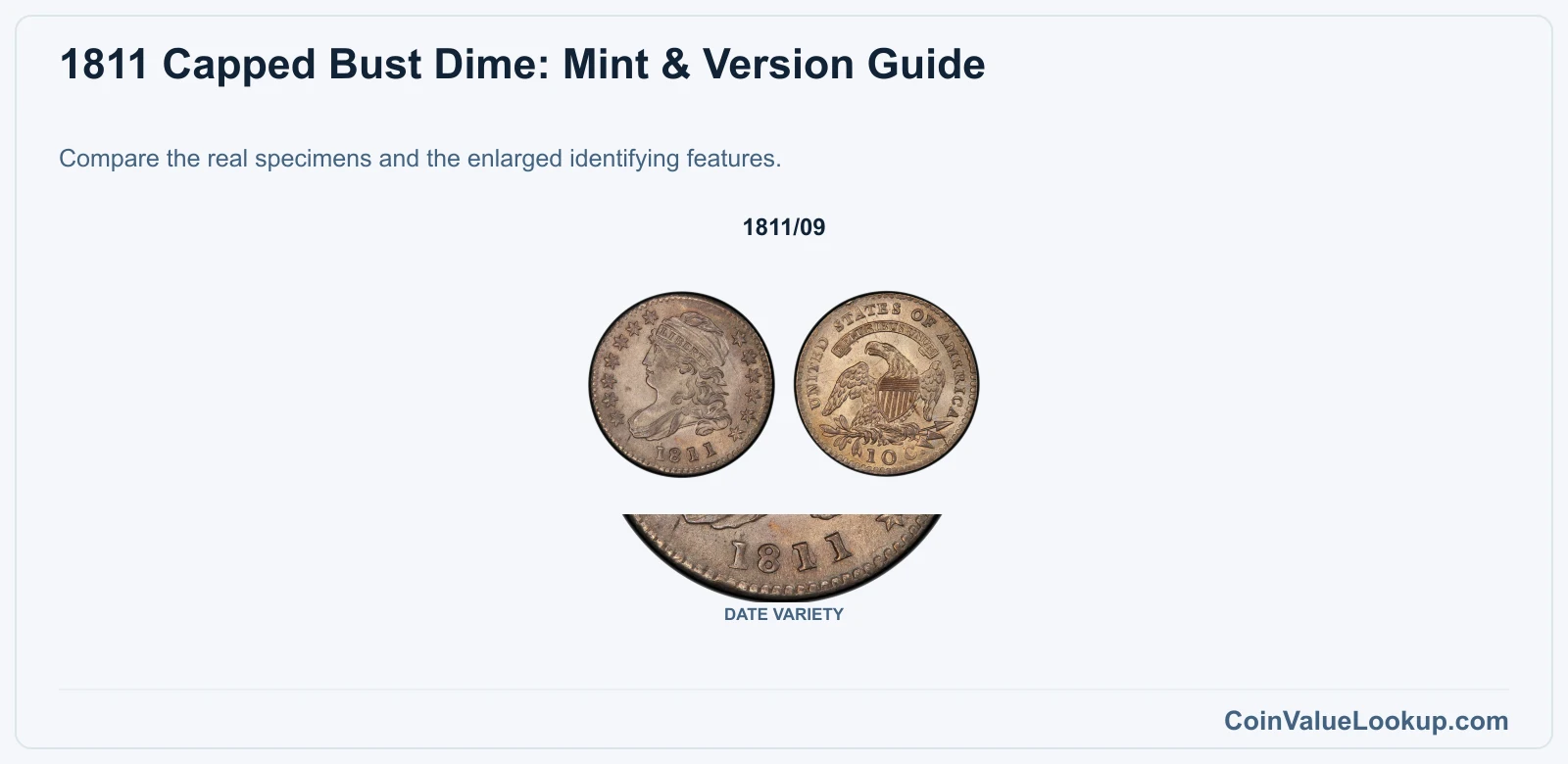
The 1811 Capped Bust Dime is one of the earliest collectible silver dimes struck at the Philadelphia Mint. Guide estimates for this year range from about $317.00 in well-worn Good-4 condition to around $10,018.00 at the Mint State 63 level, depending on the specific variety, surface quality and grade.
These anchors reflect one published guide and are not guaranteed offers; your coin's actual design branch, wear and originality determine where it falls.
Fast Way to Identify Your 1811 Capped Bust Dime
If you have an 1811 Capped Bust Dime and want a quick starting point, snap clear photos of both the front and back of your coin and upload them to our identifier. This gives you a preliminary identification of the design, date variety and general condition so you know which branch to research further.
It is not a substitute for professional authentication or precise grading.
1811 Capped Bust Dime Value
Upload both sides of your 1811 Capped Bust Dime.
Front Obverse
Upload photo
Back Reverse
Upload photo
Which 1811 Capped Bust Dime Versions Are Worth Money?
- The 1811/09 overdate is the primary collectible branch for this date — look for remnants of "09" beneath the "11" in the date.
- Guide estimates for the 1811/09 range from $317.00 in Good-4 to $10,018.00 in MS63; actual value depends on your coin's specific grade and surface quality.
- Coins with original, uncleaned surfaces command stronger interest than brightened or damaged examples at any grade level.
Step 1: Identify Your 1811 Capped Bust Dime Mint Mark and Version
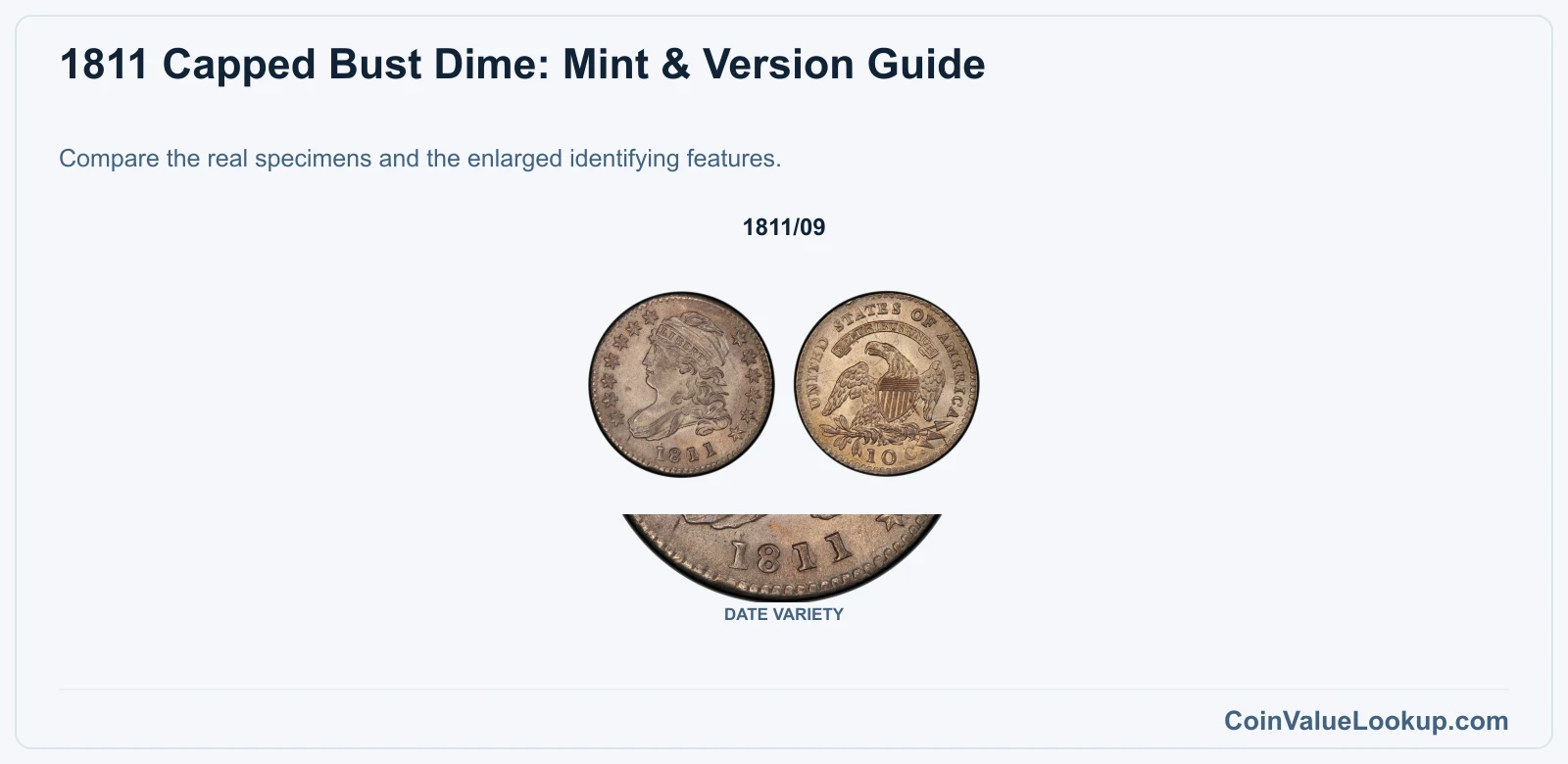
Every 1811 dime was struck at the Philadelphia Mint, so there is no mintmark to look for. The coin is a silver-copper alloy, roughly 89.24% silver, and uses the Capped Bust design with large dentils and a wider planchet than later dimes.
Do not confuse this with a half dime, which is a smaller denomination entirely. The key branch for 1811 is the 1811/09 overdate, where the Mint reused a die originally dated 1809.
Under magnification, you can spot traces of the earlier "09" lurking beneath the final "11" in the date.
If those ghostly earlier digits are visible, you are looking at the overdate variety. That is the primary identification step for this date.
Step 2: Check Your 1811 Capped Bust Dime Grade
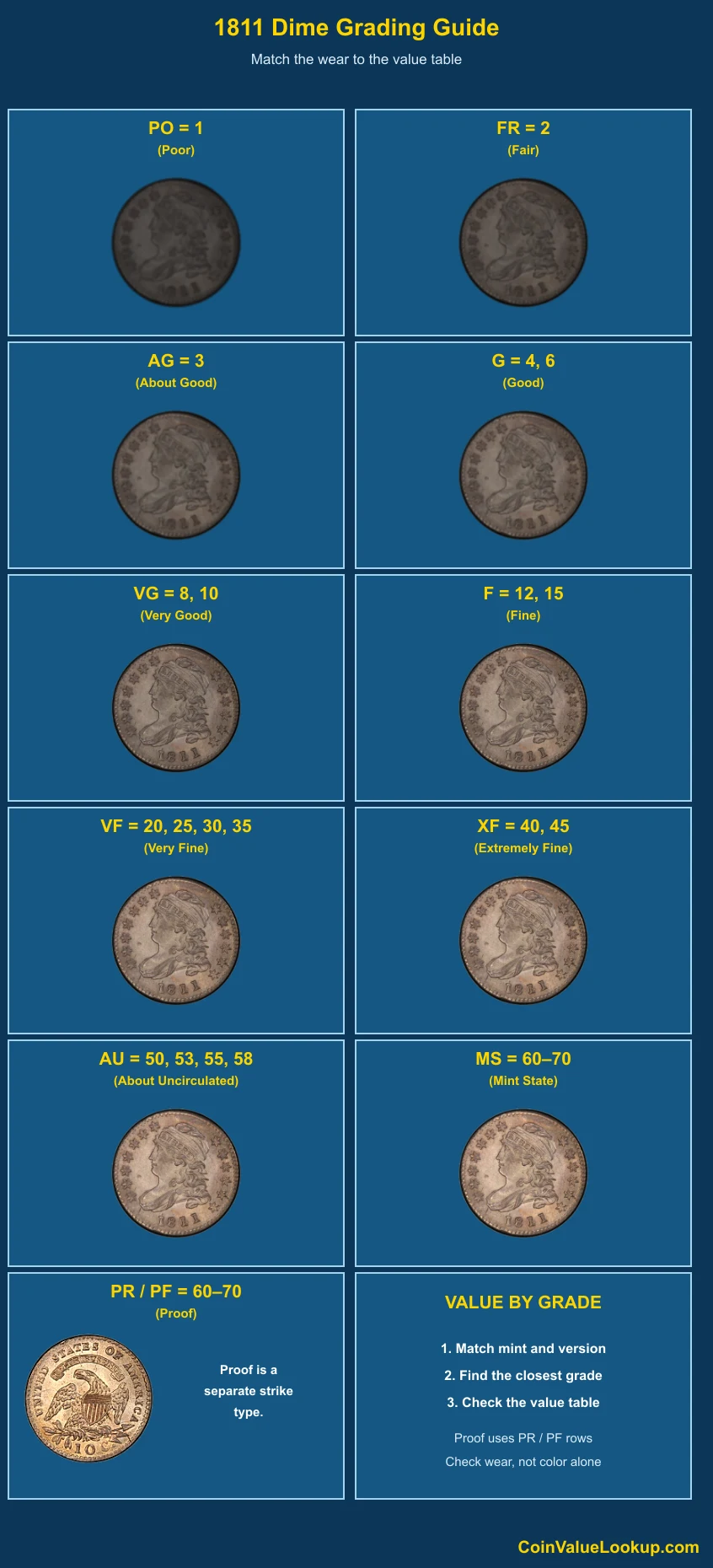
Focus on Liberty's hair curls, cheek and the drapery near the cap on the obverse. These are the first areas to show smoothing from circulation wear.
On the reverse, check the eagle's breast feathers and wing tips.
Early dimes were struck on hand-operated presses, so even uncirculated examples can show uneven or slightly weak details in spots. Do not mistake original strike softness for wear.
Look at overall luster and the pattern of contact marks to separate a weakly struck mint-state coin from a lightly worn one.
Use the comparison image to match your coin's remaining detail against known grade benchmarks. Cleaning, polishing or artificial brightening reduces a coin's desirability and value significantly, even if the underlying detail looks sharp.
Leave the surfaces alone.
Coin Value Lookup is a handy place to look up guides like this one for other early U.S. coin series. If you are working through a collection of Capped Bust coinage, it can save you a lot of tab-juggling.
Step 3: Check 1811 Capped Bust Dime Value by Mint and Version
1811 Capped Bust Dime — /09
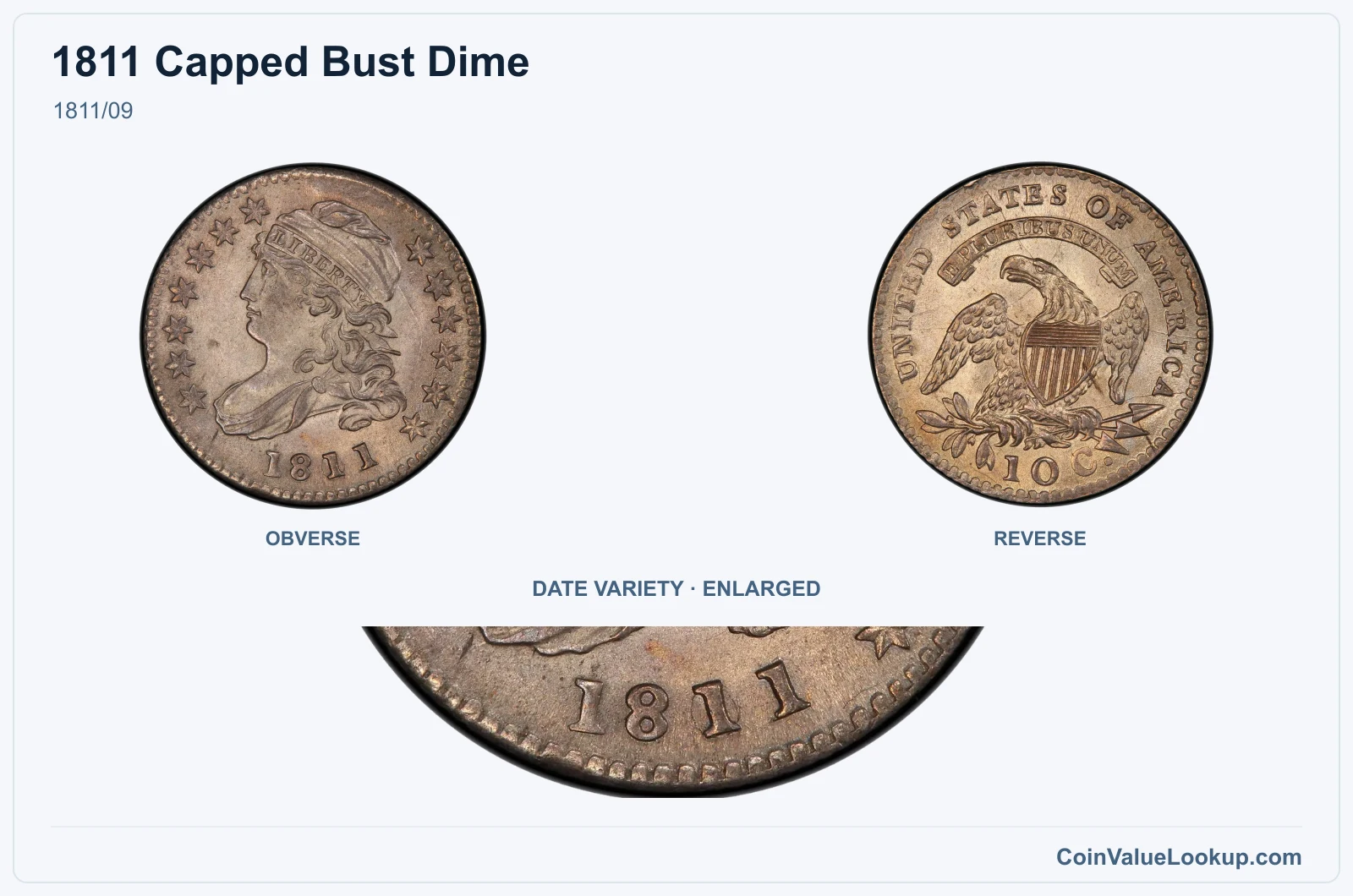
The 1811/09 Capped Bust Dime is an overdate variety. The Philadelphia Mint economized by reworking an 1809-dated die, punching new digits over the old ones.
Under a loupe or strong magnifying glass, you can see curved remnants of the original "0" and "9" peeking out beneath the "1" and "1" of the final date. It is a neat piece of early Mint pragmatism.
This is a silver-copper alloy coin, about 89.24% silver, in the wider Capped Bust format with large dentils around the rim. Published guide estimates place it around $317.00 in Good-4 and approximately $10,018.00 in MS63, per USA Coin Book.
Those figures are reference anchors for coins with original surfaces and no damage; cleaning, scratches or corrosion will pull real-world value below the guide for any given grade. Match the date, confirm the overdate remnants, and then assess wear honestly before comparing to a grade-based estimate.
Range Grade
Price Auction Records Appraisal PO PO 1
—
Coin Identifier FR FR 2
—
Coin Identifier AG AG 3
Coin Identifier G G 4
—
Coin Identifier
G 6
Coin Identifier VG VG 8
Coin Identifier
VG 10
Coin Identifier F F 12
Coin Identifier
F 15
Coin Identifier VF VF 20
Coin Identifier
VF 25
Coin Identifier
VF 30
Coin Identifier
VF 35
Coin Identifier XF XF 40
Coin Identifier
XF 45
Coin Identifier AU AU 50
Coin Identifier
AU 53
—
Coin Identifier
AU 55
Coin Identifier
AU 58
Coin Identifier MS MS 60
—
Coin Identifier
MS 61
Coin Identifier
MS 62
Coin Identifier
MS 63
Coin Identifier
MS 64
Coin Identifier
MS 65
Coin Identifier
MS 66
—
Coin Identifier
MS 67
—
—
—
MS 68
—
—
—
MS 69
—
—
—
MS 70
—
—
—
1811 Capped Bust Dime Error List
1. 1811 Capped Bust Dime — Overdate
The 1811/09 overdate is a die variety where traces of the original 1809 date survive beneath the re-engraved 1811 digits. To spot it, examine the last two digits of the date under magnification.
You should see faint curved outlines of the "0" and "9" underlying the final "11." The remnants are part of the die itself, not post-strike damage.
Not every odd-looking date is an overdate. A damaged or corroded date can mimic similar ghosting, and ordinary machine doubling produces shelf-like raised edges rather than the distinctly different numeral shapes you see on a genuine overdate die.
If the underlying shapes clearly form different numbers, that is the diagnostic.
No separate numerical price range is adopted here for the overdate as an error listing. Its value depends on the visibility of the overdate feature, overall condition and surface quality.
A professional grading service can confirm the variety for coins where the remnants are ambiguous.