2005 Roosevelt Dime Coin Value: How Much Is It Worth?
A worn 2005 Roosevelt dime from your pocket is worth face value — ten cents. In mint state, a USA Coin Book guide estimate places an MS65 example at around $2.50 for Philadelphia or Denver strikes.
The S clad proof sits at about $3.08 in PR65, and the S silver proof reaches roughly $9.65 in the same grade. Finish, condition, and authenticated errors can push values well beyond those starting points.
Fast Way to Identify Your 2005 Roosevelt Dime
Want a quick read on your 2005 dime? Upload clear photos of the front and back, and our identifier can offer a preliminary look at which version you have — mintmark, finish type, and general condition.
It is not a substitute for professional grading or authentication, but it gives you a useful starting point before digging deeper.
2005 Roosevelt Dime Value
Upload both sides of your 2005 Roosevelt Dime.
Front Obverse
Upload photo
Back Reverse
Upload photo
Which 2005 Roosevelt Dime Versions Are Worth Money?
- Sharp mint-state P or D business strikes — an MS65 guides at $2.50 per USA Coin Book, and coins with confirmed Full Bands strike designation can attract additional collector interest.
- S silver proof dimes in PR65 guide at $9.65, meaningfully above the clad proof at $3.08; confirm the 90% silver composition by weight and edge before assuming the higher value.
- P and D Satin Finish coins from 2005 Uncirculated Coin Sets are separate collectible versions with their own market; value depends on authenticated identity and condition.
- A 2005-D missing reverse clad layer error sold for $75 in December 2020 at auction, certified MS64 — a dramatic-looking error worth checking for.
- A 2005-P improperly annealed planchet error has appeared at auction in certified holders; value depends on the individual coin's authentication and grade.
Step 1: Identify Your 2005 Roosevelt Dime Mint Mark and Version
Start with the date. Confirm you see 2005, Roosevelt's portrait on the obverse, and the torch-with-branches reverse.
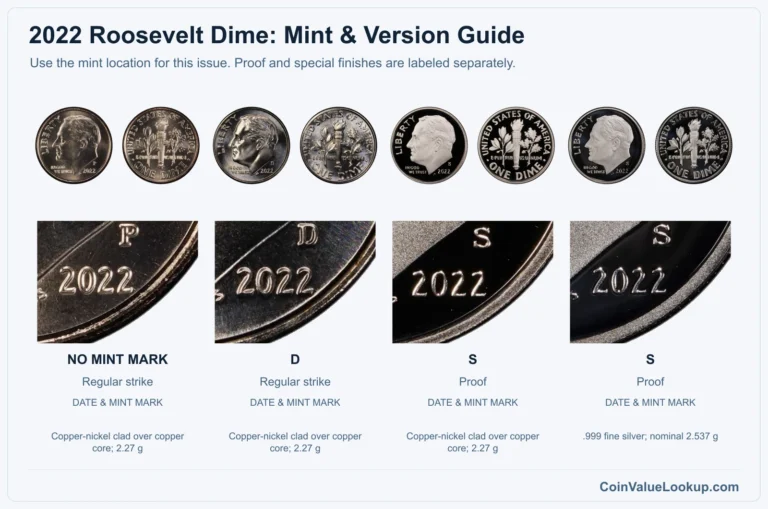
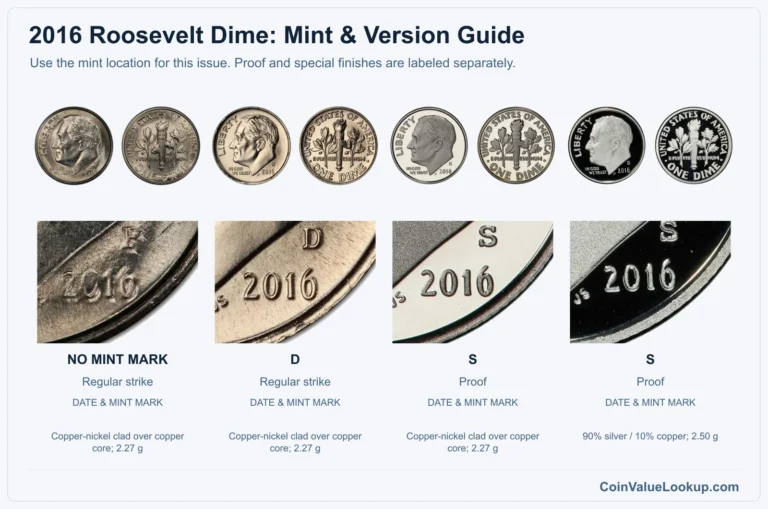
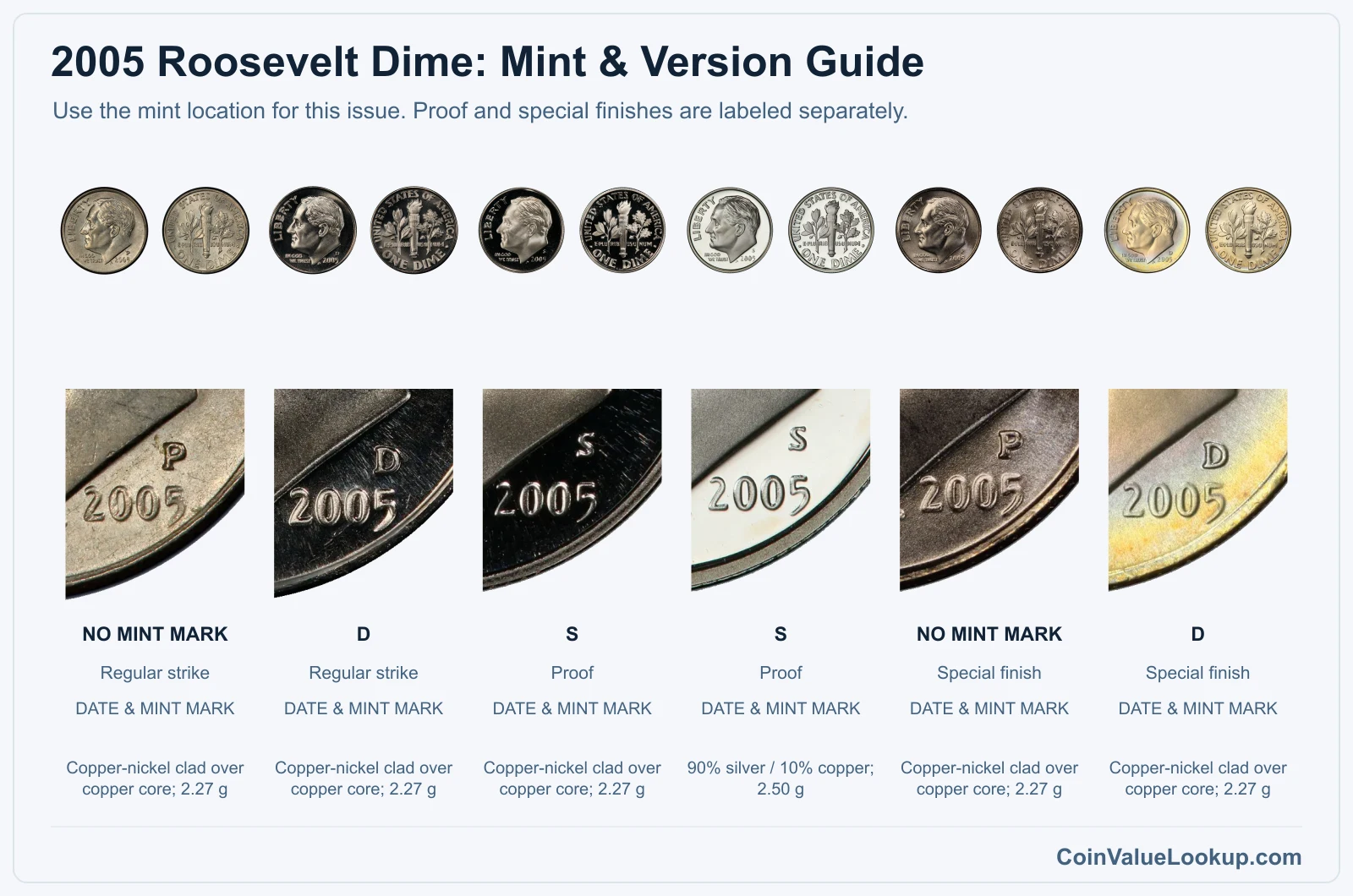
Then find the mintmark near the date — P for Philadelphia, D for Denver, or S for San Francisco.
P and D coins pulled from circulation are copper-nickel clad business strikes weighing about 2.27 grams with a diameter around 17.9 mm. An S mintmark means either a clad proof or a 90% silver proof, and both look identical from the front.
You cannot tell them apart by mintmark alone.
To separate the two S-mint versions, check weight and edge. The silver proof weighs 2.50 grams; the clad proof weighs 2.27 grams.
A silver edge shows a uniform gray tone, while a clad edge reveals layered metal. Original packaging also helps — silver proofs ship in their own designated sets.
There are also Satin Finish versions from the 2005 Uncirculated Coin Sets, carrying P and D mintmarks. These are special strikes with a distinctive soft luster, not regular business strikes and not proofs.
Color alone does not authenticate any alloy or finish — use edge inspection, weight, and packaging together.
Step 2: Check Your 2005 Roosevelt Dime Grade
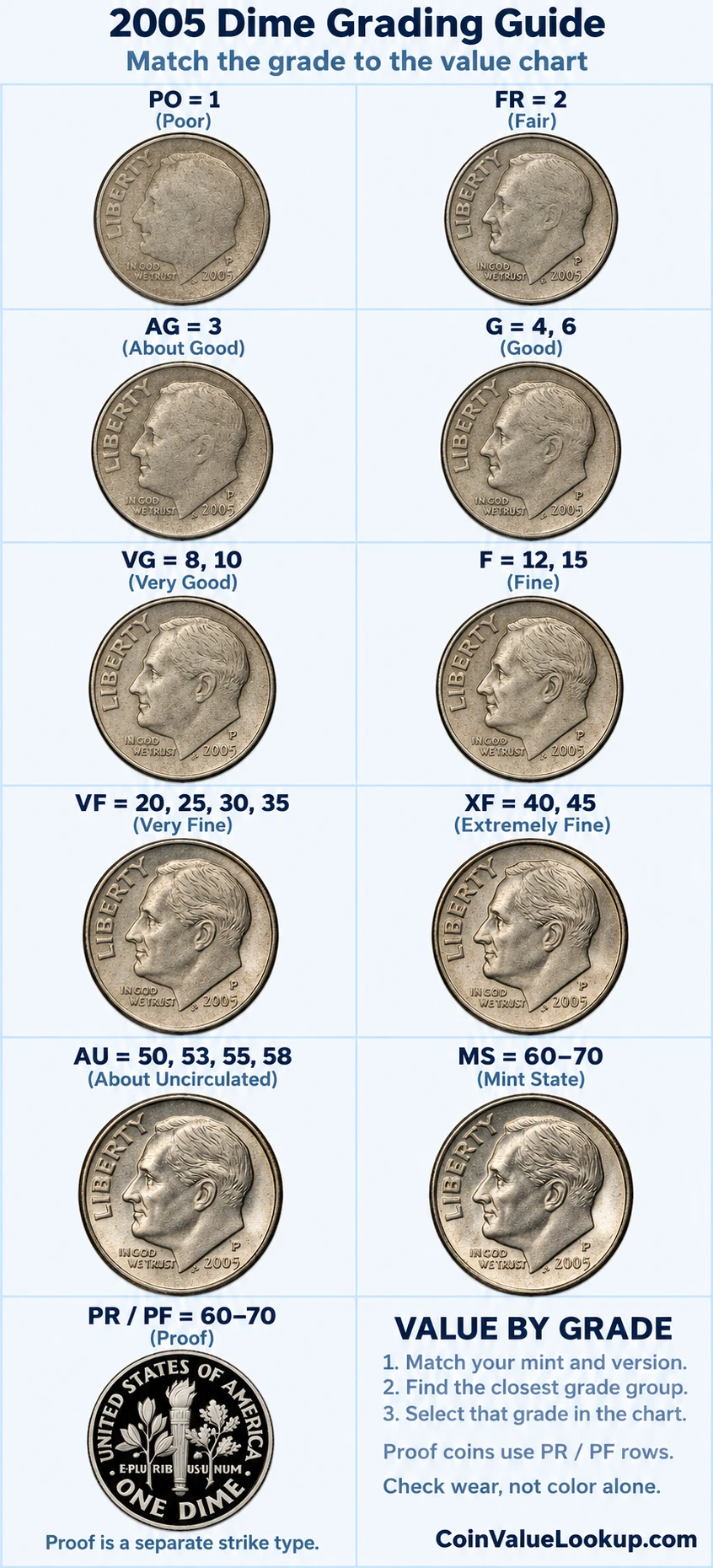
On a circulated 2005 dime, check Roosevelt's cheekbone, jawline, and the hair above the ear first. These are the highest points and show wear earliest.
On the reverse, the torch lines and leaf details lose definition as the grade drops.
Original luster matters more than shine. A cleaned coin can look bright but will show hairlines under light and grade lower than a naturally toned piece with intact surfaces.
A weak strike is not the same as wear. Full Bands refers to complete separation of both horizontal torch-band pairs on the reverse — that is a strike designation, not a different alloy or an error.
Compare your coin to the grading image to see where it falls.
Proof and Satin Finish coins have their own grading scales and surface expectations. A proof with haze or fingerprints is impaired regardless of how sharp the details remain.
Damaged or cleaned coins of any type receive condition qualifications from grading services.
Step 3: Check 2005 Roosevelt Dime Value by Mint and Version
2005 Roosevelt Dime — P Business Strike
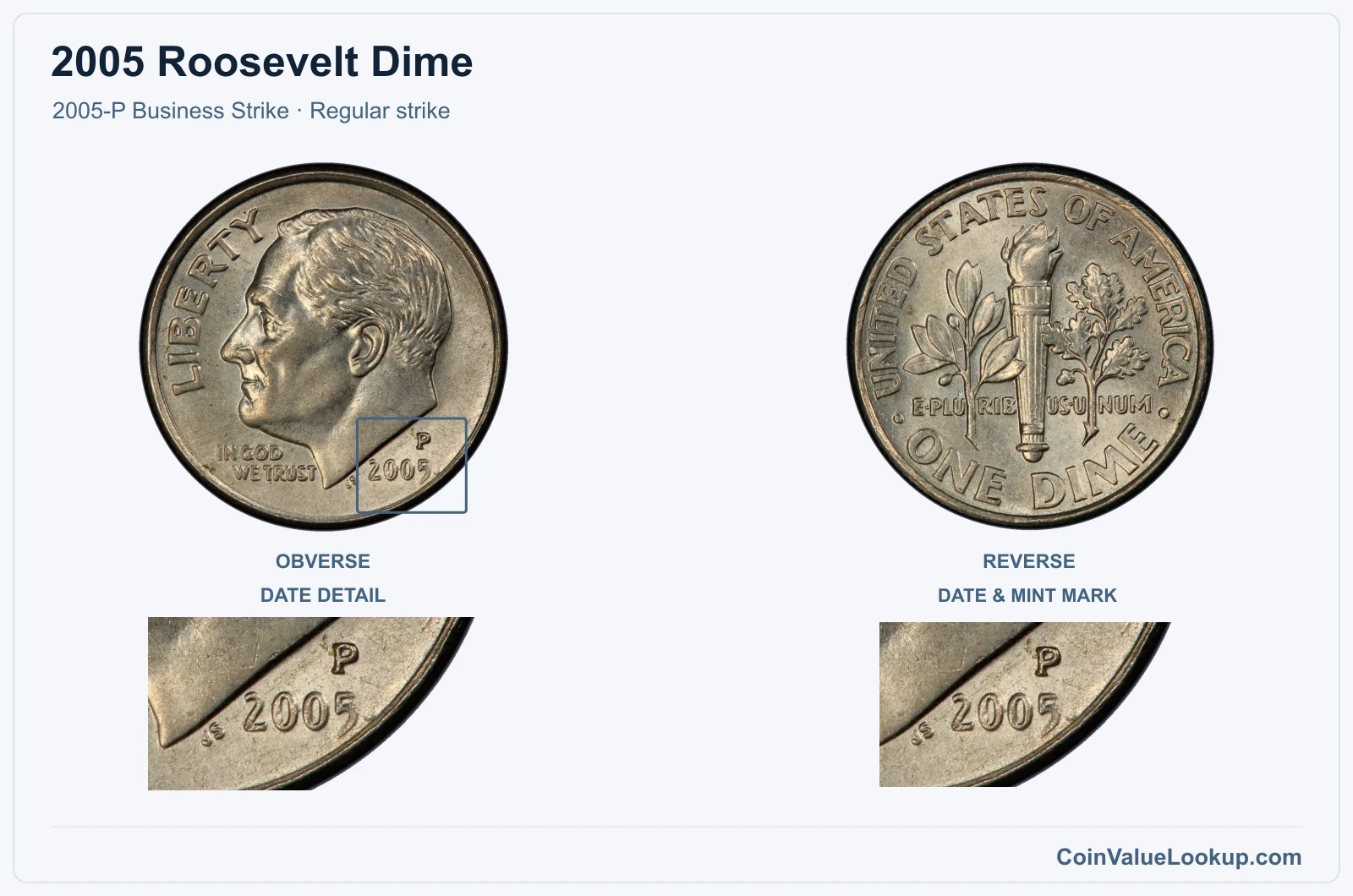
The 2005-P business strike is the standard Philadelphia circulation dime. It is copper-nickel clad over a copper core, weighs 2.27 grams, and carries a P mintmark near the date.
Most circulated examples are worth face value.
In mint state, a USA Coin Book guide estimate places MS65 at $2.50. Coins with well-struck torch bands may draw extra attention from Roosevelt dime collectors pursuing the Full Bands strike designation.
Compare your specific coin in the version's own price and history section for the most relevant data.
Range Grade
Price Auction Records Appraisal PO PO 1
—
Coin Identifier FR FR 2
—
Coin Identifier AG AG 3
—
Coin Identifier G G 4
—
Coin Identifier
G 6
—
Coin Identifier VG VG 8
—
Coin Identifier
VG 10
—
Coin Identifier F F 12
—
Coin Identifier
F 15
—
Coin Identifier VF VF 20
—
Coin Identifier
VF 25
—
Coin Identifier
VF 30
—
Coin Identifier
VF 35
—
Coin Identifier XF XF 40
—
Coin Identifier
XF 45
—
Coin Identifier AU AU 50
—
Coin Identifier
AU 53
—
Coin Identifier
AU 55
—
Coin Identifier
AU 58
—
Coin Identifier MS MS 60
—
Coin Identifier
MS 61
—
Coin Identifier
MS 62
—
Coin Identifier
MS 63
—
Coin Identifier
MS 64
—
Coin Identifier
MS 65
—
Coin Identifier
MS 66
—
Coin Identifier
MS 67
—
Coin Identifier
MS 68
—
—
—
MS 69
—
—
—
MS 70
—
—
—
2005 Roosevelt Dime — D Business Strike
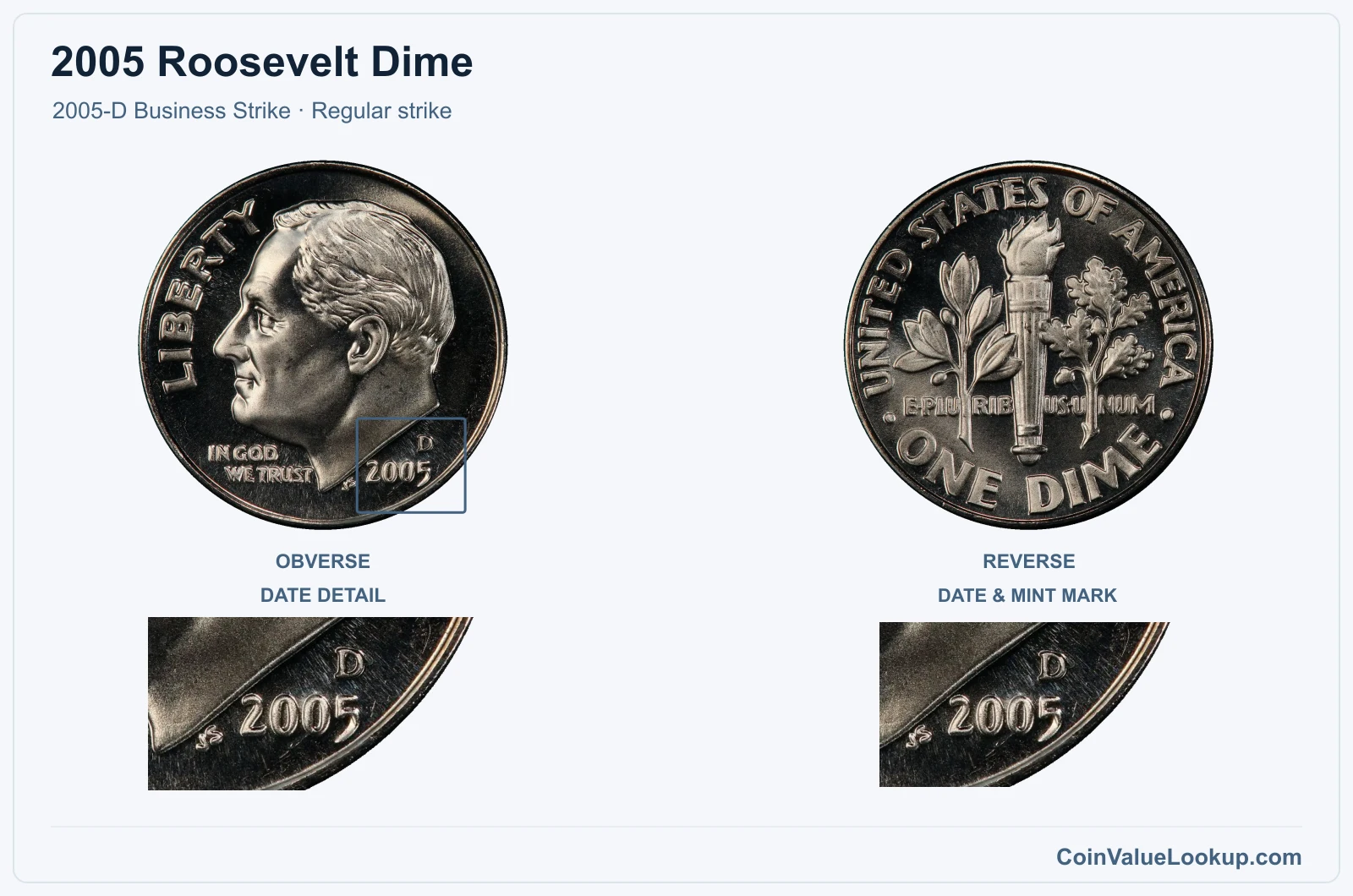
Denver's 2005-D business strike shares the same copper-nickel clad composition and 2.27-gram weight as its Philadelphia counterpart. Look for the D mintmark beside the date.
Circulated pieces trade at face value. The USA Coin Book guide puts MS65 at $2.50, identical to the P-mint.
Full Bands examples — where both horizontal torch-band pairs show clean separation — can be worth tracking down. The D-mint version also has a documented missing reverse clad layer error, so give the reverse and edge an extra look.
Range Grade
Price Auction Records Appraisal PO PO 1
—
Coin Identifier FR FR 2
—
Coin Identifier AG AG 3
—
Coin Identifier G G 4
—
Coin Identifier
G 6
—
Coin Identifier VG VG 8
—
Coin Identifier
VG 10
—
Coin Identifier F F 12
—
Coin Identifier
F 15
—
Coin Identifier VF VF 20
—
Coin Identifier
VF 25
—
Coin Identifier
VF 30
—
Coin Identifier
VF 35
—
Coin Identifier XF XF 40
—
Coin Identifier
XF 45
—
Coin Identifier AU AU 50
—
Coin Identifier
AU 53
—
Coin Identifier
AU 55
—
Coin Identifier
AU 58
—
Coin Identifier MS MS 60
—
Coin Identifier
MS 61
—
Coin Identifier
MS 62
—
Coin Identifier
MS 63
—
Coin Identifier
MS 64
Coin Identifier
MS 65
—
Coin Identifier
MS 66
Coin Identifier
MS 67
Coin Identifier
MS 68
—
Coin Identifier
MS 69
—
—
—
MS 70
—
—
—
2005 Roosevelt Dime — S Clad Proof
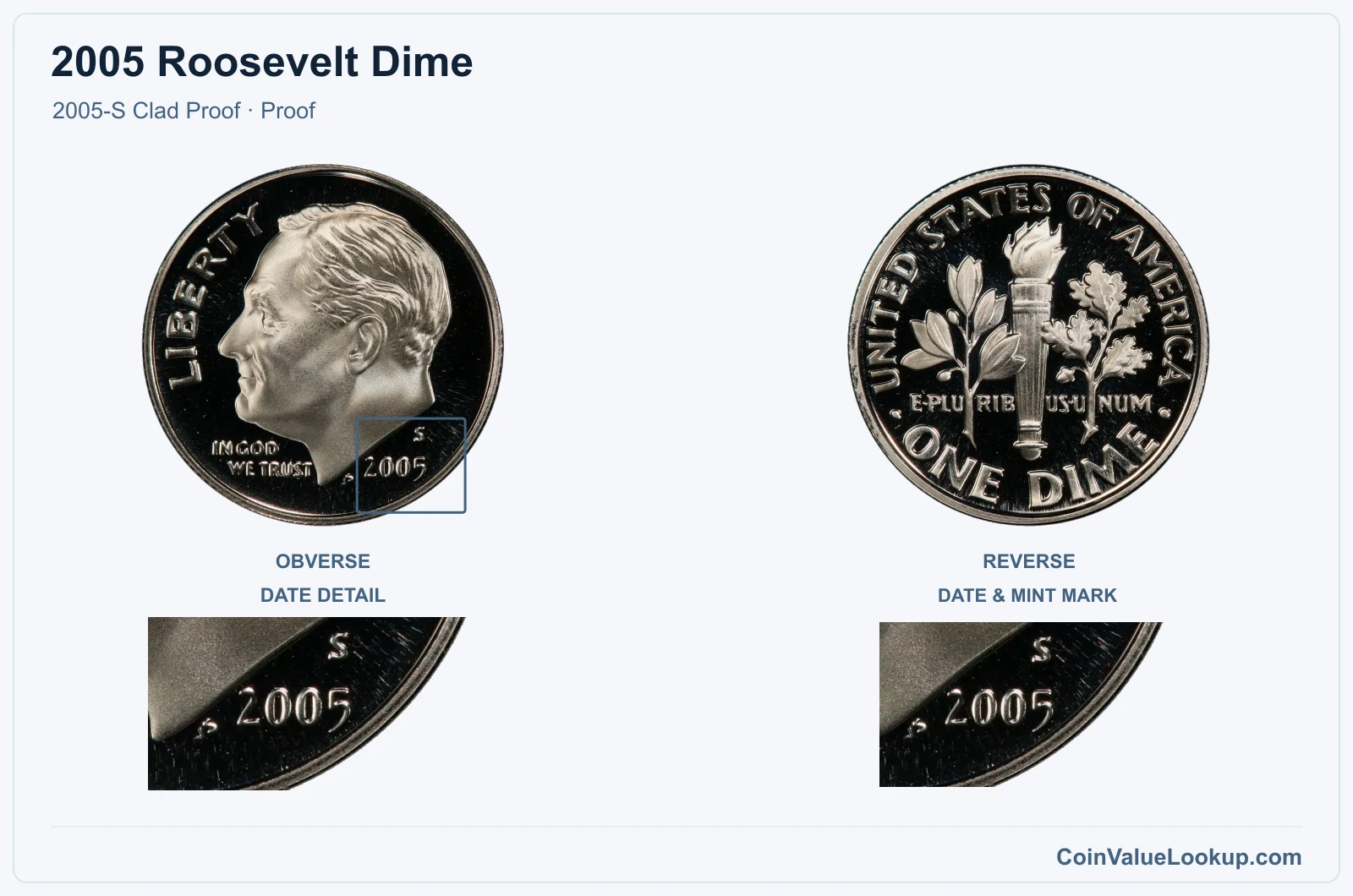
The 2005-S clad proof was struck at San Francisco on a copper-nickel clad planchet, the same metal as business strikes but with a mirror-finish proof surface. It weighs 2.27 grams.
A PR65 guide estimate from USA Coin Book is $3.08. Because the S silver proof uses the same mintmark and design, you must verify composition independently.
Weigh the coin — 2.27 grams is clad, 2.50 grams is silver. Check the edge for layered metal.
Original proof-set packaging is also a reliable indicator.
Coin Value Lookup is a good starting point if you want to compare this dime's value against other Roosevelt dates or denominations. You can browse guides organized by series and year.
Range Grade
Price Auction Records Appraisal PR PR 1
—
Coin Identifier
PR 2
—
Coin Identifier
PR 3
—
Coin Identifier
PR 4
—
Coin Identifier
PR 6
—
Coin Identifier
PR 8
—
Coin Identifier
PR 10
—
Coin Identifier
PR 12
—
Coin Identifier
PR 15
—
Coin Identifier
PR 20
—
Coin Identifier
PR 25
—
Coin Identifier
PR 30
—
Coin Identifier
PR 35
—
Coin Identifier
PR 40
—
Coin Identifier
PR 45
—
Coin Identifier
PR 50
—
Coin Identifier
PR 53
—
Coin Identifier
PR 55
—
Coin Identifier
PR 58
—
Coin Identifier
PR 60
—
Coin Identifier
PR 61
—
Coin Identifier
PR 62
—
Coin Identifier
PR 63
—
Coin Identifier
PR 64
—
Coin Identifier
PR 65
—
Coin Identifier
PR 66
—
Coin Identifier
PR 67
—
Coin Identifier
PR 68
—
Coin Identifier
PR 69
Coin Identifier
PR 70
Coin Identifier
2005 Roosevelt Dime — S Silver Proof
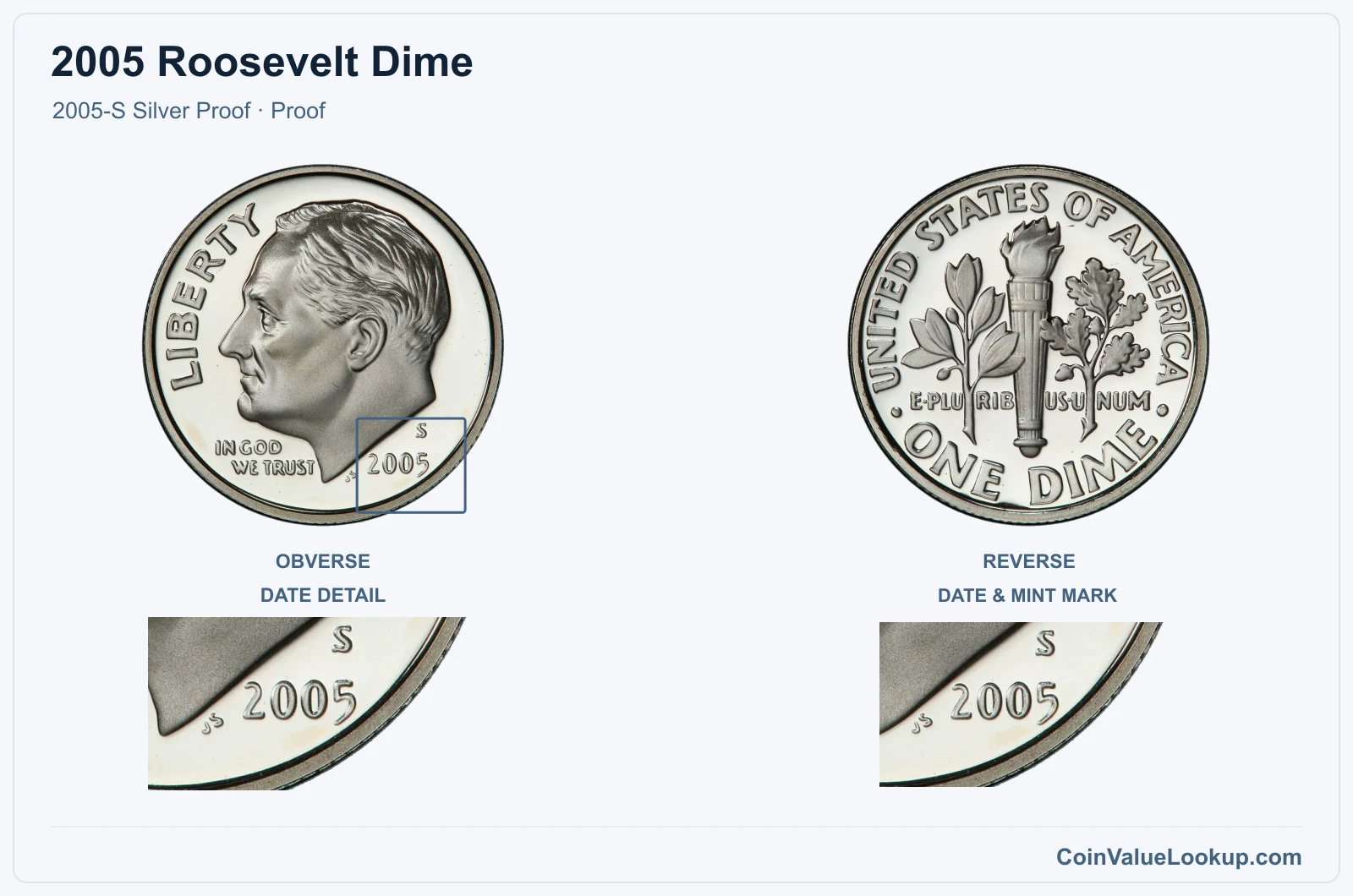
The 2005-S silver proof is struck on a 90% silver, 10% copper planchet weighing 2.50 grams. Silver proofs returned to the Roosevelt dime series in 1992, and this issue came in the 2005 Silver Proof Set from the United States Mint.
USA Coin Book guides PR65 at $9.65 — roughly triple the clad proof in the same grade. That premium exists because of the precious-metal content and the smaller production audience.
To confirm you have the silver version, weigh the coin and inspect the edge. A uniform silver-gray edge with no visible layering is the key visual clue.
Packaging from the original Silver Proof Set is the simplest confirmation method.
Range Grade
Price Auction Records Appraisal PR PR 1
—
Coin Identifier
PR 2
—
Coin Identifier
PR 3
—
Coin Identifier
PR 4
—
Coin Identifier
PR 6
—
Coin Identifier
PR 8
—
Coin Identifier
PR 10
—
Coin Identifier
PR 12
—
Coin Identifier
PR 15
—
Coin Identifier
PR 20
—
Coin Identifier
PR 25
—
Coin Identifier
PR 30
—
Coin Identifier
PR 35
—
Coin Identifier
PR 40
—
Coin Identifier
PR 45
—
Coin Identifier
PR 50
—
Coin Identifier
PR 53
—
Coin Identifier
PR 55
—
Coin Identifier
PR 58
—
Coin Identifier
PR 60
—
Coin Identifier
PR 61
—
Coin Identifier
PR 62
—
Coin Identifier
PR 63
—
Coin Identifier
PR 64
—
Coin Identifier
PR 65
—
Coin Identifier
PR 66
—
Coin Identifier
PR 67
—
Coin Identifier
PR 68
—
Coin Identifier
PR 69
Coin Identifier
PR 70
Coin Identifier
2005 Roosevelt Dime — P Satin Finish
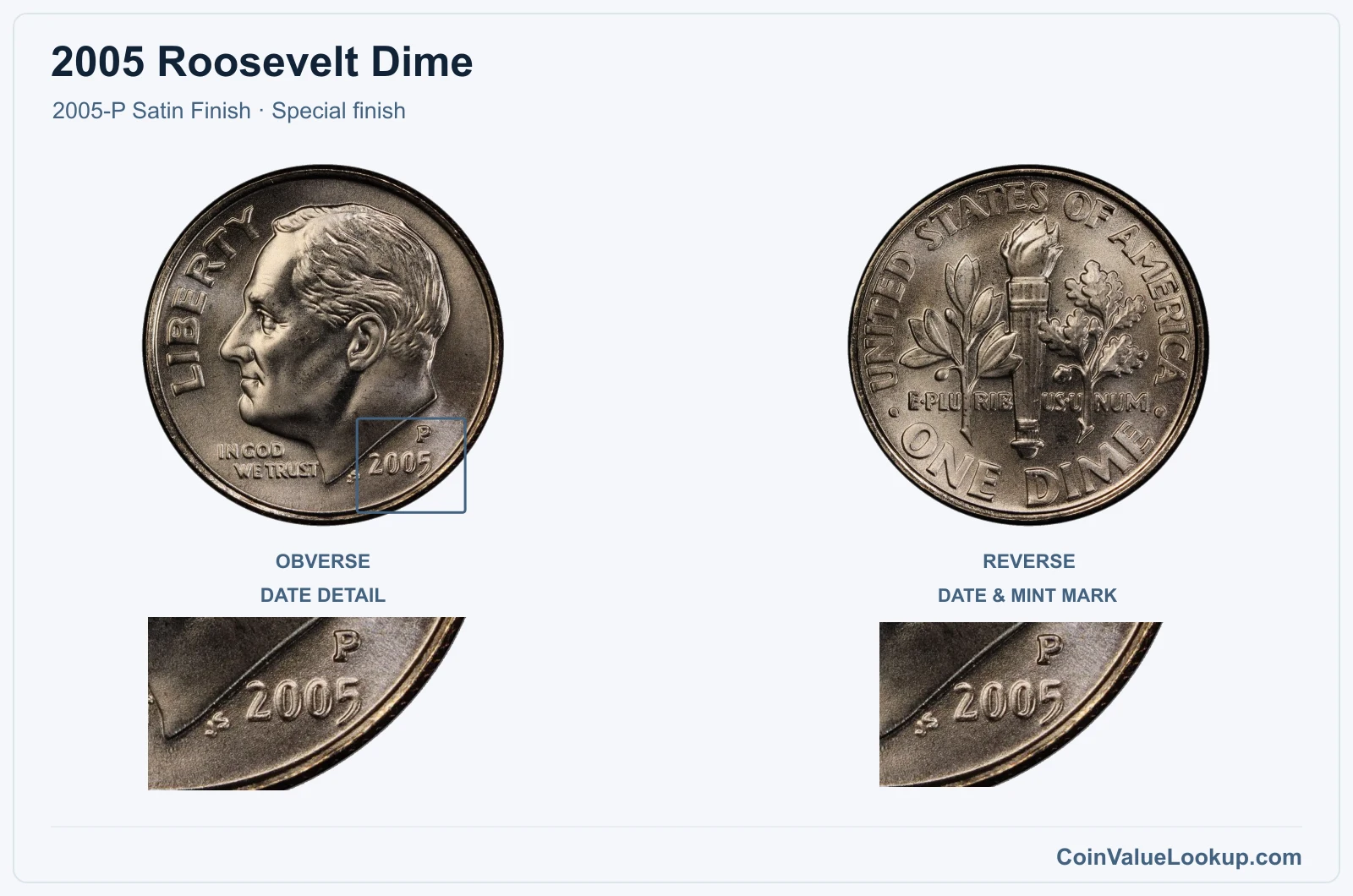
The 2005-P Satin Finish dime was included in the 2005 Uncirculated Coin Set. It is copper-nickel clad, weighs 2.27 grams, and carries a P mintmark — but its surface texture is distinctly softer and more uniform than a regular business strike.
Satin Finish coins are special strikes produced from 2005 through 2010. They are not proofs, and they are not mint errors.
They occupy their own collecting lane with separate grading expectations.
No specific guide price is adopted here, so value depends on authenticated identity, condition, and the current market for this particular finish. Having the coin verified as a genuine Satin Finish issue is the first step.
Range Grade
Price Auction Records Appraisal SP SP 1
—
Coin Identifier
SP 2
—
Coin Identifier
SP 3
—
Coin Identifier
SP 4
—
Coin Identifier
SP 6
—
Coin Identifier
SP 8
—
Coin Identifier
SP 10
—
Coin Identifier
SP 12
—
Coin Identifier
SP 15
—
Coin Identifier
SP 20
—
Coin Identifier
SP 25
—
Coin Identifier
SP 30
—
Coin Identifier
SP 35
—
Coin Identifier
SP 40
—
Coin Identifier
SP 45
—
Coin Identifier
SP 50
—
Coin Identifier
SP 53
—
Coin Identifier
SP 55
—
Coin Identifier
SP 58
—
Coin Identifier
SP 60
—
Coin Identifier
SP 61
—
Coin Identifier
SP 62
—
Coin Identifier
SP 63
Coin Identifier
SP 64
—
Coin Identifier
SP 65
—
Coin Identifier
SP 66
Coin Identifier
SP 67
Coin Identifier
SP 68
Coin Identifier
SP 69
Coin Identifier
SP 70
—
—
—
2005 Roosevelt Dime — D Satin Finish
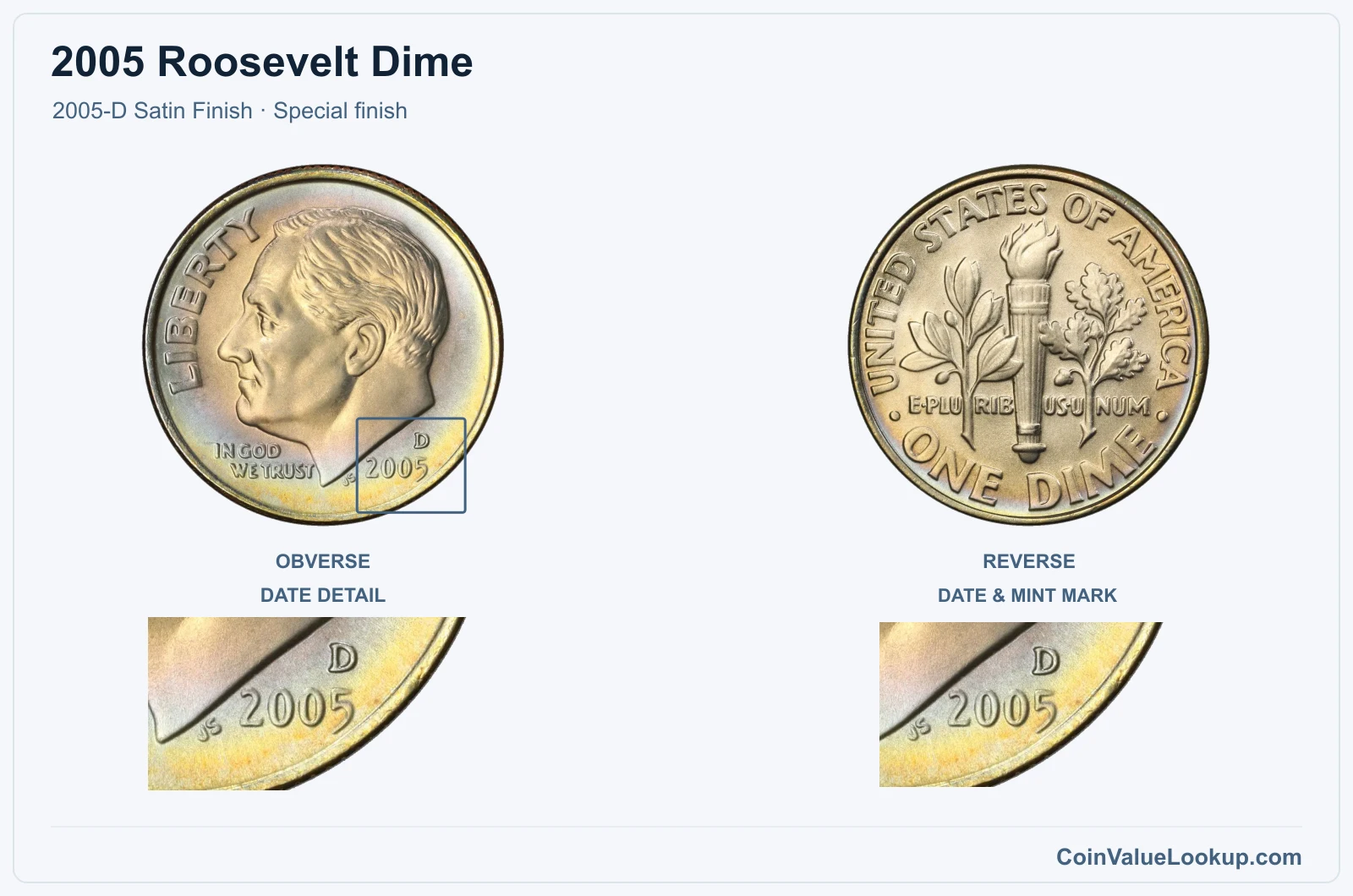
The 2005-D Satin Finish dime is the Denver counterpart from the same Uncirculated Coin Set program. Same copper-nickel clad metal, same 2.27-gram weight, same soft-luster surface that sets it apart from a regular D-mint circulation strike.
Like the P-mint Satin, this version was produced from 2005 through 2010 as a special strike — not a proof and not an error. It has its own collectible identity.
No specific guide price is adopted for this version. What your coin is worth will depend on its authenticated identity, preservation, and how the market prices D-mint Satin Finish dimes at the time of sale.
Range Grade
Price Auction Records Appraisal SP SP 1
—
Coin Identifier
SP 2
—
Coin Identifier
SP 3
—
Coin Identifier
SP 4
—
Coin Identifier
SP 6
—
Coin Identifier
SP 8
—
Coin Identifier
SP 10
—
Coin Identifier
SP 12
—
Coin Identifier
SP 15
—
Coin Identifier
SP 20
—
Coin Identifier
SP 25
—
Coin Identifier
SP 30
—
Coin Identifier
SP 35
—
Coin Identifier
SP 40
—
Coin Identifier
SP 45
—
Coin Identifier
SP 50
—
Coin Identifier
SP 53
—
Coin Identifier
SP 55
—
Coin Identifier
SP 58
—
Coin Identifier
SP 60
—
Coin Identifier
SP 61
—
Coin Identifier
SP 62
—
Coin Identifier
SP 63
—
Coin Identifier
SP 64
—
Coin Identifier
SP 65
—
Coin Identifier
SP 66
Coin Identifier
SP 67
Coin Identifier
SP 68
Coin Identifier
SP 69
Coin Identifier
SP 70
—
Coin Identifier
2005 Roosevelt Dime Error List
1. 2005 Roosevelt Dime — Missing Reverse Clad Layer
A 2005-D business strike missing its reverse clad layer is one of the more visually dramatic errors for this date. The reverse appears copper-colored because the outer nickel-alloy layer is absent, exposing the underlying metal.
The obverse looks normal.
The certified example weighs 1.9 grams — noticeably lighter than the standard 2.27 grams — and shows a thinner edge profile. A specimen in NGC MS64 sold for $75 in December 2020 at auction.
Before getting excited about a copper-looking reverse, rule out acid stripping and surface toning, both of which can mimic the appearance. Weight is your best friend here: a normal clad dime at 2.27 grams versus roughly 1.9 grams for the missing-layer coin is a gap you can measure at home.
Professional certification is still the gold standard for confirming this error.
2. 2005 Roosevelt Dime — Improperly Annealed Planchet
A 2005-P business strike with an improperly annealed planchet has appeared at auction in a certified NGC MS66 holder. Improper annealing occurs before the coin is struck, leaving the planchet with abnormal color and surface texture compared to a properly prepared blank.
The key diagnostic is that the unusual appearance should be consistent across the coin's surface, not localized or random like heat damage or environmental exposure. Compare side by side with a normal 2005-P dime under the same lighting.
The main lookalike is a dark or discolored circulated coin that simply encountered heat or chemicals after leaving the mint. Certification matters here because color alone is not enough to confirm an annealing problem.
No specific price is adopted for this error; value depends on the individual coin's authenticated identity, condition, and the severity of the annealing defect.
3. 2005 Roosevelt Dime — Off-Center Strike
An off-center strike happens when the planchet is not properly seated in the collar during striking. The result is a displaced design with an unstruck crescent of blank metal along part of the rim.
The key thing collectors want is a visible date. An off-center dime with 2005 readable is far more collectible than one where the date drifts off the edge.
The percentage of displacement and overall condition also affect desirability.
Do not confuse an off-center strike with a clipped planchet, a one-sided die misalignment, or post-mint flattening from damage. An off-center coin has the entire design shifted, not just a missing edge.
No specific price is adopted for this error on 2005 dimes; value depends on condition, the degree and direction of the misalignment, and whether the date remains visible.
4. 2005 Roosevelt Dime — Clipped Planchet
A clipped planchet error means part of the original blank was missing before the coin was struck. The clip can be curved, straight, or ragged depending on what went wrong during blank production.
Look at the edge where metal is missing. A genuine clip often shows a smooth, slightly concave boundary, and you may notice design weakness on the opposite side of the coin — that weakness results from incomplete metal flow during the strike.
The lookalike to rule out is post-mint damage: a filed notch, an edge cut from a counting machine, or corrosion eating away the rim. Damage after striking does not produce the corresponding opposite-side weakness.
No specific price is adopted for 2005 dime clips; the value of any individual example depends on the size and type of clip, overall condition, and professional verification.
5. 2005 Roosevelt Dime — Broadstrike
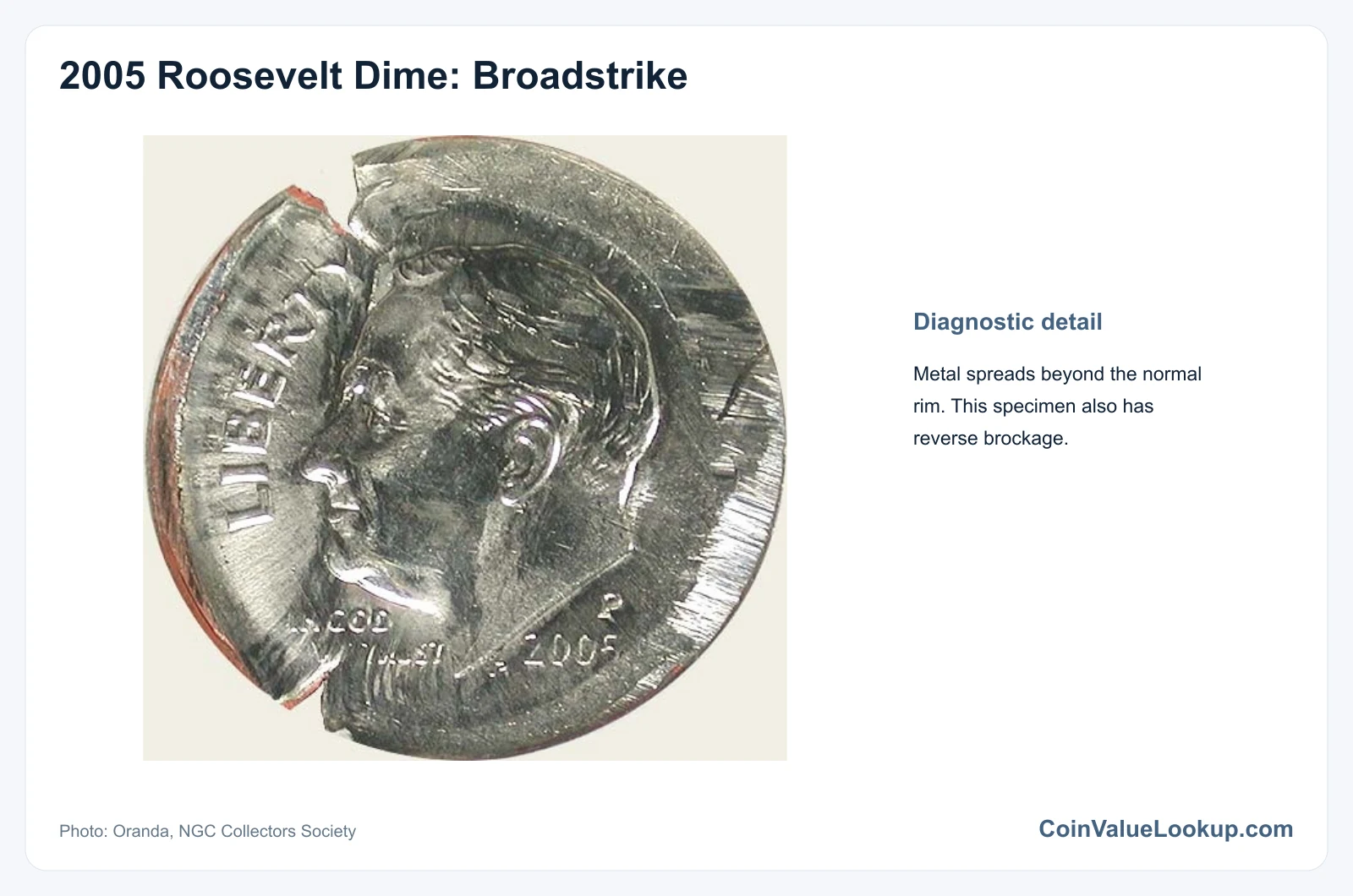
A broadstrike occurs when the coin is struck without normal collar confinement. The collar normally holds the planchet in place and forms the reeded edge.
Without it, metal spreads outward, making the coin slightly wider than normal with a smooth or malformed rim.
The full design is still present and roughly centered — that is what separates a broadstrike from an off-center error. Check the edge profile: it should look expanded and lack normal reeding rather than showing post-mint flattening.
Coins that were squeezed or smashed after leaving the mint can mimic this look, but they typically show distorted details and uneven thickness. No specific price is adopted for broadstruck 2005 dimes.
Value depends on how dramatic the spread is, the coin's condition, and authenticated confirmation of the error.
6. 2005 Roosevelt Dime — Die Crack / Die Chip
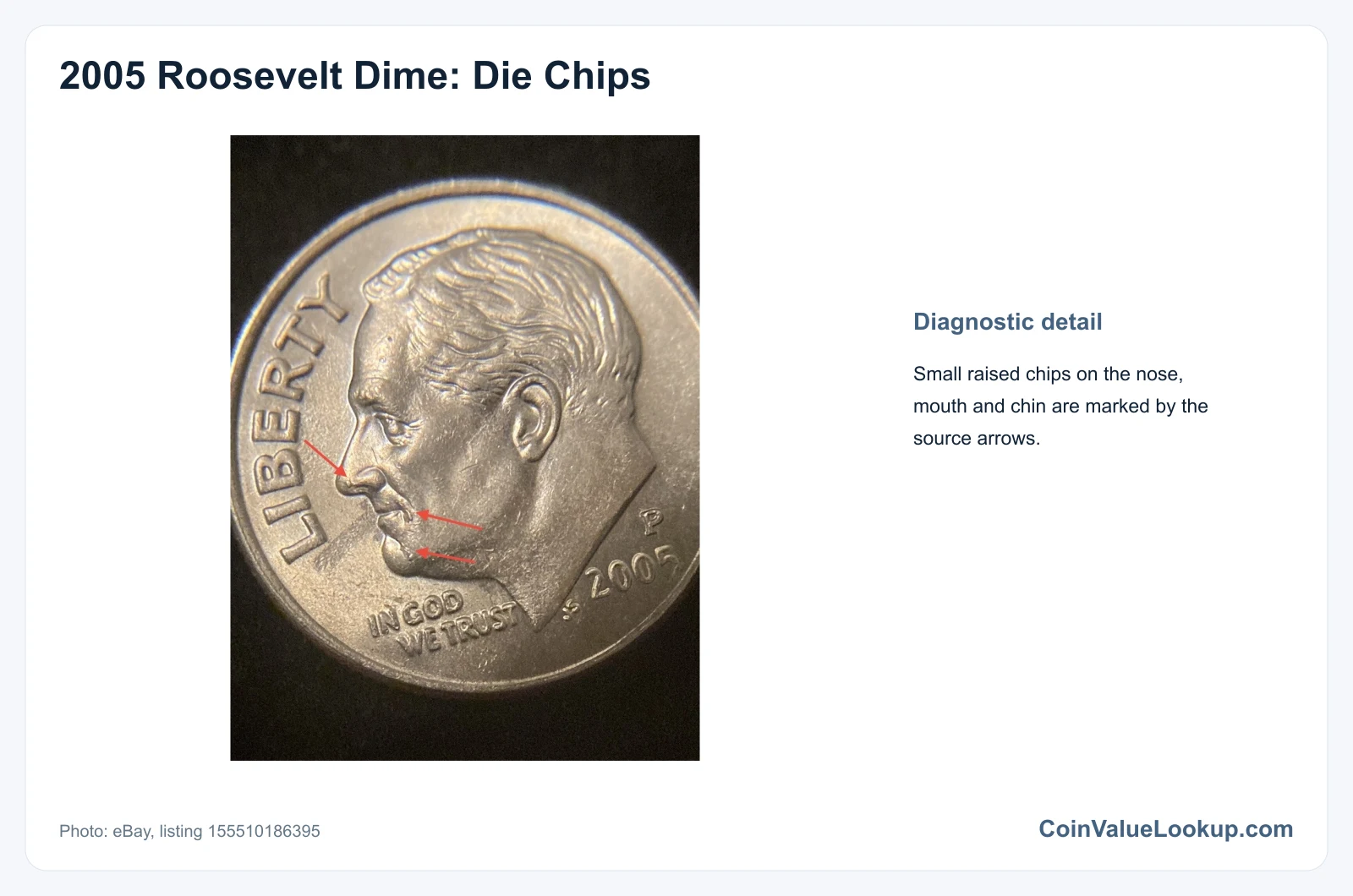
Die cracks and die chips are caused by damage to the steel die itself, and they transfer onto every coin struck by that die. A die crack appears as a thin raised line on the coin's surface.
A die chip shows up as a small raised blob, often in a letter or near the rim.
If a crack runs from the design to the rim, the resulting raised area is sometimes called a cud — a more dramatic and typically more collectible form. Interior chips tend to be smaller and less dramatic.
Do not confuse these with incuse scratches, surface corrosion, or bits of foreign material stuck to the coin. Die cracks and chips are raised above the surface, not pressed into it.
No specific price is adopted for 2005 dime die cracks or chips; the size, location, and overall condition of the coin determine collector interest.
7. 2005 Roosevelt Dime — Struck-Through Error
A struck-through error results when foreign material — grease, a metal fragment, thread, or other debris — sits between the die and the planchet during striking. The coin ends up with a localized depression, an impression of the object, or a patch of missing detail.
Grease-filled dies produce soft, washed-out areas where design elements disappear. A retained foreign object leaves a more defined impression and is generally more collectible.
These are distinct subtypes worth noting when you describe what you see.
The lookalikes are ordinary wear, cleaning scratches, and naturally weak strikes from a worn die. A struck-through area is typically sharply bounded and does not match the gradual loss of detail you see from circulation.
No specific price is adopted for 2005 dime struck-through errors; the value depends on the size of the affected area, what the object was, and the coin's overall grade.
8. 2005 Roosevelt Dime — Doubled Die Obverse
A minor doubled die obverse has been reported for the 2005 dime. Doubled dies occur during the die-making process, producing consistent doubling on every coin struck by that die.
Look for separation or notching on obverse lettering or design elements, not a flat directional shelf.
The biggest lookalike is machine doubling, which is mechanical damage from the strike itself. Machine doubling produces flat, shelf-like displacement and does not carry the same premium.
Worn die contours and lighting reflections can also trick your eye.
Compare your coin's lettering to a known normal 2005 dime under the same magnification and lighting. Genuine die doubling shows consistent separation in the same direction across affected elements.
No specific price is adopted here; value depends on the visibility of the doubling, the coin's condition, and professional confirmation.
9. 2005 Roosevelt Dime — Feeder-Finger Marks
Feeder-finger marks come from the mechanism that feeds blank planchets into the striking chamber. When the fingers contact a planchet at the wrong time or with too much force, they leave parallel or repeated raised marks across the coin's surface.
These marks have a distinctive pattern — look for evenly spaced, roughly parallel lines that run in a consistent direction. They are typically raised because the feeding mechanism indented the planchet before striking, and the strike then raised those indentations.
The tricky part is distinguishing genuine feeder-finger marks from handling scratches, cleaning hairlines, or die-polish lines. Post-mint scratches tend to be incuse and random.
Die-polish lines are usually finer and more uniform. Not every set of parallel scratches is a mint error.
No specific price is adopted for 2005 dime feeder-finger errors; value depends on the clarity and extent of the marks, condition, and authenticated identification.